
LPN Programs in Maryland: 2026 October Complete Guide to Accredited Schools, Costs & Licensing
LPN programs in Maryland 2026 October: accredited schools, tuition, admission requirements, NCLEX-PN pass rates, licensing steps, and salary outlook for new... 🏆
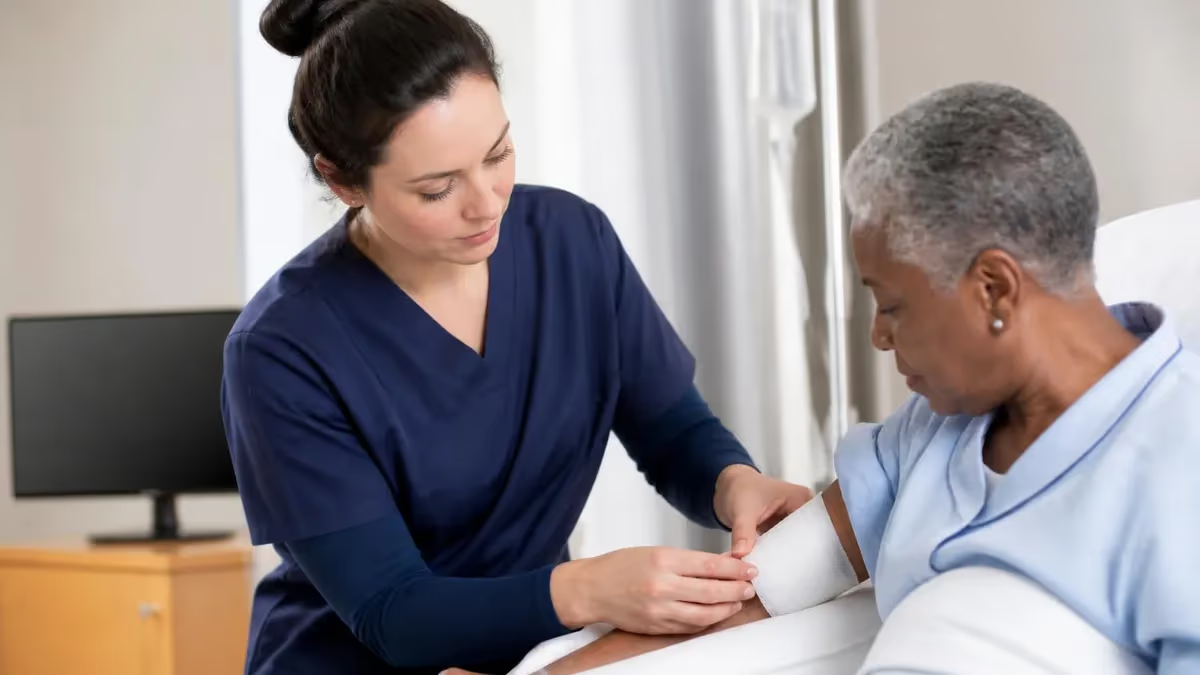
Choosing among LPN programs in Maryland is one of the most consequential career decisions a future practical nurse will make, because the school you pick determines tuition, clinical placements, NCLEX-PN preparation quality, and ultimately how quickly you can enter the workforce. Maryland currently licenses practical nurses through the Maryland Board of Nursing (MBON), and only graduates of MBON-approved programs are eligible to test, which makes program selection both a financial and regulatory decision worth careful research before applying.
Maryland is unique among states because it offers a relatively small but highly competitive pool of approved practical nursing programs spread across community colleges, vocational technology centers, and a handful of private career schools. Most programs run between 12 and 18 months full-time, blend classroom theory with supervised clinical rotations, and culminate in eligibility to sit for the NCLEX-PN. Tuition varies widely, from under $7,000 at in-county community colleges to more than $25,000 at private institutions, so cost comparison matters enormously.
The demand for licensed practical nurses across Baltimore, Frederick, Hagerstown, Salisbury, and the DC suburbs continues to climb as the population ages and skilled nursing facilities, hospice agencies, and outpatient clinics absorb new graduates almost as fast as schools can produce them. The Bureau of Labor Statistics projects steady job growth for LPNs through 2032, and Maryland salaries currently exceed the national median by several thousand dollars annually, especially for nurses willing to work nights, weekends, or in long-term care.
Before you commit, you should understand admission prerequisites, accreditation status, NCLEX pass rates, the length of waitlists, and the realistic out-of-pocket cost after financial aid. Many Maryland LPN programs require a TEAS or HESI entrance exam, a high school diploma or GED, a criminal background check, immunizations, and proof of CPR certification. Some community colleges also require completion of a CNA course or experience as a Geriatric Nursing Assistant before the practical nursing curriculum begins.
This guide walks through every approved pathway, breaks down tuition at the most popular schools, explains the licensing process step-by-step, and highlights what hiring managers look for when they recruit new LPNs in Maryland hospitals and long-term care facilities. Whether you live in Prince George's County, the Eastern Shore, or western Maryland, you will find a program option within reasonable driving distance, though commute times and clinical site locations should factor into your final decision.
You will also see realistic salary data, career advancement options like LPN-to-RN bridge programs, and the specialty certifications that boost earning power for experienced practical nurses. By the end of this article you should be able to shortlist three to five schools, estimate your total cost of attendance, plan a study timeline for prerequisites, and map out the licensing application sequence so nothing delays your first nursing paycheck after graduation.
If you are still in the early stages of exploring this career, take time to review free study tools, candidate handbooks, and sample exam questions before applying. Practical nursing is rigorous, fast-paced, and academically demanding, and the students who succeed treat their preparation like a full-time job from the first week of orientation through the final NCLEX-PN attempt.
Maryland LPN Programs by the Numbers
Top Approved LPN Programs in Maryland
A 12-month full-time certificate program with strong NCLEX-PN pass rates, affordable in-county tuition near $7,500, and clinical rotations at Carroll Hospital and area long-term care facilities. Limited seats and competitive admission each fall.
Offers a practical nursing certificate completed in three semesters with options for evening/weekend cohorts. Clinicals at Anne Arundel Medical Center and skilled nursing facilities. Includes a seamless LPN-to-RN bridge pathway.
Day and evening tracks taking 12-18 months, integrated with a Career Studies certificate. Strong simulation lab and partnerships with Howard County General Hospital. In-county tuition under $9,000 plus uniforms, books, and fees.
Hybrid practical nursing program serving the upper Eastern Shore and northeast Maryland. Articulates directly into the AAS-RN. Smaller cohorts allow personalized faculty attention and high clinical-to-student ratios.
Private career school offering accelerated practical nursing in roughly 13 months with multiple start dates per year. Higher tuition (around $30,000) but flexible scheduling, smaller wait times, and dedicated NCLEX-PN prep services.
Admission to a Maryland LPN program is competitive, and meeting the minimum requirements is rarely enough to secure a seat. Most programs admit between 24 and 40 students per cohort, while applications often exceed seats by two or three times. Understanding how each school ranks applicants, what cutoff scores they accept on the TEAS or HESI A2, and which prerequisite courses raise your composite score will significantly improve your odds of acceptance on the first application cycle rather than waiting another full year.
At minimum, every MBON-approved practical nursing program requires applicants to be at least 18 years old, hold a high school diploma or GED, and pass a criminal background check through the Maryland Criminal Justice Information System. Many schools additionally require completion of a Certified Nursing Assistant (CNA) course or active employment as a Geriatric Nursing Assistant (GNA) before classes begin. This bedside experience helps students adapt to clinical environments and is heavily favored on competitive admission scoring rubrics.
Academic prerequisites typically include high school biology and chemistry, intermediate algebra, and English composition. Community colleges generally require placement into college-level math and English, which may mean completing developmental coursework first if your placement scores are low. Some programs also require completion of Anatomy and Physiology I before entry, while others build A&P into the practical nursing curriculum itself. Always check the most current school catalog because requirements update frequently.
The TEAS (Test of Essential Academic Skills) or HESI A2 exam is the standardized admissions gate at most Maryland schools. Competitive applicants score in the proficient or advanced range, usually 65% or higher on the TEAS composite. Plan three to six months of dedicated study using official ATI or Elsevier review materials, focus on reading comprehension and math (the two most commonly failed sections), and budget for at least one retake since few applicants ace it on the first attempt.
Health clearance documentation is extensive and time-sensitive. You will need a physical exam, current immunizations (MMR, hepatitis B series, varicella, Tdap, annual flu shot, and updated COVID guidance), a two-step PPD or QuantiFERON tuberculosis test, drug screening, and current Basic Life Support certification through the American Heart Association. Many of these have specific timing windows, so coordinate with your primary care provider once you accept your seat.
For applicants comparing in-state options against neighboring jurisdictions, the LPN Programs Near Me directory can help you see which Pennsylvania, Delaware, Virginia, and DC programs accept Maryland residents and how their tuition compares. Border-area students sometimes find that an out-of-state school with rolling admissions is faster to enter than a competitive Maryland community college with a 12-month waitlist, even if total tuition is somewhat higher.
Finally, almost every Maryland LPN program reviews professional references, a personal essay, and a short admissions interview. Treat the interview as a job interview: dress professionally, prepare two-minute answers about why you chose nursing and how you handle stress, and bring questions about clinical rotations and NCLEX-PN preparation. Strong interview performance often differentiates two academically similar applicants when one seat remains in the cohort.
LPN Practice Test Questions
Prepare for the LPN - Certified Practical Nurse exam with our free practice test modules. Each quiz covers key topics to help you pass on your first try.
LPN - Certified Practical Nurse Basic Care...
LPN Exam Questions covering - Certified Practical Nurse Basic Care and Comfort. Master LPN Test concepts for certification prep.
LPN - Certified Practical Nurse Coordinate...
Free LPN Practice Test featuring - Certified Practical Nurse Coordinated Care. Improve your LPN Exam score with mock test prep.
LPN - Certified Practical Nurse Health Pro...
LPN Mock Exam on - Certified Practical Nurse Health Promotion and Maintenance. LPN Study Guide questions to pass on your first try.
LPN - Certified Practical Nurse Pharmacolo...
LPN Test Prep for - Certified Practical Nurse Pharmacological Therapies. Practice LPN Quiz questions and boost your score.
LPN - Certified Practical Nurse Physiologi...
LPN Questions and Answers on - Certified Practical Nurse Physiological Adaptation. Free LPN practice for exam readiness.
LPN - Certified Practical Nurse Psychosoci...
LPN Mock Test covering - Certified Practical Nurse Psychosocial Integrity. Online LPN Test practice with instant feedback.
LPN - Certified Practical Nurse Reduction ...
Free LPN Quiz on - Certified Practical Nurse Reduction of Risk Potential. LPN Exam prep questions with detailed explanations.
LPN - Certified Practical Nurse Safety and...
LPN Practice Questions for - Certified Practical Nurse Safety and Infection Control. Build confidence for your LPN certification exam.
LPN Ethical, Legal & Professional Standards
LPN Test Online for Ethical, Legal & Professional Standards. Free practice with instant results and feedback.
LPN Health Evaluation & Monitoring
LPN Study Material on Health Evaluation & Monitoring. Prepare effectively with real exam-style questions.
Tuition, Fees & Financial Aid for LPN Programs in Maryland
Maryland community colleges offer the most affordable path to becoming an LPN, with in-county tuition typically running between $130 and $180 per credit hour. A full practical nursing certificate of 35-45 credits at a school like Carroll, Howard, or Anne Arundel Community College commonly costs between $7,000 and $10,000 in tuition alone, before adding fees, uniforms, textbooks, and supplies. Out-of-county Maryland residents pay slightly more.
Additional expenses include lab fees ($300-$600 per semester), uniforms and shoes ($200-$400), textbooks ($800-$1,200), clinical equipment like stethoscopes ($100), background checks and drug screening ($150), CPR certification ($75), and NCLEX-PN application fees ($350). Plan a realistic total cost of attendance closer to $11,000-$14,000 for the full program at a community college, even before factoring in transportation and lost wages during clinical rotations.

Should You Pursue an LPN Program in Maryland?
- +Shorter training timeline (12-18 months) than RN or BSN programs
- +Lower total tuition cost, especially at community colleges
- +Strong job demand in long-term care, home health, and clinics
- +Maryland median LPN salary exceeds national average by several thousand dollars
- +Seamless LPN-to-RN bridge pathways at most community colleges
- +Multiple practice settings: skilled nursing, rehab, doctor's offices, hospice
- +Flexible scheduling options including evening and hybrid cohorts
- −Competitive admission with limited cohort seats
- −Some hospitals in Maryland prefer or only hire RNs/BSNs for bedside roles
- −Required CNA or GNA prerequisite at many schools adds time and cost
- −Background check failures can disqualify otherwise qualified applicants
- −Clinical rotations may require long commutes or odd-hour shifts
- −NCLEX-PN must be retaken if not passed within license eligibility window
LPN Programs in Maryland Application Checklist
- ✓Confirm the program is approved by the Maryland Board of Nursing (MBON)
- ✓Verify ACEN or comparable national accreditation status if available
- ✓Complete high school diploma or GED with official transcripts on file
- ✓Finish college-level math and English placement or coursework
- ✓Take the TEAS or HESI A2 entrance exam and score competitively
- ✓Earn CNA or GNA certification if required by your target program
- ✓Submit a complete application with essay, references, and transcripts
- ✓Pass the criminal background check and fingerprinting requirements
- ✓Complete physical exam, immunizations, drug screening, and TB testing
- ✓Obtain American Heart Association BLS/CPR certification before classes
- ✓Apply for FAFSA and Maryland nursing scholarships by published deadlines
- ✓Attend mandatory program orientation and purchase required textbooks
Apply to three programs, not just one
Because Maryland LPN cohorts are small and applicant pools are large, savvy candidates apply to at least three different programs in the same admission cycle. Spread your applications across one community college you are highly competitive for, one reach school with stronger NCLEX pass rates, and one private or out-of-state option as backup. This strategy can save you 12 full months of lost income compared to waiting through a single rejection.
Once you graduate from an MBON-approved practical nursing program, the licensing process moves quickly if you stay organized, but it can stall for weeks if a single document is missing or out of date. The Maryland Board of Nursing requires applicants to submit a Maryland licensing application, register separately with Pearson VUE for the NCLEX-PN, complete fingerprinting through MorphoTrust, and provide proof of program completion directly from your school. Each step has its own fee and processing time.
The NCLEX-PN is a computer-adaptive test administered by the National Council of State Boards of Nursing. The exam covers four major client need categories: Safe and Effective Care Environment, Health Promotion and Maintenance, Psychosocial Integrity, and Physiological Integrity. Questions adapt to your demonstrated ability level, and the test ends when the algorithm determines with 95% confidence whether you have passed or failed, typically between 85 and 150 questions over a maximum of five hours.
Maryland's first-time NCLEX-PN pass rate generally hovers between 80% and 88%, which is roughly consistent with the national average. Pass rates vary widely by school, so before committing to a program ask the admissions office for the most recent three years of NCLEX-PN results disaggregated for first-time test takers. Programs with sustained pass rates above 90% reflect strong curricula, effective remediation policies, and faculty who actively prepare students for the test format.
Plan to test within 30 to 45 days of graduation while content is fresh. After your school files the transcript with MBON and you receive your Authorization to Test (ATT) email from Pearson VUE, schedule the earliest available date at a Maryland or nearby DC, Virginia, or Delaware testing center. Most candidates benefit from a structured review program such as UWorld, Kaplan, or Hurst combined with daily timed question banks of 50 to 75 questions for six to eight weeks.
The license itself is valid for 28 months in Maryland and renews on a biennial schedule tied to your birth month. Renewal requires completing the Maryland Board's continuing competency requirements and paying a small renewal fee online through the MBON portal. Failing to renew on time results in lapsed status, which prevents you from working as a nurse until reinstatement, so set calendar reminders the moment your wallet card arrives.
Maryland participates in the Nurse Licensure Compact (NLC), which means an LPN licensed in Maryland can practice in any other compact state without obtaining a separate license. This is enormously valuable for travel nurses, telehealth practitioners, and anyone living near the DC, Virginia, Pennsylvania, or Delaware borders. To qualify for a multistate license, you must have Maryland as your primary state of residence and meet uniform licensure requirements including federal and state fingerprint background checks.
If you completed a foreign nursing program, the Maryland licensing path involves additional steps including credential evaluation through CGFNS, English language proficiency exams if applicable, and possibly supplemental coursework to meet US practical nursing scope requirements. Foreign-educated applicants should begin the credentialing process at least six months before applying for licensure because document verification from international institutions can take several months to complete.
Maryland's Board of Nursing reviews all criminal history during licensure. Certain felony convictions, recent drug-related offenses, prior nursing discipline in other states, and unresolved child support arrears can delay or prevent licensure. If you have any history, request a pre-application review with MBON before paying program tuition so you know your eligibility upfront, not after spending thousands on training.
Maryland is an excellent state to launch a practical nursing career, with steady demand across Baltimore City, Montgomery County, Prince George's County, Anne Arundel County, and the Eastern Shore. The Maryland Department of Labor projects continuing growth for LPNs through the next decade, driven largely by an aging population requiring more skilled nursing, rehab, and home health services. New graduates typically receive job offers within weeks of passing the NCLEX-PN, and many secure conditional offers even before licensure.
Wages vary by region and practice setting. According to the Bureau of Labor Statistics, the median annual wage for Maryland LPNs is approximately $59,420, with the top 10% earning more than $72,000 per year. Skilled nursing facilities in the Baltimore-Towson and Washington-Arlington metro areas generally pay the highest hourly rates, while rural and Eastern Shore positions sometimes include hiring bonuses, loan forgiveness, or housing stipends to attract candidates to underserved communities.
Long-term care remains the largest employer of Maryland LPNs, followed by physician offices, home health agencies, hospice, correctional health, school nursing, and outpatient specialty clinics. Hospitals increasingly hire LPNs in float pools, observation units, and rehabilitation departments, though many Maryland health systems prefer registered nurses for inpatient acute care. Understanding which settings hire LPNs helps you target the right job applications without wasted effort on positions limited to RNs.
Career advancement is straightforward if you continue your education. Most Maryland community colleges offer LPN-to-RN bridge programs that grant credit for your practical nursing coursework and allow completion of an Associate Degree in Nursing in roughly 12 to 18 additional months. From there, an RN-to-BSN pathway can be completed online while working full time, opening doors to charge nurse, case manager, public health, and specialty practice positions with significantly higher pay ceilings.
Specialty certifications dramatically boost earnings and employability for experienced LPNs. Popular options in Maryland include IV therapy certification, gerontological nursing, hospice and palliative care, and wound care. Reviewing the wound care certification for LPN guide can help you decide whether the WCC or CWCA credential is worth the time and tuition investment for your career goals. Specialty-certified LPNs often command $3 to $8 more per hour than uncredentialed peers.
Day-to-day responsibilities for a Maryland LPN include vital signs monitoring, medication administration, wound care, catheter insertion and care, IV therapy where state scope permits, patient education, charting, and supervising CNAs and GNAs. Strong assessment skills, time management, and clear communication with supervising RNs and physicians are essential. New LPNs should expect a structured orientation of two to six weeks at most facilities, followed by gradual assignment of full patient loads under preceptor supervision.
Finally, network early and often. Join the Maryland Nurses Association as a student member, attend local nursing job fairs, connect with clinical preceptors on LinkedIn, and follow Maryland hospital and long-term care recruiters online. The nursing community is small and reputation matters. Strong references from clinical instructors and preceptors frequently lead to job offers before formal applications even open, especially at the facilities where you completed rotations during school.
Succeeding in a Maryland LPN program requires more than just attendance. The students who pass the NCLEX-PN on the first attempt and land strong job offers treat their training as a serious professional commitment from day one. Build a study routine of three to four focused hours daily outside of class, use spaced repetition for pharmacology and lab values, and form a small accountability group of two or three peers who will quiz each other and review case studies together throughout the program.
Master nursing math early. Drug calculations cause more practical nursing course failures than almost any other content area, and Maryland programs typically require a 90% or higher score on medication calculation quizzes to progress. Practice every day using IV drip rates, weight-based dosing, unit conversions, and reconstitution problems. A few minutes of daily math practice during the first semester pays enormous dividends when you face high-stakes clinical medication passes later.
Take clinical rotations seriously. Arrive early, dress immaculately, introduce yourself to every staff nurse, and volunteer for procedures other students avoid. Clinical instructors and preceptors write the references that get you hired. Demonstrate curiosity, accept constructive feedback gracefully, and never sit in the break room when patient care opportunities exist. The students who finish clinicals with strong evaluations often receive direct job offers from those same units after graduation.
Begin NCLEX-PN preparation in the first semester, not the last. Buy a question bank such as UWorld, Kaplan, or ATI on day one and answer at least 20 to 30 questions daily, reviewing every rationale carefully whether you got the question right or wrong. By graduation you should have completed at least 2,500 to 3,500 practice questions and reviewed every weak content area at least twice. Consistent daily practice beats marathon weekend cramming sessions every time.
Self-care matters more than most nursing students realize. Sleep deprivation, poor nutrition, and skipped exercise tank both grades and clinical performance. Schedule workouts and meal prep into your weekly calendar the way you schedule lectures. Maintain at least one non-nursing hobby or social connection that grounds you outside the program. Burnout in nursing school is real, and the students who finish strongest treat their physical and mental health as protected priorities.
Plan your finances carefully throughout school. Many practical nursing students work part-time as CNAs or GNAs during the program, which both provides income and reinforces clinical skills. However, full-time work during the second semester is generally not realistic given clinical hours and study demands. Build a small emergency fund before starting school, minimize new debt, and review the LPN program cost guide to plan a realistic budget through graduation, licensing, and your first paycheck.
Finally, prepare for the NCLEX-PN application well before graduation. Submit your Maryland Board of Nursing application early, complete fingerprinting promptly, request transcripts from every institution you attended, and budget for the $200 NCLEX-PN exam fee plus the MBON licensure fee. Aim to test within 30 to 45 days of graduation while content is fresh. Every additional week of delay is a week of lost LPN wages you can never recover, which often exceeds $1,000 per missed pay period.
LPN Questions and Answers

About the Author

Registered Nurse & Healthcare Educator
Johns Hopkins University School of NursingDr. Sarah Mitchell is a board-certified registered nurse with over 15 years of clinical and academic experience. She completed her PhD in Nursing Science at Johns Hopkins University and has taught NCLEX preparation and clinical skills courses for nursing students across the United States. Her research focuses on evidence-based exam preparation strategies for healthcare certification candidates.
Join the Discussion
Connect with other students preparing for this exam. Share tips, ask questions, and get advice from people who have been there.
View discussion (7 replies)