
LPN Programs in Chicago 2026 September: Top Schools, Costs & Requirements
LPN programs Chicago 2026 September guide. Compare top accredited schools, 📝 tuition costs, admission requirements, NCLEX-PN pass rates, and career outlook in
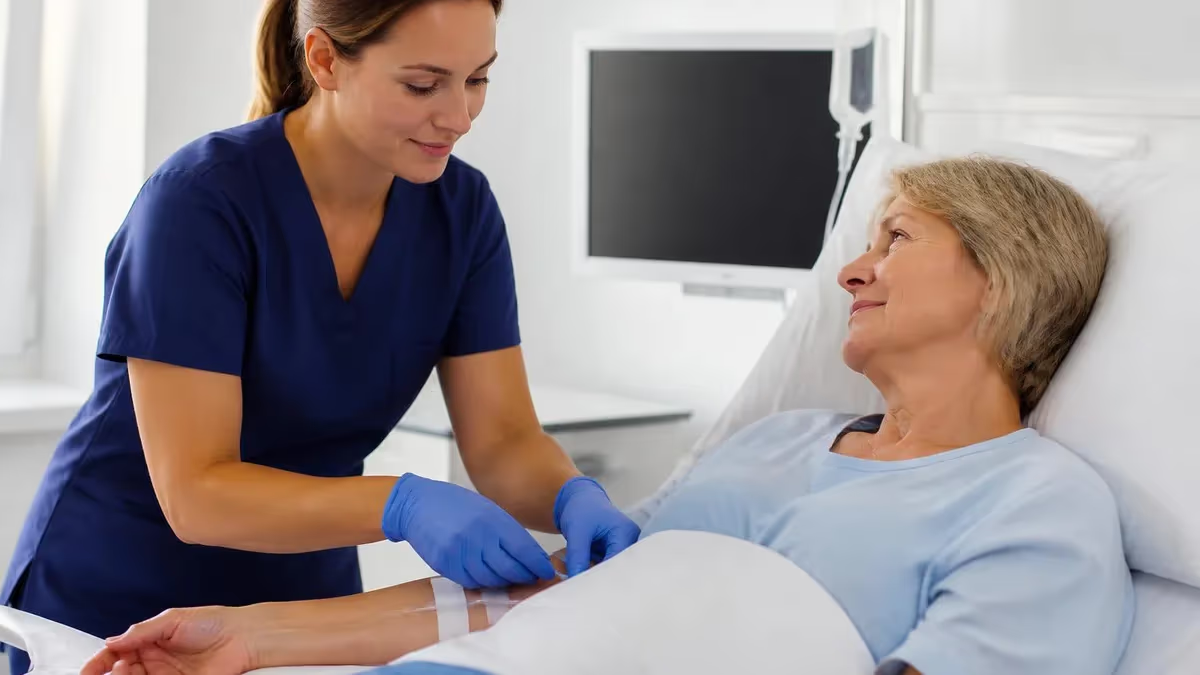
Searching for LPN programs Chicago residents trust to launch their nursing careers? The Windy City offers one of the most diverse practical nursing education landscapes in the Midwest, with more than two dozen accredited programs spread across community colleges, private career schools, and hospital-based training centers. Whether you live in Rogers Park, the South Loop, or out in the western suburbs, you can find a program that fits your schedule, budget, and career goals, and most graduates can sit for the NCLEX-PN within twelve to fifteen months of starting class.
Chicago's healthcare ecosystem creates exceptional demand for licensed practical nurses. The metro area is home to giants like Northwestern Memorial, Rush University Medical Center, the University of Chicago Medical Center, and a sprawling network of skilled nursing facilities, rehabilitation centers, and home health agencies. The Illinois Department of Employment Security projects roughly 1,200 LPN job openings each year in the Chicago-Naperville-Elgin metro through 2032, driven by an aging population and steady turnover in long-term care.
Tuition for a full LPN program in Chicago typically ranges from $9,500 at City Colleges to more than $32,000 at private institutions like Coyne College or Ambria College of Nursing. Financial aid, employer tuition reimbursement, and Illinois Nurse Educator Loan Repayment options can dramatically reduce out-of-pocket costs. Before you commit, you need to verify Illinois Board of Nursing approval, ACEN or NLN CNEA accreditation status, and the school's three-year NCLEX-PN pass rate, because those three data points predict your future employability more than any glossy brochure.
This guide walks through every step of the Chicago LPN journey: how to pick an approved program, what admission tests like the TEAS or HESI require, realistic tuition and living-cost math, the Illinois licensure timeline, and where graduates actually land jobs once they pass boards. We pulled data from the Illinois Department of Financial and Professional Regulation, the National Council of State Boards of Nursing, and direct conversations with program directors at five of the largest Chicago schools to keep the numbers current for the 2026 enrollment cycle.
If you already know nursing is your path, supplement this guide with our LPN Practice Test PDF (Free Printable 2026) so you can start drilling NCLEX-style questions on the train ride to your campus tour. Even applicants weeks away from starting class benefit from early exposure to the test blueprint, because Illinois schools weave NCLEX content into every semester and reward students who arrive already familiar with the question style.
One last note on geography: Chicago LPN programs serve students from a 60-mile radius, and several offer evening, weekend, or hybrid tracks for working adults. If your home zip code is closer to Aurora, Joliet, or Waukegan, look at the suburban campuses we mention later, because commute time often matters more than tuition once clinical rotations begin and you are driving to a different hospital five mornings a week.
By the end of this article you will have a checklist of approved schools, a realistic budget, an admission timeline, and a study plan to clear NCLEX-PN on your first attempt. Chicago rewards prepared nursing candidates with high starting wages, strong union representation in many facilities, and clear paths to bridge into RN or BSN programs within two years of licensure.
Chicago LPN Programs by the Numbers
Top Accredited LPN Programs in Chicago
Three-semester practical nursing certificate on the Near West Side. Illinois Board of Nursing approved with an 86% three-year NCLEX-PN pass rate. Total tuition under $10,000 for Chicago residents. Clinicals rotate through Rush, Stroger, and West Suburban Medical Center.
Loop-based private school offering a 60-week practical nursing diploma with day and evening cohorts. Total cost around $31,500. Heavy clinical placement in skilled nursing facilities across Cook County, with strong job-placement support upon graduation.
Suburban northwest campus serving the greater Chicago area. ACEN-accredited LPN certificate with a 12-month accelerated option. Tuition near $28,000. Graduates report strong placement at Advocate Aurora and AMITA Health facilities.
Public community college 12 miles west of downtown. Two-semester practical nursing certificate priced under $9,800 for in-district residents. Pass rate consistently above 80%. Articulation agreement lets graduates bridge directly to the associate-degree RN program.
Several Chicago-area hospitals partner with regional programs to offer hybrid LPN tracks combining online theory with on-site clinicals. Best fit for career-changers who need scheduling flexibility while keeping a part-time job.
Admission to a Chicago LPN program is competitive but achievable for organized applicants. Every Illinois Board of Nursing approved school requires a high school diploma or GED, a minimum cumulative GPA of 2.5 (some schools demand 2.75 or 3.0), and proof of completion for prerequisite courses such as basic anatomy, English composition, and college algebra or its equivalent. Malcolm X College, for instance, asks for a C or better in biology and math placement at college level before you can even apply to the practical nursing certificate track.
Most schools require either the Test of Essential Academic Skills (TEAS) or the HESI A2 entrance exam. The TEAS measures reading, math, science, and English language usage across roughly 170 questions in 209 minutes. Chicago programs typically set a minimum composite score between 58 and 65, but competitive applicants score 70 or higher to secure a seat in the next cohort. Plan to take the TEAS at least four months before your application deadline to allow a retake if your first attempt falls short.
Background checks and drug screens are non-negotiable. Illinois law bars individuals convicted of certain felonies, including forcible felonies and Class X offenses, from holding a nursing license. Programs run a fingerprint-based check through the Illinois State Police and the FBI before clinical placement, and any positive drug screen, including for cannabis (still federally illegal even though Illinois legalized recreational use), can disqualify you from rotations at most hospital systems.
Immunization documentation must be current. Expect to provide proof of MMR, varicella, hepatitis B series, Tdap within the last ten years, annual influenza vaccine, COVID-19 vaccination (still required by many Chicago hospitals as of 2026), and a two-step PPD or QuantiFERON-Gold tuberculosis screen. Your program will charge a separate health-compliance fee of $150 to $300 to track these records through services like CastleBranch or Verified Credentials.
CPR certification through the American Heart Association (Basic Life Support for Healthcare Providers) is required before your first clinical day. Plan to spend $80 to $110 on a one-day course, and remember the credential expires every two years, meaning you will likely renew once during your program. Many schools list a specific provider list because some online-only CPR cards are not accepted at hospital clinical sites.
Letters of recommendation, a personal essay describing why nursing, and an in-person or virtual interview round out most applications. Admissions committees in Chicago LPN programs care less about charity-work resumes than about evidence you understand the physical and emotional demands of bedside care. If you have CNA experience, home health work, or even reliable caregiving for a family member, document it clearly — those hours signal commitment more than any abstract statement about helping people.
Need a quick refresher on the role you're applying for? Read What Does LPN Stand For? Meaning, Role & Career Guide before drafting your personal essay, because admissions interviewers frequently ask candidates to articulate the scope of practice differences between an LPN and an RN. A clear, confident answer signals readiness for the program and the profession.
LPN Practice Test Questions
Prepare for the LPN - Certified Practical Nurse exam with our free practice test modules. Each quiz covers key topics to help you pass on your first try.
LPN - Certified Practical Nurse Basic Care...
LPN Exam Questions covering - Certified Practical Nurse Basic Care and Comfort. Master LPN Test concepts for certification prep.
LPN - Certified Practical Nurse Coordinate...
Free LPN Practice Test featuring - Certified Practical Nurse Coordinated Care. Improve your LPN Exam score with mock test prep.
LPN - Certified Practical Nurse Health Pro...
LPN Mock Exam on - Certified Practical Nurse Health Promotion and Maintenance. LPN Study Guide questions to pass on your first try.
LPN - Certified Practical Nurse Pharmacolo...
LPN Test Prep for - Certified Practical Nurse Pharmacological Therapies. Practice LPN Quiz questions and boost your score.
LPN - Certified Practical Nurse Physiologi...
LPN Questions and Answers on - Certified Practical Nurse Physiological Adaptation. Free LPN practice for exam readiness.
LPN - Certified Practical Nurse Psychosoci...
LPN Mock Test covering - Certified Practical Nurse Psychosocial Integrity. Online LPN Test practice with instant feedback.
LPN - Certified Practical Nurse Reduction ...
Free LPN Quiz on - Certified Practical Nurse Reduction of Risk Potential. LPN Exam prep questions with detailed explanations.
LPN - Certified Practical Nurse Safety and...
LPN Practice Questions for - Certified Practical Nurse Safety and Infection Control. Build confidence for your LPN certification exam.
LPN Ethical, Legal & Professional Standards
LPN Test Online for Ethical, Legal & Professional Standards. Free practice with instant results and feedback.
LPN Health Evaluation & Monitoring
LPN Study Material on Health Evaluation & Monitoring. Prepare effectively with real exam-style questions.
LPN Programs Chicago: Cost & Financial Aid Breakdown
City Colleges of Chicago and suburban community colleges deliver the most affordable LPN training. Malcolm X College charges roughly $146 per credit hour for in-district residents, totaling around $9,500 for the full 35-credit certificate when you add lab fees, books, uniforms, and the NCLEX application. Triton College, Oakton, and College of DuPage offer similar pricing structures for Cook, DuPage, and surrounding county residents.
Public programs accept Pell Grants, MAP (Illinois Monetary Award Program) grants, federal Direct Loans, and a growing list of workforce-development scholarships funded by hospital systems facing nursing shortages. Apply for FAFSA by the priority deadline (typically February 1 for Illinois MAP eligibility) to maximize aid. Most public Chicago LPN students graduate with under $5,000 in debt when grants and scholarships stack properly.
Should You Choose a Chicago LPN Program?
- +Strong job market with 1,200+ annual openings across the metro area
- +Median salary of $57,420 — higher than the national LPN average
- +Direct articulation agreements into ADN and BSN bridge programs
- +Multiple union-represented employers offering pensions and tuition reimbursement
- +Diverse clinical sites: academic medical centers, SNFs, home health, and clinics
- +Public-program tuition under $10,000 for Chicago residents
- −Competitive admission with TEAS or HESI score cutoffs
- −High cost of living in Chicago can offset salary advantages
- −Long commutes to suburban clinical sites without a car
- −Background-check rules strict; past felony convictions can disqualify candidates
- −Private-school tuition can exceed $30,000 for a one-year certificate
- −Hospital-based LPN roles have decreased; most jobs now in long-term care
Chicago LPN Application Checklist for 2026
- ✓Verify the program is approved by the Illinois Board of Nursing
- ✓Confirm ACEN, NLN CNEA, or state accreditation status in writing
- ✓Request official high school transcripts or GED verification
- ✓Complete prerequisite courses with a C or better grade
- ✓Register for and pass the TEAS or HESI A2 with a competitive score
- ✓Submit FAFSA before February 1 to qualify for Illinois MAP grant
- ✓Schedule fingerprint-based background check through approved vendor
- ✓Gather immunization records including hepatitis B, MMR, varicella, Tdap
- ✓Obtain American Heart Association BLS for Healthcare Providers certification
- ✓Draft a personal essay describing your nursing motivation and goals
Apply early and apply to multiple programs.
Top Chicago LPN cohorts fill 6-9 months before classes begin. Program directors at Malcolm X, Triton, and Coyne all recommend submitting applications to at least three schools simultaneously. Acceptance is rolling at many private programs but cohort-based at community colleges, where you may wait an entire semester for the next intake if you miss a deadline by a single day.
The Chicago LPN curriculum mirrors the NCLEX-PN test plan and follows a predictable arc: foundational sciences and basic nursing skills in semester one, medical-surgical nursing and pharmacology in semester two, and specialty rotations plus an NCLEX-PN review course in the final term. Expect roughly 700 clinical hours alongside 600 to 800 classroom hours, depending on whether your program runs three semesters or four. Illinois minimum requirements set the floor; most accredited schools exceed those minimums by 10 to 20 percent.
Clinical rotations are where Chicago programs genuinely differentiate themselves. Malcolm X students rotate through Rush University Medical Center, Stroger Hospital, and West Suburban Medical Center, gaining exposure to trauma, public-health populations, and community medicine. Coyne College emphasizes long-term care placements because that's where the majority of LPN jobs actually exist post-graduation. Ambria sends students to Advocate Aurora and AMITA facilities in the northwest suburbs. Ask each program for its clinical-site list before enrolling, because those rotations become your first professional network.
Pharmacology is the make-or-break course for most LPN students. You will memorize the top 200 medications by generic and brand name, learn safe dose ranges, recognize adverse effects, and practice calculating IV drip rates, pediatric weight-based doses, and insulin sliding scales. Chicago programs typically dedicate one entire 16-week semester to pharmacology, and a failing grade (usually below 75%) forces a semester repeat or program dismissal at strict schools.
Skills labs replicate hospital environments with high-fidelity manikins, simulated medication-administration carts, and IV practice arms. You will demonstrate competency in vital signs, sterile dressing changes, urinary catheterization, nasogastric tube insertion, tracheostomy care, wound packing, blood glucose monitoring, subcutaneous and intramuscular injections, and basic respiratory assessments before any instructor will sign you off for live patient care. Plan to spend 4 to 6 hours per week in open lab time beyond scheduled class hours.
NCLEX-PN preparation is woven throughout, not saved for the end. Most Chicago programs build practice-question sessions into every course, use end-of-program comprehensive exams from ATI or Kaplan, and require a minimum predictor score before clearing graduates to apply for licensure. The Illinois NCLEX-PN first-time pass rate has hovered between 80% and 84% for the past five years, and graduates from programs with built-in remediation consistently score above 90%.
Soft skills matter more than students expect. Documentation, hand-off communication using SBAR, delegation to certified nursing assistants, and respectful interaction with diverse patient populations are graded competencies. Chicago serves one of the most linguistically and culturally diverse patient populations in the country, and programs increasingly incorporate cultural humility, trauma-informed care, and basic medical Spanish into the curriculum. These are not optional; clinical instructors will fail students for unprofessional conduct just as quickly as for clinical errors.
Graduating is not the finish line. Within 30 days of completing your program, you must register for the NCLEX-PN through Pearson VUE ($200 exam fee), apply for licensure through the Illinois Department of Financial and Professional Regulation ($75 application fee), and pass a separate jurisprudence component reviewing Illinois Nurse Practice Act requirements. Most Chicago graduates test within 45 days of finishing class, while the curriculum is still fresh.
Several online-only or out-of-state nursing programs market aggressively to Chicago residents but lack Illinois Board of Nursing approval, meaning graduates cannot sit for NCLEX-PN in Illinois. Always confirm current approval status directly on the IDFPR website before signing enrollment paperwork, and demand the school's last three years of NCLEX-PN pass rates in writing. A pass rate below 75% is a serious red flag.
Chicago's LPN job market remains one of the strongest in the Midwest. The Bureau of Labor Statistics May 2024 data reports a Chicago-Naperville-Elgin median LPN wage of $57,420 with the 90th percentile clearing $73,000. Top-paying employers include unionized long-term care facilities, home health agencies, correctional health providers, and specialty clinics. Hospital-based bedside LPN roles have declined over the past decade as health systems shifted to all-RN staffing models, but skilled nursing, rehab, and outpatient settings continue to hire aggressively.
Cook County's largest LPN employers include Symphony Network skilled nursing facilities, Alden Network, Manorcare HCR, Bridge Care Suites, and the Cook County Department of Corrections health services. Suburban giants like Advocate Aurora, Edward-Elmhurst, and Northwestern Medicine maintain LPN roles in their post-acute and skilled-nursing divisions. New graduates typically start between $26 and $30 per hour, with shift differentials adding $2 to $5 per hour for evenings, nights, and weekends.
Specialty certifications boost earning power. IV therapy certification (required separately in Illinois because the LPN scope of practice does not automatically include IV push medications), wound care certification, gerontology certification, and pediatric LPN credentials all increase marketability and pay. Most certifications cost between $200 and $600 and can be completed within 40 hours of continuing education. Many Chicago employers pay for these credentials as part of orientation or first-year benefits.
Career ladder options abound. LPN-to-ADN bridge programs at City Colleges, Triton, and Oakton accept up to 25 credits from completed LPN coursework, letting graduates earn an associate degree in nursing within 12 to 18 additional months. LPN-to-BSN online programs from Chamberlain, Aspen, and West Coast University offer similar acceleration with 100% online theory and locally arranged clinicals. Plan the bridge before you graduate; many employers fund it through tuition reimbursement.
Union representation matters in Chicago. SEIU Healthcare Illinois represents thousands of LPNs in long-term care, securing higher base wages, defined-benefit pensions in some facilities, and structured grievance processes. Ask during interviews whether the facility is union or non-union, what the contract pay scale looks like, and whether differentials are guaranteed or discretionary. Union shops typically pay 8 to 15 percent more than comparable non-union employers in the same neighborhood.
Work-life balance varies dramatically by setting. Hospital and SNF LPN shifts run 8 or 12 hours with rotating weekends, holidays, and on-call expectations. Clinic and physician-office LPN roles are largely weekday daytime hours but pay $5 to $8 per hour less. Home health LPNs enjoy flexible scheduling and high mileage reimbursement but absorb the cost of car maintenance, insurance, and unpaid driving time between visits. Match the setting to your personal life, not just the paycheck.
For the broader cost picture before committing, compare your top three programs using our LPN Program Cost: Complete 2026 Tuition & Fees Guide and budget realistically. A two-bedroom apartment near the Medical District averages $2,100 per month in 2026; a similar unit in the Beverly or West Lawn neighborhoods runs closer to $1,400. Where you live during school and after licensure changes the financial math more than any tuition discount you'll negotiate.
Final preparation for a Chicago LPN program demands the same discipline you'll bring to nursing itself. Begin a structured study routine the moment you accept admission, ideally three to four months before the first day of class. Brush up on basic algebra (dose calculations rely heavily on ratio-proportion math), review high-school biology with a focus on cellular function and body systems, and read introductory medical-terminology guides. These three pre-program investments shorten the learning curve in semester one dramatically.
Buy your textbooks the moment your booklist drops. Used copies of Davis Drug Guide, Saunders Comprehensive Review for NCLEX-PN, and a quality medical-surgical text save hundreds of dollars and let you start pre-reading. Several Chicago program directors recommend reading the first three chapters of your med-surg book before orientation, because faculty assume foundational knowledge and move quickly through basic anatomy reviews.
Establish your support system early. Chicago LPN programs are intense; expect to study 20 to 30 hours per week outside class during medical-surgical semester. Identify childcare backups, talk to your employer about reducing hours, and build a small study group of two to four classmates within the first month. Group study works best when each member arrives prepared with specific questions, not as a substitute for individual review.
Master test-taking strategy as a separate skill. NCLEX-style questions reward critical thinking over rote memorization. Practice prioritization (Maslow's hierarchy, ABCs of airway-breathing-circulation), delegation (what LPNs can versus cannot do under Illinois scope of practice), and recognizing distractors. Free practice resources, ATI's Capstone modules, UWorld's NCLEX-PN QBank, and our own LPN practice tests give you thousands of repetitions before you sit for the real exam.
Take care of your physical and mental health. Chicago winters add seasonal-affective stress on top of nursing-school workload. Schedule regular exercise, protect sleep (7 to 8 hours), and use your school's counseling services if anxiety or depression spikes. Multiple research studies show nursing students who maintain consistent self-care routines pass NCLEX-PN at higher rates than peers who push through chronic burnout.
Network from day one. Treat every clinical instructor, charge nurse, and preceptor as a potential future reference or supervisor. Chicago's healthcare community is smaller than it looks; the nurse manager who supervises your final rotation might be hiring six months after you graduate. Show up early, ask thoughtful questions, volunteer for difficult assignments, and follow up with thank-you notes after rotations end. Professional reputation begins in school, not on your first job.
Finally, plan your NCLEX-PN application timeline backward from your target license date. Allow 45 to 60 days from graduation to test date, factor in 6 to 8 weeks for the Illinois Board to issue your license number after passing, and identify potential employers willing to hire you as a graduate practical nurse (GPN) under temporary practice rules. The faster you move from graduation to licensure to first paycheck, the less student-loan interest accumulates and the sooner you start building Chicago LPN experience that employers value.
LPN Questions and Answers

About the Author

Registered Nurse & Healthcare Educator
Johns Hopkins University School of NursingDr. Sarah Mitchell is a board-certified registered nurse with over 15 years of clinical and academic experience. She completed her PhD in Nursing Science at Johns Hopkins University and has taught NCLEX preparation and clinical skills courses for nursing students across the United States. Her research focuses on evidence-based exam preparation strategies for healthcare certification candidates.
Join the Discussion
Connect with other students preparing for this exam. Share tips, ask questions, and get advice from people who have been there.
View discussion (7 replies)