
LPN Nursing Programs Online: Complete 2026 October Guide to Hybrid Practical Nursing Education
Explore LPN nursing programs online in 2026 October: ✅ hybrid formats, accreditation, costs, clinical requirements, and how to enroll in accredited practical
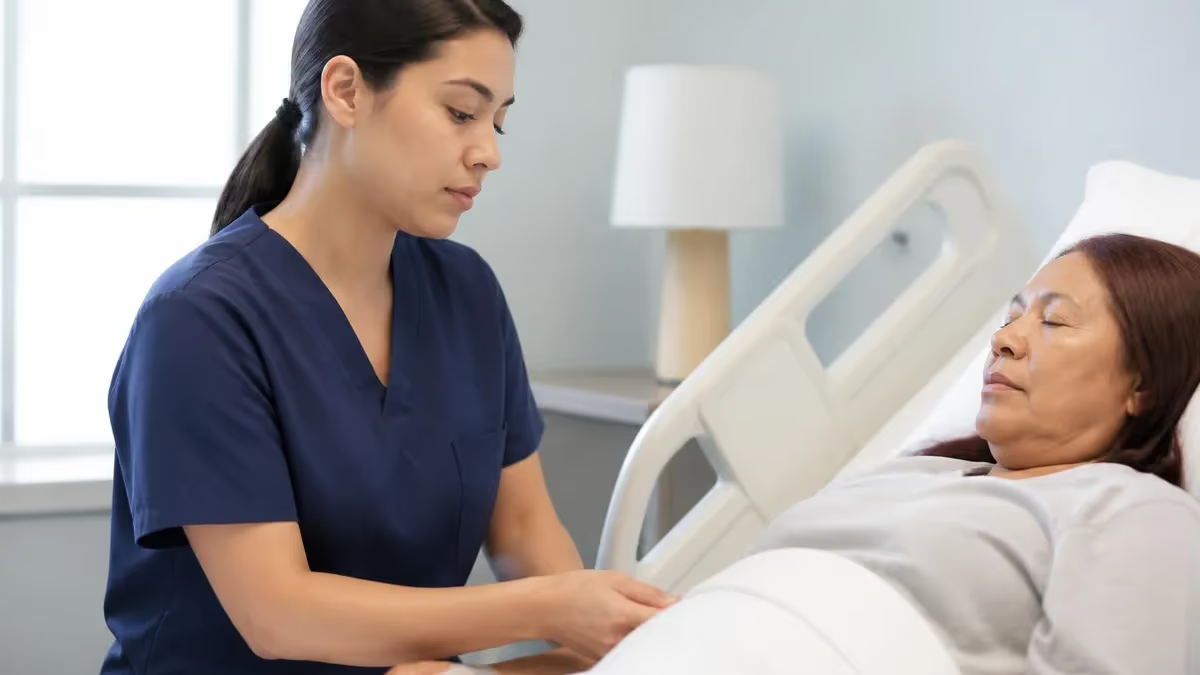
LPN nursing programs online have transformed how aspiring practical nurses earn their credentials in 2026, blending self-paced digital coursework with in-person clinical rotations that meet every state board requirement. These hybrid pathways are designed for working adults, parents, and career changers who need flexibility but still want a NCLEX-PN eligible diploma or certificate from a fully accredited institution. Understanding what an online format actually delivers—and what it cannot—is the first step toward choosing a program that fits your schedule, learning style, and long-term nursing career goals.
The phrase "online LPN program" is slightly misleading because no state allows a 100% virtual practical nursing education. What you will find instead are hybrid programs where lectures, pharmacology modules, anatomy labs, and case studies run through a learning management system like Canvas or Blackboard, while skills labs and supervised clinicals happen at partner hospitals, long-term care facilities, or community health sites near your zip code. This structure preserves the rigor that state boards demand while giving students 60% to 75% schedule flexibility.
Enrollment in hybrid LPN tracks has grown roughly 38% since 2022 according to National League for Nursing data, driven by nursing shortages, rising tuition at traditional schools, and the maturation of virtual simulation software like Shadow Health and Swift River. Employers including HCA Healthcare, Genesis HealthCare, and large home-health networks now actively recruit graduates of accredited online-hybrid programs, recognizing that competency on the NCLEX-PN and at the bedside matters far more than the delivery format of the curriculum itself.
This guide walks you through every component of choosing, applying to, and succeeding in an online LPN program: accreditation standards from the ACEN and state boards of nursing, realistic tuition ranges between $5,000 and $25,000, prerequisite coursework, technology requirements, clinical placement logistics, and how to evaluate program outcomes like first-time NCLEX pass rates and job placement statistics. Each section includes data current as of early 2026.
You will also find practice scenarios drawn directly from the NCLEX-PN test plan, organized around the four major client-needs categories: Safe and Effective Care Environment, Health Promotion and Maintenance, Psychosocial Integrity, and Physiological Integrity. Strong online programs weave these domains into every module rather than saving them for a capstone review, and the better schools publish their content alignment publicly so prospective students can verify rigor before signing a financial-aid agreement.
Whether you are a certified nursing assistant looking to advance, a medical assistant pivoting into bedside care, or a high-school graduate seeking the fastest legitimate route into licensed nursing, the next sections will help you compare programs intelligently, avoid diploma mills, and build a study plan that maximizes your chances of passing the NCLEX-PN on the first attempt and entering practice with confidence.
By the end of this article you will understand the regulatory landscape, the realistic time-to-completion of 12 to 18 months, the financial math behind student loans versus employer tuition reimbursement, and the day-to-day reality of balancing asynchronous lectures with in-person clinical shifts—giving you everything needed to make an informed enrollment decision in the current academic year.
Online LPN Programs by the Numbers (2026)
Accreditation and State Approval Standards
The Accreditation Commission for Education in Nursing is the gold standard for practical nursing programs, evaluating curriculum, faculty credentials, clinical partnerships, and student outcomes every 5-8 years.
Every online LPN program must be approved by the state board of nursing where clinicals occur. Approval ensures graduates can sit for the NCLEX-PN and qualify for licensure.
Schools with regional accreditation from agencies like SACSCOC or HLC allow credit transfer to RN bridge programs later, protecting your future LPN-to-RN or LPN-to-BSN options.
Federal financial aid requires accreditation by a U.S. Department of Education-recognized body. Always verify Title IV status before applying for FAFSA-based grants or loans.
Admission requirements for online LPN programs are stricter than many prospective students expect, largely because hybrid formats demand strong self-discipline and the schools need to predict who will succeed without daily classroom contact. Almost every accredited program requires a high-school diploma or GED with a minimum cumulative GPA of 2.5, though competitive schools like Hondros College, Rasmussen University, and Herzing University often look for 3.0 or higher to offset limited cohort seats.
Prerequisite coursework typically includes high-school-level biology and chemistry with a grade of C or better, plus college-level English composition and basic mathematics. Some programs also require an introductory anatomy and physiology course completed within the past five to seven years, since clinical instructors assume students arrive already understanding body systems at a working level before pharmacology and pathophysiology modules begin.
Standardized entrance exams remain a major filter. The TEAS (Test of Essential Academic Skills) and the HESI A2 are the two most common, and most online LPN programs want composite scores at or above the 60th percentile. The TEAS measures reading, math, science, and English-language usage across roughly 170 questions in three and a half hours, while the HESI A2 covers similar ground plus an optional learning-style component that some schools use for cohort placement.
Background checks, drug screenings, and immunization records become non-negotiable once you are conditionally accepted. Expect to provide proof of MMR, varicella, hepatitis B series, Tdap, annual influenza, and a current PPD or QuantiFERON tuberculosis test. Clinical partner sites also require fingerprint-based criminal history checks through state-level systems, and any felony conviction must be disclosed and reviewed by the state board of nursing before clinical placement.
Technology prerequisites are equally important for online formats. Students need a laptop running Windows 11 or macOS Sonoma or newer, a stable broadband connection of at least 25 Mbps, a webcam and microphone for proctored exams through Respondus or ProctorU, and the ability to install lockdown browsers. Some programs supply a Chromebook bundle as part of tuition, but most expect students to provide their own hardware that meets published minimum specifications.
References, personal statements, and admissions interviews round out the application package. Two professional or academic references are standard, and the personal statement should articulate clear motivation for nursing, awareness of the LPN scope of practice, and a realistic understanding of clinical demands. Many programs now conduct 20-minute video interviews via Zoom to assess communication skills, schedule realism, and emotional maturity before extending a final acceptance.
If you're still researching foundational topics before applying, the practice resources at LPN Nursing Care & Clinical Skills Practice Test can help you benchmark your readiness in clinical reasoning, medication math, and infection-control fundamentals that admissions committees increasingly probe during interviews and entrance exams.
LPN Practice Test Questions
Prepare for the LPN - Certified Practical Nurse exam with our free practice test modules. Each quiz covers key topics to help you pass on your first try.
LPN - Certified Practical Nurse Basic Care...
LPN Exam Questions covering - Certified Practical Nurse Basic Care and Comfort. Master LPN Test concepts for certification prep.
LPN - Certified Practical Nurse Coordinate...
Free LPN Practice Test featuring - Certified Practical Nurse Coordinated Care. Improve your LPN Exam score with mock test prep.
LPN - Certified Practical Nurse Health Pro...
LPN Mock Exam on - Certified Practical Nurse Health Promotion and Maintenance. LPN Study Guide questions to pass on your first try.
LPN - Certified Practical Nurse Pharmacolo...
LPN Test Prep for - Certified Practical Nurse Pharmacological Therapies. Practice LPN Quiz questions and boost your score.
LPN - Certified Practical Nurse Physiologi...
LPN Questions and Answers on - Certified Practical Nurse Physiological Adaptation. Free LPN practice for exam readiness.
LPN - Certified Practical Nurse Psychosoci...
LPN Mock Test covering - Certified Practical Nurse Psychosocial Integrity. Online LPN Test practice with instant feedback.
LPN - Certified Practical Nurse Reduction ...
Free LPN Quiz on - Certified Practical Nurse Reduction of Risk Potential. LPN Exam prep questions with detailed explanations.
LPN - Certified Practical Nurse Safety and...
LPN Practice Questions for - Certified Practical Nurse Safety and Infection Control. Build confidence for your LPN certification exam.
LPN Ethical, Legal & Professional Standards
LPN Test Online for Ethical, Legal & Professional Standards. Free practice with instant results and feedback.
LPN Health Evaluation & Monitoring
LPN Study Material on Health Evaluation & Monitoring. Prepare effectively with real exam-style questions.
How LPN Nursing Programs Online Deliver Curriculum
Asynchronous lectures form the backbone of online LPN coursework. Pre-recorded videos covering anatomy, pharmacology, medical-surgical concepts, and mental health nursing are released weekly with built-in checkpoint quizzes, discussion-board assignments, and reading guides drawn from textbooks like Saunders, Linton, or Williams & Hopper. Students typically commit 15 to 25 hours per week to these modules.
The asynchronous model lets students review difficult sections multiple times, pause for note-taking, and adapt study pace to personal learning speed. Most programs require module completion within a fixed weekly window—usually Sunday at 11:59 p.m. local time—so flexibility exists within structure rather than as open-ended self-direction. Faculty hold weekly office hours via Zoom for live questions.

Should You Choose an Online LPN Program?
- +Flexible scheduling lets you keep a part-time or full-time job during training
- +Lower commuting costs and zero classroom parking fees over 12-18 months
- +Asynchronous lectures allow review of complex pharmacology multiple times
- +Virtual simulation builds clinical judgment safely before live patient contact
- +Wider school selection beyond your immediate geographic area
- +Strong fit for adult learners with family or caregiver responsibilities
- +Identical NCLEX-PN credential and licensure as traditional programs
- −Requires high self-discipline and consistent weekly time management
- −Clinical placement coordination can be stressful in rural areas
- −Limited face-to-face faculty mentoring compared to traditional cohorts
- −Technology failures during proctored exams cause real anxiety
- −Some employers still prefer graduates of well-known local schools
- −Social isolation can affect motivation midway through the program
Pros and Cons at a Glance
| Pros | Cons |
|---|---|
| Flexible scheduling lets you keep a part-time or full-time job during training | Requires high self-discipline and consistent weekly time management |
| Asynchronous lectures allow review of complex pharmacology multiple times | Clinical placement coordination can be stressful in rural areas |
| Virtual simulation builds clinical judgment safely before live patient contact | Limited face-to-face faculty mentoring compared to traditional cohorts |
| Wider school selection beyond your immediate geographic area | Technology failures during proctored exams cause real anxiety |
| Strong fit for adult learners with family or caregiver responsibilities | Some employers still prefer graduates of well-known local schools |
| Identical NCLEX-PN credential and licensure as traditional programs | Social isolation can affect motivation midway through the program |
Enrollment Checklist for LPN Nursing Programs Online
- ✓Verify ACEN or state board accreditation on the official agency website.
- ✓Confirm the program is approved for clinicals in your home state.
- ✓Submit official high-school or college transcripts to the admissions office.
- ✓Schedule and complete the TEAS or HESI A2 entrance exam.
- ✓Complete prerequisite anatomy, English, and math courses with a C or better.
- ✓Gather immunization records and schedule a recent TB skin test.
- ✓Order a national background check and fingerprint-based state check.
- ✓File the FAFSA early and request institutional scholarship consideration.
- ✓Purchase a laptop and webcam that meet program technology specifications.
- ✓Plan reliable transportation to clinical sites within a 60-mile radius.
Accreditation is non-negotiable
A program without ACEN, ABHES, or state board approval will not let you sit for the NCLEX-PN, no matter how polished its marketing or how low its tuition. Always verify accreditation directly on the agency website before signing any enrollment agreement or paying a deposit. This single check protects your tuition investment and your future nursing license.
Tuition for online LPN programs varies more widely than most prospective students realize. Public community colleges offering hybrid practical nursing tracks—such as Ivy Tech in Indiana, Lone Star College in Texas, and Cuyahoga Community College in Ohio—charge in-district residents roughly $5,000 to $9,000 for the entire 12 to 15-month program. Out-of-district or out-of-state students at the same schools often pay double, putting total cost closer to $14,000 before fees.
Private for-profit institutions like Hondros College of Nursing, Fortis College, and Pima Medical Institute typically run $18,000 to $28,000 for the same credential, though they often start cohorts every six to eight weeks and offer more flexible enrollment dates. The premium pays for smaller class sizes, dedicated clinical coordinators, integrated NCLEX-PN review software, and sometimes a tuition guarantee where you can retake the program if you fail boards twice.
Beyond base tuition, students should budget another $2,500 to $5,000 for textbooks, uniforms, stethoscope, watch, lab kits, background checks, immunizations, malpractice insurance, NCLEX-PN application fees, state licensure fees, and the NCLEX-PN exam itself ($200). Building these line items into your financial plan from day one prevents the cash-flow surprises that derail many otherwise-prepared students during the final clinical semester.
Federal financial aid is available to students enrolled in accredited programs that participate in Title IV. The FAFSA opens each October 1 for the following academic year, and most LPN students qualify for some combination of Pell Grants (up to $7,395 for 2026-2027), subsidized Stafford loans, and unsubsidized loans up to $12,500 annually as independent students. Filing early maximizes institutional grant matching at many schools.
Employer tuition reimbursement has expanded dramatically as healthcare systems compete for nurses. Major employers including HCA Healthcare, Kindred Healthcare, Genesis HealthCare, Brookdale Senior Living, and many regional hospital networks now reimburse $3,000 to $10,000 per year for current employees enrolled in LPN programs, often with a service commitment of 12 to 24 months post-graduation. CNAs and medical assistants already employed at these systems are prime candidates for this benefit.
Return on investment math favors the LPN credential strongly. With a median annual wage of $59,730 in 2024 according to the Bureau of Labor Statistics and entry-level wages between $48,000 and $54,000 in most metropolitan areas, graduates typically recoup tuition within 9 to 18 months of starting work. Higher-paying specialties like IV therapy certification, long-term-care charge nurse roles, and home-health visits push earnings into the $65,000 to $75,000 range within two to three years.
Before signing any loan paperwork, compare total program cost against published NCLEX-PN pass rates and job placement statistics from the past three years; for a deeper financial breakdown including hidden fees and regional variations see our companion guide on what programs really cost across the country.

Any program promising a fully online LPN credential with no in-person clinical hours is operating outside state board approval and graduates cannot sit for the NCLEX-PN. Always cross-check the school's name on your state board of nursing's official list of approved programs before paying a single dollar. If the school is missing from that list, walk away immediately—no exceptions.
NCLEX-PN preparation begins on day one of any quality online LPN program, not after graduation. Strong schools integrate ATI, Kaplan, or HESI review software into every semester, requiring students to complete proctored content mastery exams in fundamentals, pharmacology, medical-surgical, mental health, maternal-newborn, and pediatrics. Students who meet benchmark scores (typically Level 2 or higher on ATI) consistently demonstrate first-attempt pass rates above 90% on the actual NCLEX-PN.
The NCLEX-PN itself is a computer-adaptive test of 85 to 150 questions over a maximum five-hour window. Content is distributed across Safe and Effective Care Environment (24-38%), Health Promotion and Maintenance (6-12%), Psychosocial Integrity (9-15%), and Physiological Integrity (38-56%). The exam includes alternate item formats such as drag-and-drop ordering, hot-spot images, audio clips, and Next Generation NCLEX case studies introduced in 2023 that test clinical judgment across six cognitive steps.
Effective NCLEX preparation in the final months of training centers on three pillars: doing thousands of practice questions in test-mode timing, reviewing rationales for both correct and incorrect answers, and reinforcing weak content areas with targeted reading. Most successful graduates complete between 2,500 and 4,000 practice questions across UWorld, Saunders Q&A Review, and Kaplan question banks before scheduling their exam through Pearson VUE.
The job outlook for new LPN graduates remains strong through the late 2020s. The Bureau of Labor Statistics projects roughly 54,000 average annual openings nationally between 2024 and 2034, driven primarily by population aging, expanded home-health utilization, and retirement of the existing nursing workforce. Skilled nursing facilities, assisted living communities, rehabilitation hospitals, dialysis centers, and physician group practices represent the largest employer categories for LPN graduates.
Geographic mobility magnifies opportunity. States in the Nurse Licensure Compact—now numbering 41 plus Guam and the U.S. Virgin Islands—allow LPNs to practice across state lines under one multistate license, enabling travel nursing assignments paying $1,400 to $2,200 per week for 13-week contracts. New graduates typically need 12 to 18 months of bedside experience before agencies will consider them for travel roles, but the long-term earning ceiling is substantial.
Many graduates use their LPN license as a stepping stone to RN or BSN status through LPN-to-RN bridge programs that grant 20 to 30 credits for prior practical nursing coursework, shortening the additional time required to roughly 12 to 18 months for an ADN or 24 to 30 months for a BSN. Employers increasingly pay full tuition for this advancement track, recognizing the retention benefits of growing nurses from within rather than recruiting externally.
If you want to verify the licensed practical nurse role and scope before committing to an online program, our explainer on What Does LPN Stand For? Meaning, Role & Career Guide covers the full credential, supervisory relationships, and state-by-state scope differences that shape your future work environment and earning potential after graduation.
Practical study habits separate students who pass the NCLEX-PN on the first try from those who must retest 45 days later. Build a weekly schedule that locks in 20 to 25 hours of academic work outside of clinicals, split into 90-minute blocks with 10-minute breaks. Brain-imaging research from the University of California shows that distributed practice across multiple short sessions consolidates nursing knowledge far better than weekend cramming, especially for pharmacology and pathophysiology.
Active recall beats passive rereading every time. Instead of highlighting textbook pages, close the book after each section and write out everything you remember on a blank page, then check your notes against the source material. Flash card apps like Anki and Quizlet make spaced repetition automatic—create cards for high-yield topics like normal lab values, ABG interpretation, ECG strip recognition, common drug suffixes, and emergency nursing interventions, and review the deck daily for 15 to 20 minutes.
Form a small online study group of three to five classmates and meet by Zoom twice weekly for case-study discussion. Teaching concepts aloud to peers reveals knowledge gaps faster than any quiz, and study-group accountability dramatically improves consistency for students prone to procrastination. Choose group members with diverse backgrounds—a former CNA, a paramedic, a parent returning to school—because varied perspectives enrich every case discussion.
Take care of your body during the program. Sleep deprivation crushes memory consolidation; aim for seven to nine hours nightly, especially before exam days. Limit caffeine after 2 p.m., walk or exercise 150 minutes per week to keep stress hormones in check, and meal-prep on Sundays to avoid the convenience-food spiral that wrecks both energy and budget. Many programs now embed wellness coaching into student services for exactly this reason.
Clinical days demand a different kind of preparation. Arrive 20 minutes early, review your assigned patients in the EHR, look up every medication you will administer including indication, dose range, side effects, nursing implications, and patient teaching, and bring a small notebook for jotting questions to ask your preceptor. The students who impress clinical instructors most are those who arrive curious and prepared, not those who arrive simply on time.
Document everything you learn in a clinical journal. Even five minutes of reflection after each shift—what you saw, what surprised you, what you would do differently—builds the clinical judgment that the NCLEX-PN now tests heavily through Next Generation case studies. Journals also become powerful study tools during NCLEX review because they tie textbook concepts to real patient memories.
Finally, schedule your NCLEX-PN exam within four to six weeks of graduation while content is fresh. Use the gap for an intensive review boot camp—UWorld, Kaplan, or Hurst all offer three-week structured programs—and take a full-length practice test under timed conditions before your real testing date so the actual exam feels familiar, not foreign, when you sit down at the Pearson VUE workstation.
Sample Certified Practical Nurse Practice Questions
Try these questions from our free Certified Practical Nurse practice tests. The correct answer and an explanation follow each question.
What is the importance of patient education in nursing care?
- A. To increase compliance with treatment plans
- B. To help patients understand their conditions, treatments, and preventive care
- C. To reduce hospital stay duration
- D. To monitor patient behavior
Answer: B. To help patients understand their conditions, treatments, and preventive care
Patient education is vital in nursing care as it empowers patients to understand their health conditions, prescribed treatments, and preventive measures. By providing clear and comprehensive information, nurses help patients make informed decisions and actively participate in their self-care. This understanding promotes adherence to treatment plans and contributes to better long-term health outcomes.
What is the purpose of professional nursing organizations?
- A. To regulate hospitals
- B. To set standards, provide education, and advocate for nursing
- C. To administer medications
- D. To monitor drug interactions
Answer: B. To set standards, provide education, and advocate for nursing
Professional nursing organizations serve a critical purpose by setting standards for nursing practice, providing ongoing education, and advocating for the nursing profession and patient welfare. They contribute to policy development, research, and professional development, ensuring that nursing care remains current, ethical, and of high quality. These organizations empower nurses, strengthen their collective voice, and advance the profession as a whole.
Why is cultural competence important in nursing?
- A. To make patients comfortable
- B. To respect and understand cultural diversity and provide appropriate care
- C. To reduce medical costs
- D. To enforce hospital rules
Answer: B. To respect and understand cultural diversity and provide appropriate care
Cultural competence is essential in nursing because it enables nurses to respect and understand the diverse cultural beliefs, values, and practices of their patients. This understanding allows for the provision of culturally appropriate and sensitive care, which improves patient satisfaction, adherence to treatment, and overall health outcomes. By acknowledging and integrating cultural differences, nurses can deliver more effective and personalized care that honors each patient's unique background.
When performing wound care, the nurse notes the patient's wound has purulent drainage and a foul odor. Which is the priority nursing action?
- A. Document findings and continue with routine wound care
- B. Increase wound irrigation frequency
- C. Notify the healthcare provider and obtain a wound culture
- D. Apply a stronger antiseptic solution to the wound
Answer: C. Notify the healthcare provider and obtain a wound culture
Signs of wound infection require notifying the provider and obtaining a culture to identify the causative organism and guide treatment.
LPN Questions and Answers

About the Author

Registered Nurse & Healthcare Educator
Johns Hopkins University School of NursingDr. Sarah Mitchell is a board-certified registered nurse with over 15 years of clinical and academic experience. She completed her PhD in Nursing Science at Johns Hopkins University and has taught NCLEX preparation and clinical skills courses for nursing students across the United States. Her research focuses on evidence-based exam preparation strategies for healthcare certification candidates.
Join the Discussion
Connect with other students preparing for this exam. Share tips, ask questions, and get advice from people who have been there.
View discussion (7 replies)