
LPN Program Near Me: How to Find, Compare, and Enroll in 2026 July
Searching for an LPN program near me? Compare local LPN schools, ✅ tuition, length, NCLEX-PN pass rates, and admission requirements for 2026 July.
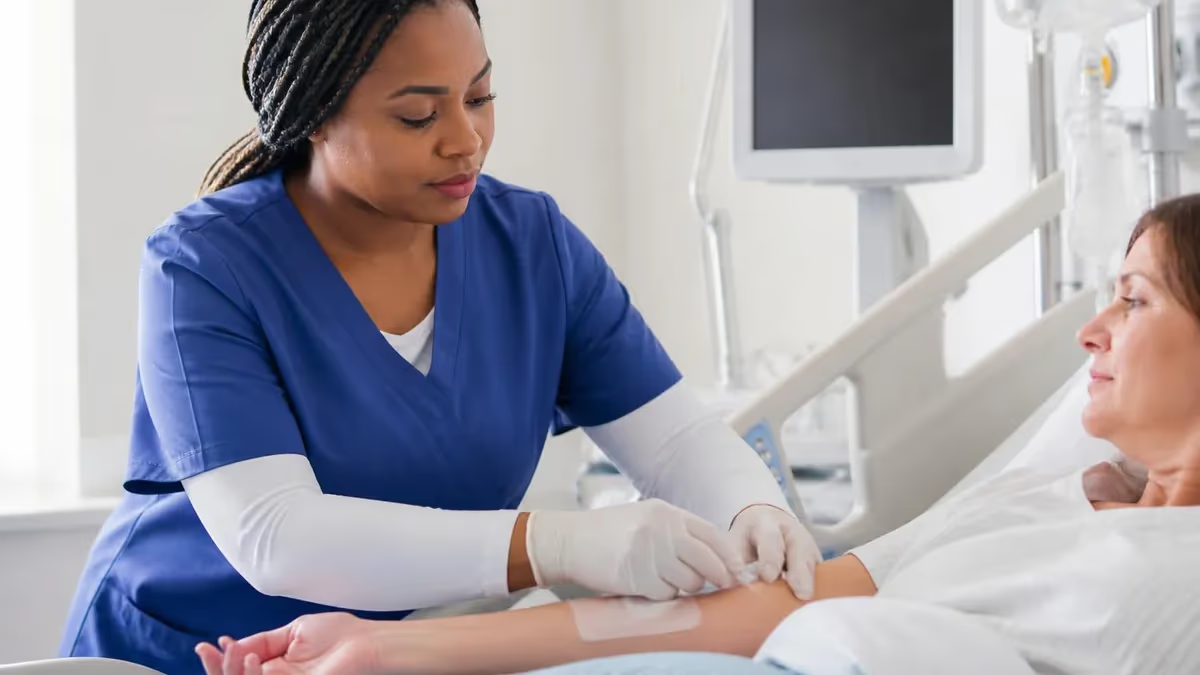
If you have been typing "lpn program near me" into Google late at night, you are not alone. Thousands of future practical nurses begin their search exactly that way, hoping to find a nearby school that fits a tight schedule, a tighter budget, and a real-life mix of childcare, jobs, and family. The good news is that licensed practical nurse training is one of the most accessible healthcare paths in the United States, with community colleges, vocational schools, and hospital-based programs spread across every state.
A local LPN program typically takes 12 to 18 months of full-time study, although some part-time tracks stretch to 24 months. Tuition usually runs between $5,000 and $25,000 depending on whether you choose a public community college or a private career school. You will graduate ready to sit for the NCLEX-PN, the national licensing exam that decides whether you can legally work as a practical nurse in your state. Choosing the right local school makes that exam, and the job hunt that follows, dramatically easier.
This guide is built to answer the questions real applicants ask: which schools are nearby, how much they really cost, what their NCLEX-PN pass rates look like, whether they accept federal aid, how long classes run, and what clinical sites you will rotate through. We will walk through how to search smartly, what to ask on a campus tour, and how to compare two or three finalists side by side before you sign an enrollment agreement and pay a non-refundable deposit.
You will also find practical advice for nontraditional students. If you are a parent, a CNA hoping to bridge up, a career changer at 35 or 50, or someone returning to school after a long pause, your situation matters. Many local LPN programs now offer evening, weekend, and hybrid online tracks specifically for adult learners. How to become an LPN is no longer a single straight road; it is a network of regional options.
Before you commit, you should also know what the workload feels like. LPN school is intense. Expect roughly 20 to 30 hours of class and clinicals per week, plus another 15 to 25 hours of reading, drug card writing, care plans, and practice questions. Programs move quickly because you are responsible for safe patient care from your very first clinical day. Knowing this upfront protects you from dropping out in week six, which is unfortunately the most common attrition point.
Throughout this article, we will quote real numbers from the Bureau of Labor Statistics, the National Council of State Boards of Nursing, and recent state board of nursing reports. Where the data varies by region, we will note it. The aim is to give you a 2026-current, US-focused playbook so you can finish your search confidently and start the actual application work this month, not next year.
LPN Programs in the US by the Numbers
Types of LPN Programs You Will Find Near You
Two-semester to three-semester certificates or diplomas at public colleges. Lowest tuition (often $5,000-$10,000 total), strong financial aid access, established clinical partnerships, but competitive waitlists of 6-18 months in many states.
Private trade schools offering accelerated 12-month LPN diplomas. Rolling admissions, smaller cohorts, faster start dates, but tuition often runs $18,000-$30,000. Verify Title IV aid eligibility before signing.
Run directly by health systems with built-in clinical rotations and frequent post-graduation job offers. Highly clinical, often tied to employment commitments, and sometimes tuition-reimbursed if you agree to work 1-2 years on staff.
Some districts run LPN programs through adult career centers or BOCES, often evenings or weekends. Tuition is typically the lowest available, but seats are limited and prerequisites must be completed before applying.
Theory coursework delivered online with in-person labs and clinicals at a partner facility near you. Great for working adults, but verify your state board approves the program and that clinical sites are within driving distance.
The fastest way to build a real list of LPN programs near you is to start with your state board of nursing. Every board publishes an approved program directory, usually free and current. Search "[your state] board of nursing approved LPN programs" and you will get an official PDF or web list with school names, addresses, contact info, and program approval status. If a school is not on that list, you cannot use its diploma to sit for the NCLEX-PN in that state. Period.
Next, layer on accreditation. The Accreditation Commission for Education in Nursing (ACEN) accredits practical nursing programs nationally. State approval is the legal minimum to take the licensing exam, but ACEN accreditation signals quality, supports financial aid eligibility, and can help if you later bridge into an RN program. Check the ACEN directory and cross-reference it with your state list to build a tier one short list of three to five schools within an hour of home.
Then use Google Maps with intent. Search "LPN program," "practical nursing," or "vocational nursing" within your city, then expand to a 30-mile, 45-mile, and 60-mile radius. Many adult students underestimate commute fatigue. Driving 45 minutes each way to clinicals starting at 6:30 a.m. for 14 months is a different kind of exhausting than evening classes near home. Pin every option on a map before you compare costs.
Workforce development boards are an underused resource. Every US state has American Job Centers (sometimes called CareerOneStop sites) that maintain lists of training programs eligible for Workforce Innovation and Opportunity Act (WIOA) funding. If you qualify, WIOA can cover the full tuition, books, and even childcare or transportation stipends. Walk in, ask for a career counselor, and bring a list of the schools you found on the state board list to confirm WIOA approval.
Do not skip hospital career pages. Large health systems such as HCA, Ascension, Trinity Health, and many regional networks now sponsor LPN apprenticeships and paid earn-while-you-learn pathways. The hospital partners with a nearby school, pays your tuition, and guarantees a position when you license. Search "LPN apprenticeship" or "earn while you learn LPN" along with your city to surface these. After graduation, you can use these same systems to land your first LPN jobs near me without a long search.
Finally, talk to current LPNs in your area. Reddit's r/nursing, Facebook nursing student groups, and even TikTok have honest reviews of regional programs. Pay attention to repeated themes: did the school cancel clinicals at the last minute, did graduates pass NCLEX-PN, were instructors reachable, did financial aid arrive on time? Anecdotes from three or four graduates of the same school usually surface the same red flags or green lights.
Build a simple spreadsheet with columns for school name, distance, start dates, length, total cost, NCLEX-PN pass rate, accreditation, and waitlist length. You will refer back to it constantly. Aim for at least three viable schools before you commit to one, because rolling waitlists and missed prerequisite deadlines can sink your top choice with no warning.
LPN Practice Test Questions
Prepare for the LPN - Certified Practical Nurse exam with our free practice test modules. Each quiz covers key topics to help you pass on your first try.
LPN - Certified Practical Nurse Basic Care...
LPN Exam Questions covering - Certified Practical Nurse Basic Care and Comfort. Master LPN Test concepts for certification prep.
LPN - Certified Practical Nurse Coordinate...
Free LPN Practice Test featuring - Certified Practical Nurse Coordinated Care. Improve your LPN Exam score with mock test prep.
LPN - Certified Practical Nurse Health Pro...
LPN Mock Exam on - Certified Practical Nurse Health Promotion and Maintenance. LPN Study Guide questions to pass on your first try.
LPN - Certified Practical Nurse Pharmacolo...
LPN Test Prep for - Certified Practical Nurse Pharmacological Therapies. Practice LPN Quiz questions and boost your score.
LPN - Certified Practical Nurse Physiologi...
LPN Questions and Answers on - Certified Practical Nurse Physiological Adaptation. Free LPN practice for exam readiness.
LPN - Certified Practical Nurse Psychosoci...
LPN Mock Test covering - Certified Practical Nurse Psychosocial Integrity. Online LPN Test practice with instant feedback.
LPN - Certified Practical Nurse Reduction ...
Free LPN Quiz on - Certified Practical Nurse Reduction of Risk Potential. LPN Exam prep questions with detailed explanations.
LPN - Certified Practical Nurse Safety and...
LPN Practice Questions for - Certified Practical Nurse Safety and Infection Control. Build confidence for your LPN certification exam.
LPN Ethical, Legal & Professional Standards
LPN Test Online for Ethical, Legal & Professional Standards. Free practice with instant results and feedback.
LPN Health Evaluation & Monitoring
LPN Study Material on Health Evaluation & Monitoring. Prepare effectively with real exam-style questions.
Comparing Local LPN Programs: Cost, Length, and Format
Total cost varies enormously by school type. A community college LPN program in Texas, Kentucky, or Indiana may cost $6,000 to $10,000 all-in, while a private vocational school in California or New York can run $25,000 to $35,000 once you add uniforms, books, lab fees, background checks, NCLEX-PN review courses, and licensure fees. Always ask for an itemized cost-of-attendance sheet before you enroll.
Federal Pell Grants up to $7,395 for the 2025-26 award year are available at Title IV-eligible schools. Stafford loans, state grants, WIOA workforce funds, and employer tuition assistance can stack on top. If a school is not Title IV eligible, you cannot use FAFSA aid there. That single fact disqualifies many otherwise attractive private programs for budget-conscious students.
Local LPN Program vs Traveling to a Bigger City
- +Shorter commute means more sleep and better grades during clinical rotations
- +Local clinical rotations build a hiring network in the community you want to live in
- +Easier to maintain part-time work, childcare, and family routines while in school
- +In-state public tuition usually saves $10,000 or more compared to out-of-area private schools
- +Faster access to in-person tutoring, instructor office hours, and skills lab practice
- +Familiar local hospitals and nursing homes often hire their own clinical students first
- −Rural areas may have only one or two approved programs with long waitlists
- −Local school NCLEX-PN pass rates can be lower than competitive metro programs
- −Limited specialty exposure if local clinical sites are mostly long-term care facilities
- −Smaller cohorts may mean fewer elective scheduling options each term
- −Local programs sometimes lack ACEN accreditation, complicating later RN bridge plans
- −Less curriculum diversity if you later relocate to a different state for work
LPN Program Near Me: Application Checklist
- ✓High school diploma or GED with official transcript ready to send
- ✓Minimum cumulative GPA (usually 2.0-2.5) verified on transcripts
- ✓TEAS, HESI, PAX, or Wonderlic entrance exam scored at or above the school cutoff
- ✓Completed application packet with personal statement and references
- ✓Negative TB skin test or QuantiFERON blood test within the last 12 months
- ✓Up-to-date immunizations including MMR, Tdap, varicella, hepatitis B, and flu
- ✓Current CPR for Healthcare Providers (BLS) certification from AHA or Red Cross
- ✓Criminal background check and 10-panel drug screen cleared
- ✓FAFSA submitted with the school's federal code listed
- ✓Reliable transportation plan for clinicals at sites up to 45 miles away
Choose accreditation and outcomes over price tag.
A program with a 90% first-time NCLEX-PN pass rate at $18,000 is almost always a better value than a $7,000 program with a 55% pass rate. Failing the NCLEX-PN delays your earning power by months and costs $200 per retake plus another review course. Ask every school in writing: "What was your most recent first-time NCLEX-PN pass rate, and was it above the state required minimum?"
The NCLEX-PN pass rate is the single most important quality metric for any LPN program near you. The National Council of State Boards of Nursing publishes annual statistics, and most state boards require approved programs to maintain at least an 80% first-time pass rate over a rolling three-year average. Programs that fall below face conditional approval, probation, or eventually closure. Asking for the most recent three years of pass rate data is a fair and standard request that any reputable program will answer immediately.
National averages give you context. In 2024, the first-time NCLEX-PN pass rate for US-educated candidates was approximately 82.6%, and repeat candidates passed at about 53%. Strong programs sit well above the national mean, often 88% to 95%. If a school refuses to share its number, mentions "new program, no data yet," or has a rate below 75% for two years running, treat that as a serious yellow flag and ask why.
Accreditation status is the second screen. State board approval is mandatory; you cannot legally take the NCLEX-PN without it. ACEN accreditation is voluntary but valuable. ACEN-accredited programs follow more rigorous curriculum, faculty, and outcome standards. They also transfer more cleanly into LPN-to-RN bridge programs at four-year universities. If you ever plan to pursue an associate or bachelor's degree in nursing, ACEN accreditation now saves headaches later.
Pay attention to attrition. Programs report how many students start versus how many graduate. A 30% attrition rate is roughly average; 50%-plus is concerning. High attrition can mean the program is selective and tough but also can signal weak academic support, scheduling chaos, or financial aid issues that push students out. Ask current students about who left in the last cohort and why. Their answers tell you more than any glossy brochure.
Look closely at clinical placements. The Centers for Medicare and Medicaid Services rate every nursing home and many hospitals on staffing and quality. If your program's primary clinical sites are one-star facilities with chronic short staffing, you will see less mentorship and fewer skills opportunities. Ideal clinical rotations expose you to acute care floors, long-term care, rehab, pediatrics or maternal-newborn observation, and at least one clinic or community setting. Diverse exposure prepares you for the NCLEX-PN and the job market.
Investigate faculty credentials too. Lead instructors should hold at least a Bachelor of Science in Nursing (BSN), and program directors typically hold a master's degree. Adjunct instructors who are working LPNs or RNs bring valuable bedside reality, but a program staffed entirely by adjuncts and no full-time faculty often struggles with consistency and student support. Ask the ratio of full-time to adjunct faculty during your campus visit.
Finally, weigh employer reputation. Local hospitals, nursing homes, and clinics often have unspoken preferences for graduates of certain regional programs. Call human resources at two or three places you would eventually like to work and ask which local LPN schools they recruit from. The answer is often startlingly direct and helps you align your school choice with your future paycheck.
Community college LPN programs often close applications 6 to 12 months before the start date. Miss the window and you wait an entire academic year. Confirm deadlines in writing the first time you contact a school, then put them on your calendar with 30-day reminders for prerequisite courses, TEAS testing, and immunization appointments. Many qualified students lose a year simply by missing one immunization upload deadline.
Once you have narrowed your list to two or three local programs, schedule campus visits in the same week so the comparisons stay fresh. Ask to sit in on a class if possible, walk through the skills lab, see the simulation mannequins, and meet a current student. Pay attention to the energy of the building. Do students look exhausted but engaged, or beaten down? Are instructors smiling and approachable, or unavailable? Your gut reaction during a tour is usually accurate.
Bring a one-page list of questions and write down the answers. Ask about cohort size, instructor-to-student ratio in clinicals (ideally 1:8 or better), specific clinical site names, the exact total cost including books and uniforms, recent NCLEX-PN pass rates, attrition data, employment rates at six months post-graduation, and policies on missed clinical days. If the admissions counselor cannot answer or deflects, write that down too and weight it heavily.
While you wait for acceptance letters, knock out prerequisites. Anatomy and physiology, basic math, English composition, medical terminology, and an intro psychology course are common entry requirements. Taking them at a low-cost community college before nursing classes start lets you focus entirely on clinical content once your program begins. Many students who fail out of LPN school do so because they tried to learn A&P and bedside skills simultaneously in the same semester.
Start saving and budgeting now. Even with FAFSA and grants, expect $1,500 to $3,000 in out-of-pocket costs for scrubs, stethoscope, blood pressure cuff, bandage scissors, watch with second hand, NCLEX-PN review books, parking, gas, and licensure fees. Set aside $200 per month for the year leading up to enrollment, and you will dodge the credit card debt trap that ambushes too many nursing students in week one. Compare your finalists with the Certified Practical Nurse Test overview so you understand exactly what you will be tested on.
Prepare your support system. Tell your family, employer, and friends what the next 12 to 18 months will look like. Block out study hours on a shared calendar. Identify a backup childcare plan for the unexpected 5 a.m. clinical start times. If you live with a partner, divide household labor in writing. The students who finish LPN programs almost always have one or two key people who quietly absorbed extra responsibility for a year. Recruit them on purpose.
Buy and use NCLEX-PN review materials from day one. Do not wait until the last semester to start practice questions. Ten questions per day from week one builds test-taking stamina, exposes you to clinical reasoning patterns, and reveals weak content areas while you still have time to fix them in class. Free question banks, paid tools like UWorld or Kaplan, and your school's ATI or HESI subscription should all live on your phone.
Finally, document everything. Keep digital copies of your transcripts, immunization records, CPR cards, background checks, and tuition receipts in a single labeled cloud folder. You will reach for these documents repeatedly during application, financial aid verification, clinical onboarding, and finally NCLEX-PN application. Disorganization is the silent reason qualified students miss deadlines that cost them an entire term.
Your first day of LPN school will move fast, so a few practical habits in the first two weeks will pay off all year. Show up 15 minutes early to every class and clinical, every single time. Healthcare runs on punctuality, and instructors notice. Stash a granola bar, a water bottle, two pens, and a small notebook in your bag at all times. Pre-charge your phone and laptop the night before. The students who keep their logistics tight have more mental space for content.
Master one study method early. Some students thrive on Anki flashcards, others on Cornell notes, others on color-coded concept maps. Pick one within the first three weeks, commit for the rest of the semester, and resist the temptation to switch every time a TikTok video promises a better hack. Consistent imperfect studying beats perfect inconsistent studying every time. Aim for 90 to 120 minutes of focused review on weekdays and a longer 3 to 4 hour block on Saturday or Sunday.
Form a study group of three or four classmates by week two. Not five, not eight. Three or four lets everyone get a turn talking through care plans, drug calculations, and tricky NCLEX-PN style questions. Meet weekly at a fixed time. Rotate who leads each session. Reading the chapter alone is necessary but not sufficient; verbalizing concepts to peers is when content really moves into long-term memory.
Take care of your body. Sleep less than 6 hours a night for a week and you will measurably tank your grades and your patient safety scores. Drink water instead of energy drinks. Walk 20 minutes most days. See a doctor or therapist if your stress spikes. Burnout is real in nursing school and is not a badge of honor. The students who finish strong are usually the ones who treat self-care as part of the curriculum.
Track your money carefully. Open a separate checking account or budget app category for school expenses, deposit your refund check there, and pay tuition and books out of it. This single habit prevents the most common financial mistake students make: spending Pell or loan refund money on non-school items and being short for the next semester's textbooks. If you receive any leftover refund, save it as a clinical emergency fund.
Network from day one, not at graduation. Be polite and professional to every nurse, CNA, doctor, housekeeper, and patient you meet on clinicals. Healthcare is a small world, especially in your local market. The clinical preceptor you impress in semester two may be the same hiring manager who interviews you in semester four. Send a brief thank-you email or note to nurses who taught you something. Two minutes of gratitude often produces job offers months later.
Finally, start NCLEX-PN prep formally with three months left in the program. Pick a structured review course, commit to a daily question count, and track your scores weekly. Most graduates pass on the first attempt by maintaining a 65% or higher consistency on practice tests in the final month. Walk into the testing center rested, hydrated, and confident that you already passed thousands of practice questions just like the real thing.
LPN Questions and Answers


About the Author

Registered Nurse & Healthcare Educator
Johns Hopkins University School of NursingDr. Sarah Mitchell is a board-certified registered nurse with over 15 years of clinical and academic experience. She completed her PhD in Nursing Science at Johns Hopkins University and has taught NCLEX preparation and clinical skills courses for nursing students across the United States. Her research focuses on evidence-based exam preparation strategies for healthcare certification candidates.
Join the Discussion
Connect with other students preparing for this exam. Share tips, ask questions, and get advice from people who have been there.
View discussion (7 replies)