

i-Ready Diagnostic Test Practice Test
Updated November 2026Facts verified Oct 25, 2026 against Curriculum Associates
Did you know? The i-Ready Diagnostic is adaptive, meaning the difficulty of its diagnostic questions changes based on your answers. If you get a question correct, the next one is harder; if incorrect, the next is easier. This helps find your precise "Just Right" learning level. Try our EOG practice test. Practice with the free i-Ready Diagnostic practice test on PracticeTestGeeks (7 questions with answer explanations).
i-Ready Diagnostic Test: upcoming dates and official changes
- Updated Oct 25, 2026: Eligibility is now Students in Grades K–12 (Reading and Mathematics) (previously Students in Grades K–12 (Reading and Mathematics)).
- Updated Oct 25, 2026: Exam fee is now School or district subscription with a custom quote; not sold to families (previously School or district subscription with a custom quote; not sold to families).
- Updated Oct 25, 2026: Testing window is now Up to three times per year (fall, winter, spring) (previously Up to three times per year (fall, winter, spring)).
Facts verified Oct 25, 2026 against Curriculum Associates. Dates that have passed are removed automatically.
- The i-Ready Diagnostic (now i-Ready Inform) takes about 30–60 minutes per subject depending on grade, and is often split into shorter sittings. (Curriculum Associates)
- The i-Ready program is a subscription bought by schools or districts, with pricing provided as a custom quote, and families cannot buy it directly. (Curriculum Associates)
- The i-Ready Diagnostic (now called i-Ready Inform) is a computer-adaptive assessment in Reading and Mathematics, given to students at school. (Curriculum Associates)
- The i-Ready Diagnostic (now i-Ready Inform) covers Reading and Mathematics for students in Grades K–12. (Curriculum Associates)
Facts verified Oct 25, 2026 against Curriculum Associates. Dates that have passed are removed automatically.
i-Ready Diagnostic Test Exam at a Glance
| Item | Detail | Official source |
|---|---|---|
| Time limit | About 30–60 minutes per subject, often split into shorter sittings | Curriculum Associates |
| Exam fee | School or district subscription with a custom quote; not sold to families | Curriculum Associates |
| Delivery | Computer-adaptive, taken at school | Curriculum Associates |
| Eligibility | Students in Grades K–12 (Reading and Mathematics) | Curriculum Associates |
| Testing window | Up to three times per year (fall, winter, spring) | Curriculum Associates |
Facts verified Oct 25, 2026 against Curriculum Associates. Dates that have passed are removed automatically.
Free i-Ready Diagnostic Test Study Tools
Interactive i-Ready Diagnostic Test resources on PracticeTestGeeks, free to start:
- i-Ready Diagnostic Test flashcards — review key terms and concepts card by card
- i-Ready Diagnostic Test study guide — topic-by-topic overview of what the exam covers
- i-Ready Diagnostic Test cheat sheet — one-page printable summary for last-minute review
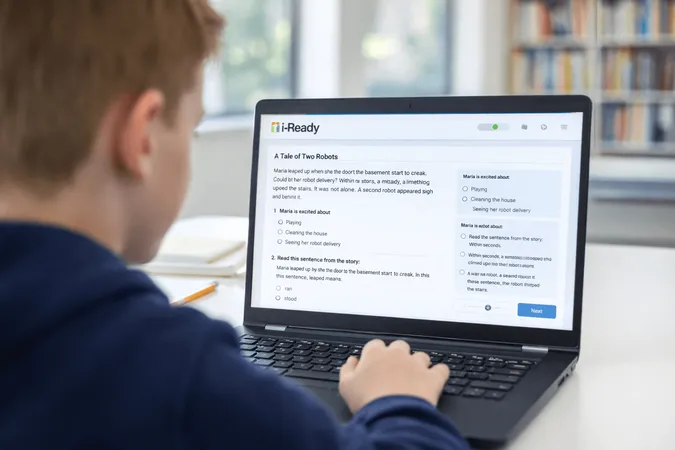
According to Curriculum Associates, “Pinpoint what students know and where they need support with adaptive Reading and Mathematics assessments for Grades K–12.”[3]
i-Ready Diagnostic Test Practice Test Questions
Prepare for the i-Ready Diagnostic Test exam with our free practice test modules. Each quiz covers key topics to help you pass on your first try.
i-Ready Diagnostic Test i-Ready Diagnostic...
i-Ready Diagnostic Test Exam Questions covering i-Ready Diagnostic Algebra and Algebraic Thinking. Master i-Ready Diagnostic Test Test concepts for certification prep.
i-Ready Diagnostic Test i-Ready Diagnostic...
Free i-Ready Diagnostic Test Practice Test featuring i-Ready Diagnostic Diagnostic Test Administration. Improve your i-Ready Diagnostic Test Exam score with mock test prep.
i-Ready Diagnostic Test i-Ready Diagnostic...
i-Ready Diagnostic Test Mock Exam on i-Ready Diagnostic Foundational Reading Skills. i-Ready Diagnostic Test Study Guide questions to pass on your first try.
i-Ready Diagnostic Test i-Ready Diagnostic...
i-Ready Diagnostic Test Test Prep for i-Ready Diagnostic Interpreting Diagnostic Reports. Practice i-Ready Diagnostic Test Quiz questions and boost your score.
i-Ready Diagnostic Test i-Ready Diagnostic...
i-Ready Diagnostic Test Questions and Answers on i-Ready Diagnostic Measurement, Data, and Geometry. Free i-Ready Diagnostic Test practice for exam readiness.
i-Ready Diagnostic Test i-Ready Diagnostic...
i-Ready Diagnostic Test Mock Test covering i-Ready Diagnostic Number and Operations. Online i-Ready Diagnostic Test Test practice with instant feedback.
i-Ready Diagnostic Test i-Ready Diagnostic...
Free i-Ready Diagnostic Test Quiz on i-Ready Diagnostic Reading Comprehension: Informational Text. i-Ready Diagnostic Test Exam prep questions with detailed explanations.
i-Ready Diagnostic Test i-Ready Diagnostic...
i-Ready Diagnostic Test Practice Questions for i-Ready Diagnostic Reading Comprehension: Literature. Build confidence for your i-Ready Diagnostic Test certification exam.
i-Ready Diagnostic Test Grammar and Langua...
i-Ready Diagnostic Test Mock Test covering Grammar and Language Conventions. Online i-Ready Diagnostic Test Test practice with instant feedback.
i-Ready Diagnostic Test i-Ready Diagnostic...
Free i-Ready Diagnostic Test Quiz on i-Ready Diagnostic Phonics and Word Recognition. i-Ready Diagnostic Test Exam prep questions with detailed explanations.
i-Ready Diagnostic Test i-Ready Diagnostic...
i-Ready Diagnostic Test Practice Questions for i-Ready Diagnostic Vocabulary and Language Development. Build confidence for your i-Ready Diagnostic Test certification exam.
i-Ready Diagnostic Test I-READY Math Conce...
Free i-Ready Diagnostic Test Practice Test featuring I-READY Math Concepts and Applications. Improve your i-Ready Diagnostic Test Exam score with mock test prep.
i-Ready Diagnostic Test I-READY Problem-So...
i-Ready Diagnostic Test Mock Exam on I-READY Problem-Solving Skills. i-Ready Diagnostic Test Study Guide questions to pass on your first try.
Worked examples: how to reason through i-Ready Diagnostic Test questions
These are practice questions written for this site, not questions from the real exam. Each explanation shows why the right answer is right and why the others are wrong.
Example 1
Question: If a clock shows 3:45 PM, what time will it be in 2 hours and 30 minutes?
- 6:15 PM
- 5:45 PM
- 6:00 PM
- 5:15 PM
Answer: A. 6:15 PM
Explanation:
The correct answer is 6:15 PM. Start at 3:45 PM and add 2 hours to reach 5:45 PM. Then add the 30 minutes: 15 minutes gets to 6:00 PM and the other 15 minutes gets to 6:15 PM.
5:45 PM is wrong because it only adds the 2 hours and ignores the 30 minutes. 6:00 PM is wrong because it adds only 15 of the 30 minutes. 5:15 PM is wrong because it counts backward from 5:45 PM instead of forward.
Rule to remember: with time problems, add the hours first, then the minutes, and when the minutes pass the hour mark, carry the extra into the next hour.
Example 2
Question: Which word is an antonym of 'ancient'?
- Old
- Historic
- Modern
- Past
Answer: C. Modern
Explanation:
The correct answer is Modern. An antonym means the opposite, and ancient describes something from a very long time ago, while modern describes something of the present or recent time.
Old is wrong because it is a synonym, close in meaning to ancient. Historic is wrong because it also points to the past, so it sits on the same side as ancient. Past is wrong for the same reason: it refers to earlier time, not the opposite of it.
Rule to remember: when asked for an antonym, first put the target word in your own words, then look for the option that points the other way. Several wrong options will often be similar to the word instead.
Example 3
Question: Sarah baked 24 cookies and wants to divide them equally into 6 boxes. How many cookies will go in each box?
- 4
- 6
- 8
- 12
Answer: B. 6
Explanation:
Check this one before relying on it. The problem asks for 24 cookies shared equally among 6 boxes, which is 24 ÷ 6 = 4. That matches option A (4), but our stored answer key marks B (6) as correct, and the stored explanation talks about pizza and toppings, so it belongs to a different question. We have flagged this item as having a faulty key.
By the arithmetic, 6 is the number of boxes, not the number of cookies per box. 8 would come from a wrong operation, and 12 would be half of 24, which would only fill 2 boxes.
Rule to remember: in an equal-sharing problem, divide the total by the number of groups, then multiply back to check that the groups add up to the total.
How to use these practice tests
Start by asking your teacher or school which parts of Reading and Mathematics the Diagnostic covers for your grade, and read the official Curriculum Associates pages so you know what to expect. Because the test is adaptive, aim for steady skill rather than memorising question types.
- Pick the area you find hardest and work through its set, for example number and operations or foundational reading skills.
- After each set, write down every miss and the reason: a careless slip, a word you did not know, or a skill you have not learned yet.
- Move on to informational text, literature or measurement, data and geometry.
- Try test-taking strategies to practise reading carefully and not rushing.
- Return to your missed items a few days later and redo them without looking at the answers.
Short, regular sittings suit this test, since the real one is often split into shorter sittings too. On test day, rest well, read each question fully and ask the teacher if something about the screen or controls is unclear.
i-Ready Exam Flashcards
Quick review for the i-Ready math test and reading assessment
📖What is a synonym?
A word that has the same or nearly the same meaning as another word, often appearing in i-Ready vocabulary questions.
REVIEW I-READY QUESTIONS➗What is a quotient?
The result obtained by dividing one quantity by another, a key concept for i-Ready math problem solving.
TRY I-READY MOCK EXAM📝What is the main idea?
The primary point or concept that the author wants to communicate to the reader, crucial for i-Ready reading comprehension.
ACCESS I-READY STUDY GUIDE🔢What is place value?
The value of a digit based on its position in a number, such as ones, tens, or hundreds, tested on the i-Ready math test.
PRACTICE I-READY TEST NOWi-Ready Exam Study Guide
The i-ready test prep process begins with understanding the test structure. Our comprehensive guide covers the essentials of the i ready reading test and mathematics components. Explore the tabs below to learn about the i ready test scores, format, and preparation tips.
Focus on the i ready math test vocabulary! Many students struggle not with the calculation, but with understanding terms like "quotient," "sum," or "attribute." Reviewing these terms can significantly improve i ready test scores. Try our ELPAC practice test.
What the i-Ready Math Diagnostic Measures
The i ready math Diagnostic is the Mathematics half of the i-Ready assessment from Curriculum Associates: a computer-adaptive test for Grades K–12 that reports results in four domains — Number and Operations, Algebra and Algebraic Thinking, Measurement and Data, and Geometry. Each domain receives its own placement, so a student can be on grade level in Geometry while placing one grade level below in Number and Operations.
Like the reading test, the i ready diagnostic for math produces a scale score on a continuous 100–800 vertical scale plus a grade-level placement such as Early, Mid or Late Grade 4. Because the scale runs across all grades, fall, winter and spring scores can be compared directly to see how far a student has moved toward their Typical Growth and Stretch Growth targets.
Most math items are multiple choice, with some drag-and-drop and other technology-enhanced formats, and the test is not strictly timed — each subject usually takes about 30–60 minutes. Keep scratch paper and a pencil handy for multi-step word problems. Results then feed the student's personalized My Path math lessons, which is why rushing or guessing hurts: a low placement sends easier lessons, not a failing grade.
What i-Ready Diagnostic Questions Cover
i-Ready diagnostic questions are drawn from fixed skill domains, and each student's report shows a separate placement for every domain. The Reading test for Grades K–12 covers six: Phonological Awareness, Phonics, High-Frequency Words, Vocabulary, Comprehension: Literature and Comprehension: Informational Text. The Mathematics test, offered in English and Spanish, covers four: Number and Operations, Algebra and Algebraic Thinking, Measurement and Data, and Geometry.
Because the test is computer-adaptive, the items a student sees depend on how they answer: correct answers lead to harder items and incorrect answers to easier ones until the test pinpoints the student's level. That is why nearly every student meets questions that feel too hard — Curriculum Associates says the process is designed to find the edge of what a child knows, not just confirm what they have already learned.
Reading items ask students to work with sounds, words, sentences and passages, then answer questions about word meanings and the ideas in literary and informational texts. Math items range from counting and operations to equations, measurement, data displays and shapes, mostly multiple choice with some drag-and-drop formats. The best preparation is practicing each domain and answering carefully rather than quickly.
i-Ready Score Interpretation
Understanding your i ready test scores and placement levels is crucial for academic planning.
| Placement Level | Interpretation | Instructional Need | Typical Action |
|---|---|---|---|
| 🟢 Mid On-Grade or Above | Exceeding Standards | Enrichment | Advanced coursework |
| 🟢 Early On-Grade | Meeting Standards | Core Instruction | Standard curriculum |
| 🟡 One Grade Below | Approaching Standards | Strategic Support | Small group help |
| 🔴 Two+ Grades Below | Below Standards | Intensive Intervention | Specialized support |
| 📈 Growth Score | Progress Measure | Yearly Gain | Track improvement |
The main goal of i-Ready is growth. Even if a student starts below grade level, achieving their "Typical Growth" or "Stretch Growth" targets indicates successful learning progress.
What Is the i-Ready Diagnostic Test?
The i-Ready Diagnostic is an adaptive assessment developed by Curriculum Associates that measures student performance in reading and mathematics from kindergarten through grade 12. Unlike fixed-form tests, i-Ready adjusts the difficulty of each question based on the student's previous answers, providing a precise measurement of ability across multiple skill domains. The test is administered online three times per year — at the beginning, middle, and end of the school year — to track academic growth over time. Starting in the 2026-27 school year, Curriculum Associates is renaming the assessment i-Ready Inform and rolling out a shorter version with fewer items; the scores, placements and growth targets stay the same.
How the i-Ready Adaptive Format Works
When a student answers a question correctly, the next question increases in difficulty; an incorrect answer lowers the difficulty level. This branching design means no two students receive the same sequence of diagnostic questions, and the test typically takes 30 to 60 minutes per subject to complete.
For a fuller set of questions on this topic, see our iready diagnostic score chart resource.
- Teacher Setup - Teachers assign the diagnostic assessment to students via the dashboard.
- Login - Students log in using their school credentials on a computer or tablet.
- Introduction - An introductory video explains the test format and tools (especially for K-2).
- Adaptive Testing - Students answer questions; the test adapts difficulty based on responses.
- Completion - Once the system has enough data, the test concludes automatically.
- Reports - Teachers receive immediate data to group students for instruction.
- Personalized Path - i-Ready automatically assigns "My Path" lessons based on the results.
While families pay nothing directly for the i ready diagnostic, the estimated value of the personalized instruction and diagnostic data provided by i-Ready is significant, replacing expensive private tutoring in many cases.


i-Ready Test Day Checklist
- ✓Get a good night's sleep before the test
- ✓Eat a healthy breakfast
- ✓Bring headphones for audio questions
- ✓Have scratch paper and pencil ready (Math)
- ✓Know your login credentials
- ✓Bring a book (for after finishing)
- ✓Encourage your child to do their best
- ✓Remind them it's adaptive (it gets hard!)
Ready to Improve Your Score?
Practice makes perfect. Take our free i-Ready diagnostic practice test quizzes to identify your strengths and weaknesses before the real assessment.
i-Ready Diagnostic Test: Pros and Cons
- +Adaptive format pinpoints exactly what a student knows, above or below grade level
- +Given three times a year, so growth is tracked against Typical and Stretch Growth targets
- +No cost to families — the district or school pays for the subscription
- +Approved by NCII for academic screening and progress monitoring, and accepted as a dyslexia screener in several states
- +Results feed directly into personalized My Path lessons and reports families can read
- −Intentionally challenging — students will see questions they cannot answer, which can feel frustrating
- −Rushing through items can produce an inaccurate placement (rush flags exist for a reason)
- −Each subject takes about 30-60 minutes, and younger students often need several sittings
- −Norms were reset in 2024-25, so percentile ranks are not comparable with pre-2024 reports
- −The name changes to i-Ready Inform in 2026-27, so older guides and reports use different labels
Sample i-Ready Diagnostic Test Practice Questions
Try these questions from our free i-Ready Diagnostic Test practice tests. The correct answer and an explanation follow each question.
Why does i-Ready ask students to complete the diagnostic without outside help from teachers or parents?
- A. To make the test harder than it needs to be
- B. So results accurately reflect the student's own skill level for proper placement
- C. Because outside help is always cheating
- D. To save the teacher time in grading
Answer: B. So results accurately reflect the student's own skill level for proper placement
Accurate placement results depend on independent responses; outside help skews the adaptive algorithm and leads to misaligned instruction.
A student finishes their Math Diagnostic in 20 minutes, which is significantly faster than the average time. The teacher checks the Diagnostic Status report. What information on this report is most critical for determining if the test results are valid?
- A. The student's final scale score.
- B. The specific domains the student 'Tested Out' of.
- C. The presence of a 'Rushing Alert' icon next to the student's name.
- D. The total number of questions the student answered correctly.
Answer: C. The presence of a 'Rushing Alert' icon next to the student's name.
The Diagnostic Status report includes specific alerts for rushing. This icon is the most direct indicator provided by the system that the student's rapid pace may have compromised the validity of the results. This alert prompts the educator to investigate further and consider reassigning the test.
Which action by a test administrator would most likely compromise the validity of the i-Ready Diagnostic results?
- A. Reading a math word problem aloud to a student who does not have a documented accommodation for it.
- B. Reminding students to take their time and try their best on every question.
- C. Helping a student log back into the test after their computer crashed.
- D. Pausing a student's test so they can take a short restroom break.
Answer: A. Reading a math word problem aloud to a student who does not have a documented accommodation for it.
Reading test content aloud is a form of assistance that can invalidate the results, as it removes the reading demand from the question. This type of help is only permissible if it is a formally documented accommodation in a student's IEP or 504 plan. All other listed actions are appropriate and recommended parts of test administration.
Which component of the i-Ready Diagnostic report provides a single, continuous score from K-12 that is used to measure academic growth from one diagnostic to the next?
- A. The National Norm Percentile
- B. The Grade-Level Placement (e.g., "Mid Grade 4")
- C. The Developmental Analysis
- D. The Scale Score
Answer: D. The Scale Score
The Scale Score is a continuous score on a vertical scale (from 100 to 800) that measures student achievement and growth over time, from kindergarten through high school. Grade-level placement is a categorical interpretation of the scale score, the national percentile is a comparison to peers, and the developmental analysis provides qualitative instructional guidance.
Take the full i-Ready Diagnostic Test practice test
For a fuller set of questions on this topic, see our i ready diagnostic test answers resource.
i-Ready Diagnostic Test Questions and Answers
Official Resources
- Curriculum Associates: i-Ready Inform (formerly i-Ready Diagnostic) — the publisher's own page for the adaptive K–12 Reading and Mathematics assessment, with details on how the Diagnostic works, the reports it produces and the 2026–27 rename to i-Ready Inform.
- i-Ready Resources for Families — Curriculum Associates' parent hub explaining what the Diagnostic measures, how to read your child's placement and scale-score reports, and how to support learning at home between the fall, winter and spring testing windows.
- Massachusetts DESE: Early Literacy Universal Screening Assessments — a state education department page showing how schools use the i-Ready Diagnostic as an approved universal screener, which is why students never pay to take it.
Written and edited by Nathan Beja, founder of Practice Test Geeks, with AI assistance. Exam facts are checked against the official sources linked below. Editorial policy
Sources & references
Exam facts on this page (fees, format, dates, passing scores) are checked against these official sources; the date is our last check. Editorial policy
- curriculumassociates.com — Test dates, time limit, fees, test delivery, eligibility · verified Oct 2026