
HVAC/R Meaning: What HVAC/R Stands For and How It Differs From HVAC 2026
HVAC/R meaning explained: what the R adds to HVAC, how refrigeration systems work, careers, certifications, and how HVAC/R differs from standard HVAC. 🟢

The hvac/r meaning is straightforward once you break the acronym down: HVAC/R stands for Heating, Ventilation, Air Conditioning, and Refrigeration. That single forward slash and the letter R do a lot of heavy lifting because they expand the scope of the field from comfort cooling alone into the world of commercial refrigeration, walk-in coolers, freezers, ice machines, beverage equipment, and food-grade temperature control. Anyone shopping for training, jobs, or contractor services will see HVAC and HVAC/R used almost interchangeably, but they are not the same discipline.
In the United States, HVAC traditionally refers to systems that keep people comfortable: residential furnaces, central air conditioners, heat pumps, and the ductwork that distributes treated air through homes and offices. HVAC/R adds equipment that keeps products cold rather than just keeping rooms comfortable. Supermarket display cases, restaurant reach-in freezers, pharmaceutical storage units, and cold-storage warehouses all fall under the refrigeration umbrella. The thermodynamic principles are identical, but the temperature ranges, refrigerants, oils, and service procedures often differ in ways that matter for safety and code compliance.
Confusion about HVAC/R also comes from the way trade schools and manufacturers brand their programs. A technician trained as an HVAC/R installer typically learns vapor-compression refrigeration deeply enough to troubleshoot any system that moves heat, from a 1.5-ton home condenser to a 40-horsepower supermarket rack. By contrast, a residential-only HVAC tech may never touch a low-temperature freezer or a CO2 cascade system. That extra training is why HVAC/R techs command higher pay in many markets and why employers list both acronyms in job postings.
From a regulatory standpoint, both HVAC and HVAC/R technicians need EPA Section 608 certification to handle refrigerants in the United States. However, the refrigeration side carries additional code obligations: ASHRAE 15 for system safety, NSF certification for food contact equipment, and FDA-aligned recordkeeping for pharmaceutical storage. Understanding the hvac/r meaning matters not only for vocabulary but for licensing, insurance, and the actual scope of work a contractor can legally perform on a given job site.
For homeowners, the distinction is usually invisible. Your central AC, gas furnace, and heat pump are all HVAC equipment. The fridge in your kitchen is technically refrigeration, but no licensed contractor visit is required for a sealed domestic appliance. The line becomes important when you own a small business with a walk-in cooler, a restaurant with line refrigeration, or a building with a chilled water plant. At that point you need a contractor whose license, training, and recovery equipment cover the R side of HVAC/R.
This guide walks through every angle of the HVAC/R acronym: the technical differences between heating, cooling, and refrigeration; the equipment categories under each letter; the careers and certifications that map to HVAC/R work; and how to choose the right contractor and training path. Along the way you will also find links to deeper resources like our guide to HVAC Solutions, which covers system selection in more depth than we can fit here.
Whether you are a student picking a trade school program, a building owner sourcing a service contract, or a homeowner trying to read your invoice without getting upsold, the goal of this article is to make the hvac/r meaning crystal clear and immediately useful. By the end you will know what each letter covers, where the boundaries fall in practice, and which certifications, tools, and test prep paths line up with each segment of the industry.
HVAC/R Industry by the Numbers
What Each Letter in HVAC/R Actually Means
Covers furnaces, boilers, heat pumps, radiant systems, and electric resistance heat. Heating raises indoor temperature using combustion, electricity, or heat transfer from outdoor air, ground, or water sources to keep occupants comfortable in cold weather.
Includes natural and mechanical air exchange, exhaust fans, energy recovery ventilators, and makeup air units. Ventilation removes stale indoor air, dilutes contaminants, controls humidity, and supplies fresh outdoor air per ASHRAE 62.1 and 62.2 standards.
Encompasses split systems, packaged units, mini-splits, and chillers. Air conditioning removes heat and moisture from indoor air using the vapor-compression refrigeration cycle, then rejects that heat outdoors through a condenser coil.
Adds commercial coolers, freezers, ice machines, beverage equipment, supermarket racks, cold storage, and transport refrigeration. Refrigeration maintains product temperatures from medium-temp produce cases at 38°F to deep-freeze ice cream rooms at −20°F.
The most important distinction in the hvac/r meaning conversation is the line between comfort cooling and product refrigeration. Comfort cooling, the AC in HVAC, is designed to hold a space somewhere in the 68°F to 78°F range with relative humidity between 30 and 60 percent. The equipment is sized around human thermal comfort, latent load from breathing and perspiration, and infiltration from doors and windows. Service technicians focus on airflow, refrigerant charge, and ductwork performance, with most residential calls resolving in a single visit.
Refrigeration, the R in HVAC/R, is engineered to protect a product rather than a person. A walk-in cooler might run at 36°F to keep dairy from spoiling. A blast freezer might pull down to −40°F to flash-freeze seafood. An ice machine produces a specific cube weight per 24-hour cycle. These applications run continuously, often 24/7/365, with no setback schedule, no occupant override, and no tolerance for a long outage. A failed walk-in over a holiday weekend can mean tens of thousands of dollars in lost inventory, which is why refrigeration service contracts usually include guaranteed response times.
The hardware looks similar at a glance, but the differences add up. Refrigeration compressors are built for higher compression ratios because the evaporator pressure is much lower at freezer temperatures. The oils, expansion devices, defrost controls, and refrigerants are all selected for the duty cycle. A tech who only services residential AC may not recognize an EPR valve, a hot-gas defrost circuit, or a CPR valve protecting a low-temp compressor on startup. Misdiagnosing any of these can damage equipment or void warranties.
Ventilation is the often-overlooked letter in HVAC/R, but it ties both worlds together. Commercial kitchens with refrigeration also need makeup air to replace what the hood exhausts. Walk-in coolers and freezers need pressure relief vents to prevent door seal damage during defrost cycles. Indoor air quality codes such as ASHRAE 62.1 dictate minimum outdoor air per person, and energy codes like IECC and Title 24 require energy recovery on many systems. Skipping ventilation design creates negative pressure problems that show up as door slams, frozen evaporator coils, and unhappy tenants.
Heating is where regional differences matter most. In the Northeast and Midwest, hydronic boilers and high-efficiency gas furnaces dominate residential heating. In the Southeast, heat pumps are standard. In the West, dual-fuel and ductless mini-split systems are common. An HVAC/R technician in Minnesota spends a different winter than one in Phoenix, but the underlying refrigeration cycle that powers a heat pump is identical to the one that cools a supermarket case. That shared physics is exactly why training programs teach the full HVAC/R curriculum even to students who plan to specialize.
From a homeowner's perspective, the hvac/r meaning rarely matters until something breaks that crosses the line. If your basement bar fridge dies, you replace it. If the walk-in cooler at your restaurant warms to 50°F overnight, you need a commercial refrigeration contractor with EPA 608 Type II certification, sufficient recovery equipment, and the right replacement parts on the truck. For deeper coverage of what specific services contractors provide, our guide to hvac maintenance service walks through the maintenance side of the trade.
One last point about terminology: some manufacturers and trade groups write HVACR without the slash, while others use HVAC-R or HVAC/R. They all mean the same thing. The slash version is most common in U.S. trade publications, the no-slash version dominates in academic and ASHRAE contexts, and the hyphenated form shows up in some legal and licensing documents. Do not let punctuation throw you off when reading job postings or training catalogs.
HVAC Practice Test Questions
Prepare for the HVAC - Heating Ventilation and Air Conditioning exam with our free practice test modules. Each quiz covers key topics to help you pass on your first try.
HVAC Air Conditioning
HVAC Exam Questions covering Air Conditioning. Master HVAC Test concepts for certification prep.
HVAC Code Compliance
Free HVAC Practice Test featuring Code Compliance. Improve your HVAC Exam score with mock test prep.
HVAC Electrical Controls
HVAC Test Prep for Electrical Controls. Practice HVAC Quiz questions and boost your score.
HVAC Energy Efficiency
HVAC Questions and Answers on Energy Efficiency. Free HVAC practice for exam readiness.
HVAC Heating Systems
HVAC Mock Test covering Heating Systems. Online HVAC Test practice with instant feedback.
HVAC Load Calculations
Free HVAC Quiz on HVAC Load Calculations. HVAC Exam prep questions with detailed explanations.
HVAC Tools and Equipment
HVAC Practice Questions for HVAC Tools and Equipment. Build confidence for your HVAC certification exam.
HVAC Refrigeration
HVAC Test Online for Refrigeration. Free practice with instant results and feedback.
HVAC Safety Practices
HVAC Study Material on Safety Practices. Prepare effectively with real exam-style questions.
HVAC System Design
Free HVAC Test covering System Design. Practice and track your HVAC exam readiness.
HVAC Thermodynamics
HVAC Exam Questions covering Thermodynamics. Master HVAC Test concepts for certification prep.
Refrigeration Systems Inside the HVAC/R Meaning
Medium-temperature refrigeration systems run evaporator temperatures roughly between 20°F and 40°F, keeping product spaces around 32°F to 50°F. Typical applications include walk-in coolers, deli cases, dairy displays, florist refrigerators, and beverage rooms. These systems usually run on refrigerants like R-448A or R-449A in newer installs, replacing older R-404A and R-22 charges under EPA SNAP and AIM Act phase-down rules.
Service work on medium-temp equipment focuses on airflow across the evaporator, proper defrost timing, accurate superheat, and condensate drainage. A 5°F rise above setpoint can trigger food safety violations in commercial kitchens, so technicians use logging thermometers and pressure-temperature relationships to verify performance, not just owner complaints, before closing out a call.

Specializing in HVAC/R vs HVAC Only
- +Higher hourly rates and overtime potential, especially for commercial refrigeration calls
- +Year-round work because refrigeration runs 24/7 regardless of season
- +Broader job market spanning supermarkets, restaurants, pharma, and cold storage
- +Stronger emergency-call premiums for after-hours and holiday service
- +More portable skill set if you relocate between climates
- +Direct path into industrial roles like ammonia operator or facility engineer
- +Better resistance to economic downturns since food cold chain never stops
- −Longer initial training and apprenticeship to cover the R curriculum
- −More expensive recovery and gauge equipment for low-temp and blends
- −On-call rotations are common and can disrupt personal schedules
- −Heavier liability if a refrigeration failure spoils inventory
- −Additional certifications such as EPA 608 Type II and Universal recommended
- −Steeper learning curve on electrical controls and PLC-based supermarket racks
- −Physically demanding work in walk-in freezers and on rooftops year-round
Pros and Cons at a Glance
| Pros | Cons |
|---|---|
| Higher hourly rates and overtime potential, especially for commercial refrigeration calls | Longer initial training and apprenticeship to cover the R curriculum |
| Broader job market spanning supermarkets, restaurants, pharma, and cold storage | More expensive recovery and gauge equipment for low-temp and blends |
| Stronger emergency-call premiums for after-hours and holiday service | On-call rotations are common and can disrupt personal schedules |
| More portable skill set if you relocate between climates | Heavier liability if a refrigeration failure spoils inventory |
| Direct path into industrial roles like ammonia operator or facility engineer | Steeper learning curve on electrical controls and PLC-based supermarket racks |
| Better resistance to economic downturns since food cold chain never stops | Physically demanding work in walk-in freezers and on rooftops year-round |
HVAC/R Technician Skills Checklist
- ✓Understand the vapor-compression refrigeration cycle and pressure-temperature relationships
- ✓Hold a current EPA Section 608 certification, preferably Universal
- ✓Read and interpret ladder diagrams and electrical schematics fluently
- ✓Identify common refrigerants by color code, application, and PT chart
- ✓Perform accurate superheat and subcooling measurements on every charge job
- ✓Recover, recycle, and reclaim refrigerants per Clean Air Act requirements
- ✓Diagnose defrost system failures on low-temp refrigeration equipment
- ✓Size and select expansion valves, line sets, and evaporators for the load
- ✓Comply with ASHRAE 15 safety requirements for machinery rooms and leak detection
- ✓Document service work with photos, readings, and parts lists for warranty claims
HVAC/R = Heating, Ventilation, Air Conditioning, and Refrigeration
The forward slash separates HVAC (comfort systems for people) from R (refrigeration systems for products). Both share the same vapor-compression physics, but refrigeration runs colder, longer, and with stricter food-safety and pharmaceutical compliance requirements that demand additional training and certifications.
Careers tied to the hvac/r meaning span far wider than the typical residential service van. Entry-level installers start at around $18 to $22 per hour in most U.S. markets, with that figure climbing quickly once a technician earns EPA Section 608 Universal, NATE, and any state mechanical license. Commercial refrigeration techs with five years of experience routinely clear $80,000 a year before overtime, and supermarket service specialists in high cost-of-living metros can exceed $120,000 with on-call pay included. The combination of skilled-trade shortage and refrigerant regulation has pushed wages up faster than inflation since 2020.
The standard career ladder moves from helper to apprentice to journeyman to service technician, with optional branches into install, sales engineering, controls integration, and project management. Refrigeration adds two more lanes: supermarket rack specialist and industrial ammonia operator. Both pay premiums because the equipment is complex and the consequences of a mistake are large. Industrial ammonia operators in cold-storage warehouses often start above $30 per hour with full benefits because the Process Safety Management (PSM) requirements limit the talent pool.
Certifications stack in a predictable order. EPA Section 608 is mandatory for anyone working with refrigerants. NATE certification proves knowledge across heating, cooling, and refrigeration domains and is the most widely recognized voluntary credential. HVAC Excellence offers competing certifications that many trade schools use. State licensing varies wildly: Texas requires a contractor license but no separate technician license, California requires C-20 contractor licensing for the business owner, and Florida has registered versus certified contractor tiers. Knowing your state's rules before investing in training prevents wasted time.
Trade school programs run anywhere from six months for a fast-track certificate to two years for an associate degree. The longer programs include math, controls, blueprint reading, and refrigeration deep dives that pay off on day one of a commercial job. Apprenticeship programs through the United Association, SMART, or local non-union contractors combine paid work with classroom instruction, typically running four to five years. Both paths are valid. The apprenticeship route earns money sooner; the school route opens doors faster at companies that prefer formal credentials.
For students preparing for state mechanical exams or certification tests, structured practice matters more than passive reading. Working through realistic multiple-choice questions on topics like superheat, electrical diagrams, refrigerant identification, and code compliance reveals gaps that highlighters in a textbook never expose. Our category-specific practice tests cover air conditioning, heating, electrical controls, ductwork, code compliance, and energy efficiency, which together mirror the scope of most state and national HVAC/R exams.
Beyond technician work, the HVAC/R industry employs designers, estimators, manufacturers' reps, distributors, and educators. A mechanical engineer with HVAC/R field experience commands a higher salary than a degree-only engineer because they understand what actually gets installed versus what looks good on a drawing. Sales engineers at manufacturers like Carrier, Trane, Daikin, Hussmann, and Heatcraft earn six-figure incomes within a few years of moving from the field into the office, often without leaving their home region.
For homeowners and small business owners hiring this talent, the practical takeaway is that not hvac terms can service every system. When you call a contractor, ask whether they handle refrigeration in addition to HVAC, whether their EPA certification covers high-pressure systems, and whether they carry the right recovery equipment for your refrigerant. Our guide to hvac contractors walks through vetting questions that filter out underqualified providers before they show up at your door.
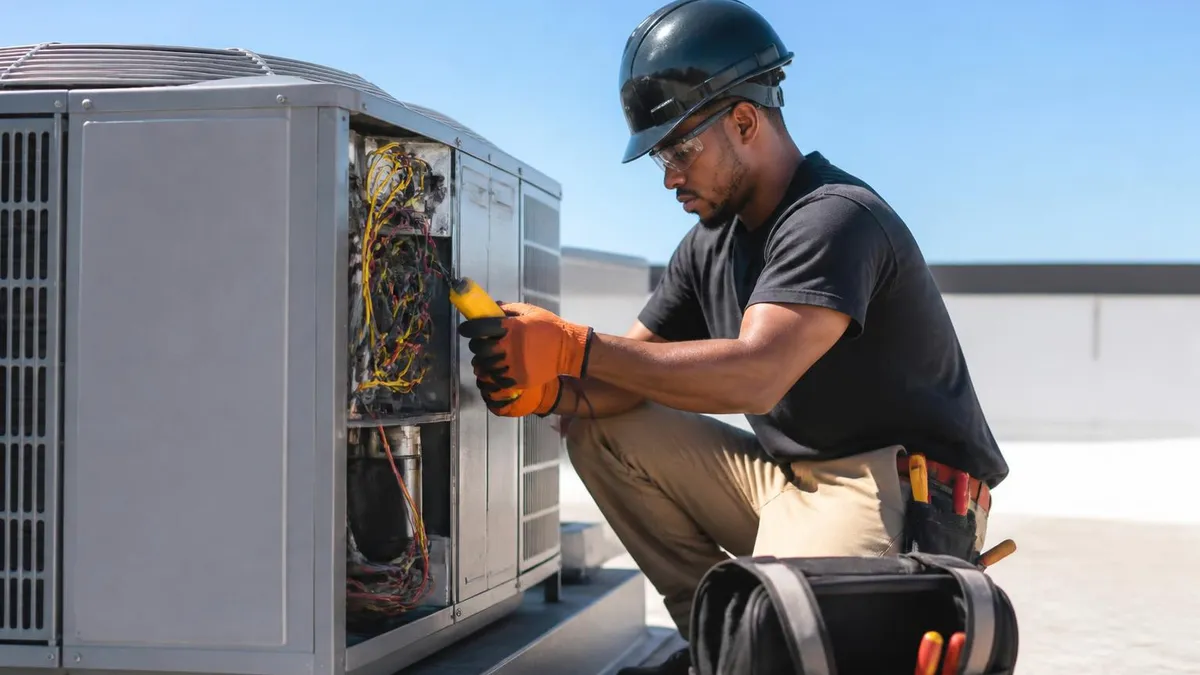
Anyone who opens a refrigerant circuit in the United States must hold a valid EPA Section 608 certification. Type I covers small appliances, Type II covers high-pressure systems including most AC and refrigeration, Type III covers low-pressure chillers, and Universal covers all three. Hiring an uncertified technician exposes you to fines up to $44,539 per violation under the Clean Air Act.
Choosing the right HVAC/R contractor starts with matching the contractor's scope to your equipment. A residential-only company is fine for a home furnace or central AC, but the moment refrigeration enters the picture, you want a company whose service trucks carry low-temp recovery units, blended refrigerants like R-448A and R-449A, and the right oils for POE-based compressors. Ask directly: "Do you service walk-in coolers and freezers in addition to comfort cooling?" If the answer is hesitant, keep calling.
Licensing and insurance verification is non-negotiable. In states with mechanical contractor licensing, check the license number on the state board's website to confirm it is active, not expired or under disciplinary action. Confirm general liability insurance of at least $1 million and workers' compensation coverage for every employee on your property. A contractor without workers' comp can leave you personally liable for an injury that occurs on your job site, an exposure most homeowners never consider until it is too late.
References matter more than online reviews for commercial refrigeration. Ask for three customers in the same business segment as yours, then actually call them. Ask about response time on emergency calls, accuracy of estimates versus invoices, and whether the contractor proactively recommended efficiency improvements or just replaced what failed. Restaurants in particular share contractor recommendations within local networks because everyone has experienced the cost of a bad call during a Friday night dinner rush.
Quoting practices reveal a contractor's professionalism. A legitimate HVAC/R company performs a load calculation for new installs (Manual J for residential, ASHRAE methods for commercial), provides written equipment specifications, and breaks down labor and materials line by line. Beware of round-number proposals like "$8,500 for a new system" with no model numbers, no SEER2 or EER ratings, and no installation scope. That estimate hides the details where corners often get cut.
Maintenance contracts are where the HVAC/R relationship really pays off. A well-written agreement specifies visit frequency, tasks performed, parts and consumables included, response time guarantees, and after-hours rates. For refrigeration, a quarterly visit that includes coil cleaning, defrost verification, superheat check, and door seal inspection costs a fraction of one inventory loss event. For residential HVAC, a spring and fall tune-up extends equipment life and catches small problems before they become emergency calls.
Parts sourcing is another area where contractors differ. Some buy from local wholesalers who stock common parts; others buy online to shave cost but cannot get a Saturday morning compressor. If your business depends on cold storage, your contractor needs accounts with the right distributors. For an inside look at the supply side of the trade, our guide to HVAC Parts and Supply covers how parts move through the channel and what that means for your repair timeline.
Finally, judge contractors by how they communicate. A pro shows up in branded uniforms, uses tablet-based invoicing with photos of the issue and the repair, explains findings in language a non-tech can follow, and leaves the site cleaner than they found it. If the technician dismisses your questions, refuses to show you the part they replaced, or pressures you into same-day decisions on expensive work, walk away. The HVAC/R industry has too many qualified contractors for any homeowner or business owner to settle.
Practical next steps depend on which side of the HVAC/R counter you are on. If you are a student, enroll in a program accredited by HVAC Excellence or PAHRA, schedule your EPA 608 exam during the first semester rather than the last, and start logging hands-on hours as soon as you can find a paid helper position. Real equipment teaches faster than any textbook, and the time you spend recovering refrigerant under a journeyman's supervision is the same time you build the muscle memory that distinguishes a $20-an-hour helper from a $40-an-hour journeyman.
If you are an apprentice or new technician, focus on superheat and subcooling until you can calculate them in your head from gauge readings. Practice reading wiring diagrams every day, even when no one assigns it. Buy a quality digital manifold, a clamp-on ammeter with low-amp accuracy, and a refrigerant scale before spending money on flashier tools. The boring fundamentals are what stop callbacks, and zero callbacks is what gets you promoted to lead service tech.
If you are a homeowner, schedule a spring AC tune-up and a fall heating tune-up every year without exception. Replace your air filter at the interval the manufacturer specifies, usually every one to three months for one-inch pleated filters. Keep two feet of clearance around your outdoor condenser, rinse the coil gently with a hose each spring, and watch your utility bills for sudden jumps that often signal a developing efficiency problem. Catching a low refrigerant charge in May is cheap; catching it in August during a heat wave is not.
If you are a small business owner with refrigeration, install temperature loggers on every walk-in and reach-in. The data tells you whether your equipment is drifting before food safety inspectors do, and the logs satisfy HACCP documentation requirements automatically. Train your staff to recognize warning signs like ice buildup on evaporator coils, sweating door gaskets, or short-cycling compressors and to call service immediately rather than wait for the next scheduled visit.
For anyone considering relocating for HVAC/R work, regional demand varies. Sun Belt cities like Phoenix, Houston, Dallas, Orlando, and Atlanta have massive residential AC populations and constant install demand. Pacific Northwest cities are heat-pump heavy with strong electrification incentives; our guide to HVAC Repair Portland covers that market specifically. Industrial Midwest cities have process refrigeration, food production, and large commercial portfolios that prize experienced techs. Coastal cities pay top wages but at high cost of living. Knowing the local mix helps you pick training and target employers strategically.
For preparing for state mechanical exams or NATE tests, build a study schedule that mixes reading, video, hands-on review, and timed practice questions. Set a target score of at least 80 percent on practice tests before sitting the real exam. Spend extra time on electrical theory and code chapters because those sections drive the most failures. The actual exam pressure is reduced significantly when you have already answered hundreds of similar questions in practice mode.
Whether your goal is to hire smart, work smart, or study smart, the hvac/r meaning is the foundation. Understanding what the acronym covers, where the boundaries sit between comfort and refrigeration, and how the certifications stack gives you the vocabulary to ask better questions and the framework to interpret the answers you get back. From here, follow the related guides below to dive deeper into the segments most relevant to your situation.
Sample HVAC Practice Questions
Try these questions from our free HVAC practice tests. The correct answer and an explanation follow each question.
According to the International Mechanical Code, what is required when a condensate drain line from an HVAC unit is routed to a floor drain?
- A. Check valve
- B. Air gap
- C. Backflow preventer with atmospheric vent
- D. Trap primer
Answer: B. Air gap
An air gap is required when connecting a condensate drain to a sanitary drain to prevent contamination of the condensate by sewer gases or backflow.
What is the minimum safe distance a technician should maintain from an electrical panel before beginning work on an HVAC system connected to it?
- A. No specific distance is required if breakers are off
- B. At least 1 foot with insulated tools only
- C. Follow NFPA 70E arc flash boundary requirements based on voltage
- D. At least 6 feet at all times
Answer: C. Follow NFPA 70E arc flash boundary requirements based on voltage
NFPA 70E establishes arc flash protection boundaries that vary based on system voltage and available fault current.
What is 'hunting' in an HVAC control system?
- A. Searching for the optimal setpoint value
- B. Continuous oscillation of the controlled variable above and below setpoint due to overcorrection
- C. Increasing system capacity to find the maximum output
- D. Locating a refrigerant leak using electronic detectors
Answer: B. Continuous oscillation of the controlled variable above and below setpoint due to overcorrection
Hunting occurs when a control system repeatedly overcorrects, causing the controlled variable to swing continuously above and below the setpoint without stabilizing.
What is the primary function of a contactor in an HVAC system?
- A. Measure current flow
- B. Switch high-voltage loads using a low-voltage control signal
- C. Protect against short circuits
- D. Regulate refrigerant pressure
Answer: B. Switch high-voltage loads using a low-voltage control signal
A contactor uses a low-voltage coil (typically 24V) to magnetically close contacts that switch high-voltage loads like compressors and condenser fan motors.
HVAC Questions and Answers
HVAC Repair Portland: The Complete 2026 Homeowner's Guide to Furnace, AC, and Heat Pump Service in the Rose City
HVAC Tune Up Service: The Complete Guide to Professional HVAC Maintenance and Why It Pays for Itself
HVAC Solutions: The Complete Guide to Heating, Cooling, and Indoor Air Quality Systems for Homes and Buildings
Certified HVAC Contractors: How to Find, Vet, and Hire the Right Professional for Your Home or Business
HVAC Parts and Supply: The Complete Guide to Sourcing, Identifying, and Buying Heating and Cooling Components in 2026
How this page was made: written with AI tools. We have not yet matched this exam's facts to an official source, so confirm fees, dates and rules with the exam body. Not reviewed by a subject-matter expert. Editorial policy