
HVAC Differential Temperature: How to Measure, Read, and Diagnose Delta T 2026
💡 Learn HVAC differential temperature: how to measure delta T, ideal 15-22°F ranges, and what bad readings reveal about airflow and refrigerant charge.
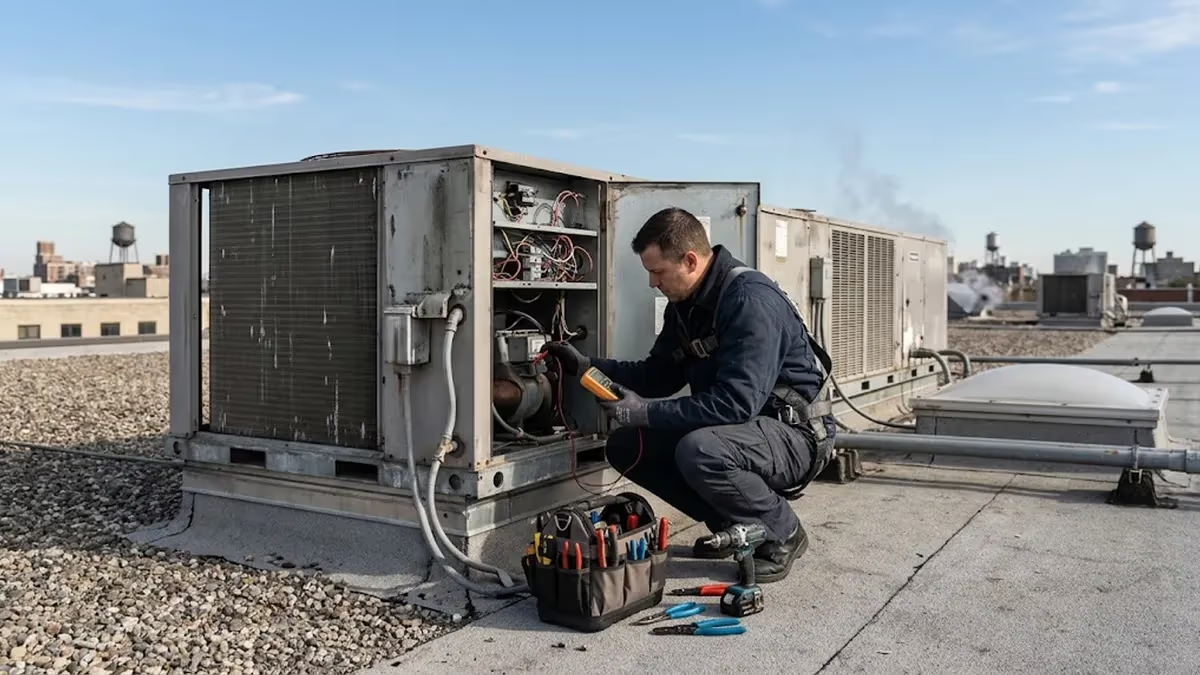
HVAC differential temperature, usually called delta T, is the difference between the air entering a system and the air leaving it. Technicians measure it in seconds with two thermometers, yet it reveals more about airflow, refrigerant charge, and heat transfer than almost any other reading. Whether you are studying for an exam, working in the field, or wondering why your house feels clammy, delta T is foundational knowledge that connects nearly every diagnostic you will perform.
In cooling mode, delta T is calculated by subtracting the supply air temperature from the return air temperature. If return air measures 76°F and supply air measures 56°F, the differential is 20°F. In heating mode, the math reverses: supply minus return, often called temperature rise. A gas furnace pulling in 65°F air and delivering 125°F air has a 60°F rise. The concept is identical, but the target numbers differ widely by equipment type.
Why does one number matter so much? Because air carries heat, and the amount of heat moved depends on two things: how much air flows and how many degrees that air changes. The sensible heat formula, Q = 1.08 × CFM × ΔT, ties them together. If you know airflow and delta T, you know how many BTUs per hour the system is actually delivering, regardless of what the nameplate promises on paper.
Delta T is a snapshot of system health, not a verdict. A reading inside the normal range suggests the evaporator coil, blower, and refrigerant circuit are cooperating. A reading far outside it points you toward a short list of suspects: dirty filters, undersized ducts, a weak blower, low charge, a failing compressor, or a restricted metering device. Good technicians use delta T to decide where to look next, then confirm with pressures and temperatures.
This article explains what normal looks like in cooling, heating, heat pump, and hydronic systems. You will learn the correct measuring procedure, how humidity and outdoor conditions shift the target, and how to translate abnormal readings into likely causes. We also cover common mistakes that produce false readings, such as measuring too early or placing a probe in the radiant path of a cold coil. Each section builds the practical judgment that exams and service calls both demand.
Entry-level learners often memorize a single number, such as 20°F, and treat everything else as a failure. That shortcut breaks down quickly. A system in a humid Gulf Coast home may legitimately show 16°F because so much energy goes into removing moisture, while the same unit in dry Phoenix may show 22°F. Context, measurement technique, and equipment specifications always matter more than any rule of thumb you carry around in your head.
If you want a broader foundation before going deeper, review our guide to hvac technical knowledge covering the switches and controls that protect a system when readings go wrong. Pairing diagnostic skill with safety awareness is what separates a parts-swapper from a true technician. By the end of this guide you should be able to take two readings, run a quick calculation, and explain confidently what the system is actually doing.
HVAC Differential Temperature by the Numbers
How to Measure HVAC Differential Temperature Step by Step
Run the System Until Stable
Check Filter and Airflow Basics
Measure Return Air Temperature
Measure Supply Air Temperature
Subtract and Compare
Confirm With Other Measurements
What Is a Normal Differential Temperature in Cooling Mode?
For a conventional split-system air conditioner, most manufacturers and training programs accept a cooling delta T between 14°F and 22°F, with 18°F to 20°F often cited as the sweet spot. That range assumes about 400 CFM per ton, a clean evaporator coil, correct refrigerant charge, and typical indoor conditions near 75°F and 50 percent relative humidity. Outside those assumptions, a reading a few degrees either side may still be perfectly healthy for the particular system.
Humidity is the biggest variable. Air conditioners remove two kinds of heat: sensible heat, which changes temperature, and latent heat, which removes moisture. When indoor humidity is high, more of the coil's capacity goes to condensing water, so the temperature drop shrinks. A home at 70 percent humidity may show 15°F while the same system at 40 percent humidity shows 21°F. Neither reading signals trouble by itself; both reflect how the coil is splitting its work.
Many service technicians use a wet-bulb based chart for a more precise target. Measure return air wet-bulb with a sling psychrometer or digital probe, then look up the expected delta T. Typical charts show roughly 20°F of drop at a 67°F wet-bulb and progressively smaller targets as wet-bulb rises, such as 16°F to 17°F near 72°F. These values vary by manufacturer, so always check the installation manual when one is available.
Airflow sets the other half of the equation. At the standard 400 CFM per ton, a three-ton system moves 1,200 CFM. Plug a 20°F delta T into the sensible heat formula and you get 1.08 × 1,200 × 20, or 25,920 BTU per hour of sensible cooling. If a dirty filter drops airflow to 900 CFM, the delta T climbs toward the mid-20s while delivered sensible capacity quietly falls, and the coil may begin to freeze.
Outdoor temperature also matters. On a mild 70°F day, a system has little condensing pressure and may produce a slightly different delta T than on a 105°F afternoon when head pressure is high and capacity drops. Most diagnostic work is best done with outdoor temperatures above about 70°F, which gives the compressor a meaningful load. Testing in cool weather can produce misleading results and, with some equipment, risks freezing the coil.
Equipment design changes the target as well. Variable-speed and multistage systems adjust blower speed and compressor output to maintain comfort and humidity, so their delta T can swing during a cycle. Systems with dehumidification modes intentionally slow the blower to push delta T into the mid-20s. Always confirm which mode the equipment is in before judging a measurement. Ignoring a dehumidify setting is a classic reason technicians condemn a perfectly good system.
Consider a realistic example. A technician arrives on a 92°F day and finds return air at 78°F dry-bulb and 66°F wet-bulb. Supply air measures 59°F, producing a 19°F delta T that sits within the expected range. Static pressure is 0.5 inches of water column and the filter is clean. The complaint turns out to be an undersized room duct, not the equipment, and the delta T reading saved a needless refrigerant diagnosis.
HVAC Differential Temperature by System Type
Residential air conditioners are judged by the temperature drop across the evaporator coil, measured from return plenum to supply plenum. The accepted band of 14°F to 22°F applies to fixed-speed split systems running at about 400 CFM per ton. Readings are most meaningful once the system has run at least 10 to 15 minutes, indoor humidity is stable, and all panels are closed and sealed. Record the number alongside outdoor conditions.
Commercial rooftop units follow the same logic, though mixed outside air, economizers, and variable air volume boxes complicate matters. Measure at the mixed-air and discharge points, and confirm economizer dampers are closed during testing. A packaged unit showing only 10°F of drop with a clean coil often points toward low charge, a weak compressor, or excessive outside air loading the coil beyond its design. Document every condition you test under.
Is Differential Temperature a Reliable Diagnostic Tool?
- +Requires only two inexpensive thermometers and a few minutes of time
- +Works on air conditioners, furnaces, heat pumps, and hydronic systems alike
- +Quickly reveals whether airflow or refrigerant circuit is the likely problem
- +Lets you estimate airflow and BTU delivery with simple math
- +Creates a baseline record for comparing future service visits
- +Helps explain comfort complaints to customers in plain language
- −Humidity can shift normal readings by several degrees and mislead beginners
- −Poor probe placement or uncalibrated thermometers create false results
- −Cannot pinpoint a specific fault without superheat, subcooling, and pressure data
- −Variable-speed and multistage equipment changes readings during a cycle
- −Testing in cool outdoor weather can produce unrepresentative numbers
- −Rule-of-thumb ranges tempt technicians to skip manufacturer specifications
Differential Temperature Checklist Before You Condemn a System
- ✓Run the system for at least 10 to 15 minutes before measuring.
- ✓Inspect and replace a dirty air filter first.
- ✓Confirm all registers, grilles, and access panels are open and sealed.
- ✓Verify the blower speed tap matches the equipment specifications.
- ✓Calibrate thermometers against an ice bath at 32°F.
- ✓Measure return air in the plenum where air is well mixed.
- ✓Shield the supply probe from radiant exposure to the coil.
- ✓Record indoor wet-bulb and humidity alongside dry-bulb readings.
- ✓Measure total external static pressure and compare to the rating.
- ✓Compare delta T with superheat, subcooling, and amp draw before deciding.
Delta T Alone Never Proves a Diagnosis
A temperature difference tells you where to look, not what to replace. Combine it with static pressure, superheat, subcooling, and humidity before recommending a repair. Technicians who document all five readings make fewer callbacks and win more customer trust.
What Abnormal HVAC Differential Temperature Is Telling You
A delta T above roughly 22°F in cooling usually means the coil is moving less air than it should. Air spends more time in contact with cold fins, so it leaves colder, but total BTUs delivered drop. Typical culprits include a clogged filter, a dirty evaporator coil, a blower set to the wrong speed tap, collapsed flex duct, closed registers, or a failing blower capacitor. Fix airflow first before touching refrigerant.
Static pressure is the best companion measurement for high readings. Most residential blowers are rated around 0.5 inches of water column total external static pressure. Readings of 0.8 or 0.9 mean the duct system is choking the blower, shaving airflow by 20 percent or more. In that case adding refrigerant would be wrong, because the charge may be correct while the ductwork is the real problem. Measure static before reaching for gauges.
A low delta T, below roughly 14°F, has a different list of suspects. Too much airflow, such as a blower on high speed or oversized ductwork, can reduce the drop. Low refrigerant charge reduces coil capacity and warms the discharge air. A weak compressor, a leaking reversing valve in a heat pump, or a leaking coil can all cut capacity. High humidity and open windows also lower the reading without any equipment fault.
Distinguishing between those possibilities requires adding two more measurements: superheat and subcooling. With a fixed orifice, superheat tells you whether charge is correct, and targets vary widely with indoor and outdoor conditions; with a thermostatic expansion valve, subcooling around 8°F to 12°F is a common target. Low delta T combined with high superheat and low subcooling strongly suggests undercharge, while low delta T with normal pressures points toward airflow or load issues.
Frozen evaporator coils offer a dramatic example. Ice forms when coil surface temperature drops below 32°F, which happens with low airflow or low charge. As ice builds, airflow drops further, creating a vicious circle. A frozen coil often shows an odd delta T, sometimes very high at first and then collapsing as the ice blocks air. Shut the system down, thaw it fully, correct the root cause, and only then retest.
Heating mode abnormalities follow similar logic. A gas furnace with a temperature rise above nameplate limits often has restricted airflow, which can trip the high-limit switch and shorten heat exchanger life. A rise below the range suggests excessive airflow, low gas pressure, or underfiring. Always compare to the rated range printed on the furnace label. A 40°F to 70°F range is common, but each model is specific, and the label always wins over a rule of thumb.
Remember that abnormal delta T is a symptom, not a repair order. Document the reading, the conditions, and what you checked to rule out each cause. Customers and inspectors appreciate a clear paper trail showing 20 minutes of runtime, measured static pressure, and confirmed filter condition. Exams test the same reasoning: given a symptom set, choose the most probable cause and the correct next step instead of jumping straight to a part replacement.
Measuring within the first few minutes of operation, placing a probe in direct line of sight of the evaporator coil, or using uncalibrated thermometers can each skew delta T by several degrees. Always de-energize and lock out power before opening electrical compartments, and never bypass safety switches to get a reading.
Calculating Airflow and Capacity From Differential Temperature
One of the most useful applications of delta T is estimating airflow when you cannot measure it directly. Rearranging the sensible heat formula gives CFM = BTU/h ÷ (1.08 × ΔT). If you know the equipment's sensible capacity and measure the delta T, you can estimate how much air is moving. This is especially valuable on systems with no test ports or in homes where a flow hood cannot capture every register.
Take a three-ton air conditioner with a rated total capacity of 36,000 BTU/h. At typical conditions, perhaps 75 percent of that is sensible, or 27,000 BTU/h. If the measured delta T is 20°F, estimated airflow is 27,000 ÷ (1.08 × 20), which equals about 1,250 CFM. That is close to the 1,200 CFM design target. If the delta T had measured 26°F, the same math gives around 960 CFM, a clear shortage.
Heating works identically. A gas furnace with 100,000 BTU/h input and 80 percent efficiency delivers about 80,000 BTU/h to the airstream. With a measured temperature rise of 50°F, airflow is 80,000 ÷ (1.08 × 50), or roughly 1,480 CFM. If the rise were 70°F, airflow would be about 1,060 CFM. Comparing the result to the manufacturer's blower table tells you whether the speed tap or ductwork needs attention.
Hydronic systems use a similar relationship: BTU/h = 500 × GPM × ΔT, where 500 comes from the density and specific heat of water. A baseboard loop moving 4 GPM with a 20°F drop delivers 40,000 BTU/h. If a failing pump cuts flow to 2 GPM, the same load now forces a 40°F drop, which is a quick sign that circulation, not the boiler, is the problem.
Accuracy depends on measurement quality. A cheap probe with a 2°F error on each end could swing the calculated delta T by 4°F, enough to turn a good system into an apparent failure. Use calibrated digital thermometers, let them stabilize, and swap probes between locations to check for bias. Average multiple readings taken over several minutes. Also remember that duct leakage and return-side air infiltration can distort mixed return temperatures.
Placement matters just as much as probe quality. Measure return temperature at the filter or return plenum where the air has mixed, not at a single grille near a sunny window. Measure supply temperature in the plenum or main trunk past the coil, shielding the probe from direct radiation from the cold coil surface. In systems with multiple returns, take a weighted view because individual rooms can differ by several degrees.
Differential temperature also supports commissioning work. Many energy programs and manufacturer startup sheets ask for recorded delta T, static pressure, and airflow as proof the system is performing as designed. A recorded 19°F delta T with 0.45 inches of static pressure and 1,180 CFM is a defensible commissioning entry. Keeping these values on file lets the next technician compare against baseline, spotting gradual degradation before it becomes an emergency call.
Practical Tips for Mastering HVAC Differential Temperature
Start by building a habit of measuring delta T on every service visit, even when the customer calls about something unrelated. Repetition builds intuition. After 50 or 100 readings you will instinctively know whether 17°F in humid July weather feels right or off. Keep a notebook or phone log with date, conditions, and results. Patterns in your own data teach more than any textbook table ever could.
Invest in quality tools. A pair of matched digital thermometers or a multi-probe meter with 0.1°F resolution costs under a hundred dollars and pays for itself quickly. Add a manometer for static pressure, a psychrometer for wet-bulb readings, and a manifold gauge set with temperature clamps. Calibrate against an ice bath, which should read 32°F, at least twice a year, because drifting probes silently corrupt every diagnosis you make.
Learn the units and formulas cold, since exams often include a calculation. Memorize 1.08 for sensible heat in air, 500 for water, 400 CFM per ton as a baseline, and 12,000 BTU/h per ton. Practice rearranging each equation to solve for CFM, delta T, or BTU/h. Work at least ten example problems with different numbers until the arithmetic feels automatic and you can finish each one without a calculator.
Study how delta T interacts with other readings rather than treating it in isolation. Create a simple symptom matrix: high delta T with high static pressure points to airflow restriction, low delta T with high superheat suggests low charge, and low delta T with low superheat suggests overcharge or flooding. Drawing this matrix by hand a few times locks the logic into memory far better than rereading your notes.
Practice explaining your reasoning aloud, because licensing exams and job interviews reward clear logic. Try this routine: state the reading, state the normal range, list two or three possible causes, name the quick test that separates them, and give the correct fix. Teaching a colleague or recording yourself is excellent practice. If you can explain delta T to a homeowner in plain language, you truly understand it.
Use practice questions strategically. Take a timed quiz, then review every wrong answer and write down the concept you missed. Focus on weaker areas such as psychrometrics or heating temperature rise rather than rereading material you already know. Spacing your practice across several weeks beats cramming, and retesting after a few days reveals what actually stuck. The HVAC practice tests below cover diagnostics, code, and safety topics.
Finally, respect safety and code. Always lock out power before opening electrical compartments, verify with a meter, and never bypass safety switches to get a reading. Follow EPA Section 608 rules whenever you handle refrigerant, and follow local mechanical code and manufacturer instructions for airflow and clearances. Strong technical knowledge includes knowing when not to proceed. Careful, documented, safe work earns trust, repeat customers, and a long career in the trades.
HVAC Questions and Answers

Most Switches Used for Safety Controls in HVAC Circuits: A Complete Guide
HVAC Advertising: The Complete Playbook for Generating Leads, Booking Calls, and Growing Your Heating and Cooling Business

HVAC Jobs Near Me: How to Find Local Work, Pay, and Hiring Companies in 2026
HVAC Duct Cleaning Cost: The Complete 2026 Homeowner's Guide to Pricing, Process, and ROI

HVAC Orifice: What It Is, How It Works, and Why It Matters for Your System
How this page was made: written with AI tools and published by Nathan Beja, founder of Practice Test Geeks, who is responsible for its content. We have not yet matched this exam's facts to an official source, so confirm fees, dates and rules with the exam body. Not reviewed by a subject-matter expert. Editorial policy