
HVAC Orifice: What It Is, How It Works, and Why It Matters for Your System 2026
Learn what an HVAC orifice does, how to size it correctly, and how to troubleshoot common failures. 💡 Complete guide for homeowners and technicians.
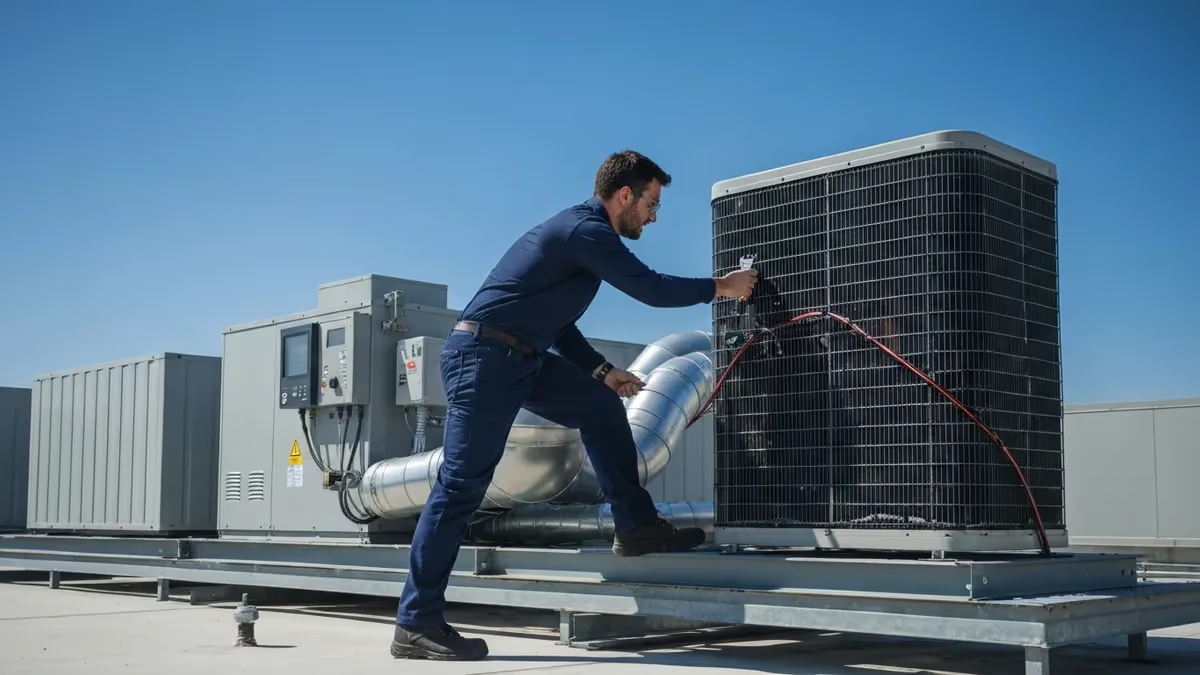
The HVAC orifice is one of the smallest yet most critical components in any refrigeration or air conditioning system. Essentially a precisely sized opening or restriction device, the orifice controls how much liquid refrigerant passes from the high-pressure side of the system into the low-pressure evaporator coil. Without correct orifice sizing and function, your entire system loses efficiency, struggles to meet temperature demands, and may even suffer compressor damage. Whether you are troubleshooting an underperforming unit or studying for certification, understanding the orifice is fundamental HVAC knowledge. Practice with the free HVAC practice test on PracticeTestGeeks (750+ questions with answer explanations).
Refrigerant metering is the heart of the refrigeration cycle. As liquid refrigerant flows through the orifice, it experiences a sudden pressure drop that causes it to flash into a cold vapor-liquid mixture. This transformation absorbs heat from the surrounding air, which is exactly how your air conditioner cools your home. The orifice therefore acts as the gatekeeper between the high-pressure liquid line and the low-pressure evaporator, and even a small error in sizing — just a fraction of a millimeter — can throw the entire system out of balance.
There are several types of refrigerant metering devices used in modern HVAC equipment, and the fixed orifice (sometimes called a piston or fixed restrictor) is among the simplest and most widely deployed. Unlike thermostatic expansion valves (TXVs) that modulate flow based on superheat, a fixed orifice delivers a constant opening size regardless of load conditions. This makes fixed orifices inexpensive, durable, and easy to replace, but they also demand careful sizing during installation because they cannot self-adjust to changing conditions the way electronic expansion valves can.
Understanding the hvac orifice and how it interacts with other components — including fan coil units, condenser coils, and the compressor — is essential for anyone working in residential or commercial HVAC. Technicians who grasp refrigerant metering are better equipped to diagnose low superheat, high superheat, refrigerant flooding, and compressor slugging. These are among the most common yet most misunderstood failure modes in the field, and they almost always trace back to problems with the metering device.
From a study and certification standpoint, the HVAC orifice appears on virtually every major industry exam, including the EPA 608 certification, NATE examinations, and state licensing tests. Questions about metering devices, superheat calculation, subcooling measurement, and refrigerant charge verification all relate directly to how orifices and expansion devices function. If you are preparing for any of these credentials, building a thorough conceptual and practical understanding of orifice behavior will pay dividends on both the test and in the field.
This article covers everything you need to know about HVAC orifices: the physics behind them, the different types and their applications, how to size and select them correctly, common problems and diagnostic techniques, and how orifice function connects to broader system performance metrics like SEER ratings and energy efficiency. Whether you are a homeowner curious about why your air conditioner is not cooling properly or a technician brushing up on refrigeration fundamentals, you will find clear, practical information throughout this guide.
We will also look at how orifice technology is evolving alongside newer refrigerants like R-454B and R-32, which are replacing R-410A across the industry. Because these next-generation refrigerants operate at different pressures and have different thermodynamic properties, orifice sizing tables and selection criteria are shifting. Staying current on these changes is important for any HVAC professional who wants to service modern equipment safely and effectively.
Free HVAC Study Tools
Interactive HVAC resources on PracticeTestGeeks, free to start:
- HVAC EPA 608 Refrigerant Certification — 35 questions with instant scoring and answer explanations
- HVAC flashcards — review key terms and concepts card by card
- HVAC study guide — topic-by-topic overview of what the exam covers
- HVAC cheat sheet — one-page printable summary for last-minute review
HVAC Orifice by the Numbers
Types of HVAC Orifices and Metering Devices
A solid plug with a precisely drilled hole, installed inside the liquid line. Inexpensive and reliable, but cannot adjust to load changes. Sized at the factory for a specific refrigerant and system capacity. Common in residential split systems and heat pumps.
A modulating valve that senses suction-line superheat and adjusts refrigerant flow accordingly. More efficient across varying load conditions than a fixed orifice, but more complex and costly. Standard in commercial applications and high-efficiency residential systems.
A solenoid-driven valve controlled by the system's microprocessor. Offers the finest control of refrigerant flow, enabling inverter-driven compressors to modulate capacity efficiently. Found in premium mini-splits, variable refrigerant flow systems, and modern commercial equipment.
A long, thin copper tube that meters refrigerant through friction and length rather than a discrete orifice. Common in small appliances, window units, and older residential equipment. Simple and durable but highly sensitive to refrigerant charge and contamination.
Selecting the correct orifice size for an HVAC system is both a science and a craft. Every system manufacturer publishes orifice selection charts that cross-reference system tonnage, outdoor design temperature, refrigerant type, and sometimes even the length of the refrigerant line set. Using the wrong size orifice — even one that is just slightly too large or too small — creates measurable performance problems that accumulate over time and can shorten equipment life significantly. Getting sizing right from the start is far less expensive than diagnosing and correcting a mismatched orifice after installation.
The fundamental principle behind orifice sizing is matching refrigerant mass flow rate to the evaporator's capacity at design conditions. If the orifice is too large, more refrigerant than the evaporator can vaporize flows into the low-pressure side. The result is low superheat or even liquid refrigerant reaching the compressor, which can cause catastrophic compressor damage through a condition called slugging. Technicians refer to this as a flooded evaporator, and it is one of the most damaging operating conditions a compressor can experience on a sustained basis.
Conversely, if the orifice is too small, insufficient refrigerant reaches the evaporator. Superheat climbs far above the target range of 10°F to 20°F at the suction line, meaning the refrigerant has absorbed all available heat long before the end of the coil and is now simply superheating as a gas. The evaporator loses effective capacity, discharge temperatures rise, compressor efficiency drops, and in severe cases the compressor overheats. High superheat is often misdiagnosed as a low refrigerant charge when the real culprit is an undersized orifice or a partially blocked one.
When installing a replacement orifice in a residential heat pump, technicians must also consider the reversing valve operation. Heat pumps use the same orifice or piston for both heating and cooling modes, but refrigerant flows in opposite directions through the device. Most residential heat pump pistons are designed to pass refrigerant in both directions, using check valves to ensure flow only passes through the piston in the correct direction for each mode. Failing to install check valves correctly — or using a non-heat-pump piston in a heat pump application — is a common installation error that causes seasonal performance problems.
Line set length also affects effective orifice sizing. Longer line sets create additional pressure drop in the liquid line, which means less pressure differential is available across the orifice. If you extend a line set significantly beyond the manufacturer's standard specification, you may need to upsize the orifice slightly and potentially add refrigerant to compensate for the additional line volume. Always refer to the manufacturer's extended line set guidelines, as each OEM has specific correction factors for their equipment. Guessing at refrigerant charge adjustments without accounting for line set length is a recipe for chronic system problems.
Refrigerant type plays a critical role in orifice selection as the industry transitions from R-410A to lower-GWP alternatives like R-454B (sold as Puron Advance) and R-32. These newer refrigerants have different saturation pressures, latent heats of vaporization, and vapor densities compared to R-410A, which means orifice sizing tables developed for R-410A equipment do not directly transfer. Equipment designed for the new refrigerants ships with correctly sized orifices, but technicians who retrofit or work on mixed fleets need to understand that refrigerant-specific orifice selection is essential for maintaining rated efficiency and equipment longevity.
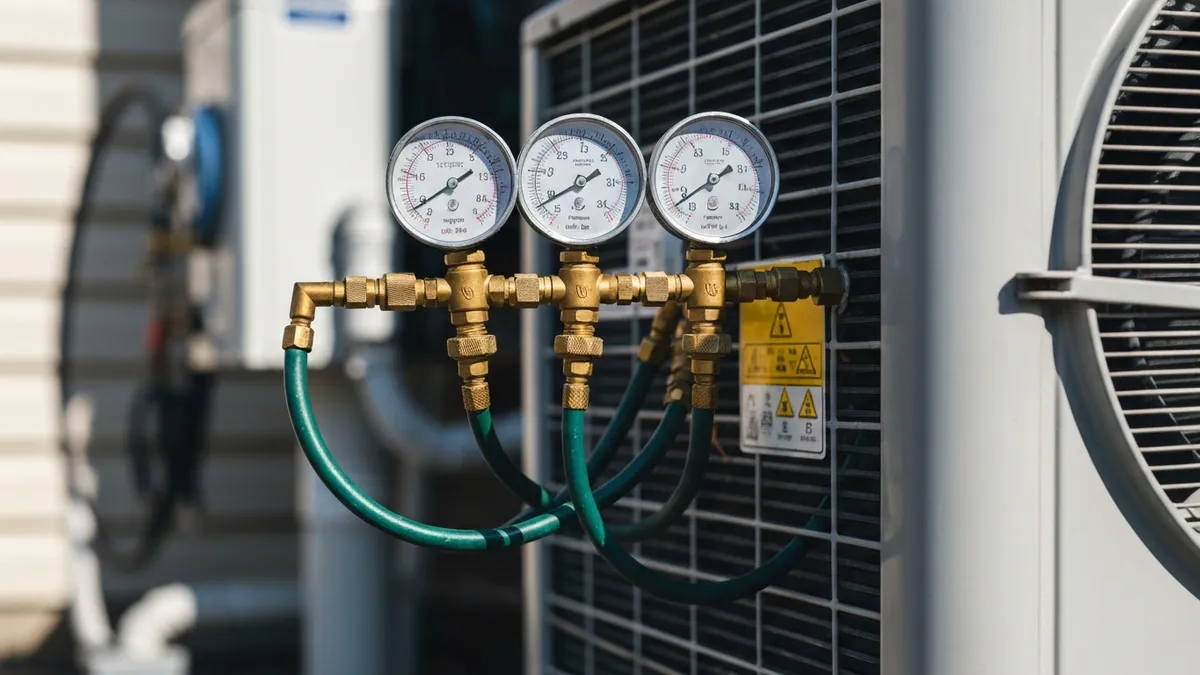
Modern diagnostic tools make orifice performance verification more accessible than ever. Digital manifold gauge sets with Bluetooth connectivity allow technicians to monitor high-side and low-side pressures simultaneously while recording superheat and subcooling values in real time. These readings, combined with manufacturer's charging charts and target superheat tables, give technicians objective data to confirm whether the existing orifice is performing correctly or needs to be replaced. Documentation of these measurements before and after any refrigerant or orifice service is increasingly expected by equipment manufacturers and utility rebate programs alike.
HVAC Orifice Operation: Cooling, Heating, and Heat Pump Modes
In cooling mode, high-pressure liquid refrigerant exits the condenser coil and travels through the liquid line toward the indoor unit. As it passes through the fixed orifice or expansion device, the sudden pressure drop causes the refrigerant to partially flash into vapor, dramatically lowering its temperature. This cold, two-phase mixture enters the evaporator coil and absorbs heat from the indoor air stream, completing the refrigerant's transformation into a low-pressure vapor before returning to the compressor.
Proper orifice function in cooling mode is confirmed by measuring suction-line superheat at the service valve on the indoor unit. A correctly sized and functioning orifice will produce superheat values between 10°F and 20°F under most residential load conditions. Values outside this range — especially consistent readings above 25°F or below 5°F — indicate that the metering device may be the source of the problem, though low refrigerant charge and airflow issues must also be ruled out before replacing any components.
Fixed Orifice vs. Thermostatic Expansion Valve: Pros and Cons
- +Fixed orifices cost as little as $5–$25, making them affordable to stock and replace
- +No moving parts means exceptional durability and decades of reliable service life
- +Simple installation with no sensing bulb, external equalizer, or adjustment required
- +Works in both directions in heat pump applications with proper check valve setup
- +Easy to source from multiple suppliers, reducing downtime during service calls
- +Ideal for systems with consistent load conditions and well-matched indoor and outdoor unit combinations
- −Cannot adjust to varying load conditions — performance degrades on very hot or very mild days
- −Must be precisely sized at installation; wrong size causes immediate efficiency and reliability problems
- −More sensitive to refrigerant charge than TXV systems — small overcharges or undercharges have larger impacts
- −Does not compensate for extended line sets or unusual installation configurations without manual adjustment
- −Provides no diagnostic feedback — you cannot tell it is failing without measuring superheat
- −Less efficient than TXV or EEV systems across diverse operating conditions, lowering seasonal SEER ratings
Pros and Cons at a Glance
| Pros | Cons |
|---|---|
| No moving parts means exceptional durability and decades of reliable service life | Cannot adjust to varying load conditions — performance degrades on very hot or very mild days |
| Simple installation with no sensing bulb, external equalizer, or adjustment required | Must be precisely sized at installation; wrong size causes immediate efficiency and reliability problems |
| Works in both directions in heat pump applications with proper check valve setup | More sensitive to refrigerant charge than TXV systems — small overcharges or undercharges have larger impacts |
| Easy to source from multiple suppliers, reducing downtime during service calls | Does not compensate for extended line sets or unusual installation configurations without manual adjustment |
| Ideal for systems with consistent load conditions and well-matched indoor and outdoor unit combinations | Provides no diagnostic feedback — you cannot tell it is failing without measuring superheat |
HVAC Orifice Maintenance and Inspection Checklist
- ✓Verify refrigerant type and confirm the installed orifice size matches the manufacturer's specification for that refrigerant.
- ✓Measure suction-line superheat at the indoor service valve and compare to the target range of 10°F–20°F.
- ✓Check liquid-line subcooling at the outdoor unit condenser outlet to confirm adequate refrigerant charge.
- ✓Inspect the filter-drier for saturation or restriction — a clogged drier mimics an undersized orifice.
- ✓Confirm that check valves in heat pump applications are installed correctly and oriented per the manufacturer's diagram.
- ✓Inspect refrigerant lines for signs of oil or moisture contamination that could clog the orifice over time.
- ✓Record high-side and low-side pressures and compare to manufacturer's pressure-temperature charts at current conditions.
- ✓Verify that line set length matches the manufacturer's default specification or that refrigerant charge has been adjusted for extended runs.
- ✓After orifice replacement, run the system for at least 20 minutes and re-verify superheat and subcooling before signing off.
- ✓Document all measurements, orifice size installed, refrigerant type, and ambient conditions on the service ticket.
Always Measure Superheat Before Replacing an Orifice
High superheat readings are frequently misdiagnosed as low refrigerant charge, leading technicians to add refrigerant when the real problem is a restricted or undersized orifice. Adding refrigerant to a system with a blocked orifice raises high-side pressure dangerously without improving evaporator performance. Always rule out metering device restriction before adjusting charge — measure subcooling at the liquid line to distinguish between the two conditions before adding any refrigerant to the system.
Diagnosing orifice-related failures requires a methodical approach that distinguishes metering device problems from refrigerant charge issues, airflow deficiencies, and compressor faults — all of which can produce similar symptom patterns. The most reliable starting point is simultaneous measurement of superheat and subcooling. Superheat is measured at the suction line near the indoor unit, and subcooling is measured at the liquid line leaving the outdoor condenser. These two values together tell a remarkably complete story about system operation that no single pressure reading can provide.
A blocked or undersized orifice produces a characteristic combination of high superheat (above 25°F), normal to high subcooling (above 15°F), low suction pressure, and high discharge temperature. The system is struggling to move enough refrigerant through the restriction, so the evaporator runs too warm, the compressor overheats, and the liquid line backs up with subcooled liquid refrigerant. This pattern is distinct from a low refrigerant charge, which produces high superheat AND low subcooling — there simply is not enough refrigerant in the system to maintain normal subcooling levels at the condenser outlet.
An oversized or failed-open orifice produces the opposite pattern: low superheat (below 5°F or even negative, meaning liquid is returning to the compressor), normal to low subcooling, high suction pressure, and low discharge pressure. Liquid refrigerant reaching the compressor causes slugging — hydraulic shock that can destroy valve plates, connecting rods, and pistons within minutes. This condition often announces itself with a distinctive liquid hammering noise from the compressor and extreme moisture accumulation on the suction line all the way back to the compressor body.
Orifice blockage from system contamination is more common than many technicians expect, particularly in systems that have experienced a compressor burnout. When a compressor burns out, it releases acid, carbon particles, and metallic debris into the refrigerant circuit. Even after the compressor is replaced and a burn-out filter-drier is installed, residual contamination can migrate to the orifice over the following weeks of operation. If a system shows progressively worsening high superheat symptoms in the weeks after a major repair, check the orifice for partial blockage before assuming the new compressor is defective.
Ice formation on or upstream of the orifice is another diagnostic indicator. If moisture has entered the system — through improper evacuation, a refrigerant leak that drew in atmospheric air, or a damaged service valve — that moisture can freeze at the orifice restriction during normal operation.
Freeze-blockage causes intermittent high superheat symptoms that improve when the system shuts off and the ice melts, then return when the system restarts. This freeze-thaw cycle can continue for days or weeks before a technician catches it in the act. The solution is a complete system evacuation to 500 microns or below, followed by installation of a new filter-drier with a moisture indicator sight glass.
When replacing a piston-style orifice in a residential system, the process is straightforward but requires attention to detail. Most pistons are located in a housing installed in the liquid line at the indoor unit. Remove the housing, extract the old piston, verify the size stamping (typically marked in thousandths of an inch), select the correct replacement from the manufacturer's piston kit, and reinstall with a new O-ring. Never reuse the old O-ring — a leaking O-ring at the piston housing will bypass refrigerant around the orifice, negating the metering function entirely and causing the same symptoms as an oversized orifice.
After any orifice service, the system must be monitored through a complete operating cycle before the technician can confirm the repair is successful. Superheat and subcooling should stabilize within their target ranges within 15 to 20 minutes of normal operation at steady-state conditions. Record all pre-service and post-service measurements on the work order. This documentation protects the technician if the system develops problems later, demonstrates professional thoroughness to the customer, and provides valuable baseline data for future service visits that may occur months or years down the line.
Adding refrigerant to a system with a blocked orifice will raise high-side pressure to dangerous levels without improving cooling capacity. Overcharging a restricted system can cause high-pressure lockout, compressor damage, or refrigerant release through the high-pressure relief valve. Always diagnose superheat, subcooling, and metering device condition before adjusting refrigerant charge — adding refrigerant is not a substitute for proper diagnosis and can make the underlying problem significantly worse.
The HVAC orifice plays a prominent role in most major industry certification examinations, and understanding how it is tested can help candidates allocate study time efficiently. The EPA Section 608 exam, required for any technician who handles regulated refrigerants, includes questions about refrigerant metering devices in the context of system recovery, leak detection, and refrigerant handling. While 608 is not a deep technical exam, it expects candidates to understand the basic function of expansion devices and the safety implications of incorrect refrigerant charge.
NATE (North American Technician Excellence) examinations go considerably deeper on orifice and metering device concepts. The NATE Air Conditioning Installation and Air Conditioning Service specialty exams both include questions on superheat measurement, subcooling calculation, orifice sizing, and diagnosis of metering device failures. These exams are scenario-based, meaning candidates must interpret pressure-temperature readings and symptom descriptions to identify the correct diagnosis or repair procedure. Rote memorization of facts is less effective than developing genuine diagnostic reasoning skills built on a solid understanding of refrigerant metering physics.
State contractor licensing examinations vary in their depth on metering devices, but most include at least a handful of questions on refrigeration cycle components, including expansion devices. Florida, Texas, California, and other states with large HVAC markets have rigorous licensing exams that expect candidates to know the differences between fixed orifices, TXVs, EEVs, and capillary tubes — and to understand the symptoms and consequences of metering device failures. Reviewing the specific exam blueprint for your state is always the most efficient way to target your study efforts.
The Refrigerating Engineers and Technicians Association (RETA) and other trade organizations offer certifications that go even deeper into refrigeration system design, including sophisticated treatment of expansion device selection, superheat control, and system optimization. These advanced credentials are most relevant for technicians working in commercial refrigeration, process cooling, and industrial HVAC applications where system complexity demands a higher level of theoretical grounding. Even technicians who primarily work on residential equipment often find that studying at this level sharpens their diagnostic instincts on simpler systems.
Practice questions are one of the most effective study tools for HVAC certification preparation, and orifice-related topics lend themselves well to scenario-based practice. Working through questions that present symptom combinations — high superheat with normal subcooling, low superheat with high subcooling, intermittent freezing and thawing — and asking you to identify the most likely cause builds the diagnostic pattern recognition that exams reward. Simply reading about orifice function is helpful, but applying that knowledge to realistic scenarios cements the understanding in a way that passive review cannot.
Beyond certification exams, a thorough understanding of orifice function makes technicians more effective and more efficient on every service call. Technicians who can quickly interpret superheat and subcooling data, correctly attribute symptoms to specific failure modes, and make accurate repair decisions without unnecessary parts replacement deliver better value to their customers and build stronger professional reputations. In a competitive HVAC labor market, the technicians who invest in deep technical knowledge consistently earn more, advance faster, and build more loyal customer bases than those who rely on trial-and-error approaches to diagnosis and repair.
If you are studying for any HVAC credential, carve out dedicated time specifically for refrigerant metering devices. Practice calculating superheat from suction-line temperature and saturation temperature. Practice calculating subcooling from liquid-line temperature and saturation temperature. Memorize the symptom patterns for oversized, undersized, and blocked orifices. And take as many practice exam questions as possible on these topics — repetition in a test-like environment is the fastest path from understanding to confident recall under examination pressure.
Looking forward, the HVAC industry is in the midst of a significant refrigerant transition that will reshape how technicians think about orifice selection and system service for the next decade. R-410A, the dominant residential refrigerant since the early 2000s, is being phased down under the AIM Act due to its high global warming potential of 2,088. Replacement refrigerants — including R-454B (GWP of 466), R-32 (GWP of 675), and R-1234yf blends — operate at different pressures and have different thermodynamic properties that directly affect metering device selection and sizing.
R-454B, which Carrier markets as Puron Advance and is adopted by several other major OEMs, operates at pressures approximately 5 to 8 percent lower than R-410A at equivalent temperatures. This means orifice sizes calibrated for R-410A systems do not directly transfer to R-454B equipment. New equipment ships with correctly sized orifices for the intended refrigerant, but technicians who are tempted to use leftover R-410A parts on new equipment risk mismatched metering that undermines system efficiency from day one of operation. Always use refrigerant-specific orifices and piston kits as specified in the equipment installation manual.
R-32, used in many mini-split systems from Asian manufacturers, operates at higher pressures than R-410A and has a higher latent heat of vaporization, which means less refrigerant mass flow is required to achieve the same cooling capacity. This results in smaller orifice diameters compared to R-410A systems of the same tonnage. Technicians unfamiliar with R-32 sometimes incorrectly diagnose these systems as having undersized metering devices when they are actually operating normally. Familiarizing yourself with refrigerant-specific performance characteristics before servicing unfamiliar equipment saves significant diagnostic time and prevents unnecessary component replacement.
Electronic expansion valves are becoming more prevalent as the industry moves toward inverter-driven variable-capacity equipment. Because EEVs can modulate refrigerant flow continuously in response to changing load conditions, they are better suited than fixed orifices to the wide capacity modulation ranges that inverter compressors demand. However, EEVs introduce new failure modes — stepper motor failures, controller board faults, position sensor errors — that technicians accustomed to simple fixed orifices may not be familiar with. Training on EEV diagnostics is increasingly important for technicians who want to service premium residential and commercial equipment effectively.
Smart HVAC systems increasingly incorporate sensors that monitor superheat, subcooling, and refrigerant pressure in real time and transmit this data to cloud-based diagnostic platforms. Some manufacturers now offer predictive maintenance services that alert building owners when metering device performance begins to degrade, before a failure causes comfort complaints or equipment damage. For technicians, these connected systems provide a rich data history that makes diagnosing intermittent orifice problems — like freeze-blockage — much easier than diagnosing the same problem on a conventional system with no data logging capability.
For homeowners, the practical takeaway from all of this technical detail is straightforward: if your air conditioner is not cooling effectively, if your energy bills have climbed unexpectedly, or if your system is short-cycling or running continuously without reaching setpoint, the metering device is one of the first things a qualified technician should evaluate. Do not accept a diagnosis of low refrigerant charge without confirmation that the metering device is functioning correctly — adding refrigerant to a system with a blocked or mismatched orifice does not solve the problem and can cause additional damage.
Investing in an annual maintenance visit from a qualified technician who takes the time to measure superheat and subcooling — not just check pressures with a single gauge — is the best way to catch orifice and metering device problems early. A technician who documents these measurements at every visit builds a trend record that makes subtle performance degradation visible long before it becomes an emergency repair. Over the life of an HVAC system, proactive metering device monitoring pays for itself many times over in avoided compressor replacements and improved energy efficiency.
Sample HVAC Practice Questions
Try these questions from our free HVAC practice tests. The correct answer and an explanation follow each question.
What is a 'dedicated outdoor air system' (DOAS) and what are its advantages?
- A. A separate exhaust-only system for chemical storage rooms
- B. A system that handles only 100% outdoor air ventilation separately from the space conditioning system, often with energy recovery
- C. An outdoor condensing unit dedicated to a specific zone
- D. A backup ventilation system that operates only when primary HVAC fails
Answer: B. A system that handles only 100% outdoor air ventilation separately from the space conditioning system, often with energy recovery
A DOAS handles 100% outdoor air ventilation with energy recovery and pre-conditioning, delivered to zone equipment—this separation improves humidity control, energy efficiency, and ventilation accuracy.
What is the significance of the 'critical charge' in a fixed-orifice AC system versus a TXV system?
- A. Both system types require the same precise charge regardless of conditions
- B. Fixed-orifice systems are far more sensitive to charge amount than TXV systems
- C. TXV systems require a more precise charge than fixed-orifice systems
- D. Charge amount only affects efficiency, not operation, in both systems
Answer: B. Fixed-orifice systems are far more sensitive to charge amount than TXV systems
Fixed-orifice (piston/capillary) systems are critically sensitive to refrigerant charge because the metering device cannot compensate for variations, while a TXV actively adjusts flow to maintain proper superheat.
In a forced-air system, what is 'heat rise' and why does it matter?
- A. The rate at which outdoor temperature drops during a cold snap
- B. The temperature difference between supply air and return air across the heat exchanger
- C. The increase in static pressure as filters become dirty
- D. The thermal expansion rate of the heat exchanger metal
Answer: B. The temperature difference between supply air and return air across the heat exchanger
Heat rise is the supply air temperature minus the return air temperature; it must stay within the furnace manufacturer's specified range to prevent overheating and damage.
What is the purpose of a hot gas bypass valve in a refrigeration system?
- A. Bypass hot discharge gas directly to the condenser during defrost
- B. Maintain minimum evaporator load by diverting hot gas to the evaporator inlet
- C. Cool the discharge line during high ambient conditions
- D. Prevent refrigerant migration to the compressor during off cycles
Answer: B. Maintain minimum evaporator load by diverting hot gas to the evaporator inlet
A hot gas bypass valve diverts discharge gas to the evaporator inlet to maintain minimum system load and prevent evaporator freeze-up during low-load conditions.
HVAC Questions and Answers
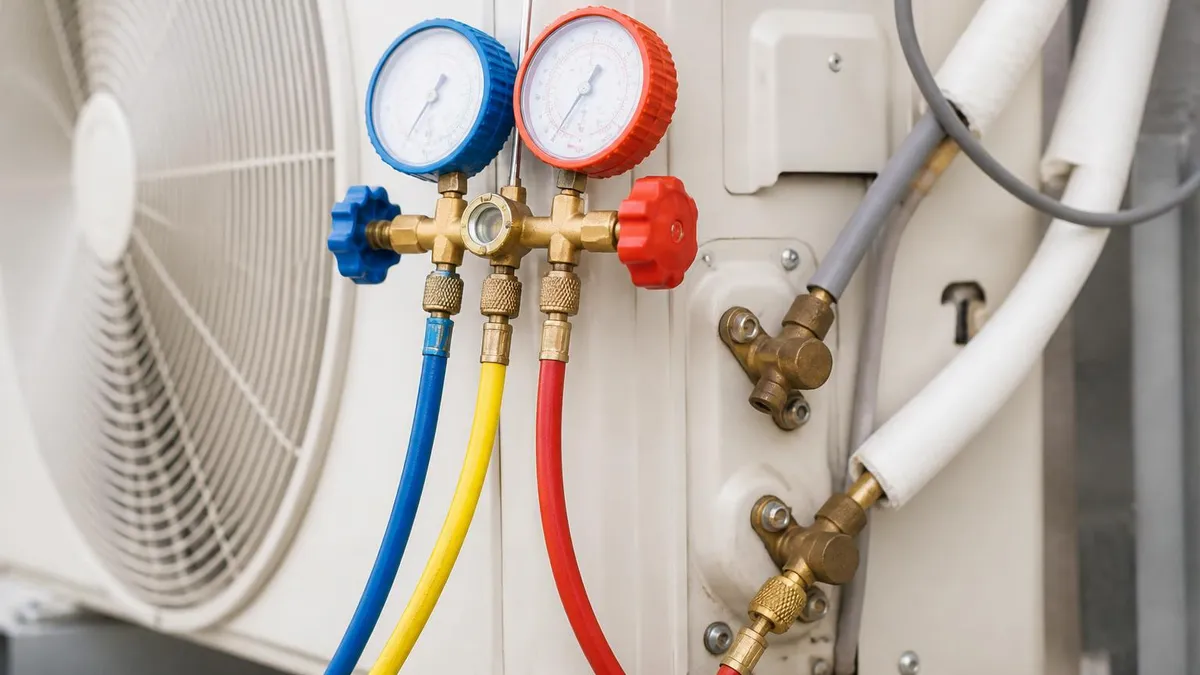
FCU HVAC: The Complete Guide to Fan Coil Units, How They Work, Where They Excel, and How to Choose the Right System
Finance a New HVAC System: 2026 Loans, 0% APR, and Rebates
HVAC Duct Repair: Common Issues, Costs, and DIY vs Professional
HVAC School -- Programs, Costs, and Career Paths in 2026
HVAC Advertising: The Complete Playbook for Generating Leads, Booking Calls, and Growing Your Heating and Cooling Business
How this page was made: written with AI tools and published by Nathan Beja, founder of Practice Test Geeks, who is responsible for its content. We have not yet matched this exam's facts to an official source, so confirm fees, dates and rules with the exam body. Not reviewed by a subject-matter expert. Editorial policy