
HVAC Apprenticeship Near Me: How to Find, Apply, and Start Your HVAC Career
Find an HVAC apprenticeship near me with our complete guide: ✍🏼 how to qualify, where to apply, pay scales, hours required, and what to expect year by year.
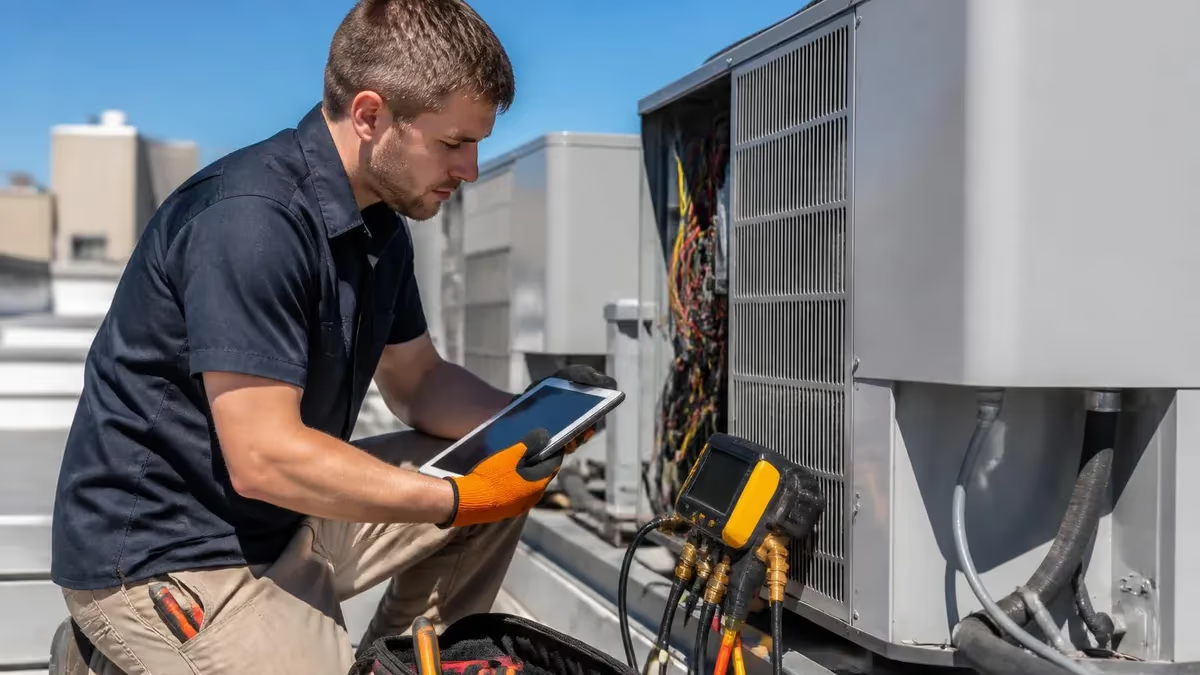
Searching for an hvac apprenticeship near me is one of the smartest career moves you can make in 2026. The heating, ventilation, and air conditioning trade is facing a documented labor shortage, with the U.S. Bureau of Labor Statistics projecting roughly 37,700 new HVAC openings per year through 2032. Apprenticeships pay you while you learn, eliminate student debt, and produce a federally recognized journeyworker credential that travels with you across state lines and across employers for the rest of your career.
An HVAC apprenticeship typically combines about 2,000 hours of on-the-job training per year with 144 hours of related classroom instruction. Programs run three to five years depending on the sponsor, and apprentices usually start earning 40 to 60 percent of a journeyworker's wage. By year four, most apprentices are clearing $25 to $35 per hour plus benefits, health insurance, and a pension contribution that few four-year college graduates ever see in their first job.
The phrase "near me" matters more than people realize. HVAC licensing rules, wage scales, union density, and apprenticeship sponsors all vary dramatically by state and even by city. A Sheet Metal Workers Local 105 apprenticeship in Los Angeles looks different from an Associated Builders and Contractors program in Birmingham, which looks different again from a community college pre-apprenticeship in rural Iowa. Geography drives everything from your starting wage to your commute to your eventual specialty.
This guide walks you through every realistic path: union apprenticeships through the United Association (UA) and Sheet Metal Workers International Association (SMART), non-union programs through ABC and Independent Electrical Contractors, employer-sponsored programs at large mechanical contractors, and military-to-civilian pipelines like Helmets to Hardhats. We will cover eligibility, application timing, what to expect during interviews, and how to position yourself so you actually get accepted on the first try.
We will also be honest about the hard parts. Apprenticeships are competitive, especially in major metros where slots fill in days. You may apply two or three times before landing a position. You will work outdoors in summer heat and crawl through attics in January. You will study for state-mandated EPA 608 certification, OSHA 10 or 30, and eventually a journeyworker exam that covers duct installation, sizing, and sealing best practice alongside electrical, refrigeration, and code knowledge.
The upside is enormous. HVAC technicians with a completed apprenticeship and a few years of post-completion experience routinely earn six figures in high-cost metros, transition into mechanical engineering technician roles, start their own hvac service co, or move into building automation and controls where bachelor's-degree salaries are common without the degree. The trade rewards problem solvers, people who like working with their hands, and anyone who values seeing tangible results at the end of each day.
By the end of this article you will know how to find every apprenticeship sponsor within driving distance of your zip code, how to prepare for the aptitude tests and panel interviews, what to wear, what to ask, and how to keep moving forward if your first application does not land. Let's break down exactly how to turn "near me" into a signed apprenticeship agreement.
HVAC Apprenticeships by the Numbers
Where to Find HVAC Apprenticeships Near You
The federal Department of Labor maintains a free, searchable database of every Registered Apprenticeship Program. Filter by zip code, occupation code (49-9021 for HVAC mechanics), and program length to surface every legitimate sponsor within a chosen radius.
Search "UA Local [number]" or "Sheet Metal Local [number]" plus your city. Union halls run their own apprenticeship committees and typically open applications once or twice per year with strict deadlines and aptitude testing on-site.
Associated Builders and Contractors operates merit-shop apprenticeships in roughly 70 chapters nationwide. Programs are tied to member contractors who hire the apprentice directly, with related instruction delivered evenings at the ABC training center.
Many community colleges offer pre-apprenticeship certificates that funnel graduates directly into employer-sponsored programs. Look for partnerships with Carrier, Trane, Daikin, or local mechanical contractors that guarantee interviews to graduates.
Large mechanical contractors, hospital facilities departments, and national service chains like ARS and Service Experts run in-house apprenticeships. Walk in with a resume, ask for the service manager, and inquire about apprentice openings directly.
Before you start clicking apply buttons, understand the eligibility floor that every registered HVAC apprenticeship enforces. You must be at least 18 years old on the date training begins, possess a high school diploma or GED, and be physically able to perform the work, which usually means lifting 50 pounds, climbing ladders, and working in confined spaces. A current driver's license is required by nearly every program because apprentices drive between job sites in company trucks loaded with tools and refrigerant cylinders.
Math placement is the single biggest filter. Most sponsors require you to pass a math assessment covering fractions, decimals, basic algebra, and applied geometry. The questions test whether you can calculate duct dimensions, convert between Fahrenheit and Celsius, size a refrigerant line by length and lift, and work out static pressure drops. If your high school math is rusty, spend two weeks with a Khan Academy refresher before you sit for the test. Failing the aptitude exam usually means a six-month or twelve-month waiting period before you can retest.
Drug screening is universal and non-negotiable. Federal Registered Apprenticeship Programs require a clean pre-employment screen, and random testing continues throughout the program. This includes marijuana even in states where recreational use is legal, because the federal classification still applies and because apprentices operate company vehicles. If you use cannabis recreationally, stop at least 30 days before testing and plan accordingly.
Background checks vary by sponsor and by the type of building you will work in. Hospitals, schools, federal buildings, and data centers often require expanded background investigations. A minor misdemeanor from years ago rarely disqualifies you, but recent felonies involving theft, violence, or drugs can be a problem. Be honest on the application; sponsors run checks anyway, and dishonesty on the paperwork is grounds for immediate dismissal even years later.
Physical requirements deserve serious consideration. A typical HVAC apprentice spends the workday on roofs, in attics that hit 140 degrees in summer, in crawl spaces filled with insulation and the occasional rodent, and on ladders running new heating, ventilation, and air conditioning systems. If you have uncontrolled asthma, severe claustrophobia, or a back injury, talk with a sponsor about realistic accommodations before applying. The trade is rewarding but unforgiving of bodies that cannot handle the work.
Some programs require additional credentials on day one. EPA Section 608 certification, which covers safe refrigerant handling, is mandatory federally before any apprentice can purchase or recover refrigerant. Many sponsors will provide and pay for the test during your first quarter, but having it already done signals seriousness and bumps you up the candidate list. OSHA 10 is similar: free online, eight to ten hours, and a green flag on your application.
Finally, document your application timeline. Union halls often open the application window for just two weeks per year. ABC and employer programs may accept rolling applications but interview in cohorts. Bookmark the sponsor websites, sign up for email alerts, and call the apprenticeship coordinator directly to confirm dates. Missing a window means waiting a full year, so treat the calendar as part of your eligibility.
HVAC Practice Test Questions
Prepare for the HVAC - Heating Ventilation and Air Conditioning exam with our free practice test modules. Each quiz covers key topics to help you pass on your first try.
HVAC Air Conditioning
HVAC Exam Questions covering Air Conditioning. Master HVAC Test concepts for certification prep.
HVAC Code Compliance
Free HVAC Practice Test featuring Code Compliance. Improve your HVAC Exam score with mock test prep.
HVAC Electrical Controls
HVAC Test Prep for Electrical Controls. Practice HVAC Quiz questions and boost your score.
HVAC Energy Efficiency
HVAC Questions and Answers on Energy Efficiency. Free HVAC practice for exam readiness.
HVAC Heating Systems
HVAC Mock Test covering Heating Systems. Online HVAC Test practice with instant feedback.
HVAC Load Calculations
Free HVAC Quiz on HVAC Load Calculations. HVAC Exam prep questions with detailed explanations.
HVAC Tools and Equipment
HVAC Practice Questions for HVAC Tools and Equipment. Build confidence for your HVAC certification exam.
HVAC Refrigeration
HVAC Test Online for Refrigeration. Free practice with instant results and feedback.
HVAC Safety Practices
HVAC Study Material on Safety Practices. Prepare effectively with real exam-style questions.
HVAC System Design
Free HVAC Test covering System Design. Practice and track your HVAC exam readiness.
HVAC Thermodynamics
HVAC Exam Questions covering Thermodynamics. Master HVAC Test concepts for certification prep.
HVAC Apprenticeship Program Types
Union apprenticeships through the United Association (UA) and Sheet Metal Workers (SMART) are the gold standard for pay and benefits. UA pipefitter-HVAC apprenticeships typically run five years with 10,000 hours of OJT and 1,000 hours of classroom. Wages start around 50 percent of journeyworker scale and increase every six months as you pass benchmarks. Health insurance is fully employer-funded from day one and a defined-benefit pension accrues automatically.
The trade-off is competitiveness and structure. Union halls dispatch you to signatory contractors, which means you may change jobs every few months as projects wrap. You pay monthly dues, follow strict work rules, and often relocate temporarily for large industrial jobs. If you value top-tier benefits and brotherhood-style training, a union program is the strongest long-term investment in your earning potential.
Should You Pursue an HVAC Apprenticeship?
- +Earn a full wage while you learn with zero tuition debt
- +Federally recognized journeyworker credential portable across all 50 states
- +Health insurance, retirement contributions, and paid time off in most programs
- +Path to six-figure income within five to seven years post-completion
- +High job security driven by ongoing labor shortage and refrigerant transitions
- +Clear progression to ownership, controls specialist, or mechanical engineer roles
- −Physically demanding work in attics, on roofs, and in extreme weather
- −Application process is competitive and may require multiple attempts
- −Starting wages are lower than tech sector or trades like electrical in some markets
- −Mandatory drug testing includes marijuana even in legal-use states
- −On-call rotations and weekend service work are common in residential
- −Tool investment of $1,500 to $3,000 in the first two years is typical
Pros and Cons at a Glance
| Pros | Cons |
|---|---|
| Earn a full wage while you learn with zero tuition debt | Physically demanding work in attics, on roofs, and in extreme weather |
| Health insurance, retirement contributions, and paid time off in most programs | Application process is competitive and may require multiple attempts |
| Path to six-figure income within five to seven years post-completion | Starting wages are lower than tech sector or trades like electrical in some markets |
| High job security driven by ongoing labor shortage and refrigerant transitions | Mandatory drug testing includes marijuana even in legal-use states |
| Clear progression to ownership, controls specialist, or mechanical engineer roles | On-call rotations and weekend service work are common in residential |
HVAC Apprenticeship Application Checklist
- ✓Confirm you are 18 or older by the program start date
- ✓Obtain a sealed high school transcript or GED certificate
- ✓Get a valid state driver's license with a clean three-year record
- ✓Complete OSHA 10 online before applying for an extra credential boost
- ✓Refresh fractions, decimals, and basic algebra for the math aptitude test
- ✓Gather three professional references with current phone numbers and emails
- ✓Prepare a one-page resume listing any construction, military, or mechanical experience
- ✓Schedule and pass a pre-employment drug screen at an approved lab
- ✓Save digital copies of your DD-214 if you served in the military
- ✓Mark application opening and closing dates on your calendar with reminders
Call the coordinator before you apply
Apprenticeship coordinators field hundreds of resumes per cycle. A 10-minute phone call to ask thoughtful questions about the program puts your name and voice in their head before they ever see your paperwork. Ask about the typical cohort size, the most common reason applicants fail the aptitude test, and what they wish more applicants knew. Then thank them by name in your cover letter.
Understanding the wage progression in an HVAC apprenticeship helps you plan your finances and evaluate offers realistically. First-year apprentices in most U.S. metros earn between $16 and $22 per hour, which works out to roughly $33,000 to $46,000 annually before overtime. By the end of year one you will typically receive a six-month wage step that bumps you 5 to 10 percent, with another step coming after another 1,000 hours of documented OJT.
Year two wages climb to roughly 60 to 70 percent of journeyworker scale, which in major markets means $24 to $30 per hour. This is the point at which many apprentices first see a paycheck higher than their friends who chose four-year degrees. The math gets even better when you factor in zero student debt, employer-funded health insurance worth $8,000 to $15,000 per year, and pension or 401(k) contributions ranging from 3 to 12 percent of wages.
By year three, most apprentices are running small service calls solo under the supervision of a remote journeyworker or foreman. Wages cross 75 to 85 percent of scale, overtime opportunities multiply, and you start qualifying for shift differentials, on-call pay, and per-diem stipends on out-of-town work. A motivated third-year in a strong market routinely clears $65,000 to $80,000 with overtime included.
Year four and year five complete the journey. UA five-year programs and many ABC four-year programs push apprentices through advanced topics like variable refrigerant flow, building automation, hydronic balancing, and commercial refrigeration. Wages hit 90 to 95 percent of scale, and graduation triggers an immediate jump to full journeyworker pay, typically a $5 to $12 per hour raise overnight. You are now eligible to test for state contractor licenses, become a foreman, or specialize.
Geography compounds these numbers significantly. A journeyworker in San Francisco, Seattle, New York, or Honolulu can earn $55 to $75 per hour plus benefits, while the same credential in rural Mississippi or Alabama might pay $25 to $35 per hour. Cost of living adjustments partially offset the difference, but apprentices willing to relocate after completion frequently double their lifetime earnings compared to peers who stay in low-wage markets.
Tool costs deserve a line item in your budget. You will be expected to show up day one with basic hand tools: adjustable wrenches, refrigeration screwdrivers, a torpedo level, tin snips, and a multimeter. Plan to spend $500 to $800 in the first month. Over the first two years, you will accumulate manifold gauges, recovery machines, micron gauges, and specialty tools that bring total investment to $2,000 to $3,000. Many employers provide tool allowances or payroll deduction purchase plans.
Finally, consider the long arc. Five years after completion, journeyworkers who pursue master mechanic licensure, controls certification, or start their own hvac service co routinely earn $100,000 to $200,000 annually. The apprenticeship is the foundation, but the career trajectory it enables is what makes the four-year sacrifice worthwhile. Treat your apprenticeship like the most important training of your life because it largely determines where you end up financially in your thirties and forties.

Most union HVAC apprenticeships accept applications only one or two weeks per year, and slots often fill within 48 hours of opening. Sign up for email alerts on every sponsor website in your area and call the apprenticeship office directly to confirm exact opening dates. Missing the window by even one day usually means waiting an entire year to reapply.
Getting accepted into a competitive HVAC apprenticeship requires more than meeting the minimum eligibility. Coordinators evaluate hundreds of applications and interview a small fraction, so your job is to demonstrate that you are coachable, mechanically inclined, and likely to complete the program. Less than 60 percent of apprentices nationally finish their program, so sponsors actively look for signals of grit and follow-through during selection.
Document any prior mechanical, construction, or military experience prominently on your resume. A summer working at a hardware store, helping a family member renovate a house, fixing your own car, or completing a high school auto shop class all signal hands-on aptitude. Veterans should highlight any MOS or rate involving electronics, mechanical maintenance, or facilities; programs like Helmets to Hardhats fast-track military applicants directly into participating apprenticeships.
Pre-apprenticeship programs are an underused secret weapon. Many community colleges and nonprofits offer 8- to 16-week pre-apprenticeships covering OSHA 10, basic tools, math review, and shop safety. Graduates often receive direct interviews with partner sponsors and meaningful preference points in scoring rubrics. Programs like Hard Hatted Women, YouthBuild, and various Job Corps centers run free pre-apprenticeships specifically designed to feed registered HVAC programs.
Show up to your aptitude test rested, fed, and 30 minutes early with two forms of ID, a basic calculator if permitted, and several sharpened pencils. The test typically includes mechanical reasoning, applied math, and reading comprehension sections. Pace yourself; most candidates fail by running out of time on the math section, not by missing questions. Practice with free WorkKeys or Bennett Mechanical Comprehension Test prep materials for two weeks before the exam.
The panel interview is where many qualified candidates lose offers. Dress in business casual, not a suit and not work clothes. Bring a printed resume, a list of references, and a small notebook. Expect questions about why you want this trade specifically, how you handle difficult coworkers or customers, what you do when you do not know an answer, and your willingness to relocate or travel. Answer with specific stories from work or school, not generic statements about hard work.
Follow up within 24 hours. A handwritten thank-you note mailed to the interview panel is rare in 2026 and almost guarantees you stand out. Mention something specific from the conversation, restate your interest, and provide a direct phone number. If you are not selected, ask for feedback and reapply at the next opening; many apprentices land their spot on the second or third try after demonstrating persistence and improvement.
Finally, treat your first 90 days post-acceptance as a probationary period regardless of what the paperwork says. Arrive 15 minutes early, ask thoughtful questions, take notes in a small pad, and never refuse a task even if it seems beneath you. Apprentices who carry tools, sweep job sites, and listen carefully get pulled onto the best crews, learn from the best mechanics, and finish the program with the strongest references for journeyworker placement. For local market context on residential service work, review our guide to HVAC repair, service, and system care.
Once you are enrolled, the difference between a struggling apprentice and a standout one comes down to a handful of habits practiced relentlessly. Start a daily field notebook from week one. Write down every model number you encounter, every refrigerant charge weight, every static pressure reading, every weird symptom and the diagnosis your journeyworker reached. After three years you will have a personalized troubleshooting database worth more than any textbook.
Master the EPA 608 certification within your first 90 days even if your program does not require it immediately. The four-part exam (Core, Type I small appliances, Type II high-pressure, Type III low-pressure) is the federal license to purchase and handle refrigerant. Universal certification covers all four and is the only version worth pursuing. Free study guides from ESCO Institute and HVAC School cover the entire exam in roughly 20 hours of focused study.
Pursue NATE Ready-to-Work certification by the end of year one and NATE Core plus a specialty by year three. NATE credentials are recognized industry-wide and signal competence beyond what your apprenticeship transcript alone communicates. Many employers and union halls pay completion bonuses for NATE certifications, and the exams reinforce material you need for the journeyworker test anyway.
Build relationships with the journeyworkers you ride with. Bring coffee, ask intelligent questions, offer to handle the grunt work without being asked, and never argue when corrected. A journeyworker who likes you will explain the why behind procedures, share career advice, and recommend you for the best assignments. A journeyworker who tolerates you will hand you a shovel and leave you in the truck.
Stay current on refrigerant transitions. The AIM Act has accelerated the phasedown of R-410A, with A2L refrigerants like R-32 and R-454B now dominating new equipment installations. Apprentices entering programs in 2026 will spend most of their careers working primarily with mildly flammable refrigerants that require new tools, new leak-detection procedures, and updated safety practices. Get ahead of this transition rather than learning it reactively five years from now.
Protect your body deliberately. Wear knee pads in attics, hearing protection around package units, safety glasses always, and respiratory protection when cutting fiberglass or working with refrigerants. Lift with your legs, use mechanical assists for compressors and condensers, and never skip stretching before a long install day. Veteran mechanics often retire early because of preventable injuries accumulated in their twenties; the discipline you build now extends your career by decades.
Finally, plan your post-apprenticeship trajectory before you complete the program. Decide whether you want to specialize in commercial refrigeration, become a controls technician, move into project management, or eventually own a service company. Each path requires different certifications, networking, and post-completion training. Apprentices who graduate with a clear five-year plan consistently outearn those who graduate and then ask, "now what?"
Sample HVAC Practice Questions
Try these questions from our free HVAC practice tests. The correct answer and an explanation follow each question.
Under NFPA 70E electrical safety standards relevant to HVAC, what is the minimum approach boundary for unqualified persons near exposed energized parts at 120V?
- A. Restricted approach boundary
- B. Limited approach boundary
- C. Arc flash boundary
- D. Prohibited boundary
Answer: B. Limited approach boundary
NFPA 70E defines the Limited Approach Boundary as the distance unqualified persons must stay from exposed energized conductors to avoid electrical shock hazard.
A potential relay used in a single-phase compressor motor is installed in which circuit?
- A. Common winding
- B. Start winding in parallel
- C. Run capacitor circuit
- D. Discharge line
Answer: B. Start winding in parallel
The potential relay coil is wired in parallel with the start winding and its normally-closed contacts are in series with the start capacitor, opening once back-EMF rises.
In a hydronic system, what does the term 'pumping away from the point of no pressure change' mean?
- A. The circulator should always push water away from the boiler
- B. The circulator should be positioned to discharge away from the expansion tank connection
- C. Pump discharge pressure should overcome all system head losses
- D. The pump should be located on the return line only
Answer: B. The circulator should be positioned to discharge away from the expansion tank connection
When the circulator is located so that it pumps away from the expansion tank connection point, it adds pressure throughout the system, preventing air infiltration and cavitation.
A geothermal heat pump has a much higher COP than an air-source heat pump in winter. Why?
- A. Ground temperatures remain relatively stable year-round, providing a more favorable heat source than cold outdoor air
- B. Geothermal systems use larger compressors
- C. Underground refrigerant lines are shorter
- D. Geothermal systems use a different refrigerant cycle
Answer: A. Ground temperatures remain relatively stable year-round, providing a more favorable heat source than cold outdoor air
Ground temperatures at depth stay near 50–55°F year-round, giving geothermal heat pumps a much warmer heat source than outdoor air during cold winters, greatly improving COP.
HVAC Questions and Answers
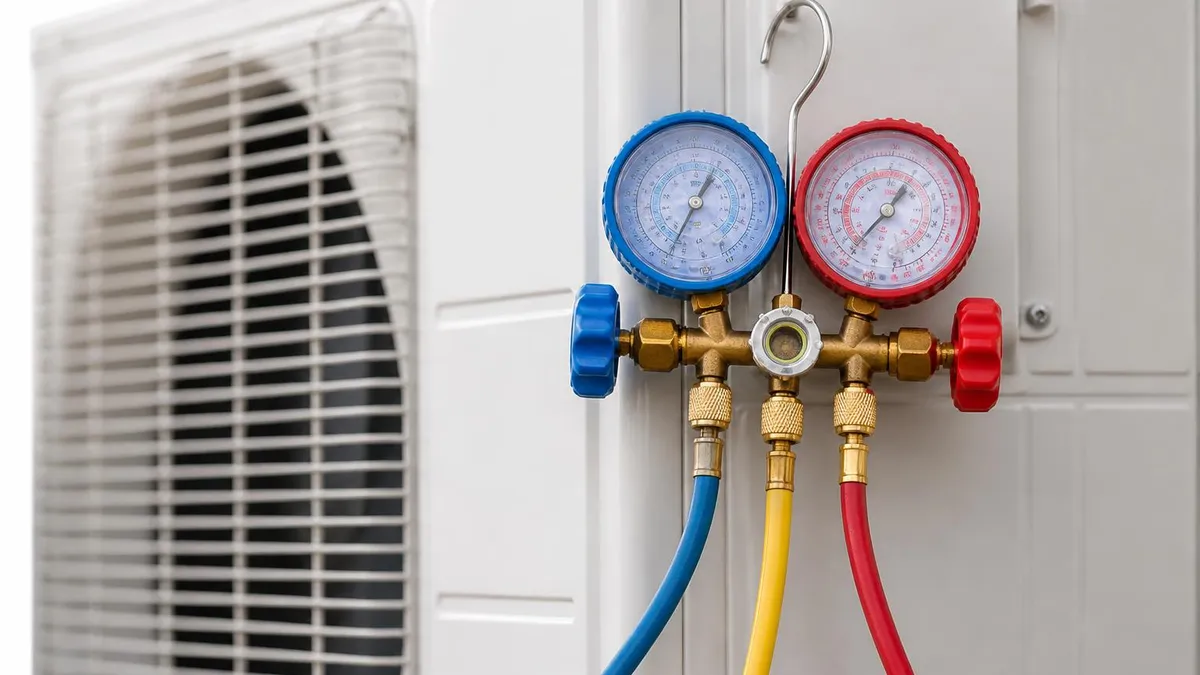
HVAC Duct Installation: Materials, Sizing, Sealing and Best Practice
HVAC UV Light: How It Works, Types and What the Evidence Shows

UV Light for HVAC: How It Works, Benefits, and Cost
HVAC Meaning: What Heating, Ventilation & Air Conditioning Really Covers
HVAC Rancho Cucamonga CA: Complete Guide to Repair, Service, and System Care
About the Author

NATE Certified HVAC Technician & Licensing Exam Trainer
Universal Technical InstituteMike Johnson is a NATE-certified HVAC technician and EPA 608 universal-certified refrigerant handler with a Bachelor of Science in HVAC/R Technology. He has 19 years of commercial and residential HVAC installation and service experience and specializes in preparing technicians for NATE certification, EPA 608, A2L refrigerant safety, and state HVAC contractor licensing examinations.