
HHA Exchange & Time Sheet for Home Health Aide: Complete Guide 2026 October
Learn how to use the time sheet for home health aide work, HHA Exchange login, and steps to earn your HHA certification. Full 2026 October guide. 🗨️
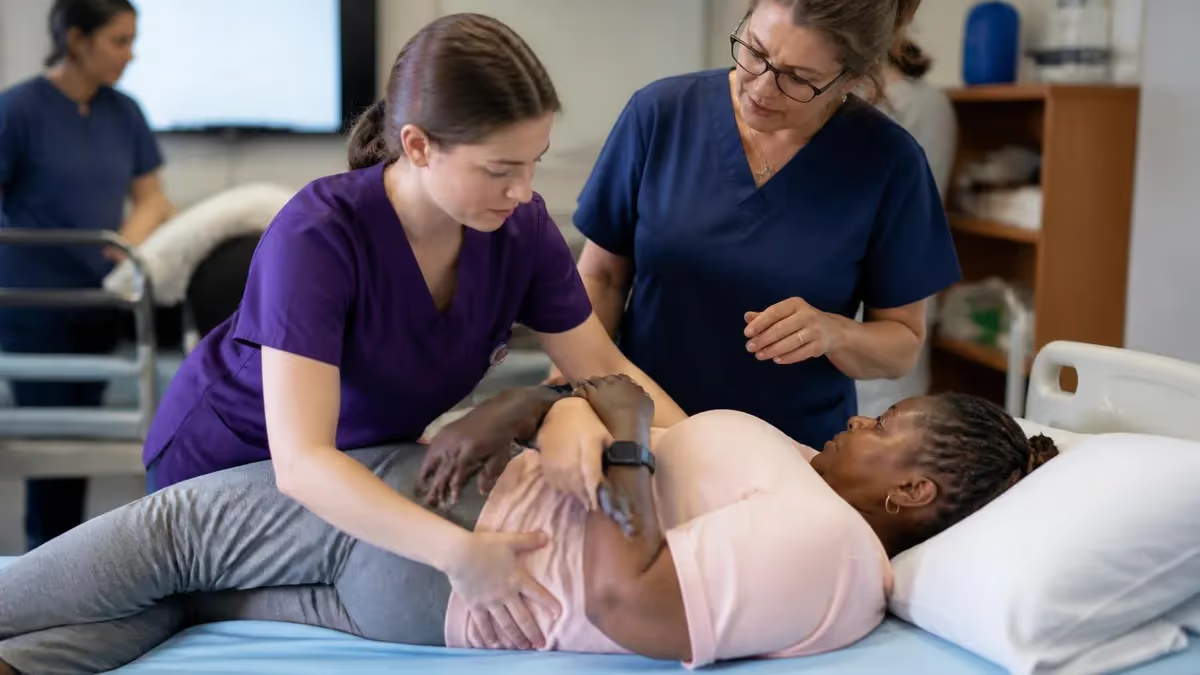
Whether you are just entering the field or have years of hands-on experience, understanding how to properly complete a time sheet for home health aide work is one of the most important administrative skills you will use every single day. Accurate timesheets protect your pay, satisfy state and federal compliance requirements, and help agencies maintain the documentation needed for Medicare and Medicaid reimbursement. Programs like HHA Exchange have become the industry standard for electronic visit verification, making it essential for every aide to understand how the platform works.
HHA Exchange is a web-based platform used by hundreds of home care agencies across the United States. It serves as a central hub where aides log visits, document care tasks, and submit timesheets electronically. When you use the HHA Exchange login portal, you gain access to your scheduled visits, client information, and compliance checklists in real time. Agencies rely on this data to process payroll accurately and to demonstrate to payers that services were delivered as prescribed — a requirement that has grown stricter since the federal Electronic Visit Verification mandate took effect.
For anyone pursuing a career as a certified home health care aide, learning timesheet procedures goes hand-in-hand with clinical training. Your home health aide training program will typically cover documentation basics, but the day-to-day reality of clocking in and out, recording vital signs, and noting any changes in a client's condition requires ongoing practice. Errors on timesheets — even small ones like a missing signature or an incorrect time stamp — can delay your paycheck by an entire pay cycle and create compliance flags for your agency.
The demand for qualified home health aides continues to grow at a remarkable pace. The Bureau of Labor Statistics projects that employment in this sector will increase by more than 21 percent through 2033, far outpacing most other occupations. With that growth comes greater scrutiny of documentation practices. State regulators and federal auditors now routinely review visit records, making a properly completed timesheet not just a payroll tool but a legal document that can determine whether an agency keeps or loses its operating license.
Earning your HHA certification is the starting point for a sustainable career, and understanding documentation tools like HHA Exchange is what keeps that career on solid footing. Whether your agency uses paper forms, a mobile app, or a full EVV system, the underlying principles of timesheet accuracy remain the same: record the correct start and end times, document every task performed, obtain any required signatures, and submit within your agency's deadline. This guide will walk you through every aspect of that process.
Beyond the mechanics of clocking in and out, timesheets serve as a communication bridge between aides, supervisors, and the broader care team. A well-documented visit record tells a nurse or physical therapist what happened during your time with a client, flags any deviations from the care plan, and creates a chronological record that protects both the client and the aide if questions arise later. Think of every timesheet as a brief clinical note: concise, factual, and complete.
This article covers the full landscape of HHA timesheets — from the basics of HHA Exchange and how to complete the HHA login, to the home health aide certification requirements that qualify you to work in the first place, to practical tips for avoiding the documentation mistakes that cost aides money and agencies compliance points. By the end, you will have a clear, actionable understanding of how timekeeping fits into the larger picture of professional home health aide work.
HHA Timesheets & Certification by the Numbers

What Is a Home Health Aide Timesheet?
A timesheet documents the exact start and end time of each home visit. It is the primary source agencies use to calculate an aide's pay and to verify that scheduled hours were delivered as agreed in the client's care plan.
Under the 21st Century Cures Act, all Medicaid personal care and home health visits must use Electronic Visit Verification. The timesheet — whether paper or digital — must capture time, location, client identity, and services performed.
Beyond payroll, the timesheet serves as a brief care note. Supervisors and nurses review it to confirm that the care plan was followed, that vital signs were within normal range, and that no safety incidents occurred during the visit.
During a state or federal audit, timesheets are pulled as primary evidence that services were rendered. An incomplete or altered timesheet can trigger recoupment of payments and, in serious cases, agency decertification.
HHA Exchange is a purpose-built platform designed to connect home care agencies, caregivers, and clients through a single digital workflow. When an aide completes the HHA Exchange login at the start of a shift, the system captures a GPS-verified timestamp that satisfies the federal EVV requirement automatically. This removes the risk of forgetting to clock in on a paper form and eliminates the common payroll dispute of disputed hours, because both the agency and the aide have access to the same digital record in real time.
Accessing the HHA login for the first time is straightforward. Your agency will provide you with a username, a temporary password, and the agency's specific portal URL. After logging in, you will be prompted to reset your password to something secure. The dashboard displays your upcoming schedule, any tasks assigned to each visit, and alerts about missing documentation from prior shifts. It is good practice to review your schedule the evening before each workday so you know exactly which clients you are visiting, their addresses, and any special instructions in their care plans.
During a visit, HHA Exchange prompts you to confirm your arrival, work through a digital care task checklist, and clock out when care is complete. Many agencies require aides to use the mobile app version of the platform because it auto-populates GPS coordinates — eliminating the need for a supervisor to manually verify location. If you are working in a rural area with limited cell service, the app often has an offline mode that syncs records once connectivity is restored. Always verify with your agency whether offline mode is enabled and approved before relying on it.
One of the most useful features of HHA Exchange is the ability to view your own timesheet history. After submitting a visit, you can pull up a record showing the exact times you clocked in and out, the tasks you documented, and whether the submission is pending review, approved, or flagged for correction.
If you notice an error — for example, the app recorded your clock-out 30 minutes late because you forgot to tap the button — most agencies allow a correction window of 24 to 48 hours. Submit correction requests with a written explanation and supervisor approval to maintain a clean record.
For aides who work for multiple agencies simultaneously, HHA Exchange accounts are agency-specific. You will have a separate login for each employer, and your records do not cross over between agencies. This is important to understand when managing your schedule and when reporting hours for tax purposes. Some states also require aides to report total hours worked across all employers for overtime calculations, so maintaining your own summary log alongside the agency platform is a smart habit.
The platform also supports the home health aide salary verification process that clients and families sometimes request. Because every visit is logged with a timestamp and task record, disputes about whether a visit occurred or what services were provided can be resolved quickly by pulling the digital record. This transparency builds trust with clients, protects aides from false accusations, and gives agency administrators the documentation they need to defend billing claims to insurers.
Understanding HHA Exchange is only one piece of the compliance puzzle. The underlying requirement — accurate, timely documentation of every visit — applies regardless of what software your agency uses. Whether you are filling out a paper timesheet, using a proprietary agency app, or logging into HHA Exchange, the same professional standards apply: be precise about times, be honest about tasks performed, and submit on schedule. Building these habits early in your career will serve you well throughout it.
HHA Certification: Paths, Requirements & Training Programs
Federal law requires that home health aides working for Medicare-certified agencies complete a minimum of 75 hours of training, including at least 16 hours of supervised practical training. This federal floor is set by the Centers for Medicare and Medicaid Services and applies uniformly across all 50 states. Aides must also pass a competency evaluation — either a written exam, a skills demonstration, or both — before being placed on the Aide Registry and assigned to clients independently.
The 75-hour requirement covers core topics including personal care skills, safety and emergency procedures, infection control, basic nutrition, and observation and reporting techniques. Timekeeping and documentation are woven into this curriculum because accurate recordkeeping is classified as a core competency under CMS guidelines. Aides who cannot demonstrate proper documentation practices — including how to complete a time sheet for home health aide assignments — may fail the competency evaluation even if their hands-on clinical skills are strong.

Paper Timesheets vs. Electronic Visit Verification (EVV)
- +EVV systems like HHA Exchange auto-verify GPS location, satisfying federal Medicaid mandates without extra steps
- +Digital timesheets are submitted instantly, speeding up payroll processing by one to three business days
- +Real-time dashboards let aides review their own records and catch errors before the pay cycle closes
- +Electronic records are searchable and auditable, protecting agencies and aides during compliance reviews
- +Mobile apps support offline mode, ensuring documentation is captured even in low-connectivity rural areas
- +Agencies receive automatic alerts for missed clock-ins, reducing unbilled visits and lost revenue
- −EVV requires a smartphone or tablet; aides without reliable devices may struggle to comply
- −App malfunctions or GPS errors can create false compliance flags that require manual correction requests
- −Learning a new platform like HHA Exchange takes time, and tech-averse aides may need extra onboarding support
- −Paper timesheets remain legally valid in some states, meaning agencies may run dual systems during transition periods
- −Battery life and data connectivity issues can prevent clock-in at visit start, creating compliance gaps
- −Privacy concerns arise from continuous GPS tracking; aides should understand what location data is stored and for how long
Pros and Cons at a Glance
| Pros | Cons |
|---|---|
| EVV systems like HHA Exchange auto-verify GPS location, satisfying federal Medicaid mandates without extra steps | EVV requires a smartphone or tablet; aides without reliable devices may struggle to comply |
| Digital timesheets are submitted instantly, speeding up payroll processing by one to three business days | App malfunctions or GPS errors can create false compliance flags that require manual correction requests |
| Real-time dashboards let aides review their own records and catch errors before the pay cycle closes | Learning a new platform like HHA Exchange takes time, and tech-averse aides may need extra onboarding support |
| Electronic records are searchable and auditable, protecting agencies and aides during compliance reviews | Paper timesheets remain legally valid in some states, meaning agencies may run dual systems during transition periods |
| Mobile apps support offline mode, ensuring documentation is captured even in low-connectivity rural areas | Battery life and data connectivity issues can prevent clock-in at visit start, creating compliance gaps |
| Agencies receive automatic alerts for missed clock-ins, reducing unbilled visits and lost revenue | Privacy concerns arise from continuous GPS tracking; aides should understand what location data is stored and for how long |
Home Health Aide Timesheet Compliance Checklist
- ✓Record your exact clock-in time the moment you arrive at the client's location — never round up or estimate.
- ✓Confirm the client's identity before beginning care and document the confirmation method used.
- ✓Complete all required care task checkboxes in HHA Exchange or on the paper form during the visit, not afterward.
- ✓Note any changes in the client's condition, including vital signs outside normal range, in the observation section.
- ✓Obtain the client or caregiver signature before leaving the visit if required by your agency's policy.
- ✓Record your exact clock-out time immediately after completing care — never clock out from the parking lot.
- ✓Submit your completed timesheet within your agency's required window (typically same day or within 24 hours).
- ✓Review your submitted record in the HHA Exchange dashboard to confirm it shows as received, not pending.
- ✓Flag any corrections needed within the allowed correction window and submit a written explanation with supervisor approval.
- ✓Keep a personal log of your visits — dates, times, and client IDs — as a backup in case of platform outages.
EVV Is Now Federal Law for All Medicaid Home Visits
The 21st Century Cures Act requires Electronic Visit Verification for all Medicaid-funded personal care and home health services in every state. If your agency has not yet implemented EVV, it is required to do so or face federal funding penalties. As an aide, understanding this mandate protects you — agencies that skip EVV may face audits that put your recorded hours at risk of non-payment.
A solid home health aide training program does far more than teach you how to bathe a patient or take a blood pressure reading. The best programs integrate documentation skills, professional ethics, and workplace communication into every module — because the reality of home health work is that you are often operating alone in a client's home, making independent judgment calls that must be accurately captured in written records. Understanding this from day one sets you up for a longer, more successful career.
When evaluating programs, pay attention to how much time is devoted to documentation and administrative skills. A program that spends 70 hours on clinical skills but only one hour on paperwork is leaving you underprepared for what agencies actually expect. The best programs dedicate four to eight hours specifically to timesheet procedures, EVV platforms, incident reporting, and care plan documentation. Ask about this curriculum detail when you visit or call a school — if the admissions counselor cannot answer, that itself is a red flag.
Supervised practical training is the component of home health aide training most directly tied to documentation quality. During hands-on sessions, instructors watch not only how you perform clinical tasks but also how you record them. You may be graded on whether you documented a task in the correct sequence, used the right terminology, and noted relevant observations about the client's response. These grading criteria mirror exactly what supervisors and auditors will look for once you are working in the field.
For those who already hold a home health aid position and are updating their skills, many states allow experienced aides to challenge the competency evaluation without completing a full training program. This challenge process typically requires documentation of prior work experience — usually one to three years of verifiable home health work — and a passing score on the written and skills exams. If you are considering this path, check with your state's aide registry to confirm the eligibility requirements and whether your prior work history qualifies.
The home health aide certificate you earn at the end of your training is only the beginning of a documentation trail that follows your entire career. Each renewal, each continuing education completion, and each employer verification adds to your professional record. Keeping copies of all your certifications, renewal notices, and training completion certificates in a personal file — separate from your employer's records — is a habit every professional HHA should maintain from their first day in the field.
Advanced career development for home health aides often involves pursuing additional credentials such as certified nursing assistant (CNA), medication aide certification, or specialty training in dementia care or pediatric home health. Each of these credentials has its own training and documentation requirements, and the organizational skills you build through accurate timekeeping translate directly into managing continuing education records and credential renewals. Think of your timesheet habits as the foundation of a larger professional documentation practice.
Understanding the full scope of what training programs teach — and what they sometimes omit — helps you advocate for yourself as a learner and as a professional. If your training did not adequately cover HHA Exchange, EVV systems, or timesheet best practices, seek out online tutorials, your agency's onboarding materials, or peer guidance from experienced colleagues. The administrative side of home health work is learnable, and investing time in it early pays dividends throughout your career in fewer payroll disputes, cleaner audits, and stronger professional relationships with supervisors and clients alike.

Falsifying a timesheet — including recording hours you did not work, altering a clock-in time after the fact without a formal correction request, or documenting care tasks that were not performed — is considered fraud under both state and federal law. Consequences can include termination, loss of certification, civil penalties, and in cases involving Medicare or Medicaid billing, federal criminal charges. Always submit accurate records and use the official correction process if an honest error occurs.
Even experienced aides make documentation errors, and the most common ones are almost always preventable. The single biggest timesheet mistake is failing to clock in or out at the correct moment — waiting until you are in your car, rounding times to the nearest quarter hour, or guessing at a time you forgot to record. These habits create discrepancies between your submitted hours and the agency's scheduling system, triggering automatic flags that must be manually resolved before payroll can be processed.
The second most common error is incomplete task documentation. Many HHA platforms, including HHA Exchange, generate a task checklist for each visit based on the client's care plan. If you complete a task but forget to check it off, the system records it as undone. Supervisors may then call to ask whether the task was performed, or in some cases, the omission triggers a quality review. During your visit, build the habit of completing each checklist item in real time rather than trying to remember everything at clock-out.
Observation notes are the third area where documentation gaps commonly appear. A client's care plan may require you to record vital signs, skin condition, appetite, or mood at each visit. Failing to record these data points — or recording them as normal without actually measuring them — creates clinical and compliance risk. If a client's condition deteriorates and a supervisor reviews the records, missing observation data raises serious questions about the quality of care provided. Always measure, always record, always be honest.
Signature requirements vary by agency and payer. Some Medicare-certified agencies require the client to sign a paper timesheet at the conclusion of every visit. Others accept a digital confirmation through HHA Exchange or a similar platform. Know your agency's specific policy and follow it consistently. A missing signature can result in a denied billing claim for that visit, which means the agency does not get paid — and in some cases, that cost is passed back to the aide in the form of a corrective action or a hold on disputed hours.
Agency submission deadlines are another frequent source of payroll problems. Most agencies require timesheets to be submitted within 24 hours of the visit, and payroll is typically processed on a weekly or biweekly cycle. Submitting late — even by a few hours past the deadline — can push your hours into the next pay period, delaying your check by a full week. Set a reminder on your phone to submit your timesheet before you leave each client's location, and treat that reminder as non-negotiable.
If you notice a systemic problem — for example, the HHA Exchange app consistently fails to record GPS coordinates in a particular neighborhood — report it to your agency's administrative team immediately rather than trying to work around it. Documenting the technical issue creates a paper trail that protects you if those visits are later questioned.
Your agency's IT or compliance team can often resolve platform issues quickly when they are made aware of them, but only if aides speak up. Reviewing the home health aide job description your agency provided during onboarding often includes the specific protocols for reporting technical issues with EVV systems.
Finally, understand that documentation is a two-way protection. Yes, accurate timesheets protect your employer from audit findings. But they also protect you. A complete, unaltered record of every visit you have ever made is your strongest defense against any allegation that you did not show up, did not provide care, or acted improperly.
Treat every timesheet as if it might one day be read by a state investigator or a judge, because occasionally, it is. That standard of care in your paperwork reflects the same standard of care you bring to your clinical work — and both matter enormously in this profession.
For aides preparing to enter the workforce for the first time, the administrative learning curve can feel steep alongside the clinical training demands. A practical strategy is to shadow an experienced aide for one or two shifts before your first solo assignment. Watch not only how they deliver care but how they use the documentation system — when they clock in, how they complete task checklists, and how they handle a situation where the app behaves unexpectedly. Hands-on observation is often more effective than any tutorial for learning platform-specific workflows.
Agencies vary significantly in how much administrative support they provide to new hires. Some offer dedicated onboarding sessions that walk aides through the HHA Exchange platform step by step, with practice logins on test accounts before going live. Others hand you a username and a two-page instruction sheet and expect you to figure it out. If your agency's onboarding is sparse, proactively ask your supervisor for a 30-minute walkthrough of the documentation system before your first scheduled visit. Most supervisors will accommodate this request — they benefit directly from aides who submit timesheets correctly from day one.
Time management during visits is closely linked to timesheet accuracy. Many aides, especially new ones, feel rushed toward the end of a visit and cut documentation corners to stay on schedule. The solution is to build documentation time into your visit plan.
If a visit is scheduled for two hours, allocate the first 90 minutes to clinical care, use ten minutes for observation documentation and task completion in the app, and leave the final 20 minutes for conversation with the client and any end-of-visit needs. This structure keeps your care quality high and your documentation complete without creating a frantic scramble at clock-out.
Pay stubs and timesheet records should always be cross-referenced. Each pay period, compare your submitted timesheets against your pay stub to verify that every visit you submitted was paid at the correct rate.
Discrepancies are not always the result of errors — sometimes an agency's payroll system applies a different rate code for holiday visits, overnight shifts, or specialty care hours, and these variations should be explained in your employment agreement. If something does not match, bring it to payroll administration promptly. Most agencies have a limited window — often one to two pay periods — during which back-pay corrections can be processed.
Continuing education requirements intersect with timesheet practices in one important way: many states require aides to document continuing education hours using the same type of timekeeping forms used for client visits. When you attend a training session, you may need to log in to a state registry or agency platform, record your attendance, and obtain a completion certificate. Treating these training log-ins with the same care and accuracy you bring to client visit documentation ensures your continuing education credits are properly credited to your certification record.
Technology continues to evolve in the home health space. Newer platforms are integrating biometric verification — fingerprint or facial recognition clock-ins — to further strengthen EVV compliance. Voice-activated documentation tools are being piloted in some agencies, allowing aides to dictate observation notes hands-free during a visit. Staying current on these technological developments is part of being a modern, professional home health aide. Following industry publications, attending agency-sponsored training updates, and participating in professional associations are all ways to stay ahead of the curve and ensure your documentation practices remain compliant as standards evolve.
Ultimately, the discipline of accurate timesheet completion reflects a broader professional ethic: doing your work completely and honestly, even when no one is watching. Home health aides work in private settings with vulnerable clients, and the trust that makes this work possible depends on professional integrity at every level — from the way you provide personal care to the way you record that care in a timesheet. Aides who internalize this standard tend to advance faster, earn stronger references, and build the kind of career reputation that sustains long-term employment in a competitive field.
Sample HHA Practice Questions
Try these questions from our free HHA practice tests. The correct answer and an explanation follow each question.
Mrs. Amos has not had a bowel movement for three days. She has always given herself an enema if she does not have a bowel movement for that long a time. Mrs. Amos asks the home health aide to give her an enema. What should the aide do?
- A. Give Mrs. Amos an enema
- B. Tell Mrs. Amos to wait another day.
- C. Suggest that Mrs. Amos take a laxative first.
- D. Contact the agency supervisor to discuss the situation.
Answer: D. Contact the agency supervisor to discuss the situation.
Administering an enema is a medical procedure that typically falls outside the scope of practice for a home health aide unless specifically delegated by a licensed nurse and included in the care plan. Even if the client usually self-administers, the aide should not perform it without explicit instruction and supervision. The correct action is to report the client's condition and request to the supervisor, who can then consult with the physician and provide appropriate directives.
It is Mrs. Amos’s usual time for lunch, but she says she is not hungry yet. This is the first time that Mrs. Amos has made this type of statement. What should the home health aide do?
- A. Insist that Mrs. Amos eat at this time.
- B. Tell Mrs. Amos to let the aide know when she wants to eat, and remind her that it is important that she have lunch.
- C. Tell Mrs. Amos that if she does not eat by herself, she will have to be fed.
- D. Tell Mrs. Amos that it took a lot of time to prepare the food and that she should eat it while it is fresh.
Answer: B. Tell Mrs. Amos to let the aide know when she wants to eat, and remind her that it is important that she have lunch.
The home health aide should respect Mrs. Amos's preference while still ensuring her nutritional needs are met. By telling Mrs. Amos to let the aide know when she wants to eat and reminding her of the importance of lunch, the aide offers flexibility and maintains a client-centered approach. This balances the client's autonomy with the aide's responsibility for her health.
When a client complains of pain, what should the home health aide do first?
- A. Ask the client to describe the pain.
- B. Call the client’s doctor.
- C. Offer the client some warm tea.
- D. Change the client’s position.
Answer: A. Ask the client to describe the pain.
When a client complains of pain, the first step is to gather more information to understand the nature, location, intensity, and duration of the pain. This assessment helps the aide accurately report the complaint to the supervisor and provides crucial details for the medical team to determine the appropriate intervention. Without this initial description, any subsequent actions would be based on incomplete information.
A home health aide notices a patient's skin over the bony prominence of the hip looks reddened and does not blanch when pressed. The aide should:
- A. Apply a thick layer of lotion and continue with the care plan
- B. Reposition the patient and report the finding to the supervising nurse
- C. Leave the area exposed to air and reassess in 24 hours
- D. Place a heating pad over the area to increase circulation
Answer: B. Reposition the patient and report the finding to the supervising nurse
Non-blanchable redness over a bony prominence is a Stage 1 pressure injury. The aide must reposition the patient to relieve pressure and report immediately to the supervising nurse for further assessment.
HHA Questions and Answers

HHA Job Requirements 2026 — What You Need to Become a Home Health Aide

HHA Classes Near Me 2026 — How to Find and Enroll in Training

Medicare Coverage for Home Health Aide Services — What's Covered and What Isn't
How to Become a Home Health Aide — Training, Certification & Requirements

What Does an HHA Do — Complete Guide (2026)
About the Author

Registered Nurse & Healthcare Educator
Johns Hopkins University School of NursingDr. Sarah Mitchell is a board-certified registered nurse with over 15 years of clinical and academic experience. She completed her PhD in Nursing Science at Johns Hopkins University and has taught NCLEX preparation and clinical skills courses for nursing students across the United States. Her research focuses on evidence-based exam preparation strategies for healthcare certification candidates.
Join the Discussion
Connect with other students preparing for this exam. Share tips, ask questions, and get advice from people who have been there.
View discussion (8 replies)