
Gcse English Question Paper: AQA Format, Past Papers and Marking Explained 2026
📝 A GCSE English question paper is two 1h45 exams of 80 marks each (AQA). See the format, free past papers, marking and why leaked papers are fake.
A GCSE English question paper is the written exam booklet students sit for GCSE English Language or English Literature, with AQA English Language using two 1 hour 45 minute papers worth 80 marks each. Paper 1 tests creative reading and writing, and Paper 2 tests non-fiction reading and persuasive writing.
Gcse English Question Paper: Key Facts (Updated October 2026)
| Fact | Details | Source |
|---|---|---|
| How the exams are delivered | GCSEs are two-year courses, and students sit all their written exams in one series at the end of the course, at their school or college exam center. | GOV.UK (Department for Education) |
| AQA entry fee, June 2027 series | £52.85 per entry for English Language (8700) at UK centers and £60.80 at international centers. | AQA |
| AQA English resit fee, November 2026 | £51.20 per entry at UK centers and £58.90 at international centers. | AQA |
| Late entry deadlines, June 2027 | A late entry fee applies from 22 February 2027, and a very late entry fee applies after 21 April 2027. | AQA |
| Late entry surcharge | A late entry adds 100% of the normal fee, and a very late entry adds 150%, on top of the normal entry fee. | AQA |
| Grading and the grade 4 rule (England) | GCSEs are graded 9 to 1. Students aged 16 to 19 who do not reach at least a grade 4 in English or math must keep studying that subject. | GOV.UK (16 to 19 funding rules) |
| Resit windows (England) | The only GCSE resits held outside the summer series are in English Language and math, every November. | Department for Education |
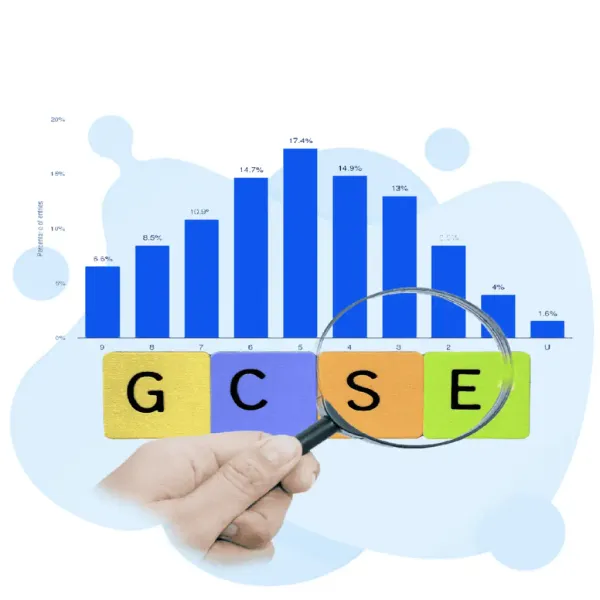
| Summer 2026 results (UK) | 67.3% of UK GCSE results were graded 4/C or above, compared with 67.4% in 2025. | Joint Council for Qualifications (JCQ) |
To define gcse for readers in the United States, it is the General Certificate of Secondary Education, the qualification British students usually sit at about age 16 after two years of study. There is no exact American equivalent, but think of it as a set of subject exams taken near the end of high school. English Language is compulsory in practice, and a grade 4 is treated by colleges and employers as the minimum benchmark, which is why so many people search for question papers.
The phrase question paper can mean two different things, and it helps to separate them. The live paper is the sealed booklet opened in the exam hall, and it stays secure until the exam series ends. A past paper is a previous year's booklet released by the exam board, usually with a mark scheme and examiner report. Past papers are legitimate revision tools. The live paper, before the exam, is something nobody outside the exam board should ever see.
Searches for leaked gcse papers spike every spring, but the honest answer is that genuine leaks are extremely rare and the files circulating online are almost always fakes, old papers relabeled, or scams. Exam boards investigate any suspected breach, and candidates who use leaked material can be disqualified. This guide explains what the official papers contain, where to find legitimate ones, and how to practice with them so you improve without risking your results.
Most students meet the GCSE's English question paper in two forms. English Language is the skills exam, where you read unseen texts and write your own. English Literature is the knowledge exam, where you answer on set texts such as a Shakespeare play, a nineteenth-century novel, a modern drama and an anthology of poetry. Many schools run a mock GCSE in Year 11 using real past papers, so the format is familiar before the summer.
This article focuses on the AQA specification because it is the most widely taken English board in England, though Edexcel, OCR and Eduqas offer alternatives with different layouts. Every board assesses the same core skills: reading comprehension, analysis of language and structure, comparison, and accurate writing. Once you understand how AQA splits its marks, you can transfer the approach to any board. The sections below cover format, past papers, mark schemes, and a realistic practice routine that fits around a school week.
One more point on scope: this page covers the written question papers only. English Language also includes a separate spoken language endorsement, which is teacher-assessed, reported as pass, merit or distinction, and does not count toward the 9 to 1 grade. Because the endorsement has no printed question paper, it is not covered here. If you are short on time, start with the key facts table above, then jump to the format section and the marking guide.
How Big Is a GCSE English Question Paper in Numbers?
What Is on the AQA GCSE English Language Paper 1 and Paper 2?
| Section | Questions | Time | Weight | Notes |
|---|---|---|---|---|
| Paper 1 Section A: Reading (Questions 1-4) | 4 | 15 min reading + 45 min | 25% | 40 marks on one unseen fiction extract |
| Paper 1 Section B: Creative Writing (Question 5) | 1 | 45 min | 25% | 40 marks: description or story |
| Paper 2 Section A: Reading (Questions 1-4) | 4 | 15 min reading + 45 min | 25% | 40 marks on two non-fiction sources |
| Paper 2 Section B: Viewpoint Writing (Question 5) | 1 | 45 min | 25% | 40 marks: article, letter, speech or essay |
| Total | 10 | 3 hours 30 minutes | 100% |
Where Can You Find AQA GCSE English Language Past Papers?
You can find AQA GCSE English Language past papers for free on the AQA website, in the past papers and mark schemes area for specification 8700. AQA publishes question papers, mark schemes and examiner reports for each exam series, though the newest papers are sometimes held back so schools can use them for mocks. Your teacher can access those secure papers through the board's portal. Always download from the board itself, because third-party copies are often incomplete or mislabeled.
A free online copy of AQA English Language GCSE Paper 1 usually comes as three PDFs: the question paper, a separate insert containing the source text, and the mark scheme. Paper 1 uses one fiction extract, often from a twentieth- or twenty-first-century novel or short story. Print the question booklet and the insert together, because you will flip between them constantly in the real exam. Practicing with the genuine layout builds the habit of annotating the source quickly.
Students outside England often ask how a british gcse course compares with their home system, and the answer is that the structure is narrower and deeper. A typical student sits eight to ten subjects, with English Language, English Literature and math nearly always included. English papers are sat under exam conditions and marked by external examiners rather than teachers, which is why the board's own past papers are the most reliable guide to difficulty.
Beyond AQA, the same rule applies: go to the source. Edexcel past papers for English Language (1EN0) are on the Pearson Edexcel qualifications site, OCR papers are on the OCR website, and Eduqas papers are on the WJEC Eduqas site. Each board lists papers by series, so you can work chronologically. If your school entered you with a specific board, check your exam entry or ask your English teacher before practicing, because the question styles differ noticeably between boards.
Many families land on this topic after searching for leaked gcse papers 2020, usually because of the pandemic disruption that year. In reality, the 2020 summer exams were cancelled in England and grades were awarded through center assessment, so there were no live English papers to leak. Anything sold under that label is fake. A printable set of genuine past papers is a far safer route, and our printable practice test guide shows where to get them.
When you open a past paper, work through it in stages rather than all at once. First, read the instructions and the source text with a pencil, underlining the details the question asks about. Second, plan each answer in a few bullet points. Third, write under timed conditions, then mark your work against the official scheme. Keep a log with the date, paper, series, mark and one improvement target. After five or six papers, the log reveals patterns you can fix.
A good rule is to save the most recent papers for last. Start with older series to learn the question wording, which barely changes, then attempt the newest papers about three weeks before the real exam as a final dress rehearsal. Because AQA reuses the same question stems each year, such as 'How does the writer use language to...', your confidence rises quickly. The text changes, but the task does not, and that is the real advantage of repeated practice.
How Do You Answer Each Question on GCSE English Paper 2 in a Mock GCSE?
Question 1 on AQA Paper 2 is a 4-mark warm-up. You read eight statements and shade the four that are true for a specified part of Source A. Take two minutes, stay inside the line range given, and avoid inferring beyond the text. Dropping marks here is almost always caused by rushing or by using information from outside the stated lines, so treat it as free marks you simply must not waste.
Question 2 is worth 8 marks and asks you to summarize the differences between the two sources, usually how two people experience the same situation. Write about ten minutes of fluent, comparative prose: pick a difference, quote briefly from each source, and infer what the quotation suggests. Use connectives such as whereas and in contrast. Do not analyze language techniques here, because that belongs in Question 3, and doing it now costs time without earning a single mark.
Are AQA GCSE English Language Past Papers Worth Using?
- +They show the exact format, wording and timing of the real exam
- +Official mark schemes let you grade your own answers accurately
- +Examiner reports reveal the common mistakes that lose marks
- +They are free to download from the exam board website
- +Timed practice builds stamina for two 1 hour 45 minute papers
- +Repeating question types makes the exam feel familiar and less stressful
- −The number of papers is limited, so you can run out
- −Self-marking can be generous without a teacher's feedback
- −Some source texts feel dated, dense or unfamiliar
- −Past papers do not teach skills you have not yet learned
- −Specification changes can make very old papers less relevant
- −Doing too many in a row without review can cause burnout
How Do You Use GCSE AQA English Past Questions and Answers for GCSE Mocks?
- ✓Download the paper, source insert and mark scheme from the exam board site.
- ✓Print the paper so you can annotate the source text.
- ✓Set a timer for 1 hour 45 minutes and sit the paper in silence.
- ✓Spend the first 15 minutes reading the source and planning.
- ✓Write Question 5 in full, even when time is short.
- ✓Mark your answers using the official level descriptors.
- ✓Read the examiner report to spot common errors.
- ✓Rewrite one weak answer using the model response.
- ✓Log your marks and set one target for the next paper.
- ✓Sit one full paper under strict conditions before your school's GCSE mocks.
Genuine leaks are rare, and using one risks disqualification
Exam boards treat any breach of paper security as malpractice. Candidates caught with leaked content can lose results across all subjects, and many online files are scams that harvest payment details. Official past papers give you the same practice with zero risk.
How Does the AQA GCSE English Language Paper Marking Scheme Work?
The AQA marking scheme awards marks by levels, not by ticking facts. Each extended question has four levels, and examiners decide the best-fit level first, then pick a mark within it. For the 8-mark and 12-mark questions, the descriptors move from simple, limited comments at Level 1 to perceptive, detailed analysis at Level 4. Understanding this ladder tells you exactly what to improve, because each higher level asks for something specific rather than simply more writing.
Assessment objectives explain what is being rewarded. AO1 covers identifying and interpreting information, AO2 covers language and structure, AO3 covers comparing writers' ideas, and AO4 covers evaluating a text critically. On the writing side, AO5 rewards communication and organization and AO6 rewards vocabulary, sentence structure, spelling and punctuation. Match each question to its objective before you write, and you will stop giving analysis where the examiner wants interpretation, or the reverse.
Using the marking scheme properly is the single biggest upgrade you can make to any mock gcse you sit at school or at home. After finishing, mark each answer twice: first awarding a level using the descriptors, then checking the indicative content to see which points you missed. Highlight the phrases in the descriptor that you hit, and underline the ones you did not. This turns a vague score of 'six out of eight' into a clear next step.
Grade boundaries translate raw marks into the 9 to 1 scale. With 160 raw marks available across the two papers, a grade 4 has historically needed fewer than half of them, though the exact figure changes every series and is published on results day. Boundaries are set using comparable outcomes rather than a fixed percentage, so never treat last year's number as a guarantee. Use boundaries only as a rough guide to your progress.
Another frequent search is leaked gcse papers 2019, which usually leads to forums offering a download for a fee. The 2019 English papers were sat normally and are now public as past papers with full mark schemes, so there is nothing secret left to buy. If you want 2019 material, take it free from the exam board. Our England, UK and USA requirements guide also explains how the qualification fits different education systems.
Examiner reports are the most underused resource. After every series, AQA publishes a report describing how candidates answered each question, with sample responses and commentary. Typical complaints include answers that retell the story rather than analyze it, quotations that are too long, and writing answers with no plan. Reading even one report before attempting a paper tells you exactly which habits to avoid, and it takes only ten minutes.
Finally, remember that the marking scheme for Paper 1 and Paper 2 differs slightly in emphasis. Paper 1 rewards imaginative control, with 40 marks for creative writing and a 20-mark evaluation question on a statement about the extract. Paper 2 rewards argument, with a comparison question and a viewpoint essay. Knowing which skill each paper prizes helps you shift your mindset between the two sittings, which are often held on different days in the same exam week.
Files advertised as leaked papers are usually scams, malware or recycled past papers. Never pay for one, and never share personal details to get one. If you come across genuine exam material before the sitting, tell your teacher or exam officer, since reporting it protects your own results.
How Should You Handle Sources and Writing on GCSE English Paper 2?
Read first and write last on GCSE English Paper 2: spend the first 15 minutes reading both sources and all five questions, then about 45 minutes on Section A and 45 minutes on Section B. Paper 2 is titled Writers' Viewpoints and Perspectives and pairs one nineteenth-century source with one modern source on the same theme. The reading stage matters most, because every question depends on understanding each writer's attitude. Skipping it is the commonest reason students misread questions.
Annotating each source works best with a simple code. Mark the writer's attitude in the margin with one word, such as angry, nostalgic or sarcastic, then underline two or three striking phrases per paragraph. Note any shift in tone, since AQA questions often target the way a viewpoint changes. These marginal notes become the raw material for your Question 2 summary, your Question 3 analysis and your Question 4 comparison, so the time you invest at the start pays you back later.
Rumors about gcse 2020 papers leaked still circulate on social media under tags like #gcse, often claiming Paper 2 topics are 'confirmed'. Treat every such claim as false. AQA chooses source texts well in advance, keeps them secure, and does not announce topics. No credible source can know the texts before the exam. If you want to understand the qualification itself, how it is structured and what it is for, our explainer on what GCSE is covers the background for newcomers.
Nineteenth-century sources cause the most anxiety because of long sentences and unfamiliar vocabulary. Do not try to understand every word. Read for the gist, circle two or three hard words, and guess their meaning from context. Examiners reward a clear grasp of the writer's attitude, not a perfect translation. Practicing with letters, diary entries and travel writing from the period builds the stamina you need, and a small habit like reading one old article a week helps.
Questions that students ask repeatedly include how much to quote and how to structure comparisons. Keep quotations short, ideally three to six words, and embed them in your own sentence. For Question 4, organize by idea rather than by source: write one paragraph on how both writers feel about a theme, then another on a contrast. This integrated approach scores higher than describing Source A fully and then Source B, which looks like two separate answers.
For the writing question, choose the form carefully. A letter needs a greeting and sign-off, an article needs a headline and a confident byline-style voice, and a speech needs direct address like 'ladies and gentlemen' and rhetorical devices. Matching conventions earns marks under content and organization. Pick the form you can sustain, not the one that seems fanciest. A well-organized speech at Level 4 beats an overambitious article that loses control halfway through.
A short timed example shows how this works. Imagine a statement saying that schools should start later in the day. In five minutes you would plan: hook, two benefits with evidence from sleep research, one counterargument about after-school activities, a rebuttal, and a closing call to action. That plan gives five clear paragraphs, a logical flow and room for varied vocabulary. Practicing five such plans in a week, without writing the full essays, sharpens speed.
What Is the Best Way to Practice GCSE English Paper 1?
The best way to practice GCSE English Paper 1 is to sit one full paper under timed conditions each week, then rewrite your weakest answer. Paper 1 is called Explorations in Creative Reading and Writing. Section A has four reading questions on a single fiction extract, worth 40 marks, and Section B has one 40-mark creative writing task. Repeating the full routine builds both skill and stamina, which a few isolated questions never achieve.
Start Paper 1 with Question 1, a 4-mark task asking for four pieces of information from a short section of the extract. Question 2 is 8 marks on language, Question 3 is 8 marks on structure, and Question 4 is the 20-mark evaluation. The common mistake is spending too long on Question 4 and leaving too little for Question 5. As a rule, allocate about 5, 10, 10 and 20 minutes to the first four questions, leaving 45 for writing.
Your wider timetable matters as much as the paper itself. Check the dates for all your gcse exams so English preparation does not collide with science or math revision. Most students begin focused English practice in January, after the first round of school mocks, and build up to two papers a week by April. Spread the work out, rather than saving everything for the Easter break when stress peaks. Treat English Language like a skill you train, not content you memorize.
Build a small toolkit for creative writing, since Question 5 is worth 40 marks. Prepare two or three flexible story structures, a bank of precise verbs and adjectives, and a few sentence patterns for openings. Use the picture prompt or the written prompt to start with a specific sensory detail rather than a long backstory. Descriptive tasks reward showing, not telling: write the cold metal handle under a trembling palm instead of saying the character was nervous.
Vary your practice formats so it stays fresh. Some days, do a single question in isolation with a ten-minute timer. Other days, annotate an extract and write only a plan for Question 5. Once every two weeks, swap answers with a friend or ask a teacher to mark one response against the level descriptors. A second pair of eyes catches vague comments and repeated sentence openings that you will not notice in your own work.
Look after the basics in the final week. Sleep properly, eat breakfast, and pack a black pen, a spare pen, a simple analog watch and your ID. Smartwatches are banned. Re-read your error log instead of starting new papers. On exam morning, do a five-minute warm-up by reading a short article and annotating it. Arrive early, because a rushed start raises anxiety and can cost you the first few minutes of reading time.
If a paper goes badly, resist the urge to panic. A single weak result is information, not a verdict. Compare it with the mark scheme, find the one question type that cost you the most, and drill that for a week. If you miss a grade 4, remember that a November resit exists for English Language, so you get a second chance. Talk to your teacher early so the resit entry is booked before the deadline. Steady practice nearly always beats last-minute cramming.
GCSE Questions and Answers
GCSE 2026

GCSE Subjects 2026: Compulsory, Optional & How to Choose
Periodic Table GCSE: Groups, Trends, Electrons and Revision Guide

GCSE Exam Guide 2026: Dates, Format, Rules & What to Expect

GCSE Practice Test PDF (Free Printable 2026)

England, UK and USA GCSE Requirements Explained for 2026

What Is GCSE? The General Certificate of Secondary Education Explained
Past GCSE Papers AQA: Where to Find Them, How to Use Them, and What to Avoid
How this page was made: written with AI tools and published by Nathan Beja, founder of Practice Test Geeks, who is responsible for its content. Exam facts are checked against the official sources listed below. Not reviewed by a subject-matter expert. Editorial policy
Sources & references
Exam facts on this page (fees, format, dates, passing scores) are checked against these official sources; the date is our last check. Editorial policy
- gov.uk — Test delivery, retake policy, passing score · verified Oct 2026
- aqa.org.uk — Exam format, fees, late registration, retake fee · verified Oct 2026
- jcq.org.uk — Exam information · verified Oct 2026