
GCSE Past Papers: Free Downloads, Mark Schemes & Revision Guide (2026 August)
🆕 GCSE past papers from AQA, Edexcel, OCR & WJEC. Free downloads, mark schemes, examiner reports plus a 10-step revision plan for Year 11 students.

GCSE Past Papers: The Complete 2026 Revision Guide
GCSE past papers are the single most useful revision resource any Year 11 student has access to, and the brilliant thing is they cost absolutely nothing. Every major UK exam board — AQA, Edexcel (Pearson), OCR, WJEC/Eduqas and CCEA in Northern Ireland — publishes previous summer and November papers, along with mark schemes and examiner reports, on its public website. If you know where to look, you can build a bank of hundreds of authentic GCSE questions for every subject you sit.
This guide walks you through everything you need: what GCSE past papers actually are, which exam board sets your papers, where to download them legally and for free, and exactly how to use them so you walk into the exam hall feeling prepared rather than panicked. We have written it for UK students sitting their summer 2026 exams, parents helping their children revise, and tutors looking for trustworthy sources to share with classes.
You will also find a 10-step revision checklist, a breakdown of the 9-1 grading system, and a comparison of the top free websites including resources for GCSE exams in England. By the end you will know how many papers to do, when to start, and how to use mark schemes properly so the marks actually translate into grades on results day in August.
The biggest mistake students make is leaving past papers until the final fortnight. Treated as a last-minute drill, they panic you. Treated as a weekly habit from January onwards, they become the most powerful diagnostic tool in your revision arsenal — telling you exactly what you know, what you do not know, and how the examiners want you to phrase your answers in the language they actually reward.
What surprises most parents is just how much material is available. AQA alone publishes around 60 separate Maths papers across Foundation and Higher tiers since 2017, plus mark schemes, plus examiner reports, plus specimen papers, plus November resit series. Multiply that across nine or ten GCSE subjects per student and you have more practice material than any tuition package could realistically deliver. The only catch is knowing which papers match your specification, your tier and your exam board — which is exactly what this guide is here to sort out.
And here is the honest truth no revision app will tell you: past papers work. Studies from Ofqual and the Education Endowment Foundation consistently rank timed past-paper practice among the highest-impact revision strategies, ahead of flashcards, ahead of re-reading notes, and miles ahead of watching revision videos. The active recall under pressure simulates what your brain has to do on exam day, and the marking afterwards trains you to think like an examiner.
One more thing before we dive in. A lot of online discussion about GCSEs focuses on so-called "leaked GCSE papers" — searches for that phrase rack up tens of thousands of queries every year, especially around the 2019 and 2020 sittings. To be very clear: chasing leaked papers is a waste of effort. Past papers from previous years are free, legal and abundant, and they teach you everything a leak ever could.
Most genuine past-paper hunters end up rotating between three or four trusted sites — the official exam board page for the latest official series, Save My Exams for topic-sorted question banks, Physics & Maths Tutor for worked solutions in STEM subjects, and BBC Bitesize for quick concept refreshers between papers. Build your own bookmarks folder for each subject in week one of revision; you will save hours of searching across the months that follow.
Past papers are written by the same examiners who will mark your exam this summer. The wording of questions, the command words (describe, explain, evaluate, compare), the mark distribution and the phrasing of mark scheme answers all repeat year after year. Practising 6–10 past papers per subject in the three months before your exams typically lifts grades by one to two levels, and the marking criteria do not change between years.
GCSE Past Papers by Exam Board
AQA is the largest GCSE exam board in England, used by roughly half of all state schools. Past papers, mark schemes and examiner reports are free on aqa.org.uk under the "Find past papers and mark schemes" tool. Filter by subject, year and tier (Foundation or Higher). Papers go back to 2017 for the reformed 9-1 specifications. AQA covers Maths, English Language, English Literature, Combined Science, Triple Sciences, History, Geography, Religious Studies, French, Spanish, German and most arts subjects. Paper codes start with the year and subject prefix (e.g. 8300/1F for Maths Foundation Paper 1).
Top 5 Sites for Free GCSE Past Papers
- Source: AQA, Edexcel, OCR, WJEC, CCEA
- Cost: 100% free
- Best for: Most recent papers, official mark schemes
- Coverage: Every subject, every tier, since 2017
- URL: savemyexams.co.uk
- Cost: Free basic / paid premium
- Best for: Topic-sorted questions by specification
- Strength: Sciences, Maths, languages
- URL: physicsandmathstutor.com
- Cost: Completely free
- Best for: Past papers + worked solutions
- Strength: STEM subjects, model answers
- URL: mathsmadeeasy.co.uk
- Cost: Free
- Best for: Maths past papers + revision cards
- Strength: Foundation & Higher tier Maths
- URL: bbc.co.uk/bitesize
- Cost: Free
- Best for: Quick recap + sample questions
- Strength: All subjects, all four UK nations
How to Find Out Which Exam Board Sets Your GCSEs
Before you download a single paper, you must know which board sets each of your subjects. Schools choose different boards for different subjects, so it is perfectly normal to sit AQA Maths, Edexcel English and OCR Computer Science within the same week. Ask your subject teacher or check your candidate statement of entry — the letter your school sends home in March or April listing every paper you are entered for. Every entry lists the board, specification code and tier.
If you cannot find that paperwork, the paper code on a recent mock will tell you everything. Codes like 8300 mean AQA Maths, 1MA1 means Edexcel Maths, J560 means OCR Maths. A quick web search of the code plus "specification" will land you on the right board's webpage. Some students discover too late they have been revising the wrong board's papers — a costly error because question styles differ noticeably between boards.
Foundation vs Higher Tier: Pick the Right Papers
Maths, Combined Science, Triple Sciences and modern foreign languages are tiered. Foundation tier covers grades 1-5 and Higher tier covers grades 4-9. Schools enter you for one tier based on your mock results, and your name appears on the entry list for one tier only. Practising the wrong tier wastes time — Higher tier students get bored by Foundation questions, and Foundation students get demoralised by Higher topics they will never face. Always download papers matching your entry tier.
If you are a borderline grade 4/5 student your school may switch you between tiers right up to the February entry deadline. Ask your teacher in November what tier they currently plan to enter you for, and if it changes, swap your past-paper bank immediately. Borderline candidates often sit one paper at each tier in the autumn mocks to help the decision — keep both sets of papers handy until your final entry is locked in.
Available Subjects and Where Coverage Is Strongest
The most heavily downloaded papers are Maths, English Language, English Literature, Combined Science (the dual-award trilogy) and the three separate sciences for triple-science students. You will also find past papers for History (with different option topics like Cold War, Weimar and Nazi Germany, Medicine Through Time), Geography (paper 1 physical, paper 2 human, paper 3 fieldwork), French, Spanish, German, Religious Studies, Computer Science, Business Studies, Art & Design, Music, Drama, Food Preparation, Design Technology and PE.
For arts subjects like Art & Design, Music and Drama, written papers form only a small slice of the grade — most marks come from coursework portfolios or controlled assessments. Past papers still matter for the written exam component, but do not over-invest. Your portfolio time pays far better. Speaking papers in modern languages similarly cannot be replicated by past papers, so for those use recordings of past sample responses on the exam board sites instead.
Most Popular GCSE Subjects with Past Papers
- Boards: AQA, Edexcel, OCR, WJEC
- Tiered: Foundation + Higher
- Papers: 3 papers, 1.5hrs each
- Boards: AQA, Edexcel, OCR, Eduqas
- Tiered: No — single tier
- Papers: 2 each, 4 in total
- Boards: AQA, Edexcel, OCR
- Tiered: Foundation + Higher
- Papers: 6 papers — 2 per science
- Boards: AQA, Edexcel, OCR
- Tiered: No — single tier
- Papers: 2 papers, option topics vary
How to Actually Use Past Papers — The Three-Pass Method
Downloading 50 past papers and never sitting them properly is the most common revision trap. Use this three-pass method instead. Pass one — diagnostic. Sit the paper untimed, with your notes and textbook open. The goal is to see the question types and identify topics you cannot answer at all. Mark it yourself using the mark scheme, and flag every question worth 4+ marks where you scored under half.
For your second pass try printable GCSE practice tests under closed-book conditions but with no time limit. This separates topic knowledge from exam technique. Your third pass is the full simulation — timed, in silence, no notes, ideally first thing in the morning if your real exam is at 9am. Mark strictly. Practising one paper seriously beats skim-reading three papers any day.
Between passes, give yourself at least 48 hours and revise the topics where you dropped marks. Otherwise you are simply memorising the specific paper rather than mastering the underlying syllabus. Examiners deliberately rotate topics across years, so a paper you have memorised will not help you in June — but the broader topic knowledge you built revising for it absolutely will.
Mark Schemes: The Skill Most Students Get Wrong
Mark schemes are where the real grades are won. Examiners do not award marks for being roughly right — they award marks for specific keywords, phrases and explanations listed in the scheme. After every paper, do not just tick or cross. Read every mark scheme answer in full and underline the exact words that score marks. Notice the command words: "describe" wants observations, "explain" wants reasons, "evaluate" wants weighed judgements. Examiner reports (published alongside mark schemes) flag the common mistakes from real candidates — pure gold.
A useful exercise: pick three of your weakest 6-mark questions across different papers and rewrite the answers using the exact phrasing from each mark scheme. After two or three rounds your brain starts producing examiner-style language naturally. Within a month, marks on long-answer questions typically jump by a full grade boundary. That is the entire trick to grades 7-9 — write the way the mark scheme writes.
One last tip on mark scheme work: pay attention to the levels grids on extended-response questions in English Literature, History and Religious Studies. These grids describe what a level 1, level 2, level 3 and level 4 response looks like in plain English. Read the level 4 descriptor before you start writing the question. Knowing exactly what the top band rewards — sustained analysis, integrated quotation, evaluative judgement — lets you write towards it rather than hoping you stumble into it.
How to Revise with Past Papers — 10-Step Plan
- ✓Confirm your exam board for every subject — check your statement of entry or ask each teacher.
- ✓Download all available past papers, mark schemes and examiner reports for the correct tier.
- ✓Start in January with one paper per week per major subject — untimed, open-book.
- ✓Print papers single-sided so you can write working out alongside questions.
- ✓Self-mark immediately using the official mark scheme — never skip the marking step.
- ✓Highlight in your notes every topic where you lost more than half the marks.
- ✓Build a personal "weak topic" list — revise those for two weeks before doing the next paper.
- ✓From Easter onwards, sit one timed paper per subject per week under exam conditions.
- ✓Read examiner reports — they tell you exactly what previous candidates got wrong.
- ✓Final fortnight: sit at least 2 full mocks per subject in silence, at exam time of day.
The 9-1 GCSE Grading System Explained
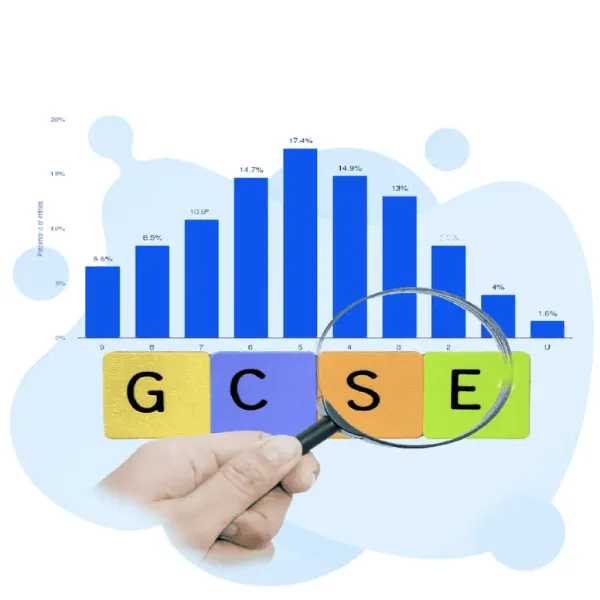
England switched from A*-G to numerical grades 9-1 between 2017 and 2019, with grade 9 the highest and grade 1 the lowest. A grade 4 is a "standard pass" — the equivalent of an old C grade. A grade 5 is a "strong pass". Roughly 67% of marks earns a grade 7 in most subjects; around 80-85% is needed for a 9.
Wales kept the A*-G system, while Northern Ireland uses a hybrid: A*, A, B, C*, C, D, E, F, G. When you mark past papers, use the grade boundaries published by your board for that year — they shift slightly each summer depending on how candidates performed nationally on each individual paper.
Grade boundaries are published on the same exam board page as the paper itself, usually as a one-page PDF. Looking them up takes 30 seconds and converts your raw mark into a meaningful grade. Many students mark a 56/80 paper without ever checking that 56 was a high grade 7 last August — leaving themselves either anxious or complacent for no reason. Always convert raw marks into grades immediately after marking.
How Many Past Papers Should You Do?
Aim for 6 to 10 full past papers per subject across the revision period. For most students this means starting in January with one paper per fortnight, increasing to weekly from Easter, then 2 per week in May. Below 4 papers per subject and you will not have seen enough question variation; above 12 papers and you risk diminishing returns — better to redo earlier papers and chase the marks you previously lost. Quality of marking beats quantity of papers every time.
Common Mistakes — What Wastes Revision Time
The five biggest past-paper mistakes are: reading questions without writing answers (passive revision changes nothing), skipping the mark scheme stage (you never learn what scores marks), only practising the most recent year (older papers contain the same recurring topics), ignoring examiner reports (the cheat code most students never open), and doing every paper open-book (gives a false sense of readiness). Avoid those five and your grade lifts immediately.
A sixth, sneakier mistake: doing papers for subjects you already enjoy and feel confident in, while avoiding the subjects you find hardest. It feels productive because you score well, but it adds zero grades. Force yourself to start each revision session with your weakest subject. Save the easy paper as a reward at the end of the week. That single mindset shift typically lifts overall results by a grade across the board.
Where Parents Can Help
Parents reading this — the most useful thing you can do is help with timing and silence, not subject content. Print the papers, set a kitchen timer, sit in the room so phones stay away, and mark the paper together afterwards. You do not need to understand GCSE Chemistry to circle keyword matches in a mark scheme. For deeper subject help, the GCSE practice test resources are tailored for 2026 specifications. Encouragement matters more than expertise — past-paper revision is gruelling, and consistent weekly habits beat panicked all-nighters.
Final Two Weeks: The Cool-Down Phase
The last fortnight before exams should not feel like cramming. Switch from full papers to targeted topics — pull out the questions you scored badly on across all your earlier papers and redo just those. Sleep matters more than one extra paper. Walk into the exam hall having marked your last full paper at least 72 hours before, so any confidence boost is recent but the stress is gone. Take a sample paper-style breakfast, even — examiners report performance dips when blood-sugar crashes at 11am during a 90-minute paper.
And remember the bigger picture. Past papers train you for a six-week sprint of exams that determines your sixth-form, college or apprenticeship route. They do not define you, your intelligence or your future. Stay calm, stick to the weekly habit, and trust the process. Students who start consistent past-paper practice in January almost always exceed their mock grades by results day. That is the closest thing to a guarantee revision can offer.
Learn more in our guide on GCSE Practice Test PDF (Free Printable 2026). Learn more in our guide on GCSE 2025: Complete Guide to GCSE Exams in England. Learn more in our guide on what is gcse.

GCSE Past Papers by the Numbers
Past Papers vs Revision Guides
- +Authentic exam wording from real past sittings
- +Free downloads from official boards
- +Mark schemes show exact scoring criteria
- +Examiner reports reveal common mistakes
- +Builds exam-day stamina and timing
- +Identifies weak topics with precision
- −No use without proper marking with the scheme
- −Tier-specific — wrong tier wastes time
- −Specifications updated — pre-2017 papers may not match
- −Need printer or large screen for longer papers
- −Solo practice misses teacher feedback
Past Paper Revision Timetable — Year 11
September - December
January - February
March - Easter
Easter - May
Final 2 Weeks
Exam Day
A surprising number of students search for "leaked GCSE papers" hoping for an unfair advantage. Genuine leaks are rare, criminal offences, and any site claiming to have current-year papers is almost certainly a scam, phishing site or malware vehicle. Past papers from previous years are free and legal — that is what you want. If you are tempted by leaks, channel that effort into one extra past paper instead.
GCSE Questions and Answers


About the Author

Educational Psychologist & Academic Test Preparation Expert
Columbia University Teachers CollegeDr. Lisa Patel holds a Doctorate in Education from Columbia University Teachers College and has spent 17 years researching standardized test design and academic assessment. She has developed preparation programs for SAT, ACT, GRE, LSAT, UCAT, and numerous professional licensing exams, helping students of all backgrounds achieve their target scores.