
GCSE Practice Tests: Past Papers & Question Banks 2026 August
✍🏼 Free GCSE practice tests with past papers, question banks, and full mock exams across maths, English, and sciences. Prep smarter for your 9-1 grades.

If you're staring down a stack of GCSE subjects and wondering how to actually prepare — without drowning in revision guides — you're in the right place. The GCSE exam test system isn't just about memorising facts. It's about thinking under pressure, managing time, and recognising the kinds of questions examiners love to throw at you. That's exactly where practice papers earn their keep, and that's why we built this guide around them.
The current 9-1 grading scale replaced the old A*-G letters back in 2017, and it's tougher than it looks on paper. A grade 9 sits above the old A*, a 4 is the standard pass, and a 5 is what schools usually flag as a "strong" pass. So when you take a GCSE test under timed conditions, you're not just checking what you know — you're calibrating yourself against a scale that rewards genuine depth rather than surface recall.
Here's the thing about GCSE testing: the syllabus changes, but the rhythm of the questions doesn't. Examiners reuse structures, command words, and topic weightings year after year. Sit enough past papers and you'll start to see the pattern emerge. That's why students who tackle six or seven full mocks in a subject tend to outperform those who only read textbooks — even when both groups put in the same number of hours. The difference isn't intelligence. It's familiarity with the format.
This guide walks you through everything you need to know about using GCSE past papers and question banks effectively. We'll cover the major subjects, the four big exam boards, smart revision tactics, and the trade-offs between past-paper practice and traditional study. By the end, you'll have a plan you can actually use this week — not a vague set of intentions, but a sequence of steps that produces measurable progress.
One quick note before we dive in. Every region has its quirks. Schools in England, Wales, and Northern Ireland all sit GCSEs, but Scotland uses its own National 5 system. If you're outside the UK and taking International GCSEs (IGCSEs), the principles in this guide still apply — but the boards will differ, with Cambridge International (CIE) and Edexcel International being the dominant players. Check your specification code carefully.

GCSE Practice Tests by the Numbers
Those numbers tell you something important — the scale of GCSEs is massive, and the variation between boards is real. A student sitting AQA biology in Manchester isn't taking the same paper as someone sitting Edexcel biology in Cardiff. Same content overall, different question styles, different mark schemes. When you grab a GCSE test online, the first thing to check is which board produced it. Otherwise you might spend two hours rehearsing for a paper format you'll never actually see.
That matters because exam boards have signature habits. AQA tends to favour structured, layered questions that build up to a six-marker. Edexcel often front-loads with shorter recall items before pivoting to extended response. OCR likes context-heavy scenarios with a real-world hook. WJEC/Eduqas — popular in Wales and parts of England — leans toward straightforward phrasing but expects tight, focused answers without padding. Knowing your board changes how you revise, what you prioritise, and even how you structure your written responses.
There's also a quiet truth most teachers don't spell out: examiner expectations shift slightly each year, and the easiest way to spot the drift is to compare three consecutive years of past papers from your board. You'll notice subtle changes in command-word frequency, mark-scheme generosity, and topic emphasis. That kind of pattern-reading isn't cheating — it's the same intelligence-gathering that any well-prepared candidate does, whether they're sitting GCSEs or applying to university.
Why GCSE practice papers beat passive revision
Reading notes feels productive. It rarely is. Active recall under timed conditions — the kind a GCSE practice paper forces — has been shown in multiple studies to outperform re-reading by a factor of two or three. When you sit a paper, you're not just reviewing content. You're rehearsing the exact mental state you'll need on results-determining day. That transfer effect is enormous, and it's the single biggest reason past papers belong at the centre of your revision plan — not at the edges.
Let's get specific about subjects. Maths and English are compulsory for everyone, and they carry the most weight in terms of progression — sixth form, college, apprenticeships, all of them look closely at those two grades. Sciences (combined or separate) come next, followed by a humanity and usually a language or arts subject. That's the typical eight to ten GCSE bundle most students sit, though some take eleven or twelve, and a handful go even higher.
For maths, the functions maths gcse questions tend to trip up even confident students. Mapping diagrams, composite functions, inverse functions — they show up in nearly every higher-tier paper, and the wording can feel deliberately slippery. Working through a focused set of gcse functions questions before your full mock will pay off disproportionately. Same goes for algebraic proof and trigonometry beyond SOHCAHTOA. Iteration, vectors, and circle theorems are the other classic mark-droppers worth drilling separately.
English language tests something different entirely. The gcse english language questions on Paper 1 and Paper 2 ask you to analyse unseen extracts under tight time pressure. You can't really "revise" content the way you can for biology — but you can rehearse the technique. Reading mark schemes alongside sample answers is one of the best uses of your time here, because it shows you exactly what examiners reward. Look at the wording of the level descriptors. "Perceptive" beats "clear" beats "some understanding," and you can engineer your writing toward that top band once you know what it looks like.
Sciences — whether you're sitting Combined or Triple — reward students who treat past papers like spaced-repetition flashcards. Each topic recurs every two or three years, so once you've done six full papers, you'll have seen most of the question types at least once. Required practicals are the unexpected goldmine: they account for around 15% of marks, but most students under-revise them because they feel like coursework rather than exam content. Don't make that mistake.
English literature deserves its own note. The set texts vary by board and centre, but the question structures are remarkably consistent — extract-based analysis, then a wider essay on the same text. Practising with past papers here trains your timing on the dual-task: closely analysing an extract while keeping enough fuel in the tank for the broader essay.
Most lost marks come from candidates who over-invest in extract analysis and then race the second half. Six full timed essays before your exam will fix that pacing problem better than any amount of quote-learning alone. Add the unseen poetry comparison if you're sitting AQA or Edexcel, and you've got the literature paper covered end-to-end.
Core GCSE Subjects at a Glance
Three papers (one non-calculator, two calculator) covering number, algebra, ratio, geometry, probability, and statistics. Higher tier targets grades 4-9; foundation targets 1-5. Functions, quadratics, and trigonometry are common stumbling blocks.
Two papers focused on reading unseen fiction and non-fiction extracts plus original writing. No content to memorise — pure technique. Practice papers are essential for timing and structuring extended responses under pressure.
Closed-book exams (in most boards) on a Shakespeare play, a 19th-century novel, modern prose or drama, and a poetry anthology. Quote memorisation and thematic analysis dominate. Past papers help you spot recurring question types.
Combined Science awards two GCSE grades from six papers; Triple Science gives three separate grades across biology, chemistry, and physics. Required practical write-ups appear in every paper — don't skip them.
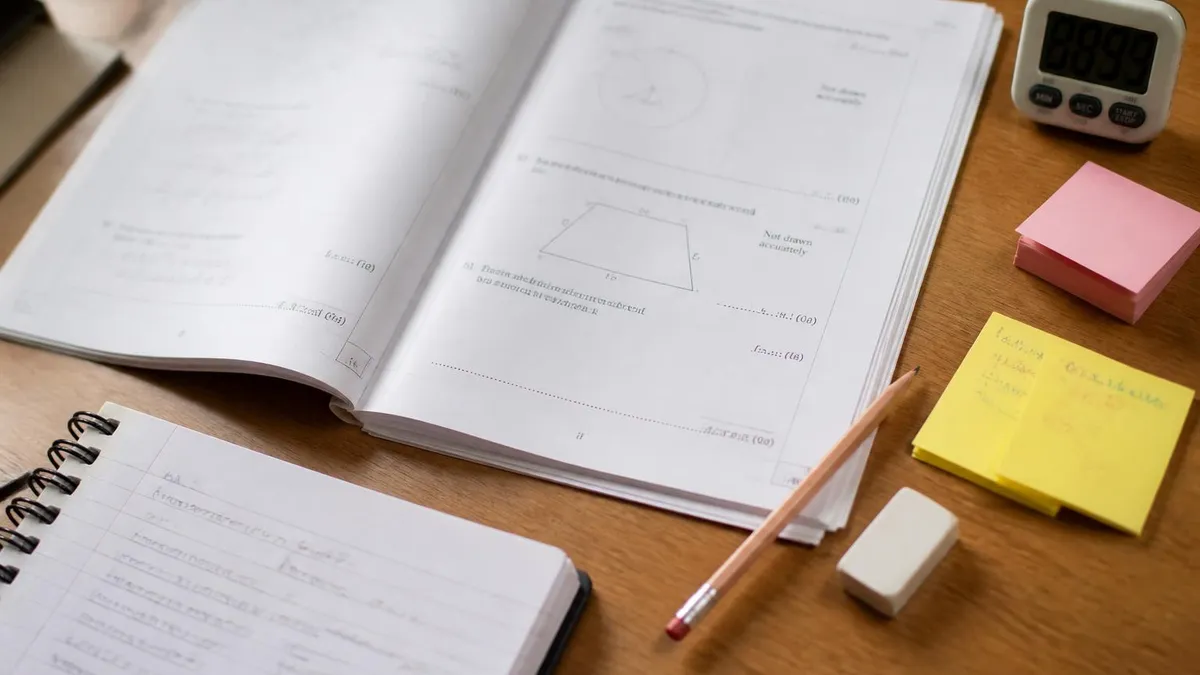
Now, about the exam boards. There are four big players in England and Wales, and you'll usually find out which one runs each of your subjects by checking the front cover of your textbook or asking your teacher. It's worth knowing — because hunting down the wrong board's gcse past papers is a common mistake that costs students hours of misdirected revision. Different boards even use slightly different terminology, so the practice you do for one won't fully transfer to another.
Each board publishes its own past papers, mark schemes, and examiner reports. The examiner reports are gold dust. They tell you exactly where students lost marks last year, which common misconceptions cropped up, and what the chief examiner wishes more candidates had done. Five minutes with an examiner report can change how you approach a topic for good. If you only read one thing from your board's website besides the papers themselves, make it the chief examiner's annual commentary.
GCSE Exam Boards Compared
Once you've identified your board and downloaded a stack of papers, the next question is how to actually use them. Most students make the same mistake — they treat a past paper like a worksheet, dipping in and out, checking answers as they go. That's not testing. That's reviewing. And it doesn't build the stamina or judgement you need for the real exam, no matter how many pages you tick off.
The single most useful habit you can develop is the full-paper sit-down. Phone off, timer running, no notes, no breaks. Even if you only do this once a fortnight per subject, the difference between students who do it and students who don't is enormous. The gcse mathematics questions on a Higher paper, for instance, build cognitive load across 90 minutes. If you've never practised that endurance, you'll fade in the last 20 minutes — and that's where the highest-mark questions live. Sitting one full paper a week from February onwards is a sensible target.
It also matters that you mark your own paper, at least the first time. Self-marking is uncomfortable. You'll feel the sting of every dropped mark in a way you don't when a teacher hands back a graded script. But that discomfort is exactly what cements the lesson. Students who mark their own work tend to remember their mistakes for weeks. Students who only ever get papers back already-marked tend to skim the feedback and move on.
Watch the specification dates. GCSE specifications were overhauled around 2015-2017, and any "gcse old papers" from before that period follow a different content structure and grading scale (A*-G rather than 9-1). They're still useful for technique practice — but don't rely on them for current content coverage. Always check the specification code on the front of the paper before you sit it.
If you want a structured way to use practice papers — one that genuinely moves the needle on your grades — here's a checklist that revision coaches across the country quietly recommend. It's not flashy. But students who follow it tend to see jumps of one or two grades over a term, especially in subjects where technique matters as much as content. The habits below work because they're cumulative: each one feeds the next, and skipping any single step makes the others less effective.
Notice what's not on the list — endless rewriting of notes, colour-coded flashcards you never test yourself with, or watching YouTube revision videos as background noise. Those activities feel productive, but they're what learning scientists call "fluency illusions": they trick your brain into thinking you've learned something when you've really just become familiar with it. Past-paper work, by contrast, is uncomfortable precisely because it surfaces what you don't yet know. That discomfort is the signal that real learning is happening.
How to Use GCSE Past Papers Effectively
- ✓Sit at least one full paper per subject every two weeks during the spring term — timed, undistracted, no notes.
- ✓Mark your own paper using the official scheme before checking a worked solution. Self-marking forces you to engage with the criteria.
- ✓Keep a "mistake log" — one line per error, what went wrong, and the topic. Revisit it weekly.
- ✓Always read the examiner's report for any paper you sit. Five minutes there is worth an hour of generic revision.
- ✓Mix paper types — don't just keep doing 2023's. Variety exposes you to a wider range of question structures.
- ✓Practise the start. The first ten marks of every paper are usually the most accessible — train yourself to bank them quickly and free up time for the harder back end.
- ✓Use a second timer for individual sections, not just the whole paper, so you build internal pacing without staring at the clock.
Now, there's a fair debate to be had about whether past papers should dominate revision or sit alongside textbook work. Both have their place — but they do different jobs. Textbooks teach. Practice papers test. Mix them up the wrong way and you'll either know loads but freeze in the exam, or you'll be sharp under pressure but full of gaps. The trick is balance, and it shifts as you get closer to the real test gcse dates each summer.
Early in the year — say, autumn term of Year 11 — your revision should lean about 70/30 toward learning content and 30 toward testing it. By spring term, flip that balance to 30/70. By Easter, you should be almost entirely in test-and-review mode, dipping back into the textbook only to plug specific gaps surfaced by your practice papers. That gradient mirrors how athletes train: skill-building early, race-rehearsal late.
Parents reading this often ask the same question: how do we tell whether our child is over-relying on either approach? A simple test — ask them to score a recent practice paper without looking at the mark scheme first, and see if their estimate matches. Students who over-rely on textbooks usually overestimate. Students who only do past papers without consolidating content tend to underestimate, because they recognise gaps but haven't yet plugged them. A good balance produces a self-estimate within five marks of the actual score.
There's also the question of resits. Maths and English GCSEs are unique in that students who don't achieve a grade 4 are typically required to resit them in November or the following summer. The autumn resit window is short and intense, so past-paper practice becomes even more critical — you've got perhaps eight weeks to retool your approach. Treat resits not as a repeat of the original campaign but as a fresh diagnostic exercise: which question types did you lose most marks on, and which can you genuinely improve in two months? Focus there.
Past Papers vs Textbook-Only Revision
- +Builds exam-day stamina and timing instincts that textbooks can't replicate.
- +Exposes you to authentic question wording, command words, and mark-scheme expectations.
- +Reveals your real weak spots — not just topics you think you don't know.
- +Provides instant, measurable progress through actual scores.
- +Free to access on every major exam board's website.
- +Builds confidence — sitting a paper you'd have failed in October and passing in March is genuinely motivating.
- −Won't teach you brand-new content — you still need a textbook or class notes first.
- −Risk of pattern-spotting that doesn't transfer if a question style changes.
- −Can feel demoralising early on when scores are low and topics aren't covered yet.
- −Mark schemes don't always explain WHY an answer earns marks — examiner reports help fill that gap.
- −Older papers may not match the current specification, especially in maths and sciences.
- −Without a teacher to spot-check your self-marking, you may over- or under-credit yourself.
One last thing worth saying — because students rarely hear it from teachers under exam pressure. The point of gcse testing isn't to define you. It's a checkpoint, not a verdict. Plenty of people who didn't hit their predicted grades at 16 went on to thrive at A-level, in apprenticeships, in careers nobody at school could've predicted.
So while practice papers matter — and they really do — don't let the prep eat your sleep, your friendships, or your sense of who you are outside of grades. Burnt-out students don't perform well, and recovery from exam burnout can take longer than the exam season itself.
That said, when you do sit down to revise, do it properly. Pick your board. Download three or four recent papers per subject. Set a timer. Mark honestly. Read the examiner's report. Repeat. By the time you walk into your real exams, the room won't feel unfamiliar — it'll feel like the dozenth time you've done this, because, well, it will be. Familiarity is the best antidote to exam-day nerves, and practice papers are how you manufacture it.
Bookmark this guide, share it with a friend who's also revising, and most importantly — go open a past paper this week. Not next week. Not after you've finished one more revision guide chapter. This week. The earlier you start treating your GCSE preparation like the rehearsal it really is, the more confident you'll feel when the actual papers land in front of you.
Below you'll find answers to the questions students and parents ask most often about GCSE practice tests, past papers, and question banks. If yours isn't covered, the exam board websites and your school's revision coordinator are the next best ports of call. Tutors and online forums can help too — but always sanity-check advice against the official specification before acting on it.
A final word of perspective. Every cohort of GCSE students thinks they've got it hardest. They might even be right — the 9-1 reforms made papers genuinely tougher than the legacy A*-G versions, and pandemic disruption left lasting gaps in some year groups. But difficulty is also the great equaliser. The students who put in the practice-paper hours are the ones who walk out of exam halls feeling like the questions matched what they'd rehearsed. That feeling — that calm recognition — is what good preparation buys you. And it starts with the very next paper you sit down to.
GCSE Questions and Answers
About the Author

Educational Psychologist & Academic Test Preparation Expert
Columbia University Teachers CollegeDr. Lisa Patel holds a Doctorate in Education from Columbia University Teachers College and has spent 17 years researching standardized test design and academic assessment. She has developed preparation programs for SAT, ACT, GRE, LSAT, UCAT, and numerous professional licensing exams, helping students of all backgrounds achieve their target scores.