
Why the Gaokao Exam Is So Hard: A Complete Guide for Students and Parents
Discover why the gaokao exam is tough, what makes it so demanding, and how students prepare. Real stats, subject breakdowns, and study tips. 🎓
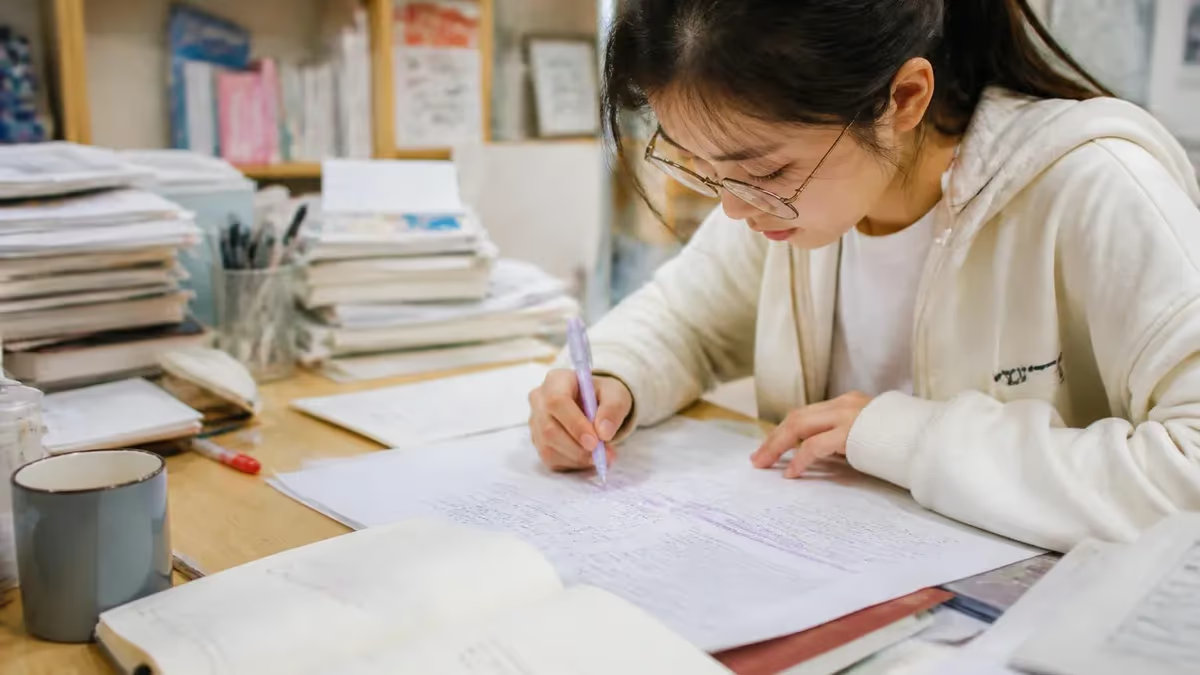
Few standardized exams in the world generate as much anxiety, preparation, and cultural weight as the gaokao. Short for Pǔtōng Gāoděng Xuéxiào Zhāoshēng Quánguó Tǒngyī Kǎoshì — the National College Entrance Examination of China — this single two-day test determines whether a student earns a place at a top university or must settle for a lesser option. Understanding why the gaokao exam is tough requires looking at its scope, its stakes, and the sheer competitive pressure that surrounds every seat in every testing hall across China.
The gaokao examination is taken by roughly 13 million students each year, all competing for a limited number of seats at elite universities. Peking University and Tsinghua University — China's most prestigious schools — admit only a fraction of a percent of test-takers. Even middle-tier universities have cutoff scores so high that a single bad morning can erase years of preparation. The exam does not offer retakes the following week; in most provinces, students must wait an entire year before sitting again, raising the emotional and practical cost of underperformance to extraordinary levels.
What makes the gaokao test genuinely difficult is not just its breadth but its precision. Questions are designed to separate students within the top five percent — meaning the exam is engineered to punish near-perfect knowledge rather than reward basic competence. A student who understands 90 percent of the curriculum thoroughly may still score in the middle of the pack, because the questions targeting the final ten percent of mastery are exactly where the rankings are decided. This philosophical approach to exam design is fundamentally different from most Western standardized tests.
The subjects covered span Chinese language and literature, mathematics, English (or another foreign language), and a choice of either science subjects (physics, chemistry, biology) or humanities subjects (history, politics, geography). Each subject demands years of study. Chinese literature questions reference classical texts spanning more than two thousand years of history. Math questions — particularly the gaokao math questions — routinely involve multi-step proofs, analytic geometry, and calculus problems that would challenge undergraduate students elsewhere in the world. English sections include dense reading passages, nuanced grammar questions, and a cloze test that requires command of idiomatic usage.
The cultural and social context of the gaokao amplifies the difficulty far beyond any individual question on the paper. Chinese families often restructure their entire lives in the years leading up to the exam. Parents may relocate to cities with better schools, quit jobs to supervise study schedules, or hire specialized tutors for every single subject.
Students routinely study twelve to fourteen hours per day in the final year of high school, sometimes called the "gaokao year." Sleep deprivation, psychological pressure from family expectations, and the knowledge that peers are doing the same creates an environment of relentless competition that has no obvious parallel in American education.
Regional inequality adds another layer of complexity. A student from Beijing faces a vastly different admissions landscape than a student from Henan province, where the exam population is massive but the number of locally allocated university seats is comparatively small. Rural students often lack access to the same quality of teachers, practice materials, or exam coaching that urban students receive as a matter of course.
This structural inequality means the gaokao is not simply a test of intelligence or hard work — it is also a test of access, geography, and socioeconomic circumstance. For American observers, understanding this context is essential to grasping just how much weight rests on each test question.
This article breaks down exactly why the gaokao examination is so demanding, covering its format, subject difficulty, competitive landscape, and the preparation strategies that top scorers use. Whether you are a student curious about international exams, a parent evaluating educational systems, or someone preparing to sit the gaokao yourself, the sections below give you a thorough, honest picture of what makes this test one of the most challenging academic assessments on the planet.
The Gaokao by the Numbers
Gaokao Exam Format and Structure
| Section | Questions | Time | Weight | Notes |
|---|---|---|---|---|
| Chinese Language & Literature | 22 | 150 min | ~19% | Classical texts, modern prose, essay |
| Mathematics | 21 | 120 min | ~19% | Algebra, calculus, analytic geometry, statistics |
| Foreign Language (English) | 55 | 120 min | ~19% | Reading, cloze, writing, listening (some provinces) |
| Science Track (Physics/Chem/Bio) | ~90 | 150 min combined | ~43% combined | Students choose science OR humanities track |
| Humanities Track (History/Pol/Geo) | ~90 | 150 min combined | ~43% combined | Alternative to science track |
| Total | ~180 (varies by province) | 9 hours (2 days) | 100% |
No single subject on the gaokao examination is easy, but each presents a distinct type of intellectual challenge. Understanding the difficulty profile of each subject helps students allocate study time strategically and gives outside observers a clearer sense of just how demanding this curriculum truly is. The subjects are not siloed — strong performance across all of them simultaneously is what separates top-scoring students from the rest of the field.
Chinese Language and Literature is perhaps the most underestimated section for non-Chinese observers. The exam draws on classical Chinese texts — wenyan wen — that have not been in everyday use for centuries. Students must read passages from Tang dynasty poetry, Song dynasty prose, and pre-Qin philosophical writing, then answer comprehension and analysis questions without dictionaries or reference materials. The modern prose section demands literary interpretation at a sophisticated level, and the final essay prompt requires a structured, nuanced argument of at least 800 characters, judged not just for content but for elegance of expression.
Mathematics is widely regarded as the most technically demanding section of the gaokao test. The curriculum covers algebra, trigonometry, analytic geometry, sequences and series, probability, statistics, and introductory calculus — all at a level that exceeds standard American high school AP coursework.
Gaokao math questions often chain multiple concepts together in a single problem, requiring students to apply integration, geometric reasoning, and algebraic manipulation within the same solution. The final two or three questions on the math paper — worth a disproportionate number of points — are designed so that only a tiny fraction of students can complete them fully and correctly.
English presents a different kind of challenge. The reading comprehension passages are dense academic texts on science, history, and social issues, written at a college reading level. The cloze test — a passage with 15 blanks to fill from a word bank — tests vocabulary depth, grammatical sensitivity, and contextual reasoning simultaneously.
The written expression section requires students to produce coherent, idiomatic English paragraphs under significant time pressure. Because English is a second language for virtually all test-takers, the gap between students who have had extensive exposure to authentic English and those who have studied primarily through grammar drills is enormous and often decisive.
For science track students, physics is notoriously punishing. Questions frequently involve multi-variable scenarios — electromagnetic fields, mechanics problems with friction and pulleys, thermodynamic systems — where a single arithmetic error cascades into total loss of marks for a problem. Chemistry demands not only factual recall of reactions and periodic properties but also the ability to design experimental procedures and analyze data from novel scenarios never seen in the textbook. Biology, while considered somewhat more accessible, still tests molecular mechanisms, ecological models, and genetic reasoning at a depth that would challenge first-year biology undergraduates at many American universities.
Humanities track subjects carry their own formidable demands. History questions require students to analyze primary sources, evaluate historical causation, and write structured essays connecting events across multiple dynasties and the modern era. Politics — more accurately described as Marxist theory and Chinese government ideology — requires precise recall of official doctrine combined with the ability to apply theoretical frameworks to current events. Geography combines physical and human geography in ways that demand quantitative reasoning alongside spatial thinking, often presenting students with data sets and maps that must be interpreted under strict time constraints.
The compound difficulty of mastering all these subjects at exam level simultaneously, in the same two-day window, is what truly distinguishes the gaokao from most other national exams. A student weak in one subject cannot compensate by excelling in another the way many admissions systems would allow — every point on every paper counts toward the single composite score that determines university placement. This all-or-nothing character of the scoring system is one of the most psychologically and academically demanding aspects of the entire gaokao experience.
What Makes Gaokao Exam Questions So Hard
Gaokao exam questions are engineered to discriminate at the very top of the score distribution. Rather than testing whether students understand core concepts — which most serious students do — the exam tests whether they can execute flawlessly under time pressure, apply multiple concepts in unfamiliar combinations, and maintain accuracy when problems become deliberately convoluted. The final questions in math and physics, for example, are constructed so that fewer than five percent of all test-takers can complete them correctly.
Each question type is carefully weighted and positioned on the paper to maximize psychological pressure as well as intellectual challenge. Early questions build confidence but also consume time; later questions demand more working memory and creative problem-solving. Students who have only practiced standard question types from textbooks are frequently thrown by the novel framing that gaokao questions use to disguise familiar underlying concepts — a deliberate design choice that rewards depth of understanding over pattern memorization.

The Gaokao System: Fairness vs. Pressure
- +Provides a single objective standard accessible to students regardless of personal connections
- +Eliminates subjective application processes like essays, interviews, and extracurricular portfolios
- +Creates strong incentive to master a rigorous, comprehensive academic curriculum
- +High scorers from poor rural backgrounds can access elite universities purely on merit
- +Produces graduates with exceptionally deep subject-matter knowledge in STEM fields
- +Encourages long-term academic discipline that often translates to professional excellence
- −Extreme psychological pressure leads to high rates of anxiety, burnout, and depression among students
- −Single-exam-determines-everything model punishes illness, family emergencies, and bad days
- −Rewards test-taking skill and memorization over creativity, curiosity, and independent thinking
- −Regional quota systems mean equally scored students face very different university outcomes
- −Massive private tutoring industry creates significant socioeconomic advantages for wealthier families
- −Twelve-plus years of exam-focused education can crowd out broader developmental experiences
Gaokao Exam Preparation Checklist
- ✓Complete at least five full-length timed mock gaokao exams before the actual test date.
- ✓Review all official past gaokao papers from the previous ten years for each subject.
- ✓Memorize all required classical Chinese poetry and prose passages on the official list.
- ✓Master every gaokao math question type including analytic geometry, sequences, and calculus.
- ✓Practice the English cloze test daily with vocabulary exercises targeting academic word lists.
- ✓Build a dedicated error notebook and revisit wrong answers every two weeks.
- ✓Study under realistic exam conditions — timed, no phone, same time of day as the actual test.
- ✓Identify your two or three weakest sub-topics per subject and drill them with targeted practice.
- ✓Work with a teacher or tutor to review essay writing technique in both Chinese and English.
- ✓Schedule deliberate rest and recovery days to prevent burnout in the final preparation month.

The Top 5% Is Where the Real Competition Happens
Most gaokao students understand the full curriculum well enough to answer 80 to 85 percent of exam questions correctly. The separation between an average score and a score that earns entry to a top-tier university happens almost entirely in the final 15 percent of questions — the ones designed to be solved by fewer than one student in twenty. Directing disproportionate preparation time toward these high-difficulty question types, rather than reviewing content you already know, is the single highest-leverage change most serious students can make to their study strategy.
The competitive pressure surrounding the gaokao extends far beyond the individual student. In China, the exam is a family event in a way that has no real equivalent in the United States. Parents organize their schedules around exam day with the same intensity they would bring to a family medical emergency.
Grandparents often relocate temporarily to help manage household logistics, cook specialized brain-boosting meals, and ensure that the testing student has no distractions whatsoever in the final weeks. Hotels near examination centers are booked solid by families who want their child to be within walking distance of the test hall, eliminating any risk of traffic delays.
The high school year immediately preceding the gaokao — the third year of senior high school, or gāosān — is structured entirely around exam preparation. Schools reduce or eliminate physical education, music, art, and other non-tested subjects entirely. The school day often runs from early morning into the evening, with mandatory self-study periods after dinner. Weekend outings, social events, and recreational screen time are generally prohibited or strongly discouraged by both school administrators and parents. For twelve months, the gaokao is effectively the only thing in a student's life.
Psychological support has become a growing concern within the Chinese educational system. Counselors report significant rates of anxiety disorders, sleep disorders, and depression among gaokao-year students. The weight of family expectation — particularly in families where the student would be the first college graduate, or where the family has made substantial financial sacrifices to support the student's education — creates a sense of obligation that many teenagers describe as overwhelming. Some students report feeling that their entire worth as a person is measured by their score, a narrative that educators and mental health advocates are actively working to counter.
Provincial variation in difficulty and competition adds yet another dimension to the pressure. Students in Henan, Shandong, and Hebei — three of China's most populous provinces — face the most intense competition per available university seat in the country.
A student from one of these provinces who scores 600 out of 750 may fail to qualify for a first-tier university, while a student from Beijing or Shanghai with an identical score might have their pick of top schools. This geographic lottery is one of the most debated aspects of the gaokao system, generating persistent calls for reform from education researchers, parents, and students alike.
The gaokao's difficulty is also amplified by the absence of a safety net that American students take for granted. In the United States, a student who performs poorly on the SAT can retake it multiple times, apply to a broad range of colleges using holistic criteria, transfer between schools, or take a gap year without significant stigma.
None of these options exist in the same form in China. The gaokao score determines everything in one moment, and the pathways for recovering from a poor result are genuinely limited, expensive, and socially complicated. This finality is perhaps the deepest reason why the exam generates such extraordinary levels of stress and preparation.
International observers are often surprised to learn that a meaningful number of Chinese students choose to take foreign standardized tests — the SAT, ACT, or A-levels — as an alternative pathway to overseas universities. For families with sufficient financial resources, studying abroad is partly a hedge against the extreme risk concentration of the gaokao. However, this option is available only to a wealthy minority. For the vast majority of China's 13 million annual test-takers, the gaokao remains the only viable path to higher education, reinforcing its status as the most consequential exam most of them will ever take.
Understanding this landscape helps explain why gaokao preparation culture has become a global export. Chinese students studying abroad, Chinese-American students whose parents insist on gaokao-style rigor, and international educators looking to raise academic standards have all contributed to growing global interest in gaokao content, practice materials, and preparation strategies. The exam's difficulty is not mythological — it is documented, measurable, and deeply real for everyone who sits it.
Gaokao registration windows typically open in November or December for the following June exam and close within a matter of weeks. Missing the registration deadline means waiting a full year to sit the exam again — there are no late registrations, no exceptions for technical difficulties, and no appeals process for missed windows. Students planning to take the gaokao for the first time, or retake after a previous attempt, should confirm their provincial registration calendar at least three months in advance and complete registration on the first available day.
Top-scoring gaokao students share a set of preparation habits that distinguish them from peers who study just as many hours but achieve lower results. These habits are not secrets — they are widely documented in Chinese educational research and increasingly studied by international educators interested in high-performance learning systems. What they share is a commitment to deliberate, structured, feedback-rich practice rather than passive review of familiar material. Looking at gaokao questions through the lens of what separates good scores from great scores reveals several consistent patterns worth examining closely.
The most effective preparation strategy consistently cited by high scorers is the systematic use of past papers under timed conditions. This is not the same as simply doing practice problems — it means simulating the exact conditions of the exam, including the time limits, the seating position, the absence of distractions, and the emotional state of performing under high stakes.
Students who have completed 20 or more full-length timed mock exams report significantly lower anxiety on actual exam day, because the experience of the test format is no longer novel. The cognitive overhead of managing time and pacing is reduced to near-zero, freeing mental resources for the actual problem-solving.
Error analysis is the second pillar of elite preparation. The highest-performing students do not just mark questions wrong and move on — they maintain detailed error notebooks in which every incorrect answer is categorized by type: conceptual misunderstanding, arithmetic error, misreading the question, or incomplete knowledge. Each category requires a different remediation strategy. Conceptual errors require re-studying the underlying theory. Arithmetic errors require slower, more deliberate calculation practice. Question misreads require training in careful reading under time pressure. Without this categorization, students tend to repeat the same types of errors indefinitely regardless of how many hours they study.
Subject-specific strategies matter enormously. For the math section, the most effective preparation involves mastering the standard problem types thoroughly before attempting the novel application questions. Students who try to tackle the hardest gaokao math questions before solidifying their foundation in sequences, vectors, and basic calculus typically develop bad habits and fragile understanding that fails under exam pressure. The correct sequencing — foundation mastery first, then application, then high-difficulty novel problems — produces dramatically better outcomes than skipping to advanced material prematurely.
For the Chinese language section, the single highest-leverage activity is reading classical Chinese texts actively rather than passively. Many students memorize poems and passages without truly understanding their grammatical structure, which means they can recall but cannot analyze. The exam rewards analysis. Students who read classical texts with a focus on understanding each particle, verb form, and syntactic structure — rather than just the overall meaning — are far better equipped to answer the interpretation questions that carry the most marks on the paper.
English preparation is most effective when it incorporates authentic English-language content alongside exam-specific drilling. Students who watch English-language documentaries, read English news articles, and listen to podcasts in addition to completing grammar exercises develop a more natural sense of idiomatic usage that directly benefits their performance on the cloze test and reading comprehension sections. The vocabulary depth required for top scores on the gaokao English section is genuinely substantial, and it is built more effectively through wide reading than through vocabulary list memorization alone.
Finally, the mental and physical health component of gaokao preparation cannot be dismissed as secondary. Research on learning and memory consistently shows that sleep deprivation impairs long-term retention, procedural memory consolidation, and executive function — all of which are directly relevant to exam performance. Students who sacrifice sleep for extra study hours in the weeks before the exam are, on average, harming rather than helping their scores. The elite preparation approach treats sleep, exercise, and nutrition as non-negotiable inputs to peak cognitive performance, not as luxuries to be sacrificed when time is short.
For students who want to understand or prepare for the gaokao from outside China's school system, the most important first step is getting honest about the gap between typical American high school preparation and gaokao-level expectations. The math curriculum alone extends well beyond AP Calculus BC into topics that most American students encounter only in their first or second year of college.
The classical Chinese literature requirements are simply not replicable without years of dedicated study starting in childhood. This is not a reason for discouragement — it is a reason to approach any gaokao preparation seriously and systematically from the beginning.
Practice materials are more accessible than ever before. Authentic past gaokao exam papers are available through official Chinese Ministry of Education channels and through numerous educational publishers. For gaokao math questions specifically, there are excellent English-language explainer resources that walk through solution methods for the high-difficulty problems that most distinguish the gaokao from other exams. Online communities of gaokao students and alumni share strategies, error analyses, and translated materials that can accelerate preparation significantly for self-directed learners.
One practical recommendation for international students or American students with Chinese heritage: treat gaokao practice as a supplement to, rather than a replacement for, your primary educational pathway. The analytical skills, mathematical depth, and reading comprehension demanded by the gaokao make it an exceptional training tool even for students who ultimately sit the SAT or ACT for college admission purposes. Many students who incorporate gaokao math practice into their SAT preparation report finding the SAT math section significantly easier as a result, because the gaokao has calibrated their difficulty baseline upward.
Study groups are particularly effective for gaokao preparation in ways they are not always effective for other exams. Because the curriculum is so broad and each student has different weak areas, peer teaching — where students take turns explaining topics to each other — produces much faster mastery than solo review.
When you explain a topic clearly enough for another person to understand it, you are forced to confront any gaps in your own understanding in a way that simply re-reading your notes does not. This pedagogical insight is backed by decades of learning science research and is widely applied in the most competitive Chinese high school programs.
Time allocation between subjects requires honest self-assessment. Most students naturally gravitate toward subjects they find easier or more enjoyable, which means they tend to over-prepare in their strengths and under-prepare in their weaknesses.
Because the gaokao composite score weights all subjects roughly equally, improving a weak subject by twenty points contributes exactly as much to your total as improving a strong subject by twenty points — and improving a weak subject by twenty points is usually far easier, because you are starting from a lower baseline. Ruthless allocation of study time to your lowest-scoring subjects is one of the highest-return strategies available in the final months of preparation.
The gaokao examination will likely continue evolving. China's Ministry of Education has introduced reforms in recent years aimed at reducing pure memorization demands, increasing the weight of analytical thinking, and eventually incorporating more project-based and skill-based assessment elements. The shift toward the "New Gaokao" format in an increasing number of provinces is gradually changing what the exam rewards. Students preparing for the gaokao today should ensure their preparation materials reflect the current format for their specific province, as the differences between old and new format papers are substantial enough to affect strategy meaningfully.
Ultimately, the gaokao is hard because it was designed to be hard, by a society that treats educational achievement as one of its most important cultural values. Its difficulty is not arbitrary or sadistic — it is a direct reflection of the genuine belief that rigorous academic standards produce better-prepared graduates and, ultimately, a more capable society. Whether or not one agrees with that philosophy, understanding it is essential to understanding why the gaokao exam continues to shape the lives of millions of young people each year, and why it commands respect and fascination far beyond China's borders.
gaokao Questions and Answers


About the Author

Educational Psychologist & Academic Test Preparation Expert
Columbia University Teachers CollegeDr. Lisa Patel holds a Doctorate in Education from Columbia University Teachers College and has spent 17 years researching standardized test design and academic assessment. She has developed preparation programs for SAT, ACT, GRE, LSAT, UCAT, and numerous professional licensing exams, helping students of all backgrounds achieve their target scores.