
Gaokao Top Score: What It Takes to Ace China's Most Competitive Exam
What is a gaokao top score? Learn how scoring works, what 700+ means, and how to prep for China's national exam. 🎯
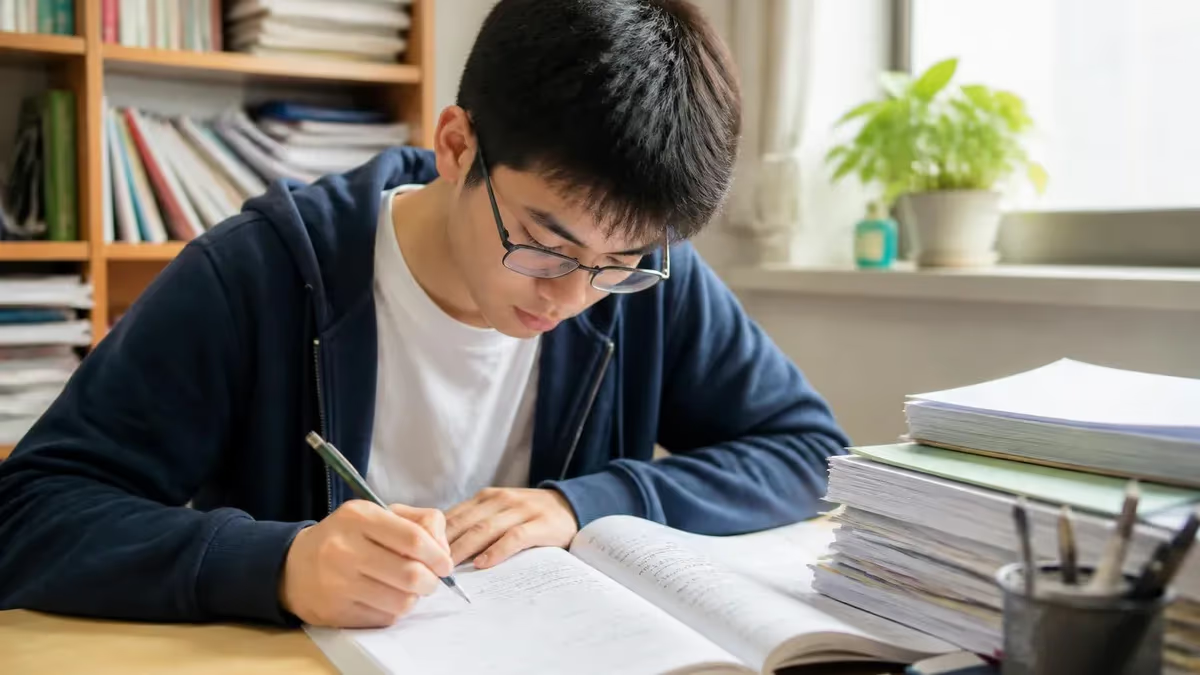
The gaokao top score is the gold standard of academic achievement in China — a number that can determine which university a student attends, what career paths open up, and even social status within a family. Earning a gaokao top score of 700 or above on a 750-point scale places a student in the top fraction of a percent of all test-takers, a group that typically earns admission to elite institutions like Peking University and Tsinghua University. For millions of students and their families, understanding the gaokao scoring system is the first essential step in preparing for this life-defining examination.
The gaokao examination is officially known as the National College Entrance Examination, or NCEE, and it is administered each June across every province of China. Approximately 12 to 13 million students sit for this test each year, competing for a limited number of spots at top-tier universities. The sheer scale of the competition makes a perfect or near-perfect gaokao top score extraordinary — scoring in the 700s means outperforming tens of thousands of exceptionally well-prepared peers who have spent years in dedicated study.
Understanding what constitutes a high score requires knowledge of the exam's structure. The gaokao is scored out of a maximum of 750 points in most provinces, covering Chinese language, mathematics, and English as compulsory subjects, plus elective science or humanities modules. Each subject contributes a defined portion to the total, and provincial scoring curves can shift the competitive threshold from year to year. What counts as a top score in one province may differ significantly from another due to population size and local university seat quotas.
For American students curious about the gaokao exam or international observers benchmarking global education systems, the difficulty is almost incomprehensible. The gaokao test lasts two days across multiple sessions, and preparation typically begins years in advance. High school curricula in China are largely structured around gaokao readiness, and supplemental tutoring, practice exams, and past-paper drilling are standard parts of student life from at least tenth grade onward. This intense preparation culture underscores why only a small fraction achieve gaokao top scores.
The stakes of gaokao scores extend beyond university admission. In China, a student's gaokao result is effectively a single-shot performance — there are limited opportunities to retake the exam, and the score follows a student through the university application process with no alternative standardized test accepted in its place at domestic institutions. This all-or-nothing structure amplifies both the pressure and the reward, making a gaokao top score not just academically meaningful but personally and socially significant.
Research into gaokao exam questions and score distributions shows that the highest-scoring students share common characteristics: extraordinary time management during the exam, deep mastery of edge-case problem types in mathematics, strong essay argumentation skills in Chinese, and consistent accuracy across all subjects with minimal careless errors. For students aiming at gaokao top scores, this means balancing breadth of knowledge with surgical precision under time pressure — a combination that demands both intelligence and rigorous, systematic practice over multiple years.
This article breaks down everything you need to know about gaokao top scores: how scoring works, what score thresholds matter, which subjects carry the most weight, how provincial differences affect your standing, and how to design a preparation strategy that maximizes your chances of reaching the highest tier. Whether you are a student preparing for the exam or a researcher studying China's education system, this guide provides a comprehensive, data-driven overview of what it truly takes to achieve an elite gaokao result.
Gaokao Top Score by the Numbers

Gaokao Exam Format & Scoring Structure
| Section | Questions | Time | Weight | Notes |
|---|---|---|---|---|
| Chinese Language | 23 | 150 min | 20% | Compulsory for all students |
| Mathematics | 22 | 120 min | 20% | Separate Science and Arts versions |
| English | 25 | 120 min | 20% | Includes listening and reading |
| Science Electives (Physics/Chem/Bio) | 40 | 150 min | 40% | Science track students |
| Humanities Electives (History/Geo/Politics) | 40 | 150 min | 40% | Humanities track students |
| Total | 150 | 2 Days (approx. 9 hours total) | 100% |
Achieving a gaokao top score requires understanding precisely where the elite score boundaries fall and why they matter so much in the university admissions process. In most provinces using the traditional 750-point system, a score of 700 or above is widely considered an elite-tier result. Scores in this range are typically required for admission to China's top two universities — Peking University (Beida) and Tsinghua University — both of which rank among Asia's finest academic institutions and carry enormous prestige in Chinese society and the global academic community.
The score thresholds for top schools are not fixed; they shift annually based on the difficulty of that year's exam, the provincial cutoff lines established by education bureaus, and the overall distribution of student performance. In competitive provinces like Henan, Shandong, and Sichuan — which have enormous student populations relative to top-university seat allocations — the effective threshold for elite schools can be even higher than in less populated provinces. A student scoring 690 in Henan might face far steeper competition than a student with the same score in a smaller province like Qinghai or Tibet.
The gaokao examination scoring breakdown by subject also matters enormously when calculating where a student stands. The three compulsory subjects — Chinese, Math, and English — each contribute 150 points to the total, accounting for 450 out of 750 possible points. Students who aim for a gaokao top score must excel in all three, but mathematics is typically considered the highest-use subject because score spread is greatest there. A student who scores 145 in math versus 120 gains a substantial advantage that can be difficult to compensate for with small gains in other subjects.
For students pursuing the science track, the elective subjects — physics, chemistry, and biology — contribute the remaining 300 points, each scored out of 100 in many provincial systems (though specific configurations vary). A gaokao top score in the science stream requires both mastery of compulsory humanities-adjacent content like classical Chinese essays and precision in quantitative reasoning across multiple scientific domains. This breadth is one of the exam's defining characteristics and explains why preparation begins so early in secondary school.
One critical insight about gaokao top scores is the role of the writing component in Chinese language. The composition section, worth approximately 60 out of 150 points, requires students to write a formal argumentative or expository essay responding to a prompt. High-scoring essays demonstrate sophisticated reasoning, precise vocabulary drawn from classical and modern Chinese literature, structural clarity, and ideological alignment with national educational values. Essays that score in the top tier — consistently above 55 points — often make the difference between a score of 690 and 710, pushing a student from the excellent tier into the elite tier.
Students using gaokao examination practice resources can benchmark their performance against historical score distributions and identify which subject areas offer the most room for improvement. Analyzing past years' cutoff scores for target universities, combined with personal mock exam results, allows students to prioritize their remaining study time strategically. The goal is not simply to study harder across all subjects equally but to maximize marginal gains in the areas where improvement is most achievable and most impactful on the final total.
It is also important to understand the psychological dimension of gaokao top score performance. Students who consistently score in the 680–700 range on practice exams often fail to match that performance on exam day due to anxiety, sleep disruption, or failure to manage time effectively during the actual test. Developing mental resilience, exam-day routines, and time management protocols for each section is just as important as content knowledge when pursuing a top score. Elite scorers typically train themselves to work through difficult problems methodically without panic and to skip and return strategically rather than getting stuck on any single item.
Gaokao Test Score Strategies by Subject
Mathematics is the highest-variance subject on the gaokao test, meaning it separates top scorers from average scorers more dramatically than any other section. The 150-point math section includes fill-in-the-blank items, multiple-choice questions, and multi-step constructed response problems covering algebra, trigonometry, sequences, statistics, and analytic geometry. Elite scorers consistently secure all available points on the easier front-loaded questions and allocate additional time to complex proof-based problems at the end.
To achieve a near-perfect math score, students typically need two to three years of targeted practice with gaokao-style problem sets, working through past exam papers year by year and identifying recurring problem structures. Conic sections — ellipses, hyperbolas, and parabolas — are perennial high-difficulty topics that reward deep conceptual understanding over rote memorization. Students aiming for 140 or above should master these topics thoroughly, including non-standard configurations that appear in the final two or three problems of the section.
Gaokao Top Score: Rewards vs. Challenges
- +Guaranteed admission consideration at China's most prestigious universities
- +Opens doors to highly competitive majors like medicine, law, and engineering
- +Provides lifetime social prestige and career networking advantages
- +Can earn significant financial scholarships at top Chinese institutions
- +Demonstrates world-class academic discipline to international graduate programs
- +Creates a strong foundation for lifelong analytical and problem-solving skills
- −Requires years of intensive study that can limit social and extracurricular development
- −A single exam day determines the outcome — high-pressure, low-margin for error
- −Provincial score disparities mean equal effort yields unequal admission chances
- −Mental health challenges from sustained high-pressure academic environments are common
- −Narrow focus on tested subjects can leave gaps in broader education
- −Top university admission does not guarantee job placement in a competitive economy
Pros and Cons at a Glance
| Pros | Cons |
|---|---|
| Guaranteed admission consideration at China's most prestigious universities | Requires years of intensive study that can limit social and extracurricular development |
| Opens doors to highly competitive majors like medicine, law, and engineering | A single exam day determines the outcome — high-pressure, low-margin for error |
| Provides lifetime social prestige and career networking advantages | Provincial score disparities mean equal effort yields unequal admission chances |
| Can earn significant financial scholarships at top Chinese institutions | Mental health challenges from sustained high-pressure academic environments are common |
| Demonstrates world-class academic discipline to international graduate programs | Narrow focus on tested subjects can leave gaps in broader education |
| Creates a strong foundation for lifelong analytical and problem-solving skills | Top university admission does not guarantee job placement in a competitive economy |
Gaokao Top Score Preparation Checklist
- ✓Complete at least five full years of gaokao past exam papers under timed conditions
- ✓Build a subject-specific error log and review every missed question within 24 hours
- ✓Master conic sections and sequence proofs — the highest-difficulty math topics on the gaokao
- ✓Write one timed argumentative essay per week and get graded feedback on each
- ✓Complete at least 200 English cloze practice passages to build contextual vocabulary speed
- ✓Memorize 30 to 50 classical Chinese passages including grammar and interpretation notes
- ✓Study provincial cutoff data for your target universities across the last five years
- ✓Simulate full two-day exam conditions at least twice before the actual test date
- ✓Track your mock exam scores monthly and identify the three lowest-performing subsections
- ✓Develop an exam-day routine including sleep schedule, meal timing, and warm-up strategies

Mathematics Alone Can Decide Your Tier
On the gaokao, a 20-point swing in mathematics — the difference between a 120 and a 140 — frequently determines whether a student earns admission to a top-10 university or a second-tier institution. Because math score variance is higher than any other subject, prioritizing math mastery typically delivers the highest return on study time investment. Students aiming for 700+ should target a minimum math score of 135 before considering their preparation complete.
China's gaokao system is not a single uniform exam — it is a provincially administered national examination, and this distinction has profound implications for what a top score means in practice. The 31 provinces, autonomous regions, and municipalities each set their own cutoff lines for first-tier universities, meaning a score of 680 can represent very different competitive standing depending on where a student sits the exam. Understanding provincial score dynamics is essential for any student or parent trying to interpret gaokao results in context.
Beijing and Shanghai operate under special systems that differ significantly from the rest of the country. Shanghai, for example, has implemented a new gaokao reform model — sometimes called the New Gaokao — in which students choose three elective subjects from a pool rather than following rigid science or humanities tracks. Under this system, scores are partially calculated using rank-based grade assignments rather than raw totals, which changes the competitive dynamics considerably. Students in these reform provinces need to understand both the raw score and the rank-band implications of their performance.
In provinces like Henan and Shandong, where populations exceed 100 million and the ratio of gaokao candidates to top-university seats is extremely unfavorable, the competition for elite scores is arguably the most intense in the world. Students from these provinces routinely study for 14 to 16 hours a day during the final year of high school, attend intensive summer prep programs, and take dozens of mock exams to calibrate their readiness. A student scoring 700 in Henan has typically outperformed hundreds of thousands of peers — a feat that carries immense statistical significance.
Smaller autonomous regions and minority-majority provinces often have policies that boost effective scores for local ethnic minority students, providing additional points or lowering the admission threshold for certain university categories. These policies reflect a deliberate effort to balance educational equity across China's diverse geography and demographic landscape. International observers studying the gaokao examination system sometimes misunderstand these regional score adjustments, interpreting raw provincial cutoffs without accounting for local policy modifiers.
For students studying gaokao questions and score data from outside China, the provincial dimension is one of the most important factors to understand. Standardized comparison sites and academic studies frequently report average national scores, but these aggregates mask enormous within-country variation. A score at the 95th percentile nationally might only represent the 85th percentile in a hyper-competitive province — and vice versa. Any serious analysis of gaokao top scores must disaggregate data by province to be meaningful.
Students preparing for the gaokao exam in regions with reform-based scoring systems — where rank bands replace raw totals for elective subjects — need to recalibrate their study strategies accordingly. In these systems, maximizing raw points on electives matters less than avoiding rank-band drops, which means strategic subject selection at the beginning of high school becomes a significant competitive decision. Choosing electives where a student has natural strength and where provincial competition is relatively thinner can meaningfully improve the effective final score and university admission outcome.
Comparative analysis of gaokao math questions across provinces also reveals meaningful difficulty differences. Some provinces historically produce more straightforward math sections while others feature notoriously complex final problems that challenge even the most advanced students. Reviewing gaokao exam questions from multiple provinces over multiple years provides the broadest possible preparation base, particularly for students who want to ensure they can handle any difficulty configuration they encounter on the actual test day.
University admission cutoff scores for the gaokao are recalculated annually based on exam difficulty and the national score distribution — a score that earned admission to a top university last year may fall short this year. Students should track five-year cutoff trends for each target school rather than relying on any single year's data. Consult your provincial education bureau's official published cutoff tables before drawing conclusions about competitiveness.
The study strategies that consistently produce gaokao top scores share a common architecture: spaced repetition for foundational knowledge, deliberate practice on high-difficulty question types, regular full-length simulation exams, and systematic error analysis. Students who achieve scores above 700 rarely do so through heroic last-minute cramming — they have built layered, durable knowledge structures over years of consistent effort, and their exam-day performance reflects that accumulated preparation rather than a sudden surge of ability.
Spaced repetition is particularly powerful for the English and Chinese vocabulary components of the gaokao. Research in cognitive science consistently shows that reviewing material at increasing intervals — revisiting a word or concept one day, three days, one week, and two weeks after initial learning — produces significantly stronger long-term retention than massed study. Students who build vocabulary flashcard systems with spaced repetition software from tenth grade onward typically arrive at the gaokao exam with 8,000 to 10,000 English vocabulary items accessible at exam speed, far more than those who cram lists in the final month.
For gaokao math questions, the most effective study approach is not reading through solved examples but rather attempting problems independently before consulting solutions. This retrieval-practice principle — forcing the brain to actively reconstruct a problem-solving approach rather than passively recognizing it — builds the strong, flexible mathematical reasoning that top gaokao scorers display. Students who can only solve a problem type when shown a similar example first are vulnerable to novel variations in the exam; students who have internalized the underlying structure can adapt to any configuration presented.
Time management during the actual gaokao test is a skill that must be explicitly trained, not assumed. Each section has specific time allocations, and students who practice under strict time limits consistently outperform those who study without time pressure.
On the mathematics section, for example, elite scorers typically allocate no more than 4 minutes per multiple-choice item, 5 to 6 minutes per fill-in-the-blank, and reserve the final 45 minutes for the two or three multi-step constructed response problems at the end. Deviating from this allocation — spending 12 minutes on a single multiple-choice problem — is a common error that costs students in the final score tally.
Reviewing gaokao questions from multiple test years should be a structured, analytical process rather than simply working through problems and checking answers. After each practice session, students benefit most from categorizing every error by type: was it a conceptual misunderstanding, a procedural error, a reading comprehension mistake, or a careless arithmetic slip? Each error type demands a different remediation strategy. Conceptual errors require re-learning the underlying principle; procedural errors require additional repetition; careless errors require exam-condition practice to build attention habits.
Sleep and physical health play a larger role in gaokao top score performance than most students and parents acknowledge. Neuroscience research consistently demonstrates that memory consolidation happens primarily during deep sleep — the night after studying a difficult concept is when that material is transferred from short-term to long-term memory. Students who sacrifice sleep to extend study hours are literally undermining the effectiveness of their preparation. Elite gaokao scorers typically maintain 8-hour sleep schedules even during the most intense preparation periods, treating sleep discipline as a non-negotiable part of their performance strategy.
The two weeks immediately before the gaokao exam should be treated as a performance-optimization phase rather than a content-cramming phase. Students who have prepared systematically over years should use this period to review their most reliable strong areas — reinforcing confidence rather than introducing anxiety-producing new material — and to fine-tune their time management and exam-day protocols. Practicing two or three full simulated exams during this window, under as realistic conditions as possible, allows any remaining strategic adjustments to be identified and corrected before the real test date arrives.
Building a practical, week-by-week gaokao preparation plan in the final year of high school requires balancing school coursework, independent study, mock exams, and recovery time. Most top-scoring students follow a structured schedule that dedicates approximately 4 to 6 hours of independent study daily beyond school hours during the regular academic year, increasing to 8 to 10 hours daily during the final two to three months before the exam. This level of study demands rigorous self-discipline and strong support from family and teachers.
Subject rotation is an important design principle in gaokao preparation schedules. Spending entire days exclusively on mathematics — while neglecting Chinese or English — produces subject-level burnout and weakens the cross-subject balance that top scores require. Elite preparation programs typically rotate subject focus across the week, ensuring that each subject receives dedicated attention while also scheduling integration days where students work through full mock exam sections to maintain holistic readiness. This rotation strategy mirrors the structure of the actual two-day exam and prevents any single subject from atrophying.
Mock exam analysis deserves a dedicated weekly review session. Students who simply complete mock exams and glance at their total score miss the diagnostic value these tests provide. A thorough post-exam review involves categorizing every incorrect response, identifying patterns in the error types, reviewing the official solution methods for all difficult problems, and updating study priorities for the following week. This iterative feedback loop — exam, analyze, adjust, re-study, re-examine — is the engine that drives score improvement from the good-but-not-elite range into the top tier.
Peer study groups can be enormously valuable for certain types of gaokao preparation, particularly for Chinese essay practice and English conversation preparation. Having peers evaluate essay drafts provides a different perspective than self-assessment, and explaining mathematical problem-solving approaches to a study partner reinforces the explainer's own understanding through the act of articulation. However, study groups work best when they are tightly structured with defined goals and time limits — unstructured group study frequently devolves into social conversation that consumes preparation time without producing learning outcomes.
Many students preparing for elite gaokao scores work with private tutors, particularly for mathematics and Chinese writing. The most effective tutoring relationships are not characterized by tutors solving problems for students but rather by tutors asking probing questions that help students identify their own reasoning errors and reconstruct correct solution pathways.
A tutor who consistently shows a student how to solve problems — without requiring the student to struggle through the approach independently — produces temporary performance improvement that does not transfer to independent exam conditions. Authentic gaokao top score preparation requires that students develop the ability to solve problems without assistance.
In the final two months before the gaokao, emotional support from family is as important as academic preparation. Research on high-stakes exam performance consistently identifies parental anxiety as a significant risk factor for student underperformance — when parents express fear, doubt, or excessive pressure, students internalize those emotions and bring them into the exam room. Families of students targeting gaokao top scores can support performance most effectively by maintaining calm, expressing confidence, ensuring excellent nutrition and sleep conditions at home, and refraining from adding last-minute academic pressure to an already high-stakes situation.
Ultimately, achieving a gaokao top score is the result of a long-term investment in disciplined, intelligent preparation rather than any single study technique or last-minute strategy. The students who consistently reach the 700-plus tier share a combination of natural academic aptitude, relentless work ethic, strategic preparation planning, physical and mental health management, and strong family and teacher support. For those willing to commit fully to this demanding preparation journey, the gaokao examination represents one of the world's most rigorous and consequential academic achievements — and reaching its summit opens doors that few academic credentials elsewhere can match.
Sample Gaokao Exam Practice Questions
Try these questions from our free Gaokao Exam practice tests. The correct answer and an explanation follow each question.
In the 'speeding father' story, what does the father's final silence most likely represent?
- A. Anger at being corrected by his child.
- B. A sudden realization of his hypocrisy and a sense of shame.
- C. Confusion about what the child meant.
- D. Deciding to ignore the child and continue speeding.
Answer: B. A sudden realization of his hypocrisy and a sense of shame.
The father's silence is a turning point. It's not just an admission of being wrong, but a moment of profound realization and introspection, possibly accompanied by shame. The child's simple, principle-based logic has defeated his adult, consequence-based logic, forcing him to reflect on his own values.
What was the most profound and lasting historical achievement of the 1911 Revolution (Xinhai Revolution)?
- A. It established a stable and powerful central government.
- B. It ended over two millennia of imperial monarchy in China.
- C. It completely eliminated foreign influence in China.
- D. It successfully implemented widespread land reform.
Answer: B. It ended over two millennia of imperial monarchy in China.
While the revolution did not immediately create a stable republic or expel all foreign influence, its most significant achievement was the overthrow of the Qing dynasty. This act ended more than two thousand years of imperial dynastic rule in China and established, at least in name, Asia's first republic.
When writing an essay based on the Go prompt, what is the most balanced and robust central argument to develop?
- A. One should always be creative and avoid fundamental moves at all costs.
- B. Mastering the fundamentals is the necessary foundation for achieving true innovation.
- C. It is better to play safe with fundamental moves than to risk making a poor move.
- D. The only goal in any field is to create a brilliant, unexpected '妙手'.
Answer: B. Mastering the fundamentals is the necessary foundation for achieving true innovation.
The prompt explicitly states that beginners start with '本手' and that chasing '妙手' can lead to '俗手'. This establishes a clear relationship: true, brilliant innovation ('妙手') must be built upon a deep understanding and mastery of the fundamentals ('本手'). This argument is the most complete interpretation of the material.
A regular quadrilateral (square) pyramid has a base side length of 4 and a height of 2√2. What is the angle between a lateral edge and the base?
- A. 30°
- B. 60°
- C. 45°
- D. arctan(√3)
Answer: C. 45°
The half-diagonal of the square base is (4√2)/2 = 2√2. The lateral edge length = √(height² + half-diagonal²) = √(8 + 8) = 4. Thus cos θ = (2√2)/4 = √2/2, giving θ = 45°.
gaokao Questions and Answers



About the Author

Educational Psychologist & Academic Test Preparation Expert
Columbia University Teachers CollegeDr. Lisa Patel holds a Doctorate in Education from Columbia University Teachers College and has spent 17 years researching standardized test design and academic assessment. She has developed preparation programs for SAT, ACT, GRE, LSAT, UCAT, and numerous professional licensing exams, helping students of all backgrounds achieve their target scores.