
FDNY Jobs: Careers, Salaries, and How to Get Hired by the Fire Department of New York
✍🏼 FDNY jobs guide — explore firefighter, EMT, paramedic, and civilian careers, salaries, requirements, and the full hiring process for the FDNY.
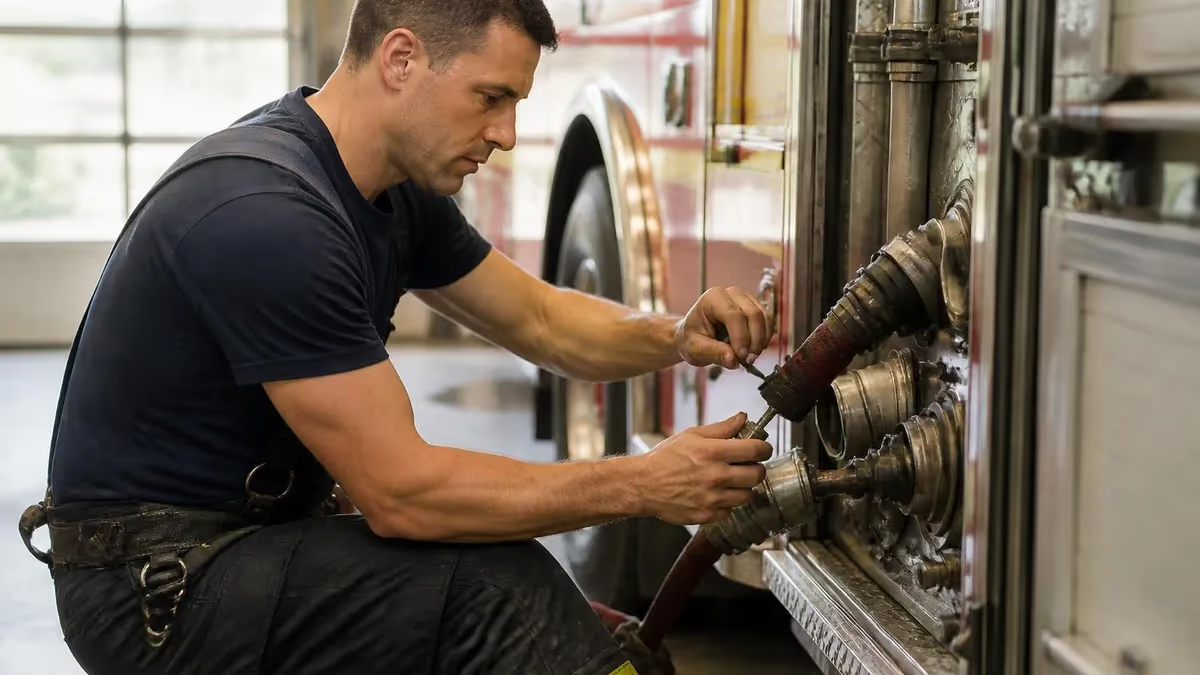
FDNY jobs are among the most respected public service careers in the United States, attracting tens of thousands of applicants each filing cycle for positions that combine physical challenge, lifesaving impact, and long-term financial stability. The Fire Department of New York employs roughly 17,000 uniformed and civilian personnel across firefighting, emergency medical services, fire prevention, dispatch, marine operations, and administrative support. Whether you want to ride the rigs, drive an ambulance, or work behind the scenes in logistics, the FDNY has a structured path that rewards preparation, fitness, and persistence.
The most well-known FDNY jobs sit on the uniformed side — firefighter, EMT, paramedic, fire marshal, and fire inspector — but the department also hires civilians in dozens of specialties including IT, fleet maintenance, communications, human resources, and community outreach. Hiring cycles vary by title. Firefighter exams typically open every four years, while EMT and paramedic recruitment runs almost continuously because turnover in EMS is higher and the department is constantly expanding ambulance tours to meet rising call volume across the five boroughs.
Pay and benefits at the FDNY are competitive with any municipal employer in the country. A probationary firefighter starts around $45,000 to $50,000, climbs past $85,000 after five years on the job, and can exceed $110,000 with overtime, holiday pay, and longevity bonuses. EMTs and paramedics earn less at entry but follow a clear promotional ladder. Civilian salaries depend on title and union, but most positions include the same city pension, health coverage, and tuition reimbursement that uniformed members receive.
The hiring process is long. From the day you file for the firefighter exam to the day you walk into the Fire Academy on Randall's Island, two to four years often pass. EMT candidates move faster — sometimes only a few months from application to orientation — but still face medical screening, background investigation, drug testing, and a Candidate Physical Ability Test or its EMS equivalent. Understanding each gate and what disqualifies applicants is half the battle.
This guide walks through every major FDNY job title, current salary ranges, the step-by-step hiring process, residency and education requirements, common disqualifiers, and study strategies that work. We pull from official FDNY recruitment notices, civil service notices of examination, union contracts, and feedback from candidates who recently completed each stage. If you are serious about a career with New fdny nypd hockey game, the information below will save you months of guesswork.
FDNY careers attract people from every background — military veterans, college graduates, second-career changers, and lifelong New Yorkers whose parents or grandparents wore the uniform before them. There is no single profile that succeeds. What unites successful candidates is preparation: knowing what the test measures, training the right muscle groups for the CPAT, gathering documentation early, and staying out of trouble during the long background phase. Read on for the full breakdown.
For broader context on department operations and the testing pipeline, the FDNY (Fire Department New York) Test: Your Guide walks through every uniformed exam in detail. This article focuses specifically on jobs, pay, and how to land one.
FDNY Jobs by the Numbers

Major FDNY Job Titles and What They Do
Frontline uniformed member assigned to an engine or ladder company. Responds to fires, medical emergencies, hazmat calls, and rescues. Requires CPAT, written exam, medical, and academy graduation.
Emergency Medical Technician staffing FDNY ambulances. Provides basic life support, transports patients, and is often the first medical responder on scene. Entry-level path into EMS with a clear promotion ladder.
Advanced life support provider with expanded scope including IV therapy, cardiac medications, and intubation. Requires paramedic certification plus FDNY-specific protocol training and field evaluation.
Sworn law enforcement officer investigating fires for cause and origin, including arson cases. Recruited from experienced firefighter ranks and trained at the Bureau of Fire Investigation.
Non-uniformed roles in IT, fleet, communications, dispatch, HR, finance, and community affairs. Filled through standard NYC civil service exams or open competitive postings on DCAS.
Salaries for FDNY jobs follow a step-based schedule negotiated by the Uniformed Firefighters Association, the Uniformed Fire Officers Association, and DC 37 for EMS and civilian titles. The structure is transparent and predictable, which is one reason these careers remain attractive even in a tight labor market. Your base pay is set by years of service, your title, and any specialty assignments. Overtime, holiday differentials, and night-shift premiums layer on top.
A probationary firefighter in 2026 starts at roughly $47,000 during academy training, jumps to approximately $54,000 after graduation, and climbs through annual steps until reaching top pay near $89,000 at the five-year mark. Add holiday pay, night differential, longevity bonuses, and routine mutual-exchange overtime, and most senior firefighters clear $110,000 to $130,000 in W-2 income. Members assigned to Rescue, Squad, Marine, or Hazmat units often earn additional specialty stipends on top.
EMT pay starts lower — around $39,000 for a probationary EMT — but climbs to roughly $59,000 at the five-year top step. Paramedics earn significantly more, starting near $53,000 and topping out above $75,000 in base pay, with overtime pushing many over $100,000. Lieutenants in EMS and fire ranks add another tier, and captain, battalion chief, and deputy chief positions can exceed $200,000 with all premium pay included.
Benefits are equally important. FDNY members receive comprehensive health insurance for themselves and dependents, a defined-benefit pension administered by the New fdny hiring Fire Pension Fund, deferred compensation options, paid vacation that grows with seniority, unlimited sick leave for line-of-duty injuries, tuition reimbursement, and access to the FDNY Family Assistance Unit for personal and financial counseling. Civilian members typically participate in NYCERS rather than the fire pension but receive similar health and leave packages.
The pension is a major draw. Uniformed members can retire after 20 or 25 years of service depending on tier, often in their early to mid-forties, with a pension equal to roughly half of their final-year compensation. Many retirees take second careers in private fire protection, insurance, or emergency management while collecting a full FDNY pension, effectively double-dipping into retirement income for decades.
Job security is another factor. Layoffs of uniformed FDNY members are essentially unheard of. The department operates under city charter mandates that require minimum staffing levels, and civil service protections make termination difficult absent serious misconduct. For families looking at long-term stability, few employers in the country can match what FDNY offers. The FDNY Foundation: How the Official Nonprofit Supports New York's Bravest also funds scholarships and family programs that supplement these benefits.
Finally, consider the soft compensation. FDNY members get reciprocity at fire departments nationwide, access to a tight brotherhood and sisterhood, opportunities to teach at the Fire Academy or work specialized details, and the satisfaction of public-facing work that genuinely saves lives. These are not perks you can put on a pay stub, but they explain why turnover among firefighters is among the lowest of any large employer in New York.
FDNY Practice Test Questions
Prepare for the FDNY - Fire Department New York exam with our free practice test modules. Each quiz covers key topics to help you pass on your first try.
FDNY Building Construction
FDNY Exam Questions covering Building Construction. Master FDNY Test concepts for certification prep.
FDNY Community Engagement and Public Educa...
Free FDNY Practice Test featuring Community Engagement and Public Education. Improve your FDNY Exam score with mock test prep.
FDNY Emergency Medical Response
FDNY Mock Exam on Emergency Medical Response. FDNY Study Guide questions to pass on your first try.
FDNY Emergency Medical Services
FDNY Test Prep for Emergency Medical Services. Practice FDNY Quiz questions and boost your score.
FDNY Hazardous Materials Response
FDNY Questions and Answers on FDNY Hazardous Materials Response. Free FDNY practice for exam readiness.
FDNY Technical Rescue Operations
FDNY Mock Test covering FDNY Technical Rescue Operations. Online FDNY Test practice with instant feedback.
FDNY Fire Behavior
Free FDNY Quiz on Fire Behavior. FDNY Exam prep questions with detailed explanations.
FDNY Firefighting Operations and Equipment
FDNY Practice Questions for Firefighting Operations and Equipment. Build confidence for your FDNY certification exam.
Eligibility Requirements for FDNY Jobs
To apply for FDNY firefighter, you must be at least 17.5 years old to file, no older than 28 at the date of filing (with allowable military extensions up to age 35), hold a high school diploma or GED, and possess a valid driver's license by appointment. U.S. citizenship is required before academy entry, and you must live within the five boroughs or designated nearby counties by your start date.
You also need to pass a written civil service exam, the Candidate Physical Ability Test (CPAT), a comprehensive medical exam, a psychological evaluation, drug screening, and a thorough background investigation. Felony convictions and serious misdemeanors can disqualify candidates, though the department reviews each case individually. Tattoos, prior driving record, and credit history may also be reviewed during background.
Pros and Cons of an FDNY Career
- +Competitive pay with strong overtime opportunities and longevity bonuses
- +Defined-benefit pension allowing retirement after 20 or 25 years of service
- +Comprehensive health insurance for member and dependents at low cost
- +Tight-knit culture and lifelong professional network across the department
- +Public-facing work with daily, tangible impact on community safety
- +Tuition reimbursement and clear internal promotion pathways
- +Job security backed by civil service protections and city charter staffing
- −Physically demanding work with real exposure to fire, trauma, and toxic environments
- −Long, unpredictable hiring timelines — often two to four years for firefighter
- −Shift work including 24-hour tours that disrupt family and sleep schedules
- −Mental health toll from cumulative trauma and high-acuity EMS calls
- −Strict residency rules that limit where members can live
- −High washout rate during the CPAT and Fire Academy probationary period
- −Disciplinary process can be slow and stressful even for minor infractions
Pros and Cons at a Glance
| Pros | Cons |
|---|---|
| Competitive pay with strong overtime opportunities and longevity bonuses | Physically demanding work with real exposure to fire, trauma, and toxic environments |
| Comprehensive health insurance for member and dependents at low cost | Long, unpredictable hiring timelines — often two to four years for firefighter |
| Tight-knit culture and lifelong professional network across the department | Mental health toll from cumulative trauma and high-acuity EMS calls |
| Public-facing work with daily, tangible impact on community safety | Strict residency rules that limit where members can live |
| Tuition reimbursement and clear internal promotion pathways | High washout rate during the CPAT and Fire Academy probationary period |
| Job security backed by civil service protections and city charter staffing | Disciplinary process can be slow and stressful even for minor infractions |
FDNY Jobs Application Checklist
- ✓Confirm you meet age, citizenship, and education requirements for your target title
- ✓Create a DCAS OASys account and bookmark the FDNY recruitment page
- ✓File for the appropriate civil service exam during the open filing window
- ✓Pay the application fee or submit a fee waiver if you qualify
- ✓Begin a structured fitness program tailored to the CPAT or EMS physical
- ✓Gather documentation — birth certificate, diplomas, DD-214, driver's license
- ✓Resolve outstanding tickets, fines, or court matters before background investigation
- ✓Pull your credit report and address negative items in advance
- ✓Take official FDNY practice exams and review the candidate handbook end to end
- ✓Update your contact information with DCAS so list calls and notices reach you
Filing day matters more than test day
Thousands of qualified candidates miss the FDNY firefighter exam every cycle because they did not file during the open window. The exam itself is only offered every four years on average, and there is no makeup date. Set calendar reminders the moment a Notice of Examination is announced, file early, and double-check that your fee or waiver was processed.
The FDNY hiring process for firefighter is the longest and most demanding pipeline in the department. It begins with filing for the civil service exam during a window announced by DCAS, usually open for four to six weeks. Filing requires a small fee, basic personal information, and a few yes/no qualification questions. Once filed, you receive an admission notice with your exam date, location, and reporting instructions. Show up early, bring approved identification, and follow the proctor's instructions exactly.
After the written test, scores are released and the eligible list is established. Your list number determines when you get called for the next stages. High scorers may receive calls within months; lower scorers may wait years. The list typically remains active for four years, after which it expires and the cycle restarts. Veterans and legacy candidates may receive points or preference depending on the rules in effect that cycle, and certain residents of NYC receive a residency credit.
Once your number is reached, you receive a call letter for the Candidate Physical Ability Test (CPAT). The CPAT is a timed, eight-event obstacle course that simulates real fireground tasks while wearing a 50-pound vest plus additional 25 pounds during the stair climb. You have ten minutes and twenty seconds to complete all events without failure. Most candidates train for six months or more before attempting the CPAT, focusing on grip strength, leg endurance, and cardiovascular capacity.
Passing the CPAT triggers the medical and psychological phases. The medical exam covers vision, hearing, cardiac fitness, pulmonary function, drug screening, and a thorough review of your medical history. Common disqualifiers include uncontrolled asthma, certain cardiac conditions, severe orthopedic injuries, and any condition that prevents safe SCBA use. The psychological evaluation includes written inventories and an interview with a department-contracted psychologist focused on judgment, impulse control, and stress tolerance.
Background investigation runs in parallel. Investigators contact employers, schools, neighbors, and references. They pull your driving record, credit report, and criminal history nationally. Honesty matters more than perfection — most disqualifications during background come from candidates who lied or omitted information that investigators then discovered independently. Disclose everything on your initial paperwork and explain it directly. The department has cleared candidates with surprising histories when the disclosure was complete and the candidate has demonstrated rehabilitation.
If you clear all phases, you receive an academy class assignment. The Fire Academy on Randall's Island runs roughly 18 weeks and combines classroom instruction with hands-on drills covering ropes, ladders, hose handling, building construction, hazmat, EMS, and live fire training. Probationary firefighters live the curriculum — there is little tolerance for missed work, poor performance, or disciplinary issues. Graduation places you on probation in a field assignment for an additional year of evaluation.
EMT and paramedic hiring moves much faster. EMTs with current NYS certification can sometimes complete the entire process from application to academy in three to six months. The EMS academy is shorter — about ten weeks for EMTs and longer for paramedics — and focuses on FDNY-specific protocols, communications, and street operations. Once cleared, members are assigned to one of the EMS stations across the five boroughs.

The background phase eliminates more candidates than the written test or the CPAT combined. Honesty on the personal history questionnaire is non-negotiable. Investigators verify employment, education, addresses, and references independently. A candidate who lies about a single traffic infraction can be disqualified, while a candidate who fully disclosed a prior arrest may still be approved.
Promotion within the FDNY follows two different tracks depending on whether you are on the fire side or the EMS side. Both rely heavily on competitive civil service exams, but the timing and seniority requirements differ. Understanding these tracks early helps you plan your career and target the specialties that match your interests, whether you want to lead a ladder company, run an EMS station, or move into investigation and inspection work.
On the fire side, the first promotion is to lieutenant. To sit for the lieutenant exam, a firefighter typically needs at least three years of service. The promotional exam is administered every three to five years, and a candidate's list number determines when they are promoted. After lieutenant comes captain, then battalion chief, deputy chief, and finally the highest uniformed ranks — assistant chief, staff chief, and chief of department. Each rank requires another competitive exam and additional time-in-grade.
The EMS promotional ladder starts with EMT, moves to paramedic (after completing a paramedic program), and continues through EMS lieutenant, EMS captain, EMS chief, and ultimately Chief of EMS Operations. Many EMTs use FDNY tuition benefits to complete paramedic school and then sit for the paramedic certification, effectively doubling their long-term earnings potential and opening doors to ALS-specific supervisory roles.
Specialty assignments exist outside the standard promotional ladder. Rescue companies, squad companies, fdny marine units, hazmat, the Bureau of Fire Investigation, and the SOC (Special Operations Command) all offer additional training, increased pay, and unique work. Members typically need several years of frontline experience and a strong performance record before being selected. Fire marshals, for example, are sworn investigators who often come from senior firefighter ranks and undergo additional law enforcement training at the FDNY Investigations Bureau.
Civilian FDNY employees follow city-wide promotional rules. Most titles have a defined ladder — for example, principal administrative associate, agency attorney, computer associate — with promotional exams or open competitive postings that let candidates move up. Civilian managers can rise to commissioner-level roles, and several FDNY commissioners have come from civilian backgrounds in law, finance, or operations.
Lateral moves within the department are also common. A firefighter might work in a busy Bronx ladder company for ten years, then transfer to a slower Staten Island engine to be closer to family. EMS members might rotate from a high-volume Manhattan station to a tactical EMS detail or training role. The department supports these moves when staffing allows, and they help members manage burnout while staying connected to the work. For a deeper look at where members serve, see fdny stations and companies.
Whatever your destination within the department, planning the path matters. Save vacation for the promotional exam study period. Build relationships with mentors who have walked the road ahead of you. Document your performance and assignments. The members who climb fastest are not always the strongest test takers — they are the ones who treat their career as a long project and prepare deliberately for each gate.
Practical preparation separates candidates who get hired from those who watch the list expire. The most common mistake is treating FDNY hiring like a single test rather than a multi-year project. Successful candidates build a routine that touches fitness, study, paperwork, and finances every week from filing day to academy day. Below are the habits that consistently appear in the histories of new probies who made it through the door.
Start CPAT-specific training the day you file. The CPAT is not a general fitness test — it rewards specific movement patterns under load. Train the stair climb on a real Stairmaster with a weighted vest. Drag a 165-pound dummy in a parking lot. Practice hose pulls with rope and resistance. Most candidates underestimate grip endurance, which is the limiting factor in the keiser sled and equipment-carry events. Two CPAT-style workouts per week, combined with steady cardio and core work, will get most candidates ready in six to nine months.
For the written exam, use only official FDNY practice materials and reputable preparation sources. The exam tests memorization, mechanical reasoning, spatial relations, and reading comprehension. Random IQ apps will not help. Work through the official candidate handbook page by page, take timed practice tests under realistic conditions, and review every wrong answer until you understand the underlying skill being measured.
Manage your record from day one. Pay every parking ticket. Resolve every court appearance. Avoid bar fights, social media drama, and anything that creates a paper trail you do not want investigators reading. Pull your own credit report annually and dispute errors immediately. If you have a complicated history, prepare a clear, honest written explanation now so you can use it on the personal history questionnaire later.
Take care of your mental health before the academy. The job exposes members to scenes that civilians will never witness, and the cumulative weight is real. Build a routine of sleep, exercise, social connection, and time off-screen before you put on the uniform. Identify a primary care doctor and, if helpful, a therapist. Lean on the FDNY Counseling Service Unit once you are hired — it is confidential and used heavily by senior members who learned the hard way.
Network strategically. Attend FDNY recruitment events. Talk to current members in your community. Join legitimate study groups but avoid online forums full of bitter ex-candidates. The members who get appointed earliest are usually the ones whose paperwork is clean, whose references are reachable, and who treat every interaction with department personnel — including the testing-site proctor and the medical clerk — as part of the evaluation.
Finally, plan financially. The hiring process can stretch across years during which you may want to avoid major job changes that disrupt references or commute patterns. Build a small cash buffer for academy gear, uniforms, and the early probationary period when pay is lower. Understand the deferred compensation options the day you start so your retirement compounds for an extra few years. For a sense of the operational tempo you will join, the FDNY Runs and Workers: What the Numbers Really Mean article is worth reading.
Sample Fire Department New York Practice Questions
Try these questions from our free Fire Department New York practice tests. The correct answer and an explanation follow each question.
When operating at a cellar fire, the FDNY typically deploys which specialized tool to apply water without exposing firefighters to the fire area?
- A. Bresnan distributor
- B. Piercing nozzle
- C. Distributor pipe
- D. Weed burner nozzle
Answer: A. Bresnan distributor
The Bresnan distributor is a rotating nozzle lowered through cellar openings to distribute water in a 360-degree pattern below without direct firefighter entry.
Who is the head of the Fire Department of New York (FDNY)?
- A. Fire Chief
- B. Fire Commissioner
- C. Deputy Commissioner
- D. Chief of Operations
Answer: B. Fire Commissioner
The Fire Commissioner is the civilian head of the Fire Department of New York (FDNY). Appointed by the Mayor, the Commissioner is responsible for the overall administration, policy-making, and strategic direction of the department. While the Chief of Department is the highest-ranking uniformed officer, the Fire Commissioner holds the top executive position.
During a community fire safety fair, a resident asks how often they should test their smoke alarm. The correct FDNY-recommended frequency is:
- A. Once a year
- B. Every 6 months
- C. Monthly
- D. Only after a fire incident
Answer: C. Monthly
The FDNY recommends testing smoke alarms monthly to ensure they are functioning properly.
An FDNY inspector finds electrical extension cords used as permanent wiring in a commercial kitchen. This violates fire code primarily because:
- A. Extension cords are not rated for kitchen environments
- B. Permanent use creates an overheating and fire ignition hazard
- C. Kitchen equipment requires three-prong plugs only
- D. Extension cords exceed the permitted cord length of 6 feet
Answer: B. Permanent use creates an overheating and fire ignition hazard
Extension cords used as permanent wiring are a fire hazard because they are not designed for continuous load, leading to overheating, insulation damage, and potential ignition.
FDNY Questions and Answers
About the Author

Law Enforcement Trainer & Civil Service Exam Specialist
John Jay College of Criminal JusticeMarcus B. Thompson earned his Master of Arts in Criminal Justice from John Jay College of Criminal Justice and served 12 years as a law enforcement officer before transitioning to full-time academy instruction. He is a POST-certified instructor who has prepared candidates for police entrance exams, firefighter assessments, and civil service examinations across dozens of agencies.
Join the Discussion
Connect with other students preparing for this exam. Share tips, ask questions, and get advice from people who have been there.
View discussion (9 replies)