
FDNY Department Orders: How Daily Directives Run the Fire Department of New York
FDNY department orders explained — 🆕 how daily, personnel, and general orders shape FDNY operations, promotions, transfers, and member discipline.
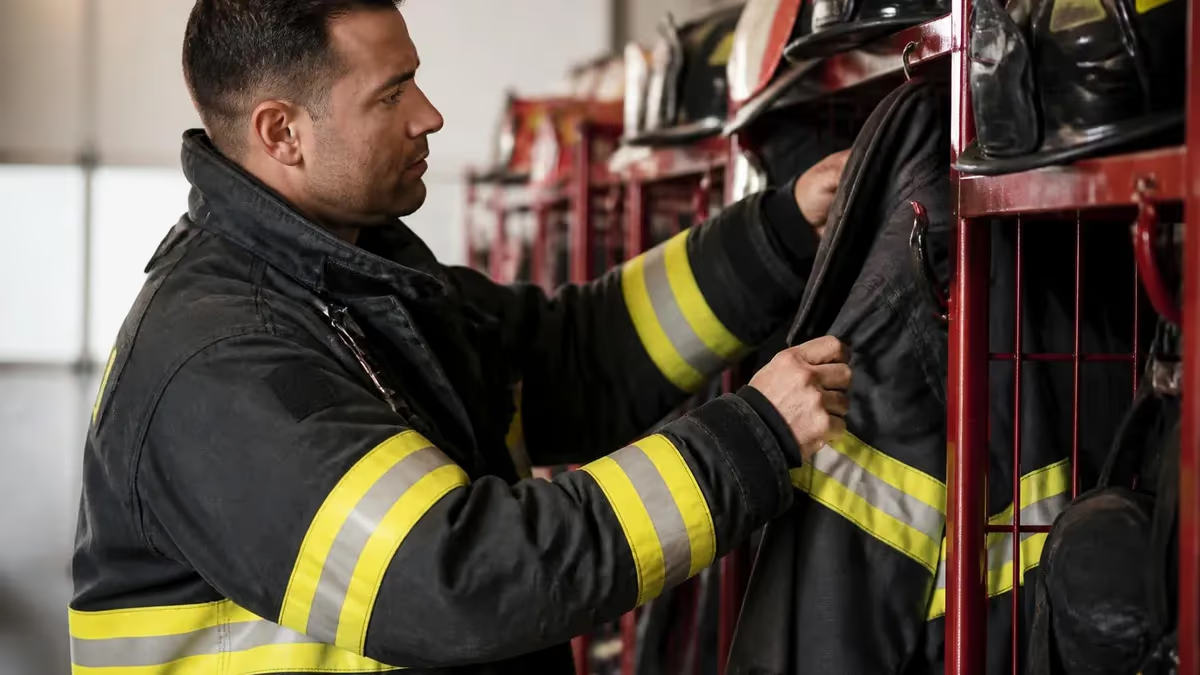
FDNY department orders are the official written directives the Fire Department of New York uses to communicate decisions, assignments, policy changes, and administrative actions to its 17,000+ uniformed and civilian members. If you have ever wondered how a firefighter learns about a transfer, how a promotion becomes official, or how a new safety bulletin reaches every firehouse in the five boroughs, the answer is almost always the same: it appears in a department order. These orders are the connective tissue of the agency, binding headquarters decisions to the kitchen tables of every engine and ladder company across New York City.
Department orders are not press releases or media statements. They are internal command documents, signed by the Fire Commissioner or the Chief of Department, that carry the full weight of policy. When you read an FDNY department order, you are reading the legal record of what the agency expects, who is responsible, and when a change takes effect. They are referenced in disciplinary hearings, civil service appeals, line-of-duty investigations, and even congressional testimony when major incidents occur.
For candidates studying for the firefighter exam, for probationary firefighters in the Fire Academy, and for current members navigating their careers, understanding department orders is more than trivia — it is a survival skill. A missed personnel order can mean reporting to the wrong firehouse on Monday morning. A missed general order can mean failing a company drill or a captain's inspection. And on the operational side, a missed safety bulletin can mean approaching a hazard the rest of the department has already learned to avoid.
The FDNY publishes several distinct categories of orders, including General Orders, Personnel Orders, Operations Orders, Training Bulletins, and Safety Bulletins. Each serves a specific purpose, each has its own format, and each is distributed through a defined chain that begins at FDNY Headquarters in Brooklyn and ends in the company journal of every firehouse. Members are expected to read these orders, log them, and apply them — and supervisors are expected to verify that they have done so.
This guide explains how the department order system works from top to bottom. We will walk through the categories, the publication schedule, the roles of the Fire Commissioner and the Chief of Department, the way orders interact with the union contract, and the practical impact on a firefighter's daily life. We will also look at how orders connect to broader operations covered in fdny stations and companies, where many of these directives ultimately land.
Whether you are preparing for a promotional exam, researching a specific policy, or simply curious how a 160-year-old fire department keeps tens of thousands of people on the same page every single day, this article will give you a complete, accurate, plain-English explanation of FDNY department orders. By the end you will understand not just what they are, but why they matter, who writes them, and how to read them like a chief.
We will also link to practice quizzes throughout, because the easiest way to retain operational knowledge is to test yourself on it. If you are pursuing a career with the department, treat this article as both a reference document and a study aid — the same way a probie treats the bulletin board inside the housewatch.
FDNY Department Orders by the Numbers

The Five Primary Categories of FDNY Department Orders
Permanent policy changes signed by the Fire Commissioner. These rewrite rules, regulations, and procedures and remain in force until rescinded. They are the most authoritative category.
Daily administrative actions: appointments, promotions, transfers, retirements, leaves of absence, and disciplinary outcomes. Issued frequently and tracked by every member affected.
Short-term operational directives covering parades, large events, weather emergencies, staffing adjustments, and special details. Often time-limited with a clear expiration date.
Issued by the Bureau of Training to update curriculum, drill procedures, and certification standards. Required reading before a related drill is conducted.
Issued by the Safety Battalion after near-misses, line-of-duty injuries, or equipment failures. The fastest-moving category — sometimes published within hours of an incident.
FDNY department orders originate at FDNY Headquarters at 9 MetroTech Center in Downtown Brooklyn. The Office of the Fire Commissioner and the Office of the Chief of Department are the two main publishing authorities, though specific bureaus — Operations, Training, Safety, EMS Command, and Fire Prevention — may draft and request publication of orders within their jurisdiction. Drafting follows a deliberate process: a bureau identifies a need, writes a draft order, routes it through legal review, gets it signed by the appropriate executive, and then submits it for publication and distribution.
Once approved, the order is assigned a number and a date. Numbering follows a calendar-year sequence within each category, so a citation like "General Order 14, 2025" tells you exactly which document is being referenced. This numbering system is critical for legal and disciplinary proceedings, where members must be shown the specific order they allegedly violated. Citing an order by topic alone is never sufficient inside the department's formal processes.
Distribution historically happened by hand-delivered printed bulletins, but today FDNY uses a hybrid system. Orders are published electronically through the department's internal portal, then printed and posted on the official bulletin board in each firehouse housewatch. The housewatch member on duty is responsible for ensuring orders are posted promptly and that the company journal reflects the time and date of posting. This dual paper-and-digital approach exists because firehouses are operational 24/7 and a member returning from vacation must be able to read every order issued in their absence.
The Fire Commissioner, a mayoral appointee, holds ultimate signing authority on General Orders that touch policy, discipline, and major reorganizations. The Chief of Department, the highest-ranking uniformed member, signs orders relating to operations, training, and the deployment of firefighting forces. This division reflects a long-standing structural balance: civilian executive authority over policy, uniformed authority over fireground operations. Both signatures carry equal force inside the agency.
Orders also interact with the union contracts negotiated between the City of New York and the Uniformed Firefighters Association (UFA) and the Uniformed Fire Officers Association (UFOA). A department order cannot override a collective bargaining agreement, but it can implement, clarify, or expand upon contractual provisions. When disputes arise, they are typically resolved through grievance procedures or, in serious cases, before the Office of Collective Bargaining. The interplay between orders and contracts is one of the reasons union delegates pay close attention to every Personnel and General Order published.
For a closer look at where these orders ultimately land — the firehouses, apparatus, and the logistical backbone of the agency — see our companion article on the fdny shop, which explains how operational directives translate into the rigs, tools, and supplies that show up at every alarm.
Finally, it is worth noting that not every internal communication is a department order. Memoranda, advisories, and roll-call announcements exist alongside orders but do not carry the same formal weight. The hallmark of a department order is its signature, number, and inclusion in the permanent record. If a document lacks those elements, it is informational only and cannot be the basis for disciplinary action.
FDNY Practice Test Questions
Prepare for the FDNY - Fire Department New York exam with our free practice test modules. Each quiz covers key topics to help you pass on your first try.
FDNY Building Construction
FDNY Exam Questions covering Building Construction. Master FDNY Test concepts for certification prep.
FDNY Community Engagement and Public Educa...
Free FDNY Practice Test featuring Community Engagement and Public Education. Improve your FDNY Exam score with mock test prep.
FDNY Emergency Medical Response
FDNY Mock Exam on Emergency Medical Response. FDNY Study Guide questions to pass on your first try.
FDNY Emergency Medical Services
FDNY Test Prep for Emergency Medical Services. Practice FDNY Quiz questions and boost your score.
FDNY Hazardous Materials Response
FDNY Questions and Answers on FDNY Hazardous Materials Response. Free FDNY practice for exam readiness.
FDNY Technical Rescue Operations
FDNY Mock Test covering FDNY Technical Rescue Operations. Online FDNY Test practice with instant feedback.
FDNY Fire Behavior
Free FDNY Quiz on Fire Behavior. FDNY Exam prep questions with detailed explanations.
FDNY Firefighting Operations and Equipment
FDNY Practice Questions for Firefighting Operations and Equipment. Build confidence for your FDNY certification exam.
Reading, Logging, and Acknowledging FDNY Department Orders
Members are expected to read every department order issued, whether or not it appears to apply to them personally. A general order on uniform standards affects every member in the field, while a personnel order announcing a promotion may signal an upcoming vacancy in your firehouse. Officers brief their companies on relevant orders during roll call, but the responsibility to actually read the document falls on each individual member, just like reading a building inspection report.
Reading is more than skimming. Members are expected to understand the effective date, the scope, and any action items the order requires. Many orders include explicit instructions — submit a form, attend a drill, update a piece of equipment, or report compliance up the chain. Missing these action items is one of the most common reasons firefighters end up on the wrong side of an administrative review, even when the underlying behavior was otherwise unremarkable.

Strengths and Limits of the FDNY Department Order System
- +Creates a permanent, citable record of every major policy decision
- +Ensures uniform communication to 17,000+ members across 218 firehouses
- +Provides legal protection for both the department and its members
- +Allows rapid distribution of safety information after near-miss incidents
- +Integrates seamlessly with the company journal and chain of command
- +Supports promotional and disciplinary processes with documented authority
- +Builds an archive that informs future training and policy development
- −Volume can overwhelm members returning from extended leave
- −Legacy paper distribution still required even with digital systems
- −Bureaucratic language can obscure practical operational impact
- −Personnel orders sometimes lag behind real-world assignment changes
- −Members may miss critical safety bulletins during high-tempo periods
- −Cross-referencing rescinded orders takes practiced research skills
Pros and Cons at a Glance
| Pros | Cons |
|---|---|
| Creates a permanent, citable record of every major policy decision | Volume can overwhelm members returning from extended leave |
| Provides legal protection for both the department and its members | Legacy paper distribution still required even with digital systems |
| Allows rapid distribution of safety information after near-miss incidents | Bureaucratic language can obscure practical operational impact |
| Integrates seamlessly with the company journal and chain of command | Personnel orders sometimes lag behind real-world assignment changes |
| Supports promotional and disciplinary processes with documented authority | Members may miss critical safety bulletins during high-tempo periods |
| Builds an archive that informs future training and policy development | Cross-referencing rescinded orders takes practiced research skills |
Personnel Order Action Checklist for FDNY Members
- ✓Check the firehouse bulletin board at the start of every tour
- ✓Review your member identification number against the order roster
- ✓Confirm the effective date of any transfer, promotion, or detail
- ✓Sign the acknowledgment sheet within the posted deadline
- ✓Update your personal records with new assignment information
- ✓Notify your union delegate of any disputed or unclear personnel action
- ✓Confirm payroll and timekeeping reflect the order's effective date
- ✓File a copy of personally-relevant orders in your member binder
- ✓Read all General Orders even when they appear administrative only
- ✓Ask your officer to clarify language you do not fully understand
Orders are evidence — not just instructions
Every signed department order becomes part of the FDNY's permanent record and can be cited in disciplinary hearings, civil litigation, line-of-duty investigations, and federal oversight reviews. Treating orders as casual reading is one of the most common avoidable mistakes a member can make in their first decade with the department.
The legal weight of FDNY department orders is substantial. Once an order is signed, numbered, distributed, and acknowledged, it becomes enforceable through the department's internal disciplinary system. Charges and specifications brought against a member almost always reference a specific order by number, citing the language the member allegedly violated. Without that anchor, a charge is procedurally vulnerable on appeal. This is why the department invests so heavily in documentation, distribution tracking, and acknowledgment procedures — the paper trail is the case.
Discipline begins with charges filed by a chief officer or a bureau head, which trigger a hearing before the Department's Bureau of Investigation and Trials (BITT). The trial commissioner, an attorney appointed for the role, hears evidence and recommends a penalty to the Fire Commissioner, who issues the final decision. Penalties range from a verbal reprimand to monetary fines, suspension without pay, mandatory transfer, demotion, or termination. Each penalty is itself documented in a personnel order that becomes part of the member's permanent file.
Members charged with violations have due process rights, including the right to union representation, the right to confront witnesses, and the right to appeal final decisions to the State Supreme Court under Article 78 of the Civil Practice Law and Rules. Article 78 challenges typically focus on procedural defects — improper notice, an arbitrary penalty, or a finding unsupported by substantial evidence. Courts give significant deference to FDNY's internal expertise, but they will overturn discipline that fails procedural tests, which is why orders themselves must be impeccable in form and distribution.
Beyond discipline, department orders also create legal protection. A member who follows an order in good faith generally benefits from qualified immunity in civil suits arising from their conduct. If a firefighter executes a tactic specified in an operations order and that tactic produces an unintended consequence, the department — not the individual — typically bears the legal exposure. This is one of the structural reasons firefighters can act decisively under chaotic conditions: the order system distributes both authority and responsibility through the chain of command.
Orders also intersect with federal law in unexpected ways. Equal Employment Opportunity Commission complaints, Americans with Disabilities Act accommodations, Family and Medical Leave Act requests, and Fair Labor Standards Act overtime claims all touch the personnel order system. When members file federal complaints, attorneys subpoena personnel orders to establish patterns of treatment. The department, in turn, uses its order archive to demonstrate consistent application of policy across thousands of members.
The interaction between orders and civil service law is another layer. New fdny hirings are civil service employees, and the New York City Charter, the Administrative Code, and the Rules of the City of New York all establish protections that orders cannot override. When an order conflicts with civil service law, the law prevails. Skilled chiefs and bureau heads are careful to draft orders that complement rather than contradict statutory protections, and the department's legal counsel reviews every major order before signature.
For students preparing for promotional exams or candidates studying the FDNY's structure, understanding this legal architecture is essential. The questions you face on a lieutenant or captain exam are not abstract trivia — they reflect the real legal environment in which FDNY orders operate every day. Read orders as if you will one day write them, because if you stay in the department long enough, you almost certainly will.

FDNY consistently holds that a member's failure to read posted department orders is not a valid defense in disciplinary proceedings. Acknowledgment sheets, journal entries, and posting timestamps establish constructive notice. Make reading orders part of every tour's routine — especially after returning from vacation, medical leave, or detail assignments.
Inside a working firehouse, department orders shape the rhythm of daily life in ways outsiders rarely appreciate. The first stop for the oncoming tour is the bulletin board near the housewatch desk, where new orders are posted and old ones are filed. The housewatch firefighter — a position rotated among members — is the gatekeeper of this information flow. They time-stamp incoming orders, post them prominently, and brief any member who has been away. A well-run housewatch makes the difference between a company that operates smoothly and one that constantly stumbles into administrative trouble.
Roll call at the start of each tour often begins with a review of new orders. The company officer — typically a lieutenant or captain — selects the most operationally relevant orders and discusses them with the assembled firefighters. This is where dense bureaucratic language gets translated into practical guidance: "New mask procedure starts Monday, here is how we will drill it," or "Personnel order assigns Probationary Firefighter Rodriguez to our second platoon starting next week." Roll call is where orders become lived practice.
Drill periods built into every tour reinforce orders that introduce new procedures. When a training bulletin announces a revised technique for forcible entry, ventilation, or hose stretching, companies practice the new technique in the apparatus floor or out in the firehouse apron. This pattern — order, brief, drill, repeat — is how FDNY translates paper into muscle memory across a department spanning all five boroughs. For a deeper look at the operational tempo of these drills, see our article on FDNY Runs and Workers, which examines what those numbers really mean.
Inspections by deputy chiefs and battalion chiefs always involve a review of the order log. Chiefs pull recent orders and ask members about them — sometimes specific members, sometimes the company as a whole. A chief who finds gaps in awareness will return for follow-up visits and may direct additional drills or counseling. This accountability mechanism is one of the reasons the order system works: there are consistent, visible checks on whether members are actually consuming the information they receive.
Orders also shape career milestones. Probationary firefighters complete the Fire Academy and report to their first firehouse through a personnel order. Promotions to lieutenant, captain, battalion chief, and beyond are announced through personnel orders, often with ceremony at headquarters. Transfers, details, and retirements all flow through the order system. Many veteran firefighters keep a personal binder of every order that mentions their name — a paper history of their career, alongside their family photos and shift schedules.
Even minor day-to-day decisions feel the influence of orders. Uniform regulations, beard policies, vehicle operation standards, station pet rules, social media guidelines, and even kitchen cleanliness expectations all trace back to General Orders or local battalion bulletins. The cumulative effect is a department culture in which written authority is respected, documented, and integrated into the daily texture of work.
For citizens, journalists, and researchers curious about how a paramilitary public-safety agency communicates with itself, the FDNY department order system is a fascinating case study. It is both an artifact of nineteenth-century military tradition and a living, daily-updated information network supporting one of the busiest fire departments in the world. Studying it teaches lessons about organizational design that go well beyond firefighting.
Practical preparation for understanding FDNY department orders begins with familiarity. If you are a candidate working toward the firefighter exam, or a current member preparing for a promotional exam, set aside time each week to read recently published orders. The department's internal portal, the union newsletters, and the firehouse bulletin boards are the primary sources. Treat orders the way a law student treats case law — read them, summarize them, and connect them to the broader rules and procedures they implement.
Develop a vocabulary of the structural pieces that appear in every order: the heading block with date and number, the subject line, the body with numbered paragraphs, the references to prior orders, the effective date, and the signature line. Once you recognize the format, you can extract meaning quickly. Skilled chiefs can read a five-page general order in under ten minutes and walk away with a complete understanding of who is affected, what changes, and what enforcement looks like.
If you are preparing for promotional exams, study how orders are referenced in the official exam syllabus. The FDNY publishes a study materials list for each exam cycle, and many cited documents are general orders, training bulletins, or operations orders. Order numbers on the syllabus are not casual references — they are the exact documents you may be tested on, sometimes by number. Build flashcards that pair order numbers with their subjects, and review them the way medical students review pharmacology.
Cross-reference orders against the Firefighting Procedures manuals and the Communications Manual. The procedures manuals are essentially organized compilations of operations and training content that originated as orders. Understanding the lineage — which order led to which procedure — helps you reason through unfamiliar exam questions and anticipate how new procedures might evolve. This kind of layered understanding separates competent test-takers from exceptional ones, and it shows up in promotional rank-list positions.
Practice quizzes are an invaluable companion to reading orders. The hardest part of mastering FDNY content is testing yourself under conditions that mimic the real exam, which is multiple-choice, time-constrained, and unforgiving of vague memorization. Use the practice tests linked throughout this article to drill construction knowledge, EMS protocols, community engagement, and the operational subjects that orders address daily. Aim for a weekly schedule of reading plus quizzing, not just one or the other.
For members already working in firehouses, develop habits that reinforce order awareness. Make a personal index of orders affecting your assignment, your specialty, and your career goals. When new orders arrive that touch your interests, file them in your binder, summarize them in one or two sentences, and revisit them quarterly. Members who do this rarely get caught off guard by procedural changes, and they tend to be the firefighters their officers nominate for special assignments and detail opportunities.
Finally, do not be afraid to ask. Officers, union delegates, training cadres, and bureau staff are accustomed to questions about orders. The department wants its members to understand the directives it issues, because well-informed members produce safer operations and better outcomes for New Yorkers. A culture of asking — humbly, but persistently — is one of the best career investments any firefighter or aspiring firefighter can make. Start today: pick a recent general order, read it twice, and explain it to a colleague tomorrow.
Sample Fire Department New York Practice Questions
Try these questions from our free Fire Department New York practice tests. The correct answer and an explanation follow each question.
Which NYC Fire Code section governs the requirements for a fire safety director in high-rise buildings?
- A. FC 402
- B. FC 113
- C. FC 405
- D. FC 301
Answer: C. FC 405
NYC Fire Code Section 405 (FC 405) governs the duties, qualifications, and requirements for fire safety directors and deputies in high-rise buildings.
During a community fire safety fair, a resident asks how often they should test their smoke alarm. The correct FDNY-recommended frequency is:
- A. Once a year
- B. Every 6 months
- C. Monthly
- D. Only after a fire incident
Answer: C. Monthly
The FDNY recommends testing smoke alarms monthly to ensure they are functioning properly.
Which entity has the authority to issue orders that are binding on all FDNY personnel?
- A. The Mayor's Office of Emergency Management
- B. The FDNY Fire Commissioner
- C. The New York City Council
- D. The NYPD Commissioner
Answer: B. The FDNY Fire Commissioner
The Fire Commissioner has full authority over the department and can issue binding orders to all FDNY personnel.
Under the New York City Fire Code, which entity is primarily responsible for enforcing fire prevention regulations in commercial occupancies?
- A. NYPD Bureau of Fire Safety
- B. FDNY Bureau of Fire Prevention
- C. NYC Department of Buildings
- D. NYC Office of Emergency Management
Answer: B. FDNY Bureau of Fire Prevention
The FDNY Bureau of Fire Prevention (BFP) is the primary agency responsible for enforcing fire prevention regulations and conducting inspections in commercial and other occupancies throughout New York City.
FDNY Department Orders: Study Flashcards
📜 What is an FDNY department order?
An FDNY department order is an official written directive issued by FDNY headquarters that communicates policy, assignments, and administrative decisions to all members. It is an internal command document, not a press release, and carries the full weight of department policy. Orders are referenced in disciplinary hearings and civil service appeals.
START FDNY PRACTICE TEST✍️ Who signs FDNY department orders?
FDNY department orders are signed by the Fire Commissioner or the Chief of Department, the two highest authorities in the agency. The Fire Commissioner is a civilian mayoral appointee, while the Chief of Department is the highest-ranking uniformed officer. Their signature is what gives an order its binding authority.
START FDNY PRACTICE TEST🗂️ What are the main categories of FDNY orders?
FDNY directives are grouped into general orders, personnel orders, and administrative or operational bulletins. General orders set lasting policy, personnel orders handle promotions and transfers, and bulletins carry safety and operational updates. Each type reaches every firehouse across the five boroughs so members stay current.
START FDNY PRACTICE TEST🏢 Where are FDNY department orders published?
Department orders are distributed from FDNY headquarters at MetroTech Center in Brooklyn and posted at every firehouse. Members are responsible for reading posted orders at the start of each tour. Missing a personnel order can mean reporting to the wrong firehouse, so daily review is a professional duty.
START FDNY PRACTICE TEST🔥 How do orders connect to FDNY fire safety exams?
Department orders often codify the standards tested on FDNY exams, including the Certificate of Fitness program. Candidates searching for FDNY F07 test questions and answers are studying the Fire and Emergency Drill Conductor certification, whose drill rules trace back to department directives. Knowing the orders helps you understand the reasoning behind exam answers.
START FDNY PRACTICE TEST🧯 What is the FDNY F-07 Certificate of Fitness?
The F-07 is the FDNY Certificate of Fitness for Fire and Emergency Drill Conductor. Holders are authorized to conduct required fire and emergency drills in buildings such as offices and hotels. The duties and drill frequency enforced by an F-07 holder flow directly from FDNY fire-safety rules and department orders.
START FDNY PRACTICE TEST⚖️ Can a member challenge a department order?
A member must first comply with an order, then challenge it through the proper channels such as a grievance under the union contract or a civil service appeal. The principle is "obey now, grieve later." Refusing an order outright can itself become a disciplinary matter documented in a later personnel order.
START FDNY PRACTICE TEST📅 How often does FDNY issue department orders?
FDNY issues orders continuously, with personnel and operational bulletins appearing regularly throughout the year as transfers, promotions, and safety updates occur. Because the agency has more than 17,000 members, a steady stream of orders is needed to keep every unit aligned. Members check for new orders at the start of each tour.
START FDNY PRACTICE TEST🚒 Why do FDNY exams test department orders?
Exams test department orders because knowing how directives work is essential to safe, compliant firefighting. A missed general order can mean failing a company drill, and a missed safety bulletin can mean approaching a hazard unprepared. Understanding the order system shows examiners you can operate within FDNY command structure.
START FDNY PRACTICE TEST📚 Are FDNY department orders public records?
Many FDNY department orders are internal, but they can become accessible through Freedom of Information Law (FOIL) requests and are frequently cited in litigation and investigations. Because they document official policy and decisions, they form part of the legal record that courts, unions, and oversight bodies rely on when reviewing FDNY actions.
START FDNY PRACTICE TESTFDNY Questions and Answers
FDNY F-07 Test, Department Orders, and the Certificate of Fitness Connection
Candidates who search for FDNY F07 test questions and answers are usually preparing for the Certificate of Fitness for Fire and Emergency Drill Conductor, known by its exam code F-07. This certification authorizes a holder to conduct the required fire and emergency drills in buildings such as office towers, hotels, and large residential properties. The duties it covers are not invented by the exam writers — they are rooted in the same chain of FDNY directives, fire-safety rules, and department orders described throughout this page.
Understanding department orders makes the F-07 material far easier to learn. When an order sets a drill frequency, a notification procedure, or a record-keeping requirement, that rule becomes the standard an F-07 holder must enforce on the ground. In other words, the department order is the "why" behind the test question. Many people who look up FDNY F07 test questions and answers memorize facts in isolation; studying the order system instead gives you the reasoning that ties the answers together.
If you are building toward any FDNY credential, treat department orders as the foundation. They connect the firefighter exam, the Fire Academy curriculum, and the Certificate of Fitness program into one consistent body of rules, which is exactly how FDNY expects its members and certificate holders to think.
Official Resources
- FDNY Official Website (NYC.gov) — the Fire Department of New York's official home for policy, news, and public information.
- FDNY Certificates of Fitness — the official list of FDNY Certificate of Fitness exams, including the F-07 Fire and Emergency Drill Conductor certification.
- NYC Fire Code — the official New York City Fire Code that many FDNY department orders and fire-safety rules enforce.
About the Author

Law Enforcement Trainer & Civil Service Exam Specialist
John Jay College of Criminal JusticeMarcus B. Thompson earned his Master of Arts in Criminal Justice from John Jay College of Criminal Justice and served 12 years as a law enforcement officer before transitioning to full-time academy instruction. He is a POST-certified instructor who has prepared candidates for police entrance exams, firefighter assessments, and civil service examinations across dozens of agencies.
Join the Discussion
Connect with other students preparing for this exam. Share tips, ask questions, and get advice from people who have been there.
View discussion (9 replies)