
FDNY Shop: Inside the Fire Department of New York's Apparatus Division and Logistics Hub
FDNY shop explained — tour the apparatus division, repair facility, uniform supply, and logistics operations that keep New York's bravest battle-ready. 📗
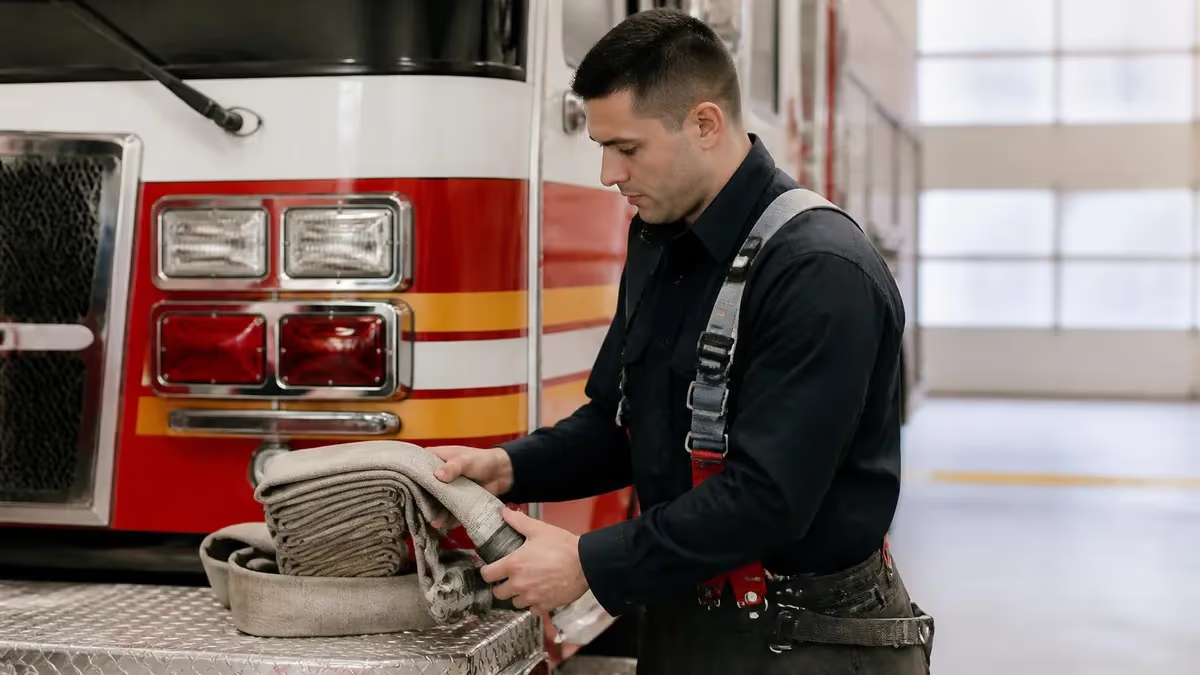
The FDNY shop is one of the most fascinating yet least understood corners of the Fire Department of New York. When most people think about the FDNY, they picture engines screaming down Broadway, ladder companies pulling up to a brownstone, or firefighters hauling hose into a burning tenement. What they rarely picture is the massive industrial operation behind the scenes — the mechanics, machinists, welders, fabricators, and supply specialists who keep more than 350 frontline apparatus and thousands of pieces of gear running twenty-four hours a day, three hundred sixty-five days a year.
The phrase FDNY shop actually refers to several distinct facilities and divisions rather than a single building. Most insiders use the term to mean the Bureau of Fleet Services located on Frank Sinatra Drive in Long Island City, Queens, but the term also gets applied to the FDNY Foundation gift shop, the uniform issue facility, the Mask Service Unit, and the various specialty shops that repair everything from self-contained breathing apparatus to thermal imaging cameras.
For a department that runs more than two million incidents per year, these support operations are not optional — they are the backbone of operational readiness.
Understanding the FDNY shop matters for anyone preparing to take the firefighter exam, anyone studying for promotional tests, or anyone curious about how the largest municipal fire department in the United States actually functions. Candidates frequently encounter questions about apparatus, equipment maintenance cycles, and logistical chain of command on written exams. Civilian fire buffs and journalists also benefit from knowing how the department sources, maintains, and retires the rolling stock that defines its identity on the streets of all five boroughs.
The Bureau of Fleet Services traces its lineage back to the early twentieth century, when horse-drawn steamers gave way to motorized rigs and the department suddenly needed mechanics rather than stable hands. Over the decades the shop has grown into a sprawling complex capable of fabricating custom parts, rebuilding entire pumpers, painting brand-new tower ladders in FDNY red, and stocking enough spare components to keep the busiest fire department on earth from ever being grounded. Most major repairs that would take a private fleet weeks are turned around in days.
What makes the FDNY shop unique compared to the maintenance operations of smaller departments is the sheer scale and the institutional knowledge concentrated in one place. Master mechanics here have rebuilt the same Seagrave pumpers three or four times across decades of service. Apparatus that started life in the late 1990s are still on reserve status because the shop knows how to keep them alive. That kind of longevity saves taxpayers tens of millions of dollars and gives company officers reliable backup when frontline rigs are pulled for service.
This guide walks through everything a civilian, candidate, or current member should know about the FDNY shop ecosystem — what it does, where it is, who works there, how apparatus moves through the system, what the FDNY Foundation gift shop sells, and how the logistics of uniforms and protective equipment actually work. By the end you will have a clear mental map of a part of the department that almost never makes the news but quietly powers every alarm that gets transmitted across the city.
If you are studying for an upcoming exam, pair this article with structured practice questions and review the FDNY Stations, Engine & Ladder Companies overview to see how apparatus and personnel actually deploy across the five boroughs. The shop only makes sense once you understand the firehouses it serves.
FDNY Shop by the Numbers
Bureau of Fleet Services: The Core of the FDNY Shop
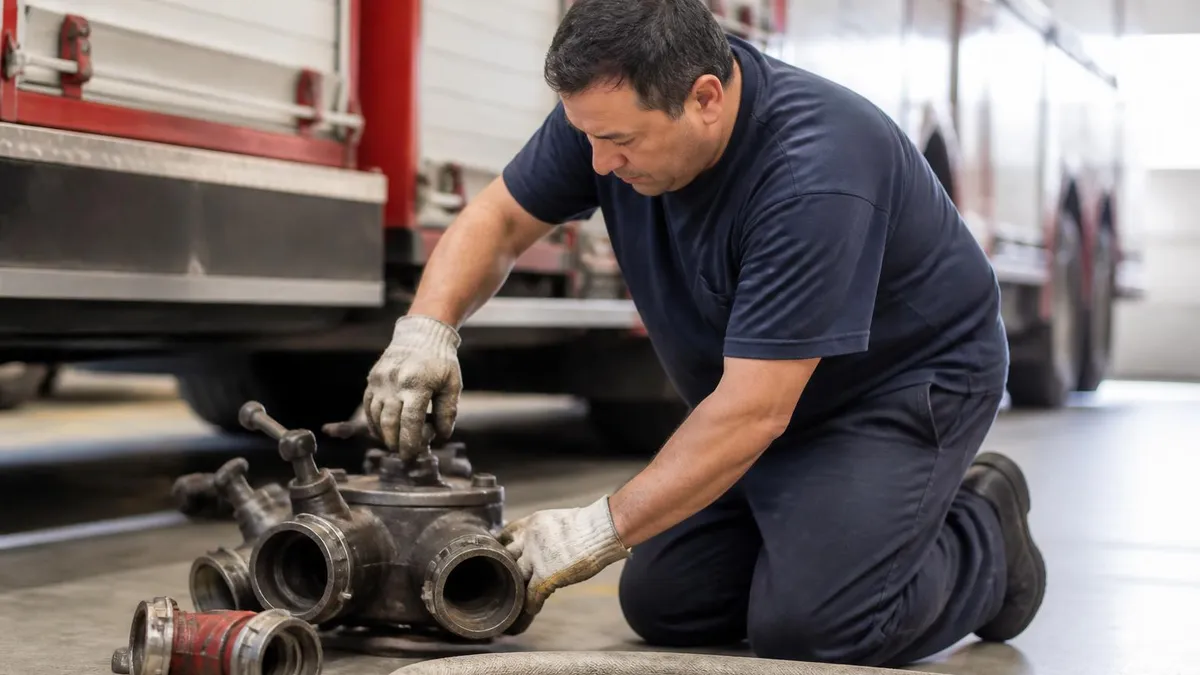
This is where major mechanical work happens — engine rebuilds, transmission swaps, pump tests, and aerial ladder service. Bay capacity allows multiple apparatus to be torn down simultaneously with overhead cranes for engine removal.
After collisions, fires, or routine wear, apparatus go through metal fabrication, body filler work, primer, and the iconic FDNY red topcoat with gold leaf lettering. Some rigs spend two to three weeks in this division alone.
Modern apparatus run on multiple computer modules, multiplex wiring, and complex lighting packages. Specialists here diagnose CAN bus issues, repair sirens, and program engine control units that govern emissions and pump operations.
Located separately from Fleet, the MSU maintains every self-contained breathing apparatus in the department. Each SCBA goes through annual flow testing, cylinder hydrostatic checks, and facepiece fit inspections.
The uniform shop issues bunker gear, helmets, gloves, hoods, and boots. Custom sizing, NFPA compliance tracking, and replacement cycles all funnel through this logistics arm that serves over 11,000 active members.
Stepping inside the main FDNY shop on Frank Sinatra Drive is an experience unlike any civilian garage. The first thing that hits you is the smell — a mixture of diesel, fresh paint, cutting oil, and brewed coffee that has soaked into the concrete over decades. The second thing is the sound. Air impact wrenches, overhead cranes, hydraulic lifts groaning under the weight of forty-thousand-pound pumpers, and the constant chatter of mechanics walking between bays. It is a fully functioning industrial complex hidden in plain sight on the Queens waterfront.
The repair operation is organized by apparatus type and by complexity of work. Routine preventative maintenance — oil changes, brake inspections, pump certifications — happens on a scheduled rotation, with each engine and ladder cycling through the shop multiple times per year. Companies do not simply roll in and wait; the shop coordinates loaner apparatus, often older reserve rigs from a fleet of more than one hundred spares, so that no firehouse is ever caught without a functioning engine or ladder on the floor.
One of the most impressive aspects of the FDNY shop is its ability to keep aging apparatus alive far longer than most fire departments could dream of. While the national average frontline service life for a pumper is roughly fifteen years, FDNY routinely runs engines for ten to twelve years on the front line and then another five to seven on reserve. That extended life is only possible because the shop can fabricate parts that manufacturers no longer stock, machine custom brackets, and source legacy components from a carefully managed parts inventory.
The mechanics themselves are a mix of civilian Fleet Service technicians and uniformed firefighters who have specialized into the apparatus trade. Civilian mechanics tend to have decades of experience with heavy diesel platforms — many came from city transit, sanitation, or private fleet backgrounds before joining FDNY. The uniformed members provide operational knowledge: they know how a rig actually behaves on a real run, what fails first under hard pumping, and how to spec equipment that works in the field, not just on paper.
Shop operations also include compliance with environmental regulations that have transformed apparatus maintenance over the last twenty years. Diesel particulate filters, selective catalytic reduction systems, and ultra-low-emission engines all require specialized diagnostic equipment and trained technicians. The FDNY shop has invested heavily in tier-four engine training, and partnerships with manufacturers like Cummins and Detroit Diesel keep technicians current on the latest powertrains rolling out of factories like Pierce, Seagrave, and Ferrara.
Beyond engines and ladders, the shop maintains a remarkable variety of specialty apparatus — collapse rescue units, hazmat trucks, foam tenders, command vehicles, marine division boats, and even brush trucks for Staten Island wildland response. Each platform has its own quirks. The fireboats alone consume entire teams of marine technicians who deal with saltwater corrosion, large displacement diesel engines, and pumping systems that move thousands of gallons per minute drawn directly from the harbor.
For anyone curious about the operational tempo behind the scenes, the FDNY Runs and Workers breakdown shows just how much wear and tear the shop has to keep up with — busy companies routinely log thousands of runs per year, and every one of those responses puts cumulative stress on an apparatus that the shop has to manage.
FDNY Practice Test Questions
Prepare for the FDNY - Fire Department New York exam with our free practice test modules. Each quiz covers key topics to help you pass on your first try.
FDNY Building Construction
FDNY Exam Questions covering Building Construction. Master FDNY Test concepts for certification prep.
FDNY Community Engagement and Public Educa...
Free FDNY Practice Test featuring Community Engagement and Public Education. Improve your FDNY Exam score with mock test prep.
FDNY Emergency Medical Response
FDNY Mock Exam on Emergency Medical Response. FDNY Study Guide questions to pass on your first try.
FDNY Emergency Medical Services
FDNY Test Prep for Emergency Medical Services. Practice FDNY Quiz questions and boost your score.
FDNY Hazardous Materials Response
FDNY Questions and Answers on FDNY Hazardous Materials Response. Free FDNY practice for exam readiness.
FDNY Technical Rescue Operations
FDNY Mock Test covering FDNY Technical Rescue Operations. Online FDNY Test practice with instant feedback.
FDNY Fire Behavior
Free FDNY Quiz on Fire Behavior. FDNY Exam prep questions with detailed explanations.
FDNY Firefighting Operations and Equipment
FDNY Practice Questions for Firefighting Operations and Equipment. Build confidence for your FDNY certification exam.
FDNY Shop Logistics: Three Divisions That Keep the City Covered
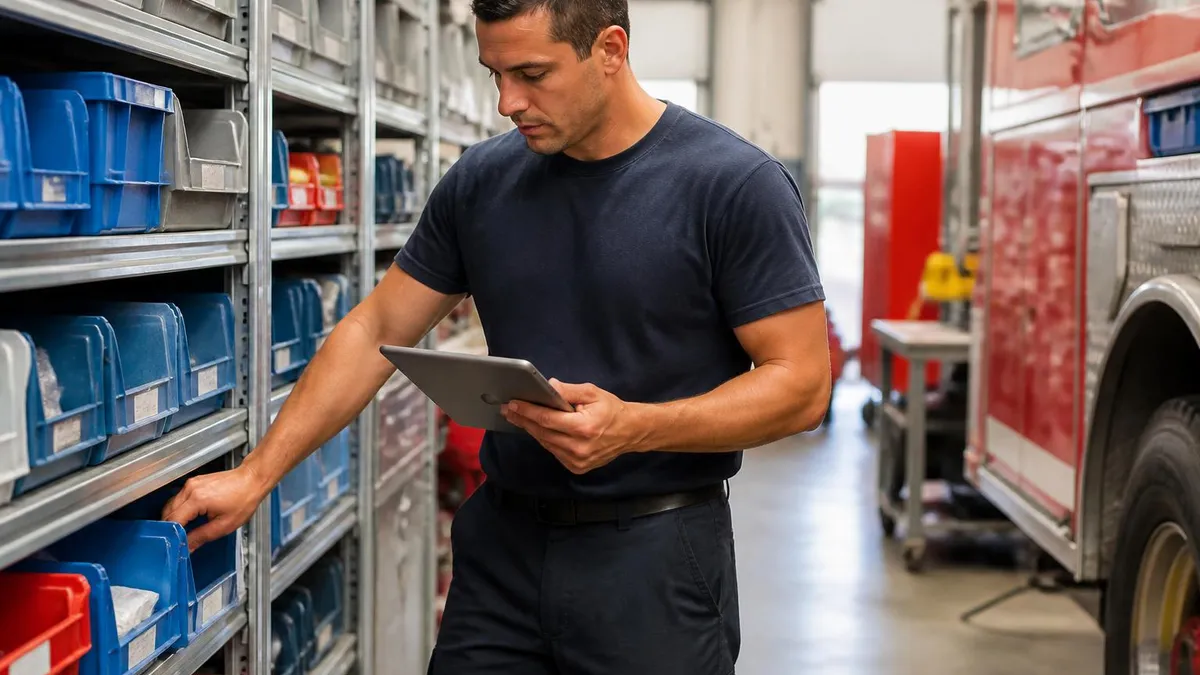
The apparatus side of the FDNY shop is what most people picture — the bays full of red rigs, mechanics under hoods, and aerial ladders extended for service inspections. This division alone manages preventative maintenance schedules for every frontline and reserve unit, tracks mileage, pump hours, and aerial cycle counts on each apparatus, and dispatches mobile mechanics to firehouses across the five boroughs for emergency roadside repairs.
Coordination with operations is constant. When a rig goes out of service overnight, the shop has loaner apparatus staged at strategic locations so a company can be back in service within hours. Annual pump testing, ground ladder certifications, and aerial inspections are all scheduled through this division to comply with NFPA 1911 and 1932 standards that govern fire apparatus testing protocols nationwide.
Centralized FDNY Shop vs. Decentralized Maintenance: A Comparison
- +Massive parts inventory means no waiting weeks for manufacturer back-orders on critical components
- +Institutional knowledge concentrated in one place — mechanics know every quirk of every apparatus type
- +Economies of scale lower per-unit maintenance costs versus farming work out to vendors
- +Custom fabrication capability extends apparatus service life far beyond industry averages
- +Tight coordination with operations ensures loaner rigs are always staged for company swaps
- +Standardized procedures across the fleet improve safety and reduce mechanic error rates
- +Training pipeline produces specialists in heavy diesel, aerials, pumps, and electronics that local vendors cannot match
- −Single-site model creates a logistical chokepoint if the main facility were ever compromised
- −Travel time from outer Staten Island or far Bronx firehouses to Queens can stretch an entire shift
- −Civil service hiring rules can make recruiting modern diesel technicians slower than private fleets
- −Aging building infrastructure requires constant capital reinvestment to remain efficient
- −Specialty parts for older apparatus become harder to source as manufacturers discontinue support
- −Environmental and emissions compliance adds complexity that smaller departments avoid
- −Coordinating with hundreds of firehouses across five boroughs creates communication challenges
Pros and Cons at a Glance
| Pros | Cons |
|---|---|
| Massive parts inventory means no waiting weeks for manufacturer back-orders on critical components | Single-site model creates a logistical chokepoint if the main facility were ever compromised |
| Institutional knowledge concentrated in one place — mechanics know every quirk of every apparatus type | Travel time from outer Staten Island or far Bronx firehouses to Queens can stretch an entire shift |
| Economies of scale lower per-unit maintenance costs versus farming work out to vendors | Civil service hiring rules can make recruiting modern diesel technicians slower than private fleets |
| Custom fabrication capability extends apparatus service life far beyond industry averages | Aging building infrastructure requires constant capital reinvestment to remain efficient |
| Tight coordination with operations ensures loaner rigs are always staged for company swaps | Specialty parts for older apparatus become harder to source as manufacturers discontinue support |
| Standardized procedures across the fleet improve safety and reduce mechanic error rates | Environmental and emissions compliance adds complexity that smaller departments avoid |
FDNY Shop Operations Checklist: What Happens to Every Apparatus
- ✓Daily check by the on-duty company chauffeur covering fluids, tires, lights, and pump operation
- ✓Weekly inspection and cleaning of all on-board equipment, hose, and tools
- ✓Quarterly preventative maintenance scheduled through the FDNY shop for oil and filter changes
- ✓Annual pump service test conducted per NFPA 1911 with full pressure and flow verification
- ✓Annual aerial ladder load test for tower ladders and aerials per NFPA 1932 protocols
- ✓Five-year SCBA cylinder hydrostatic testing through the Mask Service Unit
- ✓Ten-year mandatory retirement of bunker gear under NFPA 1851 inspection standards
- ✓Body shop refurbishment cycle to address corrosion, decals, and lettering touch-ups
- ✓End-of-life evaluation determines whether apparatus is reassigned to reserve or retired
- ✓Final disposition through auction, museum donation, or use as a training prop at the academy
More than a garage — it is the department's lifeline
The Bureau of Fleet Services operates a parts inventory worth tens of millions of dollars and turns out fully refurbished apparatus capable of another decade of frontline service. Without this shop, FDNY could not maintain its sub-five-minute response time goal across 320 square miles of dense urban geography.
Beyond routine maintenance, the FDNY shop is one of the few municipal fire department facilities in the country that does its own large-scale fabrication and custom modification work. When a new apparatus arrives from a manufacturer like Seagrave or Ferrara, it does not simply go into service the next day. The shop installs department-specific equipment mounts, configures compartments to match FDNY tool placement standards, adds custom lettering and decals, and runs through a rigorous acceptance inspection that often turns up issues the manufacturer never anticipated.
Custom fabrication shows up everywhere on an FDNY rig. Look at a tower ladder and you will see purpose-built rope rescue anchors welded into the bucket. Look at a rescue company truck and you will see custom-engineered hydraulic tool brackets, generator mounts, and air bag storage racks. These are not catalog items — they are made in the shop by welders and fabricators who understand both metalwork and the specific operational needs of FDNY companies. Each modification represents lessons learned from real incidents.
The paint and body division deserves special recognition. FDNY apparatus carry one of the most recognizable color schemes in American firefighting — deep red with gold leaf lettering and white striping — and maintaining that appearance requires significant skill. After collisions, fires, or even normal wear from saltwater spray and street debris, apparatus return to the body shop for sandblasting, primer, base coat, clear coat, and hand-applied gold leaf work. A single major refurbishment in the body shop can take three to four weeks of continuous labor.
Welding and machining capabilities at the shop go far beyond what most departments support in-house. Mechanics regularly fabricate brackets, repair cracked frame rails, build custom exhaust systems, and even create one-off prototype parts when manufacturers cannot deliver. There is an entire machine shop with lathes, milling machines, and CNC equipment that allows the shop to make components from raw steel and aluminum. This capability is what truly extends apparatus life cycles deep into territory other departments cannot reach.
The shop also maintains the marine division — the FDNY fireboats and smaller harbor craft that protect the waterfront, harbor, and the bays surrounding all five boroughs. Marine maintenance is its own discipline, with technicians qualified on large displacement diesel marine engines, hull and prop repair, fire pump systems capable of moving fifty thousand gallons per minute, and electronic navigation suites. The marine shop is partially located on Staten Island near the dedicated fireboat berths.
Specialty operations and rescue apparatus add yet another layer. Hazmat units carry sophisticated atmospheric monitoring instruments, decontamination equipment, and chemical reference libraries that must be maintained, calibrated, and inventoried. Collapse rescue rigs are essentially mobile construction sites loaded with shoring lumber, concrete cutting tools, and search cameras. Each of these specialty units has dedicated technicians at the shop who understand the equipment as well as the company members who deploy it.
Recruits and probationary firefighters often tour the FDNY shop as part of their orientation at the academy — and the visit is a revelation. Most candidates have no idea how much work goes into keeping a single rig in service, let alone hundreds. Pairing that tour with study guides like the FDNY Test guide helps connect what you learn in the classroom with the operational reality of the job.
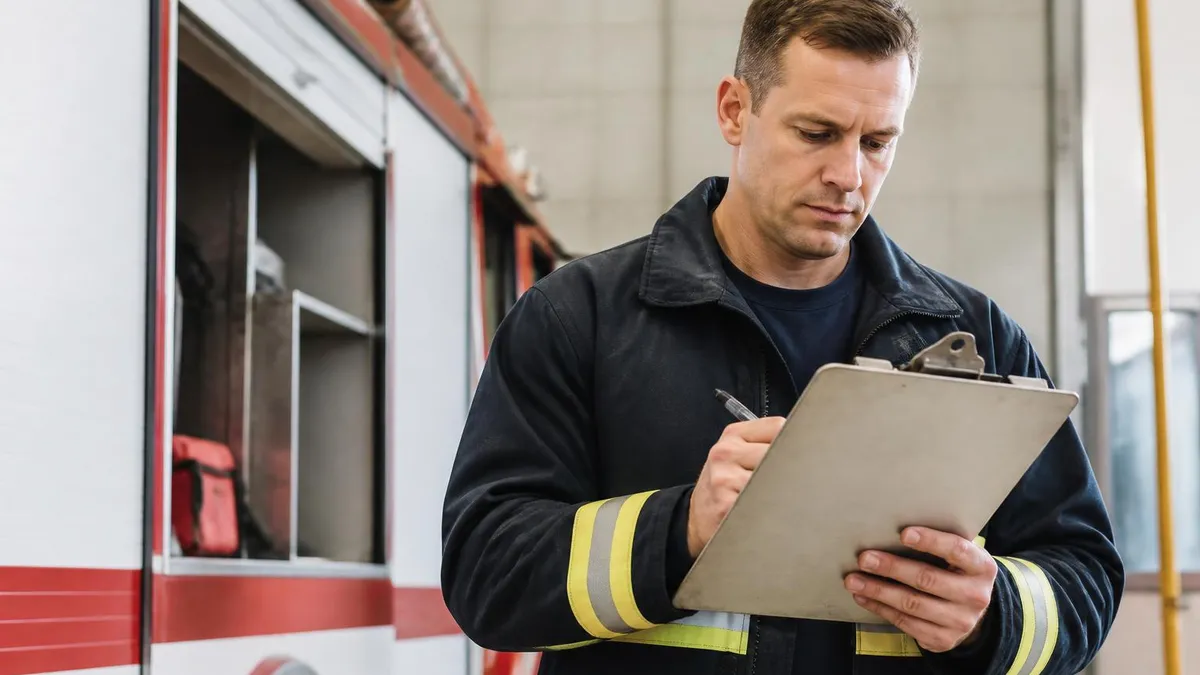
The Bureau of Fleet Services facility is a secured operational site and not open for general public tours. The FDNY Fire Museum in SoHo and the FDNY Foundation gift shop are the public-facing storefronts. Active members can coordinate visits through their company officers or borough commands during specific division-wide events.
For most members of the public, the term FDNY shop conjures up images not of mechanics and welders, but of the FDNY Foundation gift shop — the official retail outlet that sells branded merchandise and supports fire safety education across New York City. Located adjacent to FDNY headquarters in MetroTech Center in downtown Brooklyn, with an online store available nationwide, the foundation shop is where civilians buy t-shirts, hoodies, hats, mugs, challenge coins, and other officially licensed FDNY merchandise that helps fund critical department programs.
The FDNY Foundation is a registered 501(c)(3) nonprofit that operates independently from the department but works closely with it. Every dollar of profit from the gift shop is reinvested into fire safety education, youth programs, the Fire Zone learning center in Rockefeller Center, scholarships for the families of fallen firefighters, and equipment grants that supplement city funding. This is not a city-run operation — it is a charitable arm with its own board of directors and tax filings.
The product lineup has expanded significantly over the past two decades. What used to be a small selection of t-shirts and patches now includes children's clothing, pet accessories, kitchenware, holiday ornaments, fitness apparel, and a full line of memorial merchandise honoring September 11 and the 343 members lost that day. Quality has improved as well, with the foundation working with established American manufacturers to produce gear that meets the expectations of a recognizable global brand.
The gift shop also serves a less obvious but important purpose — controlling unauthorized use of FDNY trademarks. The Maltese cross, the official seal, and even the lettering style are protected intellectual property. By offering a wide range of officially licensed merchandise at reasonable prices, the foundation reduces demand for bootleg products and ensures that profits flow back to legitimate department-supported programs rather than to overseas counterfeiters.
Active and retired members receive a member discount at the foundation shop, and many companies bulk-order custom company-specific items — engine and ladder house t-shirts, mugs printed with company logos, and seasonal hoodies — through coordinated programs. There is a long tradition of company-level merchandise in the fire service, and the foundation provides a legitimate channel for that culture to thrive without conflicting with department uniform regulations.
Tourists visiting New York frequently make the foundation gift shop a destination, particularly around the September 11 anniversary period and the holiday season. The store stocks items priced for every budget, from inexpensive pins and patches to higher-end leather jackets and limited-edition collectibles. Online ordering ships nationwide, and the foundation routinely runs special promotions tied to events like Fire Prevention Week or anniversary commemorations.
If you are studying for FDNY exams and want to dig into the practical materials, pair your shop research with the practice test for printable question sets that mirror what candidates see on the actual written exam. Understanding the department holistically — including its civilian and foundation arms — gives you a more complete picture than rote memorization alone.
Whether you are planning a visit to the FDNY Foundation gift shop, researching the apparatus division for a school project, or preparing for the firefighter exam, there are practical steps that will help you get the most value from your time. Start by understanding which FDNY shop you actually want to engage with — Fleet Services for operational and apparatus questions, MSU for SCBA topics, the uniform facility for PPE logistics, or the foundation store for merchandise and charitable giving. Each one serves a different purpose and has different access policies.
If you are an exam candidate, focus your study time on apparatus identification, basic maintenance terminology, NFPA standards that govern fire department equipment, and the chain of command that links firehouse to division to bureau. Written exams occasionally include questions about apparatus types, equipment, and the support structure behind frontline operations. Knowing the difference between an engine and a ladder, a tower ladder and an aerial, a rescue and a squad, will earn you easy points.
For active members, the FDNY shop is something you will interact with throughout your career. Learn the names of the civilian mechanics who service your apparatus — they have decades of institutional knowledge and treat the rigs like their own. Take advantage of training opportunities to spend time at the shop. Many companies arrange visits during slow periods to give probies hands-on exposure to the equipment that keeps them safe at every job.
Family members and civilians interested in supporting the department should consider purchasing from the FDNY Foundation rather than third-party vendors. Counterfeit FDNY merchandise is unfortunately widespread, particularly in tourist districts. Buying from the official foundation shop ensures authenticity and directly funds programs like fire safety education for school children, scholarships for survivors of fallen members, and equipment grants that go beyond what the city budget covers.
If you want to deepen your understanding of FDNY operations beyond the shop, explore content about company assignments, run volumes, building construction tactics, and the structure of the bureaus that make up the department. Each of these topics intersects with shop operations in ways that become clearer the more you learn. A busy engine company in the Bronx generates entirely different shop demands than a slower ladder company in eastern Queens, and understanding that variation is what separates surface-level knowledge from real expertise.
Finally, recognize that the FDNY shop story is ultimately a story about preparation. Every alarm transmitted in New York City — and there are more than five thousand per day — depends on equipment that someone, somewhere, prepared in advance. The mechanic torquing lug nuts at three in the morning, the welder fabricating a custom bracket, the uniform clerk hand-fitting bunker pants to a probationary firefighter — all of them are part of a chain that ends with a fire knocked down or a life saved. That is the real value of understanding the FDNY shop.
The bottom line for anyone preparing for FDNY exams: do not overlook the support side of the department in your studies. Most candidates focus exclusively on firefighting tactics and forget that the test sometimes includes questions about the department's structure, history, and logistics. Spending an hour learning about the shop and how it integrates with operations could be the difference between a passing score and a top-tier rank on the eligible list — and it gives you talking points that impress interviewers during character review.
Sample Fire Department New York Practice Questions
Try these questions from our free Fire Department New York practice tests. The correct answer and an explanation follow each question.
A Division in the FDNY organizational structure is commanded by which rank?
- A. Captain
- B. Battalion Chief
- C. Deputy Chief
- D. Assistant Chief
Answer: C. Deputy Chief
A Deputy Chief commands a Division, which groups several battalions within a borough.
What type of fire apparatus is designed to handle large-scale fires and has the ability to pump large volumes of water?
- A. Rescue Truck
- B. Ladder Truck
- C. Engine Company
- D. Command Vehicle
Answer: C. Engine Company
An Engine Company is a type of fire apparatus specifically designed to handle large-scale fires and pump significant volumes of water. It carries a pump, a water tank, and various lengths of hose, making its primary role to deliver water to extinguish fires. Ladder Trucks, in contrast, focus on access, ventilation, and rescue.
Which FDNY unit responds alongside engine and ladder companies and provides additional manpower and equipment for complex operations?
- A. Rescue company
- B. Squad company
- C. Satellite unit
- D. Marine unit
Answer: B. Squad company
Squad companies are cross-trained firefighters who augment engine and ladder operations and also respond to hazmat incidents.
A community member reports that their neighbor hoards large amounts of combustible materials blocking hallways. The FDNY public education officer should advise the reporting resident to:
- A. Personally confront the neighbor and demand cleanup
- B. Ignore the situation as it is a private matter
- C. Contact 311 or the FDNY to file a complaint for inspection
- D. Move to a different building immediately
Answer: C. Contact 311 or the FDNY to file a complaint for inspection
Residents should report hoarding and blocked egress hazards to 311 or the FDNY so an inspection can be conducted to address the fire risk.
FDNY Questions and Answers
About the Author
Law Enforcement Trainer & Civil Service Exam Specialist
John Jay College of Criminal JusticeMarcus B. Thompson earned his Master of Arts in Criminal Justice from John Jay College of Criminal Justice and served 12 years as a law enforcement officer before transitioning to full-time academy instruction. He is a POST-certified instructor who has prepared candidates for police entrance exams, firefighter assessments, and civil service examinations across dozens of agencies.
Join the Discussion
Connect with other students preparing for this exam. Share tips, ask questions, and get advice from people who have been there.
View discussion (9 replies)