
FDNY Rescue 2: Inside Brooklyn's Elite Rescue Company 2026 October
FDNY Rescue 2 in Crown Heights, Brooklyn — history, equipment, members, missions, and how to join the FDNY's oldest rescue company. 📝
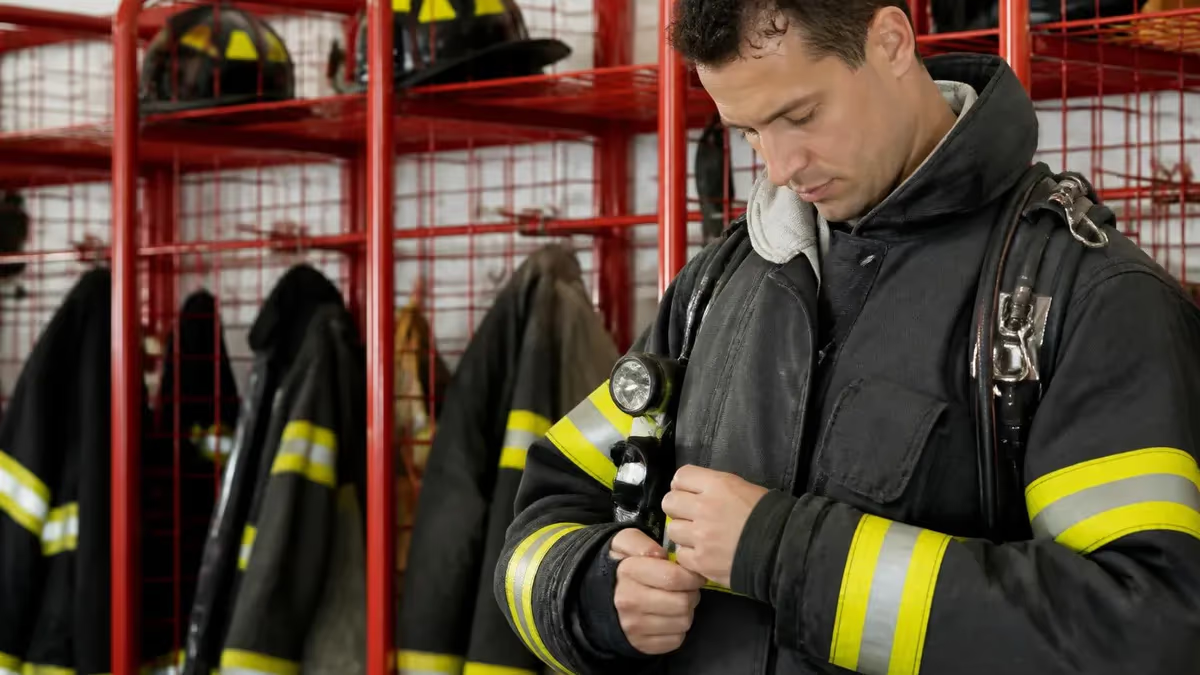
Walk down Bergen Street in Crown Heights and you'll pass a firehouse that doesn't look like much from the outside. Brick, big bay doors, a worn brass plaque. Inside that building sits one of the most decorated rescue companies in the United States: FDNY Rescue Company 2. Founded in 1925, it's the oldest of the five rescue companies in the city and one of the most coveted assignments in the FDNY.
Rescue 2 sits inside the FDNY Special Operations Command, the elite arm that handles the calls no truck or engine company can finish alone. Building collapses. High-angle rope jobs over the Brooklyn Bridge. Confined-space pulls from a trench in East New York. Hazmat events. Vehicle extrications where the dashboard is wrapped around the driver. If a call goes bad in Brooklyn, Rescue 2 is rolling — and on big jobs, they're rolling citywide.
The history matters here. So does the present-day workload. The company runs a busy box on ordinary weekdays and gets pulled into nearly every multiple-alarm in Brooklyn. The mix of work is what makes the assignment distinctive: it's not all fires, and it's not all rescues. It's everything that goes sideways in the city's largest borough by population.
This guide pulls together what the company actually does, the equipment that rides on the rig, the people who wore the leather front piece, and how a regular firefighter eventually ends up sitting in the back of that truck. If you're studying for the FDNY exam and curious about where your career could lead, this is one of the doors at the end of that hallway.
Rescue 2 is one of five FDNY Rescue Companies, all under the Special Operations Command (SOC). The other four are Rescue 1 (Manhattan), Rescue 3 (Bronx), Rescue 4 (Queens), and Rescue 5 (Staten Island). Each rescue covers its borough but responds citywide on major jobs.
The company has lived in Crown Heights since 1985, at 1472 Bergen Street. Before that, it bounced through several Brooklyn quarters going back to its 1925 founding — including stints in Brownsville and East New York during eras when those neighborhoods saw an avalanche of fire duty. The current house is a stand-alone single company quarters: no engine, no ladder, just Rescue 2 and the rig. That's intentional. Rescue companies need bay space, workshop space, a dive locker, and the constant equipment churn that comes with being a special operations unit.
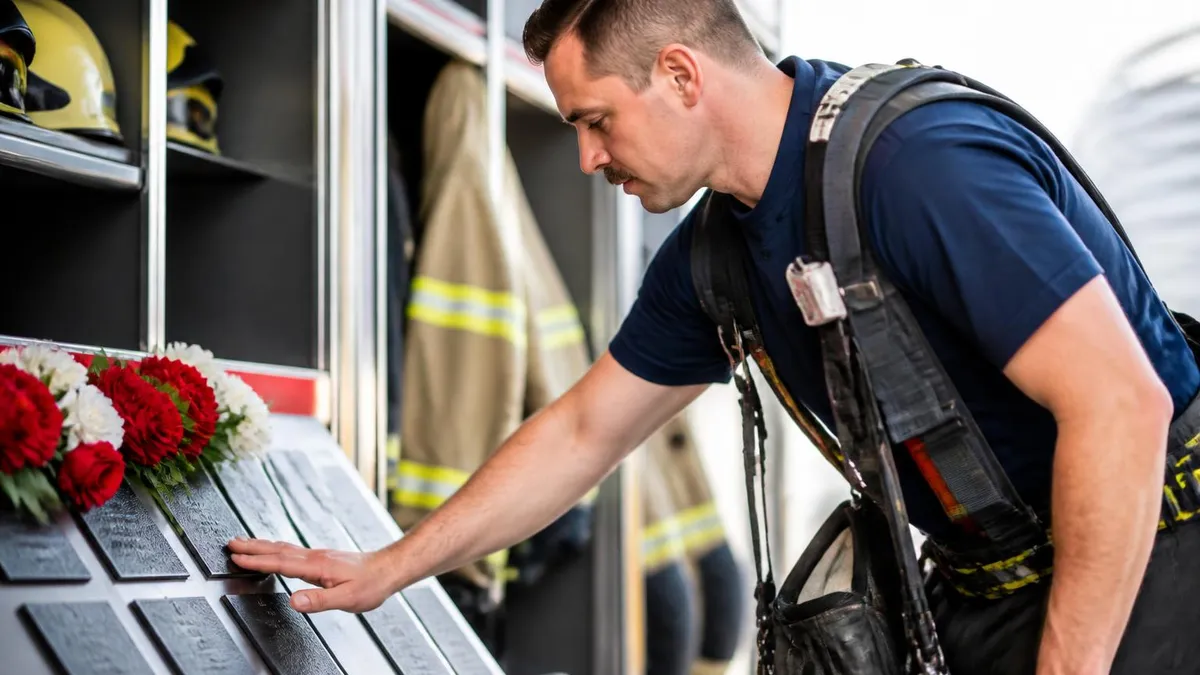
What makes the place feel different the moment you step in? It's the wall. Plaques, helmets, framed photos, mass cards. Pre-9/11, Rescue 2 lost seven members in line-of-duty deaths going back decades — fires, collapses, the brutal arithmetic of a busy borough. Then September 11 happened and the company lost seven more in a single morning. Fourteen total. That history doesn't sit in a museum. It's in the kitchen, on the apparatus floor, in the way senior guys talk to probies.
Visiting members from other companies notice it. So do mutual-aid firefighters who roll into the bay for joint drills. There's a particular quiet there. Not somber, exactly. More like a room that knows what it's seen and doesn't need to advertise it.
Rescue 2 by the Numbers
So what does a rescue company actually do? In Brooklyn, Rescue 2 answers a stripe of calls that would overwhelm a normal engine or truck. The dispatch tones are usually the boring ones — "second alarm," "10-77," "signal 7-5," "trench rescue," "high-rise." Each of those is a different problem and Rescue 2 carries a different bag of tricks for each.
On a structural collapse, the company brings shoring, cribbing, and concrete-cutting tools. On a technical rope job — say a worker dangling off a Coney Island billboard — they bring high-angle gear and the training to rig a litter pickup hundreds of feet off the ground. On a confined-space pull, they bring tripods, air monitors, and the patience to talk a victim through thirty minutes underground.
The list keeps going. Subway derailments. Construction trench cave-ins. Building-facade failures during high winds. Crane collapses on Atlantic Avenue. Hazmat releases near the BQE. Mass-casualty incidents (MCIs) where Rescue 2 sets up an extrication zone while EMS triages patients fifty feet away. Each call type has its own playbook, and each playbook lives in the muscle memory of members who've drilled it dozens of times.
You'll also see Rescue 2 on big fires, especially on the second or third alarm. A working fire pulls in Rescue 1 from Manhattan or Rescue 2 from Brooklyn depending on borough. They're not the first water — engines do that. Rescue companies are the search-and-secondary-rescue specialists. If a member of service gets trapped or a civilian is found behind a wall, that's their lane. They also serve as Firefighter Assist and Search Team (FAST) units on certain incidents, ready to deploy if a Mayday comes over the radio.
Pre-9/11 line-of-duty deaths: 7 members, including officers killed in structural collapses and working fires across Brooklyn between 1925 and 2001.
September 11, 2001: 7 members killed at the World Trade Center, all responding from Bergen Street.
Total members lost in the line of duty: 14 — a number that shapes every shift, every drill, and every probie's first month in quarters.
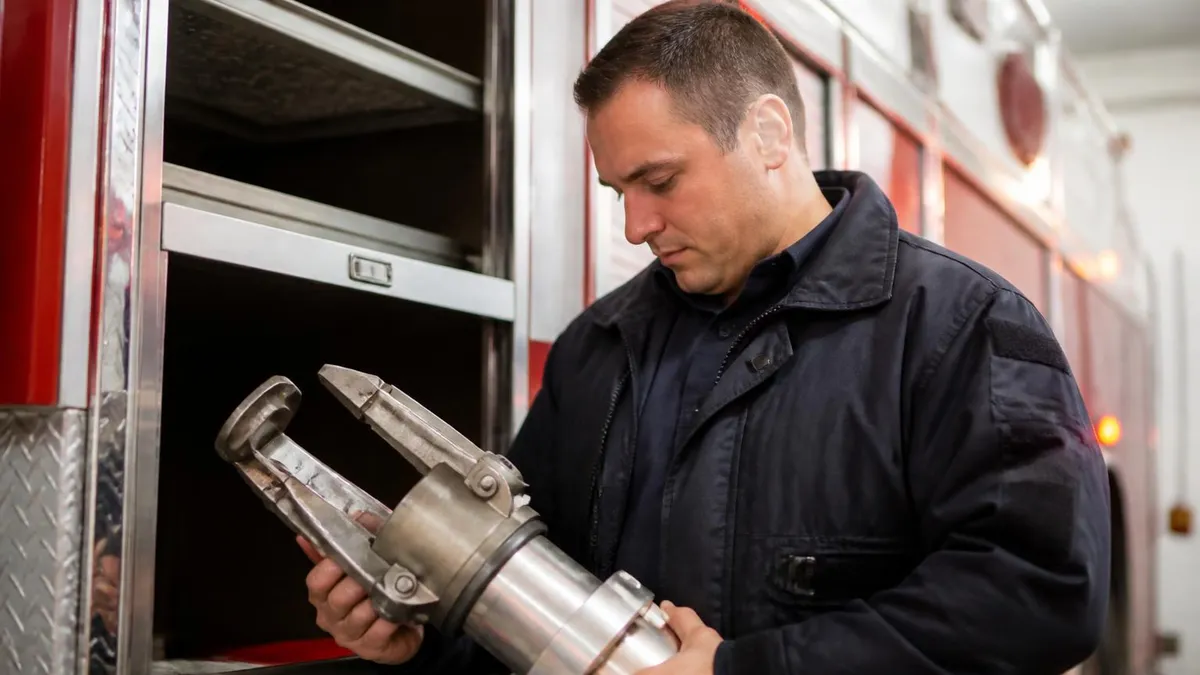
If you climb up onto the rig at Bergen Street and start opening compartments, here's what spills out. Hurst tools — spreaders, cutters, rams — for cutting cars apart and stabilizing collapsed scaffolds. K-12 rotary saws set up with carbide blades, abrasive blades, and metal-cutting blades, because the same call might need all three. Hydraulic rams ranging from low-profile 10-ton units up to monsters you can't even lift by yourself.
For collapses, they ride with FAS-T cribbing (foam-and-strap timber blocks) and Paratech pneumatic shoring you can pump into place to hold up a sagging slab. The rope locker has CMC and Petzl hardware, multiple 200-foot lengths of static line, edge protection, and the litter rigs you need to package a patient before lowering them off a roof.
Inside the truck cab there are thermal imaging cameras, multi-gas atmospheric monitors, RF radios on multiple FDNY channels, and a small library of laminated reference sheets. The back of the rig usually has a saw-and-tool bench bolted in. None of this is theoretical — every tool on the truck has been used on a job in the last twelve months.
The rig itself is a custom heavy-rescue apparatus, purpose-built to carry the tool load. Crew cab in front, walk-in compartment behind. Exterior compartments line both sides and the back, packed with hand tools, power tools, hardware bags, and disposable PPE. A built-in generator powers cordless tool chargers, scene lighting, and the bay heater. There's a clean logic to how everything is stowed: tools that get used on every job are at chest height; specialty gear lives lower or higher.
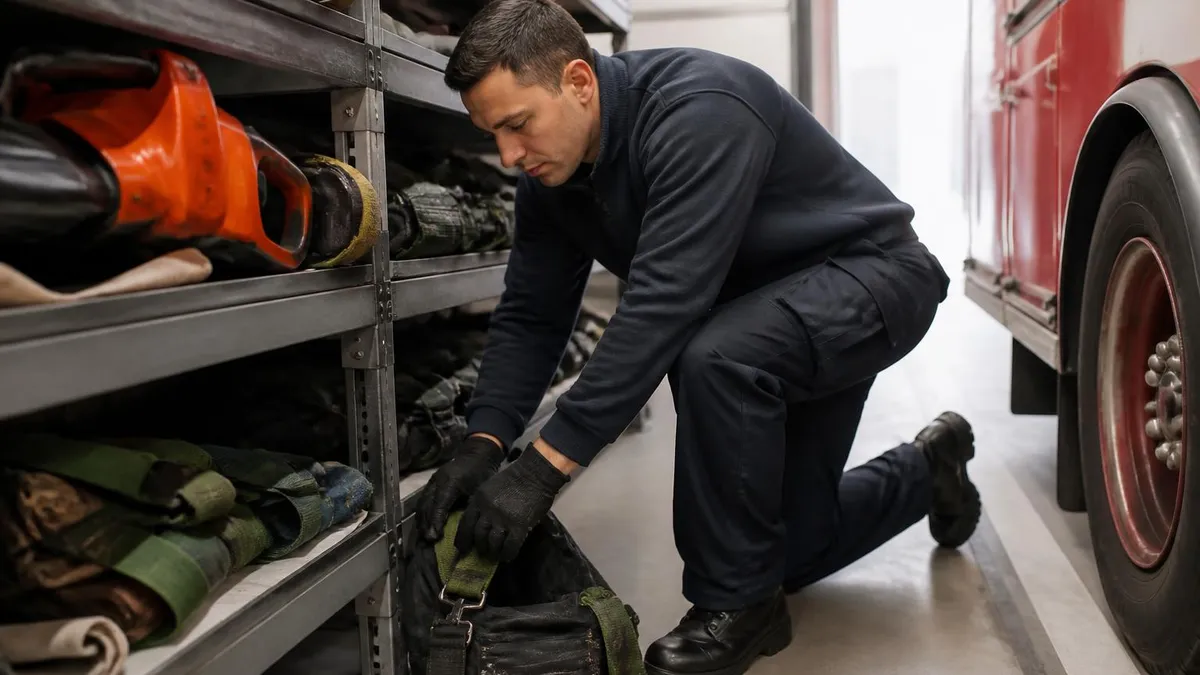
Tool maintenance is constant. After every working job, members tear down what they used, clean it, inspect it, and put it back. Saw chains get sharpened or replaced. Hurst lines get checked for hydraulic leaks. Ropes get inspected and logged. A working rescue rig doesn't have a single piece of "display" equipment — if it's on the truck, it's ready to go.
Rescue 2 Mission Set
Building, scaffold, or trench failures requiring shoring, cribbing, and victim extraction from voids.
- ▸Pneumatic shoring (Paratech)
- ▸FAS-T cribbing systems
- ▸Concrete saws, breakers, breachers
- ▸Hydraulic rams up to 30+ tons
High-angle and over-the-side rope work from bridges, billboards, construction cranes, and rooftops.
- ▸High-angle litter rigs
- ▸CMC and Petzl hardware
- ▸Anchor systems for bridges
- ▸Suspended worker pickups
Below-grade rescues from collapsed trenches, sewers, vaults, and utility chambers.
- ▸Tripod hoist systems
- ▸Atmospheric monitors
- ▸Ventilation fans
- ▸Patient packaging in tight space
Initial entry and victim removal at chemical, biological, and radiological incidents.
- ▸Level A and B suits
- ▸Identification meters
- ▸Decon coordination with Squad units
- ▸Joint operations with HazTac EMS
Complex passenger-vehicle, truck, and bus extrications, including dashboard rolls and side-out cuts.
- ▸Hurst tools (spreaders, cutters)
- ▸Glass-management gear
- ▸Stabilization struts
- ▸Patient packaging in trauma cases
Surface water and ice rescue support across Brooklyn's waterfront and inland waterways.
- ▸Cold-water suits
- ▸Ice rescue sleds
- ▸Throw bags and water rope
- ▸Joint ops with Marine Companies
Rescue 2 has produced or housed some of the most recognizable names in modern American firefighting. Captain John Vigiano Sr. ran the company in the 1980s and 1990s and became the public face of the FDNY's most painful 9/11 story — both of his sons died that morning. John Vigiano Jr. was a firefighter assigned to Ladder 132, and Joe Vigiano was an NYPD ESU detective. The captain spent the rest of his life telling their story and supporting families of fallen first responders before his own death in 2018.
William "Bill" Feehan, the First Deputy Commissioner who died at the World Trade Center, came up through Rescue 2 earlier in his career — one of his many influences on the company. Chief of Department Peter Ganci, also killed at the WTC, was tied to the SOC world Rescue 2 inhabits. The list of officers who passed through Bergen Street and went on to command battalions, divisions, and SOC itself is long. It's not an accident that promotional boards are stacked with former Rescue 2 members — see the broader FDNY command profile for context.
Beyond the famous names, the company has carried hundreds of working firefighters through its rotation over the decades. Some stayed five years and moved on to chief officer track. Some stayed twenty and retired off the rig. A few wrote books. A few teach at the academy. Almost all of them stay close to the firehouse network long after they pull the pin. Reunions, charity runs, memorial masses — the Bergen Street alumni network is one of the tightest in the FDNY.
The Five FDNY Rescue Companies Compared
Rescue 1 covers Manhattan from 530 West 43rd Street in Hell's Kitchen. Heavy diet of high-rise jobs, restaurant fires, construction collapses in midtown, and rope work off the bridges and stadiums. Lost 11 members on 9/11.
See the full breakdown on the dedicated Rescue 1 page.
How do you actually get assigned to Rescue 2? The short answer: you don't apply out of probie school. You earn the seat. The unwritten rule has been that you need at least four years on the FDNY as a firefighter before you can even sit for the rescue qualification exam, and most members who make it have closer to seven or eight years in a busy truck or engine company before they transfer.
The path starts the same as every other firefighter — pass the FDNY exam, complete the probationary academy, get assigned to a company. Then you grind. You learn your borough, you take every promotional class the department offers, you sign up for the SOC schools and the FDNY jobs ladder. Squad and Rescue qualifications usually involve a written exam plus a physical assessment that hammers on technical rope, confined space, and hazmat fundamentals.
Once you're qualified, you put your name on the list. Vacancies open through retirements and transfers, and the senior captain has a real say in who he wants in the back of the truck. It's not a meritocracy of pure exam scores. It's also reputation — who picks up overtime, who comes to drills, who handles themselves on a chaotic floor.
There's a culture at Bergen Street that's hard to describe to outsiders. It's part Marine Corps, part working-class Brooklyn, part private club. Probies don't sit on the couch. Probies don't put their feet up. Probies cook, clean, and learn. Senior guys teach by doing — quietly, with very few words, while you watch how they pack a hose or check a saw.
The drills run constantly. Every shift has at least one structured drill, and the company runs scenario-based training in the bay multiple times a week. Rope, confined space, vehicle, hazmat, collapse — the rotation never stops. That's why members who make it through their first probationary year at Rescue 2 talk about it as the most intense year of their careers, even after twenty years in the job.
Meals are taken together at the long kitchen table — that's not negotiable. The cook for the tour is responsible for shopping, prepping, and feeding the whole house. Kitchen duty is one of the ways probies start to learn personalities, preferences, and the unspoken hierarchy. Get the meal right and the chemistry follows. Get it wrong and the ribbing lasts a week.
The other thing? Quiet pride. Members don't wear the patch around town to brag. The patch shows up on the fire scene. It shows up at a funeral. It shows up at a charity 5K for a brother's family. But you won't see anyone walking around in a Rescue 2 hoodie at the supermarket — that's not the vibe. The work speaks. The patch doesn't need to.
What to Study If You Want a Rescue Company Seat
- ✓Master the basic firefighting exam material — you can't transfer until you pass it cleanly
- ✓Spend your first 2–3 years in a busy engine or truck company (south Bronx, north Brooklyn, midtown Manhattan)
- ✓Take every SOC outreach class the department offers — rope, confined space, collapse rescue
- ✓Pursue Squad assignments first — Squads are a feeder for Rescue companies
- ✓Attend Special Operations Command schools (FAST/RIT, Tech Rescue, Hazmat)
- ✓Get to know SOC officers — drills, mutual aid jobs, training cadres
- ✓Pass the Rescue qualification exam (written + physical assessment)
- ✓Put your name in for a Rescue 2 vacancy — be patient and keep your reputation clean
- ✓Bring fitness — you'll be moving heavy tools for hours on collapse and rope jobs
- ✓Read the company history before your first shift — it matters at Bergen Street
Rescue 2 has shown up on almost every major Brooklyn incident of the last forty years. The Waldbaum's supermarket fire and roof collapse in 1978 killed six firefighters in Sheepshead Bay — Rescue 2 was part of that horrific morning. The 1991 Father's Day plumbing supply explosion in Astoria pulled Rescue 2 into a multi-borough rescue operation. The Atlantic Avenue tunnel explosions, the Vanderveer Estates apartment collapses, every major Brooklyn warehouse fire of the 1990s and 2000s.
And then September 11. Rescue 2 responded with seven members. None of them came home. The company stayed in operation that night and the next morning and every shift after, because the city still needed a Brooklyn rescue. That continuity is part of the legacy: even on the worst day, the box gets answered.
More recent calls include construction collapses on Atlantic Avenue, scaffold failures in Williamsburg, and warehouse fires in Sunset Park. The pace of work hasn't slowed — if anything, the rise of high-rise construction across the borough has produced more technical-rescue work per year than the company saw a decade ago. See FDNY runs and workers for citywide volume context and how rescue companies fit into the broader response picture.
FDNY Rescue 2 Pros and Cons
- +Most coveted assignment in the FDNY — career-defining experience
- +Constant skill development across collapse, rope, hazmat, water, and vehicle rescue
- +Strong mentorship culture and direct path to SOC officer ranks
- +Citywide recognition and a tight, lifelong brotherhood
- +Equipment, training, and time you simply don't get in a normal engine or truck
- −High physical demand — collapse and rope jobs are punishing on the body
- −Difficult to get into — years of preparation, plus reputation and timing
- −Heavy emotional load — 14 members lost in the line of duty hangs over the house
- −Long shifts on chaotic, hours-long technical jobs (collapses don't end quickly)
- −Family time competes with constant drills, schools, and overtime opportunities
Pros and Cons at a Glance
| Pros | Cons |
|---|---|
| Most coveted assignment in the FDNY — career-defining experience | High physical demand — collapse and rope jobs are punishing on the body |
| Constant skill development across collapse, rope, hazmat, water, and vehicle rescue | Difficult to get into — years of preparation, plus reputation and timing |
| Strong mentorship culture and direct path to SOC officer ranks | Long shifts on chaotic, hours-long technical jobs (collapses don't end quickly) |
| Citywide recognition and a tight, lifelong brotherhood | Family time competes with constant drills, schools, and overtime opportunities |
If you're reading this and you want to be the guy or woman climbing onto that rig at Bergen Street one day, the path is long but it's clear. Get the basics right first. Pass the FDNY entrance exam, get into the academy, get assigned to a company that runs. Pay attention to how FDNY pay and overtime work — SOC members run high hours, and that has a real effect on your career arc.
Talk to current Rescue members at department events. Most are approachable if you don't waste their time. Ask about Squad assignments as a stepping stone — many Rescue 2 members spent time in Squad 1 or Squad 252 in Brooklyn before crossing over. Learn the geography — Rescue 2 covers a borough with very different neighborhoods, from brownstone Brooklyn to industrial waterfront. You can also study the FDNY stations and companies map to understand the response pattern.
And if firefighting doesn't end up being your path? FDNY EMS runs alongside Rescue 2 on hazmat and trauma jobs. Both sides of the house need talent. The city has more than one way to put you on the rig at a collapse.
One last thing. The reason Rescue 2 matters isn't the patch, the tools, or even the history. It's the standard. The company drilled and ran and answered every box for nearly a century before you read this paragraph, and it will keep doing that long after. If you decide that's the kind of work you want, the route is open — long, hard, and clear. Bergen Street isn't a shrine. It's a working firehouse, and it's waiting on its next generation of members to walk in and answer the bells.
Sample Fire Department New York Practice Questions
Try these questions from our free Fire Department New York practice tests. The correct answer and an explanation follow each question.
Which FDNY unit is specially trained and equipped to perform high-angle rope rescue, confined space rescue, and water rescue operations?
- A. Engine Company
- B. Ladder Company
- C. Rescue Company
- D. Battalion Chief Unit
Answer: C. Rescue Company
FDNY Rescue Companies (Rescue 1–5) are the department's elite technical rescue units trained in high-angle, confined space, water, and structural collapse rescue.
In water rescue, what does the FDNY motto 'Reach, Throw, Row, Go' represent?
- A. The order of commands given to a drowning victim
- B. A progressive sequence of rescue techniques from least to most risk to the rescuer
- C. The four types of water rescue equipment carried on apparatus
- D. The radio channels used during water rescue operations
Answer: B. A progressive sequence of rescue techniques from least to most risk to the rescuer
This progression describes water rescue methods in order of increasing risk to the rescuer: reach with a pole, throw a line, row a boat, and only then go in the water as a last resort.
During a structural collapse rescue, the FDNY uses a systematic victim search approach. What does the acronym 'LAST' stand for in collapse rescue?
- A. Locate, Access, Stabilize, Transport
- B. Listen, Assess, Search, Treat
- C. Locate, Assess, Secure, Triage
- D. Listen, Alert, Stabilize, Tag
Answer: A. Locate, Access, Stabilize, Transport
LAST stands for Locate, Access, Stabilize, and Transport — the four sequential phases of victim rescue in a structural collapse operation.
In FDNY rope rescue operations, what is the minimum tensile strength required for a life-safety rope used for rescue according to NFPA 1983?
- A. 2,000 lbs (8.9 kN)
- B. 4,500 lbs (20 kN)
- C. 9,000 lbs (40 kN)
- D. 20,000 lbs (89 kN)
Answer: B. 4,500 lbs (20 kN)
NFPA 1983 requires life-safety rope to have a minimum breaking strength of 4,500 lbs (20 kN) for general use rescue applications.
FDNY Questions and Answers
About the Author
Law Enforcement Trainer & Civil Service Exam Specialist
John Jay College of Criminal JusticeMarcus B. Thompson earned his Master of Arts in Criminal Justice from John Jay College of Criminal Justice and served 12 years as a law enforcement officer before transitioning to full-time academy instruction. He is a POST-certified instructor who has prepared candidates for police entrance exams, firefighter assessments, and civil service examinations across dozens of agencies.
Join the Discussion
Connect with other students preparing for this exam. Share tips, ask questions, and get advice from people who have been there.
View discussion (9 replies)