
FDNY EMS — How New York City's Emergency Medical Service Works and How to Become an FDNY EMT or Paramedic
FDNY EMS explained: what FDNY Emergency Medical Service does, how to become an FDNY EMT or paramedic, exam steps, salary, and how the bureau runs daily. ⏳
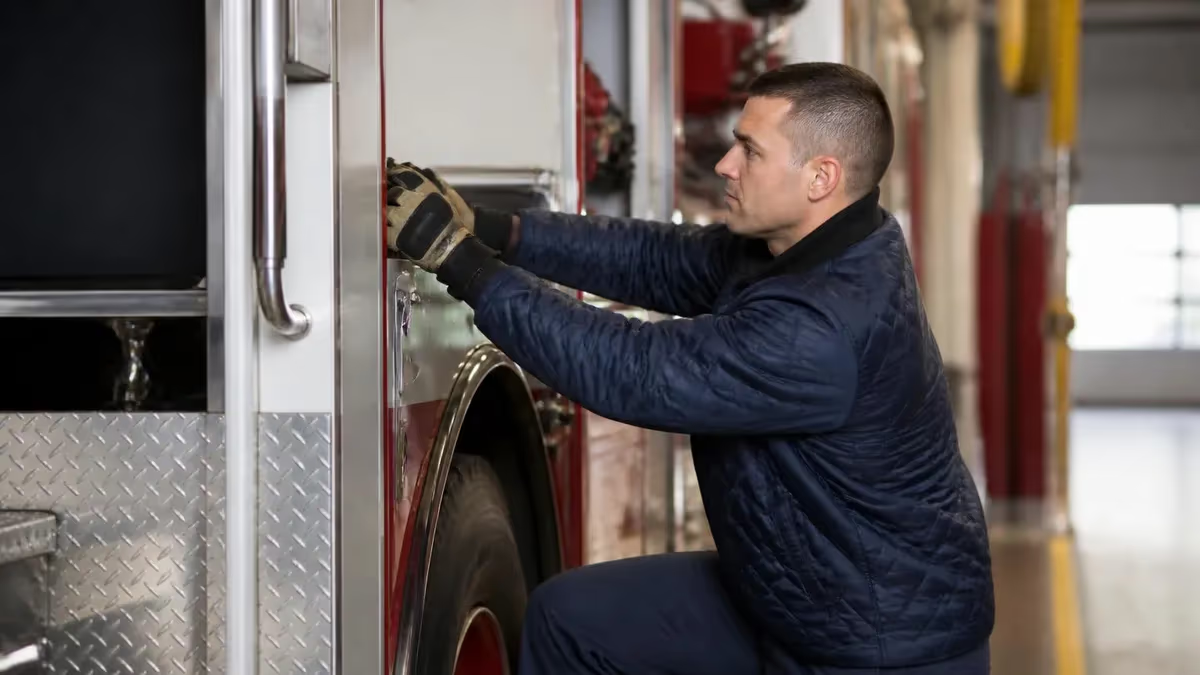
FDNY EMS is the Bureau of Emergency Medical Services inside the Fire Department of the City of New York. It is the largest municipal pre-hospital emergency medical service in the United States. The bureau answers more than 1.5 million emergency calls every year across the five boroughs.
Most people think of FDNY only as firefighters. The reality is bigger. The agency runs two parallel operations under one commissioner. One side puts water on fires. The other side keeps cardiac arrest patients alive on the way to the hospital. FDNY EMS does the second job, and it does it at a scale that no other system in the country matches.
This guide walks through how the bureau is organized, what the daily call mix looks like, how to apply for the EMT job, what the academy is like, salary steps, the path from EMT to paramedic, and how the test process actually works. Real numbers. Plain English. No fluff. If you are thinking about applying, you will know exactly what is in front of you by the end of this page.
What FDNY EMS Actually Is
FDNY EMS is one of three operational bureaus inside the Fire Department of New York. The other two are the Bureau of Fire Operations (firefighters and engine/ladder companies) and the Bureau of Fire Prevention (inspectors, plan examiners, fire marshals). The Bureau of EMS is the medical side. It runs ambulances, dispatches medical calls, staffs special operations like tactical EMS and the Haz-Tac unit, and trains every paramedic and EMT who wears the FDNY patch.
EMS joined FDNY in 1996. Before the merger, New York City EMS was a separate Health and Hospitals Corporation agency. The 1996 reorganization put fire and EMS under a single chain of command, which is why you now see FDNY ambulances on every block in the city.
The bureau operates from over 30 EMS stations spread across the five boroughs. Each station houses ambulances, supervisor vehicles, and crews who work 8 or 12-hour tours. Stations are organized into divisions, and divisions roll up to the Chief of EMS. The whole bureau answers to the Fire Commissioner.
FDNY EMS is also the dispatch authority for nearly all 911 medical calls in New York City. When you call 911 for a heart attack in Queens, the call hits the FDNY EMS dispatch center. The closest unit is sent — and that unit may be an FDNY ambulance or a voluntary hospital ambulance under contract with the city. Either way, FDNY EMS controls the dispatch.
FDNY EMS by the Numbers
EMT vs Paramedic — Two Different Jobs Inside FDNY EMS
The bureau hires for two clinical ranks: Emergency Medical Technician (EMT) and Paramedic. They are not interchangeable. The training is different, the pay is different, the scope of practice is different, and the test paths are different.
An FDNY EMT handles basic life support (BLS). That means CPR, bleeding control, splinting, oxygen, airway management with non-invasive devices, and patient assessment. EMTs run the majority of ambulances in the city. The job is physically demanding, fast-paced, and emotionally heavy. Most new hires start here.
A FDNY paramedic handles advanced life support (ALS). Paramedics start IVs, push cardiac drugs, intubate patients, run cardiac monitors, decompress chest cavities, and make medical decisions that EMTs cannot legally make. Paramedic ambulances are sent to the most serious calls — cardiac arrests, major trauma, strokes, severe respiratory distress, and pediatric emergencies.
You cannot apply directly to FDNY as a paramedic from outside the agency through the standard civil service path. The bureau promotes EMTs to paramedic after they complete the FDNY Paramedic Training Program. So almost everyone walks in as an EMT first, then promotes up. There are occasional lateral entries for already-certified paramedics, but the EMT-first path is the standard one.
If you want the full breakdown of the test, read the FDNY exam guide for the written exam structure. The EMS exam shares many of the same cognitive testing principles — reading, memory, judgment — but the EMS exam also requires you to hold a valid New York State EMT certification before you can be appointed.
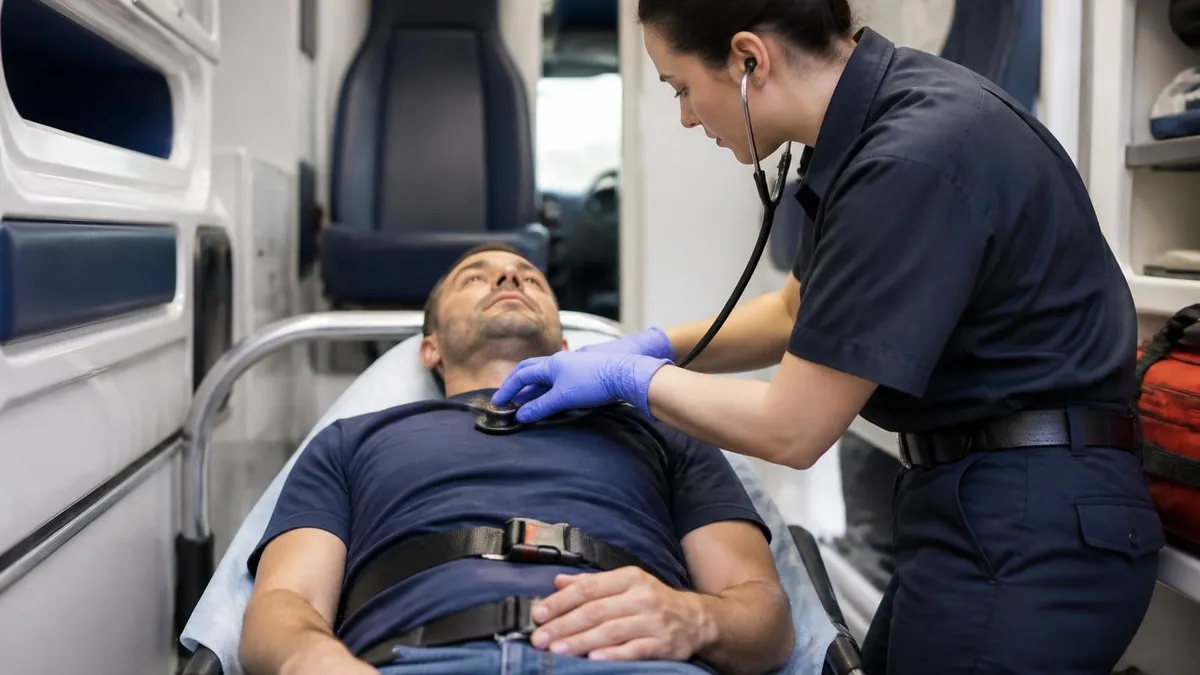
FDNY EMS Career Path — At a Glance
- Certification: NYS EMT-Basic (120-hour course)
- Starting salary: $39,386 (probationary)
- Top salary (5 yrs): $59,534 base
- Scope: BLS — CPR, oxygen, airways, splinting
- Certification: NYS Paramedic (1,200+ hr program)
- Starting salary: $57,738
- Top salary (5 yrs): $86,184 base
- Scope: ALS — IVs, intubation, cardiac drugs
- Role: EMS unit supervisor — runs a tour
- Path: Civil service exam, paramedic preferred
- Salary range: $90,000–$110,000+ with overtime
- Duties: Scene command, member discipline, scheduling
- Path: Promotional exam after lieutenant tenure
- Roles: Station commander, division chief, citywide command
- Salary range: $120,000–$200,000+
- Special units: HazTac, rescue medics, tactical EMS
What an FDNY EMS Tour Actually Looks Like
A tour is a shift. EMS members typically work 8-hour tours, with some assignments running 12 hours. You report to your station, check the rig, sign for narcotics if you are a medic, and then you are in service. Service means the truck is on the radio and available for dispatch.
Call mix is varied. On a busy weekend night in the Bronx, a crew might run 15 to 20 jobs in eight hours. Calls range from minor — a person who fell and needs help getting up — to critical resuscitations where the patient is in cardiac arrest before the rig even arrives. EMTs and paramedics learn to switch gears fast.
Between calls, crews do not return to the station. They post on street corners. Posting puts ambulances near historical call volume hotspots so response times stay short. A unit might post at the same intersection in Crown Heights for an hour, get a job, transport, then post somewhere else after clearing the hospital. The truck almost never sits empty inside a firehouse the way fire engines do.
Equipment checks happen at the start of every tour. Oxygen tank levels, defibrillator self-test, narcotics count (for ALS units), stretcher operation, fluid in the bag, suction, lights, sirens. Anything broken or missing gets fixed before the rig goes in service. A unit that goes in service with bad equipment can be cited or pulled.
Tour change happens at the station. Outgoing and incoming crews swap a quick handoff — any unusual call, any equipment issue, any documentation that needs follow-up. Then the outgoing crew goes home and the incoming crew rolls out.
Documentation is constant. Every patient gets a Patient Care Report (PCR) filled out in real time on a tablet. PCRs feed billing, hospital handoff, quality assurance, and legal records. A sloppy PCR is the fastest way to get pulled in front of a supervisor for retraining.
Radio discipline matters. EMS dispatch in New York runs hot — every transmission is timed, every status change is logged, every wait at a hospital triggers a clock. Crews learn the radio rhythm fast or they fall behind on the call queue.
Crew dynamics also shape every tour. You spend eight to twelve hours in a small box with one partner running back-to-back emergencies. Partner pairing matters more than most outsiders realize.
FDNY EMS Special Operations Units
The bureau runs several specialized units beyond standard BLS and ALS ambulances. These are sought-after assignments that take experience and additional training to reach.
- HazTac (Hazardous Materials Tactical): EMTs and paramedics trained to operate inside hazardous materials zones, terror events, and CBRN incidents. They wear Level B chemical protective suits and self-contained breathing apparatus. About 200 members assigned citywide.
- Rescue Medics: Paramedics integrated into the FDNY Rescue Companies (heavy-rescue firefighting units). They provide advanced medical care during technical rescues, building collapses, and confined-space operations.
- Tactical Medics: Paramedics who deploy with NYPD Emergency Service Unit (ESU) on high-risk operations — warrant entries, hostage situations, active shooter response. Cross-trained in tactical movement and casualty care under fire.
- Bicycle Response Units (BRU): EMTs on bicycles in pedestrian-dense areas like Times Square and major events. They reach patients faster than ambulances in gridlock.
- Marine 1 EMS: EMTs and paramedics on the FDNY fireboats covering waterway emergencies and shoreline events.
How to Become an FDNY EMT — Step by Step
Basic requirements at time of appointment:
- At least 18 years old (no upper age limit for the EMT exam)
- High school diploma or GED
- Valid New York State EMT-Basic certification (CFR-only is not enough)
- Valid US driver's license
- US citizenship or eligible work authorization with intent to naturalize
- NYC residency within 90 days of appointment
- Clean criminal record review — felony convictions may disqualify, evaluated case-by-case
- Pass medical and psychological evaluation
You do not need to live in NYC when you apply or take the test. Residency only becomes mandatory after appointment. EMS members can live in any of the surrounding counties (Nassau, Suffolk, Westchester, Rockland, Orange, Putnam, Dutchess) and commute.
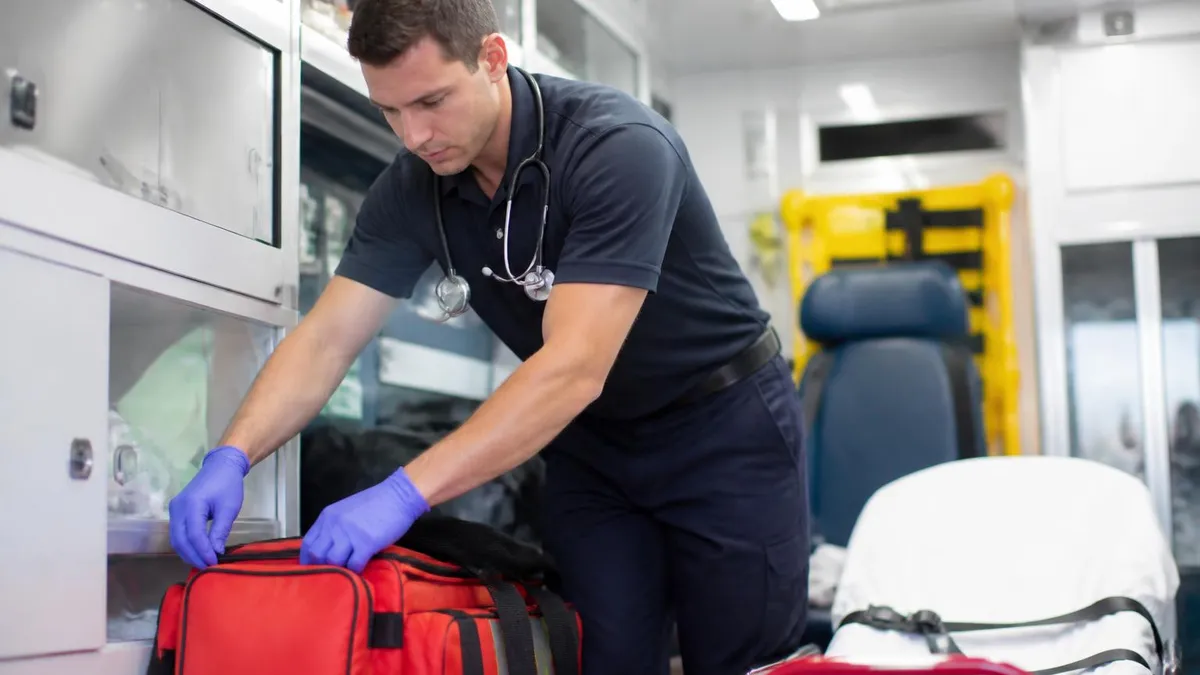
Pre-Apply Checklist for FDNY EMT
- ✓Get your New York State EMT-Basic certification — you cannot be appointed without it. The course runs about 150 hours at a NYS-approved training institution.
- ✓Build a clean driving record before applying — FDNY pulls your DMV history. Recent moving violations, DUI, or license suspensions create problems during the medical and character review.
- ✓Address any criminal history honestly on the application. Lying about a past arrest is a far bigger problem than the arrest itself. Bring court dispositions for anything older than juvenile.
- ✓Hit your CPR card renewal — FDNY accepts AHA BLS for Healthcare Providers. Keep the card current through the hiring process.
- ✓Build cardiovascular and upper-body strength. Lifting stretchers and bariatric patients is part of the daily job. The pre-employment medical includes lift and carry tests.
- ✓Save 6 to 12 months of expenses before academy starts. Probationary EMTs make around $39,000 and that does not stretch in New York City. Many new hires live with family or roommates to make it work.
- ✓Read the FDNY EMS protocol manual before academy. It is publicly available on the Regional Emergency Medical Services Council (REMSCO) website for the New York City region. Knowing the protocols going in shortens the learning curve.
- ✓Follow the FDNY recruitment social media for filing period announcements. Periods are short and easy to miss if you are not watching.
FDNY EMS Salary — What You Actually Make
FDNY EMS pay is set by collective bargaining agreement between the city and the unions — Local 2507 represents EMTs and paramedics, Local 3621 represents EMS officers. Base salaries are public record and increase with years of service. Overtime is significant, especially for paramedics and units in high-call-volume areas.
EMT base pay starts at $39,386 for the probationary year. It increases at year one, year three, year four, and year five. By year five, top base EMT pay is $59,534. Many EMTs earn an additional $10,000 to $25,000 a year in overtime depending on assignment.
Paramedic base pay starts at $57,738 after promotion to medic. It tops out at $86,184 after five years. Medics typically earn $15,000 to $35,000 a year in overtime. A senior medic in a busy unit can clear $120,000 total annual pay without doing anything unusual.
Pension, health insurance, and 22-year retirement are part of the package. EMS members get the same NYCERS Tier 6 pension as other city workers. The contract also includes uniform allowance, night differential, and longevity payments at 5, 10, 15, and 20 years.
For the deepest dive, our FDNY salary breakdown covers firefighter pay vs EMS pay side by side. Spoiler — firefighter pay is higher. That is one of the open friction points in the bureau, and one of the reasons many EMTs eventually transfer to the firefighter list.
A significant number of FDNY EMTs use the bureau as a stepping stone to the firefighter title. Time served as an EMT counts toward firefighter exam credit, and FDNY actively recruits firefighters from inside its own EMS ranks through the Emergency Medical Service Promotion to Firefighter program.
The pay gap is the main driver. A senior firefighter earns roughly $40,000 more per year than a senior EMT at base pay, with even larger overtime opportunities. Many career EMS members feel undervalued compared to their firefighter colleagues despite running far more calls per shift. This is a known issue inside the department and a current bargaining priority.
If you want firefighter pay, applying through EMS first is a legitimate strategy. You get a city job, build seniority, learn FDNY operations, and earn promotional credits — then sit for the firefighter exam from inside the agency.
Getting Promoted to FDNY Paramedic
EMTs can apply to the FDNY Paramedic Training Program once they have served as full-duty EMTs. The program is internal — FDNY trains its own medics rather than hiring outside paramedics.
The selection process starts with an open application within the bureau. EMTs in good standing apply through the EMS training division. Applicants take an exam covering anatomy, physiology, pharmacology basics, and EMT-level patient assessment. Top scorers move forward to interviews.
Selected candidates enter the Paramedic Training Program at Fort Totten. The program runs about 18 months full-time. It mirrors a college-level paramedic program — classroom science, clinical rotations in hospital ERs, ICUs, operating rooms, and pediatrics, plus field internships on ALS ambulances under preceptor supervision.
Cost is covered by FDNY. EMTs continue to earn their regular salary while attending the program. That is a major financial advantage compared to paying out of pocket for a civilian paramedic school, which can run $10,000 to $15,000 in tuition plus lost income.
Upon completion, candidates sit for the NREMT-Paramedic written and practical exams. Passing the NREMT and meeting New York State requirements grants the paramedic certification. The promotion to paramedic title and salary follow.
Some EMTs choose to go to civilian paramedic school on their own time and money. This is allowed and faster — you can transfer to medic title within FDNY after passing the state exam. But most EMTs use the FDNY-funded internal program because it pays you to train.
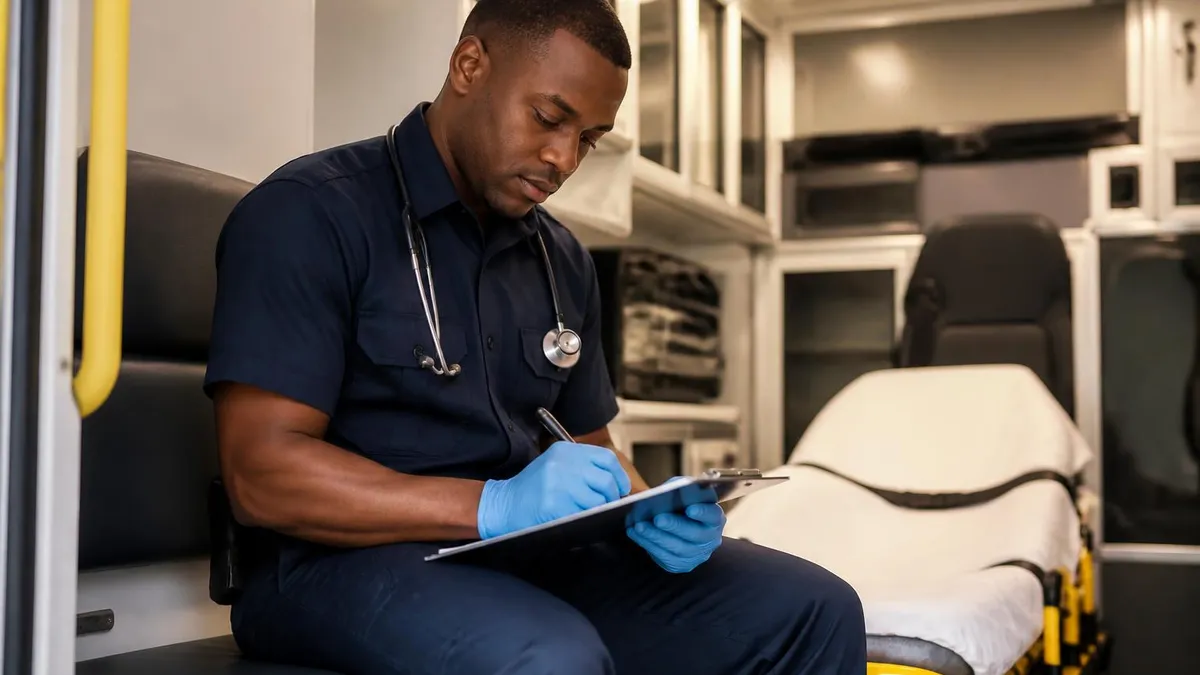
FDNY EMS Pros and Cons
- +Job security — once you pass probation, the city job is one of the most secure in EMS
- +Pension — 22-year retirement and NYCERS pension benefits beyond what private EMS offers
- +Paid paramedic school — FDNY pays for your medic training and keeps you on salary during the 18-month program
- +Career mobility — promotional paths to lieutenant, captain, special operations, and rescue units
- +Volume — running 1.5 million calls a year means you see every type of medical and trauma case, which builds clinical skills no slow system can match
- +Health insurance, sick time, vacation time, and union representation that private and hospital-based services rarely match
- −Pay gap with firefighters — EMS members run more calls but earn significantly less, which is a long-standing point of friction
- −High call volume burnout — the city does not stop, and running 15+ jobs a tour for years takes a real toll
- −NYC cost of living — $39,000 probationary pay does not go far in the five boroughs
- −Mandatory overtime — staffing shortages mean forced doubles and holdovers, especially in the Bronx and Brooklyn
- −Slow promotional movement — EMS officer promotional lists move slowly compared to fire side
- −Exposure to violence, infectious disease, hazardous environments, and traumatic incidents at higher rates than most EMS systems
How to Prepare for the FDNY EMS Exam
The EMS exam is more of a reading and judgment test than a clinical knowledge test. Studying NREMT material will not directly help. What helps is practicing the exact question style — reading a passage, then answering questions on what the passage said, sometimes after a delay.
Start with the official DCAS exam notice for the EMS exam. When the bureau announces the next exam, DCAS publishes a Notice of Examination with the exact content outline. Read this document closely. It is the only authoritative source for what the exam will test.
Practice with timed reading comprehension sets. Magazines, newspaper editorials, and government documents all work. Read a passage, look away, then write down everything you can remember about specifics — names, numbers, addresses, sequences. The exam tests recall of detail under time pressure.
Work through situational judgment questions. These give you a scenario — a patient with a difficult family member, a partner who wants to bend a rule, a hospital staff member being rude — and ask you what the most professional response is. Right answers reflect FDNY values around patient care, integrity, and chain of command. There is no clinical 'right answer' — it is judgment.
Do not cram. The exam is a skills test, not a knowledge test. Skills improve with weekly practice over months. Last-minute studying will not raise your score the way it would for a content-heavy test.
The full FDNY practice test on our site mirrors the format used in past EMS exams. Walking through it under time pressure will tell you exactly where your weaknesses are.
Job Outlook and Hiring in 2025–2026
FDNY EMS is in a sustained hiring cycle. Attrition is high — medics leaving for hospital-based jobs, EMTs transferring to firefighter, retirements among the post-merger generation — and call volume continues to rise year over year. The bureau has been recruiting continuously since the eligible list ran low, which means anyone with NYS EMT certification can apply at any time.
City budget projections through 2026 add several hundred new EMS positions. Most are EMT slots, with paramedic hires happening through internal promotion. Federal funding from FEMA and other emergency preparedness grants supports special operations growth, including HazTac and Tactical EMS expansion.
If you are an EMT in New Jersey, Pennsylvania, Connecticut, or Long Island and have considered FDNY, the moment to apply is now while the door is open. Eligibility lists have historically closed quickly when hiring slows.
Pay raises through 2026 are tied to the next union contract round. Local 2507 has been negotiating for parity with firefighters and other city responders. The outcome of that negotiation will shape EMS career pay for the next five years and is the single biggest variable in the bureau's near-term future.
Retention is the other open question. The bureau loses too many trained medics to hospital systems offering shorter hours and higher base pay. Solutions being discussed include retention bonuses at five and ten years, an accelerated promotion track for high-call-volume station veterans, and a parity adjustment that closes the firefighter pay gap. Each of these would change the calculus for current members deciding whether to stay another five years or transfer out.
From a career standpoint, the bureau still offers something the private sector cannot — pension, predictable pay raises, union protection, and a path into the largest fire department in the country. That value proposition is why FDNY EMS continues to attract more applicants than open slots every recruitment cycle, even with the well-known pay gap.
The application window does not stay open forever. Continuous recruitment can pause overnight when the city revises its hiring projections. If FDNY is on your radar at all, file the paperwork now and start the medical and background process. Worst case, you have an open application and you turn it down later. Best case, you start the academy before the next cycle closes.
FDNY Questions and Answers
About the Author

Law Enforcement Trainer & Civil Service Exam Specialist
John Jay College of Criminal JusticeMarcus B. Thompson earned his Master of Arts in Criminal Justice from John Jay College of Criminal Justice and served 12 years as a law enforcement officer before transitioning to full-time academy instruction. He is a POST-certified instructor who has prepared candidates for police entrance exams, firefighter assessments, and civil service examinations across dozens of agencies.
Join the Discussion
Connect with other students preparing for this exam. Share tips, ask questions, and get advice from people who have been there.
View discussion (9 replies)