
Esthetician Program Near Me: How to Find, Compare, and Choose the Best Local Beauty School in 2026
Find the best esthetician program near me with our 2026 guide. Compare tuition, hours, licensing, and career outcomes for local beauty schools. 💡
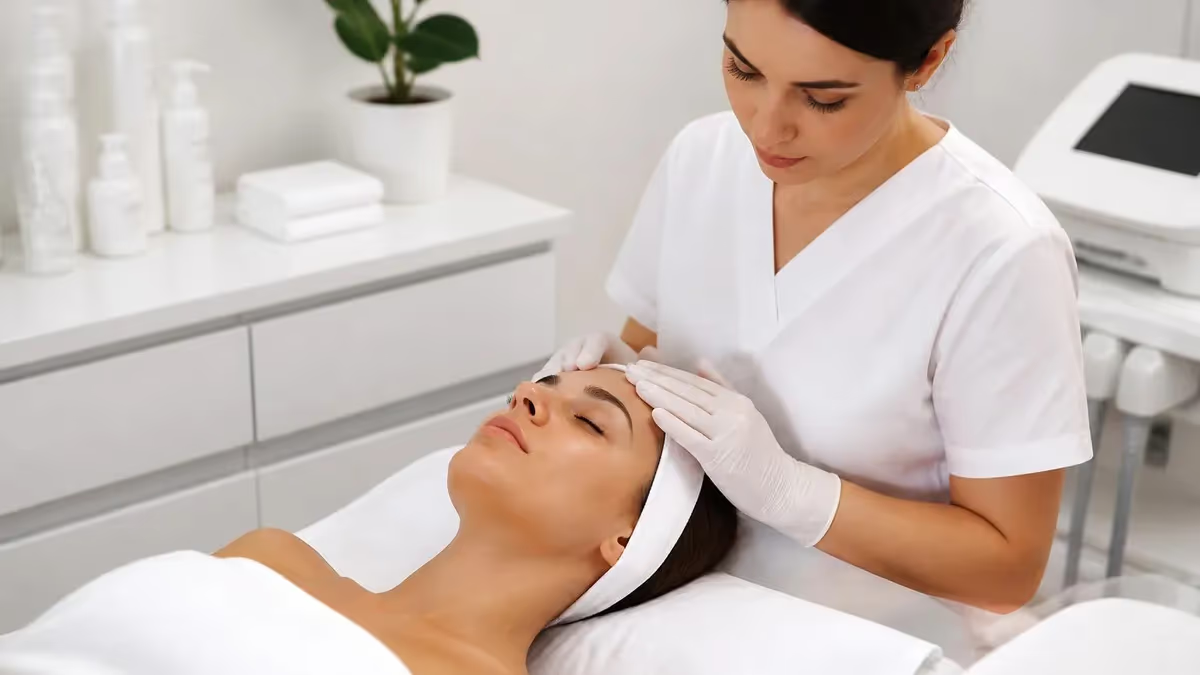
Searching for an esthetician program near me is the first real step toward a licensed career in skin care, and the choices you make in the next few weeks will shape the next decade of your professional life. The right local school sets the foundation for your state board exam, your first clinic job, and the long-term direction of your specialty, whether that becomes spa work, medical aesthetics, or independent treatment-room ownership. Local matters because clinical hours, externships, and licensing requirements are all state-specific. Practice with the free Esthetician practice test on PracticeTestGeeks (9 questions with answer explanations).
Before you compare brochures or visit campuses, it helps to understand what an esthetician actually does day to day. An esthetician is a licensed skin-care professional trained in facials, exfoliation, hair removal, makeup, body treatments, and product chemistry. If you want a deeper overview, our guide to what is an esthetician explains the scope of practice, regulated services, and how the role differs from cosmetology or nursing-based aesthetic careers in the United States.
The phrase "near me" is more than a search habit. State licensing boards require that your training program be approved in the state where you intend to test, and proximity matters because most programs include 200 to 600 supervised clinic hours that you cannot complete remotely. A school 90 minutes away may save tuition dollars but cost you in fuel, missed shifts, and burnout. Most successful students choose a school within a 30-minute commute of home or work.
Tuition for local esthetician programs in 2026 ranges from roughly $4,000 at community colleges to $20,000 at private beauty academies. Program length runs 4 to 12 months full time, depending on whether your state mandates 260, 600, 750, or 1,000 instructional hours. Florida, for example, requires 260 hours, while Texas requires 750 and Washington requires 750. Always confirm your state's hour count before enrolling, because credits do not always transfer.
Demand is strong. The U.S. Bureau of Labor Statistics projects 9% employment growth for skincare specialists from 2023 to 2033, faster than the average occupation. Medical spas, dermatology offices, resort spas, and independent treatment rooms are all hiring. The combination of stable demand, relatively short training, and flexible scheduling makes esthetics one of the most accessible licensed health-and-beauty careers in the country, especially for career changers and parents returning to work.
This guide walks through every decision point: accreditation, curriculum depth, clinic ratios, financial aid, externship quality, and the licensing path from your last day of class to the moment your state license lands in the mail. You will also find a study checklist, common mistakes to avoid, and ten practice quizzes you can use to prepare for the written portion of the state board exam while you are still in school.
By the end, you should be able to walk into any local school open house with a 15-question checklist, ask the right questions, and leave with the data you need to compare three programs side by side. The goal is not to find the cheapest option or the fanciest spa-style campus, but to find the local program with the highest first-attempt licensure pass rate, the strongest job-placement support, and the curriculum that aligns with the part of esthetics you actually want to practice.
Free Esthetician Study Tools
Interactive Esthetician resources on PracticeTestGeeks, free to start:
- Esthetician flashcards — review key terms and concepts card by card
- Esthetician study guide — topic-by-topic overview of what the exam covers
- Esthetician cheat sheet — one-page printable summary for last-minute review
Esthetician Programs by the Numbers

Types of Local Esthetician Programs
Public two-year colleges offer the lowest tuition, often $4,000 to $8,000 total, plus access to federal financial aid, transferable general-education credits, and on-campus student clinics. Schedules tend to be daytime only.
For-profit academies like Aveda, Paul Mitchell, and Empire complete training in 4 to 8 months with evening and weekend options. Tuition runs $12,000 to $20,000 but includes product kits, branded curriculum, and strong placement networks.
Some districts partner with technical centers to let high school juniors and seniors begin esthetics training tuition-free, finishing licensing hours within months of graduation. Local availability varies and seats fill quickly.
A growing number of dermatology groups and teaching hospitals sponsor accelerated medical esthetician tracks focused on chemical peels, lasers, and post-procedure care, ideal for students targeting clinical or med-spa employment.
State-approved hybrid programs deliver theory online and require in-person clinic hours one to three days a week. Best for working adults, but verify your state board accepts the online classroom component.
Once you have a list of three to five local schools, evaluating them comes down to seven concrete factors: accreditation, licensure pass rate, clinic-to-instructor ratio, curriculum breadth, externship partners, total cost, and post-graduation support. Each of these is verifiable through the school, the state cosmetology board, or the U.S. Department of Education's College Scorecard. Never rely solely on Instagram aesthetics or a polished campus tour. The numbers tell you whether graduates actually pass the board and find work.
Accreditation is non-negotiable if you plan to use federal financial aid. Look for NACCAS (National Accrediting Commission of Career Arts and Sciences) accreditation for private beauty schools, or regional accreditation for community colleges. State-board approval is separate and required for licensure eligibility. A program can be state-approved without being federally accredited, which means you can sit for the exam but cannot use Pell Grants or federal loans to pay tuition.
The single most important number to ask for is the first-attempt licensure pass rate. Strong programs report 85% to 95%; struggling programs sometimes drop below 60%. NACCAS-accredited schools must publish this data annually. If a school cannot or will not share its current pass rate, treat that as a serious warning sign. Also ask for the job-placement rate within six months of graduation, which should be above 70% for a healthy program in a metro area.
Clinic ratio determines how much hands-on time you actually get. State boards typically allow one instructor per 20 students in clinic, but the best programs operate closer to 1:12 or 1:15. Tour the student clinic during operating hours, not on a closed campus day. Watch how instructors move between students, whether equipment is modern, and whether the school books real paying clients or relies on family members and classmates as models.
Curriculum breadth separates a basic program from a strong one. Beyond facials and waxing, look for chemical peels, dermaplaning, microdermabrasion, LED therapy, lash and brow services, makeup, and at least an introduction to lasers and medical-spa protocols. If you are aiming for higher pay, our guide to esthetician salary shows how specialty certifications in advanced modalities directly translate to hourly rate differences after licensure.
Externship partnerships are often the hidden lever in career outcomes. Schools with formal placement agreements at local med-spas, dermatology clinics, resort spas, and product companies give graduates a real interview pipeline. Ask for the names of the top five externship partners and the percentage of last year's graduating class that received job offers from those sites. Generic answers like "we have many partners" usually mean the relationship is loose at best.
Finally, consider intangibles: schedule flexibility, parking, childcare access, mental-health resources, and the student-services team. Esthetics school is physically and emotionally demanding, especially during the 200-hour clinic stretch. A program that supports students through life challenges has dramatically better completion rates than one that simply enforces attendance policies. Visit at least twice — once for a tour, once unannounced during clinic hours — before signing any enrollment agreement.

Esthetician Practice Practice Test Questions
Prepare for the Esthetician Practice Exam exam with our free practice test modules. Each quiz covers key topics to help you pass on your first try.
Esthetician Practice Advanced Facial Treat...
Esthetician Practice Exam Questions covering Advanced Facial Treatments. Master Esthetician Practice Test concepts for certification prep.
Esthetician Practice Anatomy and Physiology
Free Esthetician Practice Practice Test featuring Anatomy and Physiology. Improve your Esthetician Practice Exam score with mock test prep.
Esthetician Practice Chemistry and Product...
Esthetician Practice Mock Exam on Chemistry and Product Ingredients. Esthetician Practice Study Guide questions to pass on your first try.
Esthetician Practice Client Consultation a...
Esthetician Practice Test Prep for Client Consultation and Analysis. Practice Esthetician Practice Quiz questions and boost your score.
Esthetician Practice Esthetics Chemistry a...
Esthetician Practice Questions and Answers on Esthetics Chemistry and Ingredients. Free Esthetician Practice practice for exam readiness.
Esthetician Practice Exam Esthetician Prac...
Esthetician Practice Mock Test covering Exam Esthetician Practice Advanced Facial Treatments Questions and Answers. Online Esthetician Practice Test practice with instant feedback.
Esthetician Practice Exam Esthetician Prac...
Free Esthetician Practice Quiz on Exam Esthetician Practice Anatomy and Physiology Questions and Answers. Esthetician Practice Exam prep questions with detailed explanations.
Esthetician Practice Exam Esthetician Prac...
Esthetician Practice Practice Questions for Exam Esthetician Practice Chemistry and Product Ingredients Questions and Answers. Build confidence for your Esthetician Practice certification exam.
Esthetician Practice Exam Esthetician Prac...
Esthetician Practice Test Online for Exam Esthetician Practice Client Consultation and Analysis Questions and Answers. Free practice with instant results and feedback.
Esthetician Practice Exam Esthetician Prac...
Esthetician Practice Study Material on Exam Esthetician Practice Esthetics Chemistry and Ingredients Questions and Answers. Prepare effectively with real exam-style questions.
Esthetician Practice Exam Esthetician Prac...
Free Esthetician Practice Test covering Exam Esthetician Practice Facial Treatments and Massage Questions and Answers. Practice and track your Esthetician Practice exam readiness.
Esthetician Practice Exam Esthetician Prac...
Esthetician Practice Exam Questions covering Exam Esthetician Practice Hair Removal Methods Questions and Answers. Master Esthetician Practice Test concepts for certification prep.
Esthetician Practice Exam Esthetician Prac...
Free Esthetician Practice Practice Test featuring Exam Esthetician Practice Infection Control and Safety Questions and Answers. Improve your Esthetician Practice Exam score with mock test prep.
Esthetician Practice Exam Esthetician Prac...
Esthetician Practice Mock Exam on Exam Esthetician Practice Skin Analysis and Conditions Questions and Answers. Esthetician Practice Study Guide questions to pass on your first try.
Esthetician Practice Exam Esthetician Prac...
Esthetician Practice Test Prep for Exam Esthetician Practice Skin Histology and Disorders Questions and Answers. Practice Esthetician Practice Quiz questions and boost your score.
Esthetician Practice Exam FREE Esthetician...
Esthetician Practice Questions and Answers on Exam FREE Esthetician Knowledge Questions and Answers. Free Esthetician Practice practice for exam readiness.
Esthetician Practice Exam FREE Esthetician...
Esthetician Practice Mock Test covering Exam FREE Esthetician MCQ Questions and Answers. Online Esthetician Practice Test practice with instant feedback.
Esthetician Practice Exam FREE Esthetician...
Free Esthetician Practice Quiz on Exam FREE Esthetician Practice Anatomy and Physiology Questions and Answers. Esthetician Practice Exam prep questions with detailed explanations.
Esthetician Practice Exam FREE Esthetician...
Esthetician Practice Practice Questions for Exam FREE Esthetician Practice Cosmetic Chemistry and Ingredients Questions and Answers. Build confidence for your Esthetician Practice certification exam.
Esthetician Practice Exam FREE Esthetician...
Esthetician Practice Test Online for Exam FREE Esthetician Practice Facial Treatments and Devices Questions and Answers. Free practice with instant results and feedback.
Esthetician Practice Exam FREE Esthetician...
Esthetician Practice Study Material on Exam FREE Esthetician Practice Hair Removal Procedures Questions and Answers. Prepare effectively with real exam-style questions.
Esthetician Practice Exam FREE Esthetician...
Free Esthetician Practice Test covering Exam FREE Esthetician Practice Infection Control and Safety Questions and Answers. Practice and track your Esthetician Practice exam readiness.
Esthetician Practice Exam FREE Esthetician...
Esthetician Practice Exam Questions covering Exam FREE Esthetician Practice Skin Analysis and Conditions Questions and Answers. Master Esthetician Practice Test concepts for certification prep.
Esthetician Practice Exam FREE Esthetician...
Free Esthetician Practice Practice Test featuring Exam FREE Esthetician (Reading) Questions and Answers. Improve your Esthetician Practice Exam score with mock test prep.
Esthetician Practice Facial Treatments and...
Esthetician Practice Mock Exam on Facial Treatments and Massage. Esthetician Practice Study Guide questions to pass on your first try.
Esthetician Practice Hair Removal Methods
Esthetician Practice Test Prep for Hair Removal Methods. Practice Esthetician Practice Quiz questions and boost your score.
Esthetician Practice Infection Control and...
Esthetician Practice Questions and Answers on Infection Control and Safety. Free Esthetician Practice practice for exam readiness.
Esthetician Practice Skin Analysis and Con...
Esthetician Practice Mock Test covering Skin Analysis and Conditions. Online Esthetician Practice Test practice with instant feedback.
Esthetician Practice Skin Histology and Di...
Free Esthetician Practice Quiz on Skin Histology and Disorders. Esthetician Practice Exam prep questions with detailed explanations.
Esthetician Practice Esthetician Knowledge
Esthetician Practice Practice Questions for Esthetician Knowledge. Build confidence for your Esthetician Practice certification exam.
Esthetician Practice Esthetician MCQ
Esthetician Practice Test Online for Esthetician MCQ. Free practice with instant results and feedback.
Esthetician Practice Cosmetic Chemistry an...
Esthetician Practice Study Material on Cosmetic Chemistry and Ingredients. Prepare effectively with real exam-style questions.
Esthetician Practice Facial Treatments and...
Free Esthetician Practice Test covering Facial Treatments and Devices. Practice and track your Esthetician Practice exam readiness.
Tuition, Aid, and Real Costs of Esthetician Schools
Local esthetician programs in 2026 fall into three price tiers. Community college programs charge $4,000 to $8,000 total for in-district students, sometimes less in states with workforce-development subsidies. Private beauty academies typically run $12,000 to $20,000 including kits, books, and uniforms. Hybrid online-clinic programs sit in the middle at $7,000 to $14,000 depending on whether the in-person clinic hours are bundled or billed separately.
Watch for hidden costs. State board application fees range from $40 to $200, exam fees from $75 to $190, fingerprinting and background checks from $50 to $100, and product replenishment for personal practice another $300 to $600. A realistic all-in budget at a mid-priced private academy is $14,000 to $17,000 by the time you walk into your first job interview as a fully licensed esthetician.
Community College vs. Private Beauty Academy
- +Community college tuition is 50–70% lower than private academies
- +Federal Pell Grants cover most community college costs for eligible students
- +Credits often transfer toward a future associate or bachelor's degree
- +Academic support services like tutoring and counseling are included
- +On-campus student clinics build real paying-client experience
- +Local employers respect community college credentials
- −Limited evening and weekend schedules at most public colleges
- −Smaller curriculum focused on basics, less on advanced or med-spa skills
- −Equipment may be older than at branded private academies
- −Externship networks tend to be smaller and less formalized
- −Fewer product-brand partnerships and free professional kits
- −Longer enrollment cycles — usually only two start dates per year
Pros and Cons at a Glance
| Pros | Cons |
|---|---|
| Federal Pell Grants cover most community college costs for eligible students | Limited evening and weekend schedules at most public colleges |
| Credits often transfer toward a future associate or bachelor's degree | Smaller curriculum focused on basics, less on advanced or med-spa skills |
| Academic support services like tutoring and counseling are included | Equipment may be older than at branded private academies |
| On-campus student clinics build real paying-client experience | Externship networks tend to be smaller and less formalized |
| Local employers respect community college credentials | Fewer product-brand partnerships and free professional kits |

Esthetician School Enrollment Checklist
- ✓Verify the program is approved by your state cosmetology or esthetics board
- ✓Confirm NACCAS or regional accreditation if you plan to use federal aid
- ✓Request the most recent first-attempt licensure pass rate in writing
- ✓Ask for the six-month post-graduation job placement rate
- ✓Tour the student clinic during active operating hours, not a closed day
- ✓Count clinic instructors against student stations to estimate ratio
- ✓Review the curriculum for advanced modalities, not just basic facials
- ✓Get a complete cost breakdown including kit, books, fees, and exam costs
- ✓Apply for FAFSA and request a financial-aid award letter before enrolling
- ✓Read the full enrollment agreement, especially refund and withdrawal terms
Visit twice — once announced, once unannounced
The tour version of a school is always polished. The Tuesday-afternoon-during-clinic version tells you the truth. Drop in unannounced during operating clinic hours to see real instructor-student ratios, real client flow, and how the school handles a normal day. If you are not allowed in during clinic, that itself is your answer about transparency.
Curriculum and clinic hours are where two programs at the same tuition can produce radically different graduates. Your state's minimum hour requirement is the floor, not the ceiling. The strongest local programs exceed minimums in advanced facial treatments, chemistry, and machine-based modalities, because that depth is what separates a $16-per-hour spa estie from a $40-per-hour medical-spa lead. Read the syllabus line by line before signing anything, and compare it against your state's official curriculum standards.
State requirements vary dramatically. Florida requires 260 hours, the lowest in the country. New York requires 600. California requires 600. Texas requires 750. Washington requires 750. Utah requires 800. Some states like Connecticut do not license estheticians at all. If you plan to move within the next few years, train in the higher-hour state because credits transfer downward more easily than upward. A 1,000-hour graduate can usually get reciprocity in a 600-hour state; the reverse rarely works.
Classroom theory typically covers anatomy and physiology, histology of the skin, bacteriology and infection control, chemistry of cosmetics, electricity and machines, nutrition, business and ethics, and state laws and regulations. Expect 150 to 300 hours of pure classroom instruction before you touch a client. Programs that rush theory to get students into clinic faster often produce graduates who pass the practical but fail the written portion of the state board exam.
Clinic hours are the heart of the program. You will perform facials, extractions, waxing, brow shaping, lash applications, makeup, body treatments, and basic chemical exfoliation under supervision. Most states require a minimum number of each service type — for example, 50 facials, 25 waxing services, and 25 makeup applications — documented in a service log signed by an instructor. Keep your own copy of this log; you will need it for state board application.
Advanced curriculum is where med-spa careers begin. Look for dedicated units on chemical peels (glycolic, salicylic, TCA), microdermabrasion, dermaplaning, LED phototherapy, ultrasonic skin scrubbers, and an introduction to laser and IPL safety. Even if your state does not license estheticians to fire lasers independently, employers in dermatology and plastic surgery expect new hires to understand wavelengths, Fitzpatrick contraindications, and post-procedure protocols on day one.
Business education is the most neglected — and most valuable — part of the curriculum. Strong programs cover booth rental versus commission, building a clientele on Instagram and Google, retail product math, tip reporting, scheduling software, and the basics of forming an LLC. Estheticians who treat their career as a small business out-earn employees with the same license by 30% to 50% within five years. Ask whether business hours are taught by working estheticians or generic instructors.
Finally, look at externship structure. The best programs require 40 to 100 hours of off-campus externship at a partner spa, clinic, or product company during the final third of training. This is not free labor — it is your real interview. Externs who perform well are routinely hired before graduation. Schools without externship requirements usually have weaker placement rates and longer job-search timelines for their alumni.
If you train in one state and license in another, your hours may not transfer one-to-one. A 260-hour Florida diploma will not satisfy California's 600-hour rule. Before enrolling in any program, check your target state's board website for current hour requirements and reciprocity policies. Mismatches force expensive supplemental training after graduation, sometimes delaying licensure by six months or more.
Graduation day is not licensure day. After your final clinic hour is logged and your school issues a completion certificate, you still have to apply to the state board, sit for two exams (written and practical), pass a background check, and pay licensing fees. The full timeline from graduation to license-in-hand averages 30 to 90 days, though some students complete the process in two weeks with diligent paperwork. Understanding this gap helps you plan finances and job-search timing.
The written exam in most states is administered by PSI Services, Prometric, or the National-Interstate Council of State Boards of Cosmetology (NIC). It is typically 90 to 120 multiple-choice questions covering infection control, anatomy, chemistry, treatment protocols, and state laws. The pass cut-score is usually 70% or 75%. Plan to study 80 to 120 hours specifically for the written exam during the final month of school and the weeks after graduation.
The practical exam is a live demonstration of skills on a model you bring yourself. Common stations include client setup and sanitation, basic facial, eyebrow waxing, and product analysis. Examiners grade on infection control, technique, professionalism, and time management. Most states allot 90 to 180 minutes total. Practice the exact state-board protocol — not the spa-friendly shortcut your school may have used in clinic — because graders score against the published rubric line by line.
Strong local programs run mock practical exams and timed written tests during the final two weeks. If yours does not, organize study groups and use third-party practice quizzes. Reviewing real client cases also strengthens your portfolio, which most employers now request alongside your license. For broader career planning beyond exam day, our overview of esthetician employment opportunities walks through entry-level roles, specialty niches, and pay ranges across spa, medical, and freelance settings.
Background checks and fingerprinting are now standard in nearly every state. Submit these the week you finish clinic — processing takes two to six weeks and is the single most common cause of licensure delay. If you have any prior criminal record, contact the board directly with a written disclosure; most non-violent offenses do not bar licensure, but undisclosed records do. Honesty during application protects your career long term.
Once your written and practical scores post and your background check clears, the state board mails your license within 7 to 14 business days. Many states now issue digital licenses immediately upon clearing, allowing you to start work the same day. Renew on schedule — typically every one to two years — and complete continuing education hours, which range from 4 to 16 hours per renewal cycle depending on the state, often including infection-control updates.
From here, your career compounds. The first job after licensure matters less than what you learn in it. Aim for a clinic, med-spa, or established spa with strong mentorship rather than the highest hourly rate. Estheticians who spend their first two years learning advanced modalities and building a client list outearn those who chase short-term pay bumps within five years. The program you chose is the foundation; the next decade is the build.
Practical tips for the months between enrollment and your first clinic shift can make or break your experience. Start by setting up the right physical workspace at home. You will need a model — usually a willing friend or family member — and a clean surface to practice facial massage, draping, and product application. Estheticians who practice at home an extra two hours per week consistently outperform peers in clinic, because muscle memory builds faster than classroom theory alone.
Build your study system before week one. A simple Google Doc tracker for each chapter, a flashcard app for vocabulary, and a weekly self-quiz routine put you in the top 20% of your class. Ingredients chemistry and electrical modalities are where most students lose points on the state board, so over-invest there. The terminology is technical — terms like "iontophoresis," "desincrustation," and "sodium hyaluronate" — and rote memorization is non-negotiable.
Take care of your body. Esthetics is repetitive manual work, and wrist, shoulder, and back injuries sideline students every term. Learn proper ergonomic body positioning from day one: feet shoulder-width, knees soft, table at hip height, wrists straight during massage. Stretch before and after every clinic shift. A $40 lumbar support cushion and good non-slip shoes are some of the best investments you will make during school.
Network from day one, not at graduation. Follow local med-spas, dermatology offices, and resort spas on Instagram. Engage genuinely with their content. When externship slots open, the school often gives priority to students who have shown professional interest in specific employers. Attend at least one local Professional Beauty Association event during your program — these are where most pre-graduation job offers actually originate.
Build a portfolio as you train. Photograph (with written client consent) before-and-after results from advanced facial treatments, peels, lash applications, and brow services. Use neutral backgrounds, consistent lighting, and an unfiltered camera. A 12-piece portfolio at graduation impresses employers far more than a license alone, especially for med-spa interviews where visual outcomes drive the hiring decision.
Master the state laws section. Most students underestimate it because it feels boring compared to clinical content. State law questions are usually 15% to 25% of the written exam and cover sanitation requirements, sharps disposal, license display, scope of practice, and prohibited services. Failing this section alone can fail your entire exam. Print your state's full administrative code and read it three times during the final month.
Finally, think beyond passing. The estheticians who build six-figure careers treat school as the start of a 20-year learning curve. Subscribe to industry journals like Skin Inc. and DERMASCOPE, follow educators like Lori Crete and Mary Nielsen, and budget for at least one advanced continuing-education class within your first six months after licensure. The local program you choose today is the launchpad; what you do in the first 24 months after graduation is what compounds for the rest of your career.
Sample Esthetician Practice Questions
Try these questions from our free Esthetician practice tests. The correct answer and an explanation follow each question.
A client with sensitive skin wants to use a chemical depilatory at home for the first time. What is the most critical safety instruction an esthetician should provide?
- A. Leave the product on for the maximum time recommended to ensure it works.
- B. Perform a patch test on a small, inconspicuous area 24-48 hours before full use.
- C. Apply a thick layer of the product to the entire area at once.
- D. Exfoliate with a coarse scrub immediately before applying the cream.
Answer: B. Perform a patch test on a small, inconspicuous area 24-48 hours before full use.
Chemical depilatories work by dissolving protein and can cause significant skin irritation or allergic reactions. A patch test is essential to check for adverse reactions like redness, itching, or burns before applying the product to a large area, especially for someone with sensitive skin.
An esthetician is choosing an exfoliant for a client with oily, congested skin and blackheads. Which acid is oil-soluble, allowing it to penetrate into the pore to dissolve sebum and debris?
- A. Glycolic Acid
- B. Lactic Acid
- C. Salicylic Acid
- D. Mandelic Acid
Answer: C. Salicylic Acid
Salicylic acid is a Beta Hydroxy Acid (BHA) that is oil-soluble. This unique characteristic allows it to penetrate the lipid barrier of the pores to effectively exfoliate from within and clear out sebum and dead skin cells, making it ideal for oily and acne-prone skin. The other acids listed are Alpha Hydroxy Acids (AHAs), which are water-soluble and work primarily on the skin's surface.
Which massage movement is best for relaxing facial muscles?
- A. Petrissage
- B. Tapotement
- C. Effleurage
- D. Friction
Answer: C. Effleurage
Effleurage is a gentle, gliding, stroking massage movement performed with the palms or fingertips, designed to be soothing and relaxing. It is ideal for warming up the muscles and applying products at the beginning and end of a facial. Its smooth, continuous motion helps to calm the nervous system and promote deep relaxation of the facial muscles.
Which practice best prevents cross-contamination when using a shared jar of cream or mask during facial services?
- A. Remove product with a clean, single-use spatula each time and never double-dip
- B. Allow clients to apply product themselves directly from the jar
- C. Decant the entire jar into a bowl before the service week begins
- D. Wipe the jar opening with an alcohol wipe after each use
Answer: A. Remove product with a clean, single-use spatula each time and never double-dip
Using a clean single-use spatula to remove product without returning it to the jar (no double-dipping) prevents microorganisms from being introduced into the shared container and eliminates a major route of cross-contamination between clients.
Esthetician Questions and Answers

Esthetician Practice Exam 2026
Esthetician Salary: Pay by State, Setting, and Experience (2026)
Esthetician Certification: Complete Guide to Licensing, Training, and Career Paths in 2026
Nurse Esthetician: Career Overview, Training Path, Salary, Job Duties, and How to Become One
Esthetician Classes: Pre-Licensing, CE, Online & Specialty Courses
About the Author
Licensed Cosmetologist & Beauty Licensing Exam Specialist
Paul Mitchell SchoolsMichelle Santos is a licensed cosmetologist with a Bachelor of Science in Esthetics and Salon Management from Paul Mitchell School. She has 16 years of salon industry experience and 8 years preparing students for state cosmetology board exams in theory, practical skills, and sanitation. She specializes in licensure preparation for cosmetologists, estheticians, and nail technicians.