
EEG Glue Removal: How to Get Paste Out of Your Hair After an EEG Test 2026
🧠 EEG glue removal made simple: how to clean paste from your hair after an EEG test, plus duration, cost, and side effects explained.
EEG glue removal is the part of an eeg test that nobody mentions until the recording is over and you are staring in a mirror at a head full of sticky paste. The good news is that the glue used in most clinics is water-soluble and comes out with warm water, shampoo, and a little patience. This guide explains what the paste is, how to remove it safely, and how the rest of the eeg test works.
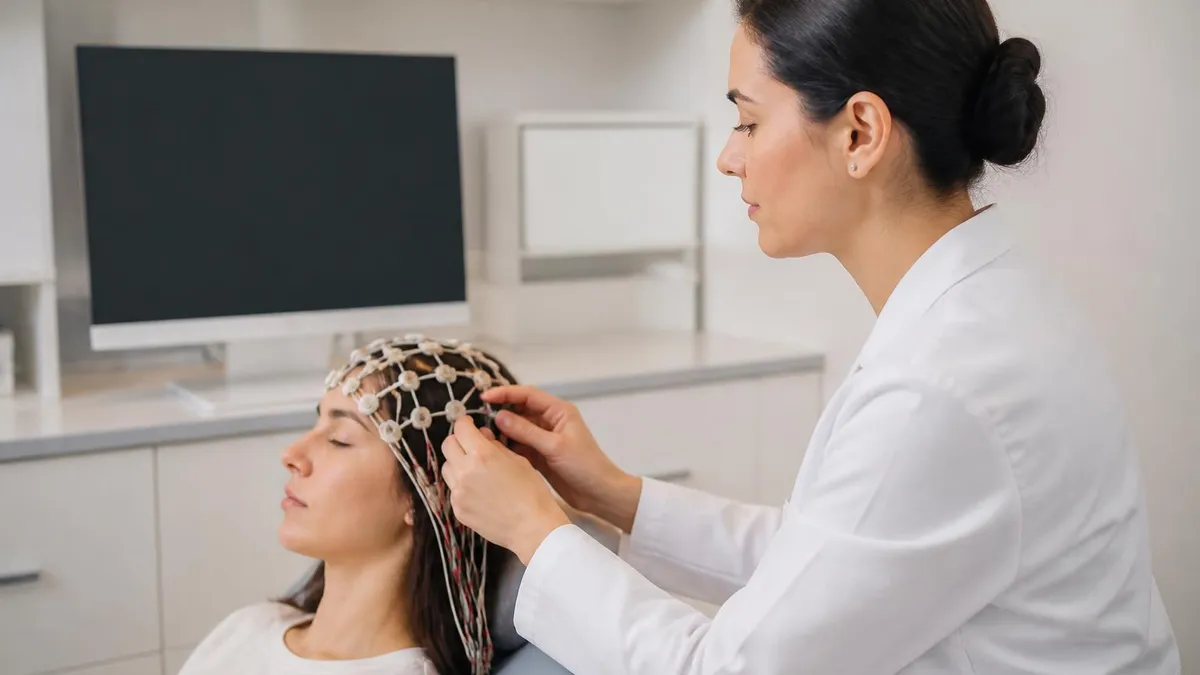
An EEG, or electroencephalogram, records the electrical activity of your brain through small metal discs placed on your scalp. If you have ever asked what is an eeg test, think of it as a painless recording, not an image or a scan. Nothing is sent into your head. The sensors only listen. Technologists attach each disc with conductive paste or gel so the signal travels cleanly, and that paste is what you will wash out afterward.
A routine eeg medical test uses about 21 electrodes arranged in the international 10-20 system, a map that spaces them at 10 or 20 percent intervals across the skull. The technologist measures your head, marks each position with a grease pencil, lightly scrubs the skin, and presses each disc into a dab of paste. Some labs use a cap with built-in electrodes, which cuts setup time and leaves less residue in your hair.
Most people want to know how long is an eeg test before they book it. The recording itself usually runs 20 to 40 minutes, but setup adds another 20 to 45 minutes, and cleanup takes a few more. Expect to be at the lab for roughly an hour to 90 minutes in total. Longer studies, such as ambulatory or video EEG monitoring, run from one day to several days and involve more glue and more cleanup.
Cost matters too. The eeg test price varies widely by facility, region, and insurance. In the United States, a routine outpatient study is often billed between about $200 and $3,000, with hospital-based labs typically charging more than independent clinics. Most insurance plans cover an EEG ordered for a documented medical reason, though deductibles and prior authorization rules apply. Ask the billing office for the eeg test cost in writing before your appointment.
As for safety, the eeg test side effects are minimal. The test uses no radiation and delivers no electrical current to the brain. Some people notice mild skin redness, slight itching under the electrodes, or a sticky scalp afterward. People with epilepsy may be asked to breathe deeply or watch flashing lights, which in rare cases can provoke a seizure, so the team is prepared. The glue itself rarely causes problems beyond temporary irritation.
This page focuses on what comes after the recording, but it also covers the full eeg procedure from preparation to results. You will learn which glue types exist, a step-by-step removal method, what to avoid, and how to handle long hair, textured hair, children, and sensitive skin. You will also find a checklist and practice questions if you are studying EEG for a technologist exam. Read it before your appointment so cleanup feels routine.
The EEG Test by the Numbers
How to Do EEG Glue Removal Step by Step
Wipe Off the Excess Paste
Soften With Lukewarm Water
Shampoo Before Fully Wetting
Condition and Comb Gently
Rinse and Inspect the Scalp
Types of EEG Glue and Paste: What Is Actually in Your Hair
Not all EEG adhesives behave alike, and knowing which one was used predicts how hard eeg glue removal will be. The most common product in routine labs is a thick, water-based conductive paste such as Ten20. It holds a disc in place for 30 to 60 minutes while keeping electrical contact. Because it is mostly water, salts, and thickeners, it softens quickly under warm running water and rinses out of most hair types.
Electrode caps use a different approach. A fabric cap holds sensors against the scalp, and the technologist injects conductive gel into each opening with a blunt syringe. Gel is runnier than paste, so it spreads through hair and dries into a stiff, flaky film. Rinsing is usually simple, but gel may need two shampoo passes. Caps are common in research and in pediatric settings where fast application matters.
Long-term and video EEG monitoring sometimes uses collodion, a clear, fast-drying adhesive that holds electrodes for days. Collodion is not water-soluble. Staff remove it with acetone or a dedicated collodion remover, usually at the lab, because the fumes are strong and the liquid is flammable. If you are sent home with collodion in your hair, follow the written instructions exactly and ask the team whether home removal is appropriate.
Paste behaves differently depending on how long it sits. Fresh paste is soft and slides out. After several hours it dries into a crusty patch that clings to hair shafts, and by the next day it can mat strands together. That is why technologists recommend washing the same day. Heat from a hair dryer, a hat, or a car seat warmer sets the residue faster, so skip those until your hair is clean.
Skin preparation also affects cleanup. Before attaching electrodes, many technologists rub each spot with a mildly abrasive prep gel to lower resistance, aiming for impedance under about 5 kilohms. This can leave pink, slightly tender dots that fade within hours. Be gentle when washing these areas. Scrubbing hard with fingernails or a brush can break the skin, and broken skin plus leftover paste is the main route to irritation or small scabs.
Many labs offer a small cleanup station. Technologists commonly wipe off most of the paste with gauze, saline, or moist towelettes before you leave, and some provide a comb. Accept the help. If the lab skips this step, ask for wipes or a paper towel and a bit of warm water before you walk out the door. A two-minute wipe in the room can save you fifteen minutes in the shower.
Hair type changes the plan. Straight, fine hair releases paste fastest. Thick, curly, or coily hair traps more residue and benefits from sectioning, conditioner, and a wide-tooth comb. Braids, locs, and extensions can complicate both application and cleanup, so tell the scheduler when you book. Technologists can part or work around protective styles, but they need notice, and they may ask you to arrive with loose, clean hair.
What Is an EEG Test? Routine, Sleep-Deprived, and Ambulatory Compared
A routine EEG is the standard answer to what is an eeg test. You lie or recline in a chair, eyes closed for most of the session, while the technologist records 20 to 40 minutes of baseline activity. You may be asked to open and close your eyes, breathe deeply for three minutes, or watch a strobe light. These activation steps help reveal abnormalities that rest alone might hide.
Glue use is modest in a routine study: a pea-sized dab under each of about 21 discs, plus tape or gauze on a few. Cleanup is usually the simplest of any EEG type, taking five to fifteen minutes with warm water and shampoo. You can go home, drive, and return to work afterward, unless your doctor says otherwise because of a seizure condition.
Is the EEG Test Worth the Glue Hassle?
- +Completely painless and non-invasive
- +No radiation exposure, unlike CT scans
- +A routine study takes about an hour in total
- +Captures electrical activity that MRI cannot show
- +Lower cost than most advanced brain imaging
- +Water-based paste washes out with ordinary shampoo
- −Paste can leave hair sticky until washed
- −Mild redness or itching at electrode spots is possible
- −A single routine EEG can miss intermittent abnormalities
- −Sleep deprivation may be required for some studies
- −Prices vary widely and surprise bills can happen
- −Stubborn collodion may need professional removal
EEG Test Glue Removal Checklist: Before and After Your Appointment
- ✓Wash your hair the night before and skip all styling products.
- ✓Remove braids, weaves, or extensions if the lab asks you to.
- ✓Pack a towel, wide-tooth comb, travel shampoo, and hair tie.
- ✓Wear a button-up or zip-front top to avoid pulling it over your head.
- ✓Ask the technologist to wipe off excess paste before you leave.
- ✓Rinse your hair with lukewarm water within a few hours of the test.
- ✓Massage shampoo into dry patches before fully wetting your hair.
- ✓Comb gently from the ends up to the roots with conditioner.
- ✓Use baby oil or conditioner on stubborn spots, then shampoo twice.
- ✓Call the lab if redness, blisters, or residue last beyond three days.
Rinse Early, Comb Gently, Never Scrub
Fresh EEG paste is soft and slides out in minutes, while paste left overnight dries into a crust that can take two or three washes. Rinse within a few hours, work shampoo in before wetting, and let conditioner do the detangling instead of force.
EEG Test Side Effects and Skin Care After Glue Removal
Most people finish eeg glue removal with nothing worse than a damp head and a slightly itchy scalp. Still, it helps to know what is normal and what is not. The eeg test side effects that clinics see most often are small red dots where electrodes sat, mild tenderness from skin prep, and temporary stiffness in hair. These usually fade within a few hours to two days and need no treatment beyond gentle washing.
Allergic or irritant reactions are less common but real. Some people react to the adhesive, the abrasive prep gel, or the tape used to secure wires. Signs include persistent itching, a rash spreading past the electrode spots, small blisters, or swelling. If you have known allergies to adhesives, latex, or medical tape, tell the technologist before the test so they can choose hypoallergenic products and note it on your chart.
The recording itself carries its own separate risks. Activation procedures such as hyperventilation and photic stimulation can cause lightheadedness, tingling in the fingers, or, in people with epilepsy, a seizure. Technologists are trained to respond, and many labs have a physician nearby. This is not a glue problem, but it explains why some patients feel tired or headachy after the visit, particularly following a sleep-deprived study.
Children need a modified approach. Kids often resist having their head touched, and paste in a child's hair can feel alarming. Many pediatric labs use caps, let children pick a sticker, and show the equipment first. For cleanup, use a washcloth soaked in warm water to soften the paste, then a tear-free shampoo in the bath. Turn the wash into a game, and avoid pulling, which can make a child dread future tests.
Sensitive skin and scalp conditions call for extra care. If you have eczema, psoriasis, seborrheic dermatitis, or an open cut, tell the technologist, who may avoid the affected area or adjust the prep. Afterward, skip medicated shampoos and heavy exfoliants for a day. Use a fragrance-free cleanser, pat the scalp dry rather than rubbing, and apply any prescribed topical only once the skin is calm and the paste is completely gone.
Hair loss from an EEG is a common worry, but a single routine test does not cause it. Temporary breakage can occur if strands are yanked during removal, especially with dried paste or collodion. Fine or chemically treated hair is more fragile. Work from the ends upward, detangle in small sections, and let conditioner do the work. Avoid cutting paste out unless a clump is truly impossible to dissolve, and ask a stylist for help if so.
Know when to call the lab or a doctor. Contact them if redness lasts beyond three days, if you see oozing or pus, if blisters appear, or if you develop a fever. Also reach out if residual adhesive remains after several washes, since technologists have scalp-safe remover products. Seizure symptoms, severe headache, or confusion after the test need medical attention right away, not a call to the billing office.
If your EEG used collodion adhesive, never remove it with acetone near flames, heaters, or cigarettes, and do not use acetone at home unless the lab told you to. Ask the technologist for written removal instructions before you leave.
EEG Test Cost, Price, and How Long an EEG Test Takes
Understanding eeg test cost starts with who is billing. A routine outpatient EEG may produce several charges: a technical fee for the equipment and technologist, a professional fee for the neurologist who interprets the tracing, and sometimes a facility fee if the lab is part of a hospital. This is why two patients can pay very different totals for the same 30-minute recording in the same city.
Typical US figures help set expectations. A routine EEG commonly lists between roughly $200 and $1,000 at independent clinics and $1,000 to $3,000 at hospital outpatient departments before insurance. Sleep-deprived and ambulatory studies run higher, and inpatient video EEG monitoring can reach many thousands of dollars per day. These are ballpark numbers, so verify with your provider. The eeg test price you actually owe depends on your plan, not the list price.
Insurance usually covers EEGs ordered for symptoms such as seizures, unexplained fainting, confusion, or suspected sleep disorders. Medicare Part B and most commercial plans cover them with ordinary cost sharing. Before booking, call the number on your card and ask about prior authorization, in-network status for both the facility and the reading physician, and your remaining deductible. Get the CPT code from the ordering office, commonly 95816 for awake and drowsy or 95819 for awake and asleep.
If you are uninsured, you still have options. Ask for a cash-pay or self-pay discount, which can cut the bill by a third or more. Compare an independent neurodiagnostic lab with a hospital outpatient department. Request an itemized estimate, and ask about payment plans or financial assistance, which nonprofit hospitals are generally required to offer. Never assume the first quote is final, because billing offices expect questions about the eeg test cost.
Now to how long is an eeg test in practice. Plan on one to one and a half hours door to door for a routine study: 20 to 45 minutes of electrode placement, 20 to 40 minutes of recording, and five to fifteen minutes for removal. Sleep-deprived studies may take up to two hours. Ambulatory EEG involves a 30 to 45 minute hookup visit, then one to three days wearing the recorder, then another visit to return it.
Results take time as well. A neurologist must review the whole tracing, which may be hundreds of pages or many hours of data. Preliminary impressions may arrive within one to three business days, with a formal report in about a week. Your ordering provider typically shares the findings at a follow-up visit. If results are urgent, such as after a first seizure, the team can often expedite. Ask about turnaround when you schedule.
What is an eeg medical test in billing terms? It is a diagnostic procedure recorded under neurodiagnostic codes, used to evaluate epilepsy, encephalopathy, sleep disorders, head injury, and brain death protocols. It is not a screening tool for healthy people, so insurers expect a documented reason. Keep your referral, symptom notes, and any prior imaging handy. A clear clinical reason speeds authorization and lowers the chance of a denied claim or a surprise bill later.
Practical Tips to Prepare for Your EEG Test and Make Cleanup Easy
Preparation begins the night before. Wash your hair with regular shampoo and skip conditioner, gel, oils, hairspray, and leave-in products, because residue interferes with electrode contact and may force the technologist to scrub harder. Dry your hair completely. Remove braids, weaves, or extensions if you can, or call ahead to discuss options. Clean, product-free hair lets the electrodes stick better and, paradoxically, makes the paste easier to rinse later.
Eat normally unless told otherwise. Low blood sugar can alter brain waves and cause artifacts, so do not fast before an EEG. Most clinics ask you to avoid caffeine for the day, including coffee, tea, energy drinks, and cola, since stimulants can change the tracing. Take your medications as prescribed unless your neurologist says to hold them. Never stop anti-seizure drugs on your own, and bring a list of everything you take.
Dress for cleanup. Wear a button-up or zip-front shirt so you can change without pulling anything over your head. Bring a small towel, a wide-tooth comb, a travel shampoo, a hair tie, and a hat or scarf. A plastic bag handles the damp towel afterward. Some people bring a spare top in case paste or water drips. These small items turn a messy exit into a ten-minute routine.
During the test, stay relaxed and still. Muscle tension in the jaw, forehead, and neck, plus blinking and swallowing, creates artifacts that obscure brain signals. Follow instructions about opening and closing your eyes. If an electrode itches or feels loose, tell the technologist instead of scratching, since touching a lead can spoil minutes of data. Honest communication shortens the session, which means paste stays on your head for less time.
Do the first rinse as soon as possible. Ideally, wipe off the bulk at the clinic, then wash at home within a few hours. Use lukewarm water, never hot, then massage a generous amount of shampoo into the paste before wetting fully. Rinse, repeat, and apply conditioner from the mid-lengths downward. Finish by combing gently with a wide-tooth comb from the ends toward the roots.
For stubborn residue, work a spoonful of conditioner or a few drops of baby oil or coconut oil into the dried patch for five minutes, then shampoo twice to remove the oil. A cotton ball with a little rubbing alcohol along the skin edge can lift paste, but avoid alcohol on irritated skin. Skip acetone and nail polish remover on your scalp unless your technologist specifically advises it for collodion.
Finally, plan the rest of your day. After a routine test you can generally drive, work, and eat normally. After a sleep-deprived EEG, go home and rest. Track any symptoms, from skin irritation to seizure-like events, and write down questions for your follow-up. If you are studying to become a technologist, review activation procedures and artifacts once you are home, because handling real patients' hair and skin is part of the daily job.
EEG Questions and Answers

Sleep Deprivation EEG: What It Is, How It Works, and What to Expect

How to Read an EEG Test: A Complete Guide to Brain Wave Patterns and Results

What Does an EEG Do? Everything You Need to Know About the EEG Test
Abnormal EEG Results: What They Mean, Common Patterns, and Next Steps

EEG Sleep Stages: How Brain Waves Change During Sleep and What the Test Reveals
How this page was made: written with AI tools and published by Nathan Beja, founder of Practice Test Geeks, who is responsible for its content. Exam facts are checked against the official sources listed below. Not reviewed by a subject-matter expert. Editorial policy
Sources & references
Exam facts on this page (fees, format, dates, passing scores) are checked against these official sources; the date is our last check. Editorial policy
- abret.org — Late registration, score validity, test delivery, fees, exam format, passing score, retake policy, score release, test dates · verified Oct 2026