
What to Bring to Your Theory Test: UK ID Requirements and Checklist 2026
Find out what to bring to your theory test in the UK. Your photocard driving licence is mandatory — 🔎 no exceptions. Full checklist inside.
What You Must Bring to Your Theory Test
So you've booked your theory test — good. Now the question most candidates forget to ask until the night before: what do you actually need to bring? The answer is simpler than you'd think, but getting it wrong can cost you your test fee and your slot. Practice with the free DVSA UK Driving Theory practice test on PracticeTestGeeks (7 questions with answer explanations).
In the UK, the DVSA has one hard requirement when it comes to ID: your valid photocard driving licence. That's it. No licence, no test — full stop. You can't swap it out for a passport, a bank card, or a student ID. The photocard driving licence is the only document the test centre will accept.
If you haven't been to a theory test centre before, it helps to know what to expect when you walk through the door. The check-in process is quick, but only if you've got everything in order. Missing your licence — even by accident — means your test is cancelled on the spot and you forfeit your theory test cost.
There's no grace period, no supervisor who'll make an exception. The rules are the rules, and the DVSA is strict about them for good reason: identity verification is part of the test's integrity. Every candidate must prove who they are before they sit down at a workstation — that's non-negotiable.
This guide covers everything you need to know about what to bring to a driving theory test: the ID rules, what's banned from the test room, how arrival and check-in works, and what the test format looks like once you're inside. Read it once before your test day and you'll have nothing to worry about on the morning. Preparation here really does come down to one thing: don't forget your photocard driving licence. That single piece of plastic is your ticket in — without it, the door stays closed.
Free DVSA UK Driving Theory Study Tools
Interactive DVSA UK Driving Theory resources on PracticeTestGeeks, free to start:
- DVSA UK Driving Theory flashcards — review key terms and concepts card by card
- DVSA UK Driving Theory study guide — topic-by-topic overview of what the exam covers
- DVSA UK Driving Theory cheat sheet — one-page printable summary for last-minute review
Theory Test Day Checklist
- Valid UK photocard driving licence — mandatory, no exceptions whatsoever
- Both parts if you have an old paper licence plus the separate photocard counterpart
- Arrive 15 minutes early — late arrivals forfeit their test slot and fee
- Phone switched off completely (not silent, not airplane mode) and stored in the locker
- Smart watch removed or left at home entirely — invigilators may ask you to remove it
- Licence in good condition — not expired, not damaged, photo must be clearly visible
Accepted ID: The Full Rules
Let's be precise about what's accepted, because there are a few variations depending on where your licence was issued and what format it's in.
Great Britain Photocard Licence
If you hold a GB provisional or full photocard driving licence, you're set. Bring the photocard — that single plastic card is your complete ID. You don't need to bring anything else. The details on the card are what the test centre staff will verify: your photograph, name, date of birth, and licence number. Staff will also cross-reference the licence number against your booking to confirm you are who you say you are.
Your photocard must be current. A licence that expired six months ago and you haven't got around to renewing isn't going to work — the DVSA won't accept it. If your licence is within its renewal window, get it sorted well before test day. The DVLA can take up to a week to process and dispatch a replacement, sometimes longer during busy periods.
Northern Ireland Photocard Licence
A Northern Ireland photocard licence is equally valid. Same rules apply: bring the card, check it hasn't expired, and you're good to go. There's no difference in how it's treated at the test centre — Northern Ireland licence holders have exactly the same rights and responsibilities as GB licence holders when sitting the theory test.
Old-Style Paper Licence
Got an old paper licence with a separate photocard counterpart? You'll need both parts with you — the paper licence and the photocard. Either part alone won't be accepted. The test centre needs to verify the photo (from the photocard) and the licence details (from the paper document), so both are required. If you've lost one half, sort it out with the DVLA before your test date, not after.
Old-style paper licences were phased out years ago, but plenty of drivers still have them. If this is you and you haven't converted to a modern photocard licence, you might find it easier to apply for a full photocard replacement before you sit the theory test. That way you only need one document, not two.
Non-GB Licence Holders
If you hold a non-GB licence — from an EU country, for example — things are slightly more complicated. The DVSA may require additional documentation. It's worth checking the latest guidance on theory test booking on GOV.UK well in advance, rather than assuming your foreign licence alone will suffice. Rules for non-GB licence holders have changed over recent years, particularly post-Brexit, so don't rely on advice that's more than a year old.
What Happens If You Forget Your Licence?
There's no workaround. If you turn up at the test centre without your valid photocard driving licence, the test will be cancelled. You'll lose your test fee — the booking is forfeited, not rescheduled. You'll need to book a new slot and pay again. Right now the theory test costs £23. That's not the end of the world financially, but it's an entirely avoidable waste of time and money.
People sometimes think a passport might work as a substitute. It won't. The DVSA made this clear in its guidance: the driving licence is the only accepted form of ID, because it directly links your identity to your driving entitlement. A passport proves who you are; it doesn't prove you've applied for a driving licence. The two serve different purposes.
One more thing: your licence must be in good condition. A heavily damaged card, a water-soaked photocard where the photo's no longer clearly visible, or a licence that's been snapped in half will all cause problems. If your licence has seen better days, replace it before your test date — and again, allow time for the DVLA to post a replacement.
Provisional licences are absolutely fine, by the way. You don't need a full licence to sit the theory test — the whole point is that you're working towards it. Whether you hold a provisional or a full licence, either works as valid ID for the theory test. The distinction doesn't matter at the theory test stage.
You can continue preparing with the free hazard perception test, which includes answer explanations for every question.
You can continue preparing with the theory test practice, which includes answer explanations for every question.
- ✓Revision notes, books, or printed materials — not permitted inside the test room under any circumstances whatsoever
- ✓Mobile phones — must be switched off completely (not silent or airplane mode) and stored in the provided locker before entering the test area
- ✓Smart watches and fitness trackers — may need to be removed at the invigilator's discretion; safest to leave both at home entirely
- ✓Personal earphones or headphones — test centres provide their own headsets specifically for the hazard perception section
- ✓Food or drink — not allowed inside the test room; eat before you arrive and bring water for outside the room only
- ✓Bags, large coats, and bulky outerwear — all go in the secure locker provided outside the test area before you enter
- ✓Any electronic device capable of recording, transmitting, or receiving information during the test — this includes tablets and earbuds
- ✓Anything that could give an unfair advantage or be construed as a cheating aid — invigilators are trained to spot these
What Not to Bring
Knowing what to leave at home matters just as much as knowing what to take. The test centre has clear rules about what's not allowed in the examination room, and these exist for straightforward reasons: to prevent cheating and to maintain a fair environment for every candidate.
Mobile phones. Your phone must be switched off completely — not on silent, not on airplane mode. Off. Then it goes in the locker. If your phone rings, buzzes, or in any way makes itself known while you're in the test room, that can be treated as an irregularity. Don't risk it. Just turn it off before you walk in.
Smart watches. These fall into a grey area, but the safer position is to leave yours at home. Some test centres will ask you to remove a smart watch and store it in the locker; others may be less strict. The DVSA guidance is that any device capable of receiving or transmitting information shouldn't be worn during the test. Don't create a problem for yourself — leave the smart watch behind.
Revision materials. Notes, books, Highway Code copies, revision cards — none of these are permitted in the test room. By the time you're at the test centre, you've either done the preparation or you haven't. Last-minute cramming in the car park is one thing; bringing materials into the building is another entirely. Keep everything in the car or at home.
Bags. You'll be directed to leave your bag in a locker before entering the test area. This isn't optional. The lockers are provided free of charge and are secured, so your belongings are safe while you're testing.
DVSA: upcoming dates and official changes
- Updated Oct 19, 2026: Eligibility (Car practical driving test) is now Theory pass usually required; 185 days' residency in England, Wales or Scotland (previously Theory pass usually required; 185 days' GB residency).
- Updated Oct 19, 2026: Time limit (Independent driving) is now 20 to 35 minutes (previously 20 to 35 minutes).
- Updated Oct 19, 2026: Eligibility is now Age 17+ (16 with higher-rate PIP mobility); provisional licence required (previously Age 17+ (16 with higher-rate PIP mobility), provisional licence required).
Facts verified Oct 19, 2026 against Driver and Vehicle Standards Agency (DVSA), GOV.UK. Dates that have passed are removed automatically.
- The hazard perception part of the UK driving theory test consists of 14 video clips. (Driver and Vehicle Standards Agency (DVSA), GOV.UK)
- The UK driving theory test multiple-choice part has 50 questions. (Driver and Vehicle Standards Agency (DVSA), GOV.UK)
- The UK car practical driving test involves driving for around 35 minutes. (Driver and Vehicle Standards Agency (DVSA), GOV.UK)
- The independent driving part of the UK car practical test lasts 20 to 35 minutes. (Driver and Vehicle Standards Agency (DVSA), GOV.UK)
- The pass mark for the hazard perception part of the UK driving theory test is 44 out of 75. (Driver and Vehicle Standards Agency (DVSA), GOV.UK)
- The pass mark for the multiple-choice part of the UK driving theory test is 43 out of 50. (Driver and Vehicle Standards Agency (DVSA), GOV.UK)
- The UK car practical driving test costs £62 on weekdays. (Driver and Vehicle Standards Agency (DVSA), GOV.UK)
- The UK car theory test costs £23. (Driver and Vehicle Standards Agency (DVSA), GOV.UK)
- After failing the UK driving theory test you must wait at least 3 working days before taking it again. (Driver and Vehicle Standards Agency (DVSA), GOV.UK)
Facts verified Oct 19, 2026 against Driver and Vehicle Standards Agency (DVSA), GOV.UK. Dates that have passed are removed automatically.
DVSA Exam at a Glance
| Item | Detail | Official source |
|---|---|---|
| Number of questions (Hazard perception) | 14 video clips | Driver and Vehicle Standards Agency (DVSA), GOV.UK |
| Number of questions (Multiple-choice questions) | 50 multiple-choice questions | Driver and Vehicle Standards Agency (DVSA), GOV.UK |
| Time limit (Car practical driving test) | Around 35 minutes of driving | Driver and Vehicle Standards Agency (DVSA), GOV.UK |
| Time limit (Independent driving) | 20 to 35 minutes | Driver and Vehicle Standards Agency (DVSA), GOV.UK |
| Time limit (Multiple-choice questions) | 57 minutes | Driver and Vehicle Standards Agency (DVSA), GOV.UK |
| Passing score (Hazard perception) | 44 out of 75 | Driver and Vehicle Standards Agency (DVSA), GOV.UK |
| Passing score (Multiple-choice questions) | 43 out of 50 | Driver and Vehicle Standards Agency (DVSA), GOV.UK |
| Exam fee (Car practical driving test (weekday)) | £62 on weekdays | Driver and Vehicle Standards Agency (DVSA), GOV.UK |
| Exam fee (Car theory test) | £23 | Driver and Vehicle Standards Agency (DVSA), GOV.UK |
| Retake policy | Wait at least 3 working days | Driver and Vehicle Standards Agency (DVSA), GOV.UK |
| Validity | 2 years | Driver and Vehicle Standards Agency (DVSA), GOV.UK |
| Eligibility | Age 17+ (16 with higher-rate PIP mobility); provisional licence required | Driver and Vehicle Standards Agency (DVSA), GOV.UK |
| Eligibility (Car practical driving test) | Theory pass usually required; 185 days' residency in England, Wales or Scotland | Driver and Vehicle Standards Agency (DVSA), GOV.UK |
| Score release | At the test centre, same day | Driver and Vehicle Standards Agency (DVSA), GOV.UK |
| Registration opens | Online booking 6am–11:40pm | Driver and Vehicle Standards Agency (DVSA), GOV.UK |
| Testing window (Car practical driving test) | Released 24 weeks ahead, 6am every Monday | Driver and Vehicle Standards Agency (DVSA), GOV.UK |
Facts verified Oct 19, 2026 against Driver and Vehicle Standards Agency (DVSA), GOV.UK. Dates that have passed are removed automatically.

What to Expect at the Test Centre
Knowing what happens when you arrive takes most of the nerves out of it. The process is fairly routine, but it helps to have a clear picture of what's coming before you walk through the door.
Arriving and Checking In
Aim to get there at least 15 minutes before your appointment. Not ten minutes. Fifteen. Being late — even by a few minutes — can mean your slot is forfeit. The DVSA doesn't offer flexibility on timing, so build in a proper buffer. If you're travelling by public transport, check your route the evening before. Add time for anything unexpected. If you're driving, account for parking. Some test centres are in town centres with paid parking; others have their own car park.
At the front desk, a staff member will check your photocard driving licence and verify your identity. They'll compare your photo to your face, check the licence number against the booking, and confirm the licence is current. This takes about two minutes if everything's in order. If there are any discrepancies — name spelt differently in the booking, for example — have supporting documentation ready, though staff will usually be reasonable about minor administrative issues.
Security and Storage
Before entering the test area, you'll be directed to a locker. Phone off, bag in, coat too if you want — everything goes in the locker. Smart watches come off if asked. The lockers are secured with a key that you keep throughout your session. They're a standard size and easily fit a small backpack, a jacket, and personal items.
Some test centres have CCTV throughout the testing area. The sessions are monitored. All of this is standard and doesn't reflect anything about you personally — it's the same for every candidate. Don't read anything into the cameras or the invigilators keeping an eye on proceedings.
The Test Itself
Once you're at your workstation, you'll have a brief introductory screen explaining the format. It's worth reading this even if you think you know it — occasionally the format or timing has been adjusted following UK driving test changes and you want to go in informed.
The theory test has two parts. The multiple choice section gives you 50 questions and 57 minutes to answer them; you need 43 correct to pass. You can flag questions to revisit before submitting, which is worth doing if you're unsure about any answer. The hazard perception section shows you 14 video clips of developing road hazards. You score points by clicking when you spot a hazard starting to develop — maximum 5 points per clip, 75 total available, and you need 44 to pass. One clip contains two scorable hazards.
Both parts must be passed in the same sitting. Pass one and fail the other — you fail the overall test and need to rebook and pay again. If you pass both, your result is confirmed on screen immediately after finishing.
The driving test centre staff are experienced with nervous candidates and won't rush you. If you encounter any technical issue during the test — a screen that freezes, a mouse that stops responding — raise your hand immediately and an invigilator will come over. Don't try to fix it yourself.
After the Test
Results appear on screen immediately after you finish. You'll also receive a printed pass certificate — keep this safe. You'll need it when you book your practical driving test. The pass certificate is valid for two years. If you don't complete your practical test within that window, your theory pass expires and you'll need to sit the theory test again from scratch.
- ✓Check your driving licence the week before your test — verify it hasn't expired, isn't damaged, and hasn't gone missing from your wallet or bag
- ✓Confirm the full test centre address (not just the town) and plan your route, parking options, and travel time the evening before
- ✓Eat a proper meal before leaving home — you cannot eat inside the test room, and low blood sugar genuinely affects concentration and reaction time
- ✓Get a full night's sleep before the test — hazard perception relies heavily on reaction timing, which degrades when you're fatigued
- ✓Don't try to cram the morning of the test — trust the preparation you've done and do a brief review of your weakest areas only
- ✓Carry your licence in your hand as you walk through the door, not buried inside your bag — this saves time and stress at the front desk
- ✓If you hold an old-style paper licence with a photocard counterpart, check that you have both physical documents the night before your appointment
- ✓If your name on the booking differs slightly from your licence (due to a typo or name change), contact the test centre in advance to avoid problems on the day
Top Tips for Theory Test Day
A few practical points that actually make a difference when it comes to test day. Most of these are obvious in hindsight — but obvious is worth saying when the stakes are real and a simple oversight costs you £23 and a rebooking wait.
Check your licence the week before. Don't discover on the morning of your test that your licence has expired, is damaged, or has gone missing from your wallet. Give yourself a full week to sort out any issues with the DVLA if needed — they can take several working days to dispatch a replacement card.
Know your test centre location. Confirm the full address — not just the town name — and work out your route, parking, and travel time the night before. Some centres are in business parks or office complexes that are easy to mistake for the wrong building. A quick check the evening before takes two minutes and removes one more potential stressor on the morning.
Get a decent night's sleep. Hazard perception in particular relies on attention and reaction timing — both suffer noticeably when you're tired. There's a limit to how much preparation you can do in the 12 hours before the test; sleep is genuinely more valuable than a late-night revision session.
Don't cram the morning of your test. A brief review of any specific weak areas is perfectly fine. Trying to absorb a hundred new Highway Code rules at 7am before a 9am test usually makes things worse, not better. You know what you know by test day — trust your preparation and go in calm.
What you need to take to your theory test is, in the end, a short list: your valid photocard driving licence, and yourself. Everything else either stays at home or goes in a locker. Once you know the rules, there's nothing left to stress about.
UK Pros and Cons
- +UK has a publicly available content blueprint — you know exactly what to prepare for
- +Multiple preparation pathways accommodate different schedules and budgets
- +Clear score reporting shows specific strengths and weaknesses
- +Study communities share current insights from recent test-takers
- +Retake policies allow recovery from a difficult first attempt
- −Tested content scope requires substantial preparation time
- −No single resource covers everything optimally
- −Exam-day performance can differ from practice test performance
- −Registration, prep, and retake costs accumulate significantly
- −Content changes between versions can make older materials less reliable
Sample DVSA UK Driving Theory Practice Questions
Try these questions from our free DVSA UK Driving Theory practice tests. The correct answer and an explanation follow each question.
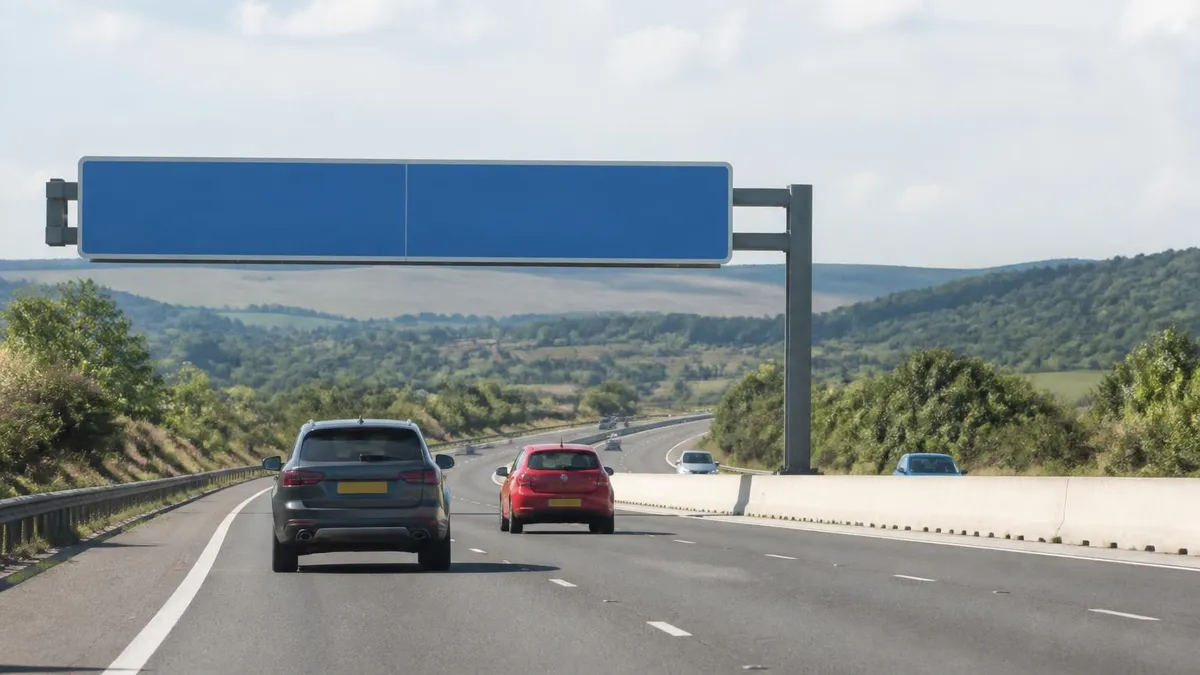
What colour are direction signs on UK motorways?
- A. Green with white text
- B. Blue with white text
- C. White with black text
- D. Yellow with black text
Answer: B. Blue with white text
Motorway direction signs have a blue background with white text and white borders, distinguishing them from other road types.
What is the maximum overhang allowed at the rear of a load on a UK vehicle before a marker board is required?
- A. 1 metre
- B. 2 metres
- C. 3 metres
- D. 4 metres
Answer: B. 2 metres
In the UK, a rear overhang exceeding 2 metres must be indicated by a marker board to warn following drivers of the projection.
You see brake lights come on several vehicles ahead of you on a motorway. What does this suggest?
- A. The vehicles are keeping the correct distance
- B. There may be a hazard or traffic queue forming ahead
- C. The road surface has changed
- D. There is a speed camera ahead
Answer: B. There may be a hazard or traffic queue forming ahead
Multiple brake lights ahead on a motorway indicate that traffic is slowing — there may be a hazard, congestion, or a queue forming. You should reduce your speed early and check your mirrors in case you need to change lanes or warn drivers behind you.
What should you do if you break down on a smart motorway with no hard shoulder?
- A. Stay in the live lane and wait for help
- B. Try to reach an emergency refuge area and call for help using the SOS phone
- C. Walk along the motorway to the next junction
- D. Stand behind your vehicle to warn other drivers
Answer: B. Try to reach an emergency refuge area and call for help using the SOS phone
If you break down on a smart motorway without a hard shoulder, try to reach an emergency refuge area (ERA). If you cannot, move to the left-hand verge if possible, switch on your hazard lights, and call 999. Stay behind the crash barrier if there is one.
DVSA Questions and Answers
How this page was made: written with AI tools and published by Nathan Beja, founder of Practice Test Geeks, who is responsible for its content. Exam facts are checked against the official sources listed below. Not reviewed by a subject-matter expert. Editorial policy
Sources & references
Exam facts on this page (fees, format, dates, passing scores) are checked against these official sources; the date is our last check. Editorial policy
- gov.uk — Eligibility, registration, test dates, passing score, retake policy, score release, score validity, time limit, exam format · verified Oct 2026