
How to Practice for Driving Theory: The Complete UK Study Guide 2026 September
Learn how to practice for driving theory and pass first time. 🏆 Study tips, question formats, hazard perception advice, and free practice tests.
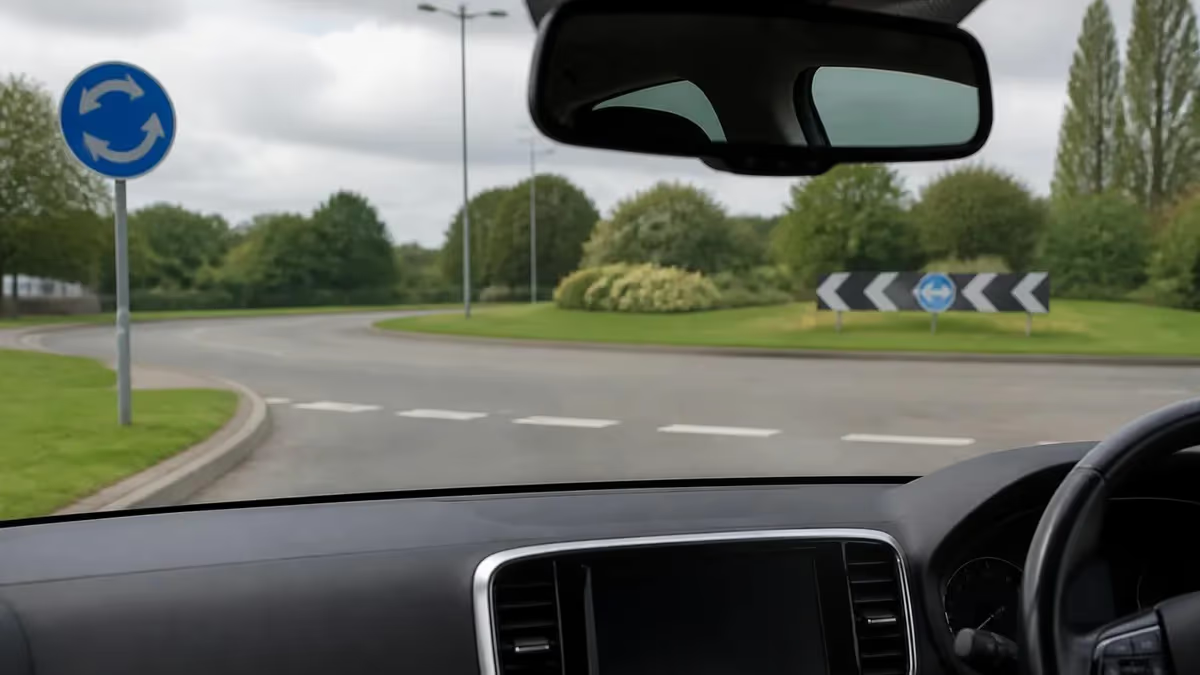
If you want to practice for driving theory and pass on your first attempt, you need a structured, systematic approach that goes well beyond simply skimming the Highway Code the night before your test. The UK driving theory test is a genuinely challenging two-part exam that catches out thousands of candidates every year — not because the material is impossibly hard, but because learners underestimate the depth of preparation required. Starting your revision with purpose, using the right resources, and understanding exactly what the DVSA expects will put you miles ahead of the average candidate walking into the test centre.
The DVSA theory test consists of two distinct sections: a multiple-choice question paper and a hazard perception video clip assessment. Both parts must be passed in the same sitting, and both require very different revision techniques. For the multiple-choice section, there are around 900 questions in the official DVSA question bank, covering topics from road signs and markings to vehicle safety, weather conditions, and motorway driving rules. You need to answer at least 43 out of 50 questions correctly to pass this section, which means you need to be confident across every topic area without gaps.
The hazard perception section is equally important and often more difficult for new learners to master. You will watch 14 video clips filmed from a driver's perspective, each featuring developing hazards on real UK roads. Clicking at the right moment — when a hazard is actively developing, not just present — is key to scoring well. One clip contains two scorable hazards. Your total score must reach at least 44 out of 75 to pass this element. Understanding the timing mechanics of hazard perception is something that requires dedicated practice, not just casual viewing of driving videos.
Many learners find it helpful to book their theory test fairly early in their learning journey so they have a fixed deadline to work towards. Having a date on the calendar creates accountability and helps you structure your revision into manageable weekly targets. You can find everything you need about scheduling your assessment and completing the online process through our guide to uk theory test practice, which walks through every step of the booking portal in detail.
One of the biggest mistakes learners make is treating all revision sources as equally valid. There is only one official question bank, maintained and updated by the DVSA, and this is the material your test will draw from. Using unofficial or outdated apps that recycle old questions can lead you to memorise answers that are no longer correct or to miss entirely new topic areas that have been added in recent years. Always verify that any practice test platform you use is aligned with the current official question bank before investing significant study time into it.
Consistency is more powerful than cramming when it comes to theory test preparation. Research into learning retention shows that short, regular study sessions — typically 30 to 45 minutes per day over several weeks — produce significantly better recall than marathon sessions crammed into the days before your test. This is because spaced repetition allows your brain to consolidate information into long-term memory rather than short-term recall that fades quickly under exam pressure. Building a daily revision habit early gives you the confidence and fluency you need on test day.
This guide covers everything you need to know to prepare effectively, from understanding the test format and scoring system, to the best study strategies for multiple-choice questions and hazard perception, to practical tips for managing anxiety on test day. Whether you are just starting your learning journey or you have already had one unsuccessful attempt and want to improve your approach, the advice here will help you walk out of the test centre with a pass certificate in hand.
UK Driving Theory Test by the Numbers

Theory Test Study Schedule
- ▸Read Highway Code sections 1–50 covering signs and road markings
- ▸Complete 50-question practice test on road signs
- ▸Make flashcards for warning, regulatory, and information signs
- ▸Watch 5 hazard perception demo clips to understand the format
- ▸Study speed limits, stopping distances, and overtaking rules
- ▸Complete 50-question practice test on vehicle safety checks
- ▸Practise hazard perception with 7 scored clips per session
- ▸Review any topics where you scored below 80% in practice tests
- ▸Study motorway rules including smart motorways and contraflow systems
- ▸Complete a full timed mock theory test under exam conditions
- ▸Focus hazard perception practice on dual carriageway clips
- ▸Review eco-friendly driving and vehicle loading topics thoroughly
- ▸Take two full 50-question timed mock tests per day
- ▸Revisit every topic where you are scoring below 90%
- ▸Complete all 14 hazard perception clip types at least twice
- ▸Read DVSA advice on test day procedure and what to bring
Building an effective revision plan for the theory test starts with an honest assessment of how much time you have available and how far away your test date is. Most learners who pass first time spend between four and eight weeks in active preparation, dedicating between 30 and 60 minutes per day to structured study.
If your test is coming up in less than two weeks and you have not yet started revising, you will need to compress this timeline significantly, which means prioritising the highest-frequency topic areas and focusing on full mock tests over isolated topic revision. Quality of practice matters far more than raw hours logged.
The Highway Code is the foundational text for the theory test and should be your starting point regardless of how much time you have. However, simply reading it cover to cover is not the most efficient study method. Instead, work through it systematically by chapter and immediately follow each section with practice questions on that specific topic.
This active retrieval approach forces your brain to engage with the material rather than passively absorbing it, which dramatically improves retention. Most good practice test platforms allow you to filter questions by topic, so you can test yourself on exactly what you have just read before moving on.
Spaced repetition is one of the most evidence-backed learning techniques available, and it works particularly well for theory test preparation because the question bank is finite and learnable. Apps and platforms that use spaced repetition algorithms will automatically schedule your review of difficult questions at increasing intervals — showing them again after one day, then three days, then seven days — until they move from uncertain to confident. This is far more efficient than randomly cycling through all 900 questions without tracking which ones are causing you problems.
Mock tests under timed, exam-like conditions are essential in the final two weeks of your preparation. Doing practice questions in a relaxed, open-book environment is very different from answering 50 questions in 57 minutes with no ability to look anything up. Run your mock tests with your phone in another room, a timer counting down, and no pausing between questions.
This builds the exam stamina and mental discipline you will need on the actual test day. Aim to be consistently scoring 47 or 48 out of 50 in your mocks before you sit the real test — you want a comfortable margin above the 43 pass mark to account for nerves.
When you get answers wrong in practice tests, do not simply note the correct answer and move on. Take time to understand why each wrong answer was wrong and why the correct answer is right. The DVSA constructs its distractors — the incorrect answer options — very carefully, often using numbers or rules that are plausible but not quite accurate.
If you understand the logic behind a question, you will not only remember it better but will also be equipped to handle similar questions phrased slightly differently. Pure memorisation of answers without understanding leaves you vulnerable to variants you have not seen before.
Hazard perception requires a completely different study approach to the multiple-choice section. The key skill being tested is your ability to identify a developing hazard — a situation that is actively changing and will require a response from a driver — as early as possible. Clicking too early (before the hazard has begun to develop) scores zero for that clip, as does clicking too late or clicking in a pattern that suggests you are guessing.
The optimal strategy is to watch each clip attentively, click once when you first notice something beginning to develop, and click again if the hazard continues to evolve. You are permitted multiple clicks, but only the earliest valid click within the scoring window receives the highest mark of five points.
Many learners benefit from watching real UK dash-cam footage outside of their formal practice sessions to train their eye for developing hazards. Seeing pedestrians stepping off kerbs, vehicles pulling out of junctions, cyclists wobbling near parked cars, and cars braking unexpectedly in real-world footage helps calibrate your sense of when a situation becomes a genuine hazard. This supplementary viewing, combined with scored practice clips on a proper hazard perception platform, builds the pattern recognition skills that separate confident passers from those who scrape through or fail the hazard section.
DVSA Practice Test Questions
Prepare for the DVSA - UK Driving Theory Test exam with our free practice test modules. Each quiz covers key topics to help you pass on your first try.
DVSA Eco-Friendly Driving and Vehicle Loading
DVSA Exam Questions covering Eco-Friendly Driving and Vehicle Loading. Master DVSA Test concepts for certification prep.
DVSA Hazard Awareness
Free DVSA Practice Test featuring Hazard Awareness. Improve your DVSA Exam score with mock test prep.
DVSA Incidents, Accidents and First Aid
DVSA Mock Exam on Incidents, Accidents and First Aid. DVSA Study Guide questions to pass on your first try.
DVSA Motorway Rules and Smart Motorways
DVSA Test Prep for Motorway Rules and Smart Motorways. Practice DVSA Quiz questions and boost your score.
DVSA Rules of the Road (Highway Code)
DVSA Questions and Answers on Rules of the Road (Highway Code). Free DVSA practice for exam readiness.
DVSA - UK Driving Theory Hazard Awareness ...
DVSA Mock Test covering - UK Driving Theory Hazard Awareness and Perception. Online DVSA Test practice with instant feedback.
DVSA - UK Driving Theory Motorway Rules an...
Free DVSA Quiz on - UK Driving Theory Motorway Rules and Regulations. DVSA Exam prep questions with detailed explanations.
DVSA - UK Driving Theory Road and Traffic ...
DVSA Practice Questions for - UK Driving Theory Road and Traffic Signs. Build confidence for your DVSA certification exam.
DVSA - UK Driving Theory Rules of the Road
DVSA Test Online for - UK Driving Theory Rules of the Road. Free practice with instant results and feedback.
Theory Test Section Strategies
The most effective strategy for multiple choice questions is to read each question fully before looking at the answer options, then attempt to formulate your answer in your head before seeing the choices. This prevents the distractors from influencing your thinking before your knowledge has a chance to surface. If you are uncertain, eliminate answers that are clearly wrong first — you will often narrow four options down to two, and from there your chances are much better. Never leave a question blank; an educated guess is always worth making.
Pay particular attention to questions involving numbers, because these are among the most commonly missed. Speed limits for different vehicle types, minimum tyre tread depths (1.6mm for the central three-quarters of the tyre across its full circumference), stopping distances, and blood alcohol limits all require precise recall. The Highway Code's stopping distance tables are worth memorising thoroughly — at 60 mph the total stopping distance is 73 metres, roughly the length of 18 car lengths. These numerical questions appear frequently in the test and reward exact learning over approximate understanding.

Online Practice Tests vs. Books and Printed Materials
- +Instant feedback shows you which answers were wrong and why
- +Timed mock tests replicate real exam pressure accurately
- +Question bank filtering lets you target weak topic areas
- +Progress tracking highlights improvement over time
- +Hazard perception video clips cannot be replicated in print
- +Available on mobile so you can study during commutes and breaks
- −Screen fatigue can reduce concentration during long sessions
- −Free apps often use outdated or unofficial question banks
- −Over-reliance on answer memorisation without genuine understanding
- −Paid platforms vary significantly in quality and question accuracy
- −No printed Highway Code means missing contextual diagrams and illustrations
- −Easy to skip difficult topics by cherry-picking comfortable subjects
Theory Test Preparation Checklist
- ✓Purchase or download the latest edition of the official Highway Code
- ✓Sign up for a practice test platform that uses the current DVSA question bank
- ✓Complete a diagnostic mock test to identify your weakest topic areas before you start
- ✓Study at least one Highway Code chapter per day and immediately follow with topic-specific practice questions
- ✓Memorise all stopping distances, speed limits, and numerical rules precisely
- ✓Complete at least 20 full timed 50-question mock tests before your test date
- ✓Practice hazard perception with a minimum of 14 scored clips every study session
- ✓Watch real UK road dash-cam footage to supplement your hazard perception training
- ✓Ensure you are consistently scoring 47 or 48 out of 50 in mocks before sitting the real test
- ✓Check you have a valid photocard driving licence to bring as ID on test day
The 900-Question Bank Is Finite — Learn It All
Unlike many exams where the question pool is effectively unlimited, the DVSA theory test draws exclusively from a published bank of approximately 900 questions. This means that a learner who systematically works through every question in the official bank, understands each answer, and reviews weak areas repeatedly is almost guaranteed to pass. The test is not designed to trick you — it is designed to confirm that you know the material. Complete bank coverage combined with regular hazard perception practice is the single most reliable path to a first-time pass.
One of the most commonly overlooked areas in theory test preparation is the section covering eco-friendly driving and vehicle loading. Many learners focus almost exclusively on road signs, speed limits, and hazard perception while neglecting these topic areas, which consistently feature in the test and can account for five or more questions in a single sitting.
Eco-friendly driving covers topics such as reducing fuel consumption through smooth acceleration and anticipatory braking, understanding how vehicle emissions affect air quality, knowing the environmental benefits of electric and hybrid vehicles, and recognising the advisory markings on motorways related to speed management for emissions reduction.
Vehicle loading regulations are another area where candidates frequently lose marks unnecessarily. The rules governing maximum loads, how load distribution affects vehicle handling, the legal requirements for securing loads so they cannot shift or fall, and the specific rules around roof boxes and towing are all examinable. A poorly loaded vehicle is significantly more dangerous than most new drivers appreciate — shifting loads change a vehicle's centre of gravity during cornering, increase stopping distances, and can cause catastrophic loss of control at motorway speeds. The DVSA treats these rules seriously, and the test reflects that importance.
Incidents, accidents, and first aid form another cluster of questions that learners tend to underestimate. You do not need medical training to pass these questions, but you do need to know the correct sequence for managing an accident scene: making the scene safe first, calling emergency services, and then providing basic first aid in the correct order of priority.
You need to know what to do if someone is unconscious and breathing versus unconscious and not breathing, the recovery position, how to treat bleeding, and the warning signs of shock. These are not obscure edge cases — they appear regularly in the test.
The rules around motorway driving are disproportionately represented in the test relative to how much road time a learner driver has had on motorways before sitting their theory. Smart motorway rules, including the meaning of different overhead gantry signals, the rules around closed lanes marked with a red X, variable speed limits, and what to do if your vehicle breaks down on a smart motorway, are all current and important examination topics.
The DVSA updated its guidance on smart motorways several times in recent years following public safety concerns, and the current test reflects the latest official position on how drivers should behave on these roads.
Weather conditions and their effect on driving are tested extensively, particularly around the adjustments drivers should make in rain, fog, ice, and strong winds. The two-second rule for following distance in dry conditions becomes a minimum four seconds in wet conditions and is expected to extend further still in icy or foggy weather.
Fog light rules — when to use them, when they must be switched off, and why leaving them on in clear conditions is both illegal and dangerous — appear consistently. The DVSA is particularly interested in whether candidates understand that a vehicle can aquaplane on standing water even at relatively modest speeds, and that gentle, early braking is essential to maintain control in wet conditions.
Vulnerable road users — cyclists, motorcyclists, pedestrians, horse riders, and children — are given significant weight in the test. The DVSA expects candidates to demonstrate understanding of why these road users are more exposed to injury in collisions, what extra care is required when overtaking them, the specific distances required when passing cyclists, and why giving way at pedestrian crossings involves more than simply stopping when lights turn red. Questions about school crossing patrols, zigzag lines, and the rules at various crossing types (pelican, puffin, toucan, pegasus) are all fair game and require precise knowledge rather than general awareness.
The rules around alcohol, drugs, and tiredness as impairments to driving ability round out the major topic areas that catch candidates off guard. You need to know not just that drink-driving is illegal but the specific legal blood alcohol limit (80 milligrams per 100 millilitres of blood in England, Wales, and Northern Ireland — lower in Scotland at 50mg), the penalties for offences, and critically that the morning after a heavy drinking session you may still be over the legal limit.
Questions about the effects of prescription and over-the-counter medication on driving ability, and your legal obligation to check whether any medication you take affects your fitness to drive, also appear regularly in the test.
The DVSA regularly updates its official question bank to reflect changes in road law, vehicle technology, and the Highway Code. Using practice apps or websites that have not been updated recently means you may be learning incorrect answers or missing entirely new topic areas. Always check that any platform you use explicitly states it is aligned with the current DVSA question bank before trusting it as your primary revision source. The official DVSA revision materials, available through the GOV.UK website, are always the most reliable reference point.
The final week before your theory test should be a consolidation phase, not a cramming phase. If you have followed a four to six week preparation plan, the last seven days are not the time to introduce entirely new material — instead, focus on reinforcing what you already know, sharpening your consistency in mock tests, and managing the mental preparation required to perform well under pressure.
Many candidates who fail their theory test do so not because they lack knowledge but because anxiety disrupts their thinking and causes them to second-guess answers they would have got right in practice. Addressing the psychological side of exam performance is as important as the technical knowledge.
Sleep quality in the days before your test has a measurable impact on memory recall and decision-making speed. The night before your test, avoid staying up late doing revision — the marginal benefit of an extra hour of study is far outweighed by the cognitive cost of sitting a time-pressured exam while fatigued.
Eat a proper breakfast on test morning, arrive at the centre in plenty of time so you are not rushing, and take a few minutes in the waiting area to breathe steadily and ground yourself before you are called to your terminal. These simple physical preparations are underrated by most candidates.
On the day of your test, if you encounter a question that you genuinely do not know the answer to, do not dwell on it. Flag it, move on, and return to it once you have completed the questions you are confident about. Often, reading subsequent questions triggers memory of facts that help with earlier flagged questions.
Your subconscious continues processing information even when you have moved on, and returning to a difficult question with fresh eyes after completing the rest of the paper frequently unlocks the answer. This strategy is well-known among experienced test-takers and works consistently for theory test candidates.
After completing the multiple-choice section, you will move immediately into the hazard perception section. There is no break between the two parts. If you have found the multiple-choice section difficult or you believe you may not have done well, it is essential to park those thoughts entirely before the hazard clips begin. Your performance in the multiple-choice section cannot be changed, but a strong hazard perception score can still secure you an overall pass. Focus completely on the task in front of you, maintain your scanning routine, and trust the practice you have put in over the preceding weeks.
When you complete both sections, your result will be displayed immediately on screen. If you have passed, you will receive a pass certificate which your driving instructor can use to book your practical test. If you have not passed, you will see which section or sections were below the pass mark and by how many points.
There is a minimum waiting period of three clear working days before you can resit the theory test, and you will need to book and pay for a new test appointment. Use the result feedback to focus your additional preparation specifically on the areas where you fell short rather than revising everything from scratch.
Many learners find it valuable to reflect honestly on why they did not pass if a resit is required. The three most common reasons for theory test failure are: insufficient coverage of the full question bank (leaving topic areas unstudied), inadequate hazard perception practice (relying on multiple-choice revision alone), and exam anxiety (knowing the material in relaxed practice but losing recall under pressure). Identifying which of these applies to you is the fastest route to a successful resit, because targeted preparation is always more efficient than general increased effort.
Our resources on the practical side of the licensing process, including what comes next after passing, are covered in our guide to uk theory test practice and the related articles section below.
Passing the theory test is a significant milestone in your journey to becoming a fully qualified driver, but it is worth remembering that it is also a test of whether you will be a safe road user, not just a certificate to collect.
The knowledge you build during your theory revision — about hazard awareness, road rules, vehicle safety, and responsible driving behaviour — will serve you throughout your entire driving life. Candidates who engage genuinely with the material rather than treating it as an obstacle to get past quickly tend to become the most competent and confident drivers, which makes the roads safer for everyone.
Practical tips for maximising your theory test score begin with understanding how you personally learn best. Some candidates retain information most effectively by reading, others by watching explanatory videos, others by writing out key facts, and others through conversation or teaching the material to someone else.
There is no single correct revision method — what matters is that you choose approaches that genuinely help you encode information into long-term memory rather than methods that feel productive but leave little lasting trace. If you have always struggled with purely text-based study, combine your Highway Code reading with explanatory YouTube videos from qualified driving instructors, which can make abstract rules feel more concrete and memorable.
Topic-based practice tests are more efficient than random question sets during the early stages of your preparation. When you have just read the motorway rules chapter, doing 20 motorway-specific questions immediately afterwards reinforces that specific material while it is freshest in your mind. Random question sets are better suited to the later stages of preparation when you need to simulate the actual test experience, where topics are mixed and you cannot predict what is coming next. Alternating between focused topic practice early on and randomised full mocks as your test approaches is the most efficient progression strategy.
Understanding the structure of DVSA answer options will help you when you are genuinely uncertain. The DVSA typically constructs its incorrect options in one of three ways: using numbers or rules that are plausible but slightly wrong (such as 1.4mm instead of the correct 1.6mm tread depth), using correct information from the wrong context (applying a motorway rule to a dual carriageway), or describing what a nervous or untrained driver might do rather than what they should do. Once you recognise these patterns, you can approach uncertain questions more analytically rather than guessing blindly.
Group study can be surprisingly effective for theory test preparation when managed well. Quizzing each other on Highway Code rules, testing knowledge of road signs using flashcards, and discussing the reasoning behind particular rules all reinforce understanding more deeply than solo reading. Many learners discover gaps in their knowledge when they try to explain a rule to someone else and realise they cannot articulate it clearly. However, group study should complement individual practice tests rather than replace them — the actual exam is a solo experience and you need to be confident working through questions independently and at speed.
The DVSA official revision materials — including the Know Your Traffic Signs publication, the Highway Code itself, and the official practice test apps — are the canonical sources for your preparation. While third-party resources can supplement your learning, particularly for hazard perception video practice, they should never be your sole or primary source.
The DVSA updates its materials to reflect changes in road law, and only the official publications are guaranteed to be current. Check the publication dates on any books you use and ensure you are not revising from an edition that predates significant Highway Code or road law changes.
Eco-friendly driving deserves special attention as a topic area because it represents a genuinely modern dimension of road knowledge that was less prominent in older editions of the Highway Code. Questions cover the fuel efficiency benefits of smooth, anticipatory driving — maintaining steady speeds, looking ahead to avoid unnecessary braking, and using engine braking on downhill sections.
They also cover tyre pressure and its effect on fuel consumption, the environmental and cost benefits of regular vehicle servicing, and the increasingly important topic of electric and hybrid vehicle operation including regenerative braking and charging infrastructure. Candidates who have only driven petrol vehicles may find some EV-specific questions unfamiliar and should ensure they study this area explicitly.
As you approach the final days before your test, shift your focus toward confidence maintenance rather than intensive new learning. Review your weakest topic areas one final time, complete one or two full timed mocks each day to keep your exam stamina sharp, and spend 15 to 20 minutes on hazard perception clips daily.
On the evening before your test, lay out everything you need to bring — your photocard licence, the test centre address, and any confirmation emails — and plan your journey so you know exactly how long it will take to arrive with time to spare. A calm, prepared arrival at the test centre puts you in the best possible mental state to perform at the level your revision deserves.
DVSA Questions and Answers

DVLA Theory Test Booking: Complete Step-by-Step Guide for UK Learners
Driving Theory Test App: The Complete Study Guide for UK Learners

How to Book Your DVSA Practical Driving Test: Complete UK Guide

Learn to Drive in the UK: Complete Beginner's Guide to Getting Your Licence

DVSA Car Practical Test: Complete Guide to Passing First Time
About the Author

Licensed Driving Instructor & DMV Test Specialist
Penn State UniversityRobert J. Williams graduated from Penn State University with a degree in Transportation Management and has spent 20 years as a certified driving instructor and DMV examiner consultant. He has personally coached thousands of applicants through written knowledge tests, skills assessments, and commercial driver licensing programs across more than 30 states.