
Colorado DMV Bill of Sale Form: Complete 2026 Guide for Buyers, Sellers and DMV Representatives
Master the Colorado DMV bill of sale form and other key DMV forms. Complete 2026 guide for DMV customer service representatives and the public. ✍🏼
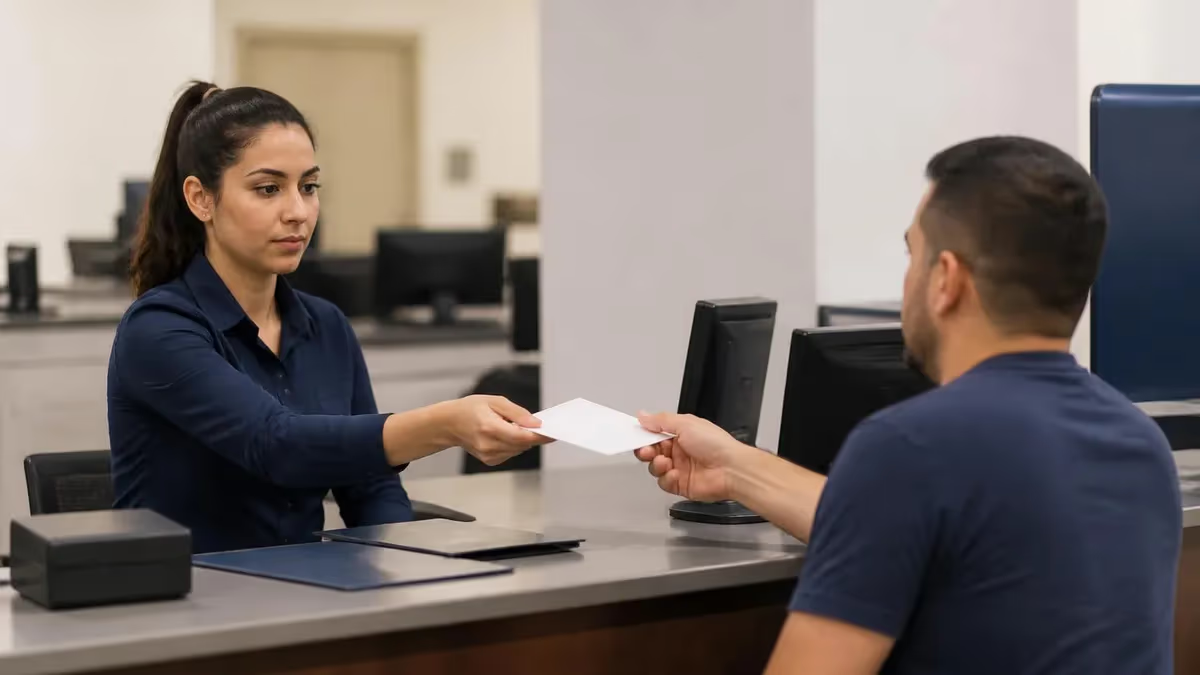
The colorado dmv bill of sale form is one of the most commonly requested documents at any motor vehicle office, and understanding it inside and out is essential for anyone preparing for the dmv customer service representative role. Whether you are a buyer transferring ownership, a seller protecting yourself from future liability, or a dmv representative guiding customers through paperwork, knowing exactly what this form requires can save hours of frustration. Colorado uses Form DR 2173 for bills of sale, and every line on that form has a specific legal purpose that representatives must explain clearly. Practice with the free DMV - Representative practice test on PracticeTestGeeks (7 questions with answer explanations).
Bills of sale function as the legal bridge between two private parties and the state titling system. They document the transfer of consideration, the vehicle identification number, the odometer reading, and the date the transaction occurred. When a dmv customer service representative reviews this form during a title transfer appointment, they are essentially verifying that a legitimate sale took place, that taxes are properly calculated on the stated purchase price, and that no critical signatures or notarizations were missed. A single error can delay a title by weeks.
Colorado is somewhat unique because, unlike states such as Vermont or New York, the bill of sale is not always mandatory for every transfer. However, the Colorado Department of Revenue strongly recommends it, and many counties require it whenever the back of the title is incomplete or when sale price documentation is needed for use-tax purposes. Representatives should understand the difference between a recommended document and a required one, because giving incorrect guidance creates compliance problems for the office and tax exposure for the customer.
For people studying to become dmv staff or aspiring to handle complex transactions, mastering bill of sale rules is foundational training. The form intersects with sales tax law, lemon law disclosures, odometer fraud regulations under 49 CFR Part 580, and Colorado-specific emissions transfer rules in the Denver-North Front Range area. A capable representative can spot the warning signs of a fraudulent transaction simply by reading how a bill of sale is filled out, which is why this topic appears so frequently on dmv representative practice exams.
This guide walks through every element of the Colorado bill of sale form, the surrounding paperwork ecosystem, and the customer service skills required to handle these transactions professionally. We will cover form-by-form requirements, typical customer mistakes, fraud-detection signals, sales tax calculations, and the soft skills representatives need when buyers or sellers come in upset about a denied transfer. By the end, you will have a comprehensive framework you can apply to nearly any titling scenario in Colorado or in similar states.
We will also touch on how related topics tie in, including consumer protection disclosures, vehicle inspections, and how to escalate complex cases. If you are preparing for the representative exam, you may want to keep this resource open alongside the official Department of Revenue Title and Registration Manual. The manual is the legal authority, but a structured walk-through like this one helps you anchor the material in real-world workflows you will see at the counter every single day.
Finally, although this article focuses on Colorado, the principles transfer well to any state. Every jurisdiction has its own form number, but the elements of a valid bill of sale, the role of notarization, and the relationship between the bill of sale and title assignment are remarkably consistent across the country. Read this as a Colorado primer first, then a national reference second.
Free DMV - Representative Exam Study Tools
Interactive DMV - Representative Exam resources on PracticeTestGeeks, free to start:
- Free DMV Representative MCQ Question and Answer — 7 questions with answer explanations
- DMV - Representative Exam flashcards — review key terms and concepts card by card
- DMV - Representative Exam study guide — topic-by-topic overview of what the exam covers
- DMV - Representative Exam cheat sheet — one-page printable summary for last-minute review
- The Motor Vehicle Representative exam allows 120 minutes. (California Department of Motor Vehicles)
- The Motor Vehicle Representative exam requires 70% for eligible-list placement. (California Department of Motor Vehicles)
- Motor Vehicle Representative exam participants must wait 12 months before retesting. (California Department of Motor Vehicles)
- Motor Vehicle Representative exam eligibility lasts 24 months. (California Department of Motor Vehicles)
- The Motor Vehicle Representative exam must be retaken to restore expired eligibility. (California Department of Motor Vehicles)
- The Motor Vehicle Representative exam is delivered online with multiple-choice questions. (California Department of Motor Vehicles)
Facts verified Oct 16, 2026 against California Department of Motor Vehicles. Dates that have passed are removed automatically.
DMV Exam at a Glance
| Item | Detail | Official source |
|---|---|---|
| Time limit | 120 minutes | California Department of Motor Vehicles |
| Passing score | 70% | California Department of Motor Vehicles |
| Retake policy | 12-month waiting period | California Department of Motor Vehicles |
| Validity | 24 months | California Department of Motor Vehicles |
| Renewal | Retake to reestablish eligibility | California Department of Motor Vehicles |
| Delivery | Online multiple choice | California Department of Motor Vehicles |
| Registration deadline | Continuous applications | California Department of Motor Vehicles |
Facts verified Oct 16, 2026 against California Department of Motor Vehicles. Dates that have passed are removed automatically.
Colorado DMV Forms by the Numbers

Anatomy of the Colorado Bill of Sale Form
Full legal names, current addresses, and signatures of both buyer and seller are mandatory. Representatives should verify that names match identification documents exactly to avoid title rejections during processing.
Year, make, model, body style, color, and the 17-character VIN must appear. The VIN should be cross-checked against the title and any inspection certificates to catch typos that derail the transfer.
Federal law requires the actual mileage on vehicles less than 20 years old. Mark exempt, actual, or not-actual. Misstating mileage is a federal offense under 49 CFR Part 580.
The agreed purchase price drives sales tax calculations. A gift requires a separate gift affidavit. Use-tax fraud often shows up as suspiciously low sale prices on otherwise normal vehicles.
Colorado does not always require notarization, but counties may. When notarization is required, both parties typically must sign in front of the notary or a county clerk authorized to witness.
Once you understand the bill of sale, the next layer of expertise for a dmv representative is the surrounding ecosystem of forms. A standard private-party vehicle transaction in Colorado often involves the bill of sale alongside the assigned title, a secure odometer disclosure if the title space is exhausted, an emissions certificate in covered counties, proof of insurance, and a verification of vehicle identification number (VIN) form when the vehicle is coming from out of state. Knowing which forms apply in which combination is the heart of competent counter work.
Form DR 2444 is the Statement of Fact, used to correct or clarify information that is missing or wrong on other documents. If a customer wrote the wrong odometer reading on the title and crossed it out, a Statement of Fact can sometimes salvage the transaction without requiring a duplicate title. Representatives need to recognize when DR 2444 is acceptable and when the only path forward is ordering a duplicate, because choosing wrong wastes the customer's day and erodes trust in the office.
For lost or damaged titles, customers need Form DR 2539A, the Application for Duplicate Title. This form requires identification, the VIN, and in some cases a notarized signature depending on whether liens are present. Representatives should always check the title record before sending the customer to a notary, because if there is an active lienholder, the duplicate must be ordered through that lienholder and not by the registered owner directly. This single nuance trips up new representatives constantly.
The Power of Attorney form, DR 2175, allows one person to handle title work on behalf of another. This is common when dealers process transfers for customers, when family members assist elderly relatives, or when active-duty military members are stationed out of state. Representatives must verify the POA is correctly executed, that it specifies the vehicle in question, and that the agent presents valid identification. Generic, non-vehicle POAs are often rejected by county clerks.
Sales tax forms are another major category. Form DR 0024 is the Standard Sales Tax Receipt for Vehicle Sales, used when a Colorado dealer collects sales tax at the point of sale. Private-party transactions instead require the buyer to pay use tax at the county clerk's office during title transfer, calculated from the bill of sale price. Representatives must verify the math, apply the correct combined state, county, city, and special-district rates, and explain any exemptions such as trade-in credits or family transfers.
Out-of-state transfers add forms DR 2698 (VIN Verification) and any emissions certifications required by the destination county. Representatives in Denver-area offices should be especially comfortable with these because the Denver-North Front Range emissions program covers many counties and applies to most gasoline vehicles between certain model years. A missing emissions test is the single most common reason out-of-state transfers fail at the counter on first attempt.
Specialty plates, disability placards, and trailer registrations each carry their own forms. While not strictly part of the bill of sale process, customers often combine errands, and a skilled representative knows how to bundle a title transfer with a plate change or placard application efficiently. The goal is one trip, one wait, one completed transaction whenever possible.
DMV Practice Test Questions
Prepare for the DMV - Representative Exam exam with our free practice test modules. Each quiz covers key topics to help you pass on your first try.
DMV - Representative Consumer Protection a...
DMV Exam Questions covering DMV - Representative Consumer Protection and Dispute Resolution. Master DMV Test concepts for certification prep.
DMV - Representative Vehicle Inspections a...
Free DMV Practice Test featuring DMV - Representative Vehicle Inspections and Safety Standards. Improve your DMV Exam score with mock test prep.
DMV - Representative Advertising and Sales...
DMV Mock Exam on - Representative Advertising and Sales Practices. DMV Study Guide questions to pass on your first try.
DMV - Representative Bonds and Business Re...
DMV Test Prep for - Representative Bonds and Business Records. Practice DMV Quiz questions and boost your score.
DMV - Representative Dealer-Specific Regul...
DMV Questions and Answers on - Representative Dealer-Specific Regulations. Free DMV practice for exam readiness.
DMV - Representative Registration and Tran...
DMV Mock Test covering - Representative Registration and Transfer Fees. Online DMV Test practice with instant feedback.
DMV - Representative Sales Contracts and D...
Free DMV Quiz on - Representative Sales Contracts and Disclosures. DMV Exam prep questions with detailed explanations.
DMV - Representative Salesperson Licensing...
DMV Practice Questions for - Representative Salesperson Licensing Requirements. Build confidence for your DMV certification exam.
DMV - Representative Unlawful Acts and Con...
DMV Test Online for - Representative Unlawful Acts and Conduct. Free practice with instant results and feedback.
DMV - Representative Vehicle Code Definitions
DMV Study Material on - Representative Vehicle Code Definitions. Prepare effectively with real exam-style questions.
DMV - Representative Vehicle Registration ...
Free DMV Test covering - Representative Vehicle Registration Procedures. Practice and track your DMV exam readiness.
DMV Representative Basic Arithmetic
DMV Exam Questions covering Representative Basic Arithmetic. Master DMV Test concepts for certification prep.
DMV Customer Service Representative Daily Workflow
The first hour of a dmv representative's day is dominated by intake. Customers arrive with stacks of paperwork, often including a bill of sale, an assigned title, identification, proof of insurance, and emissions certificates. The representative's job is to triage these documents before the customer reaches a service window, identifying missing items early so the office can either correct them or send the person home with a clear checklist rather than waiting two hours only to be turned away.
Strong morning workflow includes a quick VIN cross-check between title and bill of sale, an odometer comparison, and a signature audit. A dmv representative who builds these habits cuts rework dramatically and improves the entire office's throughput. New hires should shadow a senior clerk during this phase for at least a week before independently triaging documents, because the patterns of common mistakes are best learned by watching, not by reading procedure manuals alone.

Using a Bill of Sale vs. Title Assignment Only
- +Creates a clear paper trail of the sale price for use-tax purposes
- +Documents the exact date ownership transferred, protecting the seller from later tickets and tolls
- +Records odometer reading separately from the title, useful if the title is lost
- +Captures buyer and seller addresses and phone numbers for future contact
- +Strengthens evidence in small claims court if a dispute arises
- +Required by some counties before a private-party title transfer will be processed
- +Helps representatives detect odometer fraud or suspicious pricing patterns quickly
- −Adds an extra document the customer must produce and store
- −Notarization, when required, costs time and a small fee
- −Errors on the bill of sale can delay transfer if they contradict the title
- −Some buyers attempt to record a low sale price to dodge use tax, exposing both parties to penalties
- −Not legally required in every Colorado scenario, leading to customer confusion
- −Lost bills of sale create complications years later in audits or insurance claims
Pros and Cons at a Glance
| Pros | Cons |
|---|---|
| Creates a clear paper trail of the sale price for use-tax purposes | Adds an extra document the customer must produce and store |
| Documents the exact date ownership transferred, protecting the seller from later tickets and tolls | Notarization, when required, costs time and a small fee |
| Records odometer reading separately from the title, useful if the title is lost | Errors on the bill of sale can delay transfer if they contradict the title |
| Captures buyer and seller addresses and phone numbers for future contact | Some buyers attempt to record a low sale price to dodge use tax, exposing both parties to penalties |
| Strengthens evidence in small claims court if a dispute arises | Not legally required in every Colorado scenario, leading to customer confusion |
| Required by some counties before a private-party title transfer will be processed | Lost bills of sale create complications years later in audits or insurance claims |
Bill of Sale and Title Transfer Checklist
- ✓Complete Colorado Form DR 2173 with all parties' full legal names and addresses
- ✓Verify the 17-character VIN matches the title, registration, and the vehicle dashboard
- ✓Record the odometer reading and select the correct disclosure type (actual, exempt, not-actual)
- ✓State the true sale price in numerals and written words to avoid alteration
- ✓Have both buyer and seller sign and date the form in the appropriate sections
- ✓Notarize the bill of sale if the county or transaction type requires it
- ✓Attach the bill of sale to the assigned original title, not a photocopy
- ✓Bring valid government-issued photo identification for the buyer
- ✓Provide proof of current Colorado auto insurance covering the new vehicle
- ✓Bring the most recent emissions certificate if the vehicle is in a covered county
- ✓Calculate combined state, county, city, and special district use tax in advance
- ✓Submit everything at the county clerk's office within 60 days of the sale date
Always cross-verify three data points before stamping anything
The fastest fraud-detection technique is a three-way cross-check: VIN on the title, VIN on the bill of sale, and VIN on the physical vehicle inspection report. If any one of these disagrees by a single character, stop the transaction and investigate. This habit catches more odometer rollback and VIN-cloning fraud than any other single procedure used at the counter.
Fraud detection is one of the most consequential skills a dmv customer service representative develops. The Colorado DMV processes millions of transactions per year, and even a small percentage of fraudulent ones represents enormous financial and public-safety risk. Fraud at the bill of sale stage typically falls into three categories: price misreporting to dodge use tax, odometer rollback to inflate vehicle value, and identity fraud where the seller is not actually the registered owner. Each category has tells, and representatives need to know them cold.
Price misreporting is the most common. A representative sees a 2022 Toyota Camry being transferred with a stated price of $2,500. The Kelley Blue Book value is closer to $22,000. While there are legitimate reasons for low prices, family transfers, salvage histories, or known damage, the representative should ask clarifying questions. A confident, consistent answer that aligns with documentation usually means the transaction is fine. Defensive or shifting answers, especially combined with a recent out-of-state title, are signals to escalate.
Odometer rollback is more technical to detect. The federal odometer disclosure under 49 CFR Part 580 requires the seller to certify the mileage, and Colorado representatives should compare the bill of sale odometer to the previous title's mileage and to any emissions inspection records, which often capture mileage independently. A vehicle whose current odometer is lower than its last emissions reading is almost certainly tampered. Representatives must report suspected rollback to a supervisor and follow office escalation protocols.
Identity fraud at the seller side is harder to spot but devastating when missed. The classic pattern is a thief obtaining a duplicate title for a vehicle they do not own, then selling it to an unsuspecting buyer who shows up at the DMV. The representative may be the first and only person who notices the title's most recent issuance is suspiciously fresh and that the seller's name on the bill of sale matches a name added in the last 30 days. Pulling the title history before processing protects everyone.
Common honest errors also delay transactions and are worth knowing. Customers frequently forget to sign as both seller and buyer, write the date in European day-month-year format that looks invalid, or use whiteout on the title, which immediately voids it. Representatives should preempt these by walking customers through the form at intake. A laminated example bill of sale at each window, with the most common error spots highlighted, reduces rework by double digits in offices that have adopted the practice.
Disputes between buyer and seller occasionally erupt at the counter, especially when a transaction is denied. Representatives should remain neutral, factual, and patient. The bill of sale is a private contract; the DMV cannot enforce its terms or refund money. Direct disputants to small claims court, the Colorado Attorney General's Consumer Protection Section, or the Bureau of Automotive Repair if mechanical issues are involved. Documenting the encounter in the office log protects the representative if the dispute escalates further.
Finally, representatives should never personally accept gifts, side payments, or special favors from customers who are trying to expedite their paperwork. Even a free coffee from a regular customer can create the appearance of impropriety. Colorado state ethics rules and most local government codes of conduct address this directly. When in doubt, politely decline and document the offer in your daily log. Integrity protects your career and the public's trust in the entire motor vehicle system.

Colorado law requires buyers to title and register a vehicle within 60 days of the bill of sale date. Late fees start at $25 per month and can reach $100 maximum. Representatives should always check the sale date on the bill of sale and warn customers approaching the deadline. Missing this deadline can also create insurance gaps and complicate any future warranty or lemon-law claims.
For aspiring dmv representatives preparing for the certification exam, the bill of sale topic is a high-yield area, and you should drill it until the form fields and surrounding rules are second nature. Exam questions often test fact patterns: a customer brings in a bill of sale with the seller's signature missing, but the title is properly assigned, what does the representative do? Or: a vehicle from California arrives with no emissions certificate, and the buyer lives in Denver, what is the correct sequence of next steps? These scenarios reward careful reading and rule recall.
The dmv representative exam tends to emphasize cross-referenced topics, meaning a single question may require knowledge of the bill of sale, the sales tax structure, the emissions program, and the customer service escalation protocol all at once. Studying topics in isolation is therefore less effective than studying them in interaction. Build your own example scenarios using the forms discussed in this article, then walk through each step as though you were behind the counter helping a real customer with that exact paperwork combination.
One of the most useful preparation tactics is taking timed practice quizzes. Many candidates know the material conceptually but stumble when asked to apply it under time pressure. Aim for at least three full timed practice tests in the two weeks before your exam, scoring yourself, identifying weak topics, and returning to the source material for those topics. The Colorado Title and Registration Manual is the canonical source; supplement it with structured guides like this one for context and memorability.
Soft skills matter as much as form knowledge. Some exam questions test how you should respond to an angry customer whose transaction was denied, or how to handle a customer who appears to be in some form of distress, or whether to call security versus a supervisor when a confrontation escalates. The correct answer is almost always the procedural one: de-escalate verbally, use neutral language, document the encounter, and involve a supervisor before any escalation to law enforcement unless safety is at immediate risk.
Many candidates underestimate how much the exam values attention to detail in form processing. Even if you understand bill of sale rules at a high level, you can lose points by missing nuances such as whether a particular section requires notarization, whether the form is acceptable on a non-DOR template, or whether a foreign-issued ID is sufficient identification for the buyer. Read every answer choice carefully and watch for absolutes like always and never, which are often the giveaway for an incorrect option.
To round out your preparation, look at related practice resources covering vehicle inspections, consumer protection, and general dmv procedures. The more breadth you build, the more flexibly you can respond to scenario questions that touch multiple knowledge areas. Many representatives also find that watching short video walk-throughs of real form completions helps them visualize the steps under pressure, which translates into faster, more confident exam responses on transaction-heavy questions.
One last piece of advice: practice explaining the bill of sale process to a friend or family member who knows nothing about DMV work. If you can walk them through it clearly, you understand it well enough to pass the exam and to serve customers professionally. Teaching is the highest form of mastery, and the dmv representative role is fundamentally about explaining complex bureaucratic processes in human, accessible language to anxious customers under time pressure.
Final preparation in the days before your exam should follow a deliberate routine. Two weeks out, complete a diagnostic practice test covering all topics, not just bill of sale rules. Note your weakest two or three areas and dedicate the bulk of your study time to them. One week out, review the official Colorado Title and Registration Manual chapters that map to those weak areas, then take a second full practice test. Three days out, take a final timed test under exam-like conditions, and on the day before, rest. Cramming the night before reliably hurts performance.
On exam day, arrive early, bring two forms of identification, and remember that the exam is designed to be passable with reasonable preparation. Read every question twice, eliminate clearly wrong answers first, and trust your training. If a question seems to have two right answers, look for the one that is the most procedurally correct, the one that aligns with the chain of escalation, customer dignity, and accurate record-keeping all at once. That is almost always the intended response.
After you pass, your real learning begins. The first 90 days on the counter will teach you more about the bill of sale, title transfers, and Colorado motor vehicle rules than any study guide can. Keep a small notebook at your station and jot down every form combination you have not seen before, every escalation you handled, and every customer reaction that surprised you. Review this notebook weekly with a senior colleague. This habit, more than anything else, distinguishes representatives who plateau from those who advance into senior roles.
Continuing education is also non-negotiable. Colorado periodically updates forms, fee schedules, emissions program boundaries, and tax rates. Subscribe to Department of Revenue bulletins, attend every in-office training, and consider professional certifications such as those offered by the American Association of Motor Vehicle Administrators. Representatives who stay current are also the ones who get tapped for special projects, training new hires, and eventually moving into supervisory roles.
Customer service excellence is built on small, repeatable habits. Greet every customer warmly, even on your worst day. Explain what you are doing as you do it. Acknowledge frustration without absorbing it. Find one specific thing to compliment about a customer's preparation when their paperwork is in order, since positive reinforcement is rare in DMV interactions and customers remember it. These habits compound over a career into a reputation for being the representative everyone hopes they get when they walk through the door.
If you encounter customers asking about other DMV topics outside your specialty, know how to redirect them gracefully. Permit questions go to the permit team, driving test questions to the road test scheduling line, and complex commercial questions to the commercial vehicle desk. Sending people to the right place quickly is itself a customer service skill, and it keeps your line moving so the customers in front of you get the attention they deserve.
Finally, take care of yourself. DMV work is repetitive, emotionally taxing, and physically demanding when you are on your feet at a counter all day. Take your breaks, hydrate, and use your benefits. Burnout among new representatives is a real risk, especially in busy urban offices. The representatives who build long, successful careers are the ones who treat self-care as a professional obligation, not a luxury. Your customers and your colleagues need a representative who is steady, present, and engaged, day after day, year after year.
Sample DMV - Representative Exam Practice Questions
Try these questions from our free DMV - Representative Exam practice tests. The correct answer and an explanation follow each question.
Under the 'Seller's Right to Cancel' clause in a typical retail installment sales contract, a dealer may cancel the sale if they cannot secure financing. Within how many days of the purchase date must the dealer notify the buyer of this cancellation?
- A. 3 days
- B. 7 days
- C. 10 days
- D. 14 days
Answer: C. 10 days
If a dealer is unable to assign the financing contract to a lender, they have the right to cancel the sale, but they must notify the buyer of the cancellation within 10 days of the date on the purchase contract. If they fail to do so, the sale is considered final.
When transferring a vehicle title in a private sale, what must the seller do to the title document?
- A. Laminate the title for protection
- B. Sign the title over to the buyer in the designated area
- C. Mail the title directly to the DMV
- D. Notarize the title at a bank
Answer: B. Sign the title over to the buyer in the designated area
The seller must sign the back of the title in the seller's signature field to legally transfer ownership to the buyer.
Which California law specifically prohibits a dealer from conditioning a vehicle sale on the buyer purchasing optional add-on products such as GAP insurance or paint protection?
- A. California Vehicle Code Section 11713.1
- B. The Automobile Sales Finance Act
- C. The California Finance Lenders Law
- D. The Rees-Levering Motor Vehicle Sales and Finance Act
Answer: D. The Rees-Levering Motor Vehicle Sales and Finance Act
The Rees-Levering Act prohibits dealers from conditioning financing or vehicle delivery on the purchase of optional add-on products.
A dealer issues a spot delivery (yo-yo sale) and later calls the buyer back saying financing fell through. What is the dealer legally required to do if the buyer cannot obtain alternate financing?
- A. Charge a restocking fee and re-list the vehicle
- B. Return the buyer's down payment and trade-in in the same condition
- C. Report the buyer to a credit bureau
- D. Transfer ownership to a co-signer automatically
Answer: B. Return the buyer's down payment and trade-in in the same condition
If a spot delivery unwinds, the dealer must return all consideration provided by the buyer, including the down payment and trade-in vehicle, in substantially the same condition.
DMV Questions and Answers




How this page was made: written with AI tools and published by Nathan Beja, founder of Practice Test Geeks, who is responsible for its content. Exam facts are checked against the official sources listed below. Not reviewed by a subject-matter expert. Editorial policy
Sources & references
Exam facts on this page (fees, format, dates, passing scores) are checked against these official sources; the date is our last check. Editorial policy
- calcareers.ca.gov — Test delivery, passing score, registration deadline, retake policy, time limit, score validity · verified Oct 2026