
Virginia DMV Driving Test: Complete 2026 October Guide to Passing Your Road Skills Exam
Master the Virginia DMV driving test with our 2026 October guide. Learn scoring, scheduling, and how a dmv customer service representative can help you prep. 🆕

The virginia dmv driving test is one of the most important rites of passage for new drivers across the Commonwealth, and yet thousands of applicants walk into the testing center each year without a clear understanding of what examiners are actually looking for. Whether you are sixteen years old finishing your supervised driving hours or an adult transferring an out-of-state license, the road skills exam evaluates the same fundamental competencies: vehicle control, hazard awareness, traffic law compliance, and the ability to remain calm under pressure. Passing on the first attempt is absolutely achievable when you prepare strategically.
Before you even schedule your appointment, it helps to understand who is involved in the process. A dmv customer service representative is typically your first point of contact, whether you call the hotline, walk into a service center, or chat online. These representatives handle scheduling, document verification, fee collection, and they often clarify eligibility questions that confuse first-time test takers. Knowing how to communicate with them clearly can save you multiple trips and reduce the chance of being turned away on test day for missing paperwork.
The Virginia driving test itself lasts roughly fifteen to twenty minutes and covers a standardized route that the examiner has driven hundreds of times. They watch for specific behaviors at intersections, lane changes, parking maneuvers, and emergency stops. Each error is recorded on a scoring sheet, and accumulating too many minor mistakes, or any single critical error, results in an automatic failure. The good news is that the patterns examiners look for are predictable, which means structured practice in those exact scenarios pays enormous dividends.
Many applicants underestimate how much the cognitive side of driving matters during the exam. You can be a smooth driver in your neighborhood and still fail because nerves cause you to forget to check mirrors before lane changes or to come to a complete stop at a stop sign. Examiners are not trying to trick you, but they are required to mark every observable error. Building muscle memory through repetition, combined with a calm pre-test routine, is what separates passers from retakers.
Documentation is another silent killer of test appointments. You need a valid learner's permit, proof of completed behind-the-wheel hours, a roadworthy vehicle with current registration and insurance, and a licensed driver to accompany you to the appointment. If you completed driver's education through an approved program, your school may have already submitted your DEC-1 form to the DMV, but it is always worth confirming. For a deeper look at hazard recognition and signage, our dmv customer service representative resource pairs nicely with road skills prep.
This guide walks you through every dimension of the Virginia driving test: scheduling, what to expect on the route, scoring criteria, common failure points, vehicle requirements, retake policies, and the specific skills that examiners weight most heavily. By the time you finish reading, you will have a clear action plan for the days leading up to your appointment and a confident mindset for the moment you slide behind the wheel with an examiner in the passenger seat.
We will also touch on the broader context of DMV testing nationwide, because many Virginia residents have moved from other states and want to understand how the Commonwealth's exam compares. Virginia is generally considered moderate in difficulty, with a first-time pass rate hovering near sixty percent statewide. With deliberate practice and the right mental preparation, your odds climb significantly above that baseline.
Virginia DMV Driving Test by the Numbers

Virginia Driving Test Format
| Section | Questions | Time | Weight | Notes |
|---|---|---|---|---|
| Pre-Drive Vehicle Check | 3 | 2 min | 10% | Lights, signals, mirrors |
| Basic Maneuvers | 5 | 5 min | 30% | Turning, lane changes, parking |
| Traffic Interaction | 4 | 6 min | 35% | Intersections, merging, yielding |
| Advanced Skills | 3 | 5 min | 25% | Backing, three-point turn, emergency stop |
| Total | 15 | 15-20 minutes | 100% |
Scheduling the virginia dmv driving test has changed considerably in recent years, moving from a primarily walk-in process to an appointment-based system at most service centers. You can book your appointment through the official DMV website, through the mobile app, or by calling the customer service line. If you prefer the human touch, speaking with a dmv representative on the phone allows you to confirm eligibility, ask about specific service center wait times, and verify which documents you need to bring on test day. Each method has trade-offs in convenience and wait time.
Appointment availability varies significantly by location. Urban centers like Fairfax, Richmond, and Virginia Beach often have wait times of three to six weeks for road skills appointments, while rural service centers in the Shenandoah Valley or southwestern Virginia may have openings within a week. Strategic applicants who are flexible about location frequently drive an hour or two to a less crowded center rather than wait a month locally. The test format and scoring criteria are identical across all locations, so there is no disadvantage to testing outside your home city.
You must be at least sixteen years and three months old to take the road skills test, and you must have held your learner's permit for a minimum of nine months without any violations or accidents that would extend that period. You also need to have completed at least forty-five hours of supervised driving practice, fifteen of which must be after sunset. Parents or guardians sign a form attesting to these hours, and while the DMV does not verify each individual hour, falsifying this document is a serious offense.
The fee for the road skills test in Virginia is bundled with the license issuance fee, which currently runs around thirty-two dollars for a standard eight-year license. If you fail your first attempt, your second attempt is free, but a third attempt requires you to wait fifteen days and may involve additional supervised driving requirements. Some service centers also waive the road skills test entirely for applicants who completed an approved driver education program with a behind-the-wheel component, so check your DEC-1 form status before scheduling.
On the day of your appointment, plan to arrive at least twenty minutes early. The check-in process involves presenting your learner's permit, vision screening if it has been more than a year since your last one, proof of identity and Virginia residency, and the vehicle you plan to test in. The vehicle must have valid registration, current insurance, working headlights, brake lights, turn signals, horn, windshield wipers, and functional seatbelts for both the driver and examiner. A burnt-out bulb is the single most common reason applicants are turned away before the test even begins.
If you have questions about practice resources or want to dive deeper into specific topic areas, our dmv representative hub catalogs hundreds of sample items grouped by skill area. Combining written knowledge review with behind-the-wheel practice creates the strongest foundation, because the examiner expects you to verbalize traffic law reasoning as you drive, not just execute mechanical maneuvers.
One often-overlooked aspect of scheduling is the weather. Virginia summers bring thunderstorms that can lead to last-minute cancellations, while winter ice and snow can shut down testing entirely. If your appointment falls during inclement weather, the DMV will reschedule at no charge, but you may lose another month waiting for the next available slot. Booking in spring or fall, when conditions are most predictable, gives you the best statistical chance of completing your test on the originally scheduled date.
DMV Practice Test Questions
Prepare for the DMV - Representative Exam exam with our free practice test modules. Each quiz covers key topics to help you pass on your first try.
DMV - Representative Consumer Protection a...
DMV Exam Questions covering DMV - Representative Consumer Protection and Dispute Resolution. Master DMV Test concepts for certification prep.
DMV - Representative Vehicle Inspections a...
Free DMV Practice Test featuring DMV - Representative Vehicle Inspections and Safety Standards. Improve your DMV Exam score with mock test prep.
DMV - Representative Advertising and Sales...
DMV Mock Exam on - Representative Advertising and Sales Practices. DMV Study Guide questions to pass on your first try.
DMV - Representative Bonds and Business Re...
DMV Test Prep for - Representative Bonds and Business Records. Practice DMV Quiz questions and boost your score.
DMV - Representative Dealer-Specific Regul...
DMV Questions and Answers on - Representative Dealer-Specific Regulations. Free DMV practice for exam readiness.
DMV - Representative Registration and Tran...
DMV Mock Test covering - Representative Registration and Transfer Fees. Online DMV Test practice with instant feedback.
DMV - Representative Sales Contracts and D...
Free DMV Quiz on - Representative Sales Contracts and Disclosures. DMV Exam prep questions with detailed explanations.
DMV - Representative Salesperson Licensing...
DMV Practice Questions for - Representative Salesperson Licensing Requirements. Build confidence for your DMV certification exam.
DMV - Representative Unlawful Acts and Con...
DMV Test Online for - Representative Unlawful Acts and Conduct. Free practice with instant results and feedback.
DMV - Representative Vehicle Code Definitions
DMV Study Material on - Representative Vehicle Code Definitions. Prepare effectively with real exam-style questions.
DMV - Representative Vehicle Registration ...
Free DMV Test covering - Representative Vehicle Registration Procedures. Practice and track your DMV exam readiness.
DMV Representative Basic Arithmetic
DMV Exam Questions covering Representative Basic Arithmetic. Master DMV Test concepts for certification prep.
Key Maneuvers Tested by the DMV Customer Service Representative System
Parallel parking remains the maneuver that intimidates Virginia applicants more than any other, even though it is mechanically straightforward once you understand the geometry. The examiner will pull you alongside a marked space, usually between two cones or vehicles, and ask you to back into it without striking either reference point or ending up more than twelve inches from the curb.
The trick is to align your rear bumper with the front cone, turn the wheel fully toward the curb, back up at idle speed until your steering wheel aligns with the back of the lead vehicle, then straighten and counter-steer. Practice this in an empty parking lot using cones spaced twenty-five feet apart. Examiners want smooth, controlled motion, not speed, and they allow you to adjust your position once if needed.
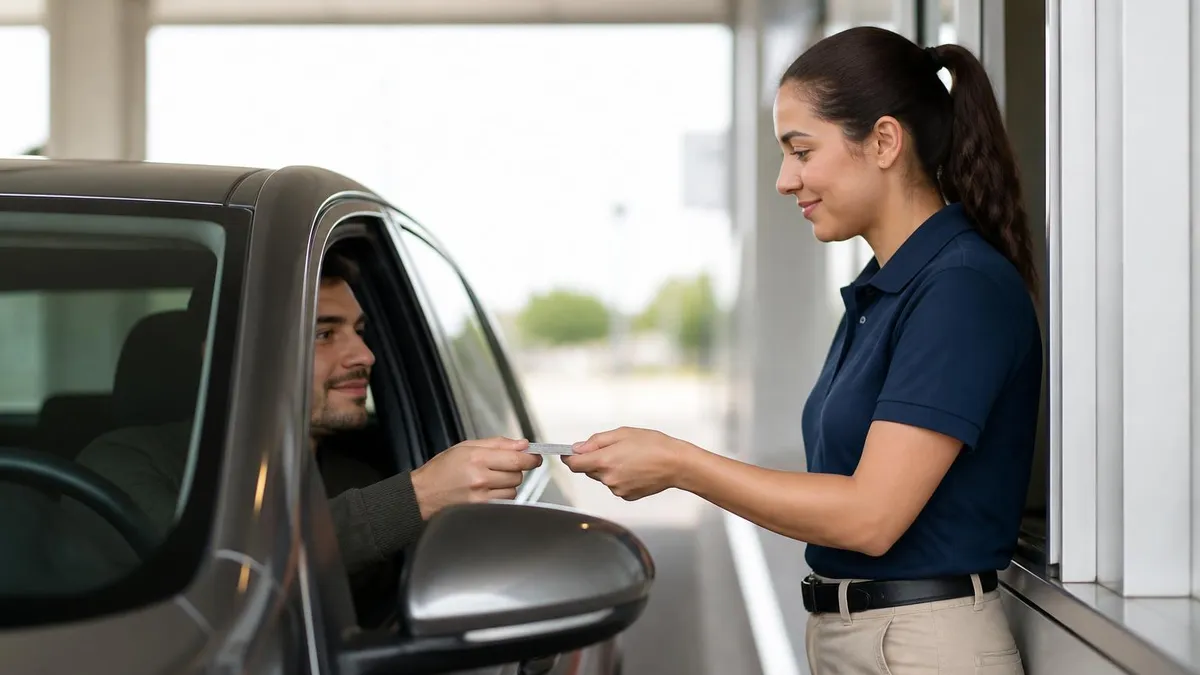
Should You Take the Virginia Driving Test in a Driving School Car or Your Own Vehicle?
- +Driving school cars have dual brake pedals for examiner safety, which some examiners appreciate
- +School vehicles are inspected daily and unlikely to have equipment issues that disqualify you
- +Driving instructors often have relationships with local examiners and know the test routes
- +The vehicle is sized appropriately for the maneuvers and is easy to control
- +Insurance and registration paperwork is handled by the school, removing administrative stress
- +You can take a final practice drive with your instructor immediately before the test
- −Rental fees for driving school cars typically run $75 to $150 for the test appointment
- −You may be less familiar with the controls than in your family vehicle
- −Scheduling must align with school availability, which limits flexibility
- −Some school cars are older and have quirks that surprise nervous test-takers
- −Using a personal vehicle lets you practice in the exact car you will drive after licensure
- −Driving schools may pressure you to take additional lessons before approving test day use
Pros and Cons at a Glance
| Pros | Cons |
|---|---|
| Driving school cars have dual brake pedals for examiner safety, which some examiners appreciate | You may be less familiar with the controls than in your family vehicle |
| School vehicles are inspected daily and unlikely to have equipment issues that disqualify you | Scheduling must align with school availability, which limits flexibility |
| Driving instructors often have relationships with local examiners and know the test routes | Some school cars are older and have quirks that surprise nervous test-takers |
| The vehicle is sized appropriately for the maneuvers and is easy to control | Using a personal vehicle lets you practice in the exact car you will drive after licensure |
| Insurance and registration paperwork is handled by the school, removing administrative stress | Driving schools may pressure you to take additional lessons before approving test day use |
Day-of-Test Checklist for the Virginia DMV Driving Test
- ✓Confirm your appointment time and service center location the evening before
- ✓Bring your valid Virginia learner's permit and a second form of identification
- ✓Bring the signed parent or guardian certification of supervised driving hours
- ✓Ensure the test vehicle has current registration and proof of insurance
- ✓Verify all exterior lights, turn signals, and brake lights are functioning
- ✓Check that the horn, windshield wipers, and defroster all work properly
- ✓Confirm both front seatbelts engage smoothly and the dashboard warning lights are off
- ✓Adjust mirrors, seat, and steering wheel to your preferred positions before the examiner enters
- ✓Arrive at least twenty minutes early to complete check-in without rushing
- ✓Bring your eyeglasses or contacts if your permit specifies a corrective lens restriction

Examiners begin scoring before you start the engine
Many applicants do not realize that the moment the examiner approaches your vehicle, observation begins. They check whether your windshield is clear, whether your seatbelt clicks audibly, and whether you adjust your mirrors before shifting into drive. Treating the pre-drive sequence with the same focus as the road portion can earn you early credibility that carries through the entire exam.
Understanding why applicants fail the virginia dmv driving test is just as important as understanding how to pass it. Virginia DMV data consistently shows that roughly forty percent of first-time test takers fail, and the failure reasons cluster into a surprisingly small number of categories. By studying these patterns, you can build a mental checklist that flags risky moments before they cost you points. The most common single failure cause is rolling stops at stop signs and red lights, which examiners classify as a critical error resulting in automatic failure.
Improper lane changes rank second on the failure list. Many applicants signal too late, fail to check blind spots, or drift out of their lane during the change. Examiners are trained to watch for the head turn that indicates a real blind spot check versus a quick glance at the mirror, and they will deduct points if the head movement is not visible. Practicing exaggerated, deliberate head turns during your supervised driving sessions builds the habit that earns full credit on test day.
Speed management causes more failures than most applicants expect. Driving too slowly is just as problematic as speeding, because it suggests you lack confidence in traffic flow and creates hazards for vehicles behind you. The general rule is to drive within five miles per hour of the posted limit when conditions allow, slowing only for traffic, weather, or specific hazards. Examiners record both excessive caution and excessive aggression as scoring deductions, and consistent moderation is what they are looking for.
Failing to yield right of way appears repeatedly in failure reports. At four-way stops, uncontrolled intersections, and merge ramps, applicants who hesitate too long or assert themselves at the wrong moment confuse other drivers and demonstrate poor situational reading. The correct behavior is to make eye contact when possible, follow the standard right-of-way rules, and proceed with confidence once you have the legal right. Hesitation reads as uncertainty, and examiners deduct points for both indecision and aggression.
Parking maneuvers, particularly parallel parking and the three-point turn, account for a meaningful share of failures. Striking the curb, ending up too far from the curb, or requiring more than the allowed number of adjustment movements all result in scoring deductions. Some service centers no longer require parallel parking, substituting straight-line backing or a pull-in parking maneuver instead, but you should be prepared for any combination because policies vary by location and examiner discretion.
Finally, vehicle equipment failures cause a significant number of applicants to be turned away before the test even begins. A burned-out brake light, an expired registration sticker, a cracked windshield in the driver's line of sight, or non-functioning windshield wipers will all disqualify your vehicle. Spending fifteen minutes the night before your test walking around the car with a flashlight and confirming every system works is one of the highest-return investments you can make in your test outcome.
One subtle but important failure pattern involves following distance. Tailgating, even by a few feet, signals poor judgment to the examiner. The accepted Virginia standard is a three to four second gap from the vehicle ahead in normal conditions, extending to five or six seconds in rain. Counting the gap out loud during practice sessions builds the habit so reliably that you will instinctively maintain proper spacing on test day without conscious effort.
Certain actions result in immediate test termination regardless of how well you performed otherwise. These include any collision or near-collision, running a stop sign or red light, requiring intervention from the examiner, exceeding the speed limit by ten or more miles per hour, and refusing to follow an examiner's instruction. Knowing these triggers helps you stay alert during the moments when they are most likely.
Passing the virginia dmv driving test on your first attempt comes down to three elements: targeted practice, mental preparation, and procedural awareness. Targeted practice means working specifically on the maneuvers and scenarios the test covers rather than just accumulating general driving hours. If you have spent forty-five hours driving but never practiced parallel parking in a marked space, your test performance will reflect that gap. Spend the final two weeks before your appointment drilling each tested maneuver until it feels routine.
Mental preparation matters more than most applicants realize. Test anxiety causes experienced drivers to forget basic procedures, skip mirror checks, and second-guess maneuvers they have executed flawlessly hundreds of times. Building a pre-test routine that calms your nervous system, whether that is breathing exercises, a familiar playlist, or a light meal at a specific time, signals to your brain that test day is a controlled situation rather than a threat. Many successful test-takers report that visualization, mentally rehearsing the route and maneuvers in advance, reduces anxiety significantly.
Procedural awareness means understanding exactly what examiners record and how they record it. The scoring sheet contains discrete items, and your goal is to make every item visibly clear. Turn your head deliberately for blind spot checks, count to three at full stops before proceeding, and announce hazards quietly to yourself so your scanning becomes obvious to the examiner. This is not about performance theater but about ensuring that your good driving habits register on the scoring document.
Familiarity with the test route is a controversial but legal advantage. While examiners may vary the exact path, most service centers use a small number of standardized routes within a few miles of the building. Driving these routes with a supervising adult in the weeks before your test exposes you to the specific intersections, school zones, and merge points the examiner will use, and it removes the surprise factor on test day. This is widely practiced and entirely within the rules.
Communication with the examiner is another underappreciated factor. Polite acknowledgment of instructions, calm questions if you do not understand a direction, and a relaxed demeanor all contribute to a smoother test. Examiners are human beings making subjective judgments on borderline calls, and an applicant who appears confident and respectful tends to receive the benefit of the doubt on close decisions. This is not about charm; it is about projecting the kind of mature, alert driver the license represents.
If you live near a state border and are curious about how other DMV systems handle road tests, our guide on how do i speak to a dmv representative in ny covers New York's process and contrasts neatly with Virginia's approach. Understanding multiple systems can sharpen your appreciation for what each examiner prioritizes and what universal driving competencies translate across state lines.
Finally, accept that even well-prepared applicants sometimes fail. If your first attempt does not succeed, request the scoring sheet, identify the specific deductions, and target those exact areas in your fifteen-day waiting period. Most second-attempt applicants pass because they know precisely what to fix. Failure on the first try is not the disaster it feels like in the moment; it is feedback, and feedback responded to thoughtfully produces a stronger driver in the long run.
The final week before your virginia dmv driving test should follow a deliberate taper, much like an athlete prepares for competition. Heavy practice in the last forty-eight hours can actually hurt your performance by introducing fatigue and second-guessing. Instead, complete your most intensive practice sessions seven to ten days out, then shift to shorter, confidence-building drives in the final days. Aim for thirty to forty-five minutes of relaxed driving the day before, focusing on smooth execution rather than learning new skills.
Sleep matters enormously. Studies on cognitive performance show that even one night of reduced sleep degrades reaction time, hazard perception, and emotional regulation, all of which are central to the driving test. Plan to be in bed at your normal time the night before, avoid caffeine after early afternoon, and resist the temptation to mentally rehearse the test while trying to fall asleep. A rested brain processes the unexpected far more effectively than a tired one drilled with last-minute facts.
Nutrition on test day should mirror what works for you on a normal demanding day. Avoid heavy, greasy meals that can cause sluggishness, and skip large amounts of caffeine if you do not regularly consume it, because jitters will undermine your steering smoothness. A moderate breakfast of protein and complex carbohydrates ninety minutes before your appointment provides steady energy without spikes. Bring a water bottle for the wait, but use the restroom before check-in so physical discomfort does not distract you during the road portion.
The drive to the service center deserves its own consideration. Plan to arrive at least twenty minutes early, scout the parking lot, and take a few minutes to settle your nerves before walking inside. Some applicants find a short walk around the building helps shake off stiffness from the drive over. If a family member or instructor drove you, give yourself a quiet moment alone in the vehicle to mentally cue your routine before the examiner approaches.
During the test itself, narrate your scanning quietly to anchor your attention. Phrases like checking left mirror, checking blind spot, confirming clear, spoken just under your breath, force your eyes to actually complete the scan rather than glaze over it. Examiners notice the deliberate movement and the verbal anchoring, and they typically interpret it as a sign of conscientious driving rather than nervous chatter. The technique is widely used by driving instructors precisely because it works.
If you make a mistake during the test, do not let it cascade. One missed mirror check is a minor deduction that you can recover from across the rest of the route. Dwelling on the error, however, often leads to a string of subsequent mistakes as your attention narrows on the past instead of the present road. Acknowledge it internally, recommit to your routine, and execute the next maneuver with full focus. Examiners reward composure and self-correction.
When the test ends, the examiner will either pass you on the spot and walk you back inside for photo and license issuance, or they will explain the reason for failure and provide the scoring sheet. Either way, thank them for their time and ask any clarifying questions while the experience is fresh. If you passed, congratulations, you have joined the ranks of licensed Virginia drivers. If you did not, treat the next fifteen days as targeted preparation, and let the second attempt close the gap that the first attempt revealed.
Sample DMV - Representative Exam Practice Questions
Try these questions from our free DMV - Representative Exam practice tests. The correct answer and an explanation follow each question.
From a handbook: 'A solid yellow center line means passing is prohibited for traffic on that side of the line. A broken yellow line means passing is permitted when safe to do so.' A driver sees a solid yellow line on their side of the road. They may:
- A. Pass only if the road ahead appears clear
- B. Pass only in a designated passing zone
- C. Not pass; the solid line on their side prohibits it
- D. Pass at speeds under 35 mph
Answer: C. Not pass; the solid line on their side prohibits it
A solid yellow line on your side of the road means you are prohibited from passing regardless of conditions.
Road sign text: 'WEIGHT LIMIT 10 TONS.' A truck weighing 22,000 pounds approaches this bridge. May the truck cross?
- A. Yes, because 22,000 pounds equals 11 tons, which is close enough
- B. No, because 22,000 pounds equals 11 tons, which exceeds 10 tons
- C. Yes, if the truck travels slowly
- D. No, only vehicles under 5 tons may cross
Answer: B. No, because 22,000 pounds equals 11 tons, which exceeds 10 tons
22,000 pounds equals 11 tons, which exceeds the posted 10-ton weight limit, so the truck may not cross.
When must headlights be used in addition to during nighttime driving?
- A. Only when visibility drops below 500 feet due to weather
- B. Whenever windshield wipers are in use, in most states
- C. Only in tunnels longer than 300 feet
- D. Headlights are optional during daylight regardless of conditions
Answer: B. Whenever windshield wipers are in use, in most states
Many US states require headlights whenever windshield wipers are actively in use, not just at night.
When driving in fog, a driver should use:
- A. High-beam headlights to see farther
- B. Low-beam headlights or fog lights
- C. Hazard flashers as the only lighting
- D. No lights to avoid glare reflection
Answer: B. Low-beam headlights or fog lights
Low-beam headlights or dedicated fog lights cut through fog better because high beams reflect off moisture particles and reduce visibility.
DMV Questions and Answers



About the Author
Licensed Driving Instructor & DMV Test Specialist
Penn State UniversityRobert J. Williams graduated from Penn State University with a degree in Transportation Management and has spent 20 years as a certified driving instructor and DMV examiner consultant. He has personally coached thousands of applicants through written knowledge tests, skills assessments, and commercial driver licensing programs across more than 30 states.
Join the Discussion
Connect with other students preparing for this exam. Share tips, ask questions, and get advice from people who have been there.
View discussion (8 replies)