
DMV Eye Exam: What to Expect and How DMV Customer Service Representatives Can Help
🏆 Learn what the eye exam at the DMV involves, vision standards by state, and how a DMV customer service representative can guide you through the process.

The eye exam at the DMV is one of the most misunderstood steps in the driver licensing process. Millions of Americans visit their state DMV each year expecting a complex medical evaluation, only to discover that the test is a straightforward visual acuity screening — typically completed in under two minutes at the front counter.
Understanding exactly what this screening involves, what the minimum standards are, and what happens if you fall short can save you a wasted trip and a great deal of anxiety. A DMV customer service representative is the first person you will speak with during your visit, and they play a central role in explaining the process before it begins.
Most states require a minimum visual acuity of 20/40 in at least one eye, with or without corrective lenses, before a standard driver's license can be issued. Some states set the threshold at 20/50 or allow restricted licenses at 20/70. The specific numbers matter because failing to meet them will trigger a referral to a licensed optometrist or ophthalmologist, which delays your licensing timeline. Knowing your state's standard in advance — information a DMV representative can provide over the phone or in person — prevents surprises on the day of your appointment.
The screening device most commonly used is a Snellen eye chart or a proprietary vision tester machine that projects letters, numbers, or symbols at a standardized distance. You will be asked to read lines on the chart from roughly 20 feet away, or to look into a lighted machine and identify characters. If you wear glasses or contact lenses, you are expected to wear them during the test, and the restriction will be printed on your license. The entire process is observational and takes only moments — there are no drops, no bright lights, and no instruments touching your eyes.
Beyond basic acuity, many states also screen for peripheral vision during the same visit. Peripheral vision, sometimes called side vision, is critical for detecting pedestrians, cyclists, and merging vehicles without turning your head. The minimum horizontal field of vision required in most states is 140 degrees, though some states accept 120 degrees for a restricted license. A DMV customer service representative will tell you whether your state tests peripheral vision as part of the standard screening or requires a separate specialist evaluation for drivers flagged during the acuity test.
Color vision deficiency, commonly called color blindness, is generally not tested at the DMV and is not a disqualifying condition for a standard driver's license in any US state. Traffic signals are designed with position cues (red on top, green on bottom) specifically to accommodate drivers with color vision differences. This is a common source of concern that a DMV representative can quickly put to rest. If you have been worried about a color vision issue preventing you from getting licensed, that concern is almost certainly unfounded under current state law.
If you do not pass the initial screening, the representative will provide a vision referral form — sometimes called a Report of Vision Examination — that you take to your eye doctor. Your doctor completes the form, and you return it to the DMV along with any updated prescription information.
Many states allow you to submit this form by mail or through an online portal so you do not need to make a second in-person visit. The dmv eye exam and road sign recognition are both components of the broader licensing evaluation, and a representative can walk you through how they connect.
Understanding the full context of why vision standards exist helps applicants take them seriously without dreading them. Traffic safety research consistently shows that drivers with uncorrected vision impairment are significantly more likely to be involved in crashes, particularly at night and in adverse weather.
States update their vision standards periodically based on highway safety data, and the representatives who administer the screening receive ongoing training to apply those standards consistently and compassionately. Preparing for the eye exam at the DMV is less about studying and more about knowing your own vision health and arriving with the right corrective lenses if you use them.
DMV Eye Exam by the Numbers
How the DMV Eye Exam Process Works Step by Step
Check Your State's Vision Standard
Arrive with Corrective Lenses If Needed
Check In with the DMV Customer Service Representative
Complete the Vision Screening
Receive Referral or Proceed to Licensing
The mechanics of the DMV vision screening are simple, but knowing them in detail removes unnecessary anxiety and helps you perform your best. Most DMV offices use one of two tools: a wall-mounted Snellen chart — the familiar letter chart with the big E at the top — or an automated vision tester machine made by companies like Keystone, Titmus, or Optec. The machine version is more common in busy urban offices because it standardizes the testing distance and lighting conditions automatically, reducing examiner error and speeding up the line.
When you step up to an automated vision tester, you look into a set of eyepiece lenses and see a projected image of letters, numbers, or random symbols at a simulated distance of 20 feet. The examiner will ask you to read the smallest line you can see clearly. If you squint, hesitate, or misread three or more characters on the minimum-pass line, the examiner records a fail for that eye. Both eyes are tested separately and then together. The whole sequence takes about 90 seconds for a practiced examiner.
Peripheral vision testing, where required, usually happens in the same machine with a secondary test mode. You will be asked to focus on a central point while indicating when you see a light appear in your peripheral field. This is a screening tool, not a clinical diagnosis — if you fail, you are referred to a specialist who will conduct a proper visual field test using more precise equipment. The DMV screening simply flags drivers who may have a peripheral deficit that warrants clinical follow-up.
One important nuance: the vision screening at the DMV is not conducted by a licensed medical professional. The DMV customer service representative or examiner administering the test has been trained to operate the equipment and record results, but they are not optometrists. This means they cannot diagnose vision conditions, recommend corrective lenses, or give medical advice.
Their role is to record whether you meet the state's minimum standard on that specific day with that specific equipment. If you disagree with a result, you have the right to request a retest or submit a form completed by your own licensed eye care provider.
Lighting conditions in the DMV office can subtly affect screening results. Fluorescent overhead lighting, reflections on the machine eyepieces, and fatigue from waiting in line can all slightly reduce your measured acuity compared to a relaxed clinical setting. If you know your vision is borderline — say, corrected to exactly 20/40 — consider scheduling your DMV appointment earlier in the day when your eyes are fresh and before screen fatigue sets in. Taking breaks from your phone or computer screen for an hour before your appointment is a practical, evidence-backed way to perform at your best.
Drivers renewing a license who have previously held a corrective lens restriction will be rescreened at renewal in most states. If your vision has improved — for example, after LASIK surgery — you can present documentation from your eye doctor at the renewal visit and request that the restriction be removed. The DMV representative will update your record if the screening confirms you now meet the standard without lenses. Conversely, if your vision has declined, a new restriction will be added. This ongoing process is how states keep their licensed driver pool matched to current vision health data.
Commercial driver's license (CDL) applicants face stricter vision standards than standard license holders. Federal Motor Carrier Safety Administration regulations require CDL holders to have at least 20/40 acuity in each eye separately and together, a horizontal field of at least 70 degrees in each eye, and the ability to distinguish colors in traffic signals.
These standards apply even with corrective lenses, and a vision waiver program exists for drivers who do not fully meet the standards but have a long safe driving record. A DMV representative handling CDL applications will direct you to the federal waiver program if your screening reveals a potential issue.
How to Speak to a DMV Representative About Your Eye Exam
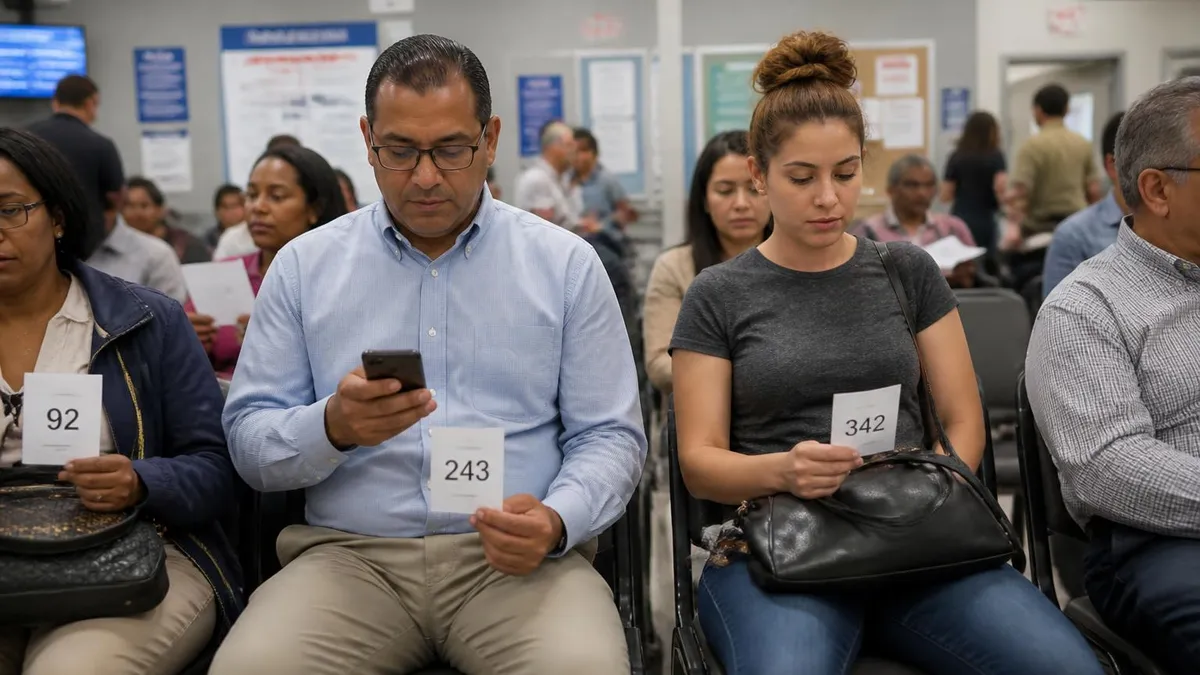
Visiting your local DMV office in person is the most direct way to speak with a DMV customer service representative about vision requirements. When you arrive, take a number or check in at the information desk and explain that you have questions about the eye exam process before your appointment. Representatives at the front counter handle hundreds of vision-related questions every week and can tell you exactly which chart or machine your office uses, what the pass threshold is, and whether your state requires peripheral testing.
If you have a specific vision condition — such as monocular vision, a recent eye surgery, or a peripheral deficit diagnosis — bring your eye doctor's documentation to the in-person visit. A representative can review the paperwork, note it in your file, and connect you with a supervisor if a non-standard accommodation is needed. In-person visits also allow you to complete the screening immediately, so bring your corrective lenses and any required identity documents to make the most of the trip.
Corrective Lens Restriction: Pros and Cons for Licensed Drivers
- +Allows drivers who need vision correction to remain fully licensed and mobile
- +Restriction is automatically noted on your license, informing law enforcement of the requirement
- +Restriction can be removed at any renewal if vision improves (e.g., after LASIK)
- +Corrective lens technology continues to improve, making compliance easy and comfortable
- +Majority of licensed US drivers carry a corrective lens restriction without any lifestyle limitation
- +Insurance rates are not affected by a corrective lens restriction on a driver's license
- −Driving without lenses when the restriction is on your license is a traffic violation in all states
- −Contact lens wearers must carry backup glasses in case a lens falls out while driving
- −Restriction applies 24/7 — including short, familiar trips that feel low-risk without lenses
- −Some commercial driving programs have stricter requirements that a restriction may complicate
- −Losing or breaking glasses creates an immediate legal compliance issue until replacement
- −Drivers must remember to update their prescription before it expires to stay safely corrected
Day-of DMV Eye Exam Checklist
- ✓Confirm your state's minimum visual acuity standard (20/40 is most common) before leaving home.
- ✓Bring your current prescription glasses or contact lenses if you use them for distance vision.
- ✓Pack a backup pair of glasses if you normally wear contact lenses.
- ✓Take a break from screens for at least 30-60 minutes before your appointment.
- ✓Bring your eye doctor's documentation if you have a diagnosed vision condition or recent surgery.
- ✓Arrive with all required identity and residency documents so the vision screen is your only concern.
- ✓Ask the DMV customer service representative to explain the testing device before you begin.
- ✓Request a retest immediately if you believe poor lighting or fatigue affected your initial result.
- ✓Pick up a vision referral form at the counter if you are close to the pass threshold and want a backup.
- ✓Confirm whether your state accepts mailed or online referral form submission to avoid a second trip.
Your Eye Doctor's Form Can Override a DMV Fail
If you fail the DMV's vision screening but believe you meet the state standard with your current correction, you have the right to submit a completed vision examination form from a licensed optometrist or ophthalmologist. Most states will issue your license based on the doctor's professional finding, even if the DMV machine produced a borderline result. Ask the representative for the correct form number before you leave the office.
Failing the DMV vision screening is more common than most applicants expect, and it does not mean you cannot get a license. It means the screening device recorded a result below the state's pass threshold on that specific visit. The most frequent reasons for a fail are forgotten or incorrect prescription lenses, eye fatigue from screen use before the appointment, unfamiliarity with the testing machine, and genuine vision decline that has not yet been evaluated by an eye care provider. Each of these causes has a clear, actionable solution.
When a fail is recorded, the DMV customer service representative will immediately provide a vision referral form — the official document you take to your licensed eye doctor. The form asks your doctor to record your corrected and uncorrected visual acuity in each eye, your horizontal visual field measurement, and whether any conditions exist that may affect safe driving. The doctor signs and seals the form, and you return it to the DMV. In most states, this form is valid for 90 days from the date of the doctor's examination.
The referral process does not restart your entire license application. Your other documents remain on file, and once the vision referral is accepted, the DMV issues your license — with a corrective lens restriction if your passing acuity was achieved with glasses or contacts. In states with online document submission portals, you can upload the completed form the same day you visit your doctor, and your license can be printed and mailed within a few business days without another in-person visit.
For drivers who have experienced a medical event affecting vision — such as a stroke, traumatic brain injury, or diabetic retinopathy — the referral process is more detailed. Some states require a Medical Review Program evaluation in addition to the standard vision form, and a DMV representative will explain whether that applies to your situation. The Medical Review Program exists to ensure that drivers with complex medical histories receive individualized assessment rather than being denied a license based solely on a screening device result.
Age-related vision changes are the most common reason existing license holders fail their renewal vision screening. Adults over 65 experience measurable changes in contrast sensitivity, night vision, and glare recovery even when their Snellen acuity remains at 20/40. Some states have responded by requiring more frequent vision re-testing for older drivers — every two to four years rather than the standard eight-year cycle. If you are approaching renewal and have not had an eye exam in the past two years, scheduling one before your DMV appointment is the single best preparation step available.
Vision conditions that do not cause outright failure may still result in a restricted license. A restriction might limit driving to daylight hours only, prohibit freeway driving, or require an outside rearview mirror on both sides of the vehicle if peripheral vision in one eye is limited.
These restrictions are not permanent — they can be lifted at your next renewal if your vision has improved or if you submit new documentation from your eye care provider showing that your condition has stabilized or resolved. A DMV representative can explain exactly which restrictions apply to your result and how to pursue removal at a future visit.
Driving with a known vision impairment that does not meet your state's minimum standard is a serious safety and legal matter. If you are involved in a crash and it is discovered that your uncorrected vision fell below the state minimum, your insurance coverage may be affected and you may face additional liability.
The DMV's vision standard is not a bureaucratic hurdle — it is a safety threshold backed by decades of crash data. Taking it seriously, addressing any deficits promptly, and working with both your eye doctor and a knowledgeable DMV representative is the path to a license that is both legal and safe.
If the DMV records a fail on your vision screening, your license application is not yet approved — and in some states, driving with vision below the minimum standard is a violation even if your previous license is technically still valid. Arrange a ride to your eye care appointment after a DMV fail, or confirm your current license status with the representative before leaving the office.
Preparing for the eye exam at the DMV does not require weeks of study, but it does require self-awareness about your vision health and a few practical steps in the days leading up to your appointment. The most important preparation step is simply scheduling an eye exam with your optometrist or ophthalmologist if you have not had one in the past year, particularly if you are over 40 or have a family history of glaucoma, macular degeneration, or diabetic eye disease. A current prescription and a clean bill of eye health eliminates virtually all risk of failing the DMV screening.
If you wear contact lenses, confirm that your current lenses are the correct prescription for distance vision and that they are comfortable enough to wear for the duration of your DMV visit. Many contact lens wearers switch to glasses for DMV appointments simply because the familiar fit of glasses reduces the chance of a lens-related issue during testing. Either option is perfectly acceptable — the DMV does not prefer one type of correction over the other, and both produce equivalent screening results when the prescription is current.
Hydration and sleep quality in the 24 hours before your appointment have a measurable effect on visual acuity. Dehydrated eyes produce fewer tears, leading to intermittent blurring and reduced contrast sensitivity. Getting seven to eight hours of sleep before your DMV visit is a simple, free way to ensure your eyes are performing at their baseline. If you use over-the-counter eye drops for dryness, bring them to the appointment and apply them in the parking lot — the temporary clarity boost from lubricating drops is fully legal and routinely used by optometry patients before vision screenings.
On the subject of contact lens users: if you wear extended-wear lenses that you sleep in, remove and replace them the morning of your DMV appointment if at all possible. Overnight wear accumulates protein deposits and reduces oxygen permeability, both of which can mildly reduce your measured visual acuity compared to fresh lenses. This is a small but real effect that matters when your corrected vision is close to the 20/40 threshold.
Knowing how to contact your state's DMV in advance also reduces day-of stress. Most states publish a customer service phone number, and some — like New York — have a dedicated representative line for driver licensing questions separate from vehicle registration. Calling ahead to confirm which vision testing device your local office uses, whether appointments are required for the vision portion, and whether walk-in renewals are available for vision-only re-tests can save significant time. The knowledge that a DMV representative is available to answer these questions before you arrive is itself a form of preparation.
If you are helping a family member — a teenager getting their first license or an elderly parent renewing — the preparation steps are the same, but communication is even more important. Teenagers may not know their own vision status if they have never had a formal eye exam.
Parents should schedule a pediatric or general eye exam before the DMV visit, especially if the teen frequently sits close to screens or complains of headaches after reading. For older adults, the conversation about vision decline and driving safety is sensitive but important, and a DMV representative is trained to handle these interactions with dignity and clarity.
Finally, remember that the DMV vision screening is a gateway, not a judgment. Its purpose is to confirm that every licensed driver on public roads meets a baseline visual capability for safe vehicle operation. Passing it means you are cleared to drive. Not passing it means you have information about your vision that you can act on.
Either outcome moves you forward. Working with a knowledgeable DMV customer service representative who understands the full process — from screening to referral to license issuance — makes every step easier and faster, whether you are getting your first license or renewing after decades behind the wheel.
Practical preparation tips for the DMV visit extend well beyond the vision component. Arriving early — at least 15 minutes before a scheduled appointment or well before the office opens for walk-in service — gives you time to organize your documents, calm any nerves, and review what you know about the process before stepping up to the counter. DMV offices process dozens or hundreds of applicants per hour, and the representatives work best when applicants arrive organized and informed.
Bring every document you might need in a single folder: your current license or ID (if renewing), proof of identity such as a birth certificate or passport, proof of residence such as a utility bill, your Social Security card or proof of Social Security number, and any eye doctor documentation if relevant. Having these items accessible without digging through a bag speeds up the entire transaction and reduces the chance that a missing document sends you home before the vision screening even begins.
If English is not your primary language, contact your local DMV in advance to ask about interpreter services. Many states offer in-person interpretation for the licensing process, and some provide translated versions of the vision screening instructions. A DMV customer service representative who speaks your language — or who can access an interpreter — can explain the vision test instructions in a way that eliminates any ambiguity about what you are being asked to do, reducing the chance of a miscommunication causing a failed result.
For drivers who have recently undergone LASIK, PRK, or another refractive surgery, the timing of the DMV visit matters. Most surgeons recommend waiting at least three months after surgery before attempting a formal vision test, as visual acuity continues to stabilize during the healing process. Some patients experience minor fluctuation in acuity during the first several months post-surgery. Waiting until your surgeon confirms your vision has fully stabilized — and ideally bringing a post-operative report from your surgeon to the DMV — is the safest approach for a smooth vision screening experience.
Drivers managing diabetes should pay particular attention to their blood glucose levels on the day of a DMV vision screening. Significant blood glucose elevation or hypoglycemia can temporarily affect visual acuity and color perception. If your glucose is outside your normal range on the morning of your appointment, it is worth rescheduling. This is not a permanent barrier to licensing — it is simply a practical step to ensure the screening reflects your actual corrected vision rather than a temporary metabolic fluctuation.
The DMV representative exam, which tests applicants for positions as DMV customer service representatives, covers a wide range of topics beyond vision screening — including consumer protection regulations, vehicle inspection standards, dispute resolution procedures, and data privacy protocols. If you are preparing for the representative exam rather than a driver's license screening, the practice quizzes linked throughout this article are specifically designed to help you master those topic areas. Representative candidates should plan to review motor vehicle laws, administrative procedures, and customer service protocols systematically over several weeks.
Ultimately, whether you are a first-time license applicant, a renewal driver, or a prospective DMV customer service representative, the key to success at the DMV is preparation and accurate information. The vision exam at the DMV is one small component of a well-designed licensing system meant to keep roads safe for everyone. Know your state's standards, arrive with your current correction, and do not hesitate to ask the representative at the counter any question you have. They are there to help you succeed — and that is exactly what most applicants do.
DMV Questions and Answers
DMV Road Sign Test: Complete Guide to Passing on Your First Try in 2026
DMV Written Test Cheat Sheet: The Complete 2026 Study Guide for First-Time Passers

DMV License Plate Renewal: Complete Guide to Renewing Your Tabs, Stickers and Registration (2026)

DMV Customer Service Representative: Career, Exam & DC DMV Inspection Guide 2026
DMV Customer Service Representative: How to Reach a DMV Representative and Pass Your License Test
About the Author
Licensed Driving Instructor & DMV Test Specialist
Penn State UniversityRobert J. Williams graduated from Penn State University with a degree in Transportation Management and has spent 20 years as a certified driving instructor and DMV examiner consultant. He has personally coached thousands of applicants through written knowledge tests, skills assessments, and commercial driver licensing programs across more than 30 states.
Join the Discussion
Connect with other students preparing for this exam. Share tips, ask questions, and get advice from people who have been there.
View discussion (8 replies)