
What Happens If You Fail the DMV Vision Test: Complete Guide for 2026 September
What happens if you fail the DMV vision test? 🎯 Learn retake rules, corrective lens options, and how reps handle vision failures.
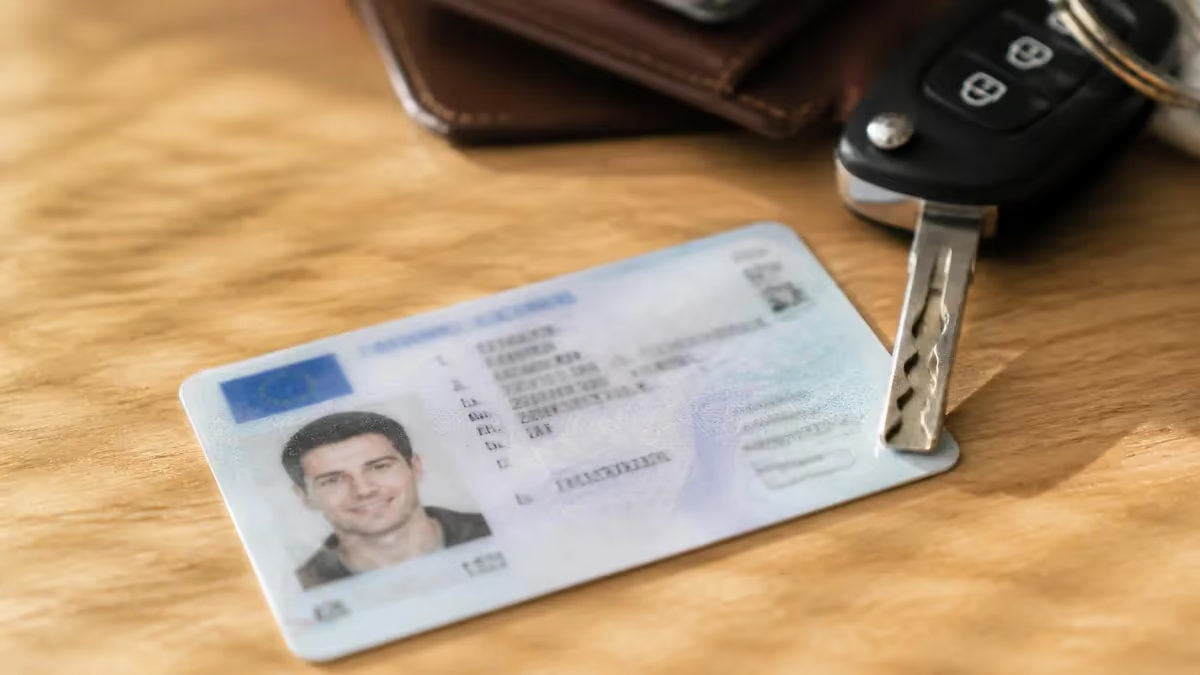
Understanding what happens if you fail the DMV vision test is essential for every driver — and for every DMV customer service representative who guides applicants through the licensing process every single day. The vision test is one of the very first hurdles a new or renewing driver faces at the DMV counter, and failing it can feel overwhelming. However, knowing exactly what the process looks like, what your options are, and how to move forward can make all the difference. A DMV representative plays a critical role in explaining these next steps clearly and compassionately.
When an applicant fails the vision screening at the DMV, the immediate response from the DMV customer service representative on duty is to explain what the failure means and what options are available. In most states, failing the vision test does not automatically disqualify you from getting or renewing your license — it simply means you need to take additional steps to demonstrate that your vision meets the minimum legal standard for safe driving. Representatives are trained to handle these situations with empathy and accuracy, providing applicants with the correct forms and referral instructions.
The standard vision requirement for driving in the United States is a visual acuity of at least 20/40 in at least one eye, with or without corrective lenses. Some states set the threshold at 20/50 or 20/70, but 20/40 is the most common benchmark. If your uncorrected vision falls below this threshold, you may still qualify for a license with corrective lenses — glasses or contact lenses — as long as you meet the minimum standard while wearing them. The DMV representative will note a corrective lens restriction on your license in this case.
The role of a DMV representative in vision test failures extends well beyond handing over a form. Representatives must accurately explain state-specific rules about retesting timelines, ophthalmologist referral requirements, and what documentation needs to be submitted before a retest is allowed. In many states, the applicant is given a vision examination report form to take to a licensed eye care professional, who then certifies the applicant's corrected or uncorrected visual acuity and returns the completed form to the DMV.
It is worth noting that the DMV vision screening is not the same as a comprehensive eye exam. The DMV uses a basic acuity chart — often a Snellen chart or an electronic equivalent — to check that you can see well enough to drive safely. This screening catches obvious vision problems but is not designed to diagnose underlying eye conditions. If your vision has changed significantly since your last visit to an eye doctor, the DMV vision test failure could actually be an important wake-up call to seek professional eye care sooner rather than later.
For applicants who are caught off guard by a dmv vision test failure, the most important thing a DMV customer service representative can do is provide clear, step-by-step guidance on what to do next. This means explaining the retake window, whether a fee is required for retesting, whether the applicant can return the same day with proof of corrective lenses, and what happens to any other testing — like the written knowledge test — that the applicant may have already passed. Keeping applicants informed prevents unnecessary confusion and repeat visits.
This guide covers every aspect of failing a DMV vision test, from the immediate next steps at the counter to long-term options for drivers with chronic vision impairments. Whether you are preparing for a career as a DMV representative, studying for the DMV representative exam, or simply trying to understand your rights and options as a driver, this resource will walk you through everything you need to know about vision test failures and how they are handled across the United States.
DMV Vision Test Failure by the Numbers
Immediate Steps After Failing the DMV Vision Test
Receive Explanation from DMV Representative
Collect the Vision Examination Report Form
Schedule an Eye Care Appointment
Obtain Corrective Lenses if Prescribed
Return to the DMV for Retesting
Receive License with Corrective Lens Restriction
Corrective lenses are by far the most common solution for drivers who fail the initial DMV vision screening. If your uncorrected vision falls below the state threshold but your corrected vision meets or exceeds 20/40, you are entitled to receive a driver's license with a corrective lens restriction. A DMV customer service representative will mark this restriction on your license record, and it becomes a legal requirement that you wear glasses or contact lenses every time you operate a motor vehicle. Violating this restriction can result in traffic citations or license suspension.
The retesting process after obtaining corrective lenses is straightforward in most states. You do not necessarily need to schedule a new appointment — many DMV offices allow walk-in retesting for vision screenings specifically, since the test takes only a few minutes to administer. However, policies vary by state and by individual DMV branch, so it is always wise to call ahead or check the state DMV's official website before making the return trip. Some busy urban DMV offices require appointments even for retests, while rural branches may accommodate walk-ins more easily.
If you already wear glasses or contact lenses and still fail the vision test, the situation is more complex. This may indicate that your current prescription is outdated or that your vision has deteriorated beyond what your existing lenses can correct. In this case, the DMV representative will still provide you with the vision examination report form, and you will need to see your eye care professional to obtain an updated prescription and new corrective lenses. Once your new lenses bring you to the required threshold, you can return for retesting.
Some applicants have underlying eye conditions — such as macular degeneration, glaucoma, cataracts, or diabetic retinopathy — that may make it difficult or impossible to achieve 20/40 corrected vision in either eye. In these situations, the DMV representative may inform you about specialized licensing programs that exist in certain states. For example, some states allow drivers with certain visual impairments to obtain a restricted license that limits driving to daylight hours only, low-speed roads, or a specific geographic radius. These accommodations are determined on a case-by-case basis by the state DMV medical review board, not at the counter level.
Peripheral vision is another factor that can cause a vision test failure even when central acuity is adequate. Standard DMV vision screenings typically check for a minimum peripheral field of 70 degrees in at least one eye, though this threshold varies by state. Drivers with conditions like retinitis pigmentosa or advanced glaucoma may have severely reduced peripheral vision even when their central acuity appears normal. A DMV representative is not expected to diagnose these conditions, but they should be familiar enough with the screening categories to explain what aspect of vision caused the failure.
For drivers who are close to the passing threshold — for example, 20/50 when the requirement is 20/40 — it is worth asking the DMV representative whether a retest is possible on the same day. Vision can fluctuate slightly due to fatigue, lighting conditions, or temporary eye strain. Some DMV offices allow a same-day retest, while others require you to wait until the next business day. Understanding this policy can save you an additional trip, especially if you believe the initial reading was not fully representative of your actual vision capability.
The practical advice for anyone who suspects they may have vision issues before going to the DMV is simple: see an eye care professional first. Scheduling an eye exam before your DMV appointment costs far less time and stress than failing the screening at the counter and having to make multiple return trips. Many optometry chains offer same-day or next-day appointments, and if a new prescription is needed, many can provide temporary eyeglasses within 24 to 48 hours. Proactive vision care is the single most effective strategy for passing the DMV vision screening on your first attempt.
How the DMV Representative Handles Vision Test Failures
For first-time license applicants who fail the vision test, the DMV customer service representative must explain that the knowledge test and driving test results are typically held on file while the vision issue is resolved. Most states allow a grace period of 30 to 90 days for applicants to provide acceptable vision documentation before the application expires. The representative collects the applicant's paperwork, notes the vision failure in the system, and issues the vision examination report form to be completed by a licensed eye care professional.
New applicants are often surprised to learn that a vision test failure does not mean starting the entire application process over from scratch. As long as the vision report is submitted within the state-mandated window, the applicant can return with corrective lenses or certification from an eye doctor and complete the vision screening without losing credit for other tests already passed. The representative should clearly communicate this timeline and any fees associated with the retest so the applicant knows exactly what to expect on their return visit.
Pros and Cons of Getting a Corrective Lens Restriction on Your License
- +Allows you to legally drive even if your uncorrected vision falls below the state threshold
- +Wide variety of corrective lens options — glasses, contacts, or progressive lenses — gives you flexibility
- +Most eye conditions causing DMV failures are fully correctable with modern lens technology
- +Corrective lens restriction does not affect your insurance rates in most states
- +Getting the restriction is quick — often resolved in a single return visit to the DMV
- +Wearing corrective lenses can significantly improve overall driving safety beyond just the legal minimum
- −You are legally required to wear lenses every time you drive — forgetting them is a traffic violation
- −Lost or broken glasses while traveling can legally prevent you from driving until replaced
- −Contact lens wearers must carry backup glasses in case lenses are lost or cause irritation
- −Some employers or positions (e.g., certain law enforcement roles) may treat vision restrictions differently
- −Corrective lenses require ongoing costs — prescription updates, new glasses, or contact lens supplies
- −If your vision deteriorates further, you may fail future DMV screenings even while wearing your current lenses
DMV Vision Test Failure Checklist: What to Do Next
- ✓Collect the vision examination report form from the DMV representative before leaving the office.
- ✓Ask the representative exactly how many days you have to resolve the vision issue and return.
- ✓Schedule an appointment with a licensed optometrist or ophthalmologist as soon as possible.
- ✓Bring the DMV vision report form to your eye care appointment so the doctor can complete it.
- ✓If a new prescription is issued, fill it immediately and allow time for glasses or contacts to arrive.
- ✓Confirm with the DMV whether you need an appointment for retesting or can walk in.
- ✓Bring the completed and signed vision report form to your retest appointment.
- ✓Wear your corrective lenses during the retest and keep your prescription documentation handy.
- ✓Ask the DMV representative to confirm the restriction code that will appear on your new license.
- ✓Keep a backup pair of glasses in your vehicle so you are never caught without corrective lenses while driving.
A Vision Test Failure Is Not the End of the Road
More than 80% of applicants who fail an initial DMV vision screening pass on their second attempt after obtaining corrective lenses or updating their prescription. The vast majority of vision test failures are caused by uncorrected refractive errors — nearsightedness, farsightedness, or astigmatism — that are easily addressed with glasses or contact lenses. Do not be discouraged by a first-time failure; treat it as a prompt to take care of your eye health and return to the DMV prepared.
The DMV customer service representative occupies a uniquely important position in the vision test failure process. Unlike online systems or automated kiosks, a human representative can assess the applicant's emotional state, explain complex state policies in plain language, and ensure that the applicant leaves the DMV with a clear action plan rather than confusion and frustration. This is why interpersonal communication skills are weighted so heavily in DMV representative training and in the representative certification exam itself.
When a DMV representative encounters an applicant who fails the vision test, the first priority is accuracy. The representative must correctly identify which aspect of the vision screening the applicant failed — central acuity, peripheral vision, or binocular function — and provide the correct corresponding documentation. Giving an applicant the wrong form, or failing to explain which type of eye specialist they need to see, can cause significant delays and may result in the applicant returning to the DMV multiple times without the correct paperwork.
A key responsibility of the DMV representative is also to remain current on state-specific policies regarding vision test exceptions and medical review processes. For example, some states have enacted laws allowing drivers with monocular vision — sight in only one eye — to obtain a standard driver's license with certain restrictions, while other states require a separate medical evaluation for monocular drivers. The representative needs to know the current policy in their state and refer applicants appropriately, rather than making assumptions based on outdated rules.
Training for DMV representatives typically includes modules on the Americans with Disabilities Act (ADA) as it relates to driver licensing. While the ADA does not require states to license drivers who cannot meet vision standards, it does require that the DMV provide reasonable accommodations in the testing and application process itself. For example, applicants with low vision who have valid restricted licenses in other states may need specific accommodations when relocating. The DMV representative must know when to escalate these situations to a supervisor or medical review officer rather than making independent determinations at the counter.
The DMV representative exam tests knowledge of these policies in detail. Questions about vision standards, corrective lens restrictions, and medical review procedures are common on the representative certification test, particularly in the consumer protection and applicant services domains. Candidates preparing for this exam should study their state's specific vision requirements, as well as the federal standards that apply to commercial drivers, and be familiar with the forms and procedures used when a vision test failure occurs.
Understanding how to speak to a DMV representative about a vision test failure is also important for applicants who feel they were incorrectly failed. If you believe the vision screening equipment was calibrated incorrectly, that you were tested under poor lighting conditions, or that the representative administered the test incorrectly, you have the right to request a retest.
In New York, for example, applicants who want to know how do I speak to a DMV representative in NY about a testing dispute can call the DMV Call Center or visit a different DMV office for a fresh screening. Representatives are trained to handle these concerns professionally and without bias.
Documentation and record-keeping are also critical parts of the DMV representative's role in vision test failures. Every failed vision screening must be properly logged in the state DMV system, along with the date of failure, which test was failed, and what documentation was provided to the applicant. This record is essential because it sets the clock on the grace period, tracks whether the applicant has returned, and ensures that the vision failure is associated with the correct license record. Accurate data entry prevents situations where a driver renews their license through a different channel without resolving an outstanding vision deficiency.

If your license has a corrective lens restriction and you drive without your glasses or contacts, you are technically operating a vehicle illegally — even if your vehicle is otherwise road-legal and you have a valid license. Traffic stops can result in citations for violating your license restriction, and repeated violations can trigger a review of your driving privilege. Always keep a spare pair of glasses in your glove compartment to avoid this situation entirely.
For drivers with progressive or chronic vision conditions, the question of long-term licensing options becomes more complex. Conditions such as macular degeneration, diabetic retinopathy, and advanced glaucoma can result in vision loss that worsens over time and may eventually fall below the minimum threshold even with the best available corrective lenses. In these cases, the DMV representative's role shifts toward providing information about the state's medical review process and guiding the driver toward the appropriate channels rather than attempting to resolve the issue at the counter level.
Most states have a Medical Review Board or Driver Safety Unit within the DMV that handles complex vision and medical cases. When a driver's condition is flagged — either through a failed vision screening or through a physician's report — the Medical Review Board can conduct an independent assessment of the driver's functional ability. In some cases, the board may authorize a restricted license that limits the driver to certain roads, speeds, daylight hours, or geographic areas. These restricted licenses allow drivers with impaired vision to maintain some independence while reducing the risk to other road users.
Bioptic telescopic lenses are another option that has gained regulatory acceptance in many states for drivers with low vision. These specialized glasses have small telescopic lenses mounted at the top of standard lenses, allowing the driver to briefly look through the telescope for distance viewing while using their normal (though low) vision for general awareness.
As of 2026, the majority of US states permit bioptic lens driving under specific conditions, and some state DMVs have developed dedicated testing protocols for bioptic drivers. A DMV representative should be aware that bioptic lens users may need to be directed to a specialized examination lane or to a state vision consultant rather than the standard screening setup.
For drivers who are ultimately unable to meet any licensing standard, the DMV representative's final responsibility is to connect them with information about alternative transportation resources. Many states have programs specifically designed to assist older adults and individuals with disabilities in accessing public transportation, ride-sharing services, and volunteer driver programs. While this is not a primary function of the DMV, a well-trained representative understands that their role is ultimately about serving the public — and sometimes serving the public means helping someone transition away from driving as safely and respectfully as possible.
State-by-state variation in vision standards can be a source of confusion for drivers who relocate. If you held a valid driver's license in one state with a vision restriction and then move to a new state with stricter standards, you may fail the new state's vision screening even though you were legally licensed before.
The DMV representative in the new state must apply their own state's standards, regardless of what another state permitted. This can be a difficult conversation, and representatives are trained to explain the situation clearly while directing the applicant to the appropriate next steps for the new state's requirements.
The intersection of aging and vision impairment is a particularly sensitive area for DMV representatives. Research consistently shows that visual acuity tends to decline with age, and many older adults are not aware of how much their vision has changed since their last formal examination.
Some states have introduced mandatory vision retesting for drivers over a certain age — commonly 70 or 75 — precisely because of this dynamic. A DMV representative working with older drivers should be especially patient and thorough in explaining vision test failure procedures, as these conversations can carry significant emotional weight for applicants whose driving independence may be at stake.
Ultimately, the DMV vision test exists to protect everyone on the road — not just the driver being tested. A driver whose vision falls below the legal minimum poses a measurable risk to pedestrians, cyclists, and other motorists. The DMV representative who handles a vision test failure professionally and compassionately is performing an essential public safety function. By learning more about dmv vision test failure procedures and studying the relevant policies, both applicants and aspiring DMV representatives can approach the process with greater confidence and competence.
Preparing for a potential vision test failure — or helping clients prepare — requires understanding the practical day-of realities of the DMV vision screening. The standard DMV vision test typically takes fewer than five minutes and is administered using an automated screening device that the applicant looks into while reading a series of letters or identifying symbols at various sizes. The device simultaneously checks both eyes together, and in some states, each eye separately. The screening also checks for peripheral vision by displaying stimuli at the edges of the visual field while the applicant focuses on a central point.
One often-overlooked preparation tip is to bring your current glasses or contact lenses to the DMV even if you think your vision is fine without them. If your uncorrected vision turns out to be below the threshold, having your corrective lenses with you allows you to immediately demonstrate that your corrected vision meets the standard. In many DMV offices, the representative can administer a second screening on the spot with your lenses in place, potentially resolving the issue without any additional visits. This one simple step has saved thousands of drivers an unnecessary return trip.
If you wear contact lenses, make sure they are clean and properly seated before your DMV appointment. Dry, dirty, or improperly fitted contacts can temporarily reduce your visual acuity enough to push you below the DMV threshold. Similarly, if you wear reading glasses only and have separate distance vision glasses, bring the distance glasses — the DMV vision screening measures distance acuity, not near vision. Confusing your lens sets is a surprisingly common mistake that results in unnecessary vision test failures at the DMV counter.
Lighting and time of day can also subtly affect vision test performance. If you know your eyes take time to adjust in bright artificial light, schedule your DMV appointment for a time when you feel your vision is typically at its best. Avoid scheduling immediately after extended screen time, long drives in bright sunlight without sunglasses, or periods of significant eye fatigue. While these factors will not override a serious underlying vision problem, they can be the difference between a borderline pass and a borderline fail for applicants whose vision is close to the legal threshold.
Eye drops present another practical consideration. Prescription eye drops for conditions like glaucoma can temporarily affect visual acuity or pupil response. If you use medicated eye drops, check with your ophthalmologist about the best timing for your drops relative to the DMV appointment. Similarly, over-the-counter lubricating drops are generally safe to use before the test and can actually improve acuity if your eyes tend to be dry — but avoid drops that cause pupil dilation unless you have confirmed with your eye doctor that dilation will not affect your test performance.
For DMV representative exam candidates, vision testing policy questions appear across multiple exam domains. You may be asked about the specific acuity thresholds your state uses, how to handle situations where an applicant disputes a vision test result, what documentation is required before a retest, how vision restrictions are coded on a license, and how to handle applicants who disclose a pre-existing eye condition before testing begins.
Studying these policy details thoroughly — through official state DMV training materials, the DMV representative exam study guide, and practice tests — will prepare you to handle vision-related situations confidently on the job and on the exam.
The broader lesson for both drivers and DMV representatives is that the vision test, like every other element of the licensing process, exists within a system of procedures, appeals, and accommodations designed to balance public safety with individual rights. Knowing how that system works — what options exist, who to ask, and what timelines apply — is the difference between a frustrating dead end and a clear path forward. Whether you are sitting on one side of the DMV counter or the other, knowledge and preparation are your most powerful tools.
DMV Questions and Answers

DMV Customer Service Representative: Complete Career Guide & Permit Test Practice

DMV Drivers License: Application, Tests, REAL ID and Renewals
DMV Learners Permit Practice Test: Complete 2026 Prep Guide for First-Time Test Takers
DMV Road Sign Test: Complete Guide to Passing on Your First Try in 2026

What to Wear for Your DMV Photo: A Complete Guide for DMV Customer Service Representatives and License Applicants
About the Author
Licensed Driving Instructor & DMV Test Specialist
Penn State UniversityRobert J. Williams graduated from Penn State University with a degree in Transportation Management and has spent 20 years as a certified driving instructor and DMV examiner consultant. He has personally coached thousands of applicants through written knowledge tests, skills assessments, and commercial driver licensing programs across more than 30 states.
Join the Discussion
Connect with other students preparing for this exam. Share tips, ask questions, and get advice from people who have been there.
View discussion (8 replies)