

Criticall Test Practice Test
Updated October 2026Facts verified Oct 16, 2026 against CritiCall
CritiCall Exam Fact: The test is modular, meaning agencies can select specific sections to administer. However, core modules like data entry, typing, and call handling are almost always included in every CritiCall test session. Practice with the free Criticall practice test on PracticeTestGeeks (9 questions with answer explanations).
Candidates targeting this certification can strengthen their exam readiness with our clerical aptitude test 2026, which covers all key content areas and question formats from the official exam blueprint.
- The CritiCall dispatcher test library contains more than 20 different tests, and each hiring agency selects only the tests that fit its own dispatcher or call-taker positions. (Biddle Consulting Group, Inc.)
- According to its publisher, the CritiCall testing process takes between one and three hours on average, depending on which tests the agency selects. (Biddle Consulting Group, Inc.)
- CritiCall3D is a computer-based test that runs and scores itself, so applicants can take it from anywhere the hiring agency allows. (Biddle Consulting Group, Inc.)
- Applicants do not need any prior dispatch experience or special dispatcher training to take the CritiCall test; it is given by public-safety agencies as part of hiring. (Biddle Consulting Group, Inc.)
Facts verified Oct 16, 2026 against Biddle Consulting Group, Inc.. Dates that have passed are removed automatically.
CritiCall Dispatcher Test Exam at a Glance
| Item | Detail | Official source |
|---|---|---|
| Number of questions | 20+ subtests; each agency picks its own battery | Biddle Consulting Group, Inc. |
| Time limit | About 1–3 hours on average (depends on the agency's battery) | Biddle Consulting Group, Inc. |
| Delivery | Computer-based; self-administering and self-scoring; can be taken remotely | Biddle Consulting Group, Inc. |
| Eligibility | No prior dispatch experience or training required | Biddle Consulting Group, Inc. |
Facts verified Oct 16, 2026 against Biddle Consulting Group, Inc.. Dates that have passed are removed automatically.
Free Criticall Test Study Tools
Interactive Criticall Test resources on PracticeTestGeeks, free to start:
- Criticall Test flashcards — review key terms and concepts card by card
- Criticall Test study guide — topic-by-topic overview of what the exam covers
- Criticall Test cheat sheet — one-page printable summary for last-minute review

CritiCall Dispatcher Test Practice Test Questions
Prepare for the CritiCall Dispatcher Test exam with our free practice test modules. Each quiz covers key topics to help you pass on your first try.
CritiCall Dispatcher Test Criticall Call H...
CritiCall Dispatcher Test Exam Questions covering Criticall Call Handling. Master CritiCall Dispatcher Test Test concepts for certification prep.
CritiCall Dispatcher Test Criticall Commun...
Free CritiCall Dispatcher Test Practice Test featuring Criticall Communication Skills. Improve your CritiCall Dispatcher Test Exam score with mock test prep.
CritiCall Dispatcher Test Criticall Custom...
CritiCall Dispatcher Test Mock Exam on Criticall Customer Service Scenarios. CritiCall Dispatcher Test Study Guide questions to pass on your first try.
CritiCall Dispatcher Test Criticall Data E...
CritiCall Dispatcher Test Test Prep for Criticall Data Entry & Typing. Practice CritiCall Dispatcher Test Quiz questions and boost your score.
CritiCall Dispatcher Test CritiCall Dispat...
CritiCall Dispatcher Test Questions and Answers on CritiCall Dispatcher Call Prioritization and Decision-Making. Free CritiCall Dispatcher Test practice for exam readiness.
CritiCall Dispatcher Test CritiCall Dispat...
CritiCall Dispatcher Test Mock Test covering CritiCall Dispatcher Data Entry and Multitasking. Online CritiCall Dispatcher Test Test practice with instant feedback.
CritiCall Dispatcher Test CritiCall Dispat...
Free CritiCall Dispatcher Test Quiz on CritiCall Dispatcher Map Reading and Directions. CritiCall Dispatcher Test Exam prep questions with detailed explanations.
CritiCall Dispatcher Test CritiCall Memory...
Free CritiCall Dispatcher Test Practice Test featuring CritiCall Memory Recall. Improve your CritiCall Dispatcher Test Exam score with mock test prep.
CritiCall Dispatcher Test CritiCall Readin...
CritiCall Dispatcher Test Mock Exam on CritiCall Reading Comprehension. CritiCall Dispatcher Test Study Guide questions to pass on your first try.
CritiCall Dispatcher Test Emergency Codes ...
CritiCall Dispatcher Test Study Material on Emergency Codes and Terminology. Prepare effectively with real exam-style questions.
CritiCall Dispatcher Test Criticall Multi-...
CritiCall Dispatcher Test Test Prep for Criticall Multi-tasking Skills. Practice CritiCall Dispatcher Test Quiz questions and boost your score.
CritiCall Dispatcher Test Criticall Stress...
CritiCall Dispatcher Test Questions and Answers on Criticall Stress Management. Free CritiCall Dispatcher Test practice for exam readiness.
CritiCall Exam Flashcards
Quick review for key dispatcher concepts
⌨️What is the typical minimum typing speed required?
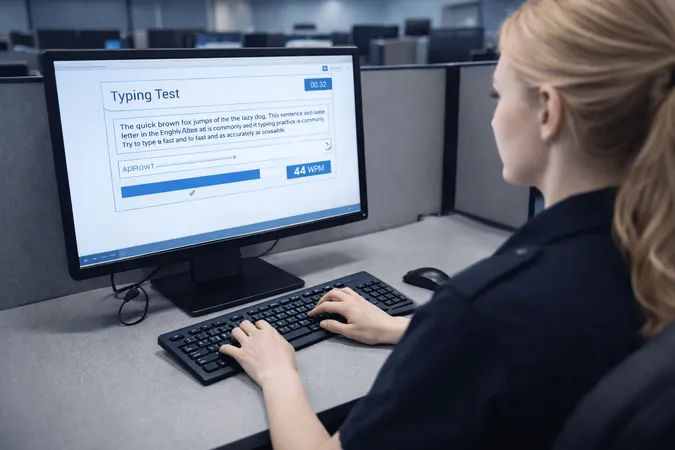
Most agencies require 35-40 WPM for the CritiCall typing test module.
START CRITICALL PRACTICE TEST🗺️What does the map reading module test?
It evaluates your ability to find the most direct route for emergency response.
GET CRITICALL EXAM PREP🧠Why is decision making important?
Dispatchers must quickly decide which units (Police, Fire, EMS) to send.
REVIEW CRITICALL QUESTIONS📝What skills does the spelling module assess?
It tests recognition of commonly used words and homonyms in emergency contexts.
TRY CRITICALL MOCK EXAM🔢How is data entry scored?
Scoring is based on keystrokes per hour (KPH) and accuracy of entered info.
ACCESS CRITICALL STUDY GUIDE📞What is call summarization?
The ability to listen to a call and record key facts accurately while typing.
PRACTICE CRITICALL TEST NOWCritiCall Exam Study Guide
Master the essentials of the CritiCall examination with our comprehensive guide. From understanding the CritiCall test format to preparing for specific modules like the CritiCall typing test, we cover everything you need to know.
The CritiCall exam heavily weighs multi-tasking. Practice listening to news broadcasts while typing what you hear to simulate the audio data entry module. Accuracy is just as important as speed.
CritiCall Score Calculator
Total Scored Questions
100
70 out of 100 correct
70%
Required to Pass: ~70% (Estimated)
How to Become a 911 Dispatcher
WK
1-2Apply Submit App
WK
3-4Test Criti Call Exam
WK
5-8Interview Oral Board
WK
9+Train Academy
- Application - Submit application to local Police, Fire, or EMS agency.
- CritiCall Exam - Pass the CritiCall assessment test with passing scores.
- Interview - Complete an oral board interview with agency leadership.
- Background Check - Undergo a thorough background investigation.
- Psych/Medical - Pass psychological and medical evaluations.
- Hiring - Receive conditional job offer and start date.
- Training - Complete academy training and on-the-job training (OJT).
Because the CritiCall test is a pre-employment assessment, agencies view it as a recruitment cost. You will rarely be asked to pay to take the exam.
CritiCall Test Day Checklist
- ✓Valid Photo ID
- ✓Invitation Letter
- ✓Glasses (if needed)
- ✓Arrive 15min Early
- ✓Relaxed Attitude
- ✓Practice Typing
- ✓Water Bottle
- ✓Confirmation Email
Ready to Pass the CritiCall?
Join thousands of successful dispatchers who passed their CritiCall exam using our free resources. Start your preparation now!
CritiCall Renewal Requirements
EMD Cert
2 Years
CPR/AED
2 Years
CE Hours
24 Hours
While you won't need to retake the CritiCall exam, maintaining your Emergency Medical Dispatch (EMD) and other certifications is mandatory for continued employment.
CritiCall Dispatcher Test: Pros and Cons
- +criticall exam — critiCall Dispatcher Test exam preparation strengthens your knowledge across all domains
- +Passing the exam proves competency to employers and clients
- +Study materials and practice tests are widely available
- +Exam-based credentials are portable across states and employers
- +Clear exam objectives help focus your study plan effectively
- −Exam anxiety can affect performance — practice tests help reduce it
- −Registration fees are non-refundable if you miss your test date
- −Limited retake opportunities may apply with waiting periods
- −Exam content updates periodically — use current study materials
- −Testing center availability may require advance scheduling
Pros and Cons at a Glance
| Pros | Cons |
|---|---|
| criticall exam — critiCall Dispatcher Test exam preparation strengthens your knowledge across all domains | Exam anxiety can affect performance — practice tests help reduce it |
| Passing the exam proves competency to employers and clients | Registration fees are non-refundable if you miss your test date |
| Study materials and practice tests are widely available | Limited retake opportunities may apply with waiting periods |
| Exam-based credentials are portable across states and employers | Exam content updates periodically — use current study materials |
| Clear exam objectives help focus your study plan effectively | Testing center availability may require advance scheduling |
Official Resources
For official information about the CritiCall test, refer to these authoritative sources.
- CritiCall for Applicants (Biddle Consulting Group) — the official page from CritiCall's publisher explaining what candidates can expect and how the TestGenius testing platform works.
- NENA — National Emergency Number Association — the national association that sets 9-1-1 standards and training resources for public-safety telecommunicators.
- APCO International — the leading public-safety communications association, offering training and certification for 911 dispatchers.
Sample Criticall Test Practice Questions
Try these questions from our free Criticall Test practice tests. The correct answer and an explanation follow each question.
The CritiCall map reading test asks for the shortest route. What is being assessed?
- A. Spatial reasoning and direction following
- B. Typing speed
- C. Memory of phone numbers
- D. Spelling ability
Answer: A. Spatial reasoning and direction following
Map reading evaluates your ability to interpret directions and identify efficient routes.
On the CritiCall typing test, what does "net WPM" measure?
- A. Words typed per minute after subtracting errors
- B. Total keystrokes regardless of errors
- C. Words typed in the first minute only
- D. Words read aloud per minute
Answer: A. Words typed per minute after subtracting errors
Net WPM is gross words per minute minus errors, reflecting accurate output.
A caller reports a fire at 4827 Maple Drive. On the CritiCall data entry test, what is the most critical detail to record first?
- A. The exact street address
- B. The caller's mood
- C. The time of day
- D. The caller's phone provider
Answer: A. The exact street address
The location is the highest priority so units can be dispatched even if the call drops.
The CritiCall test measures typing speed and accuracy. Which combination is generally most important for a dispatcher role?
- A. High accuracy with adequate speed
- B. Maximum speed regardless of errors
- C. Slow speed with perfect spelling
- D. Speed only, accuracy is ignored
Answer: A. High accuracy with adequate speed
Accurate entry prevents dispatching errors, so accuracy is weighted heavily alongside reasonable speed.
Take the full Criticall Test practice test
You can continue preparing with the criticall practice, which includes answer explanations for every question.
Criticall Test Questions and Answers
How this page was made: written with AI tools and published by Nathan Beja, founder of Practice Test Geeks, who is responsible for its content. Exam facts are checked against the official sources listed below. Not reviewed by a subject-matter expert. Editorial policy
Sources & references
Exam facts on this page (fees, format, dates, passing scores) are checked against these official sources; the date is our last check. Editorial policy
- criticall911.com — Exam format, time limit, test delivery, eligibility · verified Oct 2026