
How to Pass the CritiCall Dispatcher Test Exam in 2026 October — Complete Study Guide
Free How to Pass the CritiCall Dispatcher practice test with questions and answer explanations. 🗨️ Prepare for the 2026 October exam with instant scoring.

CritiCall Dispatcher Test Exam Overview
The CritiCall Dispatcher Test exam is a standardized assessment that validates your knowledge and readiness in the field. Whether you are a first-time test taker or retaking after a previous attempt, understanding the exam structure is the first step toward success.
The CritiCall Dispatcher Test exam typically covers multiple content areas, each weighted differently in the final score. Familiarizing yourself with the exam format — including question types, time limits, and scoring methodology — allows you to allocate your study time effectively.
What to Expect on Exam Day
- Format: The exam consists of multiple-choice questions designed to test both knowledge recall and applied understanding
- Duration: Plan for a full testing session — arrive early to complete check-in procedures
- Scoring: Each section contributes to your overall score; there is no penalty for guessing on most standardized exams
- Preparation: Use CritiCall Dispatcher Test Practice Tests to familiarize yourself with the question style and difficulty level
The most successful candidates begin their preparation 30 to 60 days before the exam date, following a structured study plan that covers all tested domains.
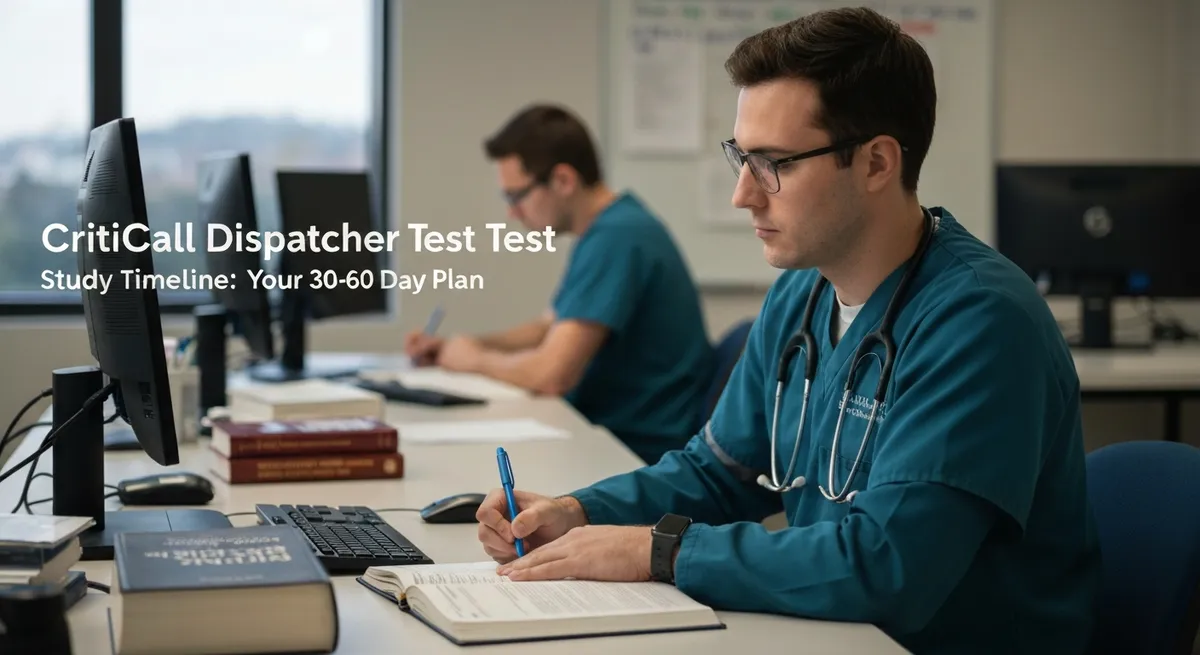
CritiCall Dispatcher Test Study Timeline: Your 30-60 Day Plan
A well-structured study plan is the single most important factor in passing the CritiCall Dispatcher Test exam. The timeline below provides a proven framework that balances content review, practice testing, and targeted remediation.
Public safety dispatcher candidates can prepare for California POST dispatcher testing with our free POST dispatcher practice test — covering reading, writing, reasoning, and multitasking under call-processing conditions.
EMD emergency medical dispatcher candidates often also prepare with our EMR practice test for the emergency triage and prehospital patient care protocols both assessments cover.
Many readers pair this guide with the criticall practice test to check their readiness before exam day.
Days 1-10: Foundation Building
- Review all content domains — Read through official study materials and identify the major topic areas
- Take a diagnostic practice test — Use Criticall Call Handling, Criticall Data Entry & Typing, Criticall Multi-tasking Skills to establish your baseline knowledge level
- Identify weak areas — Score your diagnostic test and note which domains need the most attention
- Create a study schedule — Dedicate 1-2 hours daily, with longer sessions on weekends
Days 11-30: Deep Content Review
- Focus on weak areas first — Spend 60% of study time on your lowest-scoring domains
- Use active learning techniques — Create flashcards, write summaries, and teach concepts to others
- Take topic-specific practice tests — Complete practice questions after each content area review
- Track your progress — Keep a study journal to monitor improvement in each domain
Days 31-45: Practice and Reinforcement
- Take full-length practice exams — Simulate real testing conditions with timed practice tests
- Review every wrong answer — Understand why the correct answer is right, not just what it is
- Revisit difficult concepts — Return to topics where you consistently score below 80%
- Join study groups — Discuss challenging topics with other candidates preparing for the exam
Days 46-60: Final Preparation
- Take 2-3 final practice exams — Aim for consistent scores above 85% before test day
- Light review only — Avoid cramming new material in the final week
- Prepare logistics — Confirm your test center location, required identification, and arrival time
- Rest and recover — Get adequate sleep the night before; mental fatigue reduces performance
Key Topics to Focus On for the CritiCall Dispatcher Test Exam
Not all topics carry equal weight on the CritiCall Dispatcher Test exam. Strategic candidates focus their study time on high-yield areas — topics that appear most frequently and carry the most points.
High-Priority Content Areas
- Criticall Call Handling — Master the fundamental concepts and their practical applications in real-world scenarios
- Criticall Data Entry & Typing — Master the fundamental concepts and their practical applications in real-world scenarios
- Criticall Multi-tasking Skills — Master the fundamental concepts and their practical applications in real-world scenarios
- Criticall Customer Service Scenarios — Master the fundamental concepts and their practical applications in real-world scenarios
- Criticall Communication Skills — Master the fundamental concepts and their practical applications in real-world scenarios
Study Priority Matrix
| Priority Level | Action | Time Allocation |
|---|---|---|
| High Priority | Topics you scored below 60% on diagnostic tests | 40% of study time |
| Medium Priority | Topics you scored 60-80% on diagnostic tests | 35% of study time |
| Low Priority | Topics you scored above 80% on diagnostic tests | 15% of study time |
| Review Only | Topics you consistently score above 90% | 10% of study time |
Use practice tests to identify which category each topic falls into for your personal preparation plan.
CritiCall Dispatcher Test Study Resources and Materials
Having the right study resources makes the difference between passing and failing. Here are the most effective resources for CritiCall Dispatcher Test exam preparation, ranked by impact.
Essential Resources
- Official Study Guides — Always start with materials published by the certifying organization; these align directly with exam content
- Practice Tests — CritiCall Dispatcher Test Practice Tests provide the closest simulation of the actual exam experience
- Flashcard Sets — Create your own or use pre-made sets to reinforce key terminology and concepts
- Study Groups — Connect with other candidates through online forums and local study groups
Recommended Study Strategy
| Resource Type | When to Use | Effectiveness |
|---|---|---|
| Textbooks/Guides | Days 1-30 (content learning) | High — builds foundation |
| Practice Tests | Throughout (weekly minimum) | Very High — identifies gaps |
| Flashcards | Daily (15-20 min sessions) | Medium — reinforces memory |
| Video Tutorials | As needed for difficult topics | Medium — visual learning |
| Study Groups | Weekly meetings | Medium — peer discussion |
Take advantage of Criticall Call Handling, Criticall Data Entry & Typing, Criticall Multi-tasking Skills to test your knowledge regularly throughout your study period. Research shows that frequent testing improves retention by up to 50% compared to passive reading alone.

Test Day Tips for the CritiCall Dispatcher Test Exam
Your performance on the CritiCall Dispatcher Test exam depends not only on what you know but also on how well you manage the testing experience itself. These proven strategies help you perform at your best.
Before the Exam
- Get 7-8 hours of sleep — Cognitive performance drops significantly with less than 6 hours of sleep
- Eat a balanced meal — Include protein and complex carbohydrates; avoid heavy or unfamiliar foods
- Arrive 30 minutes early — This allows time for check-in without added stress
- Bring required documents — Valid photo ID, confirmation number, and any permitted reference materials
- Minimize caffeine — Moderate amounts are fine, but excess caffeine increases anxiety
During the Exam
- Read each question carefully — Look for qualifying words like "always," "never," "most," and "except"
- Manage your time — Divide total time by number of questions to set a pace; flag difficult questions and return to them
- Eliminate wrong answers — Even if unsure, eliminating 1-2 options significantly improves your odds
- Trust your preparation — Your first instinct is usually correct; avoid changing answers without a clear reason
- Stay calm during difficult sections — If you encounter a challenging question, take a deep breath and move on; come back to it later
Time Management Strategy
| Phase | Action | Time Allocation |
|---|---|---|
| First Pass | Answer all questions you know immediately | 60% of total time |
| Second Pass | Return to flagged questions and work through them | 25% of total time |
| Final Review | Check answers and ensure no questions are skipped | 15% of total time |
Common Mistakes to Avoid on the CritiCall Dispatcher Test Exam
Understanding what not to do is just as important as knowing the right strategies. Here are the most common mistakes that cause candidates to fail the CritiCall Dispatcher Test exam — and how to avoid them.
Preparation Mistakes
- Starting too late — Cramming in the final week leads to poor retention; begin at least 30 days before your exam date
- Ignoring weak areas — It is natural to study what you already know, but focusing on weaknesses yields the biggest score improvements
- Not taking practice tests — Practice exams are the closest thing to the real test; use CritiCall Dispatcher Test Practice Tests to simulate the experience
- Relying on a single resource — Use multiple study materials to get a well-rounded understanding of all topics
- Studying passively — Reading without actively testing yourself leads to an illusion of competence
Test Day Mistakes
- Spending too long on one question — If a question takes more than 90 seconds, flag it and move on
- Changing answers without reason — Research shows first answers are correct more often than changed answers
- Not reading all answer choices — The best answer may be the last option listed
- Panicking during difficult sections — Difficult questions are often mixed with easier ones; maintain composure
- Leaving questions blank — Unless there is a penalty for wrong answers, always select an answer
Candidates who avoid these common pitfalls and follow a structured study plan consistently achieve passing scores on their first attempt.
How to Pros and Cons
- +Structured CritiCall study guides organize all required content in exam-aligned order, reducing time spent identifying what to study
- +Combining review guides with practice questions provides both content knowledge and test-taking fluency
- +Focused study plans allow candidates to allocate more time to weak areas rather than reviewing already-mastered content
- +Free and low-cost study resources mean comprehensive preparation is accessible at any budget level
- +Spaced repetition techniques (Anki, regular review sessions) significantly improve long-term retention of tested facts
- −No single study guide covers all tested content optimally — most candidates need 2–3 resources for complete preparation
- −Study guides can become outdated quickly when exam content is updated; verify edition currency before purchasing
- −Self-study requires self-discipline; candidates without structured external accountability often underallocate preparation time
- −Coverage breadth in comprehensive guides can create false confidence — recognizing content is not the same as answering questions correctly under timed conditions
- −Study time estimates in guides often assume ideal conditions; real preparation time is typically 30–50% longer due to life disruptions


Sample Criticall Test Practice Questions
Try these questions from our free Criticall Test practice tests. The correct answer and an explanation follow each question.
The CritiCall test measures typing speed and accuracy. Which combination is generally most important for a dispatcher role?
- A. High accuracy with adequate speed
- B. Maximum speed regardless of errors
- C. Slow speed with perfect spelling
- D. Speed only, accuracy is ignored
Answer: A. High accuracy with adequate speed
Accurate entry prevents dispatching errors, so accuracy is weighted heavily alongside reasonable speed.
A dispatcher is halfway through entering details for a minor noise complaint when an on-screen pop-up message appears requiring a decision about dispatching an ambulance for a fall victim. According to CritiCall multitasking protocols, the dispatcher should:
- A. Ignore the pop-up until the current data entry task is fully completed.
- B. Address the pop-up decision within the allotted time frame (e.g., 15 seconds) before returning to the noise complaint.
- C. Close the pop-up window and wait for the caller to call back if it is a true emergency.
- D. Quickly guess an answer for the pop-up to close it faster and return to the original task.
Answer: B. Address the pop-up decision within the allotted time frame (e.g., 15 seconds) before returning to the noise complaint.
CritiCall tests often include interruptions or pop-up scenarios that require the test-taker to switch tasks. Failing to respond to these prompts, or failing to respond within the specified time, negatively impacts the score. This simulates a real dispatch environment where a high-priority call can interrupt a low-priority one, and the dispatcher must be able to shift attention appropriately.
On the CritiCall typing test, what does "net WPM" measure?
- A. Words typed per minute after subtracting errors
- B. Total keystrokes regardless of errors
- C. Words typed in the first minute only
- D. Words read aloud per minute
Answer: A. Words typed per minute after subtracting errors
Net WPM is gross words per minute minus errors, reflecting accurate output.
A dispatcher is managing three active incidents when a fourth call comes in. The dispatcher has no available units. What is the correct action?
- A. Tell the fourth caller to call back later
- B. Log the fourth call, assign it a priority, and notify a supervisor that all units are engaged
- C. Drop the call to avoid overload
- D. Dispatch units already on scene to the new call immediately
Answer: B. Log the fourth call, assign it a priority, and notify a supervisor that all units are engaged
All calls must be logged and prioritized regardless of unit availability. Supervisors must be notified when resources are exhausted so mutual aid can be requested.
CritiCall Dispatcher Questions and Answers
About the Author

Law Enforcement Trainer & Civil Service Exam Specialist
John Jay College of Criminal JusticeMarcus B. Thompson earned his Master of Arts in Criminal Justice from John Jay College of Criminal Justice and served 12 years as a law enforcement officer before transitioning to full-time academy instruction. He is a POST-certified instructor who has prepared candidates for police entrance exams, firefighter assessments, and civil service examinations across dozens of agencies.