
CPR Practice Test: Free Questions, Study Guide, and Certification Prep
⏳ Take a free CPR practice test with adult, AED, and BLS questions. Study guide, pass rates, and exam tips to ace your certification on the first try.
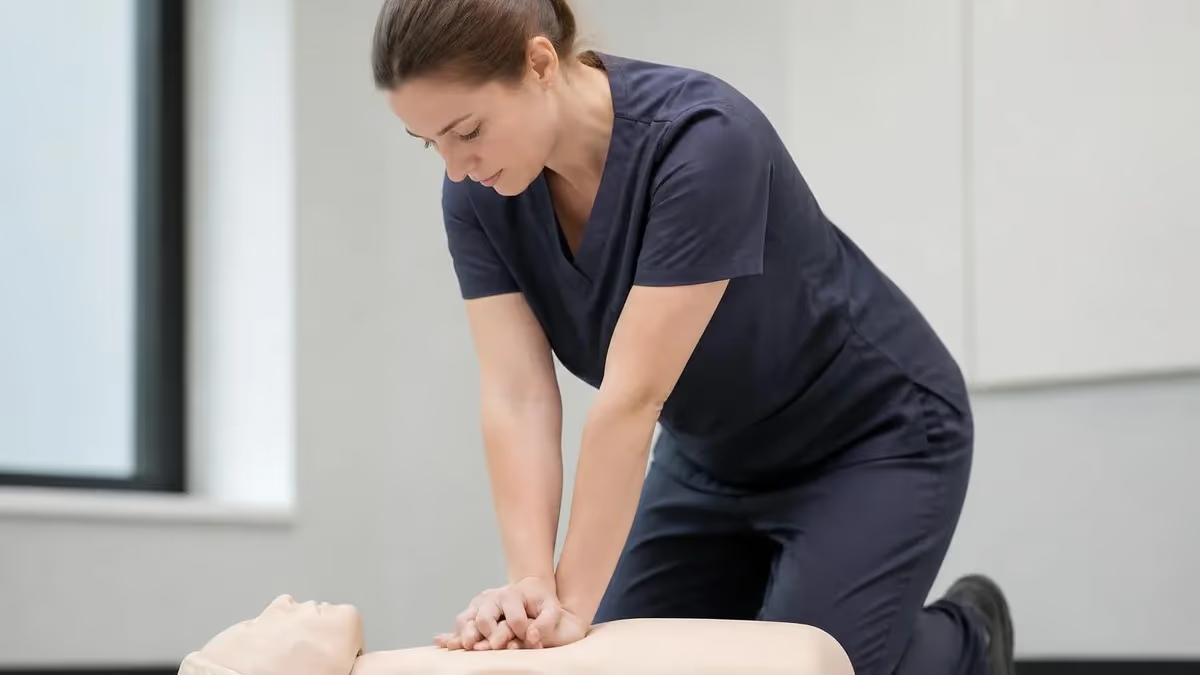
Taking a cpr practice test before your certification exam is the single most reliable way to walk into class confident, calm, and ready to pass on the first attempt. Whether you are pursuing American Heart Association (AHA) BLS certification, a Red Cross Adult CPR/AED card, or a workplace refresher, sample questions mirror the format, vocabulary, and reasoning the actual test demands. They also expose weak spots — compression depth, AED pad placement, recovery position, or two-rescuer ratios — long before those gaps cost you a passing score.
If you are searching for a free CPR practice test — or simply free tests for CPR skills and certification — start with the free questions on this page: every answer comes with an explanation, and the study notes below cover the CPR exam topics in order.
Most CPR certification exams contain between 25 and 50 multiple-choice questions and require a score of 80% or higher to pass. That sounds generous until you realize how many candidates lose points on small details: the exact compression rate (100–120 per minute), the correct compression depth for an adult (at least 2 inches but no more than 2.4 inches), and the proper compression-to-ventilation ratio for one-rescuer adult CPR (30:2). Practice questions hammer these numbers into long-term memory.
This guide pulls together everything you need to prepare. You will find free practice questions across adult CPR, AED use, and two-rescuer scenarios, a week-by-week study schedule, an honest look at pass rates, and the exact checklists certified instructors use the morning of an exam. Every question set is drawn from current 2020/2025 AHA Guidelines and the latest ILCOR consensus on resuscitation science.
You will also see how a CPR practice test differs from the skills test. Written questions cover knowledge — recognizing cardiac arrest, calling 911, choosing the right rescue technique. The skills test is hands-on, scored against a checklist while you perform compressions on a manikin. Both matter, but the written exam is where most candidates trip if they skip practice. We cover both, with separate prep tracks for each.
If you are completely new to CPR, start with the basics: cardiac arrest kills roughly 350,000 Americans outside hospitals every year, and bystander CPR can double or triple survival. That is why employers in healthcare, childcare, fitness, and education require active certification. The exam exists to confirm you can actually help — not just memorize a card. A serious practice test pushes you toward real competence, not just a passing number.
Throughout this article you will see links to topic-specific quizzes you can take right now, plus a deeper resource on how to become CPR certified if you have not yet enrolled in a course. Bookmark this page, work through one practice section per study session, and you will be ready well before exam day.
CPR Certification by the Numbers
Key Facts at a Glance
| Item | Value | Details |
|---|---|---|
| Minimum Passing Score | 80% | AHA and Red Cross written exam |
| Written Test Duration | 30–60 min | 25–50 multiple-choice questions |
| Certification Validity | 2 years | Renewal required after |
| Course Cost Range | $0–$110 | Free online to AHA in-person |

CPR Exam Format at a Glance
| Section | Questions | Time | Weight | Notes |
|---|---|---|---|---|
| Adult CPR | 15 | 18 min | 30% | Compression depth, rate, ratios |
| Child & Infant CPR | 10 | 12 min | 20% | Age-specific technique differences |
| AED Use | 10 | 12 min | 20% | Pad placement, shock delivery |
| Choking & Recovery | 8 | 10 min | 16% | Heimlich, recovery position |
| Team Dynamics & Scene Safety | 7 | 8 min | 14% | Two-rescuer, calling EMS |
| Total | 50 | 60 minutes | 100% |
The CPR written exam covers a tight set of high-yield topics. If you map your study time to these categories, you will not waste hours on material the test ignores. Adult CPR carries the most weight because adult cardiac arrest is statistically the most common scenario any rescuer will encounter. Expect questions about compression depth, hand placement on the lower half of the sternum, full chest recoil between compressions, and minimizing interruptions to less than 10 seconds.
Pediatric resuscitation is the second-largest section. Examiners want to know you can switch techniques: two fingers or two thumb-encircling hands for infants under one year, the heel of one hand (or two for larger children) for ages 1–8, and a compression depth of about one-third the anteroposterior chest diameter — roughly 1.5 inches for infants and 2 inches for children. Compression rate stays at 100–120 per minute across all ages.
AED questions trip up candidates more than any other topic. The test will probe whether you know to power on first, attach pads to bare dry skin, clear everyone before analysis, and resume compressions immediately after the shock without checking pulse. Pad placement matters: anterior-lateral for most adults, anterior-posterior for infants and small children, and pediatric pads (or pediatric mode) under age 8 when available.
Choking questions distinguish between mild and severe airway obstruction. A responsive adult with severe obstruction gets abdominal thrusts; an infant gets five back blows alternating with five chest thrusts. If the victim becomes unresponsive, you begin CPR — checking the mouth for the dislodged object before each set of rescue breaths. The test loves to ask what changes when the victim loses consciousness.
Team dynamics has grown in recent guidelines. Expect a question about closed-loop communication, role assignment (compressor, ventilator, AED operator, recorder), and rotating compressors every two minutes to prevent fatigue-related quality drop. Healthcare-provider tests dig deeper into team leadership and debriefing after a code.
Finally, knowledge of when not to act gets tested. Scene safety always comes first. You will see questions about electrical hazards, traffic, opioid overdose response (naloxone before or with CPR), and obvious signs of death where resuscitation is not indicated. For a deeper look at curriculum options, see American Heart Association CPR classes and what each course covers.
Memorize the numbers cold: 30:2 ratio for single-rescuer adult CPR, 15:2 for two-rescuer child and infant CPR with a healthcare provider, 100–120 compressions per minute, and at least 2 inches deep for adults. Almost a third of the CPR test questions you will face hinge on these exact figures, and they are the easiest points to lock in before exam day.
CPR Practice Test Questions
Prepare for the CPR - Cardiopulmonary Resuscitation exam with our free practice test modules. Each quiz covers key topics to help you pass on your first try.
CPR Adult CPR
CPR Exam Questions covering Adult CPR. Master CPR Test concepts for certification prep.
CPR AED Use
Free CPR Practice Test featuring AED Use. Improve your CPR Exam score with mock test prep.
CPR Basic CPR Principles
CPR Mock Exam on Basic CPR Principles. CPR Study Guide questions to pass on your first try.
CPR Child and Infant CPR
CPR Test Prep for Child and Infant CPR. Practice CPR Quiz questions and boost your score.
Types of CPR Practice Test Questions You Will See
Recall questions test pure memorization of guidelines numbers. Expect items like "What is the correct compression depth for an adult?" with answer choices clustered around 2 inches to trip up sloppy memory. The right answer is at least 2 inches but no more than 2.4 inches. Other classic recall items target compression rate (100–120/min), the 30:2 ratio, and how long to check for breathing and a pulse simultaneously (no more than 10 seconds).
These questions reward flashcards and repetition. If you can rattle off compression depth, rate, ratio, and pulse-check duration for adults, children, and infants without hesitating, you have already secured roughly 25% of the exam. Practice tests catch you saying "about 2 inches" when the test demands the exact range. Train yourself to think in precise numbers from day one of study.

Should You Use Free Online CPR Practice Tests?
- +Identifies weak topics before the real exam so you can focus study time efficiently
- +Builds familiarity with multiple-choice phrasing the AHA and Red Cross actually use
- +Free or low-cost compared to repeating a failed certification course
- +Available 24/7 on any device, perfect for short study sessions during breaks
- +Instant feedback with explanations helps cement correct answers in memory
- +Reduces test anxiety by simulating real exam timing and question density
- −Quality varies widely — outdated tests may still reference pre-2020 guidelines
- −Cannot replace hands-on skills practice on an actual manikin
- −Some free tests lack detailed answer explanations, limiting learning value
- −Question pools are often smaller than the real exam, leading to repeat questions
- −Online tests do not satisfy the practical skills check required for certification
- −No proctoring means it is easy to look up answers and overestimate your readiness
CPR Practice Test Exam Day Checklist
- ✓Get at least 7 hours of sleep the night before — fatigue tanks recall on numbers questions
- ✓Eat a balanced breakfast with protein and complex carbs about 90 minutes before the exam
- ✓Bring photo ID, course enrollment confirmation, and any required prepayment receipts
- ✓Arrive 20 minutes early to settle in and avoid stress-related cognitive fog
- ✓Review the 30:2 ratio, 100–120 rate, and 2-inch depth one final time on the way in
- ✓Wear comfortable clothing you can move in for the hands-on skills portion
- ✓Bring a water bottle and a small snack for the break between written and skills tests
- ✓Skip caffeine if it makes your hands shake — manikin compressions get scored on quality
- ✓Read every question twice and watch for negative wording like 'EXCEPT' or 'NOT'
- ✓Mark uncertain questions and return at the end rather than burning time mid-test
- ✓Trust your first instinct on scenario questions unless you find a clear reason to change
- ✓Take three slow breaths before the skills station to steady your compression rhythm
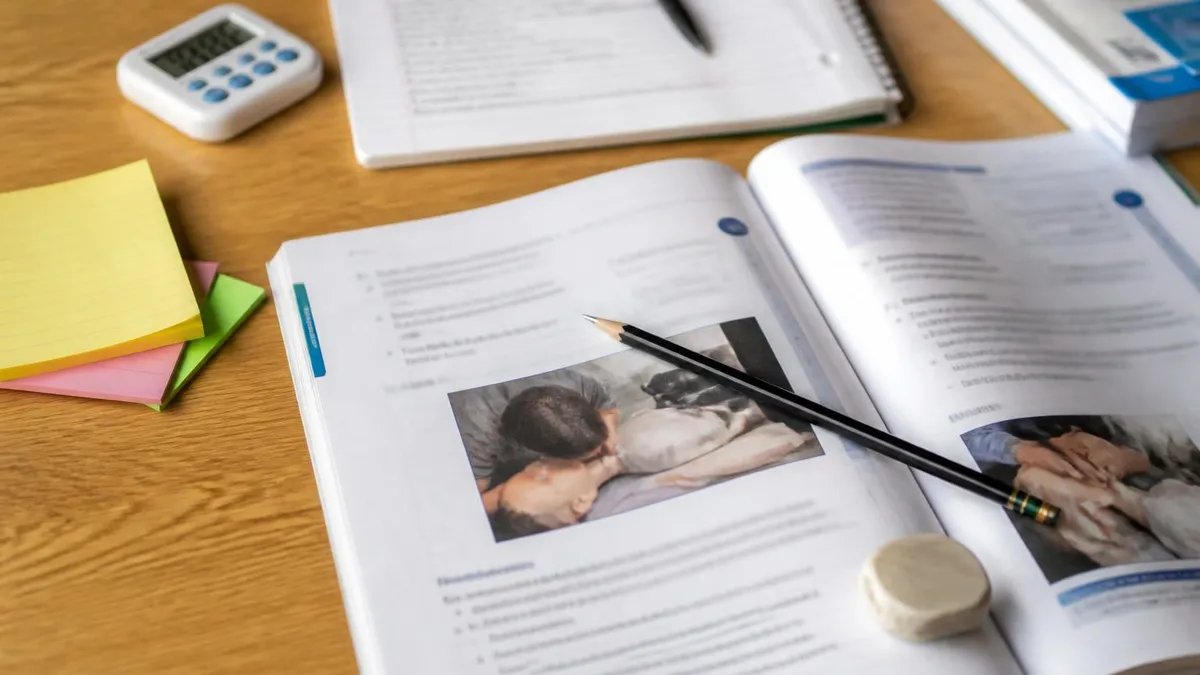
You only need to miss 10 of 50 questions
Most CPR written exams require 80% to pass, meaning you can miss up to 10 of 50 questions and still earn certification. That is a generous margin — but only if you have mastered the high-yield numbers (depth, rate, ratio) and the AED algorithm. Practice tests show you exactly how close to that margin you are before exam day arrives.
The most common mistake CPR candidates make is treating practice questions like a graded exam instead of a learning tool. If you take a 25-question practice test, score 18, and move on, you have wasted the opportunity. The correct workflow is to review every single question — including the ones you got right — and write down the exact reasoning for the correct answer. Did you get it right because you knew it, or because you guessed? That distinction predicts your real exam score better than any total.
Mistake number two is ignoring pediatric and infant content because adult cardiac arrest feels more common. Pediatric questions account for roughly 20% of most exams, and the technique differences (compression depth, ratio, AED pad placement) are exactly the kind of detail that gets tested. If you only practice adult scenarios, you are leaving an easy 10 points on the table. Distribute your practice across all age groups proportional to their exam weight.
Mistake three is memorizing without understanding the why. The 30:2 ratio exists because uninterrupted compressions maintain coronary perfusion pressure, and each pause to ventilate drops that pressure dramatically. When you understand the physiology, scenario questions become straightforward — you can reason out the answer even on a question you have never seen before. Pure memorization fails the moment a question is phrased differently than your study materials.
Mistake four is skipping the rationales in practice test answer keys — working through CPR test questions and answers side by side, instead of just scoring yourself, is what actually moves your real exam score. The explanation for why a wrong answer is wrong often contains the next exam question you will see. "Compression depth of 1.5 inches is incorrect because adult compressions require at least 2 inches to generate adequate cardiac output" teaches you two facts in one sentence. Read every rationale, even on questions you aced.
Mistake five is procrastinating until the day before. Cramming works for some standardized tests, but CPR exams reward spaced repetition because the algorithms must become automatic. Studying 30 minutes a day for two weeks beats 7 hours the night before, every time. Spaced practice also leaves room for hands-on skills rehearsal, which is the other half of the certification.
Mistake six is neglecting the skills test in favor of the written test. Many candidates pass the written exam easily and then fail the manikin check because they never practiced compression depth and recoil with feedback. If your course offers a manikin with a CPR feedback device that lights up at the correct depth, use it relentlessly. Muscle memory comes from repetition, not reading.
Mistake seven is comparing yourself to other candidates instead of the rubric. The pass mark is 80%, full stop. Whether your classmate finished in 20 minutes or struggled through 45 has zero bearing on your score. Focus on your own gaps, work through them with targeted practice tests, and trust the process.
Not all CPR certifications are accepted by all employers. Hospitals, EMS agencies, and most licensed healthcare facilities require American Heart Association BLS or Red Cross BLS for Healthcare Providers — generic online "certifications" without an in-person skills check are usually rejected. Confirm with your employer or licensing board which credential they accept before paying for a course.
To pass your CPR exam on the first try, build a study system that combines reading, practice questions, and hands-on skills work. Start with the course manual — AHA's BLS Provider Manual or the Red Cross Participant Manual — and read it cover to cover before opening any practice test. The manual establishes the framework; practice tests reinforce and test it. Skipping the manual and going straight to questions leaves gaps you will not notice until exam day.
Week one should focus on adult CPR fundamentals: compression mechanics, rescue breathing, and the basic algorithm from recognition through AED arrival. Aim for 60–80 practice questions across this topic alone. Week two shifts to pediatric and infant CPR plus choking response. Week three covers AED, special situations, and team dynamics. Week four is mixed-topic practice tests under timed conditions to simulate exam pressure.
Use multiple practice test sources. AHA-affiliated practice questions match AHA exams most closely, but cross-training on Red Cross and independent question banks broadens your exposure to different question phrasings. The real exam will not match any single practice test exactly, so variety builds adaptability. Aim for at least 200 total practice questions before exam day across all sources.
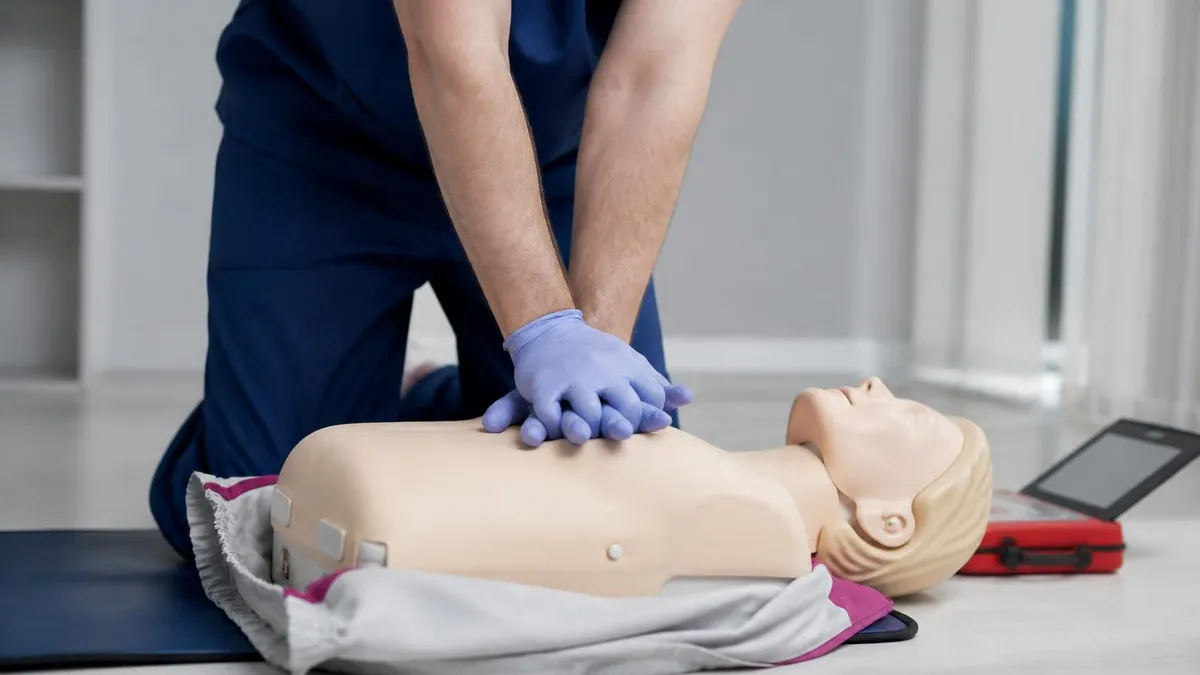
Schedule your hands-on practice. If your course offers manikins for after-class practice, book the time. If not, find a CPR training mannequin online for under $40 and practice at home. Focus on three things: compression depth (use a yardstick or feedback device), rate (use a metronome set to 110 beats per minute or hum "Stayin' Alive"), and full recoil between compressions. These are the three skills test failure points.
The night before, do not cram. Review your notes for 30 minutes, then stop. Sleep matters more than one more practice test the evening before — memory consolidation during sleep is when your studying actually sticks. Set out your ID, course paperwork, and clothes the night before so the morning is stress-free.
On exam morning, eat breakfast, arrive early, and complete the written test methodically. Read every question twice. Watch for absolute words ("always," "never") and negative phrasing ("which of the following is NOT"). Skip and mark any question you find difficult and return at the end — every question is worth the same, so do not let one stumper eat 5 minutes you need elsewhere.
If you are preparing for healthcare-specific certification, our guide to BLS CPR certification covers the additional content healthcare providers face. The principles are the same but the depth is greater, especially around team dynamics, advanced airway considerations, and post-cardiac-arrest care that EMTs and nurses are expected to understand.
Final prep advice comes down to managing the last 72 hours. Three days before the exam, do one full-length timed practice test under exam conditions — no music, no phone, single sitting. Score it honestly. If you hit 85% or above, you are ready and the remaining days should be light review and rest. If you scored 70–84%, identify the two weakest topics and drill them with focused practice sets. Below 70%, consider rescheduling if your course permits.
Two days out, switch to active recall over passive review. Close the manual and try to recite the adult, child, and infant algorithms from memory, end to end, without prompts. Then check what you missed. This technique, called the blurting method, surfaces gaps that re-reading never reveals. Repeat for AED steps and choking response. Active recall is roughly three times more effective than re-reading the same material.
The day before the exam, do not take any more practice tests. Your job is to consolidate, not learn new material. Review the high-yield numbers card you have been building — depth, rate, ratio, pulse-check duration, ventilation timing — and then put the materials away. Spend the evening doing something relaxing. Anxiety about the test causes more failures than knowledge gaps.
Morning of the exam, eat a real breakfast. Eggs, oatmeal, fruit — something with protein and fiber that will not spike and crash your blood sugar. Skip new caffeine doses if you do not normally drink coffee; an unfamiliar stimulant during a high-stakes test is a recipe for jitters. Drink water steadily but not so much that you need a bathroom break mid-exam.
During the written test, pace yourself. With 50 questions in 60 minutes, that is roughly 70 seconds per question — comfortable for recall items, tight for complex scenarios. Use a quick first pass to answer everything you know cold, then a second pass to think through harder items, then a final pass to address your marked questions. This three-pass strategy outperforms straight-through test-taking on virtually every multiple-choice exam.
For the skills test, breathe, position yourself correctly, and start compressions with deliberate rhythm. Examiners score depth, rate, recoil, hand placement, ventilation effectiveness, and minimization of interruptions. If the manikin has a feedback monitor, use it — examiners want to see you respond to feedback, not ignore it. If you make a mistake mid-skill, correct it openly. Self-correction shows competence; pretending it did not happen does not.
After the exam, regardless of how you feel about your performance, congratulate yourself. You are now part of a small, brave subset of people who can keep someone alive in the seven to ten minutes before professional help arrives. That matters more than any test score. If you passed, your certification card or e-card typically arrives within 24–48 hours. If you did not pass, ask about the retest policy — most courses allow at least one free retake within 30 days, often after a brief review session.
CPR Test Questions and Answers: What to Expect
Most CPR certification exams draw their CPR test questions and answers from a fixed pool covering adult, child, and infant resuscitation, AED use, choking response, and team dynamics. Questions are almost always multiple-choice with four answer options, and each one maps directly to a single fact from the course manual — a compression depth, a ratio, a timing window, or a step in the algorithm. There is rarely a trick; the difficulty comes from precision, not ambiguity.
A typical question reads like a mini-scenario: "You are alone with an unresponsive adult who is not breathing normally. What is your first action after confirming the scene is safe?" The correct answer is almost always the next step in the AHA or Red Cross algorithm — call for help and get an AED, then begin compressions — rather than a plausible-sounding distractor like checking for a pulse first. Reading practice explanations, not just the answer key, teaches you to recognize this pattern before exam day.
Expect roughly 5–10 questions on adult compression mechanics, 4–8 on pediatric and infant differences, 4–8 on AED steps, and the remainder split across choking, team roles, and scene safety. Working a few dozen realistic practice questions until the reasoning becomes automatic is the fastest way to walk into the real test prepared.
🫀 How deep should adult chest compressions be?
At least 2 inches (5 cm) but no more than 2.4 inches (6 cm) for an average adult. Compressing too shallow fails to circulate blood; compressing too deep risks rib fracture.
START ADULT CPR PRACTICE TEST⏱️ What compression rate does the exam expect you to know?
100 to 120 compressions per minute for every age group. Many candidates hum "Stayin' Alive" or use a metronome app to lock in the tempo before test day.
START ADULT CPR PRACTICE TEST🔁 What is the compression-to-ventilation ratio for single-rescuer adult CPR?
30 compressions to 2 rescue breaths (30:2). For two-rescuer CPR on a child or infant with a healthcare provider present, the ratio changes to 15:2.
START BASIC CPR PRINCIPLES TEST⚡ Where do AED pads go on an adult?
One pad on the upper-right chest below the collarbone, the other on the lower-left side below the armpit (anterior-lateral placement). Pads must go on bare, dry skin, and everyone must clear the victim before the shock is delivered.
START AED USE PRACTICE TEST👶 How deep should compressions be for a child (ages 1-8)?
About 2 inches, or roughly one-third the depth of the chest, using one or both hands depending on the child's size. This is shallower than the adult standard but deeper than infant compressions.
START CHILD & INFANT CPR TEST🍼 What technique is used for infant chest compressions?
Two fingers (or two thumb-encircling hands for two rescuers) in the center of the chest, just below the nipple line, compressing about 1.5 inches deep. The rate stays 100-120 per minute, same as adults and children.
START CHILD & INFANT CPR TEST🆘 What do you do for a responsive adult with severe choking?
Give abdominal thrusts (the Heimlich maneuver) until the object is expelled or the person becomes unresponsive. If they lose consciousness, lower them to the ground and begin CPR, checking the mouth before each set of breaths.
START SPECIAL SITUATIONS TEST✅ What score do you need to pass the CPR written exam?
80% or higher on most AHA and Red Cross written exams, typically out of 25 to 50 multiple-choice questions. Missing up to roughly 1 in 5 questions still earns certification, but the skills test must also be passed.
START CERTIFICATION & LEGAL TEST📅 How long does a CPR certification stay valid?
Most AHA and Red Cross CPR/AED certifications are valid for 2 years before renewal is required. Some employers, especially in healthcare, require annual skills refreshers even within that window.
START CERTIFICATION & LEGAL TEST🗣️ What does the exam test about team dynamics in multi-rescuer CPR?
Closed-loop communication, clear role assignment (compressor, ventilator, AED operator, recorder), and rotating the compressor every 2 minutes to prevent fatigue-related drops in compression quality.
START SPECIAL SITUATIONS TESTCPR Questions and Answers
Official Resources
- American Red Cross — CPR Classes: official course catalog and certification pathways for Red Cross Adult, Pediatric, and Infant CPR/AED credentials.
- International Liaison Committee on Resuscitation (ILCOR): the global scientific body whose consensus reviews shape the current AHA and Red Cross CPR guidelines, including compression depth, rate, and ratio standards.
- National Heart, Lung, and Blood Institute (NIH): authoritative background on cardiac arrest and heart attack, useful context for understanding why the CPR algorithm is structured the way it is.
Free CPR Practice Test 2026 - CPR Exam Questions
How to Become CPR Certified: Steps, Costs, and What to Expect
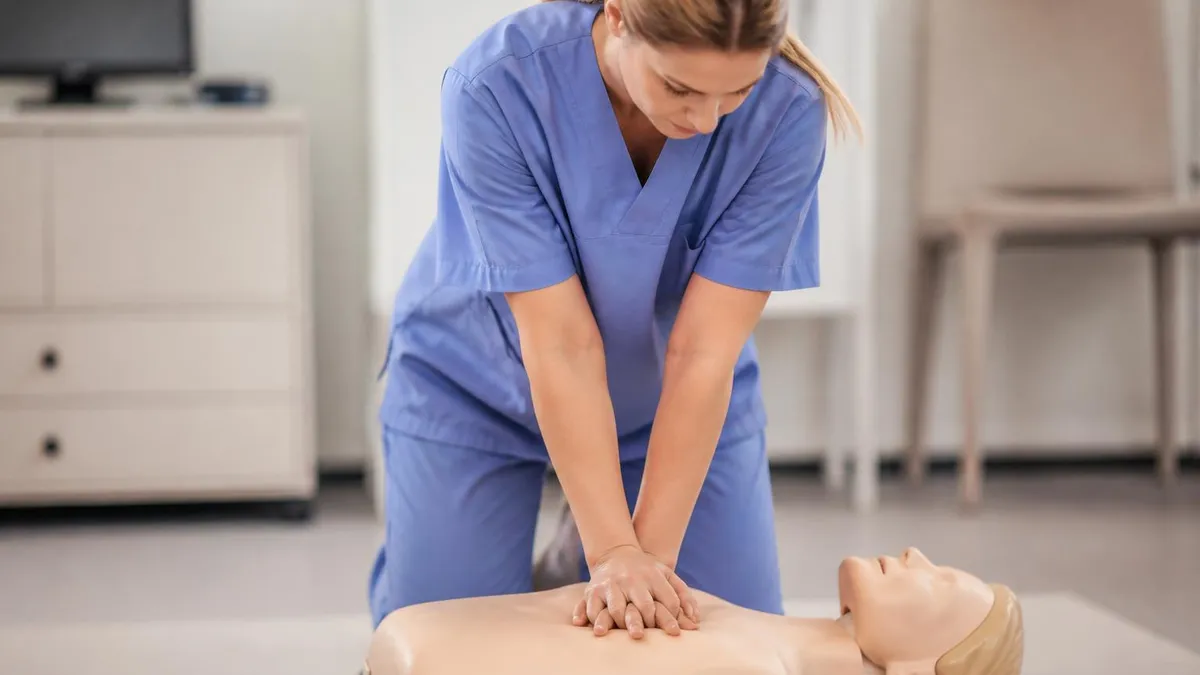
American Heart Association CPR Classes: Types, Cost, and Where to Find

Online CPR Certification: How to Get Certified and What It Covers
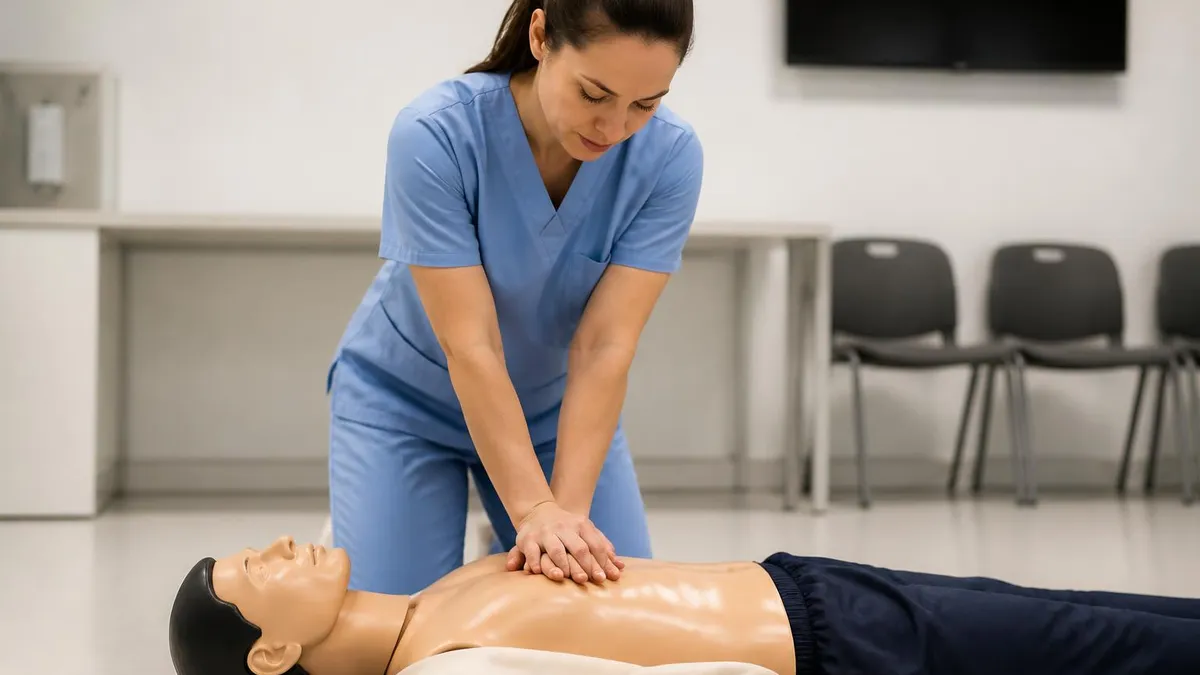
BLS CPR Certification: Course, Cost, and Healthcare Provider Guide
About the Author

Registered Nurse & Healthcare Educator
Johns Hopkins University School of NursingDr. Sarah Mitchell is a board-certified registered nurse with over 15 years of clinical and academic experience. She completed her PhD in Nursing Science at Johns Hopkins University and has taught NCLEX preparation and clinical skills courses for nursing students across the United States. Her research focuses on evidence-based exam preparation strategies for healthcare certification candidates.