
BLS Online: How to Get Recognized Basic Life Support Certification Without a Classroom
✍🏼 BLS online courses, costs, recognized providers, skills check rules, and free practice tests. Pick a course your employer will accept on the first try.
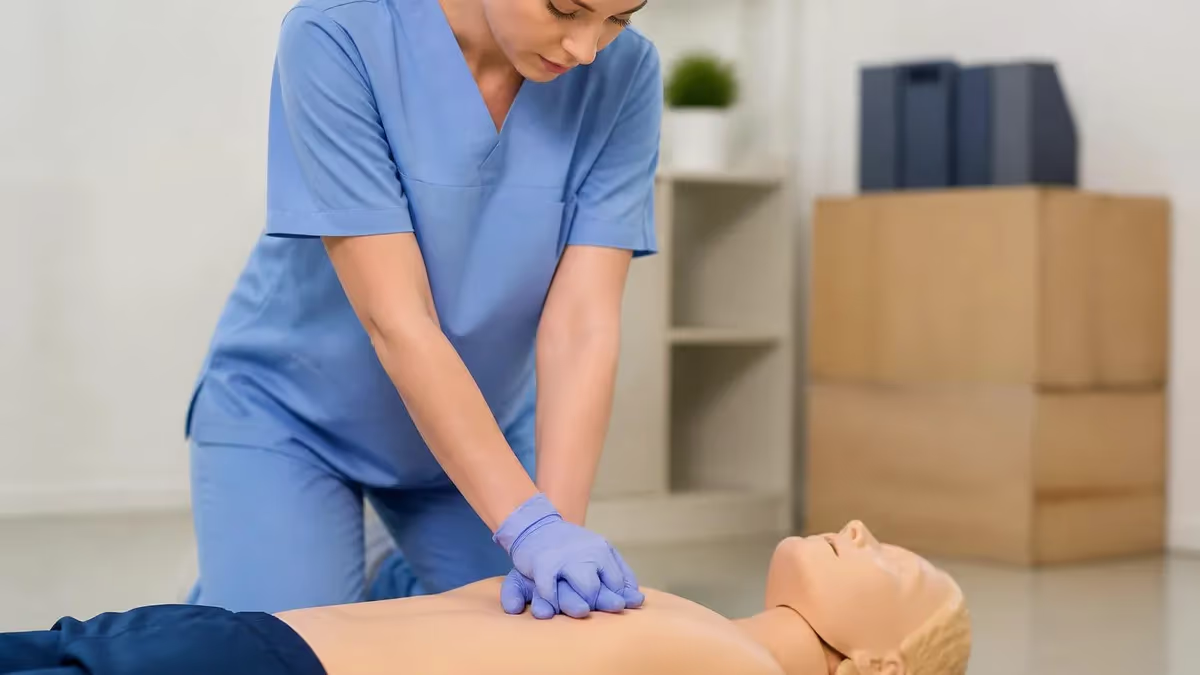
BLS online courses promise something every busy healthcare worker dreams about: a way to renew certification without giving up a Saturday in a windowless classroom. Whether you are an RN re-credentialing for a hospital floor, a nursing student preparing for clinicals, or a dental assistant whose card expires next month, the online path looks fast, affordable, and convenient. It can be all of those things, but only if you pick the right course and understand what your employer or licensing board will actually accept.
The phrase "BLS online" hides a lot of variety. Some courses are fully online, with video lessons, written modules, and a multiple-choice exam you take from your kitchen table. Others are blended, meaning the lectures live on a screen but the hands-on skills test still requires an in-person session. A few sites sell unaccredited certificates that look official but get rejected the moment your HR coordinator opens them. Knowing the difference saves money, time, and the misery of repeating a course.
This guide walks through every angle of online BLS in 2026: who it is for, which providers are recognized, how the blended model works, what skills you still need to demonstrate, and how to study so you pass the cognitive exam on the first try. You will also find common pitfalls, renewal timelines, and a checklist for verifying that the course you are eyeing actually counts toward your job requirements. Free practice tests are linked throughout so you can pressure-test your knowledge before you commit to a paid course.
BLS Online at a Glance
BLS, short for Basic Life Support, is the standardized response to a cardiac arrest or breathing emergency in adults, children, and infants. It covers chest compressions, rescue breaths, the use of an automated external defibrillator (AED), relief of choking, and team-based resuscitation.
Most healthcare employers in the United States require an active BLS card. Many nursing schools require it before the first clinical rotation. If you have wondered what is BLS certification and how it differs from a generic CPR card, the short answer is that BLS is the provider-level course, taught faster and tested at a higher standard.
An online BLS course delivers the cognitive part of that training over the internet. You log into a learning platform, watch lessons on the chain of survival, the compression-to-ventilation ratio, AED pad placement, and team dynamics, then complete short quizzes that gate progress.
At the end you take a proctored or auto-graded multiple-choice exam. If the course is fully online, you receive a digital certificate as soon as you pass. If it is blended, you receive a Part 1 complete voucher that you carry into a 45 to 90 minute in-person skills session, where an instructor watches you compress a manikin, ventilate with a bag-mask, and run an AED.
The American Heart Association calls its blended product HeartCode BLS. The American Red Cross sells a similar product as the Basic Life Support Online with Skills Session. The American Safety and Health Institute and the Health and Safety Institute (ASHI/HSI) each offer their own blended formats.
Each looks different, but they share the same core skill list because they all map to the same International Liaison Committee on Resuscitation (ILCOR) guidelines published every five years.
A fully online BLS course gives you a card without a skills check. A blended course pairs the online lessons with a short in-person skills session and is what most US hospitals will accept.
Who Online BLS Works For
- ✓Healthcare professionals renewing an existing BLS card
- ✓Working parents and shift workers without weekend availability
- ✓Rural learners over 30 minutes from a training center
- ✓Pre-health students wanting to study at their own pace
- ✓Anyone whose employer pre-approves AHA HeartCode or Red Cross blended
Online BLS is not a universal solution. Most hospitals in the United States accept blended courses from the AHA or the Red Cross, but a smaller subset require fully in-person training, especially for ICU, ED, and operating room staff. Long-term care facilities, dental practices, and outpatient clinics are usually more flexible.
Before you click buy on any course, log into your employer's learning management system or call HR and ask which providers and which delivery formats they accept. The course is non-refundable at most vendors, so a 60-second phone call can save you a couple hundred dollars.
The blended model works best for healthcare professionals renewing an existing BLS card who only need to refresh their knowledge and re-test their skills, for working parents and shift workers who cannot block out an 8-hour day for a classroom session, for rural learners who live more than 30 minutes from the nearest training center, and for pre-health students who want to study at their own pace before clinical placement.
It is a poor fit for anyone who has never done chest compressions on a manikin and learns better with hands-on coaching from the first minute, for people whose employer explicitly requires the instructor-led classroom version of BLS, and for learners who do not have reliable internet or a quiet space at home. If you fall into one of those buckets, pay for the classroom course and treat the time as an investment in retention.
Pick Your Path
If you have held BLS before, the blended renewal pathway is fastest. Refresh knowledge online in two to three hours, then drop in for a 45-minute skills check at a partner site or in-hospital skills station. eCard usually issued the same day.
First-time learners often benefit from the blended format because the in-person session reinforces compressions, ventilation rhythm, and AED handling. Some schools host group skills sessions for students; check with your program director before paying out of pocket.
Most state dental boards accept ASHI or AHA blended courses. Check the state board's CE bulletin and confirm the course is current with the latest ILCOR cycle before booking. Group sessions for the whole practice are often cheaper than individual signups.
Hospitals affiliated with your group practice usually accept any AHA or Red Cross card. If you split time across multiple facilities, pick the provider that the strictest facility accepts and use it everywhere.

The word BLS is not trademarked, which means anyone can sell a course and call it BLS. Recognition is what matters. A recognized course is one your licensing board or employer will accept as proof of competency. The three most widely recognized providers in the United States are the American Heart Association, the American Red Cross, and the American Safety and Health Institute. The AHA card is the gold standard for hospitals. The Red Cross card is accepted nearly everywhere and is often slightly cheaper. ASHI is common in dental and outpatient settings.
Beyond those three, you will find dozens of online-only vendors with names like National CPR Foundation or ProTrainings that issue digital cards within minutes for under $25. Some of these courses are excellent for refreshing knowledge, but their cards are frequently rejected by hospital HR.
Treat them as study tools, not as your primary certification path, unless you have written confirmation from your employer that the specific brand is accepted. Our AHA BLS online overview covers the official HeartCode pathway in more detail and explains why so many hospital systems standardize on it.
The skills check requirement is what protects the credential. ILCOR guidelines require demonstration of compressions, ventilations, and AED use in real time on a manikin that records depth and rate. A purely online course with no skills check cannot, by definition, verify those psychomotor skills. That is why the AHA, the Red Cross, and ASHI all build a hands-on skills session into their online offerings.
Recognized BLS Providers
American Heart Association HeartCode BLS is the gold standard for US hospitals and academic medical centers. The online module runs three to four hours and ends with a 25-question exam at 84% pass mark. The eCard is verifiable on the official AHA atlas, which most hospital HR portals query directly during onboarding. Skills sessions can be booked at AHA training centers or HeartCode Skills Stations inside larger hospital systems. Pricing is typically $50 to $75 for the online portion, plus $40 to $75 for the in-person check. Required by most critical-care, OR, and ED departments.
A typical blended online BLS course runs about three to four hours of screen time, plus a 30 to 75 minute in-person skills session. The online portion is broken into modules covering the science of resuscitation, adult one-rescuer CPR, two-rescuer CPR, child CPR, infant CPR, AED use, choking relief, and team dynamics. After each module you complete a short knowledge check. You can pause, rewind, and replay the lessons as many times as you need. The platform tracks your progress and lets you resume on any device.
The cognitive exam at the end is typically 25 questions, multiple choice, and you need 84% or higher to pass. Most providers let you retake the exam once for free; after that you may need to repurchase the course. Once you pass, you receive a voucher with a unique code.
You bring that code to a scheduled skills session at a training center, hospital, or partner site. The instructor verifies your code, hands you a manikin and AED trainer, and runs you through a checklist of skills. Compress at 100 to 120 per minute, push to a depth of at least two inches, deliver effective breaths, and place AED pads correctly. The whole skills check usually takes 20 to 45 minutes, with the rest of the slot used for practice and feedback.
Once you finish both parts, your eCard is issued within minutes. AHA eCards are verifiable on the official AHA atlas; Red Cross digital certificates are verifiable through the Red Cross learning portal. Most employers want the verification link, not just the PDF, so save the email confirmation. If you want to see how the structure compares to the underlying CPR skill set, our explainer on BLS CPR shows how the two terms overlap and where they diverge.
Always save the verification URL for your eCard, not just the PDF. Most hospitals require the live verification link during onboarding and will not accept a screenshot of the certificate alone.
Even though the lecture is virtual, the skills check is unforgiving. Examiners are trained to watch for a small list of non-negotiable actions that you must perform correctly to pass. Miss one, and you repeat that skill until you get it right. Miss several and you fail the session, which means rescheduling and sometimes repurchasing. The good news is that the list is short, predictable, and easy to drill at home with a couch cushion.
The most commonly failed elements are compression depth and full chest recoil. Many learners compress fast enough but do not push hard enough, especially on larger manikins. Others lean on the chest between compressions, which prevents recoil and reduces blood flow. Practice on a firm surface, count out loud, and let your hands rise fully off the chest between every push. Rescue breaths trip up another group of learners; the trick is to make a tight seal with the bag-mask, deliver each breath over about one second, and look for visible chest rise without over-inflating.
AED skills are mostly about confidence. Turn the unit on, attach the pads in the correct position, clear the patient, deliver the shock if advised, and immediately resume compressions. The examiner is watching for fluent transitions, not memorized scripts. If you fumble a pad or miss a verbal cue, narrate what you are doing and keep moving; instructors care about safety and continuity, not perfect speeches.
Skills Check Non-Negotiables
- ✓Compression rate between 100 and 120 per minute
- ✓Compression depth at least 2 inches (5 cm) in adults
- ✓Full chest recoil between every compression
- ✓Rescue breaths visible chest rise, about 1 second each
- ✓Correct AED pad placement and clear-before-shock cue
- ✓Smooth role swap during two-rescuer CPR

Pricing across the major providers is more similar than marketing pages suggest. As of 2026, a blended AHA HeartCode BLS course usually runs $50 to $75 for the online part, plus another $40 to $75 for the in-person skills session at a participating training center. Some hospitals offer free skills sessions to staff, which makes the total cost about $65. The Red Cross blended product is comparable, sometimes a few dollars less. ASHI courses vary widely because they are sold by independent training centers; expect $60 to $100 for the bundle.
Fully online courses that issue a card immediately are cheaper, often $25 to $45, but you take on the risk that the credential will not be accepted. If your employer is on the fence, ask whether they will accept your card if you can provide the syllabus, the testing standard, and the provider's accreditation. Some HR teams will say yes once they see the documentation. Others will say no regardless. Either way, get it in writing before you pay.
Renewal pricing matters too. A new card lasts two years. If you renew with the same provider, many platforms offer a 10% to 20% discount, or a shorter blended course that skips redundant modules. Veterans, students, and group bookings often qualify for an additional discount. Always check for a coupon before checkout.
2026 Cost Snapshot
Plenty of learners walk into the cognitive exam thinking it will be easy, then fail because they trusted common sense answers over the AHA guidelines. The exam is built on specific numbers and protocols. You need to know the compression rate (100 to 120 per minute), the depth for adults (at least 2 inches, not more than 2.4 inches), the depth for children (about 2 inches), the depth for infants (about 1.5 inches), and the compression-to-ventilation ratios for one- and two-rescuer scenarios. Memorize them cold.
You also need to know the order of operations. For a sudden adult collapse, the sequence is confirm scene safety, check for response and breathing, send someone for help and an AED, start compressions, attach the AED as soon as it arrives. For an unwitnessed infant arrest, the sequence shifts: two minutes of CPR before leaving the patient to call for help, because the most likely cause is respiratory. Confusing those sequences is the single most common reason candidates fail.
The best preparation is question-bank practice. Our free basic life support certification prep hub links to BLS practice tests that mirror the format of the AHA and Red Cross exams. Work through one set at a time, review every explanation, and retake the questions you missed until you score 90% or higher.
Pair that with the printed AHA BLS Provider Manual or the Red Cross BLS Participant Handbook if your course included a copy. The combination of book reading plus active practice typically gets candidates to a passing score in under five hours of study.
Online BLS Pros and Cons
- +Self-paced study at home
- +Lower total time than classroom course
- +Same eCard as classroom learners
- +Easy to retake cognitive exam
- −Still requires in-person skills check
- −Some employers reject non-AHA cards
- −Tech issues can interrupt module progress
- −Less hands-on coaching for beginners
BLS cards expire two years from the end of the month of issue. Most employers expect you to renew before the expiration date, not after. If you let your card lapse, you may be barred from clinical work until you complete a new course.
Renewal works just like a new certification. The blended online course is the same length, and the skills check is the same checklist. Some providers, including the AHA, offer a slightly shorter renewal pathway for learners who can show evidence of recent clinical practice.
If you change jobs, double-check the new employer's accepted providers. A hospital might honor an existing AHA card from another facility, but a stand-alone surgical center may want its own internal version.
Book the skills session 30 days before your card expires, complete the online portion the week before, and walk out with the new card before the old one lapses. A lapsed card can pull you off the clinical schedule overnight.
Most learners who run into trouble with online BLS make one of four mistakes. The first is buying from a non-recognized vendor and finding out at orientation that the card is rejected. The second is skipping the in-person skills session, then discovering at credential check that the eCard was never finalized.
The third is failing the cognitive exam because they relied on a quick-reference cheat sheet instead of working through real practice questions. The fourth is missing the renewal date and being pulled from the shift schedule until they complete a new course.
If you have specific exam anxiety, schedule the cognitive exam for a time of day when you concentrate best and treat it like a real test: quiet space, no phone, full attention. The questions are not designed to trick you.
Five-Minute Pre-Purchase Check
Confirm AHA, Red Cross, or ASHI is on your employer's accepted list before checkout. A 60-second HR call can save you a couple hundred dollars on a non-refundable course.
The course must include a hands-on session. Fully online certificates with no in-person skills test fail clinical credentialing at almost every US hospital.
A skills slot must be bookable before your current card expires. Pick the date first, then buy the online portion — many providers tie the voucher to a session date.
Two reminders, at 90 and 30 days before expiry, prevent lapsed-card surprises and avoid the higher fees some providers charge for lapsed renewals.
Store the verification link in a password manager or HR profile for fast onboarding. Most hospitals query the verification URL, not the PDF screenshot.
Online BLS is a legitimate, time-efficient path to certification when you pick a recognized provider and follow through with the skills session. The hardest part is not the science; it is the upfront homework that lets you avoid the few dozen sketchy vendors crowding the search results.
Spend an extra ten minutes verifying the course with your employer, then commit. With practice tests and the right provider, online BLS becomes a recurring half-day chore instead of a weekend lost to a folding chair.
BLS Questions and Answers
About the Author

Registered Nurse & Healthcare Educator
Johns Hopkins University School of NursingDr. Sarah Mitchell is a board-certified registered nurse with over 15 years of clinical and academic experience. She completed her PhD in Nursing Science at Johns Hopkins University and has taught NCLEX preparation and clinical skills courses for nursing students across the United States. Her research focuses on evidence-based exam preparation strategies for healthcare certification candidates.
Join the Discussion
Connect with other students preparing for this exam. Share tips, ask questions, and get advice from people who have been there.
View discussion (8 replies)