
ACLS and BLS Certification Online: Complete Study Guide & Exam Prep
What is a BLS certification? Complete guide to ACLS and BLS certification online — exam format, prep tips, costs, and free practice tests. 🎯
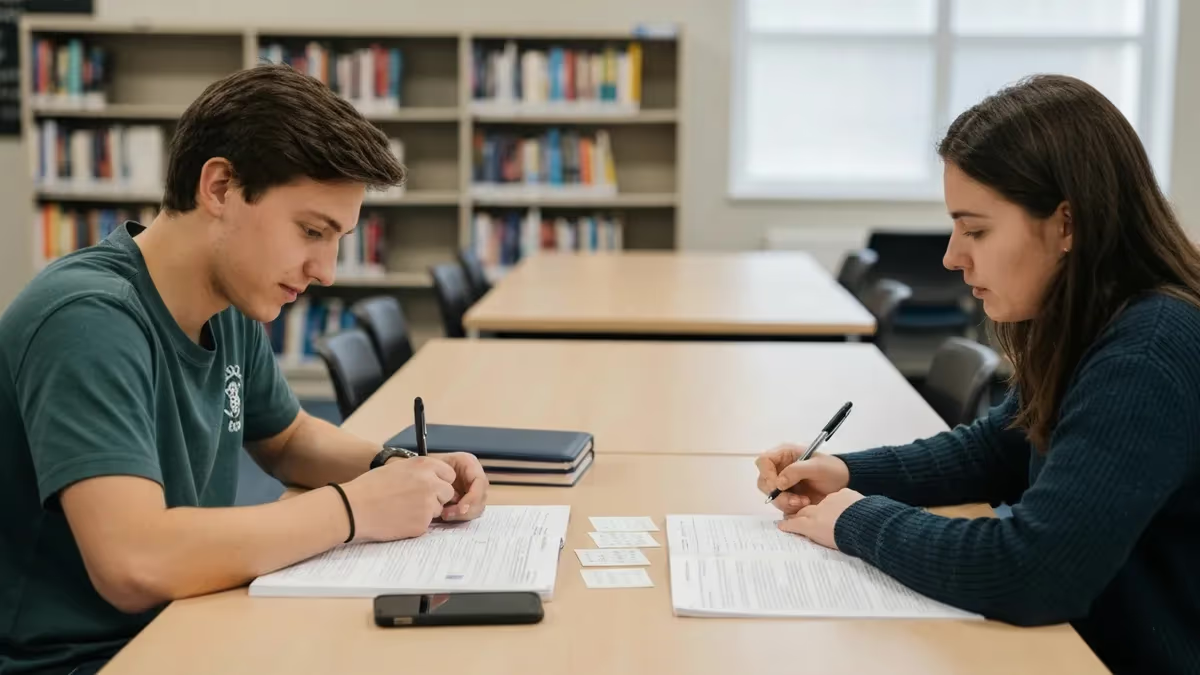
Understanding what is a BLS certification is the first step toward becoming a competent, confident healthcare provider. BLS — Basic Life Support — is a standardized credential that equips clinicians, first responders, and trained laypersons with the skills to recognize and respond to life-threatening emergencies. In today's healthcare environment, pursuing ACLS and BLS certification online has never been more practical, making high-quality emergency training accessible to nurses, physicians, paramedics, and medical students across the United States without sacrificing clinical rigor or AHA standards compliance.
What does BLS stand for? The acronym stands for Basic Life Support, and it encompasses a core set of emergency competencies: high-quality CPR for adults, children, and infants; use of an automated external defibrillator (AED); relief of foreign-body airway obstruction; and effective bag-mask ventilation. These are not just theoretical concepts — they are hands-on protocols that must be performed correctly under pressure, often within the first critical minutes before advanced medical personnel arrive on scene.
A common question among healthcare workers and students is: is BLS the same as CPR? The short answer is no — CPR is one component within BLS. While CPR refers specifically to the chest compressions and rescue breaths used to maintain circulation and oxygenation, BLS training covers a broader scope. BLS includes team dynamics, recognition of cardiac arrest rhythms, two-rescuer CPR coordination, AED operation, bag-mask ventilation, and scenario-based decision making. Thinking of CPR as a subset of BLS is the most accurate way to understand the relationship.
The American Heart Association (AHA) and the American Red Cross are the two dominant credentialing bodies for BLS in the United States. The AHA's BLS for Healthcare Providers course is the gold standard in clinical settings, required by most hospitals, outpatient facilities, and professional licensing boards. The American Red Cross basic life support course is widely accepted in community, public safety, and some healthcare contexts. Both programs deliver nationally recognized certifications, though AHA BLS is specified by name in the majority of hospital employment contracts and nursing school curricula.
Preparing for your certification exam requires more than watching videos or passively reading guidelines. Successful candidates combine active recall, timed practice questions, and scenario-based review to build the pattern recognition needed under real exam conditions. Knowing how long does it take to get bls certification and planning your study timeline accordingly helps you avoid last-minute cramming, which is one of the most common reasons candidates underperform on their first attempt despite knowing the material.
This guide is designed as your comprehensive ACLS and BLS certification online study hub. Whether you are pursuing initial certification, preparing for renewal, or studying for the Advanced Cardiovascular Life Support (ACLS) exam that builds on BLS foundations, the sections below break down everything you need to know: exam format, key content domains, proven study strategies, cost considerations, and free practice tests modeled on actual AHA exam questions. Work through each section methodically and you will enter your exam date with genuine confidence.
Online certification pathways have expanded significantly since the COVID-19 pandemic accelerated the adoption of blended-learning formats. The AHA now offers a fully blended BLS course — online cognitive learning plus an in-person skills check — that many providers find more flexible than traditional classroom-only training. Understanding how these formats work, what employers accept, and how to choose the right course for your specific professional requirements is critical before you invest time and money into any program.
BLS Certification by the Numbers
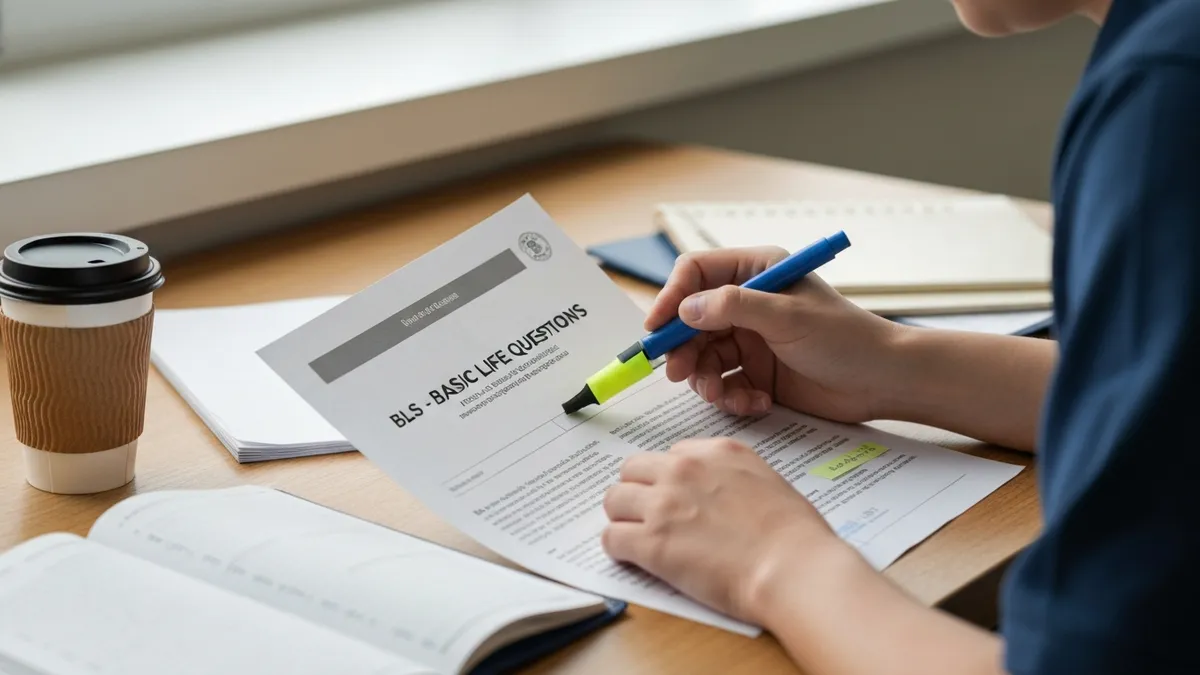
BLS Certification Study Schedule
- ▸Read AHA BLS Provider Manual chapters 1–3
- ▸Learn the Adult Chain of Survival and call-first vs. care-first protocols
- ▸Memorize compression rate (100–120/min) and depth (2–2.4 inches for adults)
- ▸Complete BLS High-Quality CPR Practice Test 1
- ▸Study pediatric and infant BLS differences (1-finger, 2-finger, 2-thumb techniques)
- ▸Review AED operation steps and special populations (pacemakers, wet patients)
- ▸Practice 2-rescuer CPR coordination and team communication
- ▸Complete BLS High-Quality CPR Practice Test 2
- ▸Study choking relief for conscious and unconscious adults, children, and infants
- ▸Review bag-mask ventilation technique and common errors
- ▸Practice special scenarios: pregnancy, opioid overdose, submersion, electrocution
- ▸Complete BLS Special Situations Practice Tests
- ▸Take a full 30-question timed practice exam under realistic conditions
- ▸Review all missed questions and trace them to AHA manual sections
- ▸Practice skills check checklist for in-person session (if blended format)
- ▸Attend in-person skills check or full in-person course
Basic life support for healthcare providers is a distinct, more rigorous track compared to lay-rescuer CPR courses. While community CPR classes teach simplified, compression-only techniques designed for bystanders with no medical training, the BLS for Healthcare Providers course — offered by both the AHA and the American Red Cross — covers a clinical-grade curriculum. This includes two-rescuer CPR, bag-mask ventilation, advanced airway adjuncts, team roles, and integration of CPR with early defibrillation using an AED. Healthcare professionals are expected to master all components, not just compressions.
The basic life support exam American Heart Association format is relatively straightforward once you know what to expect. The AHA BLS written exam consists of 30 multiple-choice questions drawn from the BLS Provider Manual. You must score at least 75% — meaning 23 correct answers out of 30 — to pass the written portion. Questions focus on compression ratios (30:2 for adults and children with one rescuer; 15:2 for two-rescuer infant and child CPR), compression depth, rate, recoil, AED operation, and scenario interpretation. Most candidates who have studied consistently find the written exam manageable.
The aha basic life support exam also includes a hands-on skills component that is evaluated by an AHA-certified instructor. This skills check assesses your ability to perform high-quality adult CPR, use an AED correctly, deliver effective bag-mask ventilations, and respond appropriately to coaching. In the blended learning format, you complete the online cognitive portion on your own schedule and then attend a brief in-person session — typically one to two hours — where the instructor evaluates your skills and signs off on your certification card. This format is now widely available and accepted by most employers.
Understanding the relationship between BLS and ACLS helps you plan your professional development pathway strategically. ACLS — Advanced Cardiovascular Life Support — is the next-level AHA credential that builds directly on BLS foundations. ACLS adds pharmacology (epinephrine, amiodarone, adenosine), advanced airway management (intubation, supraglottic airways), 12-lead ECG interpretation, and systematic management of specific arrest rhythms including VF, VT, PEA, and asystole. Most ACLS courses require current BLS certification as a prerequisite, so getting your BLS card is step one on the ACLS pathway.
Choosing between the AHA and the American Red Cross depends largely on your employer's specific requirements. Most hospitals and healthcare systems in the United States explicitly require AHA BLS certification, particularly for nursing staff, respiratory therapists, and clinical support personnel. The red cross basic life support course is a strong alternative for community health workers, school nurses, fitness professionals, and public safety personnel whose employers do not specify AHA. Before enrolling in any program, verify your employer's accepted credentials to avoid having to repeat a course unnecessarily.
The basic life support online renewal pathway is a convenient option for providers whose certification is expiring. AHA renewal courses cover updated guidelines, changes since your last certification, and a streamlined skills check that assumes you have maintained your competency. Renewal courses are typically shorter than initial certification — around two to three hours for the blended format — because the written exam and skills scenarios are condensed. Note that you cannot renew a BLS card that has already expired; if your card has lapsed, you must complete the full initial certification course rather than a renewal course.
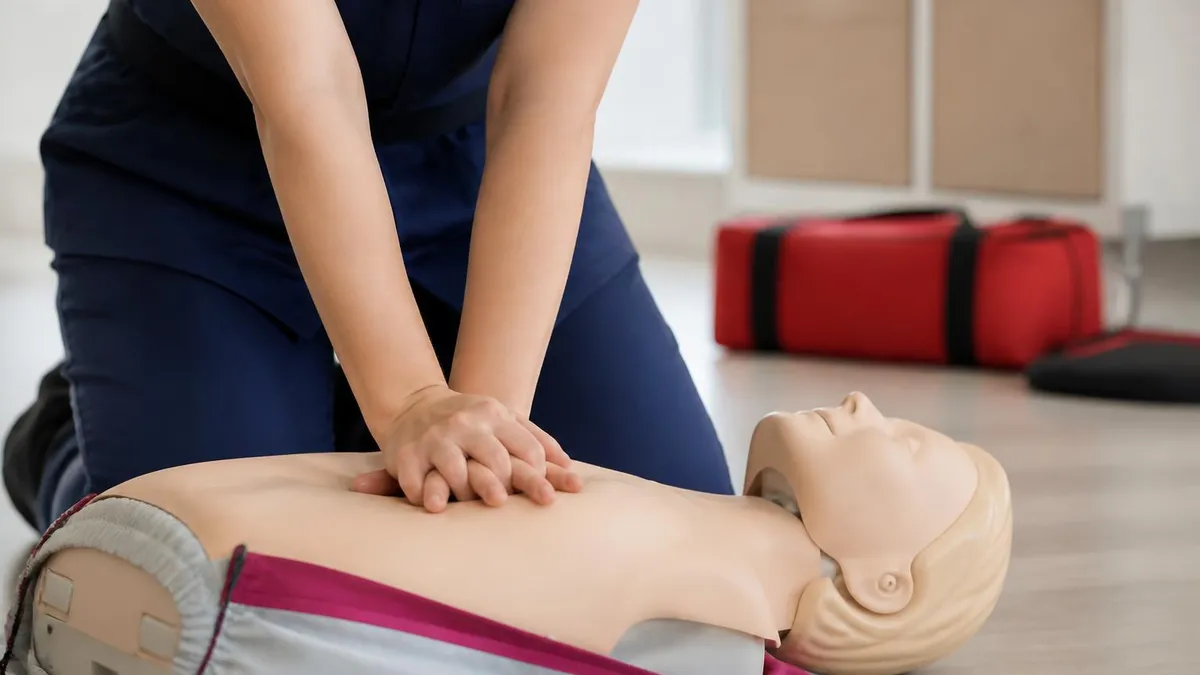
One of the most frequently overlooked aspects of BLS preparation is the systematic integration of knowledge with skills practice. Many candidates score well on practice questions but struggle during the skills check because they have not physically rehearsed compressions, ventilations, and AED steps. If you are preparing for the blended format, arrange access to a mannequin before your in-person session. Community CPR training centers, fire stations, hospital simulation labs, and some community colleges offer open skills practice sessions. Even 30 minutes of deliberate physical practice significantly improves your performance during the instructor evaluation.
Basic Life Support Exam: AHA vs. Red Cross vs. Online Providers
The American Heart Association BLS for Healthcare Providers course is the most widely required credential in U.S. clinical settings. It covers adult, child, and infant CPR; AED operation; bag-mask ventilation; and two-rescuer team dynamics. The blended learning format pairs an online cognitive module — completed at your own pace — with a hands-on skills check lasting roughly 90 minutes with a certified AHA instructor. The written exam is 30 questions with a 75% passing threshold. Most AHA training centers issue your certification card the same day as your skills check.
Costs for the AHA BLS course range from $30 to $80 for the online cognitive portion, with the in-person skills check adding another $20 to $50 depending on the training center. Some hospital systems cover BLS costs for employees as part of credentialing requirements. The AHA Heartsaver BLS course is a separate product designed for non-clinical responders and is generally not accepted as a substitute for the BLS for Healthcare Providers credential in hospital employment contexts. Always verify which specific AHA course your employer requires before enrolling.
Online BLS Certification: Is It Right for You?
- +Complete the cognitive learning portion on your own schedule — no fixed class times
- +Blended AHA format is accepted by the vast majority of U.S. hospitals and clinical employers
- +Online modules use interactive scenarios and animations that reinforce muscle memory concepts
- +Typically cheaper than traditional classroom-only courses when factoring in travel and time
- +Self-paced review lets you spend extra time on weak areas like pediatric CPR ratios
- +Easily accessible in rural or underserved areas where in-person AHA classes are scarce
- −Still requires an in-person skills check for AHA BLS — not fully remote for healthcare providers
- −Technology issues (slow internet, browser compatibility) can disrupt online module completion
- −Without instructor feedback during practice, bad habits can go uncorrected before the skills check
- −Fully online-only (no skills check) cards are rejected by most hospitals and clinical employers
- −Some learners find the online module less engaging than hands-on classroom instruction
- −Scheduling the in-person skills check can still be logistically challenging in some regions
BLS Certification Prep Checklist: Everything You Need Before Exam Day
- ✓Confirm your employer's required BLS provider — AHA BLS for Healthcare Providers is required by most U.S. hospitals.
- ✓Register for an AHA-authorized training center and schedule both the online module and in-person skills check.
- ✓Download or purchase the AHA BLS Provider Manual (2020 guidelines edition) and read it cover to cover.
- ✓Memorize compression rate (100–120/min), depth (2–2.4 in adults; 2 in children; 1.5 in infants), and ratio (30:2 single rescuer; 15:2 two-rescuer child/infant).
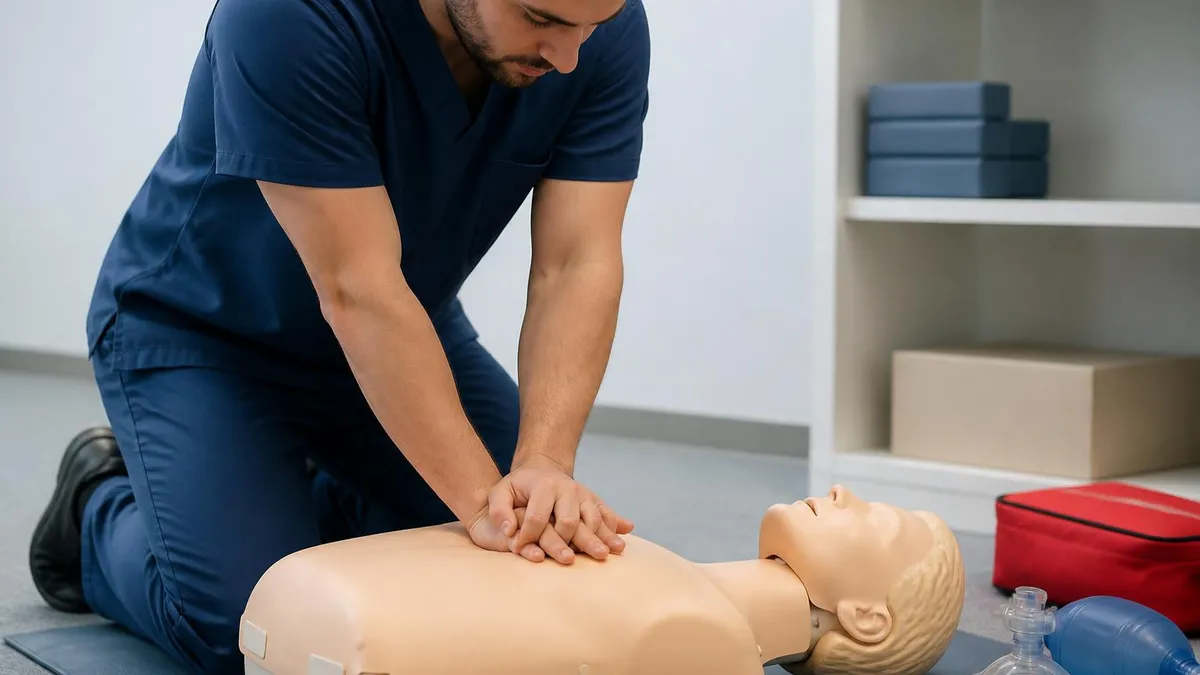
- ✓Practice physical compressions on a mannequin or firm pillow at least twice before your skills check session.
- ✓Review AED operation steps in order: power on, attach pads, analyze rhythm, clear and shock if advised.
- ✓Study bag-mask ventilation technique: proper mask seal, EC clamp grip, one breath over one second with visible chest rise.
- ✓Complete at least two full timed practice exams (30 questions, under 30 minutes) to simulate real exam pacing.
- ✓Review special situations: opioid overdose (naloxone + CPR), drowning (give 5 rescue breaths first), pregnant patients (left lateral tilt).
- ✓Bring your government-issued photo ID and payment confirmation to the skills check session on your scheduled date.

Incorrect Compression Ratios Cost More Points Than Any Other Error
Analysis of AHA BLS written exam question banks consistently shows that compression-to-ventilation ratio errors — confusing 30:2 (single rescuer adult/child/infant) with 15:2 (two-rescuer child/infant) — account for the highest proportion of missed questions. Memorize the single rule: 15:2 applies ONLY to two-rescuer CPR for children and infants. Every other scenario uses 30:2. Burn this distinction into memory before exam day.
Mastering the core BLS skills is not just about passing an exam — it is about performing reliably when a patient's life depends on you. High-quality CPR is the foundation of everything else in BLS, and quality means far more than simply pressing on someone's chest.
The AHA defines high-quality CPR by five measurable parameters: rate of 100 to 120 compressions per minute; depth of at least 2 inches for adults and 2 inches for children (with a maximum of 2.4 inches to avoid injury); complete chest recoil between compressions; minimization of interruptions (pause time under 10 seconds); and avoidance of excessive ventilation. Each of these parameters matters independently — you cannot compensate for shallow compressions with a faster rate.
Understanding compression depth across age groups is a common source of confusion. For adults, the target depth is 2 to 2.4 inches. For children (age 1 to puberty), the target is at least 2 inches — approximately one-third of the anterior-posterior chest diameter. For infants (under 1 year), the target is at least 1.5 inches, again approximately one-third the chest depth.
When performing infant CPR as a single rescuer, you use two fingers on the center of the chest just below the nipple line. In the two-rescuer infant scenario, you use the two-thumb encircling technique, which generates higher peak systolic pressure and is preferred when a second rescuer is available.
AED use is one of the most heavily tested topics on the BLS written exam. The four universal steps are: power on, attach the pads, analyze the rhythm (ensure everyone is clear of the patient), and deliver the shock if advised before immediately resuming CPR.
Common exam questions test your knowledge of special AED situations: for children under 8 years or under 55 lbs, use pediatric pads or a pediatric dose attenuator if available; if unavailable, adult pads may be used. Do not delay defibrillation to start CPR if the AED is immediately available — for witnessed, shockable rhythms, early defibrillation dramatically improves survival rates.
Bag-mask ventilation is the most technically demanding skill in BLS and the one most commonly performed incorrectly during skills checks. The EC-clamp technique is the standard: form the letter E with your middle, ring, and little fingers under the jaw to lift it forward, while your thumb and index finger form the letter C to create a tight seal over the mask.
Each breath should be delivered over one second and produce visible chest rise — no more, no less. Over-ventilation is a critical error that increases intrathoracic pressure, reduces venous return to the heart, and worsens outcomes during CPR. If you see the chest rise, that breath was adequate.
Team dynamics are a uniquely important component of BLS for Healthcare Providers that distinguishes it from lay-rescuer CPR training. The AHA emphasizes clear role assignment (compressor, ventilator, AED operator, team leader, recorder), closed-loop communication (speaker states instruction, receiver acknowledges and confirms completion), and constructive feedback during resuscitation. Exam questions may present scenarios where team communication breaks down and ask you to identify the error or correct response. These questions are testing your understanding of resuscitation team leadership, not just individual CPR skills.
Choking management is tested in both written and skills format. For a conscious adult or child with a severe airway obstruction, deliver abdominal thrusts (Heimlich maneuver) until the object is expelled or the patient loses consciousness. For a conscious infant with severe obstruction, use five back blows followed by five chest thrusts — never abdominal thrusts on infants. If any victim becomes unconscious, lower them carefully to the ground and begin CPR, looking in the mouth before each ventilation attempt and removing any visible object. Do not perform blind finger sweeps, which can push the obstruction deeper.
The most important mindset shift for BLS exam success is thinking like a provider, not a student. That means practicing decision trees — not just memorizing isolated facts — so that when an exam question presents a scenario, you can reason through it systematically: Is the patient responsive? Is there a pulse? Is the victim adult, child, or infant? Are there two rescuers or one? What is the shockable vs. non-shockable rhythm? Building this systematic approach through scenario-based practice questions produces far better exam performance than passive re-reading of the manual.
AHA BLS certification is valid for exactly two years from the date your skills check is completed and signed off by an instructor. If your certification expires — even by one day — you are no longer eligible for the shorter renewal course and must complete the full initial BLS for Healthcare Providers course again. Most hospital credentialing departments require proof of valid BLS before your hire date or before you can practice independently. Plan your renewal at least 60 days before your expiration date to allow scheduling flexibility.
BLS renewal and recertification are areas where many providers make costly, avoidable mistakes. The most important thing to know is that AHA BLS certification must be renewed before it expires — not after. Many providers mistakenly schedule their renewal course for the month their card expires, only to discover that their training center cannot accommodate them on that exact date, leaving them with a lapsed credential. The safe approach is to begin the renewal process 60 to 90 days before expiration, giving you a substantial buffer for scheduling complications, course availability, and any administrative delays in receiving your updated card.
Knowing how long does basic life support certification last is essential for building a sustainable credential management calendar. AHA BLS cards are valid for two years. However, the clock starts from the date your skills check is completed and certified by an instructor — not from the date you completed the online module. This distinction matters because providers sometimes complete the online cognitive portion weeks before their in-person skills session, and may miscalculate their expiration date. Always use the date printed on your AHA BLS Provider card as your official expiration date.
Renewal courses are structured differently from initial certification courses. They assume you already have foundational competency and focus on guideline updates, correcting common errors observed in clinical practice, and streamlined skills verification rather than a from-scratch skills assessment. The AHA BLS renewal course in blended format typically takes two to three hours total — around 60 to 90 minutes of online modules plus a 60-minute in-person skills check. Some hospital systems run in-house renewal sessions specifically for credentialed staff, which can be more convenient and sometimes free as an employee benefit.
The basic life support renewal class content is updated periodically to reflect new AHA guidelines. The most recent major update was the 2020 AHA Guidelines for CPR and Emergency Cardiovascular Care, which brought significant changes including updated recommendations for systems of care, dispatcher-assisted CPR, opioid-associated emergencies (including naloxone administration), and COVID-19 personal protective equipment (PPE) modifications. Providers renewing after a gap of several years should pay particular attention to these updates and not assume that their previous training fully covers current protocols.
For those pursuing ACLS certification alongside or after BLS, the renewal cycle requires careful coordination. ACLS is also valid for two years, but the skills and knowledge required are substantially more complex. Most ACLS providers renew BLS and ACLS simultaneously or within the same time period to simplify their credentialing calendar. Some training centers offer combined BLS renewal and ACLS initial or renewal packages, which can save time and cost compared to booking separate sessions. Verify that your ACLS renewal provider is AHA-authorized — ACLS renewal from non-AHA providers is generally not accepted in hospital settings.
Many healthcare professionals are now exploring the basic life support certification cost before committing to a specific training center, and this is a wise approach. Costs vary considerably depending on format, location, and provider. Hospital-sponsored in-house renewal courses are typically free or heavily subsidized for employees. Independent AHA training centers charge between $50 and $150 for the full BLS for Healthcare Providers blended course, with renewal courses on the lower end of that range. Online cognitive modules sold directly through the AHA website cost approximately $30, with the separate skills check fee set by the local training center.
International healthcare professionals working in the United States should also be aware that BLS certification earned outside the U.S. — even from internationally recognized bodies — is typically not accepted by U.S. hospital credentialing departments, which almost universally require AHA BLS specifically. International providers must complete the full AHA BLS for Healthcare Providers course in the United States, regardless of their existing certifications from other countries. Some providers are surprised by this requirement, so it is worth confirming with your employer's credentialing department before assuming foreign BLS credentials will transfer.
Practical exam-day strategies make a measurable difference in BLS written exam performance. Arrive early to your skills check session — ideally 10 to 15 minutes ahead of your scheduled time — so you have a moment to mentally review the key protocols before the pressure of the skills evaluation begins. Review your compression depth, rate, and ratio one final time.
Remind yourself of the two scenarios where CPR ratios differ from the default: two-rescuer child CPR (15:2) and two-rescuer infant CPR (15:2). Every other scenario is 30:2. This single mental review at the door has saved many providers from avoidable errors in the first 60 seconds of a skills scenario.
During the written exam portion, read each question carefully and identify the key variables before evaluating the answer choices: patient age (adult, child, or infant), number of rescuers, presence or absence of an AED, whether the cardiac arrest was witnessed, and whether the patient has a pulse or not. Many BLS exam questions are designed to test whether you correctly identify the scenario type before applying the appropriate protocol. Rushing through the scenario setup and jumping to answers is the most common error pattern on the written test, even among well-prepared candidates.
Time management on the written portion is generally not a significant challenge — 30 questions in 30 minutes gives a full minute per question, which is more than adequate for most candidates. Use the time to be deliberate. Flag questions where you are genuinely uncertain and return to them after completing the questions you are confident about. On review, trust your first instinct on questions where two choices seem plausible — research on multiple-choice testing consistently shows that initial responses are more often correct than second-guessed revisions unless you recall a specific fact that clearly changes the answer.
Physical preparation for the skills check is often neglected in online-first study approaches, but it is critically important. High-quality CPR requires more physical stamina than most providers expect, particularly for two-minute cycles of uninterrupted compressions. Rescuer fatigue is a real and clinically significant problem that leads to decreased compression depth and rate within 90 seconds for most untrained individuals. During skills evaluations, instructors watch specifically for compression depth declining over time, which indicates fatigue-related quality drop. Practice performing full two-minute cycles of compressions on a mannequin or pillow before your evaluation to develop the muscular endurance needed.
Scenario-based practice is the highest-value study activity for the skills check. Run through the full sequence for adult single-rescuer CPR: ensure scene safety, tap and shout to check responsiveness, activate EMS, check breathing and pulse simultaneously for no more than 10 seconds, begin CPR at 30:2, attach AED, analyze, shock, resume CPR immediately. Run through two-rescuer scenarios, pediatric scenarios, and choking response.
For each scenario, verbalize your decisions out loud as you would in a real resuscitation — instructors award credit for verbalized assessments even when the mannequin cannot respond. Saying "I am checking for a pulse and breathing — no pulse, no breathing, beginning CPR" shows the evaluator you are following the protocol correctly.
Candidates who incorporate free online BLS practice tests into their study routine consistently outperform those who rely solely on passive reading. Practice questions force active recall, expose gaps in knowledge before exam day, and build the pattern recognition needed to work efficiently through scenario-based items. Aim to complete at least 100 to 150 practice questions in the two weeks before your certification date, distributed across high-quality CPR mechanics, pediatric and infant protocols, AED operation, special scenarios, and team dynamics. Track your accuracy by topic category and focus additional study time on the categories where your accuracy falls below 80%.
After passing your BLS exam and receiving your card, protect the document carefully. Most AHA training centers issue a digital card accessible through the AHA Training Network portal, with a physical laminated card mailed separately. Store a photo of both sides of your card in a secure cloud location so you can access proof of certification quickly if needed for employment verification, credentialing paperwork, or facility access.
Some hospital systems connect directly to the AHA portal for electronic verification, but many credentialing departments still request a physical or PDF copy of the card. Keep track of your certification issue date and expiration date in your professional calendar with renewal reminders set 90 days in advance.
BLS Questions and Answers

BLS Certificate Lookup: What Is a BLS Certification and How to Get Yours
Free Basic Life Support MCQ Questions and Answers Guide
AHA BLS Certification: Course, Renewal, and Exam Guide
BLS Training: Course Content, Format & How to Get Certified

Online BLS: Complete Guide to Getting Your Basic Life Support Certification
About the Author

Registered Nurse & Healthcare Educator
Johns Hopkins University School of NursingDr. Sarah Mitchell is a board-certified registered nurse with over 15 years of clinical and academic experience. She completed her PhD in Nursing Science at Johns Hopkins University and has taught NCLEX preparation and clinical skills courses for nursing students across the United States. Her research focuses on evidence-based exam preparation strategies for healthcare certification candidates.
Join the Discussion
Connect with other students preparing for this exam. Share tips, ask questions, and get advice from people who have been there.
View discussion (8 replies)