
ARRT Certification: How Long Does It Take? Complete Timeline & Requirements
How long does ARRT certification take? 🎓 Learn the full timeline from education to exam — typically 2–4 years. Requirements, costs & prep tips inside.
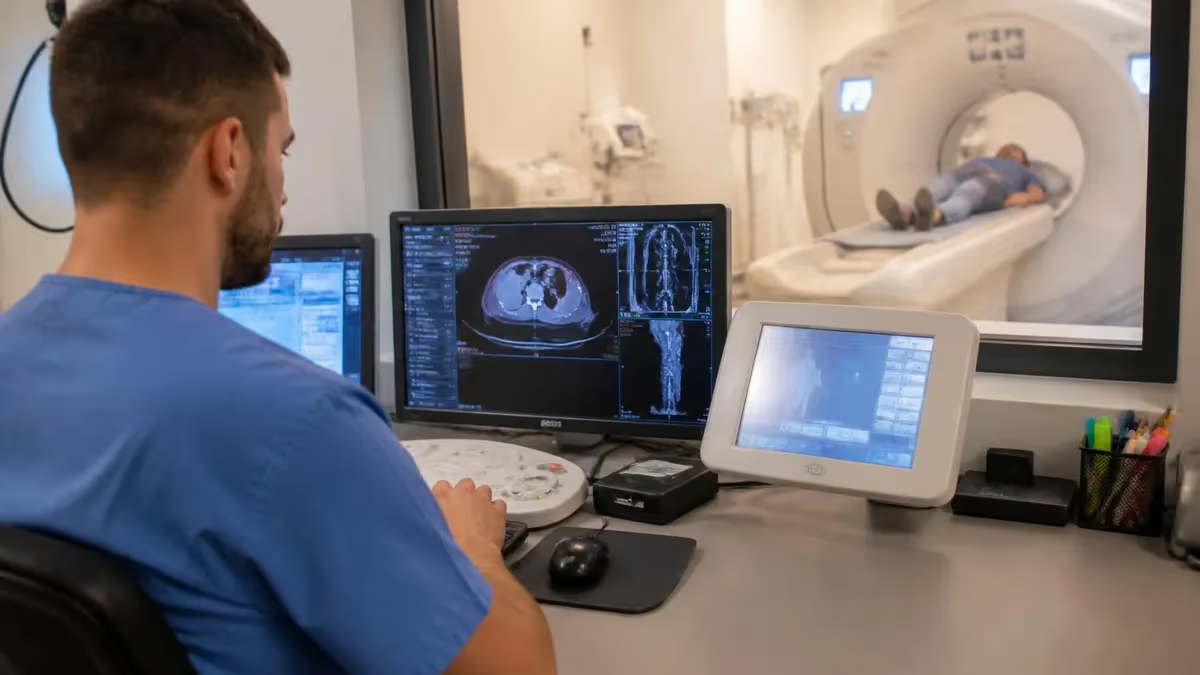
If you are wondering how long ARRT certification takes, the honest answer is that it depends on which educational path you choose and how quickly you move through the application process — but for most candidates, the full journey from enrolling in an accredited program to holding an active ARRT credential spans two to four years.
Understanding arrt certification how long the process realistically takes helps you plan your finances, career timeline, and family commitments before you ever set foot in a classroom. The American Registry of Radiologic Technologists is the primary credentialing body for radiologic science professionals in the United States, and its certification is widely recognized as the gold standard for employers across hospitals, imaging centers, and outpatient clinics nationwide.
The largest chunk of that timeline is consumed by your formal education. An associate degree in radiologic technology — the most common entry point — takes approximately two years of full-time study at an accredited community college or hospital-based program.
During that time you will complete both classroom coursework and extensive clinical rotations, which give you the hands-on patient care experience that ARRT requires before you can even apply to sit for the primary certification examination. Programs accredited by JRCERT (Joint Review Committee on Education in Radiologic Technology) are the ones ARRT recognizes, so verifying your school's accreditation status is a non-negotiable first step.
Bachelor's degree programs in radiologic science or medical imaging typically run four years, adding roughly two additional years compared to the associate degree route. These programs often include more advanced coursework in imaging physics, management, and specialized modalities, which can give graduates a competitive edge for supervisory roles or specialty certifications later in their careers. Some students choose a two-plus-two pathway, completing an associate degree and earning initial ARRT certification before returning to school to upgrade to a bachelor's degree — a flexible approach that lets you start working and earning income while continuing your education on a part-time basis.
After graduating from your accredited program, the ARRT application process itself adds additional weeks or months to the overall timeline. You must submit a formal application, pay the required examination fee, provide documentation of your educational and clinical competencies, and pass an ethics review if your personal history requires one. ARRT typically reviews complete applications within four to six weeks, and once approved you receive an Authorization to Test (ATT) that allows you to schedule your Pearson VUE examination appointment at a testing center near you. Most candidates schedule their exam within two to four weeks of receiving their ATT.
Exam preparation is another phase that adds time but should never be rushed. Most candidates spend six to twelve weeks studying before sitting for the ARRT registry exam. The examination itself covers radiation protection, equipment operation, image production, and patient care, and it consists of 220 total questions with 200 scored items. First-time pass rates hover around 85 to 90 percent for candidates who completed JRCERT-accredited programs and prepared thoroughly, so investing adequate study time is strongly correlated with passing on the first attempt and avoiding the cost and delay of a retake.
Once you pass the examination, ARRT mails your official certificate and wallet card, and your name appears in the ARRT online verification database — a resource that employers check regularly before making hiring decisions. From this point forward you must maintain your credential by completing 24 continuing education credits every two years, ensuring that your knowledge stays current as imaging technology and patient care standards evolve. Planning for those ongoing CE requirements from the very beginning helps you budget time and money throughout your career rather than scrambling at the renewal deadline.
The bottom line for prospective radiologic technologists is that ARRT certification is a meaningful investment of time — typically two to four years for initial credentialing — but the rewards are substantial. Radiologic technologists enjoy strong job security, competitive salaries averaging around $65,000 per year nationally, and the opportunity to specialize in high-demand modalities like MRI, CT, and mammography through ARRT's post-primary certification pathways. Knowing exactly what to expect at each stage makes the journey feel manageable rather than overwhelming, and the sections below walk through every phase in detail.
ARRT Certification by the Numbers

Step-by-Step ARRT Certification Timeline
Enroll in an Accredited Program
Complete Didactic Coursework
Log Clinical Competencies
Submit ARRT Application
Receive ATT and Schedule Exam
Pass Exam & Receive Credential
The ARRT application and eligibility phase is often where candidates encounter unexpected delays, so understanding exactly what documents and criteria are required before you graduate can save weeks of back-and-forth processing time. ARRT's primary pathway requires candidates to have graduated from a JRCERT-accredited or ARRT-recognized program, completed all required clinical competencies, and met the organization's ethics requirements — and all three of those criteria must be satisfied before your application can be approved.
Starting your ethics review paperwork early is particularly important if you have any prior criminal history, because the review process can add four to eight weeks or more to your timeline depending on the complexity of your case.
Ethics compliance is one of the most misunderstood aspects of ARRT eligibility. ARRT does not automatically disqualify candidates with prior criminal records, but it does conduct an individualized review that weighs factors like the nature of the offense, how much time has passed, and evidence of rehabilitation.
Candidates are strongly encouraged to use ARRT's pre-application ethics review service, which lets you submit your history for an advisory opinion before you enroll in a program — avoiding the painful scenario of completing two years of education only to discover an eligibility problem at the application stage. This proactive step costs a small fee but provides enormous peace of mind.
The application fee structure is another practical consideration when planning your certification timeline and budget. As of 2025, ARRT charges $200 for the primary certification examination, and this fee covers one exam attempt. If you do not pass on the first try, you must pay the full fee again for each retake, making adequate preparation not just an academic priority but a financial one. ARRT allows candidates up to three attempts per eligibility period, and if you exhaust all three attempts without passing, you must complete additional education before applying again — a significant setback in both time and cost.
Once your application is submitted and complete, ARRT's review team verifies your educational credentials, contacts your program director to confirm your competency documentation, and checks your ethics disclosures against public records. For straightforward applications — graduates of well-known JRCERT programs with no ethics issues — the review typically takes four to six weeks.
Incomplete applications, meaning those missing a transcript, missing a program director signature, or requiring additional ethics documentation, can take significantly longer and restart the clock each time a new document is submitted. Keeping a personal checklist of every required document and confirming receipt with ARRT is a best practice that can prevent frustrating delays.
After ARRT approves your application, your Authorization to Test (ATT) is emailed to the address on file in your ARRT account. The ATT is valid for 90 days from its issue date, and this window is non-negotiable — if you do not schedule and sit for your exam within those 90 days, your ATT expires and you must reapply and pay the fee again.
Given that Pearson VUE testing centers can have limited availability during peak periods, scheduling your appointment within the first week of receiving your ATT is strongly recommended rather than waiting until the last month of your eligibility window.
Candidates who need testing accommodations — including extended time, a private testing room, or an accessible testing center — must request those accommodations through ARRT before the ATT is issued, not through Pearson VUE directly. ARRT's accommodations process requires supporting documentation from a licensed professional (such as a psychologist or physician) describing the nature of your disability and the specific accommodations recommended. Processing time for accommodation requests is typically two to three weeks beyond the standard application review, so submitting this documentation as early as possible is essential for candidates who need it.
The overall message for the application phase is that organization and proactive communication with ARRT are your most valuable tools. Read every ARRT communication carefully, check your ARRT online account regularly for status updates, and respond promptly to any requests for additional information. Candidates who treat the application process with the same diligence they applied to their clinical training consistently report smoother and faster approval timelines than those who approach it casually. With a complete, well-organized application, most candidates move from graduation to Authorization to Test within six to eight weeks.
ARRT Exam Preparation Strategies
Most successful candidates dedicate six to twelve weeks of focused preparation before sitting for the ARRT registry examination. A realistic weekly study schedule includes three to four sessions of ninety minutes each, covering one content category per week — radiation protection, equipment operation, image production, radiographic procedures, and patient care. Beginning with your weakest content area and rotating through all categories ensures comprehensive coverage rather than over-studying familiar material while neglecting genuine knowledge gaps.
Practice exams are arguably the single most effective preparation tool available. Completing at least three to five full-length practice tests under timed, test-center conditions — no notes, no phone, strict time limits — acclimates you to the pacing and question format of the actual computer-adaptive exam. Review every missed question thoroughly, tracing wrong answers back to the underlying concept rather than simply memorizing the correct choice. Candidates who integrate weekly practice testing from the first week of study consistently report lower test-day anxiety and higher first-attempt pass rates than those who only study content without testing themselves.
Is Pursuing ARRT Certification Worth the Time Investment?
- +National employer recognition — ARRT credential is the universal hiring standard across hospitals and imaging centers
- +Strong salary trajectory — starting salaries around $50,000 with experienced RTs earning $75,000+ in high-cost markets
- +Job security — Bureau of Labor Statistics projects 6% growth through 2032, faster than average for all occupations
- +Specialty certification pathways — ARRT offers 17 post-primary credentials in CT, MRI, mammography, and more
- +Portable license — ARRT certification satisfies licensure requirements in most US states, enabling career relocation
- +Professional respect — credential signals rigorous training and ethical standards to both employers and patients
- −Two to four year time commitment before earning first paycheck as a credentialed technologist
- −Program tuition typically ranges from $15,000 to $50,000 depending on institution type and location
- −$200 examination fee per attempt — retakes require repayment with no partial credit
- −24 continuing education credits required every two years to maintain active credential status
- −Ethics review process can be lengthy and stressful for candidates with any prior legal history
- −Limited flexibility — ARRT-recognized programs are structured and time-intensive, making part-time completion difficult
ARRT Certification Checklist: Everything You Need to Complete
- ✓Verify your program holds JRCERT accreditation before enrolling — check jrcert.org directly.
- ✓Complete all required didactic coursework in positioning, physics, radiobiology, and patient care.
- ✓Document every clinical competency with your supervising RT's signature as you demonstrate each procedure.
- ✓Submit a pre-application ethics review to ARRT if you have any criminal or disciplinary history.
- ✓Obtain official transcripts from your program's registrar and confirm they list your degree as conferred.
- ✓Pay the $200 ARRT examination fee and submit a complete online application immediately after graduation.
- ✓Monitor your ARRT account weekly and respond within 48 hours to any requests for additional documentation.
- ✓Schedule your Pearson VUE exam appointment within the first week of receiving your Authorization to Test.
- ✓Complete at least five full-length timed practice exams before sitting for the actual registry examination.
- ✓Arrange two forms of valid government-issued photo ID and verify your name matches your ARRT application exactly.
Ethics Disclosures Can Add 4–8 Weeks to Your Timeline
If you have any criminal history — even a minor offense that was expunged — submit ARRT's pre-application ethics review before enrolling in your program. ARRT offers an advisory opinion service that tells you in advance whether your history affects eligibility. Discovering an ethics issue after two years of school is far more costly than a proactive $150 pre-review fee.
Once you hold your primary ARRT credential in radiography, computed tomography, or another discipline, the journey toward specialty certification opens an entirely new chapter of your career — one that typically adds six months to two years of additional preparation time per specialty but dramatically expands your employability and earning potential.
ARRT offers 17 post-primary certification pathways organized into two categories: advanced qualifications and post-primary certifications. Advanced qualifications, such as those in Vascular-Interventional Radiography or Cardiac-Interventional Radiography, are available to technologists who already hold specific primary certifications and have completed a designated number of clinical hours in the specialty area within the preceding two years.
The timeline for earning a post-primary certification varies significantly by specialty. Computed tomography (CT) is among the most popular post-primary credentials, and many radiographers pursue it within the first one to two years of employment because CT experience accumulates rapidly in busy imaging departments. The CT examination covers CT physics, patient care specific to contrast administration and radiation dose management, and image production including reconstruction algorithms and multiplanar reformation techniques. Candidates must document 16 structured education hours and meet clinical experience requirements before applying, adding a structured preparation phase of approximately three to six months for most working technologists.
Magnetic resonance imaging (MRI) certification is another widely pursued post-primary credential, but its timeline is typically longer because MRI environments in many facilities are more restricted, meaning that radiographers do not accumulate MRI clinical hours as quickly as CT hours. The MRI examination blueprint differs substantially from the primary radiography exam, covering magnetic field safety, radiofrequency physics, pulse sequences, and MRI-specific patient screening protocols — all of which require dedicated study using MRI-specific resources rather than general radiography review materials. Most candidates preparing for MRI certification spend three to six months in focused preparation after accumulating the required clinical hours.
Mammography certification under ARRT has unique prerequisites tied to the Mammography Quality Standards Act (MQSA), which requires mammography technologists to meet specific initial and continuing education requirements separate from and in addition to ARRT's own credentialing standards. This dual-compliance landscape means that pursuing mammography certification requires careful coordination between ARRT's application timeline and your facility's MQSA compliance calendar. Candidates typically spend four to eight months satisfying all prerequisites before sitting for the mammography examination, and initial qualification must be completed within 180 days of a technologist's first day performing mammography independently.
For technologists interested in the fluoroscopy-heavy specialties — fluoroscopy, vascular-interventional, and cardiac-interventional — the clinical hour requirements are substantial, often requiring one to two years of full-time work in a dedicated interventional or cardiac cath lab environment before the minimum clinical documentation thresholds are met. These are also among the highest-paying radiologic science specialties, with experienced interventional technologists earning $80,000 to $110,000 annually in major metropolitan markets. The extended timeline to specialty certification in these areas reflects the genuine complexity of the skill set required and the high-stakes clinical environments in which these technologists work.
Nuclear medicine technology and radiation therapy are separate primary credentials from radiography, each with their own accredited educational programs, examination blueprints, and preparation timelines. Nuclear medicine programs typically take two years at the associate level, while radiation therapy programs are commonly offered as either two-year associate or four-year bachelor's degrees. Both fields require candidates to pass ARRT's primary examination in their respective discipline before applying for any post-primary credentials, meaning the base timeline for credentialing in these fields mirrors the radiography pathway in length even though the content is entirely different.
The strategic implication for new radiologic technologists planning their careers is to identify target specialty certifications as early as possible — ideally before graduation — so you can intentionally seek employment in facilities that offer clinical exposure in your desired specialty. A candidate who wants to pursue MRI certification within three years of graduation should target hospitals with active MRI departments and negotiate for cross-training opportunities from the outset of their career.
Proactive career planning around post-primary certification timelines is the difference between reaching your specialty credential in three years versus five or more, and it begins with knowing exactly which clinical experience requirements each target certification demands.

Your Authorization to Test expires exactly 90 days after ARRT issues it — there are no extensions. If you let your ATT expire without sitting for the exam, you must reapply and pay the full $200 examination fee again. Schedule your Pearson VUE appointment within the first week of receiving your ATT, not the last week, to avoid availability issues at testing centers during peak periods.
Maintaining your ARRT credential requires ongoing engagement with continuing education throughout your career, and understanding the renewal requirements from day one prevents the scramble that many technologists experience in the final months before their two-year deadline. ARRT requires all certificants to complete 24 continuing education credits every two years, with the renewal period running on a calendar-year cycle tied to your certification date.
At least 12 of those 24 credits must be related to your area of practice — meaning they must have direct relevance to the imaging or therapeutic modality in which you hold your credential — and all credits must come from ARRT-recognized providers to count toward renewal.
The most common continuing education formats accepted by ARRT include web-based courses through ASRT (American Society of Radiologic Technologists), journal-based CE through peer-reviewed publications like Radiologic Technology, in-person conference sessions at state and national ASRT meetings, and facility-based in-service education that meets ARRT's documentation standards. ASRT membership provides access to an extensive library of online CE courses that cover everything from radiation dose optimization to patient communication strategies, and many technologists find that ASRT membership pays for itself entirely through the CE content it provides each renewal cycle, especially when annual conference attendance is factored in.
ARRT operates on an audit system for continuing education, meaning that not every technologist's CE credits are verified in detail during each renewal cycle — but a random sample of certificants is audited each year. If you are selected for an audit, you must provide documentation for every CE credit you reported, including certificates of completion, learning outcome descriptions, and provider approval documentation.
Maintaining organized digital records of all your CE certificates throughout the two-year cycle — rather than scrambling to reconstruct them at renewal time — is an essential professional habit that protects your credential in the event of an audit.
Technologists who allow their ARRT credentials to lapse — either by failing to complete the required CE credits or by missing the renewal deadline — face a reinstatement process that is both time-consuming and more expensive than staying current. Lapsed credentials can often be reinstated within a defined window by completing overdue CE and paying a reinstatement fee, but credentials that have been inactive for several years may require retesting.
Because many states tie their radiologic technology licensure to active ARRT certification, a lapsed credential can technically mean working out of compliance with state law, which carries legal and employment risks far more serious than the inconvenience of CE completion.
Beyond the mandatory CE requirement, ARRT offers Continuing Qualifications Requirements (CQR) for technologists holding certain post-primary credentials, particularly in computed tomography, magnetic resonance imaging, and mammography. CQR is a structured self-assessment process designed to ensure that credentialed specialists are maintaining genuine competence in their specialty area, not simply completing generic continuing education that may have limited relevance to their daily work. Completing CQR on schedule is required to maintain post-primary credentials, and the process involves both a knowledge assessment and documentation of ongoing clinical practice — adding an additional layer of accountability beyond the standard CE requirement.
State licensure requirements add another dimension to the maintenance timeline for many radiologic technologists. Most states that license radiologic technologists require proof of active ARRT certification as a condition of licensure renewal, but some states impose additional requirements — such as state-specific CE on topics like radiation safety regulations or mandatory reporter training — beyond what ARRT requires for credentialing. Moving to a new state mid-career may require applying for a new state license and potentially completing state-mandated education modules, so researching your destination state's licensure requirements before relocating is prudent planning.
For technologists who want to stay ahead of their renewal requirements rather than playing catch-up at deadline time, a simple strategy is to complete eight CE credits per year rather than bunching all 24 into the final six months of the renewal cycle.
Spreading CE completion throughout the two-year period reduces the time pressure, allows you to pursue CE topics that genuinely interest you rather than whatever is available at the last minute, and ensures that you are continuously refreshing your knowledge rather than treating CE as a box to check. Treating continuing education as a genuine investment in your professional development — rather than a bureaucratic hurdle — is the mindset that distinguishes the most respected and career-resilient radiologic technologists in the field.
Practical exam preparation for the ARRT registry examination requires more than accumulating study hours — it requires strategic, structured practice that mirrors the format and cognitive demands of the actual computer-adaptive test.
One of the most common mistakes candidates make is spending the majority of their study time re-reading textbooks and reviewing class notes passively, which builds familiarity with content but does not develop the active recall and clinical reasoning skills that ARRT examinations specifically assess. Switching your study ratio so that at least half of your preparation time involves answering practice questions — rather than reading — produces measurably better outcomes for most learners.
Content mastery in radiographic positioning is arguably the most practice-intensive component of ARRT exam preparation because positioning knowledge must be applied accurately under time pressure across dozens of anatomical regions. Rather than trying to memorize every positioning detail in isolation, experienced candidates organize their positioning review by body system and practice drawing positioning diagrams from memory — marking CR angulation, IR placement, patient position, and structures of interest for each projection.
This active retrieval method is far more effective than re-reading position descriptions passively and builds the durable memory traces needed to answer positioning questions accurately after sitting in a testing center for two to three hours.
Radiation protection questions on the ARRT exam require both conceptual understanding and calculation fluency, particularly around inverse square law problems, collimation effects on patient dose, and protective shielding requirements. Candidates who struggle with radiation protection calculations should dedicate specific timed practice sessions exclusively to working through mathematical problems without a calculator, since the ARRT exam does not permit calculator use. Building mental arithmetic speed for common radiation calculations is a skill that requires repeated practice over several weeks rather than an overnight review session, so addressing this content area early in your preparation timeline is important.
The equipment operation and quality assurance section of the exam tests knowledge of x-ray tube components, generator types, automatic exposure control systems, and image receptor technologies including computed radiography (CR) and digital radiography (DR) systems. Modern clinical environments have largely transitioned to digital imaging, but ARRT exam questions still address film-screen relationships, processing chemistry, and densitometry concepts that appear less frequently in daily clinical practice.
Reviewing these legacy topics systematically rather than assuming familiarity from clinical exposure is important because they reliably appear on every exam administration and represent points that candidates who work exclusively in digital environments tend to miss.
Patient care and management questions assess knowledge of infection control, contrast media reactions, patient positioning for non-standard clinical situations, and professional communication standards. These questions reward candidates who have genuine clinical experience and have paid attention to the rationale behind patient care protocols rather than simply following institutional procedures by rote. If patient care is a relative weakness in your practice test performance, reviewing ASRT's clinical practice standards and ARRT's own patient care resources — rather than generic nursing textbooks — will give you the most exam-relevant content in the shortest time.
Two to three days before your exam, transition from intensive studying to light review and active recovery. Complete one final practice test to confirm your readiness, review any flagged weak areas briefly, and then stop introducing new content. Use the final 48 hours to prioritize sleep, normal nutrition, and moderate physical activity — all of which have documented effects on cognitive performance and memory consolidation.
Arriving at the testing center well-rested and physically prepared is not a soft recommendation; sleep deprivation measurably impairs the fluid reasoning required to answer novel clinical scenario questions, which are precisely the question type that differentiates high-scoring candidates on computer-adaptive examinations.
After passing the exam, take a moment to acknowledge what you have accomplished — ARRT certification represents years of academic effort, hundreds of clinical hours, and a rigorous standardized assessment of professional competence. The credential you have earned opens doors to a career in one of healthcare's most technologically dynamic fields, with multiple specialty pathways, strong salary growth, and the genuine satisfaction of contributing directly to patient diagnosis and care.
Every step of the preparation process, from your first day of radiography school to the moment your score appears on that testing center screen, has been building toward this outcome, and the habits of disciplined study and continuous learning you have developed along the way will serve you for the full length of your career.
ARRT Questions and Answers

ARRT Study Guide 2026: Complete Exam Prep for Radiologic Technologists

ARRT Practice Test PDF (Free Printable 2026)

ARRT Practice Test 2026: Free Questions & Full Exam Prep Guide
ARRT Credentials: Complete Guide to Types, Requirements & How to Earn Them

ARRT Certification: Requirements, Exam & How to Get Certified
About the Author

Medical Laboratory Scientist & Clinical Certification Expert
Johns Hopkins UniversityDr. Sandra Kim holds a PhD in Clinical Laboratory Science from Johns Hopkins University and is certified as a Medical Technologist (MT) and Medical Laboratory Scientist (MLS) through ASCP. With 16 years of clinical laboratory experience spanning hematology, microbiology, and molecular diagnostics, she prepares candidates for ASCP board exams, MLT, MLS, and specialist certification tests.