
ARRT Certification: Requirements, Exam & How to Get Certified 2026 October
ARRT certification guide: eligibility, education requirements, exam format, passing score, and step-by-step process to become a registered radiologic ❓
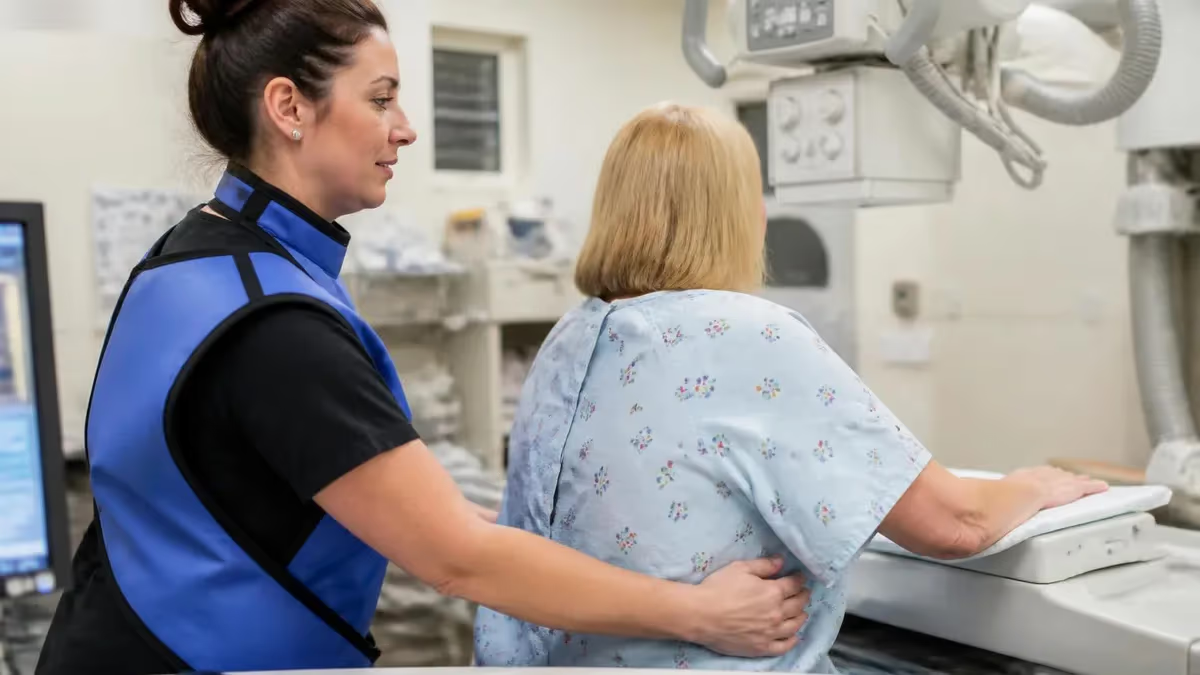
rt certification: What You Need to Know Before You Start
Getting your ARRT certification is one of the most important steps you will take in a radiologic technology career. The American Registry of Radiologic Technologists sets the standard across the country — hospitals, clinics, and imaging centers rely on that "R.T.(R)" credential to know you are qualified. But there is a lot of ground to cover before you sit for the exam, and the requirements are stricter than many candidates expect.
This guide breaks down everything you need — eligibility rules, education requirements, the ethics review process, what the exam actually looks like, and how to stay certified once you have earned it. If you are just starting your radiography program or wrapping up clinical hours and wondering what comes next, you are in the right place.
What Is ARRT Certification?
The ARRT is a nonprofit organization that certifies and registers radiologic technologists in the United States. When you earn ARRT certification, you are demonstrating that you have met rigorous education and ethics standards — and that you can pass a standardized exam testing your clinical knowledge.
There are multiple ARRT disciplines. Radiography (R) is the most common entry point, but the ARRT also credentials technologists in computed tomography (CT), magnetic resonance imaging (MRI), mammography, fluoroscopy, nuclear medicine, and radiation therapy, among others. Each discipline has its own exam and — sometimes — its own eligibility requirements.
Most radiography graduates pursue primary certification in Radiography first, then add post-primary credentials in specialty areas later in their careers. That is the most common path, but it is not the only one.
ARRT Certification Eligibility Requirements
Before you can sit for the ARRT exam, you need to meet three core requirements: education, ethics, and structured education (if applicable). Here is what each one involves.
Education Requirement
You must graduate from a radiography program accredited by the Joint Review Committee on Education in Radiologic Technology (JRCERT) or another ARRT-recognized accreditor. This is non-negotiable. A certificate, associate's degree, or bachelor's degree from an unaccredited program will not qualify you, no matter how good the training was.
Programs typically run two years for an associate's degree path. You will complete coursework in radiation physics, anatomy, patient care, imaging procedures, and radiation protection — plus extensive clinical hours. Those clinical competencies are documented and submitted as part of your application.
Ethics Requirement
This one surprises a lot of candidates. The ARRT requires you to disclose any criminal convictions, military court-martials, or license and certification actions on your application. They call this the ethics review process.
Having a record does not automatically disqualify you — the ARRT evaluates cases individually. But failing to disclose something that later shows up in a background check is a much bigger problem than the original issue. Honesty here is genuinely the best policy. If you have concerns, the ARRT offers a pre-application review so you can get a determination before you invest time and money in the full process.
Structured Education for Post-Primary Disciplines
For post-primary disciplines — things like CT or MRI certification — you typically need existing ARRT certification in a primary discipline plus documented structured education in the specialty. This usually involves completing a Category A continuing education program in that discipline. Requirements vary by specialty, so always check the ARRT website for the specific discipline you are targeting.
The ARRT Certification Exam
Once your application is approved, you will receive an Authorization to Test (ATT) letter — and then you can schedule your exam through Pearson VUE. You have 90 days to test once you receive your ATT. Do not let it expire.
Exam Format and Structure
The ARRT Radiography exam is computer-based and uses computer-adaptive testing (CAT). The difficulty of each question adjusts based on your previous answers. You will not get the same test as the person sitting next to you — the algorithm is constantly calibrating.
The exam contains up to 220 questions, but only 200 of those count toward your score. The other 20 are unscored pilot questions the ARRT uses to develop future exam content. You will not know which questions are scored, so treat every single one like it counts.
You have 3.5 hours to complete the exam. Most candidates finish before the time limit — but do not rush. The adaptive format means you cannot go back to previous questions once you have submitted an answer. Read carefully the first time.
What the Exam Covers
The ARRT Radiography exam covers four main content areas:
- Radiation Protection (~17% of scored questions) — ALARA principles, patient and personnel protection, equipment operation for dose management
- Equipment Operation and Quality Control (~16%) — x-ray production, beam restriction, image quality factors, digital imaging systems
- Image Production (~37%) — exposure techniques, image processing, artifacts, radiographic procedures and positioning
- Procedures (~30%) — positioning for all body systems, anatomy, pathology recognition
Procedures and image production together account for more than two-thirds of your score. That does not mean you can afford to ignore radiation protection and equipment questions — but if you are short on study time, prioritize the heavily weighted areas first.
Passing Score
The ARRT uses a scaled scoring system. The passing score is 75 out of a possible 99. That is a scaled score, not a percentage of questions correct — do not try to back-calculate how many questions you need to get right. The adaptive algorithm and scaling make direct comparisons unreliable.
If you do not pass on the first attempt, you can retake the exam. The ARRT allows up to three attempts within a two-year eligibility window. After three failed attempts, you will need to complete additional structured education before reapplying.
How to Apply for ARRT Certification
The application process has several distinct steps, and timing matters. Here is the sequence:
- Verify your program's accreditation status — Check the JRCERT database before you graduate, not after.
- Complete your application online — Create an account in the myARRT portal and submit your application once you are within 90 days of graduation or have already graduated.
- Program director signature — Your program director must certify your clinical competencies and confirm you have completed all graduation requirements, submitted through myARRT.
- Ethics review — Disclose any required information. If you have nothing to disclose, this step is straightforward and fast.
- Pay the exam fee — Currently 00 for the primary certification exam. Confirm the current fee on the ARRT website before applying.
- Receive your ATT — Once ARRT approves your application, you will get your Authorization to Test, typically within a few weeks.
- Schedule at Pearson VUE — Choose a test center and date. Remote proctoring may also be available.
After You Pass: Staying Certified
Passing the exam earns you initial certification. To stay registered, you need to meet ongoing requirements — this is where many technologists slip up years into their career.
Annual Renewal
ARRT certification renews every year. You pay an annual renewal fee and attest to meeting continuing education (CE) requirements. The ARRT operates on a two-year CE cycle — you need 24 CE credits per cycle, with at least 12 being Category A credits (structured education with learning objectives and assessments).
Continuing Education Sources
CE credits can come from a wide range of sources: ARRT-approved online courses, professional conferences, hospital in-service training, and more. The ARRT does not require you to submit documentation every year — but they conduct random audits. If you are audited and cannot document your credits, you risk losing your certification. Keep careful records.
Mandatory Ethics CE
Since 2022, the ARRT requires at least one ethics CE credit per two-year cycle. It is just one credit, but it is mandatory. You cannot substitute another category for it.
ARRT Certification vs. State Licensure
Here is something that trips up a lot of new grads: ARRT certification and state licensure are different things. Most states require radiologic technologists to hold a state license in addition to ARRT certification — and some states have additional requirements beyond the ARRT exam.
In states with licensure laws, you typically apply for your state license after passing the ARRT exam. Many states accept ARRT certification as the qualifying credential for licensure, so it is not usually a second exam. But timelines, fees, and paperwork vary by state.
Do not assume your ARRT certificate automatically lets you work anywhere in the country. Check your state's specific requirements through your state radiation control program or department of health before you start job hunting.
Preparing for the ARRT Exam
Most candidates spend several months preparing. Your radiography program covers the content you need — but test-taking strategy matters too, especially with the adaptive format.
Start with the ARRT Content Specifications document, available free on the ARRT website. It tells you exactly what topics appear on the exam. Use it as a checklist as you review.
Practice questions are your best prep tool. They help you identify weak areas and get comfortable with question phrasing. ARRT questions are scenario-based — you will be asked what to do in a given clinical situation, not just recall a definition. Build that clinical reasoning through practice, not just memorization.
A study schedule built over 8 to 12 weeks works far better than cramming. Review positioning and anatomy systematically — the procedures section has a lot of content, and it rewards organized review more than any other area.
If you struggle with a particular content area, seek out additional resources. Radiation physics is tough if it was not heavily emphasized in your program. Do not let one weak area drag down your overall score when targeted review can fix it in a few focused weeks.
Most importantly, use an ARRT practice test to simulate real exam conditions. Timed practice under exam-like conditions is the closest experience to test day you will get before you actually sit down at Pearson VUE.

Sample ARRT - American Registry of Radiologic Technologists Practice Questions
Try these questions from our free ARRT - American Registry of Radiologic Technologists practice tests. The correct answer and an explanation follow each question.
Which of the following blood pressure readings requires the technologist to notify the supervising physician before proceeding with an elective exam?
- A. 118/76 mmHg
- B. 130/84 mmHg
- C. 148/92 mmHg
- D. 180/110 mmHg
Answer: D. 180/110 mmHg
A blood pressure of 180/110 mmHg represents Stage 2 hypertension and warrants physician notification before proceeding with elective imaging, especially contrast studies.
Which radiation protection action most directly reduces scatter to the patient during a radiographic exam?
- A. Increasing SID
- B. Using a grid
- C. Collimating the field to the area of interest
- D. Using higher kVp
Answer: C. Collimating the field to the area of interest
Collimation reduces the volume of irradiated tissue, which directly decreases the amount of scatter produced within the patient.
A conscious patient refuses to continue a radiographic procedure mid-exam. The technologist should:
- A. Continue the exam because incomplete studies are clinically useless
- B. Restrain the patient and complete the necessary images
- C. Respect the patient's right to refuse and notify the supervising physician
- D. Call security to manage the patient
Answer: C. Respect the patient's right to refuse and notify the supervising physician
Competent adult patients have the legal and ethical right to refuse any medical procedure at any time; the technologist must honor this and inform the physician.
A patient with diabetes mellitus is diaphoretic, confused, and trembling before a scheduled imaging exam. The technologist should suspect:
- A. Hyperglycemia
- B. Hypoglycemia
- C. A contrast reaction from a previous exam
- D. Vasovagal syncope
Answer: B. Hypoglycemia
Diaphoresis, confusion, and trembling in a diabetic patient are classic signs of hypoglycemia, requiring immediate glucose administration and physician notification.
Take the full ARRT - American Registry of Radiologic Technologists practice test
Is ARRT Certification Worth It?
Short answer: yes — and there is really no alternative if you want to work as a radiologic technologist in the United States. Most employers require it. Many state licensure laws reference it. Medicare and Medicaid reimbursement for imaging procedures is tied to it in many circumstances.
Beyond practical necessity, ARRT certification demonstrates a real commitment to the profession. The exam tests clinical judgment, not just memorization. Passing it means something to employers, colleagues, and patients.
The ongoing CE requirements keep you current with evolving technology and practice standards. Radiology changes fast — digital systems, dose optimization techniques, new modalities keep emerging — and the ARRT's CE framework makes sure you keep pace throughout your career.
If you are considering specializing in CT, MRI, or another modality later, ARRT post-primary credentials open doors to higher-paying specialty positions. Many technologists start with radiography certification and add specialty credentials over time as their career and interests evolve.
Start studying early, use practice tests to guide your prep, and do not underestimate the ethics and application process steps. The exam itself is the finish line — but you need to navigate the whole track to get there.
About the Author

Medical Laboratory Scientist & Clinical Certification Expert
Johns Hopkins UniversityDr. Sandra Kim holds a PhD in Clinical Laboratory Science from Johns Hopkins University and is certified as a Medical Technologist (MT) and Medical Laboratory Scientist (MLS) through ASCP. With 16 years of clinical laboratory experience spanning hematology, microbiology, and molecular diagnostics, she prepares candidates for ASCP board exams, MLT, MLS, and specialist certification tests.