
ARRT Certification Online: Complete 2026 October Training Guide & Requirements
🗨️ ARRT certification online pathway explained: eligibility, accredited programs, clinical hours, exam prep, fees, and renewal requirements for
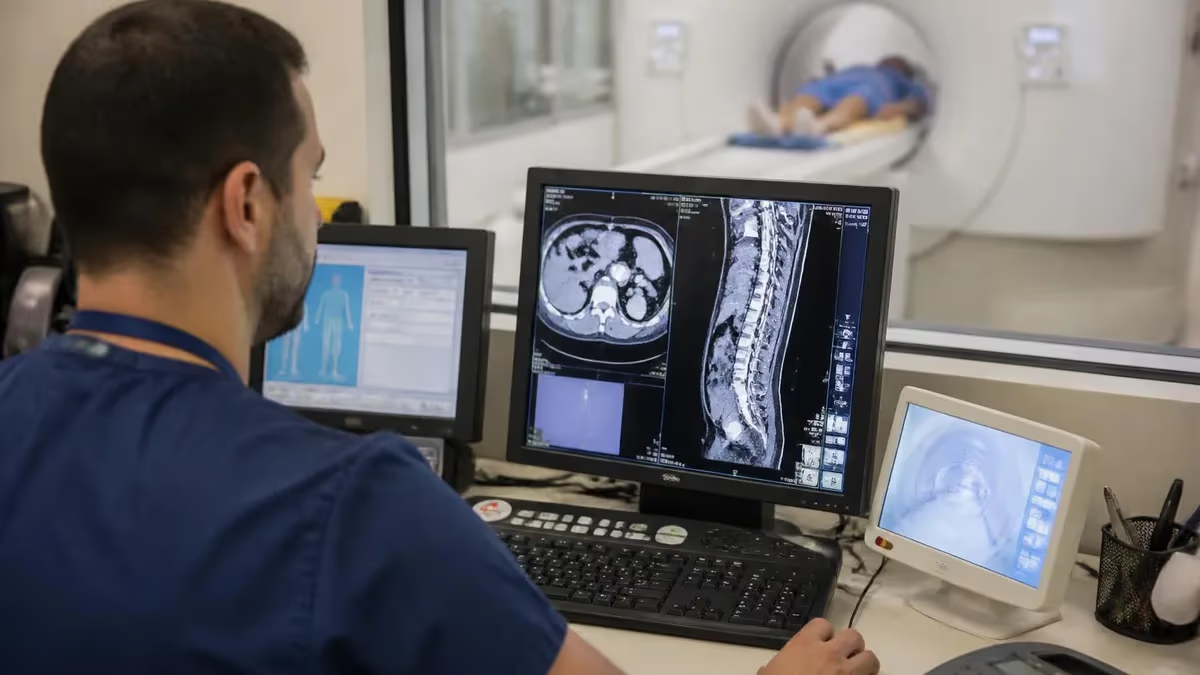
Pursuing arrt certification online has become one of the most popular pathways for working healthcare professionals, career changers, and rural students who cannot relocate to a traditional brick-and-mortar radiography program. The American Registry of Radiologic Technologists sets strict national standards, and while no portion of the credential is granted purely through a digital classroom, hybrid and online-didactic pathways now allow candidates to complete most coursework remotely while attending clinical rotations at approved imaging sites near their homes.
The 2026 certification landscape continues to favor flexibility. According to ARRT data, more than 340,000 technologists currently hold active credentials, and roughly 17 percent of new registrants completed at least 60 percent of their didactic instruction through accredited online platforms. This trend has accelerated since 2021, when JRCERT formally clarified that distance learning could satisfy classroom requirements provided clinical competencies are still verified in person by a registered technologist.
Before enrolling, candidates must understand that the ARRT does not endorse, accredit, or operate any specific online program. Instead, the Registry verifies that your educational pathway is recognized by an ARRT-approved mechanism — typically a JRCERT-accredited associate or bachelor's degree program, or a structured educational program for post-primary disciplines such as CT, MRI, or mammography. Choosing the wrong program is the single most common reason applicants are denied exam eligibility.
This guide walks through every component of the online certification journey: prerequisite coursework, accredited program selection, clinical placement logistics, the Structured Self-Assessments, the computer-based examination, ethics review, and ongoing Continuing Qualifications Requirements. We will also cover realistic timelines, total costs ranging from $8,000 to $34,000 depending on pathway, and the specific advantages and tradeoffs of remote learning compared to traditional on-campus programs.
Whether you are a high school graduate exploring radiography for the first time, a Limited Scope X-ray Operator pursuing a full credential, or a registered nurse considering a lateral move into imaging, this resource will help you map a realistic plan. We have also linked our ARRT Certification: Requirements, Exam & How to Get Certified reference for readers who want a deeper dive into the formal eligibility rules published by the Registry.
One important clarification before we begin: the phrase "ARRT certification online" is sometimes misused by predatory websites offering fast-track credentials, downloadable certificates, or weekend courses promising registry-equivalent status. These offerings are fraudulent. Legitimate certification requires accredited education, documented clinical hours, an ethics affidavit, and a passing score on the ARRT computer-based exam administered at Pearson VUE testing centers. There are no shortcuts, and the Registry actively investigates fraudulent claims.
With expectations set, let's examine exactly what an online or hybrid ARRT pathway looks like in practice, how to verify program accreditation, and the milestones you can expect to hit along the way to becoming a Registered Technologist — R.T.(R) — in 2026 and beyond.
ARRT Online Certification by the Numbers

Your Online ARRT Certification Timeline
Month 0–3: Research & Apply
Month 4–12: Didactic Coursework
Month 13–22: Clinical Rotations
Month 22–24: Exam Prep & Application
Month 25: Sit the Exam
Month 25+: Practice & Maintain
Eligibility for the ARRT certification examination has three pillars: education, ethics, and examination. Of these, education is where online and hybrid pathways differ most from traditional programs. The Registry requires candidates to graduate from a program holding programmatic accreditation from a recognized agency — most commonly the Joint Review Committee on Education in Radiologic Technology, known as JRCERT. As of 2026, JRCERT lists more than 600 accredited radiography programs in the United States, of which roughly 80 offer a substantial online or hybrid didactic component.
It is critical to understand the difference between regional accreditation and programmatic accreditation. A university may hold regional accreditation through bodies like the Higher Learning Commission or SACSCOC, which validates the institution as a whole, but its specific radiography program must additionally hold JRCERT accreditation for graduates to qualify for the ARRT exam. Always verify program-level accreditation directly on the JRCERT website at jrcert.org rather than trusting marketing claims on the school's homepage.
For high school graduates pursuing primary certification, the standard route is an associate degree in radiologic technology (AAS or AS). These two-year programs include approximately 60–72 credit hours of didactic instruction and 1,800 to 2,000 clinical hours. Online hybrid versions allow students to complete lectures asynchronously while attending labs and clinicals locally. Popular options include Western Schools, Pima Medical Institute Online, and several community college consortia in Washington, Texas, and Pennsylvania.
Post-primary candidates — meaning individuals already holding ARRT credentials in radiography who wish to add a specialty like CT, MRI, mammography, or interventional radiology — have significantly more online flexibility. Post-primary disciplines do not require a full degree program. Instead, candidates complete a Structured Education program (often 16–24 weeks of online modules) plus discipline-specific clinical competencies. This pathway is especially popular with technologists looking to expand earning potential without leaving their current job.
Bachelor's degree completion programs represent another growing category. These are designed for working R.T.(R) holders who want to advance into management, education, or radiology assistant roles. Programs at Weber State University, Midwestern State, and Clarkson College offer fully online RT-to-BSRS pathways that count toward Continuing Education requirements and prepare graduates for advanced ARRT credentials. Tuition typically runs $9,000 to $18,000 for the 30–60 credit completion track.
For readers researching the broader credentialing ecosystem, our American Registry of Radiologic Technologists: Complete Training Guide & Requirements reference provides extensive background on every discipline and pathway. Be aware that limited X-ray operator certificates, often marketed to chiropractic and orthopedic clinic staff, are state-issued credentials — not ARRT certifications — and do not transfer to full registry status without completing an accredited program.
Finally, prospective students should request a program's most recent JRCERT outcomes report. This document discloses five-year averages for credentialing exam pass rates, job placement, and program completion. JRCERT requires programs to maintain at least an 80 percent pass rate on first attempt and 75 percent job placement within twelve months. Programs failing these benchmarks face accreditation review and may not be safe bets for your educational investment.
ARRT Practice Test Questions
Prepare for the ARRT - American Registry of Radiologic Technologists exam with our free practice test modules. Each quiz covers key topics to help you pass on your first try.
ARRT - American Registry of Radiologic Tec...
ARRT Exam Questions covering - American Registry of Radiologic Technologists Equipment Operation and QA. Master ARRT Test concepts for certification prep.
ARRT - American Registry of Radiologic Tec...
Free ARRT Practice Test featuring - American Registry of Radiologic Technologists Head and Neck Procedures. Improve your ARRT Exam score with mock test prep.
ARRT - American Registry of Radiologic Tec...
ARRT Mock Exam on - American Registry of Radiologic Technologists Image Acquisition and Evaluation. ARRT Study Guide questions to pass on your first try.
ARRT - American Registry of Radiologic Tec...
ARRT Test Prep for - American Registry of Radiologic Technologists Lower Extremity Procedures. Practice ARRT Quiz questions and boost your score.
ARRT - American Registry of Radiologic Tec...
ARRT Questions and Answers on - American Registry of Radiologic Technologists Patient Care and Management. Free ARRT practice for exam readiness.
ARRT - American Registry of Radiologic Tec...
ARRT Mock Test covering - American Registry of Radiologic Technologists Radiation Physics and Radiobiology. Online ARRT Test practice with instant feedback.
ARRT - American Registry of Radiologic Tec...
Free ARRT Quiz on - American Registry of Radiologic Technologists Radiation Protection Principles. ARRT Exam prep questions with detailed explanations.
ARRT - American Registry of Radiologic Tec...
ARRT Practice Questions for - American Registry of Radiologic Technologists Spine and Pelvis Procedures. Build confidence for your ARRT certification exam.
ARRT - American Registry of Radiologic Tec...
ARRT Test Online for - American Registry of Radiologic Technologists Thorax and Abdomen Procedures. Free practice with instant results and feedback.
ARRT - American Registry of Radiologic Tec...
ARRT Study Material on - American Registry of Radiologic Technologists Upper Extremity Procedures. Prepare effectively with real exam-style questions.
ARRT Contrast Media and Pharmacology
Free ARRT Test covering Contrast Media and Pharmacology. Practice and track your ARRT exam readiness.
ARRT Digital Imaging and Exposure Factors
ARRT Exam Questions covering Digital Imaging and Exposure Factors. Master ARRT Test concepts for certification prep.
Online vs Hybrid vs Traditional ARRT Pathways
Truly 100 percent online ARRT certification does not exist for primary radiography because clinical competencies cannot be performed remotely. However, post-primary specialties such as bone densitometry, breast sonography supplement, and certain didactic portions of CT and MRI can be completed entirely through asynchronous coursework if the candidate already holds R.T.(R) credentials and works in an environment where they can document discipline-specific competencies on the job.
This pathway works well for currently employed technologists whose hospitals or imaging centers will provide clinical exposure during their normal shifts. Costs are typically lower — $1,200 to $4,500 for a structured education program — and the timeline runs 16 to 32 weeks. The downside is reduced cohort interaction and no built-in clinical placement, meaning candidates must arrange their own supervised practice hours.
Pros and Cons of Pursuing ARRT Certification Online
- +Geographic flexibility — live and learn anywhere within driving distance of a clinical site
- +Lower opportunity cost since coursework fits around existing employment and family obligations
- +Asynchronous lectures allow self-paced review of complex topics like radiation physics
- +Reduced commuting time and expenses compared to daily on-campus attendance
- +Access to nationally-ranked programs that would otherwise require relocation
- +Strong alignment with adult learner schedules, military families, and rural residents
- +Most hybrid programs cost 20–40 percent less than equivalent traditional pathways
- −Clinical placement is the student's responsibility and may be difficult in rural markets
- −Reduced face-to-face faculty interaction can hurt students who need active mentorship
- −Hands-on positioning labs are condensed into intensive weekends rather than spread over weeks
- −Online proctoring fees and technology requirements add hidden costs
- −Some employers still prefer graduates of traditional brick-and-mortar programs
- −Self-discipline is essential — historical attrition rates run 5–10 points higher online
- −Networking with peers and clinical instructors requires deliberate effort
Pros and Cons at a Glance
| Pros | Cons |
|---|---|
| Geographic flexibility — live and learn anywhere within driving distance of a clinical site | Clinical placement is the student's responsibility and may be difficult in rural markets |
| Lower opportunity cost since coursework fits around existing employment and family obligations | Reduced face-to-face faculty interaction can hurt students who need active mentorship |
| Asynchronous lectures allow self-paced review of complex topics like radiation physics | Hands-on positioning labs are condensed into intensive weekends rather than spread over weeks |
| Reduced commuting time and expenses compared to daily on-campus attendance | Online proctoring fees and technology requirements add hidden costs |
| Access to nationally-ranked programs that would otherwise require relocation | Some employers still prefer graduates of traditional brick-and-mortar programs |
| Strong alignment with adult learner schedules, military families, and rural residents | Networking with peers and clinical instructors requires deliberate effort |
Pre-Application Checklist for ARRT Certification Online
- ✓Confirm your target program holds current JRCERT programmatic accreditation through jrcert.org
- ✓Complete all prerequisite courses including anatomy, physiology, medical terminology, and college algebra
- ✓Request official transcripts from every post-secondary institution attended
- ✓Verify the program coordinates clinical placement at a facility within commutable distance
- ✓Calculate total program costs including tuition, fees, books, uniforms, and Trajecsys tracking subscriptions
- ✓Review the ARRT Standards of Ethics and self-disclose any potential ethics concerns early
- ✓Schedule a Pre-Application Review with ARRT if you have any criminal history
- ✓Reserve at least $500 for the ARRT examination and certification fee, currently $225
- ✓Confirm your state's separate licensure requirements beyond ARRT registration
- ✓Set up a study calendar that allocates 200–300 hours of dedicated exam preparation time
Always Verify JRCERT Accreditation Before Enrolling
Roughly 12 percent of denied ARRT applications in 2024 stemmed from candidates who completed unaccredited or improperly accredited programs. A program may advertise itself as "ARRT prep" or "accredited" while only holding regional institutional accreditation, which is insufficient. The Registry will not grant exam eligibility regardless of completed coursework. Always confirm programmatic accreditation directly on jrcert.org before paying any tuition deposit, and document your verification with a screenshot dated to your enrollment.
The ARRT certification examination is a computer-based test delivered exclusively at Pearson VUE testing centers across the United States and territories. Online or remote proctored versions of the exam do not exist. Candidates must report in person with two forms of identification, and personal belongings including phones, smartwatches, and study materials are secured in a locker for the duration of the test. The exam is administered year-round on demand once you fall within your 90-day eligibility window.
The primary radiography examination consists of 200 multiple-choice questions, of which 180 are scored and 20 are unscored pilot items embedded for future test development. Candidates have 3.5 hours to complete the exam, with an optional 18-minute Non-Disclosure Agreement period at the start and a brief survey at the end. Most candidates finish in 2.5 to 3 hours. The scaled score range is 1 to 99, with 75 set as the minimum passing scaled score across all ARRT disciplines.
The radiography content specifications are divided into five major categories. Patient Care accounts for approximately 15 percent of questions and covers communication, infection control, vital signs, contrast administration, and venipuncture. Safety covers 16 percent and includes radiation protection for patients, personnel, and the public. Image Production claims 25 percent, the largest category, covering image acquisition, evaluation, equipment operation, and quality control. Procedures rounds out at 28 percent across all anatomical regions. Radiation Physics and Biology cover the remaining 16 percent.
Preparation for the exam typically requires 200 to 350 hours of dedicated study spread over 8 to 14 weeks. Most successful candidates complete at least two full-length practice exams, work through a comprehensive question bank like Mosby's, Corectec, or Clovis, and review their program-specific weak areas using textbooks such as Bontrager's Textbook of Radiographic Positioning, Merrill's Atlas, and Bushong's Radiologic Science for Technologists. Our ARRT Test 2026 Prep Guide & Tips for Success walks through specific study techniques and resources.
The Structured Self-Assessments are an under-discussed but mandatory component of the application process. Candidates must complete two SSAs through the ARRT website after submitting their Application for Examination and before sitting for the exam. These are not graded for passing, but they generate a personalized score report identifying weak content areas. Completion is required for exam eligibility, and the SSAs typically take 90 minutes each. Treat them as diagnostic tools to focus your remaining study time.
Score reporting is fast. Pearson VUE provides an immediate unofficial pass or fail indication on screen immediately after you submit, with official scaled scores arriving by mail or through the ARRT online portal within five business days. Failed candidates receive a category-by-category breakdown of performance, helping them target retakes effectively. Candidates may attempt the exam up to three times within a three-year eligibility window before needing to repeat additional education.
Test anxiety management is a real challenge. Many candidates score well on practice exams but underperform on test day due to nerves. Effective strategies include taking a final full-length practice exam 5 to 7 days before your scheduled date, visiting the testing center in advance to remove unknowns, sleeping 7 to 8 hours the two nights before, and avoiding cramming the final 24 hours. Mark difficult questions for review rather than dwelling on them, and use all available time.
The ARRT Standards of Ethics require candidates to self-disclose any misdemeanor or felony convictions, professional license actions, and certain academic or military discipline issues. Failing to disclose, even for minor offenses, is treated as a separate ethics violation and may permanently bar you from certification. If you have any potential ethics concerns, request a Pre-Application Review at least six months before your intended exam date — the standard ethics review process can take 60 to 90 days to resolve.
Earning your ARRT credential is just the beginning. The Registry requires ongoing engagement to maintain registration, including annual renewal, biennial Continuing Education credit reporting, and the decennial Continuing Qualifications Requirements review. Letting any of these obligations lapse can result in suspended or revoked registration, requiring expensive reinstatement procedures. Building a tracking system from your first day as an R.T. is essential, especially for technologists juggling multiple credentials such as R.T.(R)(CT)(MR).
Annual renewal is the most straightforward obligation. Every registrant must pay a renewal fee (currently $50 for primary categories and additional fees for post-primary credentials) and reaffirm compliance with the Standards of Ethics. Renewal opens 90 days before your registration's expiration date, which is the last day of your birth month each year. Lapsed registrations face $90 late fees, and registrations expired more than one year require a full reinstatement application.
Continuing Education is reported every two years through ARRT's online CE Reporting system. Each biennium requires 24 Category A credits, with at least one credit in radiation safety for certain disciplines. CE credits are earned through approved providers — typically AHRA, ASRT, RSNA, vendor-sponsored courses, hospital in-services, and accredited academic coursework. Most working technologists earn their 24 credits passively through employer-provided training, but career-changers and per-diem techs must seek credits proactively.
The ASRT Directed Reading program is one of the most economical CE options, offering members 50+ Category A credits annually through self-paced reading and online quizzes. Webinars from RSNA, the American Society of Echocardiography, and vendor education programs from GE Healthcare, Siemens, and Canon Medical also count toward CE requirements. Online CE platforms like X-Ray Continuing Education (XCE), eRADIMAGING, and Medical Professionals also provide affordable bundles, often at $80–$150 for a full biennium of credits.
Continuing Qualifications Requirements are unique to ARRT. Every credential earned after January 1, 2011, must be reaffirmed through a CQR process every ten years. The CQR begins with a Professional Profile and Structured Self-Assessment review through the ARRT portal, identifying performance gaps. Candidates then complete targeted CE in those gap areas — typically 10 to 18 additional credits beyond their normal biennial requirement. CQR has been controversial within the profession, but it remains a mandatory condition of continued certification.
State licensure operates independently from ARRT registration. As of 2026, 39 states plus Washington D.C. and Puerto Rico require separate licensure to practice as a radiologic technologist, and most accept ARRT registration as evidence of competency. However, states like California, New York, Texas, and Florida impose additional state-specific exams, fingerprinting, and continuing education requirements. Always check your state's Bureau of Radiologic Health website for current rules before relocating between jurisdictions.
Looking ahead, technologists pursuing online specialty certifications — CT, MRI, mammography, cardiac-interventional, vascular-interventional, sonography, or bone densitometry — multiply the renewal complexity. Each credential carries its own annual fee, and CE credits earned in one discipline may not all count toward another. Maintaining a personal CE log with completion certificates, provider information, and category designations is essential. For long-term career planning, see our ARRT Certification 2026–2026 — How to Get Certified as a Radiologic Technologist guide.
With the structural and regulatory framework in place, let's turn to the practical realities of succeeding in an online ARRT pathway. The students who thrive in remote programs share several habits: they create dedicated study spaces, treat asynchronous lectures with the same discipline as in-person classes, and proactively build relationships with classmates and clinical instructors despite the lack of physical proximity. These soft skills often determine outcomes more than raw intelligence or prior healthcare experience.
Time management deserves special attention. A hybrid radiography program demands roughly 50 to 60 working hours per week across coursework, clinical rotations, and study time. Successful students block their weeks in advance: Monday and Wednesday evenings for asynchronous lectures, Tuesday and Thursday for clinical shifts, Friday for synchronous labs, and weekend mornings for self-directed exam preparation. Treating school as a full-time job — not a side activity — separates graduates from the 15 to 20 percent who do not finish.
Clinical site relationships are arguably the most important variable in your program's success. Your assigned clinical instructor will sign off on every competency you complete and serve as your primary professional reference. Arrive early, dress professionally, ask thoughtful questions, and never refuse an opportunity to scrub into an unusual procedure. Technologists remember students who showed genuine curiosity, and these relationships often lead directly to job offers six to twelve months later.
For exam preparation, the most evidence-based approach combines spaced repetition with active retrieval practice. Tools like Anki, RemNote, and Quizlet allow you to convert your weakest content areas into flashcard decks reviewed daily. Pair this with weekly full-length practice exams during your final eight weeks, simulating the real testing environment by writing in a quiet room with a 3.5-hour timer. Our practice test resource offers a starting point for offline practice sessions.
Practical financial planning matters too. Beyond tuition, budget $400 to $800 for textbooks, $200 to $400 for scrubs and clinical shoes, $150 to $300 for student membership in ASRT (highly recommended for free CE and journal access), $225 for the ARRT exam, plus state licensure fees ranging from $35 to $250 depending on jurisdiction. Many programs accept federal Pell Grants and Stafford Loans, and the Department of Labor's WIOA program funds career-change students in many states.
Job market outlook through 2026 remains favorable. The Bureau of Labor Statistics projects 6 percent employment growth for radiologic technologists from 2022 through 2032, with strongest demand in outpatient imaging centers, urgent care clinics, and rural hospitals. Median annual wages reached $73,400 in 2024, with experienced CT and MRI technologists earning $90,000 to $115,000 in major metropolitan markets. Multi-credentialed technologists (R.T. plus CT and MRI) consistently command the highest salaries and most scheduling flexibility.
Finally, recognize that ARRT certification is the gateway to a long career with many lateral and upward moves. Within five years of credentialing, technologists commonly add specialty certifications, transition to lead technologist or supervisor roles, pursue radiology assistant programs, or move into PACS administration, radiology informatics, or applications specialist positions with imaging vendors. The investment of 24 months and $15,000 in your initial online certification pathway typically returns $300,000 to $500,000 in incremental lifetime earnings compared to non-certified imaging positions.
Sample ARRT - American Registry of Radiologic Technologists Practice Questions
Try these questions from our free ARRT - American Registry of Radiologic Technologists practice tests. The correct answer and an explanation follow each question.
The dose equivalent limit for the lens of the eye for radiation workers is:
- A. 15 mSv/year
- B. 50 mSv/year
- C. 150 mSv/year
- D. 500 mSv/year
Answer: C. 150 mSv/year
NCRP recommends a 150 mSv (15 rem) per year dose equivalent limit for the lens of the eye for occupational workers.
Which type of image receptor requires a laser scanner to read the stored image?
- A. Flat-panel direct conversion detector
- B. Computed radiography (CR) phosphor plate
- C. Indirect flat-panel detector
- D. Film-screen cassette
Answer: B. Computed radiography (CR) phosphor plate
CR imaging plates store a latent image in photostimulable phosphors that must be released and detected by scanning with a helium-neon or diode laser.
What is the primary function of a grid in radiography?
- A. To reduce patient motion blur
- B. To absorb scattered radiation before it reaches the image receptor
- C. To increase the primary beam intensity
- D. To filter low-energy photons from the primary beam
Answer: B. To absorb scattered radiation before it reaches the image receptor
Grids are composed of alternating radiopaque lead strips and radiolucent interspacing material that absorb obliquely traveling scattered photons while transmitting the primary beam.
Which cellular lesion produced by ionizing radiation is considered MOST critical for cell killing?
- A. Single-strand DNA break
- B. Protein denaturation
- C. Double-strand DNA break
- D. Mitochondrial membrane damage
Answer: C. Double-strand DNA break
Double-strand DNA breaks (DSBs) are the most lethal radiation-induced lesion because they are difficult to repair accurately and can lead to chromosomal aberrations and cell death.
Take the full ARRT - American Registry of Radiologic Technologists practice test
ARRT Questions and Answers
American Registry of Radiologic Technologists: Complete Training Guide & Requirements

ARRT Certification 2026–2026 — How to Get Certified as a Radiologic Technologist

ARRT Certification: Requirements, Exam & How to Get Certified

ARRT Practice Test PDF (Free Printable 2026)
ARRT Test 2026 Prep Guide & Tips for Success
About the Author

Medical Laboratory Scientist & Clinical Certification Expert
Johns Hopkins UniversityDr. Sandra Kim holds a PhD in Clinical Laboratory Science from Johns Hopkins University and is certified as a Medical Technologist (MT) and Medical Laboratory Scientist (MLS) through ASCP. With 16 years of clinical laboratory experience spanning hematology, microbiology, and molecular diagnostics, she prepares candidates for ASCP board exams, MLT, MLS, and specialist certification tests.