
American Registry of Radiologic Technologists: Complete Training Guide & Requirements
🔎 American Registry of Radiologic Technologists requirements, training, exam content, salary data, and certification steps — everything you need to

The american registry of radiologic technologists, almost universally referred to as the ARRT, is the largest credentialing organization for medical imaging and radiation therapy professionals in the United States. Founded in 1922, the organization currently certifies and registers more than 350,000 technologists across fifteen disciplines, including radiography, computed tomography, magnetic resonance imaging, mammography, sonography, nuclear medicine, and radiation therapy. For anyone planning a career behind the lead apron, rt certification is not optional — it is the professional baseline that hospitals, imaging centers, and state licensing boards build on.
Understanding the ARRT pathway early in your education will save you months of rework later. The Registry sets the rules for the educational programs you can attend, the ethics standards you must uphold, the clinical procedures you must complete, and the examination you must pass before you can write R.T. after your name. Each of these requirements has specific documentation, deadlines, and verification steps that catch unprepared candidates off guard, particularly first-generation healthcare students who lack a mentor inside the field.
The current ARRT structure is built around three pillars: education, ethics, and examination. Education means graduating from a program accredited by an ARRT-recognized agency, almost always the JRCERT for radiography. Ethics means disclosing and resolving any criminal history, honor code violations, or licensing actions through the Registry's pre-application review process. Examination means sitting for a computer-based test at a Pearson VUE center and earning a scaled score of 75 or higher on a 100-point scale.
What surprises many new candidates is how integrated these pillars are. A skipped clinical competency can disqualify your application even if your GPA was perfect. A misdemeanor from age eighteen can require an ethics pre-review that takes ninety days to resolve. A program that lost its accreditation between your enrollment and graduation can leave you ineligible to test at all. Reading the ARRT Handbook from cover to cover before your final semester is the single highest-ROI hour you can spend during your training.
This guide walks through every requirement step by step, with current 2026 fees, deadlines, content specifications, and pass-rate data drawn directly from ARRT's annual reports. We will cover what to expect during your didactic and clinical training, how the certification exam is structured, how to register for and survive test day, and what continuing education and structured self-assessment commitments come after you earn the credential. For exam practice you can use the ARRT Test 2026 Prep Guide & Tips for Success as a companion resource.
By the end of this article you should be able to map your current position on the certification timeline, identify the next three milestones in front of you, and recognize the most common reasons candidates either delay testing or fail on the first attempt. None of the ARRT process is mysterious — but almost all of it is unforgiving of missed paperwork. Treat this guide as a checklist, not just a narrative, and your odds of a clean first-pass certification climb dramatically.
Whether you are a high school junior researching the radiography pathway, a current student weeks from graduation, or a working tech adding a post-primary modality, the fundamentals below apply. The ARRT does not bend the rules for any candidate, but it has built one of the most transparent credentialing systems in healthcare, which means anyone willing to read carefully and prepare deliberately can earn this credential and the career stability that comes with it.
ARRT by the Numbers
Key Facts at a Glance
| Item | Value | Details |
|---|---|---|
| Application Fee | $225 | primary certification |
| Exam Duration | 3.5 hr | 200 scored items |
| Passing Score | 75 | scaled 1-100 |
| Biennial Credits | 24 CE | to renew |
Education & Program Requirements
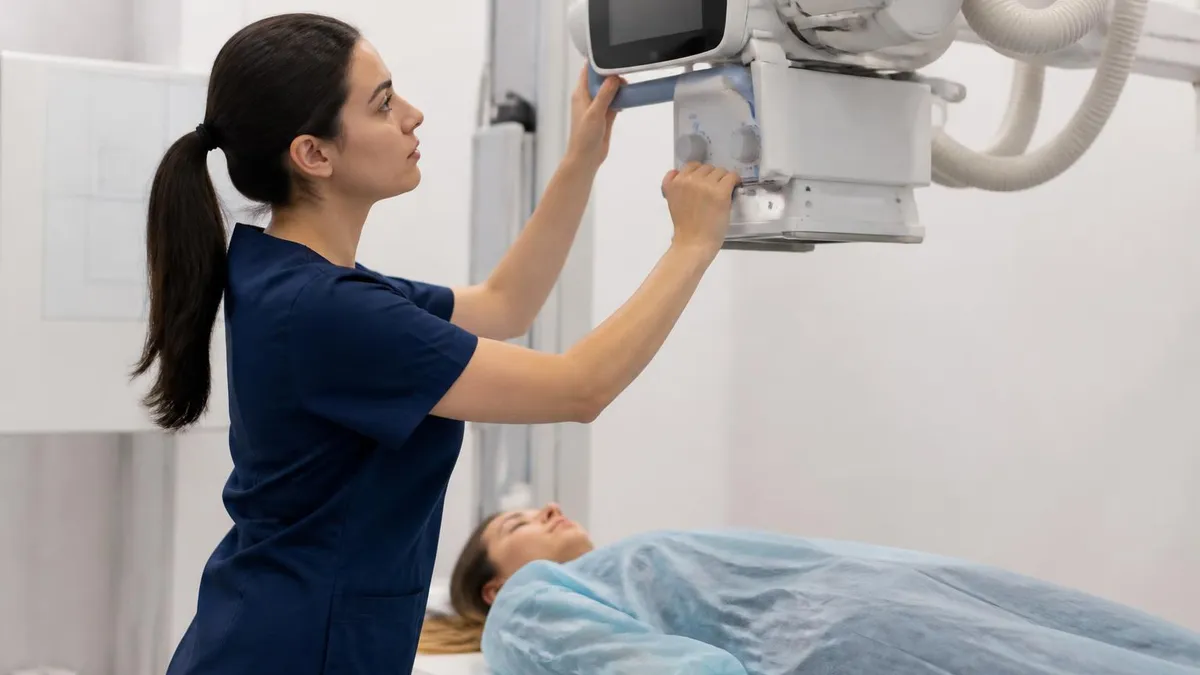
Graduate from a JRCERT-accredited associate or bachelor's program. The ARRT will not accept transcripts from unaccredited or expired-accreditation schools, even if coursework appears identical on paper.
Complete required hours in patient care, radiation protection, imaging principles, radiographic procedures, and image evaluation. Most programs run 21-24 months including summer terms.
Demonstrate competence on 36 mandatory imaging procedures plus 15 electives chosen from a list of 34. Each competency must be observed and signed by a qualified clinical instructor.
Earn an associate degree or higher from a regionally accredited college. Coursework in anatomy, medical terminology, English composition, and college algebra typically satisfies this rule.
Submit ethics pre-review if you have any criminal history, academic honor code violations, military discharge issues, or prior license sanctions before applying for examination.
Eligibility for ARRT certification is decided long before you click submit on an examination application. The Registry uses a three-part eligibility model — education, ethics, and examination — and a failure on any one part stops the process. Most denials at this stage trace back to either a missing clinical competency signature, an unverified high school equivalency, or an undisclosed legal matter. The fix is to treat eligibility as something you actively manage every semester of your program, not something you check the week before graduation.
The educational component is straightforward but inflexible. Your program must hold accreditation from an ARRT-recognized agency on both the day you enrolled and the day you graduated. The JRCERT is the dominant accreditor for radiography, while NMTCB and JRCNMT cover nuclear medicine and certain post-primary pathways. If you transfer between programs mid-stream, both schools must have continuous accreditation during your time enrolled. Confirm this with your program director in writing before your final clinical rotation.
The ethics component catches more candidates by surprise than any other requirement. The ARRT defines twelve categories of ethics violations, ranging from felony convictions to academic dishonesty to honor code violations during your radiography program. The good news is that almost none of these are automatic disqualifiers — what disqualifies candidates is failing to disclose them. The Registry's investigators routinely cross-reference court records, state licensing databases, and program reports, so honesty is genuinely the optimal strategy.
If you have any item to disclose, file an ethics pre-review at least six months before your intended exam date. The pre-review is free, confidential, and gives you a definitive ruling on whether your history affects eligibility. The most common outcome is full eligibility with no restrictions, sometimes with a one-page acknowledgment letter. Less common outcomes include a waiting period, a probationary certification, or — rarely — a denial that can be appealed. You can read more about the process in our ARRT Certification: Requirements, Exam & How to Get Certified guide.
Clinical competencies are the third quiet eligibility risk. The current ARRT didactic and clinical competency requirements list 36 mandatory procedures and require 15 of 34 electives. Programs distribute these across roughly 1,800 clinical hours, but distribution varies. Students at small rural hospitals sometimes finish without ever performing a sterile-tray procedure or a pediatric extremity exam, and have to scramble at a partner site in their final semester. Audit your competency tracker every term and ask for the harder procedures by name.
Finally, eligibility is not the same as readiness. A candidate can satisfy every paperwork requirement and still fail the certification examination, and roughly sixteen percent of first-time test-takers do. Beginning structured exam preparation in your last didactic semester — not after graduation — keeps content fresh and reduces the cognitive load when you are simultaneously job-hunting, taking a state licensure exam, and adjusting to full-time clinical hours. The strongest candidates treat the ARRT exam as the final semester of school rather than a separate event.
One more eligibility nuance worth flagging: you have three years from the date you complete program requirements to pass the certification examination. Miss that window and you must reapply, which can mean retaking clinical competencies. Three years feels generous in May of your senior year, but candidates who pause to start families, change states, or recover from health events frequently bump into the deadline. Schedule your first exam attempt within ninety days of graduation if at all possible.
ARRT Practice Test Questions
Prepare for the ARRT - American Registry of Radiologic Technologists exam with our free practice test modules. Each quiz covers key topics to help you pass on your first try.
ARRT - American Registry of Radiologic Tec...
ARRT Exam Questions covering - American Registry of Radiologic Technologists Equipment Operation and QA. Master ARRT Test concepts for certification prep.
ARRT - American Registry of Radiologic Tec...
Free ARRT Practice Test featuring - American Registry of Radiologic Technologists Head and Neck Procedures. Improve your ARRT Exam score with mock test prep.
ARRT - American Registry of Radiologic Tec...
ARRT Mock Exam on - American Registry of Radiologic Technologists Image Acquisition and Evaluation. ARRT Study Guide questions to pass on your first try.
ARRT - American Registry of Radiologic Tec...
ARRT Test Prep for - American Registry of Radiologic Technologists Lower Extremity Procedures. Practice ARRT Quiz questions and boost your score.
ARRT - American Registry of Radiologic Tec...
ARRT Questions and Answers on - American Registry of Radiologic Technologists Patient Care and Management. Free ARRT practice for exam readiness.
ARRT - American Registry of Radiologic Tec...
ARRT Mock Test covering - American Registry of Radiologic Technologists Radiation Physics and Radiobiology. Online ARRT Test practice with instant feedback.
ARRT - American Registry of Radiologic Tec...
Free ARRT Quiz on - American Registry of Radiologic Technologists Radiation Protection Principles. ARRT Exam prep questions with detailed explanations.
ARRT - American Registry of Radiologic Tec...
ARRT Practice Questions for - American Registry of Radiologic Technologists Spine and Pelvis Procedures. Build confidence for your ARRT certification exam.
ARRT - American Registry of Radiologic Tec...
ARRT Test Online for - American Registry of Radiologic Technologists Thorax and Abdomen Procedures. Free practice with instant results and feedback.
ARRT - American Registry of Radiologic Tec...
ARRT Study Material on - American Registry of Radiologic Technologists Upper Extremity Procedures. Prepare effectively with real exam-style questions.
ARRT Contrast Media and Pharmacology
Free ARRT Test covering Contrast Media and Pharmacology. Practice and track your ARRT exam readiness.
ARRT Digital Imaging and Exposure Factors
ARRT Exam Questions covering Digital Imaging and Exposure Factors. Master ARRT Test concepts for certification prep.
ARRT Exam Content Specifications
Patient care accounts for roughly 22 of the 200 scored items on the ARRT radiography exam. The section covers patient interactions, infection control, vital signs, contrast media administration, venipuncture, and medical emergencies. Expect scenario-based items about pediatric, geriatric, and disabled patients that go beyond rote memorization. The Registry leans heavily on judgment questions — what would you do first, what is the safest position, when do you escalate to the radiologist.
Strong candidates rotate through this content using realistic case studies rather than flashcards. Practice transferring a stroke patient from a wheelchair to the table, identifying a vasovagal reaction in real time, and recognizing the early signs of contrast extravasation. Twenty-two questions sounds small, but it is the single most missed content area in post-exam item analysis because students treat it as common-sense filler instead of testable material with its own technical vocabulary and protocols.
Is ARRT Certification Worth It?
- +Required for licensure in 40+ states, making it non-optional for legal practice
- +Median radiographer salary of $67,180 nationally with $90K+ ceilings in specialty modalities
- +Portable credential recognized in every U.S. jurisdiction and many federal facilities
- +Post-primary pathways into CT, MRI, mammography, and interventional radiography
- +High employment stability — imaging volume grows with the aging population every year
- +Clear continuing education structure that funds professional development through employers
- +Strong professional community through ASRT membership and state society networks
- −Application and exam fees totaling $225 per attempt with no income-based waivers
- −Strict three-year window after graduation to pass the certification examination
- −Biennial 24-credit continuing education requirement plus Structured Self-Assessment cycles
- −Ethics review process can delay testing for candidates with prior legal or academic issues
- −Demanding clinical schedule during the program — 1,800+ hours typically unpaid
- −Physical job demands including standing, lifting, and radiation exposure management
- −Post-primary modality certifications require additional clinical experience and exams
ARRT Application & Eligibility Checklist
- ✓Confirm your program holds active JRCERT or equivalent ARRT-recognized accreditation
- ✓Verify your clinical competency tracker shows all 36 mandatory procedures signed off
- ✓Complete at least 15 of 34 elective imaging procedures with instructor verification
- ✓Submit ethics pre-review at least six months early if you have any disclosable history
- ✓Create your ARRT account and confirm your name matches your government-issued ID exactly
- ✓Pay the $225 examination fee through the candidate portal using a credit card
- ✓Have your program director submit the Education Verification form electronically
- ✓Receive your Candidate Status Report and schedule at Pearson VUE within 90 days
- ✓Complete a full-length practice exam under timed conditions two weeks before test day
- ✓Bring two forms of acceptable ID to the test center and arrive 30 minutes early
Schedule within 90 days of graduation
ARRT data shows that candidates who test within 90 days of program completion pass at significantly higher rates than those who wait six months or longer. Content retention drops sharply once daily clinical practice ends. Lock in a test date the week your application is approved.
Test day for the ARRT certification examination follows a tightly scripted protocol that benefits prepared candidates and punishes improvisation. The examination is delivered at Pearson VUE Professional Centers throughout the United States, with most metropolitan areas offering daily appointment slots. The 200 scored items plus 20 unscored pilot items must be completed in 3.5 hours, an average of roughly one minute per item. There is one optional ten-minute break, and the clock continues to run if you exceed it, so plan your hydration and bathroom needs accordingly.
Identification rules are strict. You must present two forms of ID — one primary photo ID such as a passport or driver's license, and one secondary ID with your signature, such as a credit card. The name on both must match exactly the name on your candidate authorization. Discrepancies as small as a missing middle initial have caused candidates to be turned away at the door, forfeiting the entire examination fee. If you have legally changed your name, update your ARRT profile before scheduling, not on test day.
Once seated, you receive a tutorial, a brief honesty statement, and the timed exam. Items are delivered one at a time with the option to flag and review. Most candidates find that aggressive flagging during the first pass — answering quickly with a best guess and marking anything uncertain — produces better outcomes than agonizing item by item. The second pass through flagged items typically reveals patterns: you'll often realize one earlier question gave away the answer to a later one.
Scoring uses a scaled 1-to-100 system with 75 as the passing line. Scaling adjusts for difficulty differences across exam forms, so two candidates seeing different question sets are still judged against the same standard. Your unofficial pass/fail result appears at the end of the session, but the official score report, including section-level diagnostic feedback, arrives in your ARRT account within five business days. The Registry does not release raw question counts or specific items missed.
If you do not pass, the Registry permits three exam attempts in any three-year period, with a mandatory waiting period between attempts. Most candidates who fail and then study deliberately for 8-12 weeks pass on the second attempt. The diagnostic report tells you which of the five content categories underperformed, which is invaluable for targeting your remediation rather than re-reading the entire curriculum. Avoid the temptation to immediately reschedule — almost no one passes a quick retake without addressing the underlying gap.
Passing candidates receive their official ARRT certificate and wallet card by mail within two to four weeks. The credential becomes effective on the date you pass the exam, and you can begin using R.T.(R) — or the equivalent designation for your discipline — immediately. Many employers, however, will not let you work unsupervised until they have the physical card on file, so build that delay into your job-start timing. State licensure, where required, is a separate application that uses your ARRT certification as a prerequisite.
Common procedural mistakes on exam day are easy to avoid with awareness. Do not bring food, drinks, watches, hats, or electronic devices into the testing room — everything goes into a locker. Do not attempt to take notes on anything other than the provided erasable board. Do not discuss exam content with anyone after the test, including on social media, as the ARRT actively monitors and will revoke certification for confidentiality violations. The exam is observed by audio and video throughout your session.

You have exactly three years from the date you complete program requirements to pass the ARRT certification examination. Miss the window and you must repeat clinical competencies before reapplying. Schedule your first attempt within 90 days of graduation to avoid pressure later.
ARRT certification is not a one-time achievement — it is an ongoing professional commitment with three concurrent maintenance requirements: annual registration, biennial continuing education, and decennial Structured Self-Assessment. Failing to meet any of these can place your credential in inactive or revoked status, and reinstatement is more difficult and expensive than maintenance. Building each of these into a routine from your first year as a registered technologist prevents the panic refresh that affects roughly fifteen percent of registrants at every renewal cycle.
Annual registration is the simplest piece. Each year, on the anniversary of your certification, you owe a registration fee — currently $40 for primary certifications and $25 for each additional discipline — and you must attest to your continued ethical standing. The portal opens 90 days before your renewal date, and late renewals incur a $50 penalty plus risk a lapse in credential validity. Many technologists set a calendar reminder 60 days before their renewal date and pay it within an hour of receiving the email.
Continuing education is the most visible requirement. Every two years you must earn 24 Category A continuing education credits, which are awarded by ASRT-recognized providers and verified electronically through the ARRT system. Topics span clinical content, ethics, patient care, and management. Many employers fund a portion of CE through paid online libraries like ASRT EDGE, RadiologyCEU, or hospital LMS systems. The smart move is to bank credits steadily through the cycle rather than scrambling at month 23.
The Structured Self-Assessment, or SSA, runs on a ten-year cycle and is the requirement most likely to catch experienced technologists off guard. Each modality you hold has its own SSA module that takes 2-4 hours of focused work, and you must complete it within the cycle to remain eligible to renew. The SSA is not an exam — there is no pass or fail — but it must be done thoughtfully, with documentation of any learning needs you identified. Set aside a full Saturday in year nine and finish it before the deadline pressure builds.
Post-primary modality certifications are the major career-growth pathway for registered radiographers. Once you have logged the required clinical experience hours — 16 hours of documented experience for mammography, for example, or 125 patient procedures for CT — you can apply to sit for the post-primary examination. CT and MRI are the most common second credentials, each adding roughly $8,000 to $15,000 to annual salary depending on region and shift. You can review our ARRT Certification 2026–2026 — How to Get Certified as a Radiologic Technologist overview for the modality pathways currently available.
Ethics maintenance does not end with certification. Any post-certification legal event, license sanction, or employer disciplinary action involving patient safety must be reported to the ARRT within thirty days. Most reportable events do not result in credential loss, but failure to self-report is itself a separate violation. Read the ARRT Standards of Ethics annually — it takes about 25 minutes — and treat it as your professional contract with the public.
Finally, do not overlook ASRT membership and state society engagement. While not technically required for ARRT renewal, ASRT membership at roughly $169 annually gives you free access to a year of CE content, journals, advocacy representation, and conference discounts. State societies provide local CE events, networking, and a voice in licensure debates that frequently affect scope of practice and pay scales. The technologists who treat the profession as a community rather than a job tend to have longer, more upwardly mobile careers.
Final preparation in the last two weeks before your ARRT examination should look very different from your earlier study work. By this point the goal is no longer to learn new material — it is to consolidate what you know, sharpen recall speed, and calibrate your test-taking instincts to the ARRT's style of question writing. Candidates who switch into this mode at the right time outperform candidates who continue to plow through textbooks until the night before the exam.
Take at least two full-length 200-item practice examinations under timed, single-sitting conditions. Use a quiet room, a single 10-minute break, and the same hydration and snack pattern you intend to use on test day. The cognitive endurance of sitting still and reading carefully for 3.5 hours is itself a trainable skill, and most fatigued candidates lose 8-12 points in the final hour purely from concentration drift. Treat practice tests as physical rehearsal, not just content review.
Review every missed practice item in writing. For each one, document the topic, the reason you missed it (content gap, careless reading, distractor trap, math error), and a one-sentence rule you can recall next time. After 50-100 such notes you will see your personal failure pattern — almost everyone has one — and you can target the final week of review at it. Common patterns include grid math, contrast media reactions, oblique skull projections, and exposure indicator interpretation across vendors.
Plan the logistics of test day with the same care you plan a clinical procedure. Confirm your appointment, drive the route to the Pearson VUE center 48 hours in advance if you have never been there, and identify parking. Lay out your two IDs the night before. Eat a normal-protein breakfast that you have eaten dozens of times — test morning is not the time to experiment. Arrive 30 minutes early, with a snack and water for after-exam recovery, and use the bathroom one final time before check-in.
Inside the exam, manage your pace by checking the clock at items 50, 100, and 150. You want to be at roughly 50 minutes, 100 minutes, and 150 minutes respectively, leaving 50 minutes for the final stretch and review. If you are running ahead, do not slow down — speed often correlates with confidence, which correlates with accuracy. If you are running behind, force yourself to mark and move on. Leaving items blank costs more than guessing.
When you encounter a question you cannot answer, eliminate clearly wrong options first. The ARRT writes four-choice items where one option is usually a strong distractor based on a common student mistake. Identifying that trap option and removing it before choosing typically improves a wild guess from 25 percent to roughly 50 percent accuracy. Trust your first instinct on close calls — research consistently shows that changing answers without a specific new piece of evidence lowers scores.
After you submit, take a deep breath and read the unofficial result screen carefully. Whether you passed or did not, the next steps are predictable: passing candidates begin licensure and job paperwork, while non-passing candidates request the diagnostic report, schedule a debrief with their program director, and build a remediation plan focused on the lowest content category. Either way, you have completed one of the most rigorous credentialing examinations in healthcare, and the radiography community is ready to welcome you on the other side.
Sample ARRT - American Registry of Radiologic Technologists Practice Questions
Try these questions from our free ARRT - American Registry of Radiologic Technologists practice tests. The correct answer and an explanation follow each question.
When a patient arrives for a radiologic evaluation, an intravenous contrast injection is necessary. What is the creatinine normal range?
- A. 8–15 mg/100 milliliters
- B. 0–0.4 mg/100 milliliters
- C. 0.6–1.5 mg per 100 milliliters
- D. 2.0–4.0 mg per milliliter
Answer: C. 0.6–1.5 mg per 100 milliliters
This is the creatinine normal range. Increasing your exercise will raise your levels of creatinine. Low creatinine can be hazardous and dangerous. Lower creatinine levels can be caused by liver and muscle diseases. Increased concentrations may have greater detrimental effects. High blood pressure, nausea, and vomiting are among the symptoms. Renal failure and dehydration are two symptoms associated with elevated creatinine.
When performing a cross-table lateral projection of the cervical spine on a trauma patient, what is the most critical anatomical landmark to ensure is included on the image for it to be considered diagnostically complete?
- A. The sella turcica.
- B. The spinous process of C2 (axis).
- C. The top of the T1 vertebral body.
- D. The mastoid tips.
Answer: C. The top of the T1 vertebral body.
For a trauma cross-table lateral cervical spine radiograph to be considered complete and adequate for diagnosis, it must visualize all seven cervical vertebrae (C1-C7) and the C7-T1 junction. Failure to include the top of the T1 vertebral body is a common error and can lead to missed fractures or dislocations at this critical junction.
A patient is scheduled for a sialography procedure to evaluate the submandibular gland. Which of the following is a primary clinical indication for this examination?
- A. To assess for sinusitis.
- B. To diagnose a fracture of the mandible.
- C. To rule out temporomandibular joint (TMJ) dysfunction.
- D. To investigate suspected calculi or strictures in the salivary duct.
Answer: D. To investigate suspected calculi or strictures in the salivary duct.
Sialography is a specialized contrast-enhanced radiographic examination of the salivary glands and their ducts. Its primary indications include the evaluation of suspected obstructions, such as calculi (stones) or strictures (narrowing), as well as fistulas and other ductal pathologies.
For the AP axial projection of the mandible (Towne variant), the CR is directed at approximately what angle?
- A. 35° caudad
- B. 15° caudad
- C. 25° cephalad
- D. 45° caudad
Answer: A. 35° caudad
For the Towne variant used to show the mandibular condyles, the CR is directed 35° caudad to the OML.
Take the full ARRT - American Registry of Radiologic Technologists practice test
ARRT Questions and Answers



About the Author

Medical Laboratory Scientist & Clinical Certification Expert
Johns Hopkins UniversityDr. Sandra Kim holds a PhD in Clinical Laboratory Science from Johns Hopkins University and is certified as a Medical Technologist (MT) and Medical Laboratory Scientist (MLS) through ASCP. With 16 years of clinical laboratory experience spanning hematology, microbiology, and molecular diagnostics, she prepares candidates for ASCP board exams, MLT, MLS, and specialist certification tests.