
ARRT Passing Score: What You Need to Know to Pass the Registry Exam 2026 October
What is the ARRT passing score? Learn the scaled score system, passing standards, and proven strategies to pass your radiologic technologist exam. 🎯
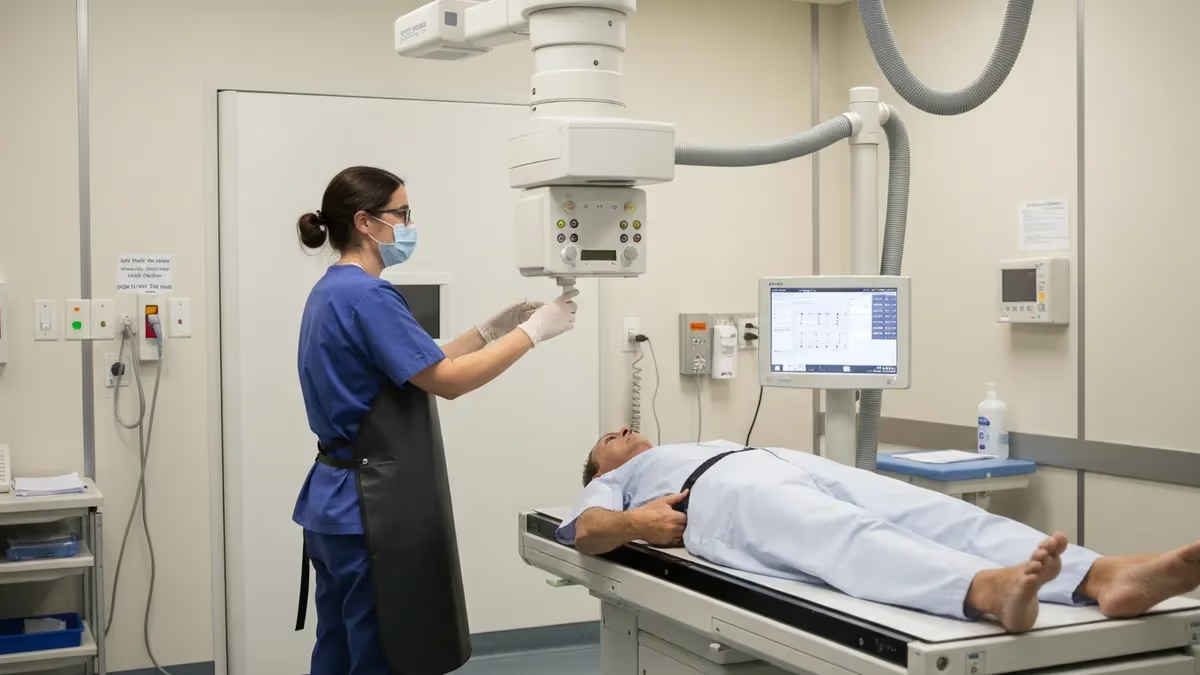
Understanding the ARRT passing score is one of the first things every radiologic technology student needs to master before sitting for the registry exam. The ARRT does not report raw scores — instead, it uses a scaled scoring system that converts your performance into a number between 1 and 99.
The minimum passing scaled score is 75, a benchmark that has remained consistent across disciplines. Whether you are preparing for Radiography, MRI, CT, or another ARRT discipline, the passing threshold is the same, though the difficulty calibration of each question set is unique. You can review an arrt passing score practice resource to benchmark your readiness before test day.
The scaled score of 75 does not mean you need to answer 75 percent of questions correctly. This is one of the most common misconceptions among candidates. Because the ARRT uses Item Response Theory (IRT) to calibrate question difficulty, your raw number of correct answers is converted into a scaled score that accounts for the specific difficulty level of the question set you received.
Two candidates who both receive a scaled score of 75 may have answered a slightly different number of questions correctly, depending on how difficult their respective question pools were. This makes the process inherently fair across all test administrations.
The ARRT exams are computer-adaptive for some disciplines, meaning the system adjusts question difficulty in real time based on your performance. For Radiography, the primary certification exam, the test consists of 220 questions, of which 200 are scored and 20 are unscored pilot questions embedded throughout. You will not know which questions are experimental, so it is essential to approach every single question with maximum effort and attention. Treating each item as though it directly affects your score is the safest and most effective mental strategy during the exam.
Most candidates find that consistent daily practice — rather than cramming — is the most reliable path to scoring above the 75 threshold. ARRT certification is a high-stakes credential that opens doors to a rewarding, well-compensated healthcare career. The Bureau of Labor Statistics reports that radiologic and MRI technologists earn a median annual wage above $65,000, making this one of the more financially stable allied health professions. The first-time pass rate for the ARRT Radiography exam hovers around 85 to 90 percent for candidates from accredited programs, which means disciplined preparation genuinely pays off.
One important distinction that confuses many candidates is the difference between a passing score and a competitive score. You only need to achieve a scaled score of 75 to earn your ARRT certification — there is no ranking system, no honor roll, and no benefit to scoring a 95 versus a 76.
Your credential is identical whether you pass by one point or twenty points. This means your study strategy should focus entirely on ensuring you meet the 75-point threshold reliably, not on optimizing for the highest possible score. Focused, targeted preparation is more efficient than exhaustive memorization of every possible fact.
Candidates who fail on their first attempt are not disqualified from future attempts. The ARRT allows three attempts within a three-year period following your initial eligibility. If you exhaust those three attempts without passing, you must apply to the ARRT Board of Trustees for additional examination opportunities, which involves an extended review process. Understanding this retake policy helps you plan your preparation timeline strategically, giving yourself enough time between attempts to identify weak areas, fill knowledge gaps, and build the confidence needed to succeed on your next try.
This comprehensive guide walks you through everything you need to know about the ARRT passing score: how the scaled scoring system works, what content areas are tested, how to interpret your score report, and the most effective evidence-based strategies for ensuring you clear the 75 threshold on your first attempt. Whether you are a student in your final semester of radiography school or a working technologist seeking advanced certification in a new modality, the insights in this article will help you approach your exam preparation with clarity and confidence.
ARRT Passing Score by the Numbers
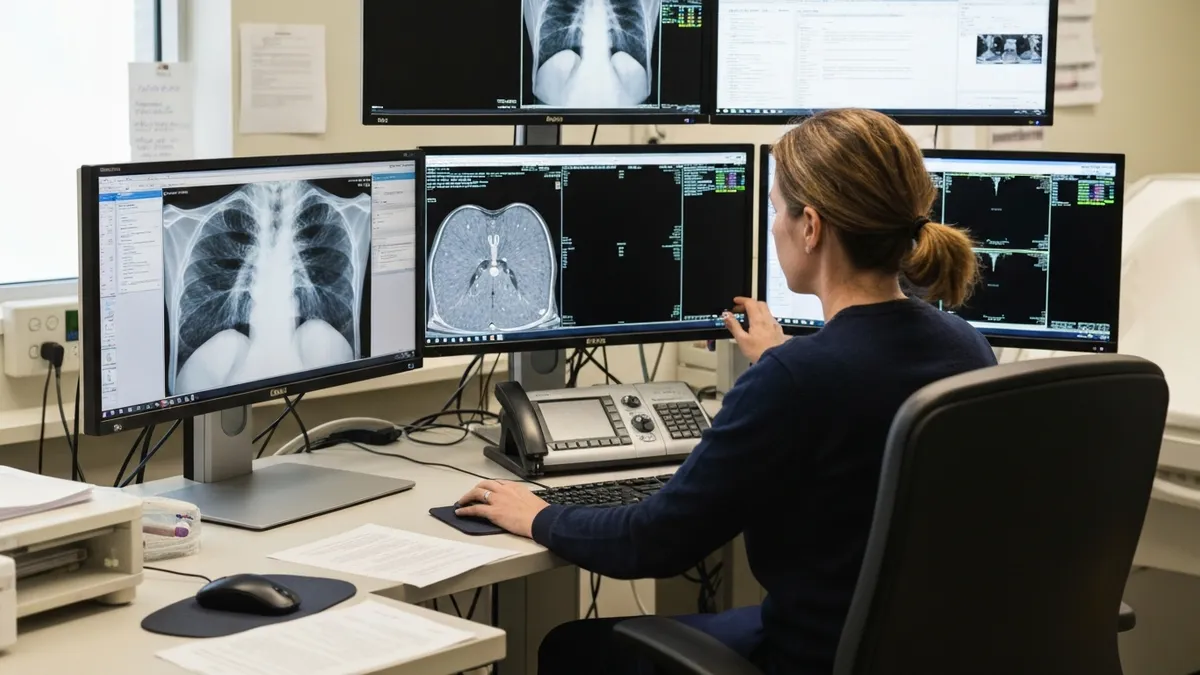
ARRT Radiography Exam Format
| Section | Questions | Time | Weight | Notes |
|---|---|---|---|---|
| Patient Care & Education | 38 | Proportional | 19% | Infection control, contrast agents, patient assessment |
| Safety | 42 | Proportional | 21% | Radiation protection, equipment safety |
| Image Production | 82 | Proportional | 41% | Largest section — exposure, processing, image quality |
| Procedures | 38 | Proportional | 19% | Positioning, anatomy, pathology recognition |
| Pilot (Unscored) | 20 | Included in total | 0% | Embedded throughout; do not know which are pilot |
| Total | 220 | 3.5 hours | 100% |
The ARRT uses a psychometric methodology called Item Response Theory to build and score its exams. Under this system, each question in the item bank has a known difficulty value determined through extensive field testing with thousands of prior candidates. When you sit for the exam, your responses to each question are analyzed in real time, and the algorithm determines the probability that a candidate of your ability level would answer each subsequent question correctly. Your final scaled score is then calculated based on the overall pattern of your responses relative to the calibrated difficulty of every item you encountered.
What this means practically is that two different candidates can sit for the same ARRT exam on the same day, answer a completely different set of questions, and both legitimately earn a scaled score of 75 even if they answered different numbers of questions correctly.
One candidate might have encountered a harder-than-average question pool and answered 155 out of 200 correctly, while another faced an easier pool and needed 165 correct answers to achieve the same scaled score of 75. The system is designed so that the passing threshold always represents the same level of competency regardless of which specific questions appeared on a given test form.
Your ARRT score report will display your scaled score as a single number between 1 and 99. If you pass, you will see a score of 75 or higher along with a PASS designation. If you do not pass, you will receive a score below 75 along with a FAIL designation and a diagnostic content area performance profile that breaks down your performance across major exam sections. This diagnostic breakdown is invaluable for candidates who need to retake the exam, because it points directly to the subject areas where focused additional study will yield the greatest improvement in performance.
The score report is typically available within 24 to 48 hours of completing your exam through your ARRT online account. For candidates who pass, the Radiography certification credential is issued and ARRT will notify your state licensing board of your passing status, often triggering the issuance of your state radiographer license within a few business days. Many employers will extend a conditional job offer pending ARRT certification and will request a copy of your score report as part of the onboarding documentation process, so it is worth downloading and saving a PDF copy immediately upon release.
One critical factor that affects how the scaled score is interpreted is the concept of standard error of measurement (SEM). Every exam score carries a degree of statistical uncertainty, and the ARRT's passing standard is set with this uncertainty in mind.
The scaled score of 75 is not a razor-thin cutoff where answering one more question correctly would have saved a failing candidate — the standard is set conservatively enough that candidates who score in the 70-74 range are, by design, below the minimum competency threshold for safe independent practice. This is why the ARRT does not offer appeals based on score proximity to the passing threshold.
Understanding the content area weighting is crucial for efficient exam preparation. Image Production accounts for 41 percent of the scored exam, making it by far the highest-priority study area. A candidate who masters exposure technique, image receptor systems, image quality parameters, and digital processing will have a significant advantage on exam day simply by virtue of that one content area's outsized contribution to the total score.
Patient Care and Procedures each account for 19 percent, while Safety accounts for 21 percent. Knowing these weights allows you to allocate your study hours proportionally rather than spending equal time on topics of unequal importance.
Many candidates find that taking timed, full-length practice exams under conditions that closely mimic the real testing environment is the single most effective preparation strategy for clearing the passing threshold. Simulating the time pressure, the fatigue of 220 questions, and the uncertainty of not knowing which items are scored helps desensitize the nervous system to exam-day stress. Candidates who have completed at least five to seven full-length practice exams before their test date report significantly lower anxiety and more consistent performance on the actual registry exam compared to candidates who relied primarily on flashcards or textbook review alone.
ARRT Passing Score by Discipline and Exam Type
The ARRT primary certification exams — including Radiography (R), Nuclear Medicine Technology (N), Radiation Therapy (T), Sonography (S), and Magnetic Resonance Imaging (MR) — all use the same minimum passing scaled score of 75. Each discipline has its own content specification, item bank, and question weighting, but the passing threshold is universally set at 75 on the 1-to-99 scale. The Radiography exam is the most commonly taken, with tens of thousands of candidates sitting annually from accredited radiography programs across the United States.
Candidates pursuing primary certification must also meet ethics and education eligibility requirements before their scores are considered valid for credentialing. The ARRT pre-application review process ensures that candidates with certain criminal history or ethics violations are evaluated before investing time and money in exam preparation. Completing this review early — ideally during your final year of school — prevents unwanted delays between passing the exam and receiving your actual certification credential.
Pros and Cons of the ARRT Scaled Scoring System
- +Fair across all test administrations — difficulty calibration ensures the score of 75 means the same thing regardless of which questions you received
- +Diagnostic content area breakdown helps failed candidates identify exactly where to focus additional study time
- +Three attempts within three years provides a reasonable safety net for candidates who do not pass on the first try
- +Score reports are delivered within 24-48 hours, allowing rapid follow-up with employers and state licensing boards
- +The single passing threshold of 75 removes pressure to score high — you only need to clear the minimum competency bar
- +IRT methodology ensures the exam accurately measures competency rather than rewarding test-taking tricks or memorization of obscure trivia
- −The scaled score can be confusing for candidates who expect a straightforward percentage-correct calculation
- −No appeals process exists for scores just below 75 — proximity to the passing threshold is not considered grounds for reconsideration
- −Pilot questions embedded in the exam cannot be identified, creating psychological uncertainty during the test
- −The three-attempt limit within three years can create time pressure for candidates who fail twice and are approaching their eligibility window
- −Content area performance profiles on failed score reports show relative performance only, not exact raw scores in each section
- −Candidates cannot review the specific questions they missed after the exam, making it harder to pinpoint exact knowledge gaps compared to seeing actual missed items
ARRT Exam Day Preparation Checklist
- ✓Confirm your test center location, parking, and travel time at least three days before your scheduled exam.
- ✓Bring two valid forms of government-issued photo ID — the name must exactly match your ARRT application.
- ✓Arrive at the test center at least 30 minutes early to complete check-in procedures without rushing.
- ✓Avoid cramming the night before — focus on light review of key formulas and a full night of sleep instead.
- ✓Eat a protein-rich meal before the exam to maintain mental energy through the 3.5-hour testing session.
- ✓Memorize the five major content areas and their percentage weights so you can pace your mental effort accordingly.
- ✓Practice the process of elimination strategy — eliminate two clearly wrong answers before choosing between the remaining options.
- ✓Flag and skip questions you are unsure about, then return to them after completing questions you can answer confidently.
- ✓Stay calm when you encounter difficult questions — the IRT algorithm expects some incorrect answers and adjusts accordingly.
- ✓Do not share exam content with others after testing — ARRT takes item security violations extremely seriously and can revoke credentials.
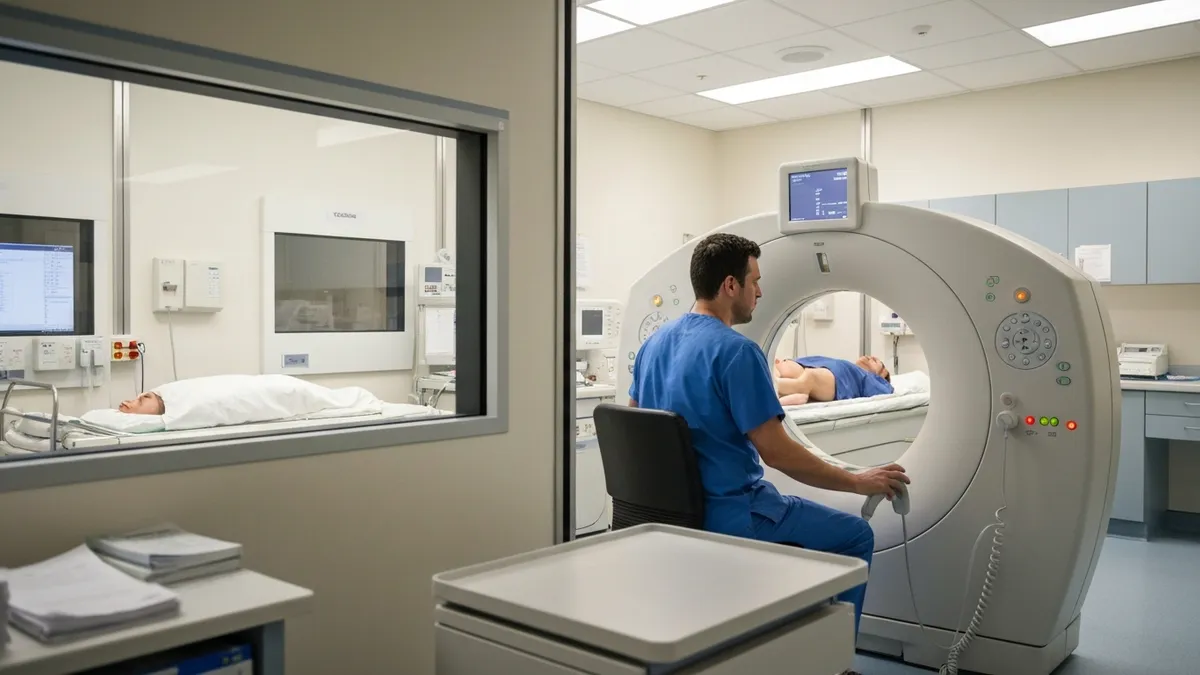
Scaled Score ≠ Percent Correct
The ARRT passing scaled score of 75 is frequently misunderstood. It does NOT mean you need to answer 75% of questions correctly. Because question difficulty varies across exam forms, the scaling process means most passing candidates answer roughly 70-75% of scored questions correctly — but the exact raw number required depends entirely on the specific difficulty of the questions you receive. Focus on mastering content, not gaming percentages.
Building a study schedule that systematically covers all five content areas while prioritizing Image Production — the highest-weighted section at 41 percent — is the foundation of any effective ARRT preparation strategy. Most candidates who pass on their first attempt begin dedicated exam preparation eight to twelve weeks before their scheduled test date. During the first two to three weeks, the priority should be content review: working through all major topic areas using a structured textbook or digital study platform, taking notes on key concepts, and identifying areas of weakness early so there is adequate time to address them.
During weeks four through eight, shift the focus toward active recall and application. This means replacing passive reading with practice questions — answering at least 50 to 100 practice questions per study session and reviewing not just the correct answers but the detailed explanations for every question you missed.
Understanding why a wrong answer is wrong is often more valuable than confirming why a right answer is right, because it exposes the specific misconception or knowledge gap that caused the error. Tracking your performance by content area during this phase helps you identify whether certain topics need additional attention before the final stretch.
The final two to three weeks before your exam should be dominated by full-length timed practice exams. Take one complete 220-question exam every two to three days, simulating test-center conditions as closely as possible: no phone, no breaks beyond what would be allowed at the actual test center, and strict adherence to the 3.5-hour time limit.
After each practice exam, spend equal time reviewing your performance as you spent taking the exam. A candidate who takes a practice test and then immediately moves on without reviewing answers is leaving the most valuable learning opportunity of that session entirely on the table.
One often-overlooked dimension of ARRT preparation is physical and psychological readiness. Exam anxiety is a real phenomenon that can cause candidates who genuinely know the material to underperform on test day.
The single most effective intervention for test anxiety is repeated practice under simulated exam conditions — the more times your nervous system has experienced the format, pacing, and pressure of a full-length test, the less novel and threatening the real exam feels when you sit down on test day. Mindfulness techniques, regular physical exercise, and adequate sleep in the week before the exam can also significantly improve cognitive performance and emotional regulation during the test.
For the Image Production content area specifically, mastery of exposure technique variables — kVp, mAs, source-to-image receptor distance (SID), and their relationships to image quality and patient dose — is non-negotiable. Candidates should be able to work through exposure compensation problems quickly and accurately, applying the 15 percent rule for kVp adjustments and the inverse square law for distance changes. These calculations appear regularly on the exam and are objectively scorable, meaning there is no ambiguity about correct versus incorrect answers. Drilling these calculations until they are second nature will reliably earn you points on exam day.
Anatomy and positioning knowledge tested in the Procedures section rewards a visual, spatial study approach. Rather than memorizing positioning descriptions in text form, study with reference images side by side and practice drawing or labeling anatomical structures from memory. Many candidates find that creating hand-drawn positioning sketches — showing beam angulation, patient position, and central ray entry point — encodes positioning knowledge more durably than reading descriptions repeatedly. Pairing visual study with practice questions that include radiographic images forces you to apply anatomical knowledge in the same way the exam will test it.
Patient Care content, while accounting for only 19 percent of the exam, contains topics that are highly learnable and reliably tested in consistent ways. Infection control protocols, contrast media administration guidelines, patient assessment procedures, and emergency response sequences follow standardized clinical guidelines that do not change frequently. Candidates who master the content specifications for Patient Care can often count on earning close to full credit in this section with focused preparation, making it a high-return area for candidates who are borderline on the overall passing threshold. A strong Patient Care performance can offset weaker performance in more challenging technical areas.
ARRT exam eligibility is time-limited. Once your initial eligibility is established — typically upon graduation from an accredited program — you have a specific window to complete your examination attempts. Scheduling delays, failed attempts, and administrative processing times can all eat into this window. Contact the ARRT directly to confirm your exact eligibility expiration date before you begin preparing, and build your study schedule backward from that date to ensure you have enough time for multiple attempts if needed.
When candidates fail the ARRT exam, the immediate emotional response is often panic or discouragement — but the structured nature of the ARRT retake policy is actually designed to support recovery and success. The score report you receive after a failed attempt contains a content area performance profile that breaks your performance into the major examination categories.
This profile uses a relative performance indicator — typically shown as below average, average, or above average — for each content area. While it does not give you exact raw scores, it provides clear directional guidance about where your preparation fell short, which is the most actionable information you can have heading into your next attempt.
After receiving a failed score report, resist the temptation to reschedule immediately. The ARRT requires a 90-day waiting period between exam attempts for most disciplines, and this waiting period is genuinely useful — it forces you to slow down and study systematically rather than rushing back in with the same inadequate preparation. Use the first two weeks after a failed attempt to process the diagnostic feedback, map it to specific content specification topics, and build a revised study plan that allocates the majority of your remaining preparation time to your weakest content areas while maintaining your strengths in higher-performing areas.
Many candidates who fail the ARRT exam on their first attempt successfully pass on their second attempt when they approach the retake strategically. The key behavioral differences between candidates who pass on the second attempt versus those who fail again are well-documented in radiography education literature: successful retakers significantly increase their use of practice questions, seek out additional instruction in weak content areas (often through their program faculty or a tutoring resource), and adopt a more structured daily study schedule rather than sporadic review sessions. The 90-day window between attempts is enough time to meaningfully improve performance if used well.
For candidates approaching their third and final attempt within the three-year window, additional resources are available. The ARRT website publishes detailed content specifications for every examination discipline, and these specifications are the authoritative source for exactly what topics can and cannot appear on the exam.
Cross-referencing your content area performance profile against the full content specification document helps you identify specific sub-topics within a weak area that need targeted attention. For example, if your score report shows below-average performance in Image Production, the content specification will tell you whether the weakness is most likely in exposure technique, image quality evaluation, or digital image processing, helping you focus your remaining study time precisely.
Peer support and structured study groups can also meaningfully improve outcomes for candidates preparing for a retake. Working through practice questions collaboratively, explaining concepts to study partners, and discussing the reasoning behind correct and incorrect answers activates deeper cognitive processing than solo review alone. Many radiography programs maintain alumni networks or study group resources specifically for candidates preparing for the registry exam, and engaging with these networks can provide both academic support and the motivational accountability needed to sustain intensive preparation over the 90-day retake window.
The ARRT also offers a pre-application review process for candidates with certain ethics history, and completing this review does not automatically disqualify a candidate — the ARRT evaluates each case individually. Candidates who have any questions about their eligibility based on past ethics history are strongly encouraged to complete the pre-application review well before graduation so that any issues can be addressed proactively rather than discovering a problem after investing months of preparation. Transparency with the ARRT in this process consistently leads to better outcomes than attempting to conceal relevant information.
Financial considerations are also a practical reality of multiple exam attempts. The ARRT examination fee is approximately $225 per attempt for most disciplines. For candidates facing a retake, budgeting this fee in advance prevents it from becoming a barrier to scheduling the next attempt promptly when the waiting period expires. Many employers and some state workforce development programs offer financial assistance for ARRT exam fees, particularly for candidates who are already employed conditionally pending certification. Exploring these resources early can reduce financial stress and keep your focus where it belongs: on preparation.
The final weeks before your ARRT exam are best spent reinforcing strengths, plugging critical gaps, and building the mental stamina needed to sustain focus through a 3.5-hour testing session. One of the most effective final-preparation strategies is what educators call spaced repetition review: instead of re-reading chapters from start to finish, systematically cycle through all major content areas on a rotating basis, spending the most time on areas that your practice exam performance has flagged as weak. This approach keeps already-mastered material fresh while continuing to build proficiency in developing areas.
Radiation physics and radiobiology is an area where many candidates lose points that could have been easily earned with targeted review. The physics concepts tested on the ARRT exam — including X-ray production, beam characteristics, scatter radiation, and the biological effects of ionizing radiation — are consistently represented across all Radiography exam forms. These topics have a finite set of core principles, and candidates who can fluently apply these principles to clinical scenarios will reliably earn points in both the Safety and Image Production content areas, which together account for 62 percent of the scored exam.
In the final 48 hours before your exam, shift away from intensive practice and toward light review and mental preparation. Re-read your key formulas — the 15 percent kVp rule, the inverse square law, the direct square law for mAs and distance, and the density maintenance formula. Review normal anatomical positioning landmarks for the most commonly tested projections.
Run through the major contrast media complication response protocols one more time. Then stop studying. The goal in the last 24 hours is preservation of the knowledge you have built, not last-minute acquisition of new information, which research shows is more likely to create anxiety and confusion than to improve performance.
Test-taking strategy on exam day is a distinct skill that can meaningfully improve your score independent of content knowledge. Read every question stem completely before looking at the answer choices — this prevents answer choices from anchoring your thinking before you have fully understood what is being asked.
For image-based questions, study the radiograph carefully before reading the answer choices, forming an initial impression of positioning errors or image quality issues independently. When you are uncertain between two answer choices, trust your first instinct more often than not — research on multiple-choice test performance consistently shows that first-instinct answers are correct more often than answers chosen after extended deliberation.
Time management during the ARRT exam requires deliberate practice. With 220 questions in 3.5 hours (210 minutes), you have approximately 57 seconds per question. In practice, straightforward recall questions can be answered in 20 to 30 seconds, leaving a larger time reserve for complex application questions that require calculations or image analysis.
Candidates who flag and skip difficult questions rather than spending three to four minutes agonizing over a single item typically finish with time available to revisit flagged questions thoughtfully. Pacing yourself through the first 50 questions and checking your elapsed time is a useful calibration exercise that prevents both rushing and falling behind.
The ARRT certification, once earned, represents far more than a passing score on an exam — it is the professional credential that defines your identity as a radiologic technologist and opens the door to a career in one of healthcare's most technically demanding and patient-centered fields.
Maintaining your credential through the ARRT's continuing qualification requirements ensures that your knowledge stays current as imaging technology evolves and clinical practice standards advance. The investment you make in thorough exam preparation is not just about clearing a 75 threshold on a single test day; it is about building the foundational competency that will serve your patients, your colleagues, and your career for decades to come.
Approach your ARRT exam preparation with the same professionalism and discipline that you will bring to your clinical practice. Set a structured study schedule and follow it consistently. Use high-quality practice materials that reflect the current content specifications. Seek help from instructors, mentors, and peers when you encounter concepts that resist self-study. And when test day arrives, trust the preparation you have done. Thousands of radiologic technologists pass the ARRT exam every year — and with systematic preparation, you will join them.
ARRT Questions and Answers

ARRT Practice Test PDF (Free Printable 2026)

ARRT Mock Exam 2026: Free Practice Tests for Radiologic Technologists

ARRT Radiography Exam 2026: Complete Practice Test & Study Guide

How Many CE Credits Do I Need for ARRT? Complete Continuing Education Guide

What Is the ARRT Exam? Complete Guide to Radiologic Technologist Certification
About the Author

Medical Laboratory Scientist & Clinical Certification Expert
Johns Hopkins UniversityDr. Sandra Kim holds a PhD in Clinical Laboratory Science from Johns Hopkins University and is certified as a Medical Technologist (MT) and Medical Laboratory Scientist (MLS) through ASCP. With 16 years of clinical laboratory experience spanning hematology, microbiology, and molecular diagnostics, she prepares candidates for ASCP board exams, MLT, MLS, and specialist certification tests.