
ACLS Scenarios: Complete Study Guide for Case-Based Certification Prep
Master the rodney lee acls patient case & all ACLS scenarios. Step-by-step breakdowns, algorithms, drug doses & practice tests. ✅ Cert prep hub.
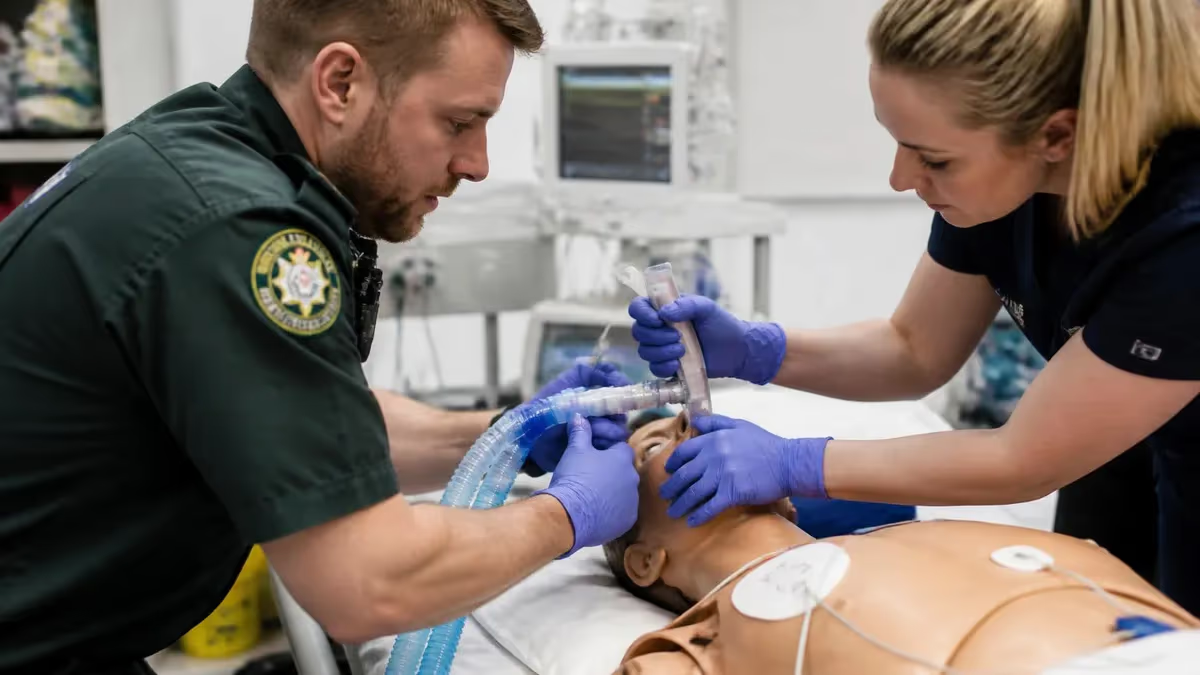
The rodney lee acls patient case is one of the most frequently referenced teaching scenarios in Advanced Cardiovascular Life Support training, and for good reason — it packages multiple clinical decision points into a single, realistic emergency that forces providers to think, prioritize, and act under pressure.
Whether you are preparing for your initial ACLS certification or working through a renewal, understanding how to navigate structured patient cases like this one is the difference between memorizing algorithms and actually applying them at the bedside. This guide breaks down the full landscape of ACLS scenarios so you walk into your skills station with genuine confidence.
ACLS scenarios are not random stress tests. Every case the American Heart Association designs follows a deliberate logic: a presenting rhythm, a patient presentation, a team dynamic challenge, and a series of decision branches that require you to recognize, intervene, reassess, and escalate. Providers who struggle during megacode evaluations almost always fail not because they forgot a drug dose, but because they did not practice the clinical reasoning loop that ties all those facts together. Scenario-based study fixes that gap in a way that flashcards simply cannot.
This article walks through the most common ACLS scenario categories — cardiac arrest (VF/pVT, PEA, asystole), peri-arrest bradycardia, unstable tachycardia, acute coronary syndrome, and stroke — and explains the key recognition cues, algorithm decision points, and team communication expectations for each. You will also find targeted practice strategies, common evaluator traps, and a curated checklist you can use the week before your exam. For deeper algorithm-level review, our guide to acls scenarios covering ACS is an excellent companion resource.
One reason experienced instructors like Rodney Lee build patient cases around realistic composite presentations is that real emergencies rarely arrive as textbook single-diagnoses. A patient might present with chest pain that evolves into a rhythm requiring synchronized cardioversion, or a post-resuscitation patient who develops bradycardia with hypotension — all within one simulation session. Practicing with that complexity in mind trains the kind of adaptive thinking that separates a competent responder from a confident team leader.
The AHA's 2024 ACLS provider course officially emphasizes high-quality CPR, systems of care, and closed-loop communication alongside the clinical algorithms. That means evaluators are watching how you lead your team, how you confirm orders, and how you debrief findings — not only whether you remember that amiodarone 300 mg IV is the first dose for refractory VF. This guide addresses all three dimensions: recognition, intervention, and team leadership, because passing your megacode station requires all three working together seamlessly under realistic time pressure.
Scenario-based study is also the most efficient preparation strategy because it forces active retrieval. When you work through a simulated case of a 58-year-old with witnessed collapse, wide-complex tachycardia, and a blood pressure of 70/40, you are simultaneously practicing rhythm recognition, hemodynamic assessment, treatment selection, and verbal communication skills. That multi-domain retrieval practice strengthens memory far better than passively reviewing the same algorithm chart for the fifteenth time. The sections below are organized to mirror how your actual ACLS station will unfold.
Expect this guide to take roughly 45 to 60 minutes to work through thoroughly. By the end, you should be able to move through any standard ACLS megacode scenario with a clear mental framework: identify the rhythm, assess the patient, select the intervention, communicate it to your team, and reassess after every intervention. That loop — recognize, treat, reassess — is the engine of every ACLS case, and mastering it is the goal of everything that follows.
ACLS Scenarios by the Numbers

The Six Core ACLS Scenario Categories
The most commonly tested shockable arrest rhythm. Requires immediate defibrillation at 200 J biphasic, high-quality CPR, epinephrine 1 mg IV every 3-5 minutes, and amiodarone for refractory VF after the third shock.
Non-shockable arrest with organized electrical activity but no palpable pulse. Management focuses on CPR, epinephrine, and immediately treating reversible causes via the 5 Hs and 5 Ts framework within the first two minutes.
Flatline rhythm requiring CPR, epinephrine, and aggressive search for reversible causes. Confirm in two leads before treating; do not shock asystole. Prognosis is poor without rapid identification and treatment of an underlying cause.
Heart rate under 50 bpm with signs of hemodynamic compromise. First-line treatment is atropine 1 mg IV. If atropine fails, move to transcutaneous pacing or dopamine/epinephrine infusion while preparing for transvenous pacing.
Narrow or wide-complex tachycardia with hypotension, altered mental status, chest pain, or pulmonary edema. Synchronized cardioversion is the definitive treatment; energy selection depends on whether the rhythm is regular or irregular.
Cardiac arrest scenarios form the backbone of every ACLS evaluation, and the megacode station almost always begins with a shockable or non-shockable arrest that requires you to demonstrate the complete cardiac arrest algorithm from recognition through post-resuscitation care. Understanding the three major arrest presentations — ventricular fibrillation, PEA, and asystole — in enough depth to manage them without hesitation is the foundation everything else is built on. The timing, drug doses, and decision branch points must become automatic through repeated scenario practice.
Ventricular fibrillation and pulseless ventricular tachycardia are the highest-yield shockable rhythms on the ACLS exam. When you identify a shockable rhythm, your immediate priority is one shock followed by two minutes of high-quality CPR — you do not stop to check a pulse immediately after the shock.
After the second two-minute CPR cycle with no ROSC, administer epinephrine 1 mg IV/IO and continue cycles. After the third shock with persistent VF/pVT, amiodarone 300 mg IV/IO is your first antiarrhythmic; a second dose of 150 mg can follow if needed. Lidocaine 1-1.5 mg/kg is an acceptable alternative if amiodarone is not available.
PEA scenarios are more cognitively demanding because the rhythm looks organized but the patient has no pulse. The critical skill here is rapidly running through the 5 Hs and 5 Ts: Hypovolemia, Hypoxia, Hydrogen ion (acidosis), Hypo/Hyperkalemia, Hypothermia, Tension pneumothorax, Tamponade (cardiac), Toxins, Thrombosis (pulmonary), and Thrombosis (coronary). In a well-designed PEA scenario, the case will include a clinical clue — JVD with absent breath sounds suggests tension pneumothorax, a history of dialysis and peaked T-waves suggests hyperkalemia, a post-surgical patient with hypotension and narrow pulse pressure suggests tamponade. Your job is to identify that clue and act on it.
Asystole is the arrest rhythm with the poorest prognosis, and ACLS evaluators want to see that you confirm it in at least two leads before committing to a management plan. Never shock a flat line — accidental defibrillation of true asystole is a critical error that evaluators note. Management mirrors PEA: CPR, epinephrine every 3-5 minutes, and an active search for reversible causes. Some instructors include scenarios where an asystole patient has an easily reversible cause — such as severe hypothermia or opioid overdose — to test whether providers think beyond the algorithm.
Post-resuscitation care is an increasingly emphasized component of ACLS scenarios. After achieving ROSC, your priorities shift to optimizing oxygenation (target SpO2 94-99%), blood pressure management (target systolic ≥90 mmHg), obtaining a 12-lead ECG to evaluate for STEMI, glucose management, and targeted temperature management if the patient remains comatose. Many providers lose points on the megacode station by treating ROSC as the finish line rather than a transition point. Demonstrating awareness of the post-arrest care bundle distinguishes competent providers from excellent ones.
During cardiac arrest scenarios, team dynamics are evaluated as closely as clinical decision-making. The team leader is expected to assign roles clearly at the start of the scenario, use closed-loop communication for every order (state the drug and dose, the person confirms verbally, and the team leader acknowledges execution), and maintain situational awareness throughout. A common evaluator trap is introducing a distractor — a team member who announces an incorrect rhythm interpretation or suggests the wrong drug — to see whether the team leader catches and corrects it gracefully without disrupting team function.
The rhythm re-check cadence is one of the most common timing errors in practice scenarios. Every two minutes of CPR, pause briefly to check the rhythm. If it is shockable, shock immediately and resume CPR. If it is non-shockable with a pulse, begin post-arrest care. If it is non-shockable without a pulse, continue CPR and look for reversible causes. That loop must happen without the team leader hesitating or needing a prompt. If you can drive that two-minute cycle confidently while simultaneously managing drug administration and team communication, you will perform well on any cardiac arrest scenario the evaluator presents.
ACLS Scenarios: Rhythm Recognition & Management
Unstable bradycardia scenarios typically feature a patient with a heart rate below 50 bpm accompanied by at least one sign of hemodynamic compromise: hypotension, altered mentation, ischemic chest discomfort, or acute pulmonary edema. The first question to answer is always whether the symptoms are caused by the slow rate — if not, treating the bradycardia will not fix the problem. Once you establish causation, atropine 1 mg IV is your initial intervention, and it can be repeated every 3-5 minutes to a maximum of 3 mg total. High-degree blocks (Mobitz II second-degree or complete third-degree AV block) typically do not respond reliably to atropine and require transcutaneous pacing as a bridge to definitive transvenous pacing.
A well-designed bradycardia scenario will test whether you initiate transcutaneous pacing correctly when atropine fails. Capture must be confirmed both electrically (pacing spikes followed by wide QRS complexes) and mechanically (a palpable pulse at the paced rate). Sedation and analgesia should be offered because transcutaneous pacing is painful in conscious patients. Dopamine 2-10 mcg/kg/min or epinephrine 2-10 mcg/min infusion are alternatives while pacing is being set up. Demonstrating knowledge of the full escalation pathway — atropine, then pacing or infusion, then expert consultation — is what evaluators look for in a strong candidate performance.

Scenario-Based vs. Algorithm-Only ACLS Study: What Works Better?
- +Builds clinical reasoning loops, not just memorized fact recall under exam conditions
- +Simulates real team dynamics so communication skills develop alongside clinical skills
- +Exposes gaps in knowledge that passive review misses until the actual skills station
- +Reinforces drug timing and sequencing through active retrieval rather than passive reading
- +Mirrors the exact format of the AHA megacode station, reducing test-day anxiety significantly
- +Allows practice of reassessment cycles so providers do not treat a rhythm and forget to recheck
- −Requires a partner or simulation environment that not all candidates have easy access to
- −Can create false confidence if the same scenarios are repeated without variation in presentation
- −Time-intensive compared to quick flashcard review sessions when preparation time is limited
- −Without an experienced debriefer, errors can become reinforced rather than corrected
- −Does not replace didactic knowledge of drug doses, which must still be memorized precisely
- −Online scenario simulators vary widely in quality and may not reflect current 2024 AHA guidelines
ACLS Megacode Readiness Checklist
- ✓Confirm you can state the cardiac arrest algorithm sequence from memory without referencing a card
- ✓Practice identifying VF, pVT, PEA, asystole, SVT, VT, AF, and third-degree block on ECG strips
- ✓Memorize epinephrine 1 mg IV/IO every 3-5 minutes and amiodarone 300 mg first dose for VF/pVT
- ✓Review the 5 Hs and 5 Ts and be able to name all ten causes from memory in under 60 seconds
- ✓Practice calling out closed-loop communication orders: state drug, dose, route, and confirm back
- ✓Know the synchronized cardioversion energy doses for SVT, AF, regular VT, and polymorphic VT
- ✓Review the bradycardia algorithm: atropine dose limit, transcutaneous pacing capture confirmation
- ✓Confirm you understand ROSC priorities: SpO2 94-99%, systolic BP ≥90, 12-lead ECG, glucose check
- ✓Practice the stroke rapid assessment and know the door-to-needle tPA time target of 60 minutes
- ✓Complete at least two full megacode simulations with a partner and debrief each one thoroughly
The Two-Minute Rule Is Non-Negotiable
Every ACLS scenario evaluator tracks CPR cycle timing. High-quality CPR for exactly two minutes before a rhythm check — not 90 seconds, not 2.5 minutes — reflects the evidence base behind ACLS guidelines. Providers who interrupt CPR early to check a rhythm or pulse demonstrate a pattern that lowers resuscitation survival rates in real patients, and evaluators score it as a critical error. Set a mental timer and commit to the full cycle every time.
Team leadership is the least-studied dimension of ACLS preparation and the one most likely to cost candidates points during a skills evaluation. The AHA explicitly assesses team dynamics during the megacode station, and evaluators use a structured checklist that includes role assignment, closed-loop communication, mutual respect, shared situational awareness, and constructive intervention when a team member makes an error. Candidates who know the algorithms cold but lead their team with vague instructions or fail to acknowledge completed tasks consistently receive lower scores than technically proficient team leaders.
Closed-loop communication is the most concrete team skill you can practice before your exam. Every order you give as team leader should follow this pattern: name the person, state the intervention, include the dose and route, and then explicitly ask for confirmation.
For example: 'Jen, I need one milligram of epinephrine IV push now — can you confirm?' Jen then states, 'One milligram epinephrine IV push, confirmed,' and when it is administered she announces, 'Epinephrine one milligram given.' That full loop closes without ambiguity. Evaluators will note when orders are confirmed without this loop, and in a real resuscitation, missing confirmations cause medication errors.
Situational awareness means the team leader maintains a running mental model of what has happened, what is happening right now, and what needs to happen next — all simultaneously. In practice, this means calling out time elapsed since last epinephrine, reminding the team that the next rhythm check is in 45 seconds, and acknowledging when a compression provider needs to rotate.
Many candidates collapse situational awareness under cognitive load because they focus entirely on the algorithm and forget to narrate their thinking. Saying out loud 'We are two minutes into the second CPR cycle, epinephrine was given 90 seconds ago, next dose in approximately 90 to 120 seconds' demonstrates leadership and keeps the entire team synchronized.
Constructive intervention — also called advocacy-inquiry — is required when a team member suggests something incorrect. Suppose your airway provider announces 'I'm going to intubate now' when the patient was just intubated 30 seconds ago. The team leader must correct this without embarrassing the provider: 'Hold on — the airway is already secured, let's focus on compressions.' Practicing this dynamic in scenario simulations makes it feel natural under evaluation conditions. Ignoring a team error because correcting it feels awkward is itself a team leadership failure that evaluators document.
Role clarity at the start of every scenario reduces cognitive load for the entire team. A strong team leader announces roles within the first 20-30 seconds: compressions, airway/ventilation, IV/IO access and medication administration, monitor and defibrillator, and documentation and timing. When everyone knows their lane, the team leader can focus on the algorithm and reassessment rather than micromanaging every action. In scenarios where roles are not pre-assigned, the evaluator may introduce a role confusion moment — two providers starting compressions, for example — to see whether the team leader redirects effectively.
Debriefing is formally part of the AHA ACLS course curriculum, and some skills stations include a brief debrief component after the megacode. Evaluators want to hear you identify what went well, what the team could improve, and — critically — whether you would make different clinical decisions with the same information.
A strong debrief is non-judgmental, anchored to specific observable behaviors rather than general impressions, and forward-focused. 'Our CPR timing was excellent and we hit the two-minute cycle consistently. I would improve our communication on the drug administration loop — there were two moments where I did not hear a verbal confirmation' is a model debrief comment.
Psychological safety within the team during a high-stress scenario is harder to practice but just as important. Team members who feel safe speaking up about errors, asking for clarification without fear of embarrassment, and admitting uncertainty perform better as a unit than teams with a dominant leader who never invites input. If you are preparing with a study group, rotate the team leader role so every member practices both leading and following, and explicitly debrief the psychological safety dimension after each run. That kind of practice environment produces not just better exam performance but better real-world resuscitation outcomes.
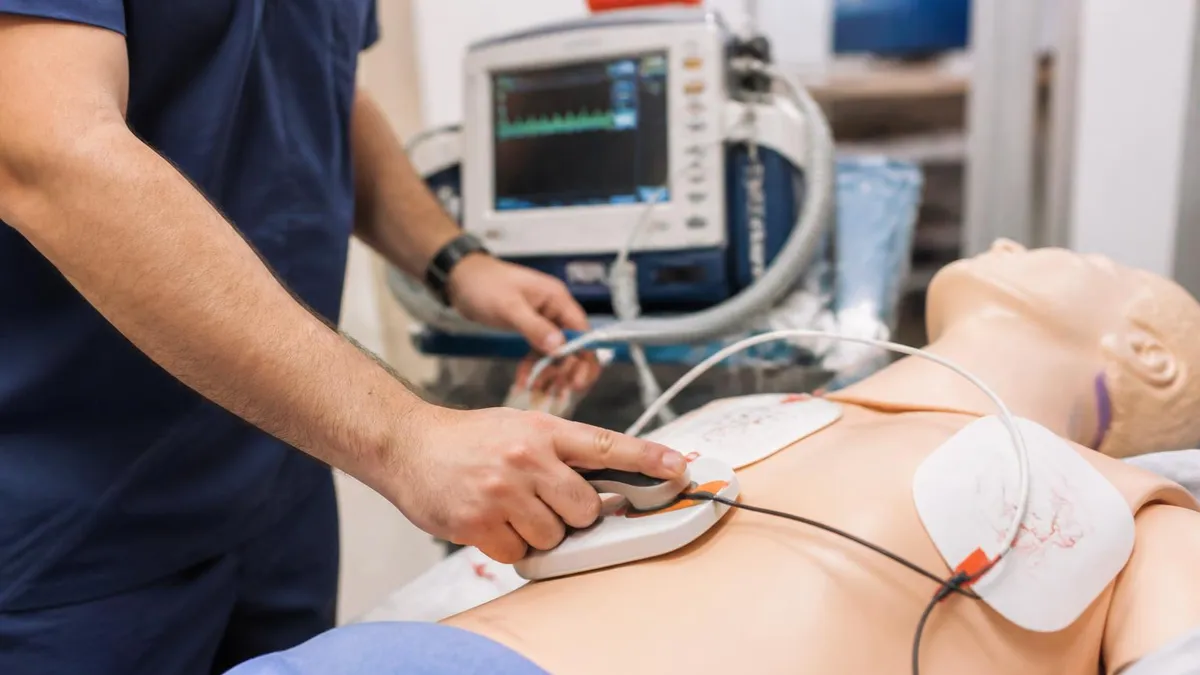
Using defibrillation mode (unsynchronized) when the patient requires synchronized cardioversion for an organized tachyarrhythmia can trigger ventricular fibrillation — a potentially fatal error in a real patient and an automatic critical failure on the megacode station. Always press the sync button before each cardioversion attempt, and visually confirm that the defibrillator is detecting and marking R-waves before discharging. The only exception: pulseless polymorphic VT (including Torsades in arrest) is treated as VF with unsynchronized shocks.
Building an effective ACLS study plan in the weeks before your exam requires balancing three types of preparation: knowledge acquisition, skills practice, and scenario simulation. Most candidates spend 90% of their time on knowledge acquisition — reading algorithms, reviewing drug cards, watching videos — and almost no time on the other two. That imbalance is why candidates who feel confident walking into the exam room sometimes struggle at the skills station. The final two weeks before your exam should deliberately shift toward active practice over passive review.
Knowledge acquisition in the early phase should focus on the six core algorithms: cardiac arrest (shockable and non-shockable), bradycardia, tachycardia (stable and unstable), post-cardiac arrest care, and acute coronary syndrome. Each algorithm has a logical structure — recognize the presentation, assess stability, intervene, reassess — and understanding that structure is more useful than memorizing bullet-point lists. The AHA 2024 ACLS provider manual is the authoritative source; use it to build your knowledge base rather than relying solely on third-party summaries that may lag guideline updates.
Skills practice means physically doing the things the algorithm requires — not just knowing them. If you have access to a simulation lab or a mannequin, practice compressions at the correct rate (100-120 per minute) and depth (at least 2 inches, not more than 2.4 inches) with full chest recoil and minimal interruptions.
Practice bag-mask ventilation with the correct seal and tidal volume. Practice saying out loud 'I am charging to 200 joules, everyone clear' and physically miming the safety check. Muscle memory for these skills reduces cognitive load during the actual evaluation, freeing mental bandwidth for the algorithmic decision-making that the evaluator is assessing.
Scenario simulation should begin at least one week before your exam. Use a study partner, an online megacode simulator, or your institution's simulation center. Run through at least one VF arrest, one PEA arrest, one bradycardia case, and one unstable tachycardia case from start to finish — not just the recognition phase. Include post-ROSC management. Debrief every scenario with specific feedback on timing, communication, and decision sequence. If you cannot identify at least two things to improve after each scenario, your debrief is not specific enough.
Drug dose memorization is most efficient when organized by context rather than alphabetically. Group epinephrine, amiodarone, and lidocaine as the arrest medications. Group atropine, dopamine, and epinephrine infusion as the bradycardia medications. Group adenosine and amiodarone as the stable tachycardia medications. Group magnesium sulfate as the Torsades medication. Nitroglycerin, aspirin, and morphine (with its cautions) belong in the ACS group. When you study drugs by clinical context, you are simultaneously reviewing the algorithm, which doubles the efficiency of your review time compared to isolated drug memorization.
The night before your ACLS exam, do not run full scenarios — review the algorithms one final time, sleep adequately, and arrive early enough to observe the setup before your station begins. Anxiety management on exam day is real: the evaluator is not trying to trick you, the scenario will follow a predictable algorithm structure, and brief pauses to think out loud are acceptable and demonstrate clinical reasoning.
Saying 'I am identifying this as ventricular fibrillation, preparing to shock' is better than silently charging the defibrillator, because the evaluator needs to hear your reasoning to give you credit for the correct decision.
After you pass, the two-year certification cycle is an opportunity to maintain and deepen your ACLS competency rather than letting it atrophy until renewal. Many institutions require annual skills verification. Consider using acls scenarios practice resources quarterly to keep your rhythm recognition sharp, particularly for less common presentations like Torsades de Pointes, Wolff-Parkinson-White syndrome with AF, or hyperkalemic patterns that may not appear in your clinical practice regularly but can appear on renewal exams. Sustained competency serves both your patients and your professional standing far better than a last-minute renewal cram.
Practical exam-day tips can make the difference between a confident performance and an unnecessarily stressful one. Arrive at your ACLS provider course or renewal skills station well-rested and having eaten, because decision-making under cognitive load is significantly worse when you are hungry or fatigued. Bring your AHA ACLS provider manual if the course allows reference materials during the written test portion — many candidates forget this is permitted. For the megacode station, listen carefully to the scenario setup and repeat back your understanding of the initial presentation before you begin managing the case.
During the megacode, verbalize everything. Evaluators cannot read your mind, and a silent candidate who makes correct decisions still risks a lower score if the evaluator cannot document the reasoning. When you identify a rhythm, say its name. When you order a medication, state the drug, dose, and route. When you check for a pulse, announce the result. When you reassess after an intervention, narrate the patient's response. This running commentary is not just test-taking strategy — it is the foundation of effective team communication in a real resuscitation environment, and it serves both purposes simultaneously.
If you make an error during the megacode, self-correct immediately and move on. Evaluators distinguish between isolated errors that are immediately caught and corrected versus errors that are repeated or that the candidate is unaware of. Saying 'Wait — I said atropine 1 mg, I need to confirm we are in the bradycardia algorithm — yes, that is correct, proceed with atropine 1 mg IV' demonstrates clinical self-awareness and recovery, which is itself a leadership competency. Freezing or apologizing extensively takes time away from the scenario and signals that the candidate is not comfortable with real-world uncertainty.
Time management during the written portion of ACLS is rarely a problem because the exam is designed with adequate time allotted, but flag any question you are uncertain about and return to it after completing the items you know well. ACLS written exams test application, not only recall — many questions present a brief clinical scenario and ask you to select the next best action. For these questions, identify the rhythm or presentation first, then apply the algorithm. Do not over-read distractors in the answer choices; the correct answer usually aligns directly with the guideline recommendation for that presentation.
Post-exam, regardless of whether you passed on the first attempt, request feedback from your evaluator. AHA-affiliated instructors are trained to provide structured debriefs, and the specific observations they offer about your megacode performance are more valuable than any generic study guide. First-attempt failures most commonly occur in three areas: failure to recognize and respond to shockable rhythms within the appropriate time window, incorrect drug doses or sequencing, and inadequate closed-loop communication. If you know which of those three areas you struggled with, you can target your restudy precisely rather than reviewing everything from scratch.
Technology tools can supplement scenario practice effectively. Many ACLS preparation platforms offer interactive megacode simulators where you progress through a case by selecting interventions from a menu, with the patient's condition responding dynamically to your choices. These tools are not a substitute for hands-on simulation with a mannequin and a partner, but they are excellent for building algorithm fluency and recognizing the decision branch points in each scenario type. Use them in the early-to-middle phase of your preparation, then transition to live simulation as your exam approaches.
Finally, remember that ACLS certification represents a commitment to a standard of care that has been shown to improve patient outcomes when consistently applied. The algorithms you are memorizing encode decades of clinical research and randomized trial data into actionable decision trees. The communication skills you are developing have been linked to better team performance and reduced resuscitation errors in real hospital settings. Approaching ACLS preparation with that understanding — not just as an exam to pass but as a clinical standard to meet — will produce both better exam performance and better patient care throughout your career.
ACLS Questions and Answers

ACLS Acute Coronary Syndrome Algorithm: Complete Study Guide for Certification Prep
ACLS Renewal Class: Complete 2026 Guide to Recertification Requirements, Costs, Formats & Pass Strategies
ACLS Bradycardia Algorithm: Complete 2026 Guide to Recognition, Treatment Steps & Drug Doses

ACLS Study Guide: Complete 2026 Certification Prep with Algorithms, Drugs & Practice Tests

ACLS BLS Course: Complete Training Guide for Healthcare Providers
About the Author

Registered Nurse & Healthcare Educator
Johns Hopkins University School of NursingDr. Sarah Mitchell is a board-certified registered nurse with over 15 years of clinical and academic experience. She completed her PhD in Nursing Science at Johns Hopkins University and has taught NCLEX preparation and clinical skills courses for nursing students across the United States. Her research focuses on evidence-based exam preparation strategies for healthcare certification candidates.