
Renew Forklift License Australia: Complete TLILIC0003 Renewal Guide for 2026 September
Renew forklift license in Australia: TLILIC0003 renewal steps, fees, deadlines, medical checks, and state-by-state requirements for 2026 September. ❓
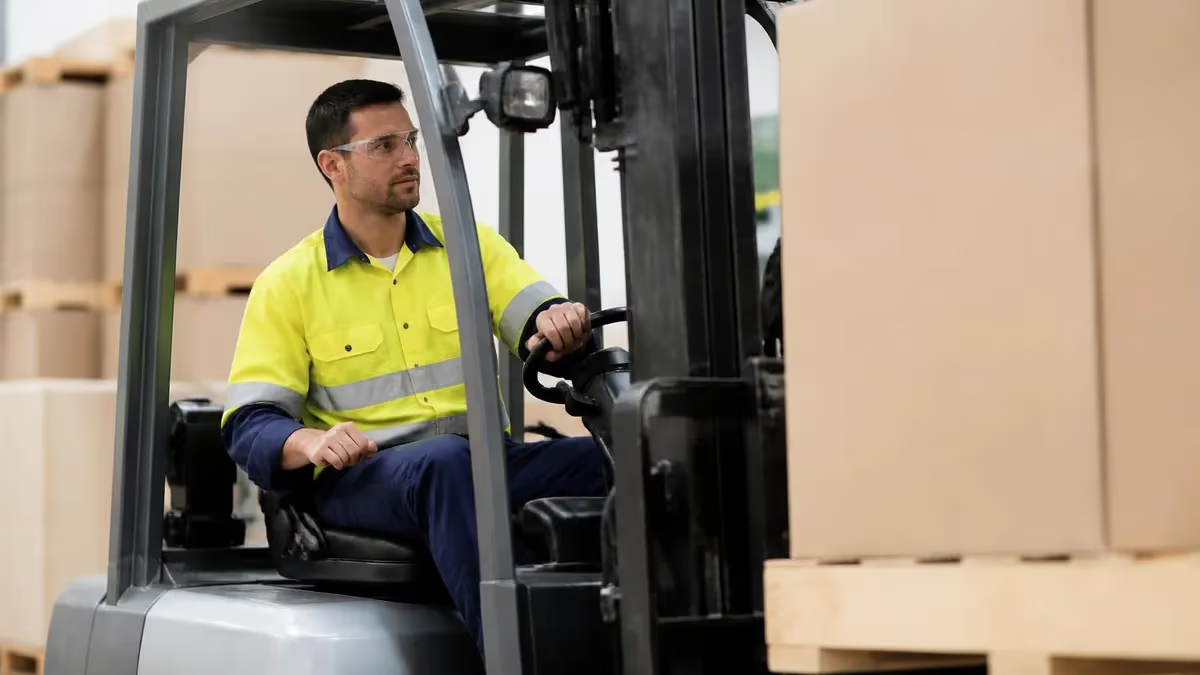
If you need to renew forklift license credentials in Australia, the process is governed by SafeWork regulations in each state and the national TLILIC0003 unit of competency that underpins your high-risk work licence (HRWL). Renewal is not optional. Letting your licence lapse means you legally cannot operate a forklift on any worksite, and reapplying after expiry can require a full retraining course rather than a simple paperwork submission. Understanding the timeline saves money, downtime, and stress.
The standard Australian forklift licence is valid for five years from the date of issue. SafeWork NSW, WorkSafe Victoria, WorkSafe Queensland, SafeWork SA, WorkSafe WA, WorkSafe Tasmania, NT WorkSafe, and WorkSafe ACT all follow the same five-year validity rule under the model Work Health and Safety regulations. The renewal window typically opens 90 days before expiry and closes on the expiry date printed on the front of your photo card.
Renewing on time is straightforward when you understand the four moving parts: identity verification, the renewal application form, the fee, and any state-specific competency requirements. In some states a simple form and fee restores your licence for another five years. In others you may need to declare ongoing currency or, if the regulator has concerns about your recent work history, complete a refresher assessment with a registered training organisation (RTO).
Many operators confuse the statement of attainment from TLILIC0003 with the licence itself. The statement of attainment never expires, but the licence card does. When you renew, you are not retesting the underlying competency unit. You are renewing the legal authorisation to perform high-risk work, which the regulator issues based on your declared continued competence and clean record. This distinction matters when you receive your renewal reminder letter.
Costs vary by state but generally range from $75 to $180 for a standard five-year renewal. Late fees may apply if you submit within the grace period (where one exists), and reissuing a fully expired licence often costs significantly more because it triggers a complete reassessment. Budget for the renewal at least six months ahead, especially if your employer covers the fee through workplace training schedules or if you operate across multiple states.
This guide walks through the complete renewal process, including state variations, medical fitness considerations, what to do if you miss the deadline, the documents you need ready, and how recent regulatory updates affect operators renewing in 2026. Whether your card is approaching expiry, has just lapsed, or you are planning ahead for the next cycle, the steps below will help you maintain unbroken legal authorisation to operate a forklift in Australian workplaces.
We will also cover the practical realities employers face when workers let licences expire, the impact on insurance and workers compensation claims, and how renewal interacts with newer competency units like TLILIC0040 for order-picking forklifts. By the end of this guide you will know exactly what to do, when to do it, and how much it will cost to keep your high-risk work licence current.
Forklift Licence Renewal by the Numbers
Forklift Licence Renewal Timeline
90 Days Before Expiry
60 Days Before Expiry
30 Days Before Expiry
Expiry Date
After Renewal
Knowing when to renew forklift license credentials is critical because the rules differ depending on whether your card is current, recently expired, or long-lapsed. The expiry date on your photo card is the absolute deadline, and most state regulators will not accept work performed on the day after that date as legally authorised. Even an overnight lapse can void your insurance coverage and expose your employer to prosecution under WHS legislation.
The 90-day renewal window is your friend. SafeWork NSW, for example, sends a reminder letter approximately 90 days before expiry to the address on file. WorkSafe Victoria and other state regulators follow similar timelines. If you have moved since your last renewal or initial issue and have not updated your address, you may never receive the reminder. This is one of the most common reasons operators discover their licence has expired only when an employer or auditor checks the database.
Within the 90-day window, renewal is typically a same-day online process. You complete the application, pay the fee, and receive an interim digital licence almost immediately. The physical card follows in the mail within 10 business days. There is no need to redo TLILIC0003 training, no theory exam, and no practical assessment, provided you have maintained currency and have no compliance concerns flagged against your record.
Some states offer a short grace period after expiry, typically 30 to 60 days, during which you can still renew without retraining but may incur late fees. NSW provides a 12-month window after expiry during which the licence can be renewed without a full reassessment, though you cannot legally operate during the lapsed period. Victoria, Queensland, and Western Australia have similar provisions but the specifics vary and change periodically, so always check the current regulator website.
If your licence has been expired for more than 12 months in most jurisdictions, you must complete a full TLILIC0003 reassessment with an RTO. This means booking a refresher course, sitting both the theory and practical assessments, paying course fees of $400 to $700, and then submitting a fresh application as if you were a new applicant. The process can take two to four weeks and prevents you from working a forklift in the meantime.
Workers who hold licences across multiple states need to be especially careful. While the HRWL is nationally recognised under mutual recognition, your card is administered by the state that issued it. Renewing in your home state preserves the national recognition. If you have moved permanently to another state, you may need to transfer the licence rather than renew, which involves slightly different paperwork and sometimes a small transfer fee on top of the renewal cost.
For deeper context on the forklift equipment you operate, review our guide to mast of forklift components and how their condition affects the verification checks regulators may request during renewal in cases where workplace incidents have been reported. Knowing your machine inside and out also helps demonstrate continued competence if challenged.
TLILIC0003 Practice Test Questions
Prepare for the Forklift Licence Australia - TLILIC0003 exam with our free practice test modules. Each quiz covers key topics to help you pass on your first try.
TLILIC0003 Forklift Licence Australia Atta...
TLILIC0003 Exam Questions covering Forklift Licence Australia Attachments and Modifications. Master TLILIC0003 Test concepts for certification prep.
TLILIC0003 Forklift Licence Australia Batt...
Free TLILIC0003 Practice Test featuring Forklift Licence Australia Battery and Fuel Safety. Improve your TLILIC0003 Exam score with mock test prep.
TLILIC0003 Forklift Licence Australia Emer...
TLILIC0003 Mock Exam on Forklift Licence Australia Emergency Procedures. TLILIC0003 Study Guide questions to pass on your first try.
TLILIC0003 Forklift Licence Australia Fork...
TLILIC0003 Test Prep for Forklift Licence Australia Forklift Pre-Operational Checks. Practice TLILIC0003 Quiz questions and boost your score.
TLILIC0003 Forklift Licence Australia Haza...
TLILIC0003 Questions and Answers on Forklift Licence Australia Hazard Identification. Free TLILIC0003 practice for exam readiness.
TLILIC0003 Forklift Licence Australia Load...
TLILIC0003 Mock Test covering Forklift Licence Australia Load Centre Calculations. Online TLILIC0003 Test practice with instant feedback.
TLILIC0003 Forklift Licence Australia Load...
Free TLILIC0003 Quiz on Forklift Licence Australia Load Handling and Capacity. TLILIC0003 Exam prep questions with detailed explanations.
TLILIC0003 Forklift Licence Australia Oper...
TLILIC0003 Practice Questions for Forklift Licence Australia Operating in Different Environments. Build confidence for your TLILIC0003 certification exam.
TLILIC0003 Forklift Licence Australia Oper...
TLILIC0003 Test Online for Forklift Licence Australia Operating Techniques. Free practice with instant results and feedback.
TLILIC0003 Forklift Licence Australia Pede...
TLILIC0003 Study Material on Forklift Licence Australia Pedestrian Safety. Prepare effectively with real exam-style questions.
Renew Forklift License: State-by-State Requirements
In New South Wales, SafeWork NSW administers HRWL renewals through the Service NSW portal. Standard renewal fee is approximately $93 for five years. You need 100 points of ID, your current licence number, and a recent photo if your appearance has changed significantly. NSW allows renewal up to 12 months after expiry without retraining, though you cannot operate during the lapsed period and a late fee applies after the expiry date.
Victoria handles renewals through WorkSafe Victoria. Fees are similar at around $95 for five years. Victorian applicants must complete an online application or visit a participating Australia Post outlet for identity verification. WorkSafe Victoria has historically been stricter on lapsed renewals, often requiring reassessment after only 60 days. Always confirm current rules on worksafe.vic.gov.au before assuming the timeline applies to your situation.
Renewing Online vs Paper Application: Which Is Better?
- +Online renewal is processed within hours, not weeks
- +Digital interim licence available immediately on smartphone
- +Lower risk of paperwork being lost in postal delays
- +Payment confirmation arrives instantly via email
- +Can be completed outside business hours from home
- +Auto-fills your existing details to reduce data-entry errors
- +Provides clear audit trail with timestamps and reference numbers
- −Requires myGovID or equivalent digital identity verification
- −Older operators may struggle with portal navigation
- −Some states still require in-person photo updates after age 50
- −Internet outages can delay submission near deadline
- −Phone-only support during weekday business hours
- −Some employers still require physical card copies for site induction
Renew Forklift License Document Checklist
- ✓Current forklift licence card (photograph both sides)
- ✓100 points of identification including primary photo ID
- ✓Renewal reminder letter or unique application reference number
- ✓Current residential address proof such as utility bill or bank statement
- ✓Updated passport-style photo if appearance has changed
- ✓Credit card, debit card, or BPAY details for fee payment
- ✓Employer letter confirming recent forklift operation if requested
- ✓Medical fitness declaration confirming no impairments affecting operation
- ✓Statement of attainment for TLILIC0003 if original licence is lost
- ✓myGovID or Digital iD account for online application portals
- ✓Record of any workplace incidents from the past five years
- ✓Refresher training certificate if completed voluntarily
Your statement of attainment is not your licence
Many operators believe their TLILIC0003 statement of attainment from training is their licence. It is not. The statement of attainment never expires and proves you completed the unit, but the HRWL photo card issued by your state regulator is what authorises legal operation. You renew the card, not the underlying competency. Treat them as two separate documents.
What happens if your licence has already expired and you discover it during a routine site induction? The first rule is simple: stop operating immediately. Every minute you spend driving a forklift on an expired licence is a breach of WHS legislation that exposes both you and your employer to significant fines, potential injury liability, and voiding of workers compensation coverage. Australian regulators treat expired HRWLs the same as having no licence at all.
If your licence has expired within the past 12 months in most states, the recovery pathway is straightforward but not automatic. You complete a late renewal application and pay the standard fee plus a late charge, typically $30 to $60 on top of the normal renewal cost. Some regulators require a brief written explanation for the lapse. Processing times for late renewals are usually the same as on-time renewals, around 5 to 10 business days for the physical card.
Lapses beyond 12 months require a full reassessment. You must enrol with a registered training organisation, attend a refresher course, complete the TLILIC0003 theory assessment, pass the practical assessment in an actual forklift, and then submit a fresh HRWL application as a new applicant. Total cost including RTO fees and the licence application typically ranges from $500 to $850. The process from booking to receiving the new card takes three to six weeks.
Workers who have been on extended leave, working overseas, or in non-forklift roles for several years often face the longest delays. RTOs may require additional practice hours before booking the assessment if the applicant has been out of practice. Some training providers offer half-day or full-day refresher sessions specifically designed for returning operators who need to demonstrate competency before the formal assessment.
Employers have legal obligations too. Under WHS regulations, persons conducting a business or undertaking (PCBUs) must verify that workers performing high-risk work hold current licences. Many large employers now use automated systems that check licence status weekly against the national register. If your licence lapses, you may be stood down from work or reassigned to non-forklift duties until renewal is complete. This protects the employer but means lost income for the worker.
If you suspect your licence is expired but have no evidence, you can verify status through the WorkSafe website in your state or by calling the regulator. The national HRWL register at hrwl.business.gov.au also allows employers and individuals to check current status. Always verify before assuming. Photo cards can be misprinted, and database errors do occur, particularly after interstate transfers or name changes following marriage or divorce.
Finally, beware of unauthorised intermediaries who claim they can fast-track expired licence recovery for a fee. Only RTOs registered with ASQA can deliver TLILIC0003 reassessment, and only state regulators can issue or renew the HRWL itself. Anyone offering shortcuts through unofficial channels is operating outside the law and any documents they provide will not be recognised by Australian regulators or employers.

If you operate a forklift on an expired HRWL and an incident occurs, your employer's workers compensation insurer can reject claims related to the incident. Public liability insurance may also be void. Personal financial exposure can run into hundreds of thousands of dollars. Always confirm current status before starting any shift.
Understanding the true cost of renewal helps you budget accurately and avoid surprises. The headline fee published on regulator websites is only part of the picture. Most states charge between $75 and $180 for a standard five-year renewal, with NSW around $93, Victoria around $95, Queensland around $87, and WA at the upper end around $109. These fees are reviewed annually and may increase slightly each financial year.
Late fees stack on top of the standard renewal cost. NSW charges approximately $40 if you renew within 12 months of expiry. Victoria adds around $50, Queensland around $35, and WA around $55. These late fees apply per renewal cycle, so missing two consecutive cycles can compound the cost significantly. Some states also charge separate fees for replacement cards, name changes, or address corrections, typically $20 to $30 each.
If your licence has lapsed beyond the late renewal window, RTO refresher course fees become the dominant expense. A one-day TLILIC0003 refresher with assessment typically costs between $350 and $550, depending on location and provider. Metropolitan Sydney and Melbourne courses tend to be cheaper due to competition, while regional and remote area courses can exceed $700. Many employers reimburse these costs as part of workforce development programs.
Travel and time-off costs are easy to forget. A full-day refresher means a day of lost wages unless your employer covers training time. Add fuel or public transport costs, parking near the training centre, and lunch, and the indirect costs can add another $100 to $200. Operators in regional areas may also need to budget for overnight accommodation if no local RTO offers the unit.
Some employers absorb the entire renewal cost as part of workforce policy. Large logistics companies, supermarket distribution centres, and major construction firms often include HRWL renewals in annual training budgets. Smaller businesses and labour-hire arrangements typically expect the worker to pay and then claim reimbursement, sometimes only after demonstrating continued employment for a set period. Clarify your employer's policy before assuming costs will be covered.
Tax deductibility is another consideration. Renewal fees paid out of pocket for the purpose of maintaining current employment are typically deductible as a work-related expense under ATO rules. Keep receipts and the renewal confirmation email. If you are self-employed or operate as a sole-trader contractor, the full cost including travel to training is generally deductible against business income. Always confirm with a registered tax agent for your specific situation.
For a broader understanding of related equipment that affects which licences you need, see our guide on multi directional forklift trucks. Operators expanding into specialised equipment may need additional HRWL classes alongside the standard TLILIC0003, and renewing multiple classes simultaneously can sometimes be done in one application to save on processing fees and administrative effort.
Practical tips from operators who have been through the renewal process can save you days of frustration. The most important habit to develop is calendar discipline. As soon as you receive your new card, set a reminder for 90 days before the printed expiry date. Most smartphones can set recurring annual reminders that escalate as the date approaches. Some operators also note the expiry on the back of business cards or in personal records to avoid digital-only single points of failure.
Update your contact details whenever you move or change phone numbers. State regulators send renewal reminders to the address and email on file. If those details are stale, the reminder never reaches you and the first time you discover the expiry may be when an employer rejects your licence at a site induction. Updating contact details is free and takes five minutes through the relevant state portal.
Keep digital backups of your licence card, statement of attainment, and any refresher training certificates. Photograph both sides of the card in good lighting and store the files in cloud storage. If your wallet is lost or stolen, you can prove current status to an employer immediately and request a replacement card without delay. Some operators also store these documents in dedicated apps like Service NSW Wallet or Service Victoria.
If you work across multiple sites or for labour-hire agencies, proactively share your renewed licence details with each principal contractor. Many sites have prequalification systems like Avetta, Pegasus, or Rapid Global that require licence verification. Updating these platforms with your new licence number and expiry date prevents delays at site entry and demonstrates professionalism that often leads to preferred-worker status.
Consider voluntary refresher training even if not required for renewal. Workplace incidents, near-misses, and regulatory updates change the operational landscape regularly. A half-day refresher every two to three years keeps your skills sharp, your knowledge of safety regulations current, and your employer confident in your capability. Some workers compensation insurers offer premium discounts to businesses that mandate periodic refresher training above the legal minimum.
Stay informed about regulatory changes. Safe Work Australia periodically updates the model WHS regulations, and these changes flow through to state regulators. Recent updates have addressed lithium-ion battery safety on electric forklifts, telematics requirements for high-risk equipment, and new competency units like TLILIC0040 for order-picking forklifts. Renewing operators are expected to be aware of significant changes, even if they are not formally tested at renewal.
Finally, treat your HRWL as a professional credential, not just a piece of plastic. The licence represents thousands of hours of safe operation, a clean compliance record, and your standing in the Australian workforce. Operators who maintain continuous unbroken licences over decades often command higher wages, get first pick of overtime, and have stronger negotiating positions when changing employers. Renewal is not a chore. It is an investment in your career and your safety on the job.
TLILIC0003 Questions and Answers
Mast of Forklift: Complete Guide to Forklift Parts for TLILIC0003 Operators in Australia

Multi Directional Forklift Trucks: Complete Guide to Forklift Types and Parts for TLILIC0003 Operators in Australia
Free Forklift Practice Test 2026 - Forklift Exam Questions
Electric 3 Wheel Forklift: Complete Guide to Electric Forklift Types for TLILIC0003 Operators in Australia
Forklift Clearance Height: Complete Guide to Forklift Specifications for TLILIC0003 Operators in Australia
About the Author

Certified Crane Operator & Skilled Trades Exam Specialist
Ferris State UniversityRobert Martinez is a Journeyman Ironworker, NCCCO-certified crane operator, and forklift trainer with a Bachelor of Science in Construction Technology from Ferris State University. He has 21 years of ironworking, rigging, and heavy equipment operation experience across high-rise and industrial construction sites. Robert prepares candidates for crane operator, rigger, forklift, and skilled trades certification examinations.