
Forklift Hydraulic System: Complete Guide to Hydraulic Components, Operation, and Safety for TLILIC0003 Operators in Australia
⏳ Master the forklift hydraulic system for TLILIC0003. Learn pumps, cylinders, valves, fluid checks, and safety inspections required for your
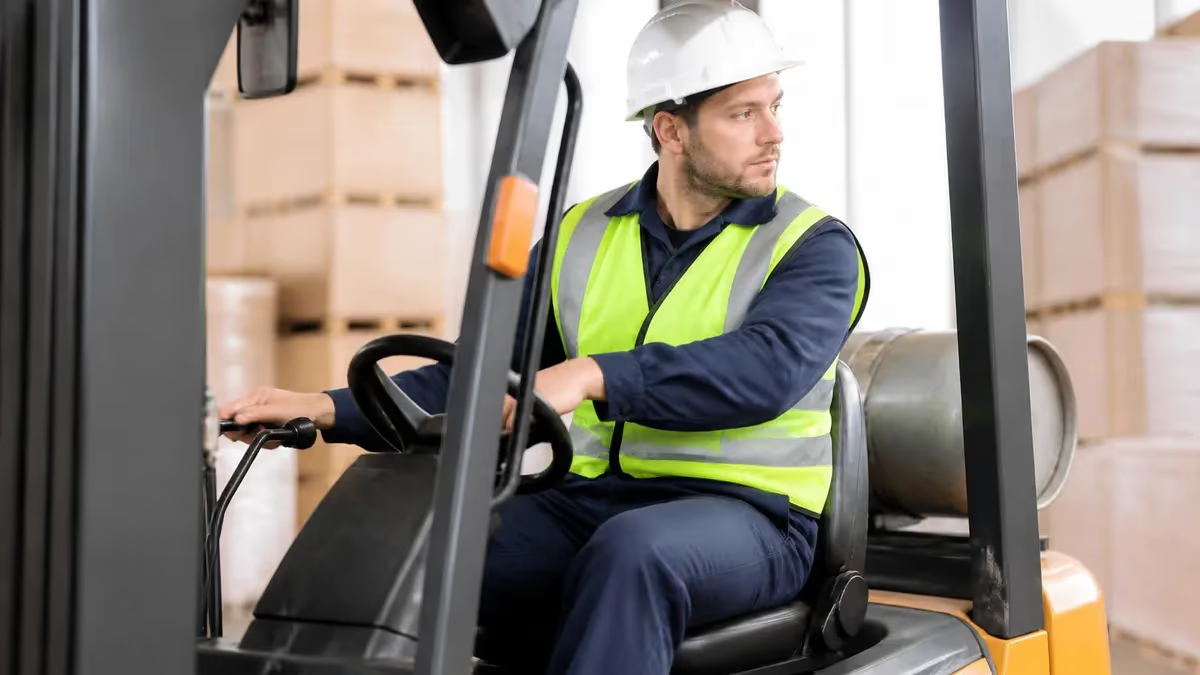
The forklift hydraulic system is the beating heart of every counterbalance, reach, and order picker truck operating across Australian warehouses, ports, and construction sites. For TLILIC0003 candidates, understanding how pressurised fluid converts engine or battery power into the smooth lifting, tilting, and side-shifting motions you rely on every shift is not optional — it sits at the centre of the High Risk Work Licence assessment. Without a sound grasp of hydraulics, pre-start checks become guesswork and minor leaks turn into catastrophic load drops.
Hydraulics work on a deceptively simple principle articulated by Blaise Pascal in 1653: pressure applied to a confined incompressible fluid transmits equally in all directions. A small forklift pump generating 2,500 PSI can lift a 4.5-tonne pallet of bricks four metres into racking because that pressure acts across the large surface area of the lift cylinder piston. The operator pulls a lever weighing grams, and tonnes move in response. This force multiplication is what makes the forklift indispensable in Australian materials handling.
Every TLILIC0003 student must be able to identify the seven core hydraulic components: the reservoir, pump, pressure relief valve, directional control valves, lift and tilt cylinders, filter, and the network of high-pressure hoses connecting them. Assessors at WorkSafe Victoria, SafeWork NSW, and WHSQ regularly fail candidates who confuse a return line with a pressure line or who cannot explain why a milky, foamy fluid in the sight glass means the truck must be tagged out immediately.
Australian workplaces report roughly 900 forklift incidents annually to state regulators, and Safe Work Australia data shows hydraulic failures contribute to approximately 12% of mast-related injuries. Sudden mast drop from a ruptured lift cylinder hose, uncommanded tilt from a sticking spool valve, or load shift from worn seals can all kill or maim. Knowing the system intimately is therefore both a regulatory requirement and a personal safety imperative for every certified operator.
This guide walks you through every element of the forklift hydraulic system as it appears on the TLILIC0003 syllabus and in real Australian workplaces. We cover the physics, the components, the pre-start inspection checklist, fluid management, common faults, attachment hydraulics, and the assessment questions you will face. For a broader view of how hydraulics integrate with the mast assembly, see our companion piece on the mast of forklift and its lift channels.
Whether you are operating a 1.5-tonne electric pedestrian stacker in a Sydney cold store or a 16-tonne diesel container handler at Port Botany, the underlying hydraulic principles remain identical. Pressure, flow, and direction — these three variables control every lift you will ever perform. Master them on paper now, demonstrate them confidently during your practical assessment, and apply them safely for the rest of your operating career across Australian industry.
By the end of this article you will know the difference between gear, vane, and piston pumps, why ISO VG 32 hydraulic oil suits cold-chain warehouses while ISO VG 46 dominates outdoor yards, and exactly which symptoms warrant an immediate red lockout tag. Bookmark this page, return after each training session, and you will walk into your TLILIC0003 assessment with the confidence regulators and employers expect from a competent forklift operator.
Free Forklift Licence Study Tools
Interactive Forklift Licence resources on PracticeTestGeeks, free to start:
- Forklift Licence practice test — 300+ questions with instant scoring and answer explanations
- Forklift Licence flashcards — review key terms and concepts card by card
- Forklift Licence study guide — topic-by-topic overview of what the exam covers
- Forklift Licence cheat sheet — one-page printable summary for last-minute review
Forklift Hydraulic System by the Numbers
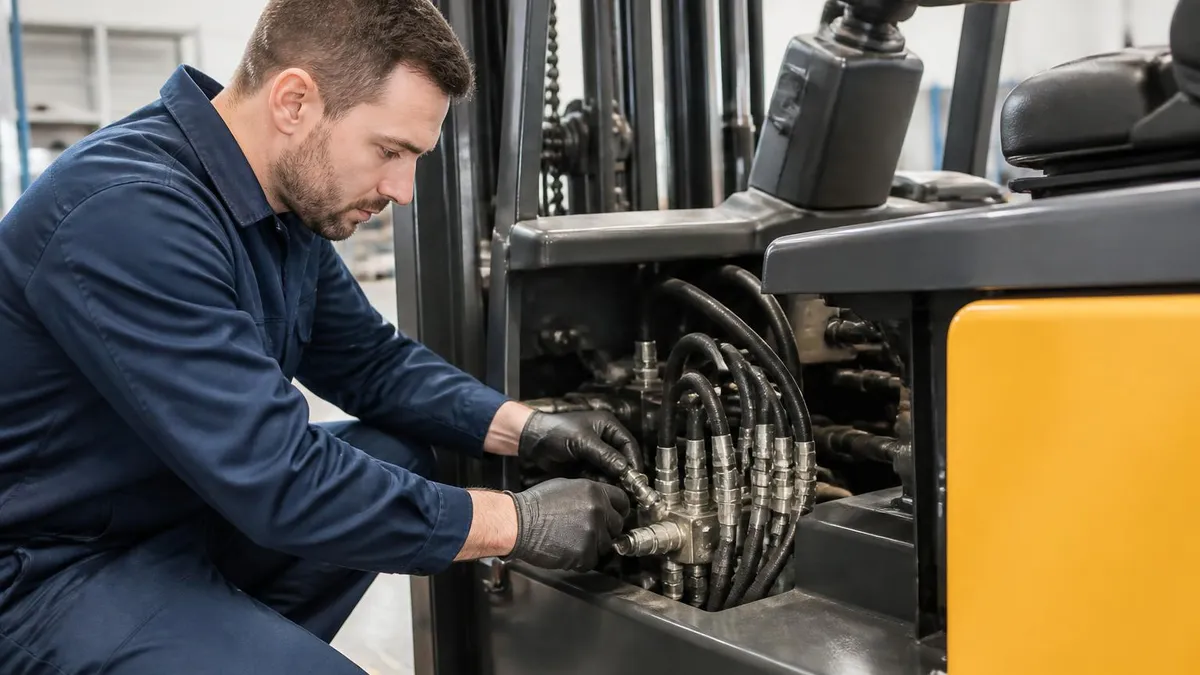
Core Components of the Forklift Hydraulic System
The tank stores 40-80 litres of hydraulic oil, allows air bubbles to separate, dissipates heat through its walls, and feeds clean fluid to the pump intake via a strainer.
Driven by the engine or electric motor, the gear, vane, or piston pump converts mechanical rotation into fluid flow, typically delivering 30-60 litres per minute at full speed.
Spool-type directional control valves route pressurised fluid to lift, lower, tilt, or auxiliary ports based on operator lever position, with detents holding spools in neutral.
Single-acting lift rams raise the carriage while double-acting tilt cylinders pivot the mast forward and back. Both convert fluid pressure into mechanical force and motion.
A 10-micron return filter traps contaminants while reinforced rubber or thermoplastic hoses rated above system pressure carry fluid between components without leaks or burst risk.
To understand how the forklift hydraulic system generates the enormous lifting force you rely on, picture the journey of a single drop of oil. It begins at rest in the reservoir, drawn through a coarse suction strainer by the rotating pump. The pump cannot create pressure on its own — it merely moves fluid. Pressure only develops when that flow meets resistance, such as the weight of a loaded pallet pressing down on the lift cylinder piston. This distinction between flow and pressure is the single most common exam question candidates get wrong.
From the pump, fluid travels at high velocity through a steel-braided pressure hose to the main control valve bank, usually located beneath the operator's feet or to the right of the seat. When all levers sit in neutral, the valve directs flow straight back to the reservoir through the open-centre passage — this is why a healthy forklift idles quietly with no mast creep. Pull the lift lever, and the spool shifts, blocking the return path and channelling fluid up to the cylinder beneath the mast.
Inside the lift cylinder, fluid pushes the piston upward. Because the cylinder is single-acting, gravity alone returns the carriage when you select lower — fluid flows back down through the same hose, across the valve, through a flow control orifice that limits descent speed, and finally through the return filter before re-entering the reservoir. This is why a forklift lowers a load smoothly even when the engine is switched off: gravity provides the energy, hydraulics merely meter the flow.
Tilt cylinders work differently. They are double-acting, meaning fluid pressure both extends and retracts the rod. Two hoses connect to each tilt cylinder — one for forward tilt, one for back tilt. The control valve simultaneously pressurises one side while opening the other to tank, allowing positive control in both directions regardless of load weight or gravity. This same double-acting principle drives side-shift carriages, fork positioners, paper roll clamps, and rotators on attachment-equipped trucks.
The pressure relief valve is your silent guardian. Set at the factory to a value typically between 2,300 and 2,800 PSI, it opens whenever system pressure exceeds the limit — for example, when an operator tries to lift a load heavier than the truck's rated capacity. Fluid spills back to tank with a distinctive whining noise, protecting hoses, seals, and cylinders from catastrophic burst failure. Hearing the relief valve squeal repeatedly is a clear signal you are exceeding the data plate capacity outlined in the forklift specifications.
Heat is the system's enemy. Every time fluid passes through a restriction — a valve, a filter, a relief — kinetic energy converts to thermal energy. Continuous heavy lifting in a 35°C Brisbane summer can push reservoir temperatures past 90°C, at which point oil viscosity drops, seals harden, and cavitation bubbles form at the pump inlet. Many modern Australian forklifts include an oil cooler with a thermostatically controlled fan, but operators must still allow rest periods during sustained high-cycle work.
Filtration completes the loop. A 10-micron return filter and a finer 3-micron pressure filter together remove the metal fines, dust, and seal debris that accumulate inside any working system. Manufacturers specify filter changes every 500 or 1,000 operating hours. Skipping these intervals is the fastest way to destroy a hydraulic pump, with rebuild costs ranging from $3,500 to $9,000 depending on truck size — far exceeding the $80 cost of a new filter element.
TLILIC0003 Practice Test Questions
Prepare for the Forklift Licence Australia - TLILIC0003 exam with our free practice test modules. Each quiz covers key topics to help you pass on your first try.
TLILIC0003 Forklift Licence Australia Atta...
TLILIC0003 Exam Questions covering Forklift Licence Australia Attachments and Modifications. Master TLILIC0003 Test concepts for certification prep.
TLILIC0003 Forklift Licence Australia Batt...
Free TLILIC0003 Practice Test featuring Forklift Licence Australia Battery and Fuel Safety. Improve your TLILIC0003 Exam score with mock test prep.
TLILIC0003 Forklift Licence Australia Emer...
TLILIC0003 Mock Exam on Forklift Licence Australia Emergency Procedures. TLILIC0003 Study Guide questions to pass on your first try.
TLILIC0003 Forklift Licence Australia Fork...
TLILIC0003 Test Prep for Forklift Licence Australia Forklift Pre-Operational Checks. Practice TLILIC0003 Quiz questions and boost your score.
TLILIC0003 Forklift Licence Australia Haza...
TLILIC0003 Questions and Answers on Forklift Licence Australia Hazard Identification. Free TLILIC0003 practice for exam readiness.
TLILIC0003 Forklift Licence Australia Load...
TLILIC0003 Mock Test covering Forklift Licence Australia Load Centre Calculations. Online TLILIC0003 Test practice with instant feedback.
TLILIC0003 Forklift Licence Australia Load...
Free TLILIC0003 Quiz on Forklift Licence Australia Load Handling and Capacity. TLILIC0003 Exam prep questions with detailed explanations.
TLILIC0003 Forklift Licence Australia Oper...
TLILIC0003 Practice Questions for Forklift Licence Australia Operating in Different Environments. Build confidence for your TLILIC0003 certification exam.
TLILIC0003 Forklift Licence Australia Oper...
TLILIC0003 Test Online for Forklift Licence Australia Operating Techniques. Free practice with instant results and feedback.
TLILIC0003 Forklift Licence Australia Pede...
TLILIC0003 Study Material on Forklift Licence Australia Pedestrian Safety. Prepare effectively with real exam-style questions.
Pumps, Valves and Cylinders Explained
The three pump types you will encounter on Australian forklifts are gear, vane, and axial piston. Gear pumps dominate the small-to-medium counterbalance market because they are cheap, strong, and tolerate contaminated fluid better than rivals. They produce constant flow whenever the engine runs, which is why hydraulic noise is louder at high RPM even when no levers are activated.
Vane pumps deliver smoother flow with less pressure ripple and are common on three-tonne electric trucks. Axial piston pumps, found on large container handlers and reach stackers, are variable displacement — meaning they only move fluid when a control signal demands lift. This saves enormous amounts of energy on battery-powered trucks, extending shift runtime by 15-25% compared with fixed-displacement designs.

Hydraulic Drive vs Mechanical Drive — Why Forklifts Use Hydraulics
- +Massive force multiplication from a small lever input, lifting tonnes with light operator effort
- +Smooth, infinitely variable speed control unmatched by chains, screws, or cables
- +Self-lubricating: hydraulic oil greases every moving part it touches
- +Inherent overload protection via the pressure relief valve setting
- +Compact power transmission — pumps and cylinders fit where gearboxes cannot
- +Excellent power-to-weight ratio for mobile equipment in tight Australian warehouses
- +Easy to add attachments by tapping auxiliary hydraulic ports
- −Hydraulic oil leaks create slip hazards and environmental contamination risks
- −Energy losses through heat reduce efficiency to 70-85% under load
- −Contaminated fluid destroys pumps quickly — filtration discipline is critical
- −High-pressure pinhole leaks can inject oil through skin, causing serious injury
- −Cold weather thickens oil, slowing response until warm-up is complete
- −Seals and hoses degrade with age regardless of operating hours
- −Specialist diagnostic equipment needed for accurate fault finding
Pros and Cons at a Glance
| Pros | Cons |
|---|---|
| Massive force multiplication from a small lever input, lifting tonnes with light operator effort | Hydraulic oil leaks create slip hazards and environmental contamination risks |
| Smooth, infinitely variable speed control unmatched by chains, screws, or cables | Contaminated fluid destroys pumps quickly — filtration discipline is critical |
| Self-lubricating: hydraulic oil greases every moving part it touches | High-pressure pinhole leaks can inject oil through skin, causing serious injury |
| Inherent overload protection via the pressure relief valve setting | Cold weather thickens oil, slowing response until warm-up is complete |
| Compact power transmission — pumps and cylinders fit where gearboxes cannot | Seals and hoses degrade with age regardless of operating hours |
| Excellent power-to-weight ratio for mobile equipment in tight Australian warehouses | Specialist diagnostic equipment needed for accurate fault finding |
Pre-Start Hydraulic System Inspection Checklist
- ✓Check hydraulic oil level on the sight gauge with mast fully lowered and tilted vertical
- ✓Confirm oil colour is clear amber — milky white indicates water contamination, black means burnt oil
- ✓Inspect under the truck for fresh drips, puddles, or wet patches on driveway or pallet boards
- ✓Examine all visible hoses for cracks, abrasion, bulges, or weeping at the crimped fittings
- ✓Verify lift and tilt cylinder rods are clean, unscored, and free of bent or pitted chrome
- ✓Listen for cavitation whine or pump groan during the first lift cycle after start-up
- ✓Test full lift travel without hesitation, jerking, or audible squeal from the relief valve
- ✓Confirm tilt operates smoothly forward and back with no drift when levers return to neutral
- ✓Check the mast holds a raised empty carriage for 60 seconds without measurable creep down
- ✓Inspect the return filter indicator gauge — replace immediately if needle is in the red zone
Never use your hand to find a hydraulic leak
A pinhole leak in a 2,500 PSI hose can inject hydraulic oil through intact skin in under 0.1 seconds, causing tissue necrosis that often requires amputation. Always use a piece of cardboard or paper to trace suspected leaks — and treat any oil-injection injury as an immediate hospital emergency, even if the entry wound looks trivial.
Common hydraulic faults follow a predictable pattern that every TLILIC0003 candidate should be able to diagnose verbally during assessment. The most frequent complaint is slow or weak lifting, which usually traces back to one of three causes: low fluid level allowing air ingestion at the pump inlet, a sticking or partially open relief valve dumping pressure to tank, or worn internal pump components reducing volumetric efficiency. Each presents slightly different symptoms experienced operators learn to recognise within seconds.
Mast drift — where a raised carriage slowly creeps downward without operator input — almost always indicates leaking lift cylinder seals or a worn lowering valve spool. Australian Standard AS 2359.2 specifies that creep must not exceed 100mm in 10 minutes under rated load. If your forklift fails this static drift test during pre-start, the truck must be tagged out and reported to a supervisor. Operating a drifting forklift with a raised load above head height is one of the most common causes of fatal struck-by-falling-object incidents reported to Safe Work Australia.
Jerky, chattering, or stepped motion during lift indicates either air trapped in the system, low fluid level, or a failing pressure compensator on variable-displacement pumps. Bleeding air from a forklift hydraulic system is straightforward on most counterbalance trucks — simply cycle the mast through full lift and lower five to ten times with the engine at idle, and any trapped air will rise through the reservoir and exit through the breather cap. If chatter persists, the problem is mechanical and requires workshop attention.
Foamy or milky-looking hydraulic oil is an unambiguous red-flag finding during pre-start. Milkiness means water has entered the system, usually through a damaged breather cap, condensation in cold storage operations, or a failed cooler core. Water in hydraulic oil destroys lubricity, accelerates seal wear, and freezes in chilled environments, blocking suction lines completely. Any milky fluid mandates immediate lockout, oil drain, and full system flush before the truck returns to service.
Overheating manifests as oil temperature exceeding 90°C, visible heat shimmer rising from the reservoir, and a sharp burnt-varnish smell. Causes include blocked cooler fins, low oil level, faulty cooler fan, slipping pump drive belt on engine-powered trucks, or simply working the forklift beyond its duty cycle on a hot day. Australian summer conditions across the Top End and inland regions routinely push hydraulic systems to their thermal limits, and operators must build mandatory cool-down breaks into heavy-cycle work planning.
Hose failures are the most dramatic and dangerous hydraulic faults. A burst lift cylinder hose under load can cause the mast to drop in milliseconds, crushing anything beneath. Modern Australian forklifts include velocity fuses — small flow-sensing valves that snap shut if oil flow exceeds normal lowering speed — but these devices fail silently and are not a substitute for hose inspection. Replace any hose showing cracks, swelling, kinking, abrasion through the outer cover, or weeping at the crimped end fittings.
Attachment hydraulic faults deserve special attention because auxiliary circuits often run at higher pressures than the main lift circuit and use quick-disconnect couplings prone to seal failure. Side-shift carriages that drift sideways, paper roll clamps that fail to maintain grip pressure, and rotators that stop mid-rotation all point to auxiliary valve, cylinder, or coupling issues. Always exercise attachments through full travel during pre-start and report any anomaly before loading the first pallet of the shift.
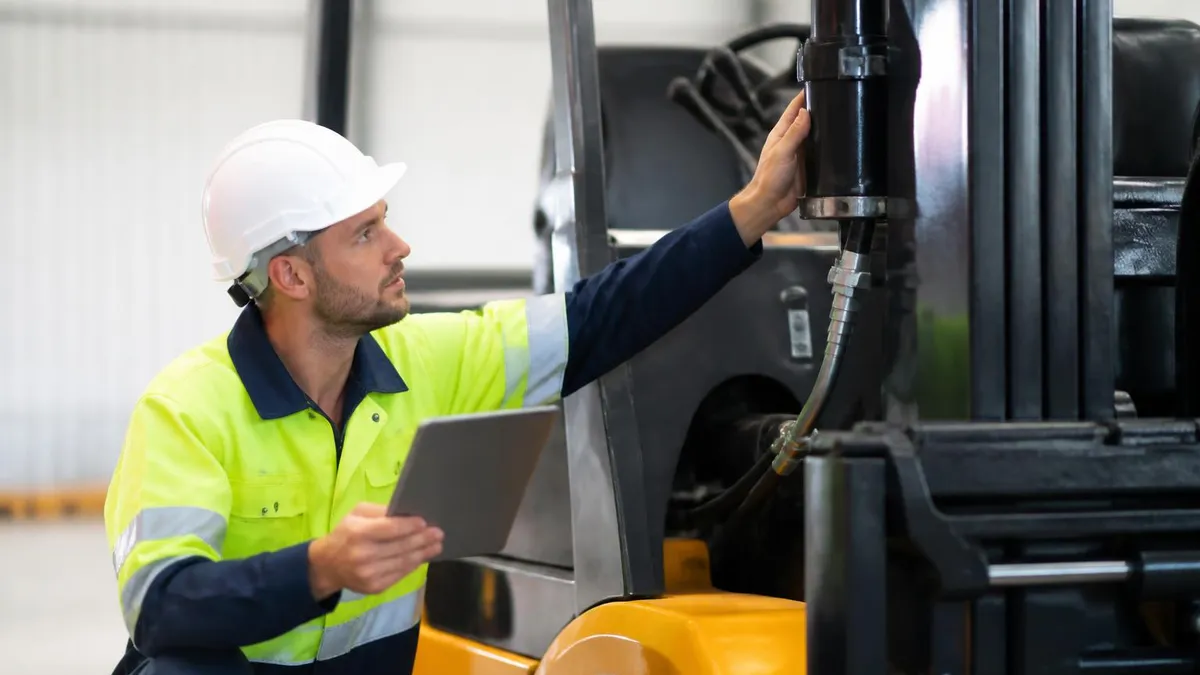
Australian WHS regulations require you to tag out and remove a forklift from service immediately if you observe any of the following: hydraulic fluid leaks of any size, mast creep exceeding 100mm in 10 minutes, milky or burnt-smelling oil, visible hose damage, or unusual pump noise. Continuing to operate exposes you to personal liability under sections 28 and 32 of the Work Health and Safety Act 2011.
Safe operation of a forklift hydraulic system extends far beyond the pre-start checklist. Every shift, the certified operator must adjust their technique to match fluid behaviour, environmental conditions, and the specific characteristics of the truck assigned to them. Cold-start procedures, in particular, are routinely missed by inexperienced operators and contribute to premature pump failure across Australian fleets. On a cold morning, run the engine at idle for two to three minutes, then cycle the mast slowly through full travel five times before attempting to lift any rated load.
Hydraulic fluid selection matters more than most operators realise. Australian forklifts typically run ISO VG 32 oil in temperature-controlled environments such as Coles or Woolworths distribution centres, where ambient stays between 2°C and 20°C. Outdoor yard trucks at quarries, ports, and timber mills generally use ISO VG 46 because higher viscosity maintains film strength at improved temperatures. Mixing grades is acceptable in an emergency but should never be standard practice — always consult the operator's manual and the data plate before topping up.
Smooth lever modulation preserves both load stability and component life. Slamming the lift lever to full deflection causes pressure spikes that hammer seals, hoses, and the relief valve. Experienced Australian operators describe the correct technique as 'squeezing' rather than 'flicking' — apply progressive force, build to the desired speed, and release just as progressively when approaching the target height. This same principle applies to tilt, side-shift, and any auxiliary attachment function across the various multi directional forklift trucks used in modern facilities.
Travel with the carriage no higher than 150mm above the ground and the mast tilted fully back. This positions the centre of gravity low and rearward, dramatically reducing tip-over risk and removing hydraulic load from the lift cylinders during transit. Many operators forget that even when stationary, a raised carriage continuously stresses cylinder seals — every minute spent travelling with forks improved shortens seal life and increases the probability of mid-shift hydraulic failure.
Daily and weekly maintenance tasks fall partly within the operator's scope. You are expected to check fluid levels, inspect for leaks, clean the breather cap, and report any abnormal readings on cooler temperature or filter indicator gauges. Deeper interventions — pump replacement, valve overhaul, cylinder reseal, hose change — are workshop tasks performed by a qualified hydraulic technician under AS 2671 standards. Knowing the boundary between operator maintenance and workshop work is itself an assessment question on the TLILIC0003 syllabus.
Environmental responsibility cannot be ignored. A single litre of hydraulic oil can contaminate one million litres of groundwater, and Australian EPAs in every state and territory issue substantial fines for spills. Keep a spill kit within ten metres of any indoor forklift operation, contain leaks immediately with absorbent pads, and dispose of contaminated material through licensed waste contractors. Operators who ignore small leaks 'because the workshop is busy' become the workplace's most expensive liability.
Finally, build a habit of listening. Hydraulic systems speak fluently to anyone who pays attention. Cavitation sounds like marbles rolling inside the pump. Relief valve squeal is a high-pitched whistle. Air in the lines produces stuttering motion and sponginess at the levers. Worn cylinder seals create a soft hiss at the rod gland under load. Every sound has meaning, and the operator who learns this language becomes the one supervisors trust with the most demanding lifts on site.
Practical preparation for the TLILIC0003 hydraulic assessment combines three streams of effort: classroom theory, online practice questions, and supervised yard time on a real forklift. Most Australian RTOs deliver the theory component over one to two days, but candidates who spend an additional five to ten hours self-studying hydraulic principles pass at noticeably higher rates than those who rely on classroom time alone. Use diagrams from your training manual to sketch the fluid path from reservoir to cylinder and back — drawing reinforces retention.
During the practical assessment, your trainer-assessor will ask you to perform a verbal walk-around inspection. Practice this aloud, pointing physically at each hydraulic component as you name it: 'This is the reservoir, this is the breather cap, this is the sight glass, here are the suction and return lines, these are the lift hoses entering the cylinder housings.' Confident, accurate verbal identification convinces assessors you understand the system rather than having merely memorised a checklist.
Expect at least three hydraulic-related questions in the knowledge assessment portion. Common examples include: 'What does the pressure relief valve do?', 'How would you respond if you noticed milky hydraulic oil during pre-start?', and 'Why must you never use your hand to locate a suspected leak?' Memorise concise one-sentence answers for each, then expand with supporting detail if the assessor probes further. Avoid waffling — assessors mark you down for unfocused answers as readily as for wrong ones.
The practical demonstration usually includes one task specifically designed to test hydraulic competency: lifting a load to a specified height and holding it for 30 seconds while you describe what is happening inside the system. Use this opportunity to verbalise the fluid path actively, demonstrate smooth lever control, and show awareness of mast creep by glancing at the carriage during the hold. These small behaviours mark the difference between a borderline pass and a confident first-time success.
Online practice tests offer the single highest return on study time invested. Free question banks aligned to the TLILIC0003 syllabus typically include 200 to 500 hydraulic-specific items covering pumps, valves, cylinders, fluid types, faults, and safety procedures. Aim for an 85% sustained pass rate across three consecutive 20-question runs before booking your formal assessment. If you score below 75%, you are not ready — go back to the textbook chapters on hydraulics before attempting more questions. Try the comprehensive free forklift practice test 2026 for a realistic preview.
After certification, your hydraulic knowledge stays current only through deliberate practice. Australian workplaces increasingly require refresher assessments every three to five years, and major employers such as Toll, Linfox, and DHL run internal verification programmes that include hydraulic theory questions. Keep your training manual accessible, subscribe to one of the major industry publications such as Forkliftaction News, and ask your supervisor for permission to attend annual safety toolbox talks even when not strictly required.
Most importantly, treat every shift as an opportunity to refine your understanding. The operator who finishes a 20-year career still curious about why the relief valve squeals at the end of a long lift, still listening for subtle changes in pump noise, and still inspecting hoses with the same care as on day one — that operator is the one Australian workplaces trust with their highest-value loads and their newest recruits. Hydraulic competence, like the systems themselves, requires constant pressure and steady flow.
Sample Forklift Licence Practice Questions
Try these questions from our free Forklift Licence practice tests. The correct answer and an explanation follow each question.
How should new Battery and Fuel Safety risks be incorporated into existing safety systems?
- A. Ignore them
- B. Through review and update of risk assessments, procedures, training, and communication to all affected workers
- C. Wait for the next scheduled review
- D. File them for future reference
Answer: B. Through review and update of risk assessments, procedures, training, and communication to all affected workers
New risks must be promptly incorporated into risk assessments, procedures, and communicated to all affected workers.
What penalties apply for non-compliance with Pedestrian Safety regulations in Australia?
- A. No penalties
- B. Significant fines (up to millions of AUD for corporations) and potential imprisonment for serious offences
- C. A verbal warning only
- D. A small administrative fee
Answer: B. Significant fines (up to millions of AUD for corporations) and potential imprisonment for serious offences
Australian WHS penalties are severe, with Category 1 offences carrying fines up to AUD 3 million and potential imprisonment.
How should new Forklift Pre-Operational Checks risks be incorporated into existing safety systems?
- A. Ignore them
- B. Through review and update of risk assessments, procedures, training, and communication to all affected workers
- C. Wait for the next scheduled review
- D. File them for future reference
Answer: B. Through review and update of risk assessments, procedures, training, and communication to all affected workers
New risks must be promptly incorporated into risk assessments, procedures, and communicated to all affected workers.
Under Australian law, what rights do workers have regarding Pedestrian Safety safety?
- A. No specific rights
- B. Rights to information, training, consultation, representation through HSRs, and to cease unsafe work
- C. Only the right to complain
- D. Rights depend on seniority
Answer: B. Rights to information, training, consultation, representation through HSRs, and to cease unsafe work
Workers have specific legal rights under WHS legislation including information, training, consultation, representation, and refusal of unsafe work.
TLILIC0003 Questions and Answers
Mast of Forklift: Complete Guide to Forklift Parts for TLILIC0003 Operators in Australia
Multi Directional Forklift Trucks: Complete Guide to Forklift Types and Parts for TLILIC0003 Operators in Australia
Free Forklift Practice Test 2026 - Forklift Exam Questions
Electric 3 Wheel Forklift: Complete Guide to Electric Forklift Types for TLILIC0003 Operators in Australia
Forklift Clearance Height: Complete Guide to Forklift Specifications for TLILIC0003 Operators in Australia
About the Author

Certified Crane Operator & Skilled Trades Exam Specialist
Ferris State UniversityRobert Martinez is a Journeyman Ironworker, NCCCO-certified crane operator, and forklift trainer with a Bachelor of Science in Construction Technology from Ferris State University. He has 21 years of ironworking, rigging, and heavy equipment operation experience across high-rise and industrial construction sites. Robert prepares candidates for crane operator, rigger, forklift, and skilled trades certification examinations.