
Forklift Cage Attachment Safety: Complete Guide for TLILIC0003 Operators in Australia
Learn forklift cage attachment safety rules, WHS requirements, and proper use guidelines for TLILIC0003 operators in Australia. Essential compliance guide. 🟢
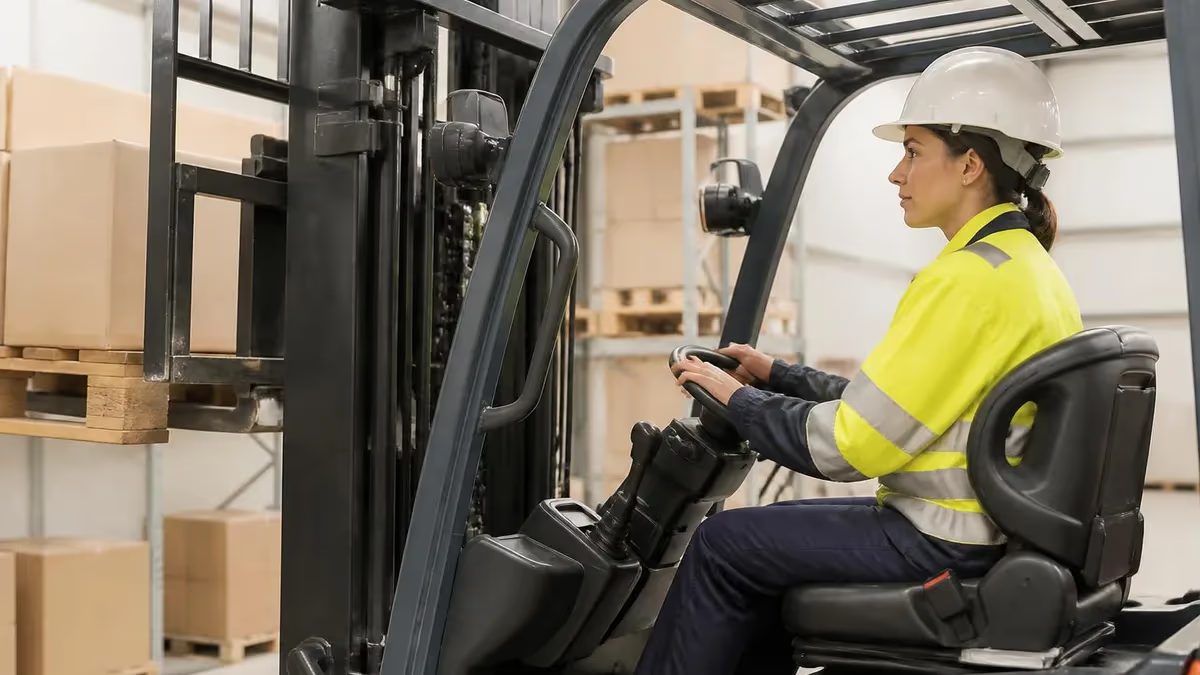
A forklift cage attachment is a purpose-built work platform that secures to the forks of a forklift truck, allowing personnel to be safely improved to height for tasks such as stock retrieval, maintenance, and overhead inspections. In Australian workplaces governed by Work Health and Safety legislation, using the correct forklift cage attachment is not optional but a strict legal requirement whenever workers must be raised on forklift tines. Understanding how to properly select, inspect, and operate these attachments is an essential competency covered under the TLILIC0003 high risk work licence.
Work Health and Safety regulations across every Australian state and territory mandate specific conditions under which personnel can be improved using a forklift. These rules exist because falls from height remain one of the leading causes of serious workplace injuries and fatalities in Australia. Safe Work Australia data consistently shows that the transport, postal, and warehousing sectors experience disproportionately high rates of injury, with many incidents linked to improvised elevation methods rather than compliant forklift cage systems approved to Australian Standards.
The importance of proper forklift cage usage extends beyond compliance with legislation. When workers are lifted using non-compliant methods such as standing on pallets, bare forks, or improvised platforms, the risk of catastrophic falls, crush injuries, and even death increases dramatically. A compliant forklift safety cage manufactured to AS 2359 provides guardrails, a solid floor, attachment mechanisms that prevent dislodgement, and anchor points for personal fall arrest systems that collectively bring the risk within acceptable tolerances recognised by regulators.
For anyone pursuing or already holding a TLILIC0003 licence to operate a forklift truck, knowledge of forklift cage attachment safety is assessed both in the written theory component and during practical evaluation. Assessors expect candidates to demonstrate awareness of when a work platform is required, what pre-use inspections must be performed, load capacity limitations, communication protocols between the improved person and the forklift operator, and the emergency procedures that apply if something goes wrong during an improved work task.
Throughout Australian warehouses, distribution centres, construction sites, and manufacturing facilities, forklift cages are used daily to access racking at height, replace lighting fixtures, perform building maintenance, and reach improved mechanical systems. The frequency of these tasks means that complacency around cage safety develops quickly among experienced workers, which paradoxically makes ongoing training and awareness more important rather than less. Refresher training specifically addressing cage procedures is recommended by most registered training organisations at least annually.
This comprehensive guide covers every aspect of forklift cage attachment safety that Australian operators need to understand. From the specific Australian Standards that govern design and manufacture, through pre-operational inspection requirements, to communication protocols and emergency procedures, you will find detailed practical guidance that directly supports both your TLILIC0003 assessment preparation and your day-to-day safe operation responsibilities on the job site.
Whether you are a new operator preparing for your initial forklift licence assessment or an experienced hand looking to refresh your knowledge of current requirements, this guide consolidates the essential safety information you need. The regulations and best practices discussed apply across all Australian jurisdictions, though you should always verify any site-specific requirements with your employer or principal contractor before commencing improved work using a forklift cage attachment.
Forklift Cage Safety by the Numbers
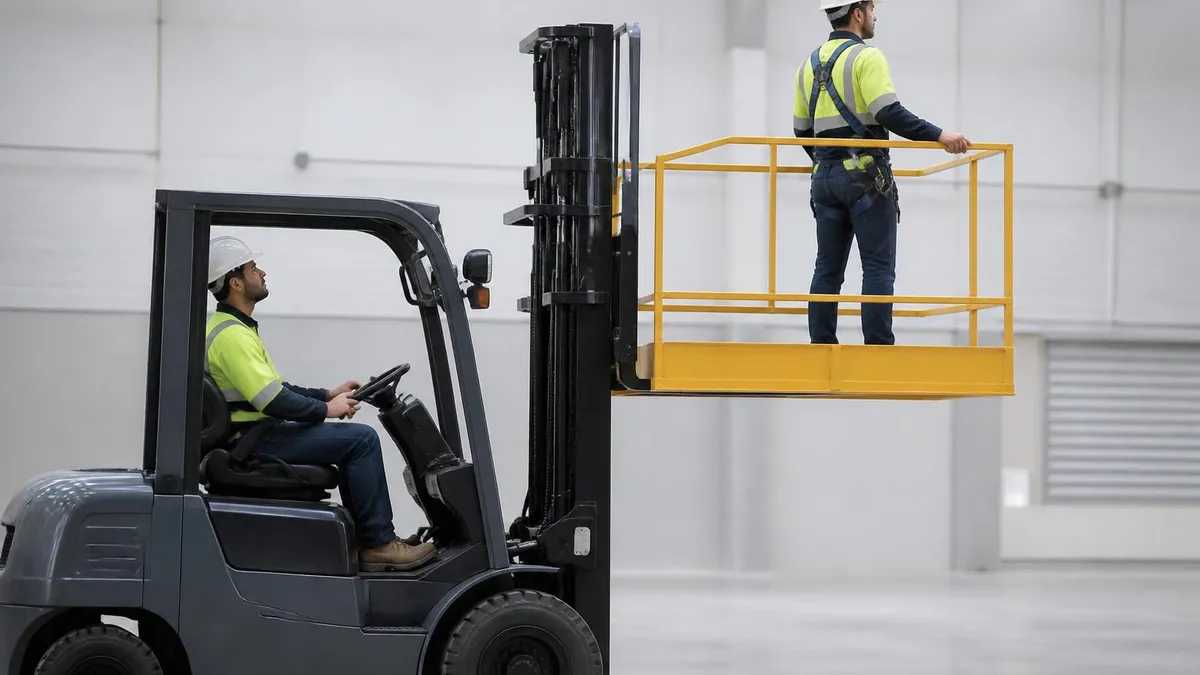
Key Safety Requirements for Forklift Cage Attachments
Every forklift cage must be manufactured to Australian Standard AS 2359, with a visible compliance plate showing safe working load, manufacturer details, and date of manufacture. Non-compliant cages must never be used for improving personnel.
The cage must incorporate a positive locking mechanism that prevents it from sliding off or tilting on the forks. Chains, pins, or mechanical clamps must secure the platform to the forklift carriage before any person enters the cage.
Guardrails at least 900mm high with mid-rails and toe boards at least 100mm high are mandatory. These prevent falls, stop tools and materials from dropping onto workers below, and provide stability for the improved worker.
A rated anchor point must be provided within the cage for attachment of a personal fall arrest use. Workers must wear and connect a use whenever they are improved in the cage, providing secondary fall protection beyond the guardrails.
The safe working load plate must be clearly visible and legible. Operators must calculate the combined weight of personnel, tools, and materials to ensure the total never exceeds the rated capacity shown on the compliance plate.
Australian Standards and Work Health and Safety regulations form the backbone of all forklift cage attachment safety requirements across the country. The primary standard governing the design, manufacture, and use of forklift-mounted work platforms is AS 2359, which specifies minimum construction requirements including material grades, guardrail dimensions, floor load ratings, and attachment mechanisms. Any forklift cage used in an Australian workplace must display a compliance plate confirming it meets this standard, and operators should verify this plate is present and legible before every use.
Under the harmonised Work Health and Safety Act adopted by most Australian states and territories, a person conducting a business or undertaking has a primary duty of care to ensure the health and safety of workers. This duty explicitly extends to the provision of safe plant and equipment, which includes forklift cage attachments. Using a non-compliant cage, or using a compliant cage in a manner inconsistent with its design specifications, exposes the PCBU to potential prosecution, significant fines, and in cases of serious injury or death, imprisonment for officers of the organisation.
The WHS Regulations provide additional specificity regarding the conditions under which a forklift may be used to improve a person. Regulation 215 in most jurisdictions states that a person must not be lifted by powered mobile plant unless the plant is specifically designed for that purpose, or the plant is fitted with a work platform designed for the purpose. This regulation effectively makes compliant forklift cages the only lawful means of raising a worker on a forklift truck within an Australian workplace, eliminating any argument for improvised solutions.
Safe Work Australia has published guidance materials that complement the legislation and standards, providing practical advice on implementing forklift cage safety in real workplace conditions. These guides cover topics including risk assessment procedures before improved work, the selection of appropriate cage designs for different forklift types, training requirements for both operators and improved workers, and record-keeping obligations that help demonstrate compliance during regulatory inspections or incident investigations conducted by workplace health and safety inspectors.
State and territory regulators including SafeWork NSW, WorkSafe Victoria, Workplace Health and Safety Queensland, and their counterparts in other jurisdictions regularly conduct targeted inspection campaigns focusing on forklift operations. During these inspections, investigators specifically check for compliant work platforms, evidence of pre-use inspections, documented training records for operators and improved workers, and safe work method statements that address cage use. Non-compliance findings during these inspections can result in improvement notices, prohibition notices that halt operations, or on-the-spot infringement penalties.
It is worth noting that some older forklift cages still in use across Australian workplaces may have been manufactured to superseded versions of the Australian Standard. While these cages are not automatically non-compliant, operators and safety managers should verify that they still meet the minimum requirements of the current edition. Any cage showing signs of structural damage, corrosion, modified guardrails, or missing compliance plates should be immediately removed from service and subjected to a competent engineering assessment before being returned to use.
Beyond the mandatory requirements, many Australian employers adopt additional safety measures that exceed the minimum regulatory standards. These might include restricting cage use to forklifts with specific mast heights, requiring dual communication systems between operator and improved worker, mandating spotter personnel during all cage operations, or implementing permit-to-work systems for any task involving personnel elevation. These enhanced measures reflect a commitment to safety culture that goes beyond mere legal compliance and are increasingly considered industry best practice.
TLILIC0003 Practice Test Questions
Prepare for the Forklift Licence Australia - TLILIC0003 exam with our free practice test modules. Each quiz covers key topics to help you pass on your first try.
TLILIC0003 Forklift Licence Australia Atta...
TLILIC0003 Exam Questions covering Forklift Licence Australia Attachments and Modifications. Master TLILIC0003 Test concepts for certification prep.
TLILIC0003 Forklift Licence Australia Batt...
Free TLILIC0003 Practice Test featuring Forklift Licence Australia Battery and Fuel Safety. Improve your TLILIC0003 Exam score with mock test prep.
TLILIC0003 Forklift Licence Australia Emer...
TLILIC0003 Mock Exam on Forklift Licence Australia Emergency Procedures. TLILIC0003 Study Guide questions to pass on your first try.
TLILIC0003 Forklift Licence Australia Fork...
TLILIC0003 Test Prep for Forklift Licence Australia Forklift Pre-Operational Checks. Practice TLILIC0003 Quiz questions and boost your score.
TLILIC0003 Forklift Licence Australia Haza...
TLILIC0003 Questions and Answers on Forklift Licence Australia Hazard Identification. Free TLILIC0003 practice for exam readiness.
TLILIC0003 Forklift Licence Australia Load...
TLILIC0003 Mock Test covering Forklift Licence Australia Load Centre Calculations. Online TLILIC0003 Test practice with instant feedback.
TLILIC0003 Forklift Licence Australia Load...
Free TLILIC0003 Quiz on Forklift Licence Australia Load Handling and Capacity. TLILIC0003 Exam prep questions with detailed explanations.
TLILIC0003 Forklift Licence Australia Oper...
TLILIC0003 Practice Questions for Forklift Licence Australia Operating in Different Environments. Build confidence for your TLILIC0003 certification exam.
TLILIC0003 Forklift Licence Australia Oper...
TLILIC0003 Test Online for Forklift Licence Australia Operating Techniques. Free practice with instant results and feedback.
TLILIC0003 Forklift Licence Australia Pede...
TLILIC0003 Study Material on Forklift Licence Australia Pedestrian Safety. Prepare effectively with real exam-style questions.
Types of Forklift Cage Attachments Used in Australia
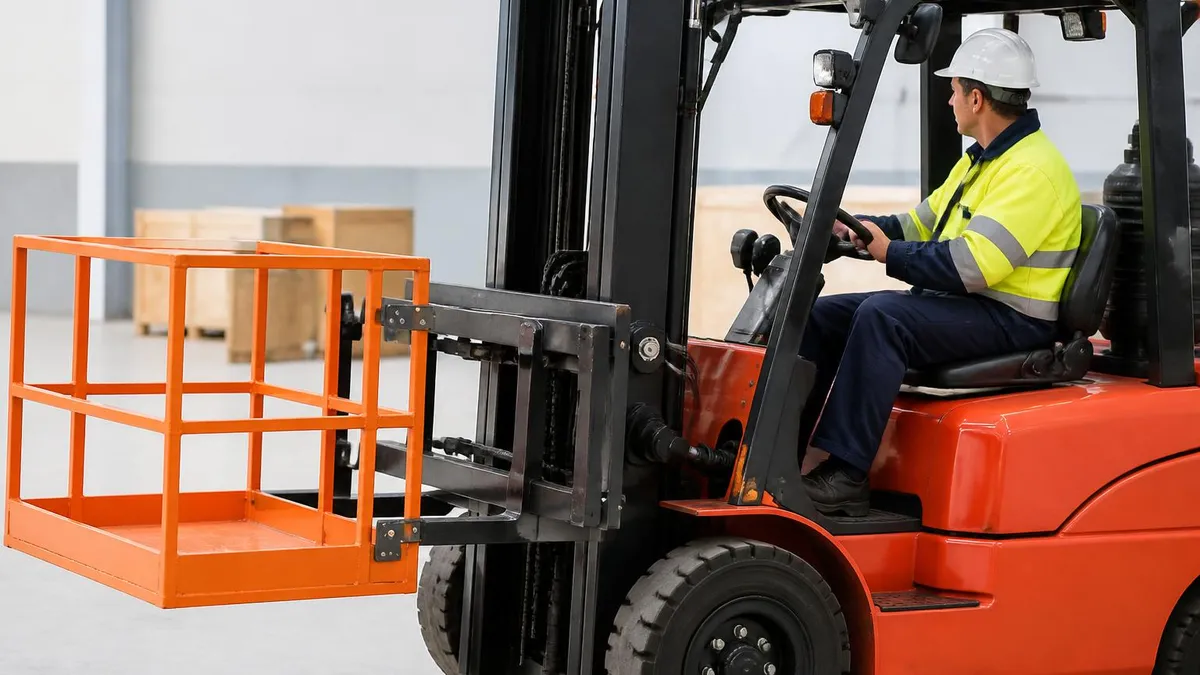
The standard personnel cage is the most commonly used forklift cage attachment in Australian warehouses and distribution centres. It typically accommodates one or two workers and is designed to slide onto standard fork tines before being secured with locking pins or chains. These cages feature full-height guardrails on all four sides, a solid steel floor with drainage holes, toe boards to prevent dropped objects, and at least one rated anchor point for personal fall arrest uses. Most standard cages have a safe working load between 200 and 350 kilograms including personnel and equipment.
When selecting a standard personnel cage for your workplace, it is critical to verify compatibility with your specific forklift model and fork dimensions. Not all cages fit all forklifts, and an incorrectly sized cage creates serious safety risks including potential dislodgement during elevation. Australian suppliers typically offer cages in multiple fork pocket widths and spacings to accommodate different forklift brands. Always confirm that the cage compliance plate references AS 2359 and that the rated capacity suits your operational requirements before purchasing or hiring a cage for use on site.
Forklift Cage vs Alternative Elevation Methods
- +Compliant with Australian WHS regulations and AS 2359 when properly used
- +Provides guardrails, toe boards, and fall arrest anchor points for comprehensive protection
- +Can be deployed quickly without scaffolding erection time or mobile platform hire costs
- +Versatile enough for use across warehousing, construction, and maintenance applications
- +Allows access to locations that scaffolding and improved work platforms cannot easily reach
- +Lower ongoing cost compared to hiring scissor lifts or boom lifts for occasional improved tasks
- −Requires a dedicated forklift and trained operator for the entire duration of improved work
- −Limited working area compared to scaffolding or mobile improved work platforms
- −Forklift engine vibration and exhaust fumes can affect worker comfort at height
- −Maximum elevation height is limited by the forklift mast reach and stability calculations
- −Cannot be used in all weather conditions due to wind loading and visibility restrictions
- −Forklift must remain stationary while the cage is occupied, blocking it from other duties
Pros and Cons at a Glance
| Pros | Cons |
|---|---|
| Provides guardrails, toe boards, and fall arrest anchor points for comprehensive protection | Requires a dedicated forklift and trained operator for the entire duration of improved work |
| Can be deployed quickly without scaffolding erection time or mobile platform hire costs | Limited working area compared to scaffolding or mobile improved work platforms |
| Versatile enough for use across warehousing, construction, and maintenance applications | Forklift engine vibration and exhaust fumes can affect worker comfort at height |
| Allows access to locations that scaffolding and improved work platforms cannot easily reach | Maximum elevation height is limited by the forklift mast reach and stability calculations |
| Lower ongoing cost compared to hiring scissor lifts or boom lifts for occasional improved tasks | Cannot be used in all weather conditions due to wind loading and visibility restrictions |
Forklift Cage Pre-Use Inspection Checklist
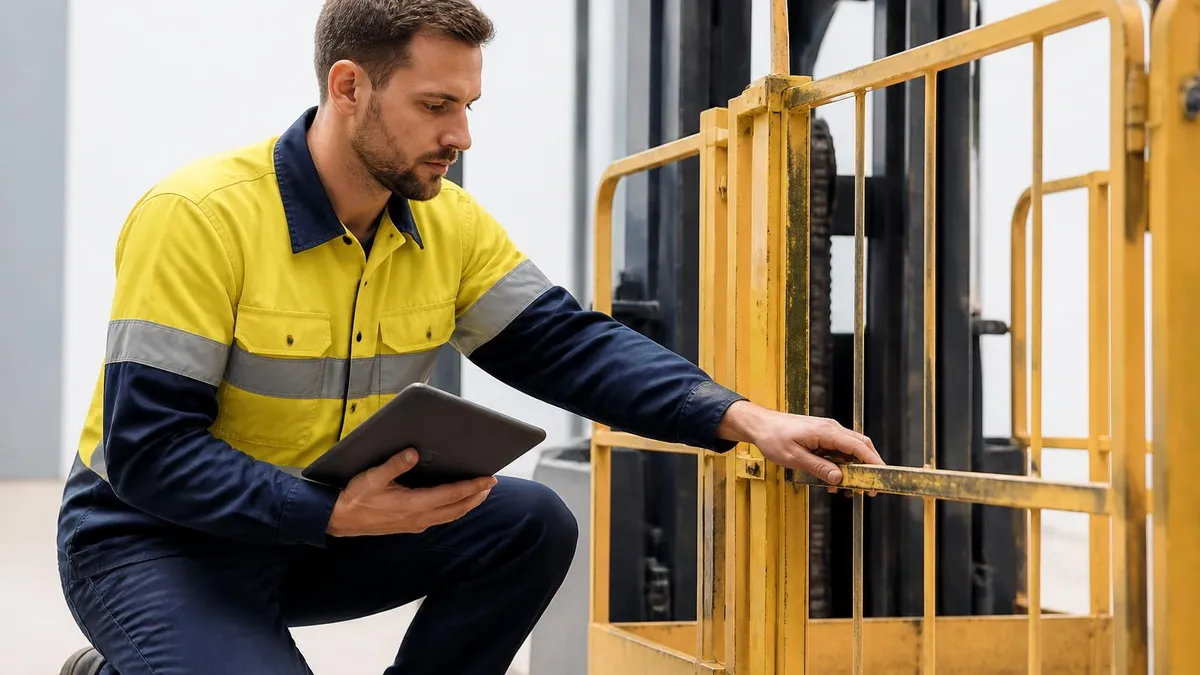
- ✓Verify the AS 2359 compliance plate is present, legible, and shows current certification details.
- ✓Inspect all guardrails for damage, deformation, cracks, or signs of unauthorised modification.
- ✓Check that toe boards are securely attached on all sides and meet the minimum 100mm height requirement.
- ✓Test the fork pocket locking mechanism to confirm it engages fully and prevents cage movement on forks.
- ✓Examine the floor plate for corrosion, holes, excessive wear, or structural damage that could compromise strength.
- ✓Confirm the fall arrest anchor point is rated, undamaged, and securely welded or bolted to the cage structure.
- ✓Verify that the cage gate or access point latches securely in the closed position without requiring force.
- ✓Check that all welds are intact with no visible cracking, porosity, or separation at structural connection points.
- ✓Ensure the combined weight of personnel, tools, and materials will not exceed the rated safe working load.
- ✓Confirm the forklift to be used is compatible with the cage fork pocket spacing and has adequate lift capacity.
Never Use a Forklift Cage Without Positive Locking
Australian Standards require every forklift cage to be positively secured to the forklift carriage or forks using mechanical locking devices such as pins, chains, or clamps. Simply resting the cage on the forks without engaging the locks is a serious breach of WHS regulations and has been identified as a contributing factor in multiple fatal incidents across Australia. Always confirm the locking mechanism is fully engaged before any person enters the cage.
Effective communication between the forklift operator and the person working in the improved cage is one of the most critical safety factors during any cage operation. Before the cage is raised, both parties must agree on a clear set of signals for commands including raise, lower, stop, emergency stop, and tilt adjustment. These signals should be established during the pre-task briefing and may include hand signals for visual communication, two-way radios for verbal communication, or a combination of both methods depending on the height involved and ambient noise levels at the work site.
The forklift operator must maintain visual contact with the improved worker at all times during cage operations. This means the operator cannot leave the forklift controls while a person is in the improved cage, even momentarily. If the operator needs to attend to another task, the cage must first be lowered to ground level and the worker must exit before the operator leaves the controls.
This requirement exists because the improved worker is entirely dependent on the operator for their safety, and any unexpected forklift movement while the cage is occupied could result in the worker being thrown from the platform.
Emergency procedures for forklift cage operations must be planned and communicated before work begins. These procedures should address scenarios including forklift mechanical failure while the cage is improved, medical emergency involving the improved worker, fire or emergency evacuation of the facility, and structural failure of the cage itself. In each scenario, the response plan should identify who takes what action, what communication method is used, and how rescue will be effected if the worker cannot self-rescue by having the cage lowered normally by the operator.
Many Australian workplaces now require a dedicated spotter or safety observer to be present during all forklift cage operations. The spotter's role is to maintain a clear exclusion zone around the forklift and cage, watch for overhead hazards that the operator and improved worker may not see, monitor environmental conditions such as wind speed, and be ready to initiate emergency procedures if required. The spotter should not perform any other tasks during the cage operation and must have direct communication capability with both the operator and the improved worker at all times.
When working at height in a forklift cage, the improved worker must wear appropriate personal protective equipment including a full-body use connected to the cage anchor point via a lanyard short enough to prevent the worker from being ejected over the guardrails. Hard hats are also typically required to protect against overhead hazards, and tool lanyards should be used for any hand tools to prevent them from being dropped onto workers below. The PPE requirements should be specified in the safe work method statement for the task and verified during the pre-task briefing.
Documentation and record-keeping for forklift cage operations serve both compliance and continuous improvement purposes. Each cage use should be recorded in a log that captures the date, operator name, improved worker name, cage identification number, forklift identification number, task performed, duration, and any issues identified during the operation. Pre-use inspection records should be retained for a minimum period specified by your state or territory regulator, typically at least three years, and must be available for inspection by workplace health and safety investigators.
Training requirements for forklift cage operations extend beyond the basic TLILIC0003 forklift operator competencies. While the forklift operator must hold a current high risk work licence, the person working in the improved cage must also receive specific training covering cage entry and exit procedures, use fitting and connection, communication protocols, and emergency response actions. This training does not require a separate licence but must be documented and should be refreshed at regular intervals determined by your workplace safety management system.
Under Australian WHS Regulations, a forklift must never be driven or repositioned while a person occupies the cage at any height. The cage must be fully lowered to ground level and the worker must exit before the forklift moves to a new location. Breaching this rule can result in prohibition notices, fines exceeding $50,000 for individuals, and criminal prosecution if a worker is injured.
The TLILIC0003 high risk work licence assessment includes specific competency elements related to forklift attachments, and forklift cage safety features prominently within this content. During the theory assessment, candidates can expect questions covering the Australian Standards applicable to work platforms, the conditions under which a forklift may legally improve a person, pre-use inspection requirements, safe working load calculations, and the regulatory penalties for non-compliance. A thorough understanding of cage safety principles is essential for passing the written component of the assessment.
During the practical assessment component, TLILIC0003 candidates may be required to demonstrate their ability to correctly attach a safety cage to a forklift, perform a pre-use inspection, calculate whether a proposed load is within the rated capacity, establish communication protocols with a simulated improved worker, and safely raise and lower the occupied cage. Assessors look for methodical, safety-conscious behaviour rather than speed, and candidates who rush through cage procedures or skip inspection steps will typically be assessed as not yet competent in this critical area.
Registered training organisations across Australia deliver the TLILIC0003 course with varying degrees of emphasis on cage safety depending on the industries they primarily serve. RTOs that cater to warehousing and logistics clients tend to provide extensive cage training because these are the environments where cages are most frequently used. RTOs serving construction clients may place greater emphasis on rough terrain operations but should still cover cage safety as it is referenced in the national training package competency elements and may appear in the assessment.
Beyond the initial TLILIC0003 assessment, many employers require additional site-specific induction training before operators are permitted to use forklift cages at their particular workplace. This induction typically covers the specific cage models available on site, the forklift units approved for cage use, site-specific communication protocols, exclusion zone procedures, permit-to-work requirements if applicable, and the location of rescue equipment. Operators should not assume that their TLILIC0003 licence alone authorises them to perform cage operations at any workplace without first completing the relevant site induction.
Ongoing competency verification is becoming increasingly common across Australian industries, with many employers implementing annual or biennial reassessment programs for forklift operators. These reassessments typically include cage safety components and provide an opportunity to identify knowledge gaps, reinforce correct procedures, update operators on any changes to regulations or standards, and address any near-miss incidents or procedural concerns that have been identified since the previous assessment period through workplace safety reporting systems.
The national training package that underpins TLILIC0003 is periodically reviewed and updated to reflect changes in technology, regulation, and industry practice. Operators should be aware that the competency requirements for their licence may evolve over time, and staying current with these changes is a professional responsibility. Industry bodies such as the Forklift Industry Association of Australia publish updates and guidance materials that help operators and employers stay informed about developments in forklift safety, including changes that affect cage attachment procedures and requirements.
Employers have a legal obligation under WHS legislation to ensure that all forklift operators working under their direction hold current and valid high risk work licences, and that these operators have received adequate training in the specific tasks they are required to perform. For cage operations, this means verifying not only that the operator holds a TLILIC0003 licence but also that they have been trained and assessed as competent in the particular cage attachment procedures used at the workplace. Maintaining comprehensive training records that document this competency is essential for demonstrating compliance during regulatory audits or investigations.
Practical tips for safe forklift cage operations begin with thorough planning before any work at height commences. Conducting a job safety analysis or take-five risk assessment before each cage task helps identify site-specific hazards such as overhead power lines, unstable ground surfaces, nearby traffic routes, weather conditions, and time pressures that might encourage shortcuts. Taking five minutes to assess these factors before starting work can prevent incidents that would otherwise result in serious injury, regulatory action, and significant disruption to workplace operations and production schedules.
Ground surface conditions directly affect forklift stability and therefore cage safety. Before positioning the forklift for a cage operation, inspect the ground for slopes, potholes, soft patches, oil spills, water pooling, and debris that could affect the forklift stability once loaded. The forklift should be positioned on firm, level ground wherever possible, and if the ground conditions are marginal, consider using load-spreading plates or selecting an alternative work location. Remember that the stability triangle calculations assume a level surface, and any gradient significantly increases the risk of forklift tip-over.
Tool and material management within the forklift cage deserves careful attention because dropped objects from height can cause serious injury to workers below. All tools should be tethered to the worker or the cage using rated tool lanyards, and materials should be secured in containers rather than loose on the cage floor. Before raising the cage, verify that nothing is balanced precariously on the guardrails or left in a position where forklift vibration could cause it to fall. Establishing a hard hat zone and exclusion zone beneath the cage provides additional protection for ground-level workers.
The condition of the forklift itself is as important as the condition of the cage for safe improved work. Before any cage operation, the forklift should receive a thorough pre-operational inspection covering hydraulic systems, mast chains, lift cylinder, tilt cylinder, brakes, steering, and all safety devices. Pay particular attention to hydraulic hoses and fittings, as a hydraulic failure while a worker is improved in the cage could result in an uncontrolled descent. Any forklift showing signs of hydraulic leaks, unusual noises during mast operation, or inconsistent lift speed should not be used for cage operations.
Environmental monitoring during cage operations should be continuous rather than limited to the initial risk assessment. Wind conditions can change rapidly, and what begins as a calm day can develop gusts that affect forklift stability and worker safety at height. Most workplace procedures specify maximum wind speeds for cage operations, typically around 30 kilometres per hour at ground level, but operators should also consider that wind speeds increase with height. If conditions deteriorate during a task, the cage should be lowered immediately and work suspended until conditions improve sufficiently to resume safely.
Fatigue management is an often-overlooked factor in forklift cage safety. Both the forklift operator and the improved worker must be alert and focused throughout the operation, which requires adequate rest, hydration, and task rotation during extended periods of cage work. The improved worker in particular may experience physical fatigue from standing in the confined cage space, and cognitive fatigue from maintaining concentration at height. Scheduling regular breaks and limiting continuous cage work periods to a maximum of two hours are practical measures that support sustained safe performance throughout the working day.
Finally, reporting and learning from near-miss incidents involving forklift cages is essential for continuous safety improvement. Every near miss, no matter how minor it may seem, provides valuable information about potential hazards and procedural weaknesses that could lead to a serious incident if left unaddressed. Australian workplaces should maintain a confidential reporting system that encourages workers to report cage-related concerns without fear of reprisal, and safety committees should regularly review these reports to identify trends and implement corrective actions that strengthen overall cage safety performance across the organisation.
Sample Forklift Licence Practice Questions
Try these questions from our free Forklift Licence practice tests. The correct answer and an explanation follow each question.
Under the Work Health and Safety (WHS) Act, what duty does a forklift operator have regarding hazards in the workplace?
- A. Report hazards only if they are in the operator's immediate work area
- B. Take reasonable care to identify hazards and report them to the person conducting the business or undertaking (PCBU)
- C. Ignore minor hazards and only report serious injuries
- D. Only follow instructions from supervisors, with no independent duty to report
Answer: B. Take reasonable care to identify hazards and report them to the person conducting the business or undertaking (PCBU)
Under the WHS Act, workers have a duty to take reasonable care for their own and others' health and safety, which includes identifying and reporting hazards to the PCBU.
What penalties apply for non-compliance with Attachments and Modifications regulations in Australia?
- A. No penalties
- B. Significant fines (up to millions of AUD for corporations) and potential imprisonment for serious offences
- C. A verbal warning only
- D. A small administrative fee
Answer: B. Significant fines (up to millions of AUD for corporations) and potential imprisonment for serious offences
Australian WHS penalties are severe, with Category 1 offences carrying fines up to AUD 3 million and potential imprisonment.
What penalties apply for non-compliance with Battery and Fuel Safety regulations in Australia?
- A. No penalties
- B. Significant fines (up to millions of AUD for corporations) and potential imprisonment for serious offences
- C. A verbal warning only
- D. A small administrative fee
Answer: B. Significant fines (up to millions of AUD for corporations) and potential imprisonment for serious offences
Australian WHS penalties are severe, with Category 1 offences carrying fines up to AUD 3 million and potential imprisonment.
How should new Attachments and Modifications risks be incorporated into existing safety systems?
- A. Ignore them
- B. Through review and update of risk assessments, procedures, training, and communication to all affected workers
- C. Wait for the next scheduled review
- D. File them for future reference
Answer: B. Through review and update of risk assessments, procedures, training, and communication to all affected workers
New risks must be promptly incorporated into risk assessments, procedures, and communicated to all affected workers.
TLILIC0003 Questions and Answers
Forklift Training Near Me: Complete Guide to Finding TLILIC0003 Courses in Australia
Mast of Forklift: Complete Guide to Forklift Parts for TLILIC0003 Operators in Australia
How To Get A Forklift License In Australia: Complete TLILIC0003 Step-by-Step Guide (2026)
Multi Directional Forklift Trucks: Complete Guide to Forklift Types and Parts for TLILIC0003 Operators in Australia
Free Forklift Practice Test 2026 - Forklift Exam Questions
About the Author

Certified Crane Operator & Skilled Trades Exam Specialist
Ferris State UniversityRobert Martinez is a Journeyman Ironworker, NCCCO-certified crane operator, and forklift trainer with a Bachelor of Science in Construction Technology from Ferris State University. He has 21 years of ironworking, rigging, and heavy equipment operation experience across high-rise and industrial construction sites. Robert prepares candidates for crane operator, rigger, forklift, and skilled trades certification examinations.