
Lost Forklift Licence: What Australian Operators Need to Do 2026 October
Lost your forklift licence in Australia? ✅ Learn how to get a replacement, what documents you need, costs, and how to stay legally compliant.

A lost forklift licence is more disruptive than most operators expect. In Australia, your TLILIC0003 High Risk Work (HRW) licence is a legal requirement for operating a forklift in any workplace, and without a valid, presentable licence card you cannot legally perform forklift duties — even if you completed your training years ago and have thousands of hours of safe operating experience behind you. The moment you realise your card is missing, it is essential to act quickly and systematically so that your downtime is minimised and your employer remains confident in your compliance status.
The licensing framework for forklift operators in Australia is administered at the state and territory level through each jurisdiction's work health and safety regulator. In New South Wales, that body is SafeWork NSW; in Victoria it is WorkSafe Victoria; in Queensland it is Workplace Health and Safety Queensland; in Western Australia it is WorkSafe WA; in South Australia it is SafeWork SA; in the Australian Capital Territory it is WorkSafe ACT; in Tasmania it is WorkSafe Tasmania; and in the Northern Territory it is NT WorkSafe.
Each regulator has its own replacement application portal, fees, and processing timeframes, so knowing which body issued your original licence is the critical first step before you do anything else.
Many operators are surprised to discover that a replacement licence card is not simply reprinted on demand in an hour. Depending on your jurisdiction, the process can take anywhere from a few business days to three or four weeks, particularly if your original records need to be manually verified, if your address has changed since the original application, or if the regulator's system requires paper forms rather than an online submission.
Understanding these timelines upfront allows you to make sensible arrangements with your employer — for example, transitioning to non-forklift duties while your replacement is processed, rather than risking an on-the-spot fine or incident report.
It is also worth clarifying the difference between losing your physical licence card and having your licence suspended, cancelled, or expired. A lost card does not mean your licence entitlement has changed — provided you have kept your details current with the regulator, your licence remains valid and you simply need a duplicate card issued.
By contrast, an expired licence requires you to demonstrate currency of competency before renewal, and a cancelled or suspended licence requires you to address the underlying compliance issue before you can legally return to forklift operations. Knowing which situation applies to you will determine the correct pathway and the correct application form to submit.
Your employer's obligations are also relevant here. Under the Work Health and Safety Act applicable in each state and territory, a person conducting a business or undertaking (PCBU) must not direct a worker to operate a forklift unless that worker holds a current HRW licence for the relevant licence class.
If you cannot produce your licence card and have not yet received a replacement, your employer is legally exposed if they continue to roster you on forklift duties. For this reason, most safety-conscious employers will require you to either produce a receipt or confirmation reference number from your replacement application, or to stand down from forklift tasks until the new card arrives.
The good news is that the process for replacing a lost TLILIC0003 forklift licence, while occasionally bureaucratic, is straightforward when you follow the correct steps. Most jurisdictions allow you to apply online, pay a modest fee — typically between $30 and $60 — and receive a replacement card by registered post within one to three weeks. Some jurisdictions also allow you to download a temporary licence confirmation letter immediately after your application is accepted, which you can carry with you as interim evidence of your licence entitlement while the physical card is being printed and mailed.
This guide walks you through every stage of the replacement process across all Australian states and territories, explains what documentation you will need to gather before you apply, outlines the likely costs and timeframes you should plan around, and provides practical advice on preventing the same problem from occurring in the future. Whether you lost your card at a worksite, during a house move, or simply cannot locate it after a thorough search, the steps ahead are clear and manageable — and keeping your TLILIC0003 licence current is well within reach.
Lost Forklift Licence Replacement — Key Numbers
Key Facts at a Glance
| Item | Value | Details |
|---|---|---|
| Replacement Fee | $30–$60 | Varies by state/territory |
| Typical Processing Time | 1–3 weeks | Can be longer for manual verification |
| ID Required | 100 points | Standard identity verification threshold |
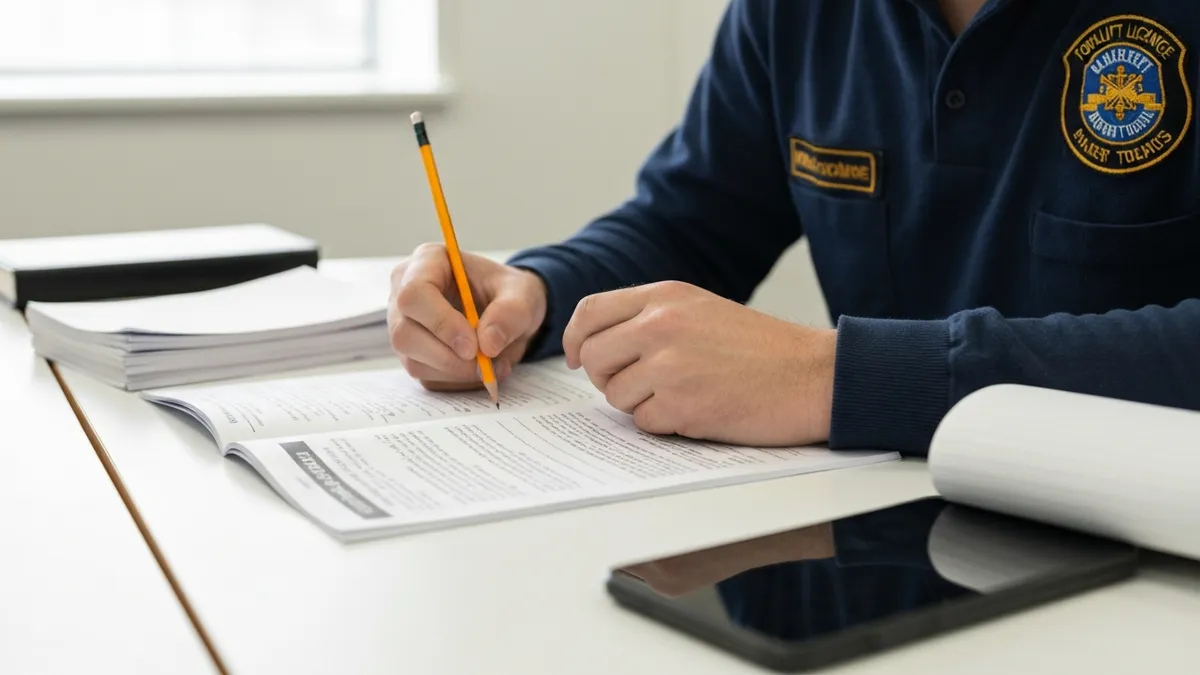
Steps to Replace Your Lost TLILIC0003 Forklift Licence
Confirm Your Licence Details
Identify the Correct Regulator
Gather Identity Documents
Submit Your Replacement Application
Notify Your Employer
Receive and Secure Your New Card
Understanding what documents and fees are required before you begin your replacement application will save you significant time and prevent your submission from being rejected or placed on hold. The identity verification requirements for a replacement HRW licence are consistent with the standards applied to initial licence applications — regulators must confirm that the person applying for a replacement is the same person recorded on the original licence record, and that no fraudulent transfer of licence entitlements is occurring. This is a sensible safeguard that protects the integrity of Australia's high-risk work licensing system.
For identity verification, every Australian HRW licensing jurisdiction uses a points-based system with a threshold of 100 points. A primary document — such as an Australian passport, foreign passport with a valid visa, or an Australian driver licence — is worth 70 points. You then need to supply supporting documents to reach the remaining 30 points.
Acceptable supporting documents typically include a Medicare card (worth 25 points), a bank statement or credit card showing your name and address (worth 25 points), a rates or utility notice (worth 25 points), or a government-issued concession card. Always check the specific requirements on your regulator's website, as exact point allocations can vary slightly between jurisdictions.
If your name has changed since your original licence was issued — for example due to marriage or a legal name change — you will need to provide documentation of the change, such as a marriage certificate or court order, in addition to your standard 100 points of ID.
Failing to provide evidence of a name change is one of the most common reasons replacement applications are delayed or rejected, so address this proactively if it applies to your situation. Similarly, if your current residential address differs from the address recorded on your original licence, some regulators require you to complete an address update as a separate step either before or simultaneously with your replacement application.
Replacement fees vary across jurisdictions and are updated periodically. As a general guide, most Australian states and territories charge between $30 and $60 for a replacement HRW licence card. Western Australia and Queensland historically sit at the lower end of this range, while New South Wales and Victoria may charge slightly more.
Some regulators also charge an additional processing fee if you request an expedited replacement, though this service is not universally available. Always check the current fee schedule on your regulator's official website immediately before applying, as printing outdated fee information can result in an under-payment that delays your application.
Payment methods accepted for replacement applications also vary. Online applications generally accept credit card, debit card, or BPAY. Applications submitted in person at a Service Centre or licensing office may also accept cash. Postal applications typically require a bank cheque or money order payable to the relevant regulator — personal cheques are not universally accepted. If you are unsure which payment method to use, the online application portal will display accepted methods at the payment step, or you can confirm by calling the regulator's licensing enquiries line before submitting a paper application.
One documentation requirement that catches many operators off guard is the need to provide a statutory declaration in some circumstances. If your original licence was issued more than ten years ago and your records cannot be readily located in the regulator's system, or if there is any discrepancy between the details you have provided and what appears in the licensing database, you may be asked to complete a statutory declaration confirming your identity and the circumstances of the loss.
A statutory declaration must be signed in the presence of an authorised witness such as a Justice of the Peace, pharmacist, accountant, or police officer — and the witness must themselves sign and stamp the document before it is submitted with your application.
Finally, it is worth being aware that some jurisdictions offer a temporary letter of evidence — also called an interim licence confirmation — that can be downloaded or emailed to you immediately after your application is accepted and payment is processed.
This letter confirms your licence entitlement and can be presented to an employer or safety inspector while you wait for the physical replacement card to arrive. Not all regulators provide this service, but it is worth checking at the time of application, as it may allow you to return to forklift duties sooner rather than waiting the full one to three weeks for the card to arrive by post.
State-by-State Replacement Process for Australian Forklift Operators
In New South Wales, replacement HRW licence applications are processed by SafeWork NSW through the Service NSW portal or by visiting a Service NSW centre in person. The current fee is approximately $53, and processing typically takes seven to ten business days. In Victoria, WorkSafe Victoria handles replacements through an online form on the WorkSafe website, with a fee of around $48 and a similar processing window. Queensland operators apply through the WHSQ online licensing portal, with a lower fee of approximately $38 and a processing time of five to seven business days for online submissions.
All three states provide an online reference number upon submission that operators can share with employers as interim evidence. NSW is notable for allowing applicants to visit a Service NSW centre and receive a printed temporary authority letter on the same day, which is useful for operators who cannot afford any downtime. Victoria allows applicants to check application status online, which is helpful for planning return-to-work timelines. Queensland's online portal is among the most simplified in the country, with the majority of straightforward applications approved within three business days when all documentation is submitted correctly at the first attempt.

Replacing vs. Renewing: What's the Difference and Which Applies to You?
- +A replacement card preserves your original licence expiry date — no loss of remaining licence term
- +Most online replacement applications take less than 20 minutes to complete
- +Replacement fees ($30–$60) are significantly lower than the cost of retraining
- +Interim confirmation letters available in some states allow rapid return to forklift duties
- +No practical assessment or knowledge test required for a simple card replacement
- +Digital backup of your licence details can prevent recurrence of the same problem
- −Processing times of 1–3 weeks can result in temporary stand-down from forklift duties
- −Each state has different forms, fees, and submission methods — research is required
- −Name changes or address discrepancies can significantly delay your application
- −Some jurisdictions still require paper forms or in-person visits rather than online applications
- −No physical card means you technically cannot produce your licence at an inspection during the wait period
- −If your licence has also expired, replacement alone is insufficient — renewal competency assessment is required
Lost Forklift Licence Replacement Application Checklist
- ✓Locate your original licence number from payslips, employment records, or previous inspection notices.
- ✓Confirm which state or territory issued your original TLILIC0003 HRW licence.
- ✓Visit the correct regulator's website and download or access the replacement application form.
- ✓Gather a primary identity document worth 70 points (passport or driver licence).
- ✓Collect supporting identity documents to reach 100 points total (Medicare card, bank statement, or utility bill).
- ✓If your name has changed since original licensing, obtain your marriage certificate or court order.
- ✓Check the current replacement fee on the regulator's website and confirm accepted payment methods.
- ✓Complete the application form accurately, ensuring your current address matches your ID documents.
- ✓Submit the application online, in person, or by post along with certified copies of your ID documents.
- ✓Save your application reference number and download any interim confirmation letter offered at submission.
Losing your card does not cancel your licence
Many operators panic when they cannot find their forklift licence card, fearing their entitlement has lapsed. In reality, your TLILIC0003 HRW licence entitlement remains valid in the regulator's database as long as your licence has not expired, been suspended, or been cancelled. The replacement process simply issues a new physical card — your years of training and licensing history remain fully intact and are not affected by the loss of the card itself.
Employers play a critical role in managing the compliance risk that arises when a worker reports a lost TLILIC0003 forklift licence. Under the Work Health and Safety Act — whether that is the harmonised WHS Act applicable in most jurisdictions or the Occupational Health and Safety Act in Victoria — a person conducting a business or undertaking has a primary duty of care to ensure, so far as is reasonably practicable, that workers are not exposed to health and safety risks.
Part of that duty involves verifying that workers holding high-risk work licences are actually licenced for the class of equipment they are operating, and that their licence is current and valid.
When an employee reports that their licence card has been lost, the most defensible employer position is to direct the employee to apply for a replacement immediately and to suspend them from forklift duties until either the new card is received or the regulator provides written confirmation of the licence entitlement.
Some employers attempt to manage this period by relying on verbal assurances from the worker or on a remembered licence number, but this approach creates significant legal exposure if an incident occurs during the interim period and the regulator subsequently determines that the PCBU failed to verify the worker's licence status before directing them to operate a forklift.
A practical risk management measure that many safety-conscious employers are now implementing is to maintain a copy of each forklift operator's HRW licence card in the worker's HR file, updated at the beginning of each licence term and again when a replacement is issued.
This does not substitute for the worker carrying their own card, but it provides the PCBU with documentary evidence that the licence was verified at the time the worker last reported for forklift duties, which is relevant to assessing whether the PCBU met its duty of care obligations in the event of a subsequent incident or audit.
Employers who operate under enterprise agreements or certified safety management systems accredited to ISO 45001 or a similar standard may also have specific requirements around licence verification frequency. Some systems mandate monthly or quarterly verification of all HRW licences held by site personnel, cross-checked against the relevant state regulator's online licence verification tool.
These verification checks are valuable because they catch not only lost licences but also expired licences, licences that have been suspended due to a separate workplace incident, and licences where the operator has been working on a licence class that does not cover the specific forklift type they are operating.
From the worker's perspective, an often-overlooked protection against the compliance complications of a lost licence is to ensure that your licensing details are kept up to date with your employer's HR or training management system. Many larger employers use workforce management software that records the licence number, issue date, and expiry date for each operator, and that sends automated reminders when a licence is approaching its expiry date.
If your licence details are accurately recorded in this system, your employer will already have a record of your licence number that you can use to contact the regulator and initiate your replacement application, even if you cannot recall the number yourself.
Site supervisors and safety officers should also be aware of the distinction between an HRW licence verification and a competency assessment. Confirming that a worker holds a valid licence is a legal compliance check that can be performed in seconds using the relevant state regulator's online lookup tool.
It does not, by itself, tell you whether the worker is competent on a specific forklift model in a specific operating environment — that judgement requires a site-specific induction, equipment familiarisation, and ongoing supervisor observation. However, the licence check is a necessary prerequisite, and no amount of demonstrated competency can substitute for a valid TLILIC0003 licence when the regulator's inspector arrives on site.
One area of particular importance for employers in the labour hire and contracting sector is ensuring that subcontractors and labour hire workers supplied to your site hold valid HRW licences before they commence forklift operations.
The duty of care under WHS legislation extends to all workers at a workplace, not just direct employees, and a host employer who allows an unlicensed or licence-expired labour hire forklift operator to work on their site faces the same penalties as if they had allowed their own employee to operate without a licence. Establishing a strong pre-commencement licence verification process for all categories of worker is therefore essential for any operation that engages contractors or labour hire personnel for forklift tasks.

Operating a forklift without being able to produce your HRW licence card is an offence under WHS legislation in every Australian state and territory. Fines for unlicensed operation can reach $3,600 for an individual and significantly more for a PCBU. Even if your licence is valid in the database, you are required to produce the physical card or an approved interim authority letter when directed to do so by an inspector or authorised officer. Do not operate until you have documentation you can present on request.
Once you have been through the process of replacing a lost TLILIC0003 forklift licence, the natural next step is to implement simple but effective measures to ensure you never have to go through the same process again.
The most reliable protection against future licence loss is to maintain multiple records of your licence information in different locations, so that even if the physical card is lost or destroyed, you have the information you need to contact the regulator and initiate a replacement without delay. This section outlines the most practical strategies that experienced Australian forklift operators use to protect their licensing records.
The single most effective measure is to photograph both sides of your HRW licence card immediately after receiving it and store those photographs in at least two separate locations — for example, in your smartphone's camera roll, in a secure cloud storage service such as iCloud or Google Drive, and in an email you send to yourself that can be retrieved even if you change phones.
The photograph captures your licence number, issue date, expiry date, and the issuing regulator's details — everything you need to initiate a replacement application. If you also photograph your card with your face visible in the frame (a selfie with the card), this can assist with identity verification if the regulator requires evidence that you are the named licence holder.
A second practical measure is to register your licence details with your employer's HR or training management system as soon as you start a new role or when your licence is renewed. Many employers already require this, but workers who change jobs frequently or who work for smaller operations without formal HR systems may need to take the initiative themselves.
Keeping a record in your employer's system means that even if you lose your card and cannot recall your licence number, your employer's records can provide this information and allow you to start the replacement process immediately rather than waiting for the regulator to look up your records by name and date of birth alone.
Consider also carrying a laminated photocopy of your licence card in a separate compartment of your wallet or work bag, kept apart from the original card. While a photocopy is not a valid substitute for the original card at an inspection, it preserves the licence number and expiry details in physical form and is invaluable for initiating a replacement application quickly. Some operators also keep a small card in their emergency contact wallet insert that notes their HRW licence number alongside other essential reference information such as their employer's emergency contact number and their own medical information.
Another preventive strategy is to set a calendar reminder — or use the automated reminder service offered by several state regulators — to alert you six months before your TLILIC0003 licence expires.
Licence expiry is a separate issue from licence loss, but many operators who work on their licence until close to expiry find that the renewal deadline creates additional stress and compliance risk, particularly if they are also dealing with a lost card at the same time. Renewing your licence well before expiry gives you a buffer period during which a temporary loss of your card is a minor inconvenience rather than a compliance crisis.
For operators who work across multiple states — for example FIFO workers who spend part of their working year in Western Australia and part in Queensland — it is important to understand that an HRW licence issued in one Australian state or territory is valid in all other states and territories, under the mutual recognition arrangements established by the Mutual Recognition Act 1992.
However, the replacement process always goes through the issuing jurisdiction, not the jurisdiction where you are currently working. This means that a WA-issued licence lost while working on a Queensland mine site must still be replaced through WorkSafe WA, not WHSQ. Knowing this in advance avoids wasted time spent contacting the wrong regulator.
Finally, if you are approaching the end of your current TLILIC0003 licence term — within 12 months of expiry — it may be worth considering whether to simply renew your licence rather than replace the lost card.
Renewal requires demonstrating currency of competency, which typically involves completing a forklift refresher course if you have not worked in the industry recently, but it results in a fresh five-year licence term from the date of renewal and eliminates the risk that your replacement card will arrive only months before expiry. Discuss this option with a registered training organisation or contact your state regulator for advice on the most efficient pathway given your specific circumstances and licensing history.
Beyond the administrative process of replacing a lost licence, it is worthwhile taking a step back and using the experience as an opportunity to refresh your knowledge of the broader regulatory obligations that apply to TLILIC0003 licence holders in Australia.
Forklift regulations do not stand still — the Safe Work Australia Model Code of Practice for Powered Industrial Trucks is periodically updated, and individual state and territory regulators may issue supplementary guidance on specific topics such as pedestrian exclusion zones, load capacity plate requirements, and the use of attachments. Staying current with these requirements protects you, your workmates, and your employer.
One area where many experienced operators find their knowledge has drifted is the rules around forklift attachments and modifications. The use of a non-standard attachment — such as a side shifter, a rotator, a paper roll clamp, or a jib — can significantly alter a forklift's load capacity, stability characteristics, and operating envelope.
The relevant standard is AS 2359 Powered Industrial Trucks, which specifies that any modification to a forklift, including the fitting of a non-standard attachment, must be assessed and the load capacity plate updated accordingly. Operating a forklift with a non-standard attachment that has not been assessed and documented is both a regulatory breach and a serious safety risk.
Your TLILIC0003 assessment will have covered the fundamentals of pre-operational checks, load stability, travel on grades, and safe stacking and destacking techniques. However, the practical reality of forklift operation in Australian workplaces often involves scenarios that were not specifically covered in your initial training — for example, operating on uneven outdoor surfaces, working in cold store environments, handling unstable or asymmetric loads, or managing battery maintenance on electric forklifts.
Building your competency in these specific operational contexts is valuable not only from a safety perspective but also from a career perspective, as operators with broad practical knowledge are typically more employable and command higher hourly rates.
If your lost licence event has prompted you to review your overall compliance position, now is also a good time to check whether any conditions are attached to your HRW licence. While TLILIC0003 licences are generally issued without conditions, some operators may have had conditions imposed following a workplace incident, a medical assessment, or an undertaking given to a regulator.
Conditions might restrict the hours of operation, require the use of specific personal protective equipment, or limit the operating environment to specific sites or equipment types. If conditions apply to your licence, ensure that you and your employer are complying with them, as a breach of a licence condition is a separate offence from unlicensed operation and can result in suspension or cancellation of your licence.
For operators who are considering expanding their skill set, the period during which you are waiting for your replacement card to arrive is an ideal time to review study materials for other HRW licence classes or for complementary qualifications. The TLILIC0003 High Risk Work Licence for forklift operation is one of the most widely held HRW licences in Australia, but many warehousing, logistics, and manufacturing worksites also require operators to hold licences for reach stacker operation (TLILIC0002), order picking forklift trucks (TLILIC0004), or slewing mobile cranes.
Adding complementary licence classes to your portfolio increases your flexibility and employability, and the study habits and regulatory knowledge you developed for your initial TLILIC0003 assessment provide a strong foundation for these additional qualifications.
Practical preparation for your return to forklift operations after the replacement period might also include a review of your employer's site-specific procedures, particularly if the replacement process took several weeks and you have been away from forklift duties during that time.
A brief equipment familiarisation check before your first post-replacement shift — checking fluid levels, tyre condition, horn, lights, load backrest, and mast operation — is good practice regardless of the circumstances of your absence. If your employer has updated their traffic management plan, introduced new pedestrian exclusion zones, or changed the approved travel routes on site during your absence, ensure you are briefed on these changes before operating.
Finally, take a moment to share your experience with your colleagues. The administrative experience of dealing with a lost licence — understanding which regulator to contact, what documents are needed, what the fees are, and how long to plan for — is genuinely useful knowledge for any forklift operator, and most people do not discover what the process involves until they are already in the middle of it and under time pressure.
A brief informal conversation with your team about the importance of photographing licence cards and keeping licence details recorded in multiple locations could save a colleague considerable stress and inconvenience if they face the same situation in the future.
Sample Forklift Licence Practice Questions
Try these questions from our free Forklift Licence practice tests. The correct answer and an explanation follow each question.
Under Australian regulations, who bears primary responsibility for Emergency Procedures compliance?
- A. Workers only
- B. The PCBU (Person Conducting a Business or Undertaking)
- C. Equipment suppliers
- D. The general public
Answer: B. The PCBU (Person Conducting a Business or Undertaking)
The PCBU has the primary duty under the WHS Act to ensure compliance with all safety requirements.
How should Pedestrian Safety incidents be reported in an Australian workplace?
- A. Ignore minor incidents
- B. Report immediately to the supervisor, with notifiable incidents reported to the regulator
- C. Wait until the weekly meeting
- D. Post on social media
Answer: B. Report immediately to the supervisor, with notifiable incidents reported to the regulator
Incidents must be reported promptly, with notifiable incidents requiring immediate regulator notification.
How should Operating in Different Environments incidents be reported in an Australian workplace?
- A. Ignore minor incidents
- B. Report immediately to the supervisor, with notifiable incidents reported to the regulator
- C. Wait until the weekly meeting
- D. Post on social media
Answer: B. Report immediately to the supervisor, with notifiable incidents reported to the regulator
Incidents must be reported promptly, with notifiable incidents requiring immediate regulator notification.
Under Australian regulations, who bears primary responsibility for Racking and Storage compliance?
- A. Workers only
- B. The PCBU (Person Conducting a Business or Undertaking)
- C. Equipment suppliers
- D. The general public
Answer: B. The PCBU (Person Conducting a Business or Undertaking)
The PCBU has the primary duty under the WHS Act to ensure compliance with all safety requirements.
TLILIC0003 Questions and Answers
Forklift Models — Complete Guide (2026)

Forklift Tyne: Everything Australian TLILIC0003 Operators Need to Know

Forklift Refresher Course: Complete TLILIC0003 Training Guide for Australian Operators
Different Forklift Types: A Complete Guide for Australian TLILIC0003 Operators

Forklift Test Questions and Answers PDF: Complete TLILIC0003 Practice Guide for Australian Operators
About the Author

Certified Crane Operator & Skilled Trades Exam Specialist
Ferris State UniversityRobert Martinez is a Journeyman Ironworker, NCCCO-certified crane operator, and forklift trainer with a Bachelor of Science in Construction Technology from Ferris State University. He has 21 years of ironworking, rigging, and heavy equipment operation experience across high-rise and industrial construction sites. Robert prepares candidates for crane operator, rigger, forklift, and skilled trades certification examinations.