
Forklift 5th Wheel Attachment: Complete Guide to Forklift Attachments and Parts for TLILIC0003 Operators in Australia
Forklift 5th wheel attachment guide for TLILIC0003 operators. ✅ Learn attachments, parts, capacity ratings, safety rules and Australian compliance.
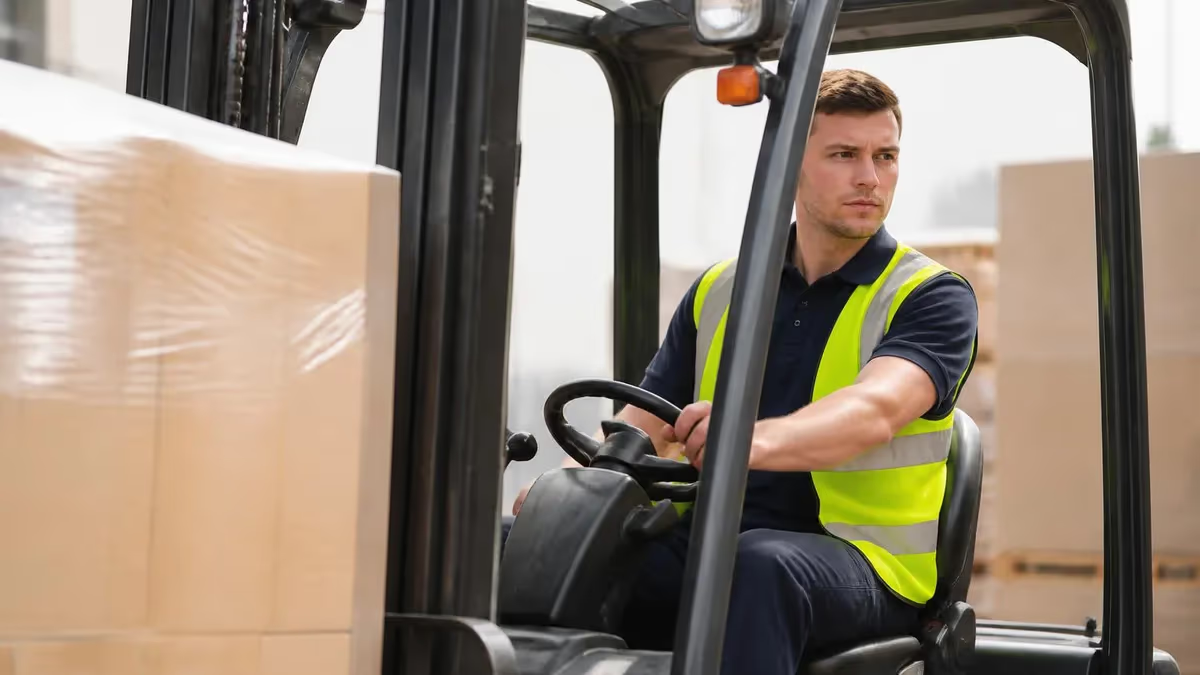
The forklift 5th wheel attachment is one of the most specialised pieces of equipment a TLILIC0003 operator will encounter on Australian worksites, and understanding how it functions alongside the rest of your forklift's attachment ecosystem is critical to passing your high-risk work licence assessment. A 5th wheel attachment essentially converts a counterbalance forklift into a yard tractor capable of coupling to semi-trailer kingpins, allowing the operator to shunt trailers within distribution centres, freight depots and intermodal terminals without needing a separate prime mover for short-distance moves.
Across Australia, attachments transform a standard forklift from a simple pallet-handling machine into a versatile materials handling platform, but every attachment fitted changes the rated capacity, the load centre, and the operating envelope. TLILIC0003 assessment specifically requires candidates to demonstrate they can read a data plate, calculate de-rated capacity, and recognise when an attachment has been installed without manufacturer approval. Getting this wrong on the day of your assessment is a common reason candidates fail their practical test.
Standard attachments you'll see in everyday Australian operations include side shifters, fork positioners, rotators, paper roll clamps, drum clamps, carton clamps, bale clamps, slip-sheet push-pulls, jib booms, work platforms and the heavy-duty 5th wheel coupler. Each one comes with its own compliance plate, hydraulic plumbing requirements and operator considerations. Safe Work Australia and state regulators treat unapproved or poorly maintained attachments as a serious breach, with penalties for the PCBU and the operator if an incident occurs.
This guide walks through every major attachment category, the parts that make them work, the inspection routines you should complete each shift, and the specific knowledge points that show up in TLILIC0003 theory and practical assessments. We'll cover hydraulic circuits, ISO carriage classes, capacity de-rating formulas, manufacturer approval paperwork, and the practical handling differences between standard fork tines and powered attachments. Before we dive deeper, you can also explore the mast of forklift components that anchor every attachment to your machine.
The Australian regulatory environment for forklift attachments is governed by AS 2359, the Powered Industrial Trucks standard series, alongside WHS Regulation 2011 (Chapter 4) and individual jurisdiction codes of practice. AS 2359.2 specifically covers operator training, while AS 2359.6 addresses safety code provisions for attachments. Your TLILIC0003 assessor will expect you to know which standard applies to which scenario, particularly when assessing whether a non-OEM attachment is legally permissible on your specific make and model of forklift.
Beyond compliance, attachments dramatically affect productivity. A well-chosen carton clamp can double pick rates in a beverage distribution centre, while a 5th wheel coupler can eliminate the need for a dedicated yard tractor, saving operators tens of thousands of dollars in capital expenditure. Conversely, the wrong attachment, or one mismatched to the load and forklift class, can cause catastrophic stability failures, hydraulic ruptures, and pedestrian injuries that result in WorkSafe prosecutions and criminal charges in extreme cases.
By the end of this article you'll be able to identify every major attachment in the Australian forklift fleet, explain how it changes machine performance, conduct a competent pre-start inspection, recognise the warning signs of attachment failure, and answer the specific TLILIC0003 questions assessors love to ask about 5th wheel couplers, capacity plates, and hydraulic auxiliary circuits. This is essential knowledge whether you're sitting your first ticket or refreshing your skills before a workplace verification of competency.
Forklift Attachments by the Numbers
Main Forklift Attachment Categories Used in Australia
Hydraulically slide forks left or right and adjust spacing without repositioning the truck. Standard on most modern Australian counterbalance forklifts, reducing pallet placement time by up to 35% and improving aisle utilisation in narrow warehouse layouts.
Includes carton, paper roll, drum, bale, and bottom-dumping rotators. Replace tines entirely and grip loads using hydraulic pressure. Common in beverage, paper, manufacturing and waste industries across NSW, VIC and QLD distribution hubs.
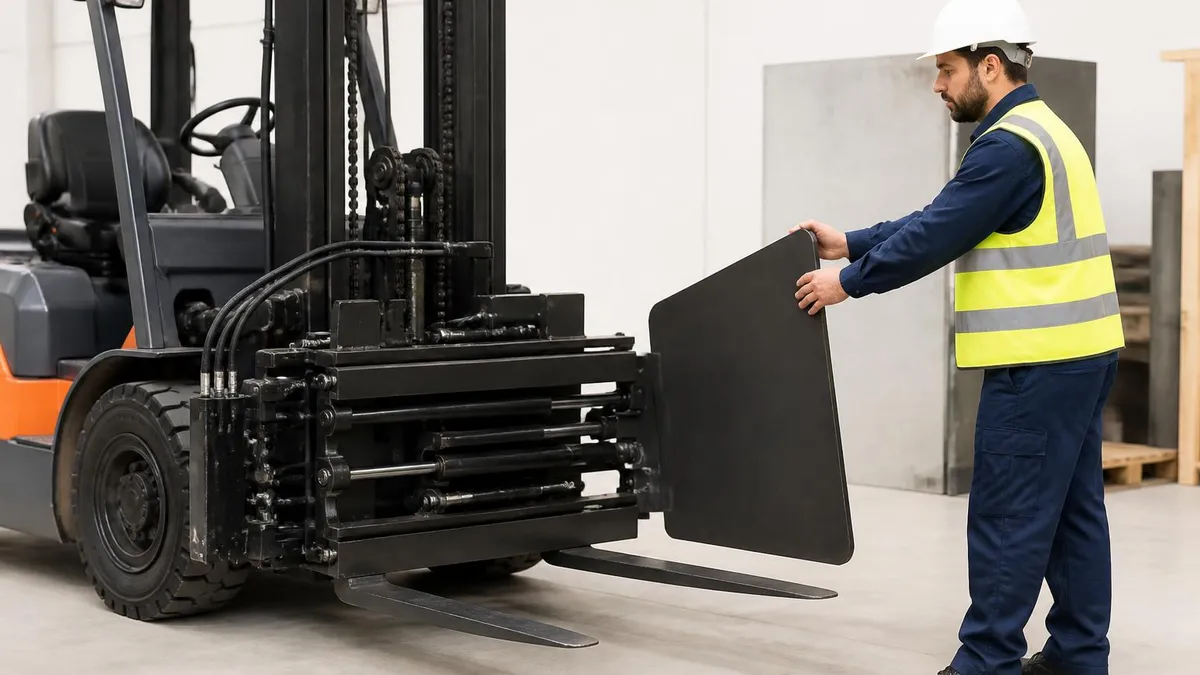
Convert counterbalance forklifts into trailer-shunting tugs by providing a kingpin coupling plate. Widely used in intermodal terminals, breweries, and large freight depots where dedicated yard tractors are not economically justified.
Extend reach via crane-style jibs, boom extensions or fork-mounted personnel cages. Personnel cages require dual interlocks, use anchors, and supervisor sign-off under AS 2359.6 before any work-at-height activity.
Replace traditional pallets with disposable slip-sheets, increasing container loading efficiency by up to 15%. Common in FMCG and export sectors where pallet weight and cost matter for international freight cubic-utilisation.
The 5th wheel attachment, sometimes called a fifth wheel coupler or trailer skate, transforms a standard counterbalance forklift into a short-range trailer mover. The unit bolts to the forklift carriage in place of the fork tines and presents a horizontal coupling plate with a jaw mechanism identical in geometry to a prime mover's fifth wheel. Once the operator reverses under the trailer kingpin and raises the mast, the jaws lock around the pin and the trailer is held securely on the forklift, allowing the operator to manoeuvre it through a yard.
Mechanically, the 5th wheel attachment relies on the host forklift's mast lift function to provide vertical engagement and the truck's drive system for propulsion. Most models include a manual release lever for the jaw, a safety locking pin to prevent inadvertent uncoupling, and grease nipples on the pivot points. Some premium units include a hydraulic actuator that opens the jaw remotely from the cab, eliminating the need for the operator to dismount during coupling cycles, which is particularly useful in rainy Melbourne or muddy Queensland yards.
Capacity considerations for 5th wheel work are different from standard pallet handling. Because the load centre is effectively the kingpin position, which sits well behind the heel of the carriage, de-rating is substantial. A 5-tonne forklift might only safely shunt a trailer with 2.5-3 tonnes of imposed kingpin weight, even though the full trailer weighs much more, because most of the trailer mass rests on its own rear axles. Always consult the data plate calculation specific to the attachment-forklift combination.
Surface conditions matter enormously when shunting trailers. The forklift's rear steer axle becomes the primary load-bearing point during coupling, and any sudden bump, pothole or kerb can cause the trailer to lift the forklift's front drive wheels off the ground momentarily, leading to loss of steering authority. Always travel slowly, plan your turning radius generously, and never attempt to shunt on slopes steeper than 5% without specific procedural authorisation from your site supervisor and PCBU.
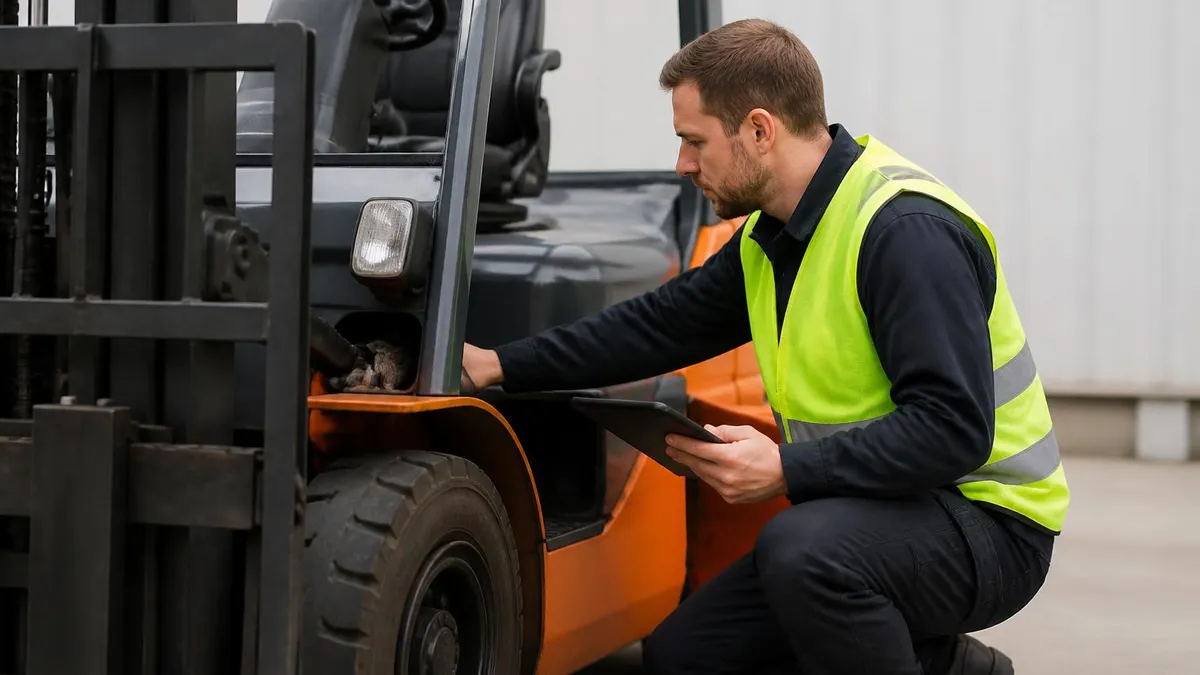
Pre-start inspection of the 5th wheel attachment must include checking the jaw spring tension, looking for hairline cracks in the coupling plate, verifying the locking pin engages fully, lubricating the pivot points with the manufacturer-specified grease, and confirming the hydraulic hoses to any powered release function are not chafed or weeping. Documenting these checks in a daily logbook is mandatory in most jurisdictions and forms part of the evidence trail your assessor will examine during TLILIC0003 evaluation.
The host forklift itself needs additional checks before 5th wheel work begins. Rear tyre pressures must be at the upper end of the manufacturer specification because the rear axle now carries a substantial portion of the trailer's kingpin weight. The mast tilt cylinders must hold steady without drift, since any drop in lift height during shunting can cause the jaw to disengage. The seatbelt interlock, horn and reversing example must all be functional, as operators frequently work in tight reverse manoeuvres around pedestrians and other vehicles.
Many Australian sites pair the 5th wheel attachment with additional multi directional forklift trucks for goods handling once trailers are positioned at the dock. This combination lets one machine type handle yard movement while another handles fine-positioning at the unloading bay, dramatically reducing the total fleet size required for medium-sized cross-docking operations. Understanding how attachments interact with fleet mix is a higher-order TLILIC0003 topic that often appears in scenario-based questions.
TLILIC0003 Practice Test Questions
Prepare for the Forklift Licence Australia - TLILIC0003 exam with our free practice test modules. Each quiz covers key topics to help you pass on your first try.
TLILIC0003 Forklift Licence Australia Atta...
TLILIC0003 Exam Questions covering Forklift Licence Australia Attachments and Modifications. Master TLILIC0003 Test concepts for certification prep.
TLILIC0003 Forklift Licence Australia Batt...
Free TLILIC0003 Practice Test featuring Forklift Licence Australia Battery and Fuel Safety. Improve your TLILIC0003 Exam score with mock test prep.
TLILIC0003 Forklift Licence Australia Emer...
TLILIC0003 Mock Exam on Forklift Licence Australia Emergency Procedures. TLILIC0003 Study Guide questions to pass on your first try.
TLILIC0003 Forklift Licence Australia Fork...
TLILIC0003 Test Prep for Forklift Licence Australia Forklift Pre-Operational Checks. Practice TLILIC0003 Quiz questions and boost your score.
TLILIC0003 Forklift Licence Australia Haza...
TLILIC0003 Questions and Answers on Forklift Licence Australia Hazard Identification. Free TLILIC0003 practice for exam readiness.
TLILIC0003 Forklift Licence Australia Load...
TLILIC0003 Mock Test covering Forklift Licence Australia Load Centre Calculations. Online TLILIC0003 Test practice with instant feedback.
TLILIC0003 Forklift Licence Australia Load...
Free TLILIC0003 Quiz on Forklift Licence Australia Load Handling and Capacity. TLILIC0003 Exam prep questions with detailed explanations.
TLILIC0003 Forklift Licence Australia Oper...
TLILIC0003 Practice Questions for Forklift Licence Australia Operating in Different Environments. Build confidence for your TLILIC0003 certification exam.
TLILIC0003 Forklift Licence Australia Oper...
TLILIC0003 Test Online for Forklift Licence Australia Operating Techniques. Free practice with instant results and feedback.
TLILIC0003 Forklift Licence Australia Pede...
TLILIC0003 Study Material on Forklift Licence Australia Pedestrian Safety. Prepare effectively with real exam-style questions.
Capacity De-Rating with Forklift Attachments
Every attachment changes the centre of gravity of the load and adds its own weight forward of the front axle, which is the fulcrum point of a counterbalance forklift. Even a lightweight side-shifter, which might only add 90 kilograms to the carriage, can reduce rated capacity by 5-8%. Heavier attachments like paper roll clamps or 5th wheel couplers can reduce capacity by 30-50%, depending on the original truck specification and the attachment geometry.
The TLILIC0003 assessor will frequently ask candidates to read both the base forklift data plate and the supplementary attachment plate to determine the actual safe working load for a specific lift. Failing to perform this calculation correctly is a serious assessment marker, and incorrectly relying on the base plate alone has caused real-world tip-overs in Australian warehouses. Always trust the lower of the two ratings, never assume the manufacturer plate is current if the attachment has been changed.

Should You Specify a 5th Wheel Attachment for Your Operation?
- +Eliminates the need for a dedicated yard tractor saving $60,000+ in capital
- +Uses existing licensed forklift operators rather than requiring HR truck licences
- +Allows rapid switching between trailer shunting and pallet work in same shift
- +Compact footprint suits tight yards and inner-city distribution centres
- +Lower fuel and maintenance cost compared to dedicated terminal tractors
- +Resale value of forklift-with-attachment holds well in Australian secondary market
- +Manufacturer-engineered units carry full compliance certification for AS 2359.6
- −Significant capacity de-rating limits maximum trailer kingpin weight
- −Operator workload increases due to constant coupling and uncoupling cycles
- −Adds wear to forklift mast cylinders and rear steer axle bearings
- −Not suitable for road registration or any movement onto public highways
- −Operator must complete additional VOC for 5th wheel work in most workplaces
- −Slope and surface restrictions reduce usable yard areas significantly
- −Initial purchase and installation cost averages $3,500-$8,000 in Australia
Pros and Cons at a Glance
| Pros | Cons |
|---|---|
| Uses existing licensed forklift operators rather than requiring HR truck licences | Significant capacity de-rating limits maximum trailer kingpin weight |
| Allows rapid switching between trailer shunting and pallet work in same shift | Operator workload increases due to constant coupling and uncoupling cycles |
| Compact footprint suits tight yards and inner-city distribution centres | Adds wear to forklift mast cylinders and rear steer axle bearings |
| Lower fuel and maintenance cost compared to dedicated terminal tractors | Not suitable for road registration or any movement onto public highways |
| Resale value of forklift-with-attachment holds well in Australian secondary market | Slope and surface restrictions reduce usable yard areas significantly |
Daily Pre-Start Inspection Checklist for Forklift Attachments
- ✓Verify combined capacity plate is legible and matches the attachment fitted
- ✓Check all mounting bolts for correct torque and absence of cracking
- ✓Inspect hydraulic hoses for chafing weeping or kinks at full mast extension
- ✓Test auxiliary hydraulic functions through full operating range with no load
- ✓Confirm grease points have been lubricated within manufacturer service interval
- ✓Examine wear surfaces such as clamp pads jaw plates and pivot pins for damage
- ✓Check that locking pins and safety detents engage positively and hold under load
- ✓Verify the attachment is the correct ISO carriage class for the host forklift
- ✓Inspect electrical connections on any powered or sensored attachment systems
- ✓Record inspection findings in the daily logbook and report any defects immediately
Attachments Always Change Capacity, Never Assume
The single biggest reason candidates fail the TLILIC0003 practical assessment is assuming the base forklift capacity applies when an attachment is fitted. Always read both plates and calculate from the lower figure. When in doubt, contact the manufacturer or refuse the lift until clarified in writing.
The hydraulic circuit that powers forklift attachments is a critical area of TLILIC0003 knowledge and one that experienced assessors probe deeply. Standard counterbalance forklifts ship with a hoist circuit and a tilt circuit, but any powered attachment requires at least one auxiliary hydraulic circuit, and complex attachments like rotators with side-shift may need two or three. These auxiliary circuits are routed through internal mast hoses to a manifold at the carriage, then connected to the attachment via flat-face quick-disconnect couplers.
Hose routing matters more than many operators realise. Hoses must be long enough to permit full mast extension and tilt without stretching, but short enough that they do not loop or chafe against the mast channels. Australian forklift technicians typically use spiral wrap protection on critical zones and ensure that hoses pass through guides that prevent them snagging on the chain anchors. Damaged hoses are the most common cause of attachment-related downtime in busy distribution centres and a frequent finding in WorkSafe inspections.
The flat-face couplers themselves deserve attention. Unlike older poppet-style couplers, flat-face designs minimise contamination ingress and oil spillage during connection and disconnection. They are colour-coded by function on most premium attachments, with pressure lines marked red and return lines marked blue. Operators must ensure couplers are fully seated and locked before pressurising the circuit. A partially engaged coupler will release under pressure, creating a high-velocity oil jet capable of penetrating skin and causing serious injury.
Manifold valves at the carriage direct flow to the appropriate attachment function based on operator joystick inputs. Modern forklifts use electrohydraulic manifolds with proportional solenoids, while older machines use mechanical spool valves linked to cab levers. Either system can develop internal leaks over time, leading to attachment drift, where a clamp slowly releases pressure or a rotator slowly turns when stationary. Any drift detected during pre-start checks must be reported and the truck taken out of service until repaired.
Filtration is another often-overlooked aspect of attachment hydraulics. Each time a coupler is connected or disconnected, a small amount of contamination enters the system. Over months and years of operation in dusty Australian yards, this contamination accumulates and degrades valve seals, pump bearings and cylinder rod seals. Manufacturers recommend changing return-line filters every 1,000 hours of attachment use, and a full hydraulic fluid change every 2,000-3,000 hours depending on the operating environment.
Electrical integration is increasingly important on modern attachments. Telematics-enabled clamps report force applied to each load, helping prevent crushing damage on fragile cartons or paper rolls. Cameras mounted on extended forks or boom attachments stream video to in-cab displays, dramatically improving visibility for blind-stacking operations. TLILIC0003 candidates should be familiar with the operator interface for at least basic side-shift and fork positioner electronics, even if advanced systems are not specifically tested.
Mechanical wear points on attachments demand specific attention. Pivot pins on clamps experience millions of cycles in a working year and gradually wear into elliptical bores, causing play that affects clamping force consistency. Rotator gear sets require periodic torque verification and may need shimming as bearings settle. Slip-sheet push-pull pantographs accumulate dust in their slides and need regular cleaning. None of this maintenance is glamorous, but it directly affects safety and is therefore squarely within the TLILIC0003 scope of competency.
Fitting any attachment that has not been approved in writing by the forklift manufacturer for that specific make, model and serial number is a breach of WHS regulations and can void insurance, attract WorkSafe prosecution, and result in criminal charges if injury occurs. Always obtain a signed compatibility statement before installation and retain it for the life of the equipment.
Compliance documentation for forklift attachments in Australia begins with the manufacturer's compatibility statement, sometimes called an approval letter or attachment certificate. This document, issued by the forklift OEM or an approved engineer, confirms that a specific attachment may be fitted to a specific forklift serial number and operated within stated capacity and load centre parameters. Without this paperwork, the attachment-forklift combination is legally non-compliant regardless of how mechanically sound it appears.
Beyond the compatibility statement, every powered attachment must carry its own compliance plate showing the manufacturer name, model number, serial number, weight, maximum hydraulic working pressure, and date of manufacture. AS 2359.6 specifies that this plate must be permanently affixed, durable, and readable from a safe inspection position. Australian Border Force inspectors and state WorkSafe officers will check these plates during random audits, particularly at major freight terminals and import facilities.
Service records form the third leg of the compliance triangle. Each attachment must have a maintenance logbook recording every inspection, lubrication, repair and component replacement. This logbook follows the attachment through its working life, regardless of which forklift it is currently fitted to. When a worksite undergoes a verification of competency assessment or a WorkSafe spot audit, the logbook is one of the first documents reviewed. Missing entries are a serious finding.
Operator records matter equally. TLILIC0003 provides the foundational licence to operate a counterbalance forklift up to load centres typically specified by the registered training organisation, but workplace-specific verification of competency is required for non-standard attachments. The PCBU must record that each operator has been assessed as competent on each attachment type they will use, and this competency must be refreshed periodically, typically annually or after any extended absence from operation.
For 5th wheel work specifically, additional documentation is often required. Some sites maintain a permit-to-work system where operators sign in before each shunting session, confirming they have inspected the attachment, checked the trailer for roadworthiness, and verified the yard surface is suitable. While not legally mandated by every jurisdiction, this practice represents good due diligence and is strongly recommended by industry associations like the Industrial Truck Association of Australia.
Reviewing the broader free forklift practice test 2026 - forklift exam questions bank will help reinforce your understanding of how attachment-specific knowledge integrates with general forklift operating principles. The TLILIC0003 assessment does not treat attachments as a separate topic, but rather weaves attachment scenarios throughout the broader competency unit, expecting candidates to demonstrate integrated knowledge in realistic worksite contexts.
Importing attachments directly from overseas suppliers, particularly from non-OEM manufacturers in Asia or Europe, requires additional caution. The attachment must still meet Australian standards, carry compliant plating, and ideally be inspected by an Australian licensed engineer before being placed into service. Some grey-market attachments have proven dimensionally non-compliant with Australian ISO carriage classes despite vendor claims, resulting in mounting failures within days of installation and at least one fatal incident in recent industry history.
Practical preparation for the TLILIC0003 assessment around attachments starts well before assessment day. Begin by spending time on machines fitted with at least three different attachment types, ideally including a side shifter, a clamp of some description, and either a 5th wheel coupler or a fork positioner. Familiarity with the joystick or lever layout for each type means you can perform the practical without hesitation, which assessors interpret as a sign of genuine competence rather than rehearsed performance.
Practice reading capacity plates aloud, calling out the base capacity, the attachment-adjusted capacity, the relevant load centre, and any height restrictions. This verbalisation habit dramatically reduces error rates in the assessment environment, because the assessor can hear your reasoning and you can self-correct before lifting a load. It also slows you down just enough to prevent the rushed decisions that cause failures, particularly under the pressure of being observed and timed.
Rehearse your pre-start inspection sequence until it becomes automatic. A good sequence starts at the operator station, moves to the data and capacity plates, then to the attachment itself, then to the mast and chains, then to the wheels and tyres, then to the rear of the truck including the counterweight and any towing connections, and finally to the operating controls and instrumentation. Following the same sequence every shift ensures nothing is missed and gives the assessor confidence in your routine.
Familiarise yourself with the specific language used in TLILIC0003 reference materials and assessor checklists. Phrases like load centre, gross capacity, net capacity, ISO Class II carriage, auxiliary circuit, kingpin coupling, slip-sheet push-pull, and counterweight stability appear repeatedly in both written questions and practical scenarios. Using the same terminology in your responses signals professional knowledge and matches the language patterns assessors are trained to recognise as competent.
Practical drills with a 5th wheel attachment should be conducted under supervision before assessment. Reverse coupling under a stationary trailer, lifting to engage the kingpin, traversing a yard at controlled speed, and uncoupling at a designated parking position all involve specific technique that improves with repetition. If your workplace has no 5th wheel attachment available, some Australian RTOs offer specific 5th wheel familiarisation sessions that can be booked separately from the main TLILIC0003 course.
Mock assessments using the free practice tests available online, including the quiz tiles linked throughout this article, will sharpen your written-question performance. The questions are deliberately worded to test deep understanding rather than rote memorisation, and many candidates find that working through 200-300 practice questions before assessment dramatically reduces anxiety on the day. Aim for at least 85% correct on practice questions before booking your live assessment.
Finally, on the day of assessment, arrive early, wear correct PPE including high-visibility clothing and steel-cap boots, bring your photo identification and any required paperwork, and approach the assessment calmly. Forklift assessors in Australia are experienced professionals who are looking for competence, not perfection. Demonstrating safe habits, clear communication, and a willingness to stop and verify when uncertain will serve you better than rushed bravado. Your TLILIC0003 ticket is your gateway to a long and varied materials handling career across the Australian economy.
Sample Forklift Licence Practice Questions
Try these questions from our free Forklift Licence practice tests. The correct answer and an explanation follow each question.
What penalties apply for non-compliance with Attachments and Modifications regulations in Australia?
- A. No penalties
- B. Significant fines (up to millions of AUD for corporations) and potential imprisonment for serious offences
- C. A verbal warning only
- D. A small administrative fee
Answer: B. Significant fines (up to millions of AUD for corporations) and potential imprisonment for serious offences
Australian WHS penalties are severe, with Category 1 offences carrying fines up to AUD 3 million and potential imprisonment.
How should new Attachments and Modifications risks be incorporated into existing safety systems?
- A. Ignore them
- B. Through review and update of risk assessments, procedures, training, and communication to all affected workers
- C. Wait for the next scheduled review
- D. File them for future reference
Answer: B. Through review and update of risk assessments, procedures, training, and communication to all affected workers
New risks must be promptly incorporated into risk assessments, procedures, and communicated to all affected workers.
What penalties apply for non-compliance with Operating Techniques regulations in Australia?
- A. No penalties
- B. Significant fines (up to millions of AUD for corporations) and potential imprisonment for serious offences
- C. A verbal warning only
- D. A small administrative fee
Answer: B. Significant fines (up to millions of AUD for corporations) and potential imprisonment for serious offences
Australian WHS penalties are severe, with Category 1 offences carrying fines up to AUD 3 million and potential imprisonment.
What training is required before workers perform Attachments and Modifications activities?
- A. No training — learn on the job
- B. Appropriate training covering hazards, procedures, equipment use, and emergency response
- C. A quick verbal briefing only
- D. Self-study from a pamphlet
Answer: B. Appropriate training covering hazards, procedures, equipment use, and emergency response
Workers must receive comprehensive training appropriate to the risks before performing the activity.
TLILIC0003 Questions and Answers
Mast of Forklift: Complete Guide to Forklift Parts for TLILIC0003 Operators in Australia
Multi Directional Forklift Trucks: Complete Guide to Forklift Types and Parts for TLILIC0003 Operators in Australia
Free Forklift Practice Test 2026 - Forklift Exam Questions
Electric 3 Wheel Forklift: Complete Guide to Electric Forklift Types for TLILIC0003 Operators in Australia
Forklift Clearance Height: Complete Guide to Forklift Specifications for TLILIC0003 Operators in Australia
About the Author

Certified Crane Operator & Skilled Trades Exam Specialist
Ferris State UniversityRobert Martinez is a Journeyman Ironworker, NCCCO-certified crane operator, and forklift trainer with a Bachelor of Science in Construction Technology from Ferris State University. He has 21 years of ironworking, rigging, and heavy equipment operation experience across high-rise and industrial construction sites. Robert prepares candidates for crane operator, rigger, forklift, and skilled trades certification examinations.