
TACHS Prep Classes Online: The Complete Guide to Acing the Catholic High School Admission Test
Master the TACHS exam with online prep classes, practice tests, and study strategies. Get scores that open doors to top Catholic high schools. 🎯

Searching for the best tachs prep classes online can feel overwhelming when your eighth-grader's admission to a top Catholic high school hangs in the balance. The TACHS exam — Test for Admission into Catholic High Schools — is taken each November by thousands of students across New York, New Jersey, and nearby dioceses. A strong score on this standardized test can open doors to prestigious schools like Cardinal Hayes, Fordham Prep, and Archbishop Molloy. Structured online prep classes give students the flexible, targeted practice they need to build real confidence before test day.
Understanding what the tachs program expects is the first step toward choosing the right online course. The exam tests Reading, Written Expression, Mathematics, and Ability — four distinct skill sets that require different study approaches. The best online prep classes address each section with dedicated lessons, timed drills, and personalized feedback. Unlike generic test-prep programs, TACHS-specific courses align every practice question to the actual exam blueprint, ensuring students spend their limited study hours on the content that matters most for admission.
Online prep courses offer a significant advantage over traditional in-person tutoring: students can log in at 9 p.m. after soccer practice or revisit a tricky algebra lesson on a Sunday afternoon. Most reputable platforms allow unlimited replays of video lessons, so a student who struggles with number series can watch the same explanation five times until the strategy clicks. This self-paced flexibility is especially valuable during the busy fall semester when school assignments, extracurriculars, and family commitments compete for every available hour.
When evaluating online programs, look for four non-negotiable features: a full-length diagnostic test, section-by-section skill modules, timed practice tests that mirror the real exam format, and detailed score reports that identify weak areas. Some platforms also include live tutoring sessions where students can ask questions in real time — a feature worth paying for if your child tends to get stuck and give up on independent practice. The diagnostic test is especially important because it reveals baseline performance and allows the program to generate a customized study plan.
Cost is another key variable. Fully self-paced online TACHS prep programs typically range from $50 to $200 for three to six months of access. Live online group classes facilitated by experienced instructors generally run $300 to $600 for an eight-to-twelve-week course. Private one-on-one online tutoring is the most expensive option at $60 to $120 per hour, but it provides the highest level of personalization. Families should weigh the cost against the student's current skill gaps, learning style, and the academic standards of the target schools before committing.
A well-rounded online study plan should begin at least ten to twelve weeks before the November test date, which typically falls in the first or second week of the month. That timeline gives students enough room to complete a diagnostic assessment, work through all four content sections, take two or three full-length practice tests, and spend the final two weeks on targeted review of their weakest areas. Cramming the night before is not an effective strategy for a comprehensive exam like this one — steady, consistent effort over several weeks produces the score improvements that admission committees notice.
Free resources, including the official TACHS sample questions published by the exam's administrator and the free practice quizzes available here on PracticeTestGeeks, are excellent complements to any paid course. These materials let students audit their readiness without any upfront investment and build comfort with the actual question format they will encounter on exam day. Combining free practice tools with a structured online prep class creates the ideal preparation environment for most students aiming at competitive Catholic high schools in the tri-state area.
TACHS Exam by the Numbers

TACHS Exam Format and Section Breakdown
| Section | Questions | Time | Weight | Notes |
|---|---|---|---|---|
| Reading | 50 | ~50 min | 25% | Vocabulary and reading comprehension passages |
| Written Expression | 50 | ~30 min | 25% | Grammar, usage, spelling, and composition |
| Mathematics | 50 | ~45 min | 25% | Concepts, estimation, and problem-solving |
| Ability | 20 | ~20 min | 25% | Analogies, pattern recognition, and logical reasoning |
| Total | 170 | Approx. 3 hours | 100% |
Choosing the right online prep course for the TACHS starts with understanding what each platform actually delivers versus what it promises in its marketing copy. A course that claims to cover all four sections of the exam but only provides twenty practice questions per section is not giving your student enough repetition to internalize test-taking patterns. Before you enroll, request a sample lesson or a free trial, and check whether the platform offers a realistic number of practice problems — at least 400 to 600 questions across all sections is the baseline for comprehensive preparation.
Instructor quality is a major differentiator among online TACHS prep programs. The best courses are developed and taught by educators who have either written TACHS questions, tutored students through the exam for many years, or both. Look for instructors who explain not just the correct answer but the reasoning process behind eliminating wrong choices. Teaching test-taking strategy — such as how to handle questions you are unsure about or how to pace yourself across a timed section — is just as important as reviewing content knowledge in math and reading comprehension.
Platform technology also matters more than most families realize when shopping for online courses. A well-designed learning management system will track your child's progress across every lesson, flag topics where performance is below a set threshold, and automatically suggest review exercises. Some advanced platforms use adaptive algorithms that generate harder or easier questions depending on recent accuracy rates. This adaptive approach can cut wasted study time significantly by ensuring students practice at precisely the right level of difficulty rather than grinding through material they have already mastered.
Reading reviews from other TACHS families is valuable, but be cautious about where you read them. Reviews on the prep company's own website are curated for marketing purposes. Instead, search for candid feedback in parenting forums, local Facebook groups for Catholic school families, and education communities on Reddit. Ask specifically whether the program improved practice test scores over the study period, how responsive customer support was when technical problems arose, and whether the course was completed by students who originally planned to finish it — completion rate is a real indicator of engagement quality.
The tachs exam 2024 results season reminded many families that score interpretation matters just as much as raw preparation. Online courses that include detailed post-test analytics — showing which question types were missed most frequently, how your student's pacing compared to the time limits, and how their score maps onto historical admission benchmarks — give families actionable information rather than just a number. This kind of data-driven feedback loop is what separates genuinely effective online prep from courses that simply expose students to questions without helping them understand what the results mean.
Group online classes offer an underappreciated social motivation benefit. When students log into a live Zoom session twice a week with twelve other eighth graders all preparing for the same exam, the shared accountability keeps attendance and effort levels higher than most self-paced solo study.
Peer discussion of tricky problems during class also helps students encounter solution methods they would never discover working alone. If your child thrives on social learning and tends to procrastinate when left to self-pace, a live online group class is almost always a better investment than a self-paced video library, even if the group class costs more.
Finally, consider the refund and pause policies before paying for any online course. Life happens — students get sick, school projects explode in scope, or a family emergency disrupts study schedules for a week or two. Reputable TACHS online prep providers offer at minimum a fourteen-day money-back guarantee and the ability to pause your subscription for medical or emergency reasons without losing remaining access time. Any company unwilling to provide these basic consumer protections should prompt serious skepticism about the quality and customer-service values behind the product.
TACHS Exam Practice Test Strategies by Section
Reading comprehension on the TACHS rewards students who practice active reading — underlining the main idea of each paragraph and noting the author's tone before attacking the questions. Online prep courses should include at least fifteen to twenty full passages drawn from literary fiction, informational texts, and persuasive writing, since the exam samples all three genres. Vocabulary in context questions are common; students who build a habit of inferring word meaning from surrounding sentences rather than memorizing isolated definitions score significantly better on test day than those who rely on rote vocabulary lists alone.
Written Expression covers grammar rules, sentence construction, capitalization, punctuation, and paragraph organization. The section is not a writing test — students select the best version of a sentence or identify an error, so the skill being tested is recognition, not production. Online practice should emphasize error-spotting drills under timed conditions because the time-per-question ratio in this section is tight. Subject-verb agreement, pronoun case, comma splices, and misplaced modifiers are the grammar categories that appear most frequently, and any solid TACHS prep course will dedicate individual lessons to each of these specific rules rather than presenting grammar as a single undifferentiated topic.
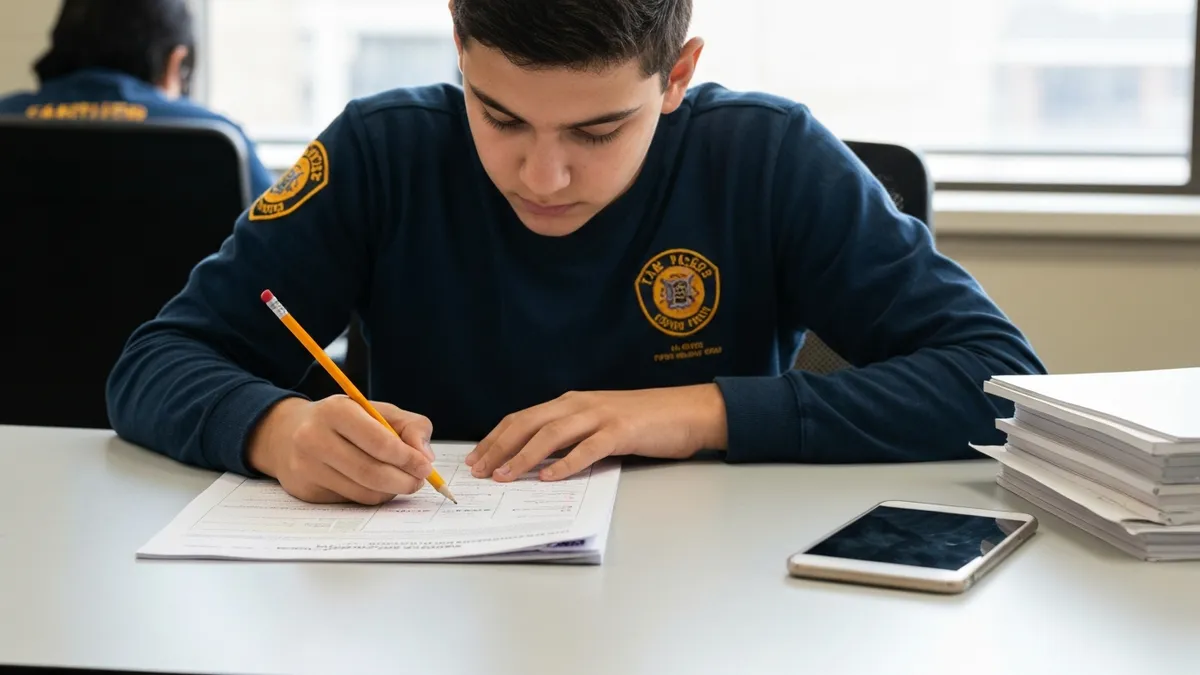
Online TACHS Prep Classes: Benefits and Drawbacks
- +Study on any device, anywhere, at times that fit a busy school schedule
- +Instant feedback on practice questions identifies mistakes before they become habits
- +Video lesson replays let students review confusing concepts as many times as needed
- +Adaptive platforms customize difficulty to each student's current skill level
- +Lower cost than in-person tutoring, with many platforms under $150 for full access
- +Detailed analytics reveal exactly which question types need the most additional practice
- −Self-paced formats require strong self-discipline that many eighth graders have not yet developed
- −Screen fatigue after a full school day can reduce the quality of evening study sessions
- −No in-person accountability or social motivation from classmates and a physical instructor
- −Technical issues — slow internet, app bugs, login problems — can interrupt study momentum
- −Some online courses are not updated to reflect recent changes in exam format or question style
- −Live online class schedules may conflict with extracurricular activities and school commitments
Pros and Cons at a Glance
| Pros | Cons |
|---|---|
| Study on any device, anywhere, at times that fit a busy school schedule | Self-paced formats require strong self-discipline that many eighth graders have not yet developed |
| Instant feedback on practice questions identifies mistakes before they become habits | Screen fatigue after a full school day can reduce the quality of evening study sessions |
| Video lesson replays let students review confusing concepts as many times as needed | No in-person accountability or social motivation from classmates and a physical instructor |
| Adaptive platforms customize difficulty to each student's current skill level | Technical issues — slow internet, app bugs, login problems — can interrupt study momentum |
| Detailed analytics reveal exactly which question types need the most additional practice | Some online courses are not updated to reflect recent changes in exam format or question style |
10-Week TACHS Test Prep Checklist
- ✓Take a full-length diagnostic practice test in week one to establish your baseline score in all four sections
- ✓Create a weekly study calendar that blocks at least one hour per day, five days per week, for focused TACHS preparation
- ✓Complete all video lessons for the Reading section and score at least 80 percent on corresponding practice drills before moving on
- ✓Memorize the thirty most common root words, prefixes, and suffixes tested on TACHS vocabulary questions by week three
- ✓Work through all Written Expression grammar modules with special attention to comma rules, pronoun agreement, and parallel structure
- ✓Complete at least 150 Mathematics practice questions covering fractions, percentages, basic algebra, and word problems before week six
- ✓Practice the Ability section analogy strategy — name the relationship first, then evaluate answer choices — on at least fifty analogy pairs
- ✓Take a full-length timed practice test in week seven under realistic conditions: quiet room, no phone, official time limits per section
- ✓Review every incorrect answer on the week-seven practice test by re-reading the relevant lesson module before the next study session
- ✓Take a final full-length timed practice test in week nine, then spend the last week on light review and confidence-building rather than new content

Students Who Complete Full Prep Programs Average 15-20 Percentile Point Gains
Research from multiple standardized test prep providers consistently shows that students who complete a structured, ten-to-twelve-week preparation program — including at least two full-length timed practice tests — improve their percentile ranking by fifteen to twenty points compared to students who prepare informally or not at all. For TACHS, where admission decisions at top schools often hinge on a few percentile points, this improvement can be the deciding factor between acceptance and waitlist placement.
Maximizing your performance on TACHS exam practice tests requires treating each practice session as a genuine simulation rather than a casual review exercise. That means sitting at a desk — not on a couch — with all distractions eliminated, setting a timer for each section, and committing to not looking up answers mid-test. Students who practice under realistic conditions build the mental endurance and pacing instincts that allow them to stay focused during the actual three-hour exam rather than hitting a wall of fatigue halfway through the Mathematics section.
Score analysis after each practice test is where the real learning happens. Raw scores are less informative than error patterns. Pull out every question you missed and categorize each mistake into one of three buckets: content gap (you did not know the underlying concept), careless error (you knew the answer but made a slip), or strategy failure (you ran out of time or guessed poorly). Each category requires a different remedy.
Content gaps require lesson review. Careless errors require slower, more deliberate checking habits. Strategy failures require pacing practice and triage skills — learning which questions to skip and return to rather than getting stuck.
Pacing is one of the most undercoached skills in TACHS prep and one of the most consequential on test day. Each section of the exam gives students roughly forty-five to sixty seconds per question on average, but individual questions vary enormously in the time they demand. A skilled TACHS test-taker moves quickly through questions they recognize immediately, banks those time savings, and uses the surplus on questions that require more thought. Online prep courses that include timed question-by-question drills — rather than only full-section timers — train this variable pacing skill far more effectively than untimed practice ever could.
The Ability section deserves special attention in any practice test review because it is the section students most often underestimate. Many students assume that because Ability questions do not test school curriculum, there is nothing to study. In fact, the patterns tested on this section are highly learnable once students know what to look for.
Abstract visual patterns follow consistent rules about rotation, reflection, counting, and shading. Numerical patterns follow arithmetic sequences, geometric sequences, and alternating rules. Students who practice identifying these pattern types explicitly — rather than relying on intuition — score meaningfully higher than those who approach the section cold.
Reading comprehension improvement requires a different kind of practice than most students expect. The instinct when struggling with a passage is to read it more slowly and carefully. In fact, the TACHS rewards students who read purposefully rather than slowly — skimming for structure and main idea on the first pass, then diving into the specific paragraph that a question references rather than re-reading the whole passage.
Online prep courses that teach this two-pass reading strategy and provide fifteen or more timed passages for practice help students overcome the common trap of spending too much time on the passage and too little on the questions.
Mathematics review should begin with an honest diagnostic of which specific skill areas are weakest rather than a linear review from arithmetic to algebra. A student who scores well on computation but poorly on word problems should spend the majority of math study time on problem setup and reading comprehension within math contexts, not on drilling multiplication tables.
Conversely, a student who understands problem setup but makes frequent arithmetic errors needs targeted practice with checking methods, including estimation as a verification tool after completing a precise calculation. Online platforms with section-level and sub-skill-level analytics make this kind of targeted allocation of study time much more achievable than working through a generic textbook chapter by chapter.
Written Expression preparation benefits enormously from daily micro-practice — even five to ten minutes of grammar drills is more effective than one long weekly session, because grammar rules are retained through frequent low-stakes exposure rather than intensive cramming.
Many of the best online TACHS prep platforms include a daily practice feature that delivers five to ten grammar questions in a push notification or email, making it easy to build this habit without carving out a dedicated study block. Students who maintain consistent daily engagement with grammar content across the full ten-week prep window consistently outperform those who treat Written Expression as a last-minute review topic.
The TACHS exam is administered once per year, typically in early November, and registration deadlines for both the exam and participating high schools often fall in September or early October. Missing a registration deadline means waiting an entire year for the next testing opportunity. Confirm deadline dates directly with the Archdiocese of New York or Diocese of Brooklyn and Queens at the start of the school year, and register your student as early as the portal opens to guarantee your preferred testing location.
Test day preparation begins the evening before the exam, not the morning of, and understanding this distinction separates well-prepared students from anxious ones. The night before, lay out all required materials — a valid photo ID if required by your testing site, two or more sharpened number-two pencils, an approved calculator if permitted for any section of your specific test year, a snack and water bottle for the break, and directions or a ride plan to the testing center. Attempting to locate these items the morning of the exam adds unnecessary stress to an already high-stakes day.
Sleep is a performance enhancer that no online prep course can substitute for. Research on memory consolidation consistently shows that the brain processes and stores newly learned information most effectively during deep sleep, which means the final study session before a major exam should end at least two hours before your student's normal bedtime. A well-rested student who reviews lightly the evening before will almost always outperform an exhausted student who crammed until midnight, regardless of the underlying knowledge base each has built over the preceding weeks of preparation.
On the morning of the exam, a nutritious breakfast that includes protein and complex carbohydrates provides sustained cognitive energy through the three-hour testing session. Simple carbohydrates — sugary cereals, pastries, orange juice alone — cause blood sugar spikes and crashes that can impair concentration during the later sections of the exam. Eggs, oatmeal, whole-grain toast with peanut butter, or a Greek yogurt parfait are all practical, quick options that parents can prepare the night before to minimize morning stress and decision fatigue.
Arriving at the testing center fifteen to twenty minutes early is standard best practice for any standardized exam. Early arrival allows students to find their assigned seat without rushing, complete any necessary check-in procedures calmly, take several slow deep breaths before the test begins, and review a brief mental checklist of their key test-taking strategies — name the analogy relationship first, use the two-pass reading method, estimate to verify math answers, and skip and return to questions that take more than ninety seconds.
This calm two-minute mental rehearsal before the proctor signals the start of the first section is one of the simplest and most effective last-minute preparation techniques available.
During the exam, bubble management deserves more attention than most students give it. Filling in the wrong bubble on a Scantron-style answer sheet is a catastrophic error that invalidates correct answers across multiple questions if not caught immediately. Students should check every five to ten questions that their answer number in the booklet matches the bubble number on the answer sheet.
If you skip a question to return to later, place a light mark next to that question number in the booklet and leave the corresponding bubble blank — never guess-fill and come back, as tracking becomes much harder once you have filled several out-of-order bubbles.
If students encounter a genuinely unfamiliar question, the best strategy is to eliminate obviously wrong answer choices, make the most educated guess from the remaining options, mark the question for review if time permits, and move on immediately without dwelling.
Spending three minutes on one hard question while leaving five easier questions unanswered at the end of the section is a poor trade that many students make out of stubbornness or anxiety. The tachs exam 2025 format continues to reward strategic time management as much as raw knowledge, and online prep courses that build this mentality through repeated timed simulation are worth every dollar families invest in them.
After the exam, resist the urge to review answers with friends or siblings immediately afterward. Post-exam comparisons of answer choices cause unnecessary anxiety without changing the score, and they serve no productive purpose. Instead, celebrate the hard work your student has put in over ten or more weeks of disciplined preparation.
Scores are typically released within a few weeks of the test date, and individual high schools send their own acceptance notifications on a separate timeline. Trust the process, stay informed about each school's notification schedule, and know that a thorough, structured preparation program gives your student the best possible foundation regardless of how test day feels in the moment.
Practical tips for the final two weeks of TACHS preparation start with a hard pivot away from new content and toward consolidation. Many students and parents make the mistake of introducing unfamiliar material in the days before the exam, creating anxiety and confusion rather than confidence. By week eleven or twelve of a structured prep plan, all content modules should be complete. The final stretch should focus exclusively on light review of already-mastered material, one final full-length practice test taken under real conditions, and mental preparation strategies including positive visualization and manageable relaxation routines.
Consistency beats intensity at every stage of TACHS preparation, but the final two weeks illustrate this principle most clearly. A student who studies for forty-five minutes per day, six days per week, across ten weeks has logged 270 hours of quality preparation — far more effective than a student who skips two months and then attempts a 30-hour marathon study session in the week before the test.
The brain forms durable memory through spaced repetition, meaning content revisited multiple times over an extended period is retained far longer than content reviewed intensively once. Online prep platforms that schedule spaced review automatically take this cognitive science principle seriously and build it directly into their curriculum structure.
Parent involvement plays a surprisingly important role in TACHS prep outcomes. Research on standardized test performance among middle school students consistently identifies parental engagement — checking in on study progress, asking about what was covered, celebrating small wins like a higher practice test score — as a positive predictor of both effort and results.
Parents do not need to understand the TACHS content themselves to be helpful; simply creating a quiet, dedicated study space, holding the study schedule accountable, and expressing genuine interest in the preparation process provides the environmental and emotional support that keeps eighth graders engaged over a multi-month prep window.
The use of tachs exam practice questions from multiple sources — official sample tests, online prep platform questions, and free resources like those here on PracticeTestGeeks — builds the question-format flexibility that protects students against surprises on test day. Every platform phrases questions slightly differently, uses different distractor patterns, and emphasizes different aspects of each skill. Students who practice exclusively from one source sometimes struggle when the actual exam uses unfamiliar phrasing for a concept they actually understand well. Multi-source practice builds the cognitive flexibility to recognize underlying skills regardless of how the surface-level question is presented.
Study groups can be a powerful supplement to individual online prep, provided they are structured rather than social. A productive TACHS study group session involves each member presenting one question they found difficult that week, walking through the solution step by step, and inviting feedback from the group.
This teaching-to-learn approach activates deeper processing than passive review and helps students articulate their reasoning — a metacognitive skill that improves performance across all four exam sections. Many online TACHS prep communities have discussion boards or Discord servers where students can ask questions, share strategies, and form virtual study partnerships even if they live in different neighborhoods.
Mental health and stress management are legitimate parts of TACHS preparation that deserve explicit attention. Eighth-grade students carrying the weight of high school admission decisions are at heightened risk of test anxiety, which is a real cognitive phenomenon that physically impairs performance by flooding the working memory with worry rather than useful content.
Online prep courses that include anxiety management modules — breathing exercises, reframing techniques, growth mindset content — are more complete preparation programs than those treating the exam as a purely academic challenge. Parents who notice signs of significant test anxiety, including sleep disruption, appetite changes, or persistent tearfulness about the exam, should consult a school counselor before assuming more practice will solve the problem.
Ultimately, the goal of tachs prep classes online is not just a higher score — it is a more confident, skilled, and resilient student who has learned how to prepare systematically for a high-stakes challenge. The habits built during TACHS preparation — consistent effort, data-driven self-assessment, strategic pacing, and calm performance under pressure — are skills that will serve students throughout high school, college, and beyond.
The exam is the immediate goal; the preparation process is a formative experience in its own right, and families who frame it as such tend to produce students who approach test day with genuine confidence rather than dread.
Sample TACHS Practice Questions
Try these questions from our free TACHS practice tests. The correct answer and an explanation follow each question.
The TACHS Abilities section includes what type of reasoning questions?
- A. Essay writing prompts
- B. Scientific experiment analysis
- C. Figural and quantitative pattern recognition
- D. Geography and map reading
Answer: C. Figural and quantitative pattern recognition
The Abilities section assesses figural reasoning (shape patterns) and quantitative reasoning (number patterns) to measure logical thinking skills.
When reading a TACHS passage, you should first:
- A. Read all the answer choices before reading the passage
- B. Skim the questions, then read the passage with purpose
- C. Read only the first and last sentences of the passage
- D. Guess all answers before reading
Answer: B. Skim the questions, then read the passage with purpose
Previewing the questions first helps you read with a purpose, making it easier to locate relevant information in the passage.
On the TACHS, if you are unsure of an answer, the best strategy is to:
- A. Leave the question blank
- B. Always choose 'C' as the default
- C. Eliminate clearly wrong answers and make your best guess
- D. Skip all difficult questions and return only if time allows
Answer: C. Eliminate clearly wrong answers and make your best guess
Process of elimination narrows down choices, improving your odds — and since TACHS does not penalize wrong answers, guessing is always worth doing.
Complete the analogy: Thermometer is to Temperature as Scale is to ___.
- A. Music
- B. Weight
- C. Height
- D. Speed
Answer: B. Weight
A thermometer measures temperature, just as a scale measures weight.
TACHS Questions and Answers

TACHS Prep: Complete Study Guide for the Catholic High School Admission Test

TACHS Exam Results: What Your Score Means and How to Improve

Ultimate Guide to TACHS Prep Classes

TACHS Test 2026: Complete Study Guide for the Catholic High School Admission Exam

TACHS Practice Test PDF 2026: Free Catholic High School Admission Test Questions
About the Author

Educational Psychologist & Academic Test Preparation Expert
Columbia University Teachers CollegeDr. Lisa Patel holds a Doctorate in Education from Columbia University Teachers College and has spent 17 years researching standardized test design and academic assessment. She has developed preparation programs for SAT, ACT, GRE, LSAT, UCAT, and numerous professional licensing exams, helping students of all backgrounds achieve their target scores.
Join the Discussion
Connect with other students preparing for this exam. Share tips, ask questions, and get advice from people who have been there.
View discussion (7 replies)