
How Long Is the TACHS Test? Complete TACHS Exam Format Guide 2026 October
How long is the TACHS test? Full exam format breakdown — sections, timing, question counts & prep tips. 📝 Score higher with our free practice tests.
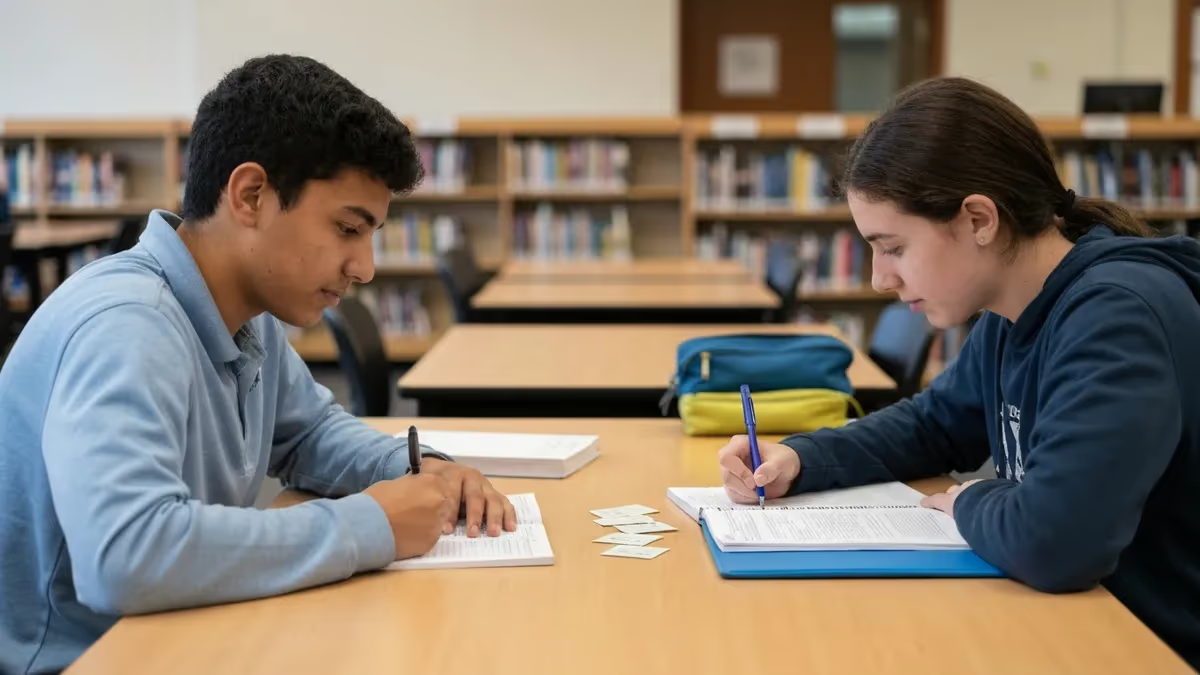
If you are preparing for the TACHS exam and wondering how long is the TACHS test, here is what you need to know: the exam runs approximately two hours and fifty minutes of actual testing time, with additional time added for instructions and short breaks between sections. The tachs is administered each November to eighth-grade students applying to Catholic high schools in the Archdiocese of New York and the Diocese of Brooklyn and Queens. Understanding the exam's structure before test day is one of the most effective ways to reduce anxiety and improve your performance.
The TACHS exam is divided into four major sections — Reading, Language, Mathematics, and Abilities — each designed to measure a different academic skill. Together these sections contain 200 scored questions, though additional unscored pilot questions may be embedded throughout the test. Students are not told which items are unscored, so it is important to approach every question with the same level of care and attention. Knowing the number of questions in each section and the time allotted helps you build a pacing strategy that keeps you moving efficiently through the exam without leaving answers blank.
One reason so many students underperform on the TACHS is that they arrive on test day without a clear sense of how quickly they need to work. Each section has its own time limit, which means you cannot borrow extra minutes from a section you finished early. Practicing under timed conditions using TACHS exam practice questions is therefore essential. Students who simulate real testing conditions during preparation consistently report feeling calmer and more in control when they sit down for the actual exam.
The TACHS exam 2025 will follow the same format that has been used in recent years, so everything covered in this guide applies to students testing this cycle. Unlike some standardized tests that change format frequently, the TACHS has maintained a stable structure, making historical practice materials useful. That said, the difficulty level of individual questions can vary from year to year, which is why it is smart to work through a wide variety of TACHS exam practice test materials rather than relying on any single source.
Each section of the TACHS tests a specific set of skills. Reading measures your ability to comprehend passages and draw inferences. Language evaluates grammar, punctuation, capitalization, and spelling. Mathematics covers arithmetic, algebra, geometry, and data analysis. The Abilities section, sometimes called the Differential Aptitude or reasoning section, assesses abstract reasoning through visual and spatial tasks that are less directly tied to school curriculum. This section often surprises students who focus exclusively on core academic subjects during their preparation.
Scoring on the TACHS is based on a scaled system, and your results are used by individual high schools to make admissions decisions. Because different schools weigh subscores differently, it is important to perform as consistently as possible across all four sections rather than allowing any one area to drag down your overall profile. This guide walks you through every component of the exam in detail so you can build a targeted, time-efficient study plan that addresses your personal strengths and weaknesses.
Whether you are just beginning your preparation or putting the finishing touches on your study plan, understanding the full scope of the TACHS test format is the essential first step. The sections that follow break down each part of the exam in depth, offer timing strategies, and point you toward free practice resources you can use right now to build confidence and accuracy before test day arrives.
TACHS Exam by the Numbers
Key Facts at a Glance
| Item | Value | Details |
|---|---|---|
| Total Exam Duration | ~3 hrs | Including instructions and breaks |
| Scored Questions | 200 | Across all four sections |
| Test Sections | 4 | Reading, Language, Math, Abilities |

TACHS Exam Format Overview
| Section | Questions | Time | Weight | Notes |
|---|---|---|---|---|
| Reading | 50 | 40 min | 25% | Passage comprehension and vocabulary |
| Language | 60 | 25 min | 30% | Grammar, punctuation, spelling, capitalization |
| Mathematics | 50 | 45 min | 25% | Arithmetic, pre-algebra, geometry, data |
| Abilities | 40 | 40 min | 20% | Abstract and spatial reasoning tasks |
| Total | 200 | 2 hrs 50 min | 100% |
The Reading section of the TACHS exam consists of 50 questions answered within a 40-minute window, giving you an average of 48 seconds per question. The section is divided into two parts: Vocabulary and Reading Comprehension. The Vocabulary portion asks you to identify the meaning of underlined words in context or choose synonyms from a short list. The Reading Comprehension portion presents several passages followed by multiple-choice questions that test your ability to identify the main idea, draw inferences, understand author purpose, and locate specific details within the text.
Most students find that reading speed is just as important as reading ability on this section. If you spend too long on any single passage, you may run out of time before reaching the final questions. A practical strategy is to skim the questions first, then read the passage with those questions in mind. This approach prevents you from reading large blocks of text without knowing what information you actually need to retain. Practice this technique repeatedly using real TACHS exam practice questions so it becomes automatic by test day.
The Language section is the longest in terms of question count, with 60 items allotted only 25 minutes — meaning you have roughly 25 seconds per question. This is the most time-pressured section of the entire exam. Questions test your knowledge of capitalization rules, punctuation conventions, spelling, and usage. Many questions present a sentence broken into four parts, and you must identify which part contains an error, or select the answer indicating that there is no error. Speed and automaticity with grammar rules are essential here; this is not a section where careful re-reading of long passages is required.
The Mathematics section covers a broad range of topics across 50 questions in 45 minutes. Topics include whole numbers and fractions, decimals, percentages, ratios and proportions, pre-algebraic expressions, basic geometry including area and perimeter, and simple data interpretation using charts and graphs. The questions increase in difficulty as the section progresses, so students who get bogged down on harder problems early may not reach the easier questions that come later. A key strategy is to skip questions that seem to require more than 90 seconds and return to them at the end.
The Abilities section is unique to exams like the TACHS and often surprises students who have not encountered it before. It assesses abstract reasoning through tasks involving visual patterns, spatial relationships, and non-verbal logic. Questions might ask you to identify which shape completes a series, determine what a folded paper would look like when punched and unfolded, or recognize a pattern in a sequence of figures.
Because this section is less tied to school curriculum, traditional studying has limited impact — the best preparation is working through many sample Abilities questions to familiarize yourself with the task types and develop efficient visual-processing strategies.
For students working through the tachs exam 2024 results and planning their next steps, understanding where score gaps exist across these four sections is the foundation of an effective improvement plan. Students who scored below expectations in Abilities often simply had not encountered that question format before. Students who fell short in Language frequently had not drilled grammar rules to the point of automaticity. Knowing which section cost you the most points tells you exactly where to focus your remaining preparation time.
Each section is timed independently, and you will not be permitted to continue working on a section once the proctor calls time. This makes it critical to develop a pacing sense specific to each section rather than relying on a single average pace for the whole test. During your practice sessions, time each section separately. When you finish a section early, use the remaining time to review flagged questions rather than sitting idle. Consistent paced practice across all four sections is the most reliable predictor of improvement between your first practice attempt and the actual exam date.
TACHS Exam Practice Test Strategies by Section
The most effective approach to the TACHS Reading section is to preview the questions before reading the passage. This targets your attention on the information you actually need, preventing you from wasting time re-reading large sections of text. Focus on identifying the main idea in the first and last paragraphs, then scan for key details mentioned in the questions. Vocabulary questions can often be answered by substituting each answer choice into the sentence and seeing which one preserves the original meaning.
Time yourself strictly during practice sessions — 40 minutes for 50 questions means about 8 minutes per passage group including reading time. If you find yourself spending more than 10 minutes on a single passage, you are falling behind. Build speed by doing at least three timed reading sections per week in the month before the exam. Students who practice paced reading consistently show the largest improvement gains on TACHS exam sample questions compared to those who review grammar rules alone.
Is the TACHS Exam Format Student-Friendly?
- +Stable format year to year makes historical practice materials reliably useful for current students.
- +Four distinct sections allow targeted preparation based on individual subject strengths and weaknesses.
- +No penalty for wrong answers means guessing on uncertain questions is always the right move.
- +The Abilities section rewards abstract thinking and benefits students whose strengths go beyond standard academics.
- +Ample free practice resources, including TACHS exam practice questions, are widely available online.
- +Administered at familiar school sites, reducing logistical stress on exam day for most students.
- −The Language section's 25-second per question pace is extremely demanding and catches many students off guard.
- −Four sections with independent time limits require building four separate pacing strategies, not one overall pace.
- −The Abilities section is unlike anything taught in middle school curriculum, requiring specific targeted practice.
- −Results are only released once annually, leaving little opportunity to retest if scores fall short.
- −High-stakes single-day format means illness, nerves, or a bad morning can disproportionately affect outcomes.
- −No official calculator is permitted, so mental math and estimation skills must be developed well in advance.
TACHS Test Prep Checklist: 10 Steps Before Exam Day
- ✓Complete at least two full-length timed TACHS practice tests under realistic exam conditions.
- ✓Review your practice test errors by section and identify the three question types you miss most often.
- ✓Drill Language grammar rules daily using flashcards until applying them feels fully automatic.
- ✓Build your reading speed by timing yourself on one reading passage group every other day.
- ✓Work through at least 50 Abilities questions to familiarize yourself with all common pattern types.
- ✓Memorize key math formulas: area, perimeter, percent change, and basic probability rules.
- ✓Practice skipping and returning to flagged questions within each section's individual time limit.
- ✓Simulate the full four-section exam back-to-back at least once to build mental stamina.
- ✓Confirm your test site, arrival time, and required materials (pencils, admission ticket, ID) one week before.
- ✓Plan a full night of sleep and a high-protein breakfast for the morning of the exam.

No Wrong-Answer Penalty: Always Guess
The TACHS exam does not deduct points for incorrect answers. This means leaving any question blank is strictly worse than making your best guess. If time is running short, quickly eliminate one or two obviously wrong choices and mark the most plausible remaining option. Even a random guess among four choices gives you a 25% chance of earning a point — far better than the guaranteed zero for a blank answer.
Understanding how the TACHS is scored helps clarify what your preparation should prioritize. Each of the 200 scored questions is worth one raw point. Raw scores are then converted to scaled scores for each section, and those section scores are combined into a composite.
The scaled score conversion accounts for minor variations in difficulty between test forms administered in different years, ensuring that a score of, say, 85 in Reading means the same thing regardless of whether you took the exam this year or last year. This is why the TACHS has maintained a consistent format — comparability across years is built into its design.
Individual Catholic high schools receive your scaled score report and use it alongside other application materials — such as grades, teacher recommendations, and personal statements — to make admissions decisions. The weight given to the TACHS score varies by school. Some institutions place it as the single most important factor; others treat it as one of several equally weighted components. This means there is no universal cutoff score that guarantees admission to all Catholic high schools, and a slightly lower TACHS score can sometimes be offset by exceptional grades or a compelling application narrative.
One important nuance in TACHS scoring is that the Abilities section is often treated separately from the academic sections by admissions offices. Because Abilities measures reasoning potential rather than learned knowledge, some schools use it as an indicator of how much a student is likely to grow academically in a challenging high school environment. A student who scores moderately on the academic sections but exceptionally on Abilities may be viewed as a strong candidate at a school that values academic potential alongside current achievement.
Students who take tachs exam practice questions and track their section-level accuracy over time develop a clear picture of where their raw-to-scaled score conversion is likely to land. If your Reading accuracy sits at 80% and your Language accuracy is at 60%, you know that three to four weeks of intensive Language drilling will yield a larger score improvement than the same time spent on Reading. Score-aware preparation — knowing not just that you need to improve but exactly where improvement will translate to the most points — is the hallmark of the most effective TACHS study plans.
The TACHS is also notable for embedding unscored pilot questions within the official test sections. These experimental items are used to evaluate future questions for inclusion in upcoming exams. Because there is no way to identify which questions are pilot items, treat every question as scored. Some students mistakenly try to guess which items are experimental and skip them — this strategy is counterproductive and can cost real points if the guess is wrong.
Score reports are typically released in the winter following the November exam, and schools begin sending admissions decisions shortly afterward. The timeline is compressed, which is another reason why TACHS preparation should be well underway by September, giving students roughly two months of focused study before the exam. Students who begin studying in August and complete four to six full practice tests before November consistently report higher confidence levels and more predictable score outcomes than those who begin preparation in October.
Finally, it is worth noting that the TACHS is a competitive exam in the context of Catholic high school admissions in the New York metro area. Because all applicants take the same test in the same November window, your score is implicitly compared to those of your peers. This is not a pass-fail test with a single cutoff; it is a ranking mechanism.
Every additional point you earn on test day is one that moves you closer to your target schools and one fewer point available to competing applicants. That competitive reality is the best argument for treating your TACHS preparation with the same seriousness you would bring to any other high-stakes academic endeavor.
The TACHS exam has a firm registration deadline that typically falls in October, several weeks before the November testing date. Students who miss the registration window cannot be added to the roster and must wait until the following year. Confirm your school's registration process with your eighth-grade guidance counselor as early as September, and submit all required materials — including any fee waivers if applicable — well before the official cutoff date.
Test day logistics matter more than most students realize. Arriving late, forgetting your admission ticket, or showing up without the required number of sharpened pencils can create unnecessary stress that affects your performance even before the first question appears. Most TACHS testing sites open doors 30 to 45 minutes before the scheduled start time. Plan to arrive at least 20 minutes early so you can find your seat, get settled, and do a brief mental warm-up before the proctor begins reading instructions.
The physical environment of the testing room also affects performance. The TACHS is typically administered in large spaces such as school gymnasiums or cafeterias with many students testing simultaneously. Background noise, temperature, and lighting conditions vary by site. Students who have test anxiety should practice in mildly distracting environments during their preparation — studying in libraries or quiet cafes rather than always in a perfectly silent bedroom — so the real testing environment does not feel jarring by comparison.
What you eat and drink on exam morning has a measurable impact on cognitive performance. Research consistently shows that a breakfast containing protein and complex carbohydrates — eggs with whole-grain toast, or oatmeal with nuts — sustains mental energy better than sugary foods that spike and crash. Avoid excessive caffeine if you are not accustomed to it, as the jitteriness can amplify test anxiety. Drink water the night before and the morning of the exam, but not so much that you are uncomfortable during a long testing session.
During the exam itself, manage your mental energy across sections. The Language section's rapid pace early in the exam can feel draining. If you are allowed a brief pause between sections, use it to take three slow deep breaths and reset your focus before the next section begins. Some students find it helpful to briefly stretch their fingers and neck between sections, releasing physical tension that accumulates during sustained pencil-gripping. These small physical resets have a disproportionate positive effect on the sections that follow.
For students planning ahead and researching the tachs exam 2025 cycle, now is an excellent time to investigate structured prep classes, which can provide expert instruction, accountability, and full-length practice tests in a structured setting. Many prep programs run from September through October and culminate in a final mock exam in late October, one to two weeks before the actual TACHS. A quality mock exam under realistic conditions is one of the most valuable single investments a student can make in their TACHS preparation.
After the exam, resist the urge to spend hours second-guessing your answers with friends or classmates. Post-exam discussion rarely changes anything and almost always increases anxiety. Instead, give yourself a day to decompress, then shift your energy toward other parts of the Catholic high school application — the essay, the teacher recommendation requests, and the school visit schedule. Your TACHS score is one component of your application, and the weeks between exam day and results day are best spent strengthening every other component.
When scores are released, read them carefully with your parents and guidance counselor. Look at both the overall composite and the individual section scores. If your scores are lower than you hoped, ask whether any schools on your list offer a waitlist or a personal interview that might allow you to make a case beyond the exam score. And if you are considering what steps to take next, remember that a detailed understanding of your section-level performance — not just the composite — is the most actionable starting point for any future preparation.
Building a structured eight-week study plan is the most reliable way to ensure you cover all four TACHS sections without burning out before exam day. In weeks one and two, focus on diagnostic: complete one full-length practice test under timed conditions, score each section separately, and identify your weakest two areas. This baseline data drives every subsequent decision about where to spend your study hours. Students who skip the diagnostic phase often waste time reinforcing areas that are already strong.
In weeks three and four, concentrate intensively on your two weakest sections. If Language and Abilities are your low scorers, spend 60% of your daily study time on those areas. Use targeted TACHS exam sample questions rather than full-length tests during this phase, so you can accumulate high volume on specific question types without spending time on sections you are already confident in. Track your accuracy on a simple spreadsheet: write down the question type, whether you got it right, and why you chose your answer. Patterns in your errors will emerge quickly.
In weeks five and six, return to full-section timed practice for all four areas. By this point your weakest sections should show measurable improvement, and you should be fine-tuning your pacing within each section's time limit. Experiment with different pacing strategies — reading questions before passages, estimating before calculating, eliminating one answer choice immediately on Abilities questions — and identify which approaches give you the best combination of speed and accuracy. What works for one student may slow down another.
In week seven, take your second full-length mock exam under the most realistic conditions you can create. Do it on a Saturday or Sunday morning to simulate the typical exam-day timing. Use a traditional analog clock rather than a phone timer, and sit at a desk rather than on a couch. When you score this mock, compare your section-level accuracy to your week-one baseline. Most students who follow a structured plan will see meaningful improvement in their weakest area and maintenance or slight improvement in their stronger areas.
In the final week before the exam, shift to light review rather than intensive study. Complete short 10-to-15-question sets in each section to stay warm, but avoid introducing new material or attempting another full-length test. Your goal in the final week is to stay sharp and confident, not to cram additional information. Review your flashcards for Language rules, look over your formula sheet for Mathematics, and do a handful of Abilities pattern questions each day to keep your visual reasoning skills active.
The most important mindset shift for TACHS preparation is recognizing that the exam measures what you can do under specific time pressure, not just what you know. A student who knows every grammar rule but has never practiced under the 25-seconds-per-question pace of the Language section will underperform. Conversely, a student who has internalized pacing through dozens of timed practice sessions will consistently score above what their raw knowledge alone would predict. Time-aware practice is the skill that separates good TACHS scores from great ones.
Consistency beats intensity for TACHS preparation. Thirty minutes of focused, timed practice every day for eight weeks produces better results than several marathon study sessions crammed into the two weeks before the test. The brain learns and retains skills most effectively through spaced repetition and regular retrieval practice — testing yourself on material you have already studied, rather than simply re-reading notes. Build this kind of active practice into your daily routine starting as early as September, and you will arrive at the testing room in November feeling genuinely prepared rather than hoping for the best.
Sample TACHS Practice Questions
Try these questions from our free TACHS practice tests. The correct answer and an explanation follow each question.
How many main sections does the TACHS exam include?
- A. 2
- B. 3
- C. 4
- D. 5
Answer: C. 4
The TACHS consists of four sections: Reading, Language, Mathematics, and Abilities.
The TACHS exam is used primarily for:
- A. College admission in New York
- B. Admission to Catholic high schools in the Archdiocese of New York and Diocese of Brooklyn/Queens
- C. State standardized testing in all grades
- D. Earning a high school diploma
Answer: B. Admission to Catholic high schools in the Archdiocese of New York and Diocese of Brooklyn/Queens
The TACHS is specifically designed for students applying to Catholic high schools in New York's Archdiocese and Diocese of Brooklyn/Queens.
In the TACHS Language section, an 'antecedent' is:
- A. A type of punctuation mark
- B. The word a pronoun refers back to
- C. The main verb in a sentence
- D. A sentence that asks a question
Answer: B. The word a pronoun refers back to
An antecedent is the noun or noun phrase that a pronoun refers to or replaces in a sentence.
To prepare effectively for the TACHS, a student should:
- A. Study only mathematics since it is the hardest section
- B. Take full practice tests under timed conditions to build stamina and familiarity
- C. Focus exclusively on memorizing vocabulary lists
- D. Study the night before the test only
Answer: B. Take full practice tests under timed conditions to build stamina and familiarity
Full timed practice tests simulate the real exam experience, build endurance, and identify weak areas in all sections.
TACHS Questions and Answers

TACHS Prep: Complete Study Guide for the Catholic High School Admission Test

TACHS Exam Results: What Your Score Means and How to Improve

Ultimate Guide to TACHS Prep Classes

TACHS Test 2026: Complete Study Guide for the Catholic High School Admission Exam

TACHS Test Prep: Complete Study Guide for the Catholic High School Admission Test
About the Author

Educational Psychologist & Academic Test Preparation Expert
Columbia University Teachers CollegeDr. Lisa Patel holds a Doctorate in Education from Columbia University Teachers College and has spent 17 years researching standardized test design and academic assessment. She has developed preparation programs for SAT, ACT, GRE, LSAT, UCAT, and numerous professional licensing exams, helping students of all backgrounds achieve their target scores.
Join the Discussion
Connect with other students preparing for this exam. Share tips, ask questions, and get advice from people who have been there.
View discussion (7 replies)