
Management of Food Safety Practices ServSafe: Complete Manager's Guide
Master management of food safety practices ServSafe style. Study key manager duties, certification tips & practice tests. 🏆 Pass on your first attempt.
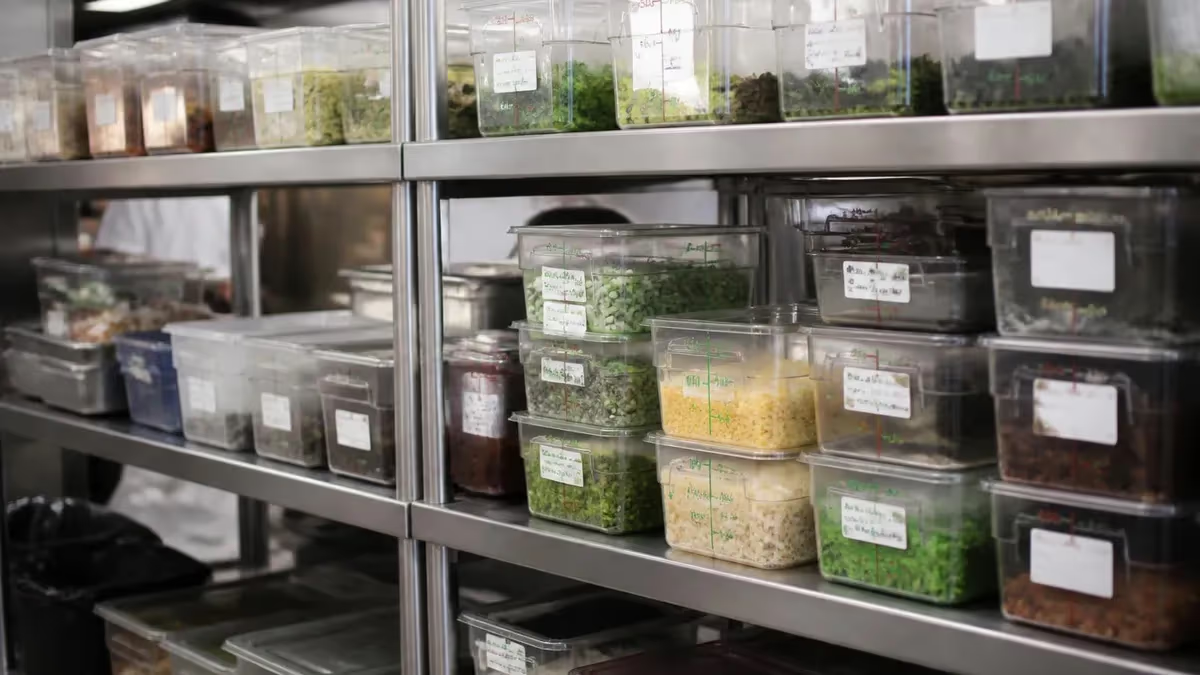
The management of food safety practices ServSafe covers is not just a certification checkbox — it is the backbone of every safe, legally compliant foodservice operation in the United States. Managers who understand their responsibilities under the ServSafe program are better equipped to prevent foodborne illness outbreaks, protect customers, and keep their establishments operating without costly shutdowns or liability. The National Restaurant Association developed the ServSafe curriculum specifically to bridge the gap between general food safety awareness and practical, day-to-day managerial decision-making in fast-paced kitchen and service environments.
When a foodservice manager earns a servsafe food manager certification, they are committing to a comprehensive understanding of how pathogens spread, how temperature abuse creates danger zones, how cross-contamination travels through a kitchen, and how regulatory compliance can be systematically maintained through proper documentation and staff training. This credential is recognized by health departments across all 50 states and is often required by law for at least one certified manager to be on duty during every operating shift in many jurisdictions.
Food safety management is fundamentally different from food handler training. While a food handler learns how to personally avoid unsafe practices, a certified manager learns how to build and sustain systems that keep an entire team safe. This means creating standard operating procedures, conducting regular food safety audits of storage and preparation areas, and establishing corrective action plans when critical control points are violated. The manager becomes the single point of accountability in the eyes of regulators and customers alike.
The ServSafe manager certification exam tests candidates on seven core content areas: foodborne microorganisms and allergens, personal hygiene, purchasing and receiving, storage, preparation, service, and facility cleanliness and pest management. Understanding how these areas interconnect is what separates a passing candidate from a failing one. A manager who only memorizes isolated facts will struggle, but one who grasps the underlying logic of food safety science will find the exam far more approachable and the job far easier to perform.
ServSafe certification is valid for five years from the date the exam is passed. During that time, managers are expected to stay current with local and federal food safety regulations, including any updates to the FDA Food Code. Many state health departments require managers to renew their certification before the expiration date to maintain compliance, and some jurisdictions have added additional local requirements on top of the national ServSafe standard, making it important to check state-specific rules alongside the core curriculum.
Preparing for the ServSafe manager exam requires more than reading the textbook once. Successful candidates typically spend several weeks reviewing core concepts, taking practice tests to identify weak areas, and studying real-world scenarios that require applying food safety principles rather than just reciting definitions. The exam consists of 90 questions, of which 10 are unscored pilot questions, giving candidates 75 questions that actually count toward their final score of 75% or higher needed to pass.
Whether you are a first-time candidate aiming for your initial certification or an experienced manager preparing to renew, understanding the full scope of ServSafe management practices is the most important investment you can make in your foodservice career. The sections below break down every major topic area, offer practical study strategies, and connect you to free practice resources that mirror the actual exam experience so you walk in confident and prepared.
ServSafe Certification by the Numbers

ServSafe Manager Exam: Core Topic Areas
Understand the Big 9 allergens, FAT TOM conditions, and the most common pathogens — Salmonella, E. coli, Listeria, Norovirus — that cause outbreaks in foodservice environments. Know reporting requirements and customer communication protocols.
Cover proper handwashing procedures, when employees must be restricted or excluded from work, fingernail and jewelry policies, and how managers enforce hygiene standards across diverse kitchen staff during every shift.
Learn safe receiving temperatures for TCS foods, how to inspect shellfish tags and invoices, FIFO storage rotation, proper labeling requirements, and the critical differences between refrigerator, freezer, and dry storage conditions.
Study minimum internal cooking temperatures for all protein types, cooling procedures using the two-stage method, reheating rules for hot-held food, and how to prevent time-temperature abuse throughout the preparation workflow.
Know the difference between cleaning and sanitizing, approved chemical sanitizers and their concentration ranges, three-compartment sink procedures, dishwasher temperature requirements, and integrated pest management principles for a clean facility.
The role of the ServSafe manager extends far beyond passing a test and hanging a certificate on the wall. Certified managers are expected to act as the primary guardians of public health within their establishment, and that responsibility touches every aspect of how the kitchen is run each day. From the moment ingredients are delivered at the back door to the moment a finished plate reaches a customer's table, a manager with ServSafe training sees the entire food journey through a safety lens that untrained staff simply cannot replicate without guidance.
One of the most critical management responsibilities is active managerial control, a concept the FDA Food Code emphasizes heavily. Active managerial control means the manager does not simply react to problems after they occur — the manager proactively identifies potential hazards, implements control measures, monitors those controls during every shift, and documents corrective actions when something falls outside safe parameters. This is the foundation of a Hazard Analysis Critical Control Point (HACCP) approach, which ServSafe teaches as the gold standard for managing food safety systematically rather than reactively.
Staff training is another cornerstone of the manager's role. A certified manager must be able to communicate complex food safety concepts to employees who may have varying levels of education, English proficiency, and prior food safety knowledge. ServSafe training materials are available in multiple languages for this reason, and managers are encouraged to use hands-on demonstrations, posted visual guides, and regular verbal reminders to reinforce correct practices. The manager's ability to train effectively directly determines how well the entire team performs under pressure during busy service periods.
The servsafe food protection manager certification also requires managers to understand regulatory inspections and how to prepare for them. Health inspectors evaluate an establishment against a list of risk factors that align almost perfectly with the ServSafe curriculum: improper holding temperatures, inadequate cooking, contaminated equipment, poor personal hygiene, and food from unsafe sources. Managers who have internalized ServSafe principles typically score significantly better on health inspections because they have already built the habits and systems inspectors look for.
Documentation is a management practice that the ServSafe curriculum takes seriously. Temperature logs for receiving, cooling, and hot-holding must be maintained consistently. Cleaning and sanitizing schedules should be posted and signed off by employees completing tasks. Pest control service records need to be retained. These paper trails protect the business legally in the event of a complaint or illness investigation, and they also serve as internal accountability tools that help managers identify recurring issues before they escalate into serious violations.
Emergency response is another area where management practices matter enormously. If an employee calls in sick with symptoms of vomiting or diarrhea, the manager must know the correct exclusion and restriction policies without hesitation. If a customer reports an allergic reaction, the manager must be able to trace the ingredient source and communicate accurately with medical responders if needed. If a cooler fails overnight, the manager must know exactly how to evaluate whether food is still safe to use or must be discarded, using time and temperature as the determining factors rather than appearance or smell alone.
Financial stewardship is also tied to food safety management. Foodborne illness outbreaks cost restaurants an average of $75,000 or more per incident when factoring in legal fees, medical costs, lost business, and reputational damage. A single critical violation cited during a health inspection can lead to immediate closure and significant fines. Managers who invest in rigorous food safety practices through SerSafe training and systematic implementation of safety protocols consistently outperform their peers in both inspection scores and long-term business sustainability.
ServSafe Manager Certification: Key Study Areas
Temperature control is one of the most frequently tested areas on the ServSafe manager exam. Candidates must know the temperature danger zone (41°F–135°F), minimum internal cooking temperatures for all TCS foods including poultry (165°F), ground meats (155°F), seafood and whole-muscle beef (145°F), and the two-stage cooling method that requires food to drop from 135°F to 70°F within two hours, then from 70°F to 41°F within four additional hours.
Hot-holding must maintain food at or above 135°F, and cold-holding must maintain food at or below 41°F. Food that has been time-temperature abused cannot be made safe by cooking or reheating — it must be discarded. Managers must understand thermometer calibration using the ice-point method (32°F) or boiling-point method (212°F at sea level), and must ensure thermometers are sanitized between uses to avoid cross-contamination between food items during temperature checks.

Benefits and Challenges of Earning ServSafe Manager Certification
- +Nationally recognized credential accepted by health departments in all 50 states
- +Demonstrates professional commitment to food safety and public health protection
- +Often required by law, making it essential for legal operation in many jurisdictions
- +Reduces risk of costly foodborne illness outbreaks and associated legal liability
- +Boosts career advancement opportunities and earning potential in foodservice management
- +Provides a comprehensive, science-based framework for managing entire kitchen operations safely
- −Exam requires a passing score of 75%, which many first-time candidates underestimate
- −Certification must be renewed every five years, requiring ongoing study investment
- −Course and exam fees can add up, especially for self-employed or small business operators
- −Content covers highly technical microbiology and regulatory concepts that require serious study time
- −State and local requirements vary, meaning additional certifications may still be needed
- −Online proctored exams require reliable internet and specific equipment that not all candidates have
ServSafe Manager Exam Preparation Checklist
- ✓Purchase or borrow the current edition of the ServSafe Manager Book and read every chapter at least once
- ✓Memorize all minimum internal cooking temperatures for poultry, ground meats, seafood, and whole-muscle proteins
- ✓Study the two-stage cooling method and practice explaining it aloud as if training a new employee
- ✓Learn the Big 9 food allergens and know the symptoms and required manager responses for allergic reactions
- ✓Review FAT TOM conditions (Food, Acidity, Temperature, Time, Oxygen, Moisture) and how each factor affects pathogen growth
- ✓Practice calibrating a bimetallic stemmed thermometer using the ice-point and boiling-point methods
- ✓Understand the correct refrigerator storage order and be able to explain the reasoning behind each level
- ✓Study chemical sanitizer types (chlorine, iodine, quaternary ammonium), their correct concentration ranges, and contact times
- ✓Take at least three full-length ServSafe manager practice tests under timed conditions to simulate the real exam
- ✓Review your practice test mistakes and re-read the corresponding textbook sections to close knowledge gaps
Active Managerial Control Is the Most Important Concept on the Exam
The single most important mindset shift for ServSafe manager candidates is understanding active managerial control — the idea that a manager does not wait for problems to occur but proactively identifies risk factors and eliminates them through documented systems. Health departments and the FDA Food Code both use this concept as the benchmark for evaluating whether an establishment has a genuinely safe food operation or just lucky food operation. Candidates who master this concept answer scenario-based questions far more accurately than those who only memorize temperature numbers and definitions.
Passing the ServSafe manager exam on the first attempt is absolutely achievable, but it requires a structured study approach rather than passive reading. The most effective candidates spend a minimum of two to three weeks preparing, dedicating at least one to two hours per day to focused review. This timeline allows enough repetition for complex concepts like HACCP principles, pathogen characteristics, and regulatory compliance requirements to become genuinely internalized rather than just superficially memorized. Rushing preparation into a single weekend almost never produces the results candidates hope for.
Start your preparation by taking a diagnostic practice test before reading any material. This baseline assessment reveals your strongest and weakest knowledge areas, which allows you to allocate your study time intelligently rather than spending equal time on every topic regardless of your existing proficiency. Many candidates discover they already know general temperature concepts fairly well from work experience but struggle significantly with the specific details of chemical sanitizer concentrations, pathogen incubation periods, or the precise regulatory definitions that appear in multiple-choice distractors designed to catch careless reading.
Reading the ServSafe Manager Book chapter by chapter is the foundation of effective preparation. Do not skim — every chapter contains details that appear directly on the exam. After each chapter, write a brief summary in your own words and then answer the review questions at the end of the chapter before checking the answers. This active recall technique dramatically improves retention compared to highlighting and re-reading, because it forces your brain to retrieve information rather than passively recognize it, which is exactly what the exam requires you to do under time pressure.
Practice tests are arguably the most important preparation tool available. The ServSafe manager exam uses a multiple-choice format with carefully constructed distractors that test whether candidates truly understand concepts or just vaguely recognize terminology. Free ServSafe practice tests available here at PracticeTestGeeks mirror the difficulty level and question style of the actual exam, allowing you to develop test-taking stamina, improve time management, and identify persistent weak areas that need additional review before exam day. Aim to complete at least three full practice tests with 90 questions each before sitting for the real exam.
Pay special attention to scenario-based questions, which make up a significant portion of the ServSafe manager exam. These questions describe a real-world situation in a foodservice environment and ask you to identify the correct managerial response, the most likely cause of a problem, or the appropriate corrective action. Answering these questions correctly requires applying food safety principles to unfamiliar contexts rather than pattern-matching to memorized facts, which is why understanding the underlying logic of food safety science matters so much more than rote memorization.
Study groups can be highly effective for ServSafe preparation, particularly when group members take turns explaining concepts to each other. Teaching a concept forces you to identify gaps in your own understanding that passive study can mask. If you cannot explain why ready-to-eat foods must be stored above raw proteins in the refrigerator, or why the two-stage cooling method works the way it does, you have not yet understood the concept deeply enough to answer exam questions confidently when they are framed in unexpected ways.
On exam day, read every question carefully and eliminate obviously wrong answers before choosing among the remaining options. Many ServSafe exam questions hinge on a single word — "must," "should," "may," or "never" — that completely changes the correct answer. Manage your time by spending no more than 90 seconds per question, and flag difficult questions to review if time permits at the end rather than getting stuck and losing time on questions you may recall later with fresh eyes.

While ServSafe is the most widely recognized food safety manager certification in the United States, some states and counties have enacted additional local requirements that go beyond the national standard. Illinois, for example, requires the Illinois Food Service Sanitation Manager Certification (FSSMC) in addition to or instead of ServSafe in certain jurisdictions. Always verify with your local health department that ServSafe satisfies your specific legal requirement before paying exam fees, as taking the wrong exam could mean completing the process twice. State requirements change periodically, so check current regulations even if you have held ServSafe certification before.
Once you have earned your ServSafe manager certification, the work of maintaining food safety compliance becomes an ongoing daily practice rather than a one-time achievement. Certification is valid for five years, but the underlying standards and regulations that ServSafe is based on — primarily the FDA Food Code — are updated on a four-year cycle, meaning that knowledge can become outdated before a certification expires. Proactively staying current with industry developments, attending food safety workshops, and reviewing updated guidance from the FDA and your local health department ensures your practices remain compliant even as regulations evolve.
Renewing your ServSafe manager certification before it expires is both a legal necessity in most jurisdictions and a professional best practice. The renewal process mirrors the initial certification process: you complete a review of current material and retake the proctored exam. Many experienced managers find renewal exams easier than their initial attempt because years of practical experience have reinforced the concepts, but preparation is still essential since some content may have changed and the exam's question pool is periodically updated to reflect new regulatory standards and emerging food safety research.
Building a culture of food safety within your establishment is perhaps the most lasting contribution a ServSafe-certified manager can make. Certification gives you the knowledge and credibility to set clear expectations, model correct behaviors, and hold staff accountable through coaching rather than punitive correction. When employees see that management genuinely prioritizes safety through consistent behavior rather than just posting rules on the wall, they are far more likely to internalize those practices and apply them even when the manager is not watching — which is ultimately what protects customers and the business most effectively.
Visiting servsafe com resources and keeping a current copy of the ServSafe Manager Book accessible in your establishment is a practical way to support ongoing staff training between formal certification courses. The book serves as a reference for answering specific food safety questions that arise during operations, training new employees on correct procedures, and reviewing protocols before health inspections. Many managers use specific chapters as the basis for brief weekly team meetings focused on a single food safety topic, which builds cumulative knowledge over time without requiring lengthy training sessions that interrupt busy service schedules.
Pest control is one area of facility management that certified managers often underestimate until they face an infestation. The ServSafe curriculum covers integrated pest management (IPM), which emphasizes prevention through facility design and maintenance rather than reactive chemical treatments. Managers should conduct regular facility inspections looking for pest entry points, moisture sources, and food debris that attract rodents and insects. Pest control service records must be maintained and made available to health inspectors upon request, and any pesticide applications must be performed by licensed pest control operators using approved products that are safe for use in food facilities.
Employee health and hygiene management remains one of the most challenging aspects of the certified manager role because it requires balancing legal employment considerations with public health responsibilities. Managers must have a written employee health policy that clearly defines when employees with specific illness symptoms or diagnoses — particularly the Big 6 pathogens that ServSafe designates as requiring immediate exclusion — must be restricted from working with food or excluded from the facility entirely.
This policy must be communicated to all employees during onboarding and reinforced regularly to ensure everyone understands their responsibility to report symptoms honestly without fear of punitive consequences.
The investment in servsafe management practices training pays dividends that extend well beyond exam day. Managers with deep food safety knowledge consistently achieve better health inspection scores, experience fewer foodborne illness incidents, demonstrate stronger leadership credibility with staff, and advance more quickly in their careers than peers without formal food safety management training. In an industry where margins are thin and reputation is everything, the competitive advantage of certified, knowledgeable management is difficult to overstate and well worth the time and financial investment required to earn and maintain certification.
Practical preparation strategies make a measurable difference in exam outcomes for ServSafe manager candidates. One of the most effective but underused techniques is writing out HACCP plans for imaginary or real menu items as a study exercise. This forces you to walk through every step of the food journey — from receiving raw ingredients through final service — and identify the critical control points where temperature abuse, cross-contamination, or other hazards could occur. This exercise deepens your understanding of HACCP principles far more effectively than simply reading the definition of each HACCP step in isolation from practical application.
Flashcards remain one of the most efficient memorization tools for the fact-intensive portions of the ServSafe curriculum. Create cards for minimum internal cooking temperatures, chemical sanitizer concentration ranges, pathogen characteristics (reservoir, symptoms, incubation period, foods associated), and regulatory definitions that appear in exam questions. Review flashcards in random order to avoid the false confidence that comes from learning information in a fixed sequence — on the actual exam, questions appear in random order covering all topic areas, so retrieval must work from any starting point.
Understanding how the FDA Food Code informs ServSafe content adds an important layer of context that improves performance on scenario-based questions. The Food Code is not a federal law — it is a model code that states adopt and adapt as state law. This means that while ServSafe teaches nationally consistent standards, some regulatory details vary by jurisdiction. The exam tests the national ServSafe standard, not local variations, so candidates should answer questions based on what ServSafe teaches even if their local health department has slightly different requirements they follow day-to-day at work.
Time management during the exam is a skill that practice tests help develop. The ServSafe manager exam allows two hours for 90 questions, which works out to 80 seconds per question. This is enough time for most candidates who have prepared well, but it can feel insufficient if a candidate spends several minutes stuck on a difficult question early in the exam.
Practicing full-length timed tests builds the ability to recognize when a question requires more thought than the time budget allows, flag it quickly, move on, and return with fresh perspective rather than burning time and increasing anxiety on a single question while unanswered questions accumulate.
The night before your exam, resist the temptation to cram new material. Your brain consolidates learning during sleep, and fatigue impairs the cognitive flexibility needed to interpret scenario-based questions accurately. Instead, do a light review of your most important flashcard categories, get a full night of sleep, eat a balanced meal before the exam, and arrive at the testing location or log in to the online proctoring platform at least 15 minutes early to handle any technical setup without stress. Candidates who are physically and mentally rested consistently outperform equally prepared candidates who stayed up studying through the night.
After passing, download and print your digital certificate promptly, and create a reminder in your calendar for your renewal date five years from now. Many managers let their certification lapse simply because they forgot about the deadline, which can create legal compliance issues for their employer and require taking the full exam again rather than a streamlined renewal. Some jurisdictions require notification to the health department when a certified manager's credential expires, and operating without a currently certified manager on duty can result in fines or temporary closure orders even for establishments that are otherwise fully compliant.
Finally, share what you learn. The best ServSafe managers use their certification not as a personal credential but as a platform for elevating the food safety knowledge of every person on their team. Brief daily huddles, posted safety reminders, hands-on demonstrations of correct technique, and genuine conversations about why food safety matters — not just that it is required — transform individual certification into organizational culture. That culture shift is what ultimately reduces foodborne illness incidents, impresses health inspectors, retains customers, and builds the kind of reputation that sustains a foodservice business for decades.
ServSafe Questions and Answers

ServSafe Cleaning Agents: Which Cleaning Agent Best Removes Baked-On Food?

Passing Score for ServSafe Manager: What You Need to Know to Pass in 2026

ServSafe Manager Book 6th Edition: Complete Study Guide & Certification Prep Hub

ServSafe Illinois: Complete Guide to Food Handler & Manager Certification (2026)

ServSafe Certification Cost: Complete 2026 Pricing Guide for Food Handlers and Managers
About the Author

Registered Sanitarian & Food Safety Certification Expert
Cornell University College of Agriculture and Life SciencesThomas Wright is a Registered Sanitarian and HACCP-certified food safety professional with a Bachelor of Science in Food Science from Cornell University. He has 17 years of experience in food safety auditing, regulatory compliance, and foodservice management training. Thomas prepares food industry professionals for ServSafe Manager, HACCP certification, and state food handler examinations.
Join the Discussion
Connect with other students preparing for this exam. Share tips, ask questions, and get advice from people who have been there.
View discussion (7 replies)