
ServSafe Flooring Requirements in Food Prep Areas: Complete Guide 2026 September
Master ServSafe flooring requirements for food prep areas. Study key rules, pass your ServSafe manager exam. 🎓 Free practice tests included.

If you are studying for the ServSafe practice test, understanding flooring requirements in food prep areas is one of the most frequently tested topics on the ServSafe manager exam. According to ServSafe guidelines, all flooring in food prep areas must be smooth, durable, nonabsorbent, and easy to clean. These properties prevent the accumulation of food debris, moisture, and pathogens that could compromise food safety. Whether you are a kitchen manager, line cook, or food service supervisor preparing for certification, mastering these standards will help you both pass your exam and protect public health in real-world kitchen environments.
The ServSafe manager practice test covers flooring requirements as part of the broader topic of facility design and maintenance. The National Restaurant Association developed ServSafe standards to align with the FDA Food Code, which specifies that food prep surfaces — including floors — must be constructed of materials that can withstand repeated cleaning with commercial sanitizers without degrading. Concrete, quarry tile, sealed hardwood, and certain epoxy coatings are common compliant materials. Each has different advantages depending on foot traffic, drainage needs, and the types of foods prepared in the space.
Many test-takers are surprised to learn that the ServSafe exam does not just ask about what materials are acceptable — it also tests knowledge of how floors must be maintained over time. A floor that was compliant when installed can become noncompliant if grout deteriorates, sealant wears away, or cracks develop.
The ServSafe manager sample test often includes scenario-based questions where students must identify whether a described floor condition represents a violation, which means you need to understand both installation standards and ongoing maintenance obligations. Take a look at our servsafe manager sample test to preview the kinds of questions you will encounter.
Drainage is another critical element tested on the ServSafe manager exam. Food prep floors must slope toward floor drains at a minimum grade to prevent standing water, which creates ideal conditions for bacterial growth and pest harborage. The FDA Food Code recommends a slope of at least one-eighth inch per foot toward a drain. This detail appears in ServSafe test prep materials because standing water is a direct food safety hazard — it can splash onto food contact surfaces and introduce pathogens into the food preparation environment.
Coving, the curved transition between the floor and wall, is a flooring-related topic that frequently appears on the ServSafe manager practice tests. Coving eliminates the 90-degree angle where floors meet walls, which is otherwise nearly impossible to clean effectively. ServSafe standards require that coving be installed in all food prep, food storage, and dishwashing areas. It must be smooth, nonabsorbent, and sealed tightly to prevent gaps where insects, moisture, and soil can accumulate. The radius of the cove must be sufficient to allow mops and scrub brushes to reach the joint fully.
Understanding why these flooring standards exist is just as important as memorizing the rules themselves. The ServSafe test prep curriculum emphasizes the connection between physical facility conditions and foodborne illness outbreaks. When floors crack, absorb grease, or allow moisture to pool, they become reservoirs for pathogens like Salmonella, Listeria, and Norovirus. A manager who understands this connection is better equipped to prioritize facility maintenance budgets and enforce cleaning schedules — and is also better prepared to answer applied reasoning questions on the ServSafe manager exam.
This article walks through every flooring-related concept that could appear on your ServSafe practice test 2026, from approved materials and installation standards to common violations and inspection red flags. Whether you are sitting for the ServSafe manager exam for the first time or renewing your certification, the guidance here will help you study smarter and walk into the testing center with confidence.
ServSafe Flooring Requirements by the Numbers
Key Facts at a Glance
| Item | Value | Details |
|---|---|---|
| Minimum Floor Slope Per Foot | 1/8" | Toward drains to prevent standing water |
| Minimum ServSafe Pass Score | 75% | Required to earn certification |
| Questions on ServSafe Manager Exam | 90 | 40 are unscored pilot questions |
| Time Allowed for the Exam | 2 hrs | Approximately 80 seconds per question |
Approved Flooring Materials for Food Prep Areas
One of the most common compliant materials in commercial kitchens. Quarry tile is extremely durable, naturally nonabsorbent when properly glazed, and resistant to the high temperatures and chemical sanitizers used in food service. Grout lines must be sealed and maintained to prevent moisture infiltration.
Poured concrete with an approved epoxy or urethane sealant is widely used in high-traffic prep areas. The sealant provides the nonabsorbent, smooth surface required by ServSafe. Unsealed concrete is porous and noncompliant. Sealant must be inspected regularly for cracking or peeling.
Seamless epoxy coatings have become popular because they eliminate grout lines entirely, creating a continuous, nonabsorbent surface that is extremely easy to sanitize. They resist grease, acids, and alkalis. Thickness and surface texture must meet local health code specifications for slip resistance.
Used in lower-risk food prep areas and dry storage, VCT must be installed with food-grade adhesives and maintained free of chips or gaps. It is not suitable for wet or high-heat zones. ServSafe recognizes it in appropriate contexts but testers should know its limitations.
Once you understand which materials are approved, the ServSafe manager exam requires you to go deeper and understand how those materials must be installed and maintained to remain compliant. Installation standards are not optional design preferences — they are codified in the FDA Food Code and enforced by local health departments during routine inspections. Floors that were installed correctly but have since developed maintenance deficiencies are a major source of health code violations in food service operations across the United States.
Drainage is the single most important installation consideration for food prep area floors. The FDA Food Code and ServSafe both specify that floors in wet areas — including prep sinks, dishwashing stations, and anywhere water is routinely used — must slope continuously toward floor drains. The minimum slope is one-eighth inch per foot, but in high-volume kitchens with significant water usage, health inspectors may expect steeper grades. Floor drains must be covered with grates that are removable for cleaning and must be located so that no area of the floor is more than a few feet from a drain opening.
Coving is the curved baseboard transition between the floor surface and the wall that ServSafe emphasizes strongly in its facility design curriculum. Without coving, the sharp interior angle where a vertical wall meets a horizontal floor is nearly impossible to clean with mops or scrub brushes — debris, grease, and moisture collect there and become breeding grounds for bacteria and insects.
ServSafe standards and most local health codes require that coving be installed wherever floors meet walls in food prep, storage, and warewashing areas. The cove radius must be large enough to allow cleaning tools to reach the joint fully — typically a minimum of 3/8-inch radius.
Surface texture is another dimension of flooring compliance that appears on servsafe practice test 2026 questions. Floors must be smooth enough to clean easily but textured enough to provide traction for kitchen workers walking on wet surfaces. This creates a design tension that ServSafe acknowledges: a perfectly smooth floor is the easiest to sanitize but the most dangerous when wet. Approved solutions include slip-resistant epoxy aggregates, textured quarry tiles, and rubber matting in specific areas. Anti-fatigue and drainage mats used in cooking lines must themselves be cleanable and stored off the floor when not in use.
The condition of grout lines in tiled floors is a frequent source of health code violations and appears often in scenario questions on the ServSafe manager practice test. Grout is porous by nature and must be sealed to become nonabsorbent. Over time, grout sealer degrades from cleaning chemicals, heavy foot traffic, and thermal cycling. When grout becomes cracked or missing, the underlying substrate is exposed to moisture and food particles. A food safety manager must schedule periodic resealing and promptly repair any damaged grout to maintain compliance.
Walk-in coolers and freezers present unique flooring challenges that ServSafe test prep materials address specifically. These spaces are subject to extreme temperature differentials that cause thermal expansion and contraction in flooring materials. Floors in refrigerated storage must still meet all the standard requirements — smooth, durable, nonabsorbent — but must also be rated for low-temperature use. Standard epoxy coatings may become brittle and crack at freezer temperatures, so food service managers must specify low-temperature-rated materials when constructing or renovating these spaces.
Outdoor areas used for food service operations — such as patio dining setups, food trucks, and outdoor prep stations — also fall under ServSafe facility standards to the extent that food is prepared or served there. Outdoor food prep surfaces must still be smooth and cleanable, though sealed concrete or approved outdoor-rated coatings are typically used. Inspectors pay close attention to whether outdoor food prep areas can be adequately cleaned and whether drainage prevents pooling near food contact surfaces. Understanding these extended applications demonstrates the comprehensive knowledge that the ServSafe manager exam expects.
ServSafe Manager Exam: Flooring Topics by Category
The ServSafe manager practice test frequently presents questions about which flooring materials meet FDA Food Code requirements. To answer correctly, remember the four core properties every compliant floor must have: smooth (no pits or crevices where soil can hide), durable (can withstand heavy equipment and foot traffic without breaking down), nonabsorbent (does not soak up moisture or food particles), and easy to clean (can be sanitized with approved chemical solutions). Quarry tile, sealed concrete, and epoxy resin meet all four criteria when properly installed and maintained.
Common wrong-answer traps on the ServSafe manager exam include unsealed concrete (porous and noncompliant), bare wood (absorbs moisture and harbors bacteria), and standard carpet (impossible to sanitize). If a question describes a material as absorbent or difficult to clean, it is noncompliant regardless of other features. Some ServSafe practice tests also ask about approved rubber matting — these are acceptable in specific zones but must be removable and cleaned regularly, and they do not substitute for a compliant permanent floor underneath.
Tile vs. Epoxy: Choosing the Right Flooring for Food Prep Compliance
- +Quarry tile withstands extreme heat from ovens and steam without buckling or releasing chemicals
- +Individual tiles can be replaced without refinishing the entire floor, reducing long-term maintenance cost
- +Tile surfaces provide natural slip resistance when finished with the correct texture grade
- +Epoxy creates a seamless surface with zero grout lines, eliminating the most common maintenance vulnerability
- +Epoxy coatings can be tinted and marked to designate specific zones, supporting HACCP workflow separation
- +Both materials are available in formulations rated for extreme temperatures, including walk-in freezer applications
- −Tile grout requires regular sealing and is the most common source of flooring violations during health inspections
- −Epoxy coatings can delaminate if applied over a poorly prepared substrate or if moisture migrates from below
- −Tile installation is labor-intensive and expensive in large kitchens with complex layouts and many drains
- −Epoxy floors must be resurfaced every several years, and the process requires a full kitchen shutdown
- −Neither material is forgiving of installation errors — improper slope or curing causes long-term compliance problems
- −Slip-resistance requirements can conflict with cleanability goals, requiring careful material specification
ServSafe Flooring Compliance Checklist for Food Prep Areas
- ✓Confirm all flooring materials are smooth, durable, nonabsorbent, and easy to clean per FDA Food Code
- ✓Verify floor slope meets the minimum one-eighth inch per foot grade toward all floor drains
- ✓Inspect grout lines in tiled floors for cracks, missing sections, or signs of deterioration and reseal as needed
- ✓Check that coving is installed at all floor-wall junctions in prep, storage, and warewashing areas
- ✓Ensure coving is sealed tightly with no gaps where moisture, grease, or pests could accumulate
- ✓Confirm floor drains are covered with removable grates and are clean and free of organic buildup
- ✓Inspect epoxy or sealant coatings for delamination, peeling, or surface damage and schedule repairs immediately
- ✓Verify that anti-fatigue mats are removable, stored off the floor when not in use, and sanitized regularly
- ✓Check walk-in cooler and freezer floors for compliance with low-temperature-rated materials
- ✓Document all flooring inspections, repairs, and corrective actions in the facility maintenance log
The Four Properties Every Compliant Floor Must Have
ServSafe practice test questions about flooring almost always hinge on the same four properties: smooth, durable, nonabsorbent, and easy to clean. If an answer choice describes a material that violates even one of these four criteria, it is wrong. Memorize these four terms and apply them as a filter to every flooring question you encounter on the ServSafe manager exam — this single rule eliminates most wrong answers instantly.
Common flooring violations in food service operations are well-documented in FDA inspection records and frequently appear as scenario questions on the ServSafe manager exam. Understanding the most frequent violations helps you both recognize noncompliant conditions in real kitchens and identify the correct answer on exam questions that describe a facility problem and ask what action a manager should take. The most prevalent violations fall into three categories: material failures, installation defects, and maintenance neglect.
Material failures occur when a kitchen uses flooring that was never compliant in the first place. The most common examples include bare wood floors, unfinished concrete, and standard carpet in food prep areas. These materials are inherently absorbent and cannot be adequately sanitized. Porous materials harbor moisture and organic matter that support pathogen growth even after surface cleaning.
On the ServSafe manager practice test, questions may describe a newly opened restaurant using polished hardwood floors in the kitchen and ask whether this setup is compliant. The answer is no — regardless of aesthetic appeal, wood is not an approved material in food prep areas unless it has been factory-sealed with a food-safe, nonabsorbent coating and meets all four compliance criteria.
Installation defects are violations that arise from errors made when the floor was first put in — typically improper slope, missing coving, or inadequate drain placement. These defects are difficult and expensive to correct after the fact, which is why ServSafe emphasizes facility design knowledge for managers.
A manager who understands flooring standards during a kitchen renovation can ensure the contractor installs the floor correctly the first time. On the exam, installation defect questions often ask about the consequences of a specific defect — for example, what happens when floor drains are placed at the perimeter rather than in the center of a high-use wet area, or what the risk is when a 90-degree floor-wall angle exists without coving.
Maintenance neglect is the most common category of flooring violations during health inspections and the one most directly under a manager's control. Cracked tiles, deteriorated grout, peeling epoxy, and blocked drains all fall into this category. The ServSafe curriculum emphasizes that a certified food protection manager is responsible for maintaining the physical facility in a compliant state, not just for training staff on food handling practices.
Maintenance neglect questions on the ServSafe manager exam often present a scenario where a manager is aware of a floor defect but has delayed repair. The correct answer almost always requires immediate corrective action and documentation.
Pest harborage connected to flooring violations is a cross-topic area that appears on servsafe test 90 questions and answers pdf free study resources. When floors are cracked, have gaps at the coving, or allow standing water, they create conditions that attract cockroaches, rodents, and other pests. These pests then introduce additional pathogens into the food prep environment. The ServSafe manager exam may ask about the relationship between facility maintenance and pest control, expecting the student to recognize that a cracked floor near a wall is both a direct sanitation violation and a contributing factor to pest infestation risk.
Cleaning protocols for food prep floors are part of the maintenance topic and are tested on the ServSafe manager exam in the context of how to prevent violations from developing. Floors should be cleaned using a two-step process: first removing gross soil with a squeegee or dry mop, then applying a cleaning solution and scrubbing, followed by rinsing and applying an approved sanitizer.
The floor must air-dry or be mopped dry to prevent standing water. Cleaning frequency depends on use — high-volume wet areas may need to be cleaned multiple times during a shift, while dry storage areas may only need daily sweeping and periodic wet cleaning.
When health inspectors find flooring violations, the typical corrective action timeline depends on the severity of the defect. Minor issues like a small crack in one tile may be classified as a low-priority violation requiring correction before the next routine inspection.
However, a large area of missing grout near a prep sink, standing water due to blocked drains, or missing coving in a critical zone may be classified as a priority violation requiring same-day correction or even temporary closure of the affected area. Understanding how health inspectors classify and prioritize violations is part of what makes the ServSafe manager certification valuable, and it is reflected in the complexity of scenario questions on the exam.
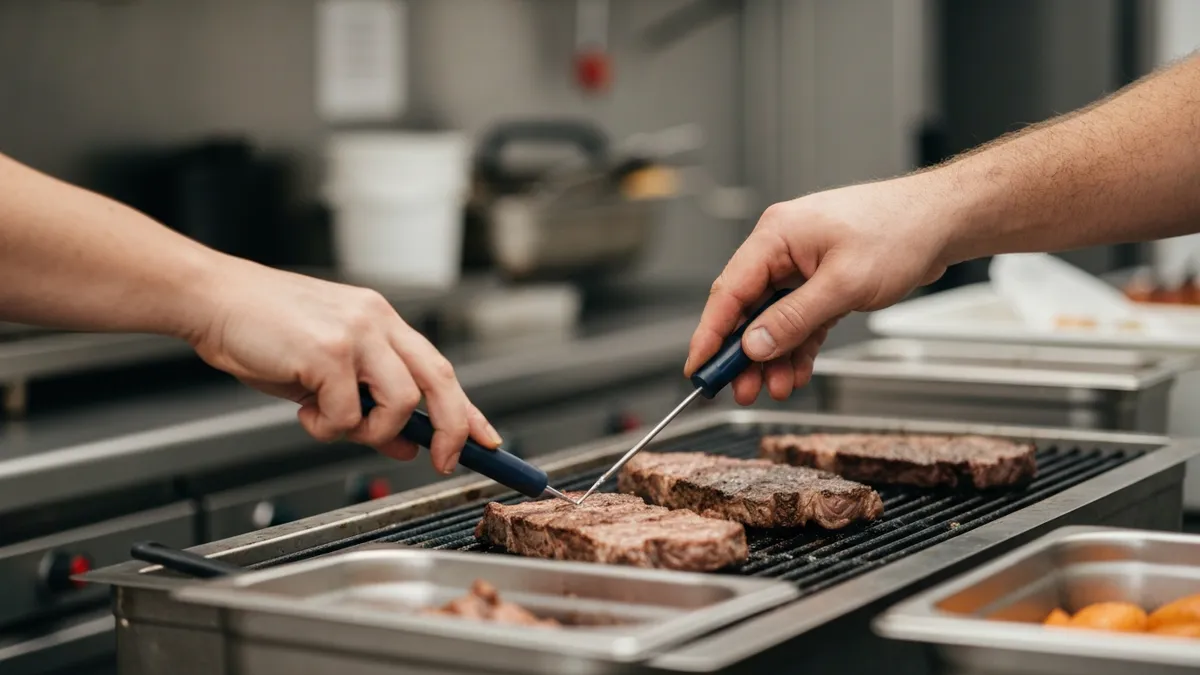
Under FDA Food Code regulations, a food protection manager who is aware of a flooring defect and fails to correct it promptly may be held personally liable during a health inspection. Cracked tiles, missing grout, and blocked floor drains are not cosmetic issues — they are documented food safety hazards. Health inspectors can issue critical violations for these conditions, which can result in fines, mandatory closure orders, or suspension of your food service permit.
Preparing for the ServSafe manager exam requires more than memorizing facts about flooring materials and installation standards. The exam is designed to test applied knowledge — your ability to read a scenario describing a real kitchen situation and identify whether a violation exists, what caused it, and what corrective action is required. This applied reasoning approach means that the best preparation combines content knowledge with extensive practice on scenario-based questions that mirror the format of the actual exam.
The ServSafe manager exam consists of 90 questions, of which 40 are unscored pilot questions used to evaluate future exam content. Only 50 questions are actually scored, and you must answer at least 70% of those correctly to pass — meaning you need to answer approximately 38 of the 50 scored questions correctly. Because you cannot identify which questions are scored and which are pilot questions, you must approach every question with the same level of care. Flooring and facility design questions are distributed throughout the exam alongside topics like temperature control, personal hygiene, purchasing, and HACCP.
One of the most effective strategies for the ServSafe manager practice test is to work through question sets organized by topic area, identify your weak areas, and then re-read the corresponding sections of the ServSafe Manager Book before taking additional practice tests. Flooring is often a weak area for test-takers who have food handling experience but limited facility management experience.
If you have never managed a kitchen renovation or dealt with a health inspection violation related to facility design, the specificity of the ServSafe flooring standards may feel abstract. Practice questions help make these abstract standards concrete by embedding them in realistic scenarios.
Time management on the ServSafe manager exam is important because the exam is not particularly long — 90 questions in 2 hours gives you approximately 80 seconds per question — but it is important not to rush through scenario questions that require careful reading. Many wrong answers on the ServSafe exam are chosen because test-takers misread the scenario or answer choices.
Flooring questions in particular often include answer choices that are partially correct but miss a key element of the standard. For example, a question might ask about a floor that is smooth and durable but absorbent, and the wrong-answer trap is to mark it compliant because it has two of the four required properties.
Study resources for the ServSafe manager exam include the official ServSafe Manager Book, online practice tests, and the servsafe exam practice questions available through authorized training providers. The official textbook is essential because exam questions are drawn directly from its content. However, many students find that the textbook alone is not sufficient for exam preparation because it presents information in a linear narrative format rather than in the scenario-based format of the actual exam. Combining textbook study with practice tests is the most effective approach for most test-takers.
Group study can be particularly effective for the ServSafe manager exam because it allows students to quiz each other on scenarios and discuss why certain answers are correct while others are not. When studying flooring topics in a group, try creating your own scenario questions based on real kitchens you have worked in and discussing how the ServSafe standards would apply. This active recall approach strengthens memory and helps you internalize the standards rather than simply recognizing them when presented in a practice question format.
The night before your ServSafe manager exam, avoid cramming new material and instead review your notes on the most frequently tested topics — flooring, temperature control, personal hygiene, and HACCP principles. Get a full night of sleep, eat a solid breakfast, and arrive at the testing center early.
The exam is proctored and timed, so familiarize yourself in advance with the testing center's rules about what materials are allowed, whether scratch paper is provided, and how the testing interface works if you are taking a computer-based exam. Arriving prepared and rested will help you perform at your best on this important certification milestone.
Beyond the exam itself, understanding ServSafe flooring standards has direct practical value for anyone working in or managing a food service operation. Health inspections happen at unpredictable intervals in most jurisdictions, and inspectors are trained to look for exactly the types of flooring violations covered in the ServSafe curriculum. A food protection manager who has internalized these standards can conduct self-inspections that catch problems before an official inspector does, avoiding violations, fines, and the reputational damage that comes with a poor inspection score.
Implementing a formal facility inspection schedule is a best practice that ServSafe recommends for all certified food protection managers. This schedule should include a weekly walkthrough of all food prep areas specifically to check flooring conditions, drain function, and coving integrity. Any deficiencies observed should be logged in a maintenance record that documents the date the problem was identified, the corrective action taken, and the date the repair was completed. This documentation demonstrates due diligence to health inspectors and can mitigate penalty severity if a violation is found during an official inspection.
When hiring contractors to repair or replace flooring in food prep areas, always specify in writing that all work must comply with the FDA Food Code and local health department requirements. Require the contractor to provide documentation of material specifications, including nonabsorbency ratings and approved uses for each material. After any flooring work is completed, conduct your own inspection before reopening the area to food prep activities. Verify that slope, drainage, coving, and surface condition all meet the standards you know from your ServSafe training — do not assume the contractor was familiar with food service requirements.
Training your entire kitchen team on flooring compliance expectations is an important management responsibility that extends beyond your own certification. Line cooks, prep staff, and dishwashers are the people who spend the most time working near the floor and are most likely to notice developing problems — a new crack, a drain that is slow to clear, or coving that is beginning to pull away from the wall.
Create a culture where staff feel empowered to report these issues immediately and where reports are taken seriously and addressed quickly. Many flooring violations that become serious problems could have been caught and repaired at minimal cost if staff had reported them earlier.
The connection between flooring compliance and foodborne illness prevention is not theoretical. Investigations of foodborne illness outbreaks in restaurant settings frequently identify facility maintenance issues, including flooring problems, as contributing factors. When floors are cracked or have inadequate drainage, pathogens like Listeria monocytogenes can establish persistent colonies that contaminate food through splash, aerosol, or contact transfer. Listeria is particularly dangerous because it can survive and even grow at refrigerator temperatures, meaning that a contaminated drain or floor crack near a walk-in cooler can be a persistent source of contamination over weeks or months.
Reviewing your facility's flooring as part of your HACCP plan is a forward-thinking approach that the most effective food safety managers take. While HACCP is traditionally focused on biological, chemical, and physical hazards in the food itself, the physical environment where food is prepared is a critical supporting element of any effective HACCP system. Flooring conditions that allow pathogen harborage or cross-contamination through splash are facility-level hazards that should be included in your hazard analysis and addressed through prerequisite programs before the more specific HACCP critical control points can be reliably managed.
As you complete your ServSafe test prep and approach your exam date, remember that the flooring standards you are studying are not arbitrary bureaucratic requirements — they represent decades of epidemiological research and regulatory refinement aimed at preventing foodborne illness. Every standard in the ServSafe curriculum exists because real outbreaks caused real harm, and the rules were written in response to those events. Approaching your study with this understanding will help you remember the material more effectively and make you a more thoughtful and effective food safety manager in your career long after you pass the exam.
ServSafe Questions and Answers



About the Author

Registered Sanitarian & Food Safety Certification Expert
Cornell University College of Agriculture and Life SciencesThomas Wright is a Registered Sanitarian and HACCP-certified food safety professional with a Bachelor of Science in Food Science from Cornell University. He has 17 years of experience in food safety auditing, regulatory compliance, and foodservice management training. Thomas prepares food industry professionals for ServSafe Manager, HACCP certification, and state food handler examinations.
Join the Discussion
Connect with other students preparing for this exam. Share tips, ask questions, and get advice from people who have been there.
View discussion (7 replies)