
Is the ServSafe Test Hard? Complete Difficulty Guide & Study Plan 2026 October
Is the ServSafe test hard? 🎓 Discover pass rates, what topics trip people up, and proven strategies to pass on your first attempt.

Is ServSafe test hard? That is the question on every food service worker's mind before sitting down to take the exam. The honest answer is: it depends on how well you prepare. The ServSafe Manager Certification exam is a legitimate, proctored test that covers a broad range of food safety topics, from temperature control and cross-contamination to employee hygiene and pest management. With a passing score of 70% required on the 80-question exam, roughly one in three first-time test takers does not pass — meaning preparation is not optional if you want to earn your certification.
The exam is designed by the National Restaurant Association Educational Foundation and is recognized across all 50 states as a legitimate food safety credential. The breadth of material it covers is what catches many test takers off guard. Unlike a simple workplace quiz, the ServSafe Manager exam draws on six major content domains and expects candidates to apply knowledge, not just recall definitions. You may be asked to interpret a temperature log, identify a biological hazard in a scenario, or determine the correct sanitizer concentration for a specific surface type.
Many candidates underestimate the exam because they have years of real-world kitchen experience. Practical experience is valuable, but the exam tests specific regulatory knowledge that may not match informal on-the-job training. For example, you might know how to cook chicken thoroughly, but the exam asks for the exact minimum internal temperature (165°F for 15 seconds). That level of precision is what separates passing candidates from those who need to retake the test.
The good news is that the ServSafe exam is very passable with the right preparation strategy. Most food service professionals who dedicate two to three weeks of structured study report feeling confident on exam day. The key is understanding which domains carry the most weight on the exam and focusing your energy accordingly. Foodborne illness prevention, temperature control for safety (TCS foods), and personal hygiene together account for nearly half of the scored questions.
Understanding how hard is servsafe test in your specific state context also matters, since some states layer additional food safety requirements on top of the national ServSafe standard. While the core exam content stays consistent nationally, local regulations around allergen disclosures, health department inspections, and food handler card requirements can add complexity for managers operating in certain jurisdictions.
One of the most effective ways to gauge your readiness before exam day is to take multiple full-length practice tests under timed conditions. Practice tests reveal which content areas still need attention and build the test-taking stamina needed for the 2-hour session. Candidates who complete at least four to five practice tests before their actual exam consistently report higher first-attempt pass rates than those who rely on reading alone.
This guide walks you through everything you need to know about the ServSafe exam difficulty — from pass rates and common failure points to a week-by-week study schedule and proven test-day strategies. Whether you are a first-time candidate or returning after a failed attempt, the strategies here will help you walk into the testing center with confidence and walk out with a passing score.
ServSafe Exam by the Numbers
Key Facts at a Glance
| Item | Value | Details |
|---|---|---|
| Scored Questions | 80 | Plus 10 unscored pilot questions |
| Time Allowed | 2 hrs | Roughly 90 seconds per question |
| Passing Score | 70% | Must answer 56 of the 80 scored correctly |
| Certification Validity | 5 yrs | Renewal required every 5 years |
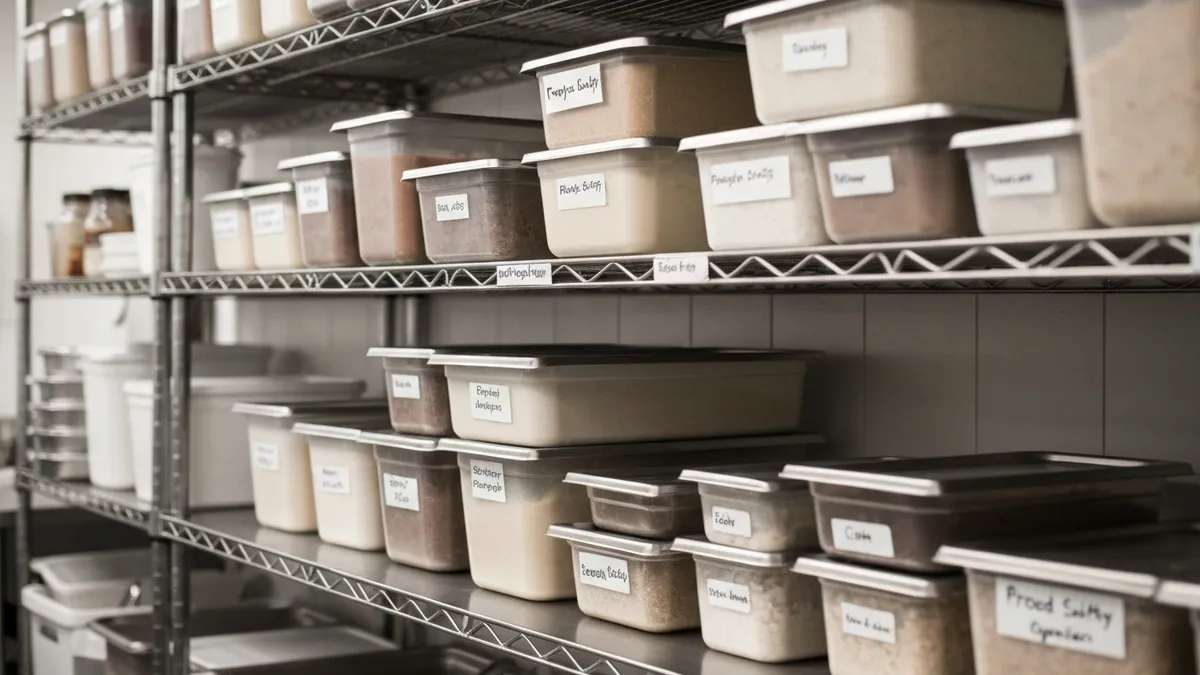
ServSafe Manager Exam Format
| Section | Questions | Time | Weight | Notes |
|---|---|---|---|---|
| Providing Safe Food | 15 | ~22 min | 19% | Biological, chemical, physical hazards |
| Forms of Contamination | 12 | ~18 min | 15% | Cross-contamination, allergens |
| The Safe Food Handler | 8 | ~12 min | 10% | Hygiene, illness policies |
| The Flow of Food | 20 | ~30 min | 25% | Receiving, storage, cooking temps |
| Food Safety Management Systems | 13 | ~19 min | 16% | HACCP, FIFO, monitoring |
| Safe Facilities & Pest Management | 12 | ~18 min | 15% | Cleaning, sanitizing, pest control |
| Total | 90 | 2 hours | 100% |
Understanding which topics are genuinely difficult on the ServSafe exam versus which ones just feel unfamiliar is critical to efficient study. The Flow of Food domain is the single heaviest section, accounting for 25% of scored questions. This domain covers the entire lifecycle of food in your operation — from receiving a shipment at the loading dock through storage, preparation, cooking, holding, cooling, and reheating. Each step has specific temperature thresholds, time limits, and regulatory requirements that must be memorized with precision.
Temperature control is where most exam candidates struggle the most. The ServSafe exam does not accept approximations. You must know that poultry requires an internal cooking temperature of 165°F for 15 seconds, that whole cuts of pork, beef, veal, and lamb require 145°F for 15 seconds with a 3-minute rest time, and that ground meat must reach 155°F for 15 seconds.
TCS foods must be cooled from 135°F to 70°F within 2 hours, and then from 70°F to 41°F within an additional 4 hours — a total cooling window of 6 hours. Missing any single number can cost you a correct answer.
The HACCP (Hazard Analysis Critical Control Points) section within Food Safety Management Systems trips up many candidates because it introduces a systematic framework that may feel abstract compared to hands-on kitchen tasks. You need to understand all seven HACCP principles in order, recognize what constitutes a critical control point versus a control point, and know how corrective actions differ from verification procedures. The exam frequently presents scenario-based questions in this domain, asking you to identify which HACCP step applies to a given situation.
Chemical contamination questions are another common stumbling block. The exam distinguishes between sanitizing and cleaning, and tests whether you know the correct concentration ranges for common sanitizing agents. Chlorine-based sanitizers must be used at 50–99 parts per million (ppm), iodine sanitizers at 12.5–25 ppm, and quaternary ammonium (quat) sanitizers at 200–400 ppm depending on the manufacturer's instructions. Candidates who mix up these ranges or confuse cleaning (removing visible dirt) with sanitizing (reducing pathogens to safe levels) consistently miss these questions.
Food allergen management has grown in importance on recent exam versions, reflecting changes in federal food labeling laws and industry best practices. The exam expects you to know all nine major food allergens recognized by the FDA — milk, eggs, fish, shellfish, tree nuts, peanuts, wheat, soybeans, and sesame — and to understand how to prevent allergen cross-contact through dedicated equipment, proper labeling, and staff training. A single allergen cross-contact incident can trigger a life-threatening reaction, which is why the exam weights this topic heavily.
Personal hygiene and employee health questions are generally more straightforward, but candidates still miss them by overthinking the scenarios. The key rule to remember is that food handlers must be restricted from working with food if they have symptoms like vomiting, diarrhea, jaundice, or sore throat with fever, and must be excluded entirely if diagnosed with a Big 6 pathogen (Norovirus, Hepatitis A, Salmonella Typhi, Shigella, Shiga toxin-producing E. coli, or Nontyphoidal Salmonella). The distinction between restriction and exclusion is a favorite exam topic that rewards careful memorization.
Pest management and facility safety questions round out the exam and are typically less difficult than temperature or HACCP questions, but they still require specific knowledge. You need to know the signs of pest infestation (rodent droppings, gnaw marks, grease trails from cockroaches), which areas of a facility are most vulnerable, and the pest control procedures that must be followed before reopening a food service area after treatment. The good news for most candidates is that these questions often yield straightforward right-or-wrong answers with less ambiguity than the scenario-based HACCP questions.
ServSafe Study Strategies by Learning Style
Visual learners benefit most from converting ServSafe content into diagrams, charts, and color-coded temperature maps. Create a large wall poster showing the temperature danger zone (41°F–135°F) with color bands for each food category and its required cooking temperature. Draw flow diagrams for HACCP principles, showing each step in sequence with arrows connecting them. Use flashcards with images on one side and the regulatory requirement on the other — for example, a picture of raw chicken paired with the 165°F internal temperature requirement on the back.
Mind maps work exceptionally well for organizing the six content domains of the ServSafe exam. Start with the central topic — food safety — and branch outward to each domain, then add sub-branches for specific concepts within each one. Color-code each domain branch differently so your brain builds a spatial memory of the information. Free tools like Canva or Miro let you build digital mind maps that you can review on your phone during breaks. Spending 30 minutes per evening reviewing your visual materials, rather than rereading text, can significantly accelerate retention for visual learners.

Is ServSafe Certification Worth the Effort?
- +Nationally recognized credential accepted in all 50 states and by most major foodservice employers
- +Increases earning potential — certified managers often command higher wages than non-certified peers
- +Required by law in many states for at least one manager per food service establishment
- +Provides genuinely useful food safety knowledge that reduces liability and health code violations
- +5-year validity period means one exam covers you for a long certification window
- +Online proctoring option allows flexible exam scheduling from home or workplace
- −Exam fee of $36–$55 plus study materials can add up to $100–$200 total investment
- −75% passing threshold is stricter than many candidates expect from a workplace certification
- −Breadth of content (6 domains, specific temperature numbers) requires genuine study time
- −Some states require additional local food handler cards beyond ServSafe certification
- −Certification must be renewed every 5 years, requiring retesting or an approved refresher course
- −No partial credit — missing temperature or time thresholds by even one degree counts as wrong
ServSafe Exam Day Preparation Checklist
- ✓Bring a valid, government-issued photo ID that matches the name on your exam registration exactly.
- ✓Arrive at the testing center at least 15 minutes early to complete check-in without rushing.
- ✓Review your temperature cheat sheet one final time the morning of the exam, then close it.
- ✓Eat a full meal before the exam — low blood sugar impairs concentration during the 2-hour session.
- ✓Bring two sharpened pencils if taking the paper-and-pencil version of the exam.
- ✓For online proctored exams, test your webcam, microphone, and internet connection the night before.
- ✓Clear your testing workspace of unauthorized materials — phones, notes, and food are not permitted.
- ✓Read every exam question completely before answering — scenario questions often include a key detail in the last sentence.
- ✓Flag questions you are uncertain about and return to them after answering the questions you know.
- ✓Pace yourself to use the full 2 hours — spending roughly 90 seconds per question keeps you on track.
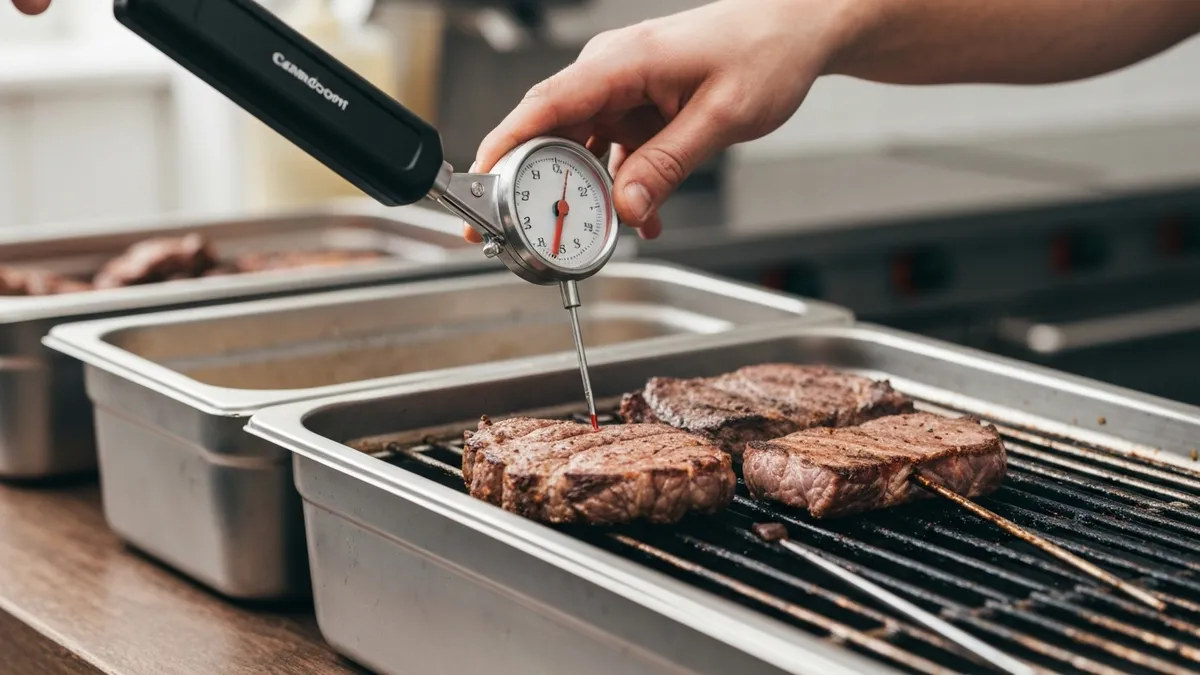
The Temperature Danger Zone Is the Most Tested Concept
Nearly 30% of all ServSafe exam questions touch on temperature control in some form. Memorizing the danger zone (41°F–135°F), all minimum internal cooking temperatures, and the 2-hour/4-hour cooling rule before exam day can alone push you from a failing score to a passing one. Prioritize this content above all others if your study time is limited.
Passing the ServSafe exam on your first attempt comes down to three fundamentals: knowing the content, managing your time, and staying calm under pressure. Candidates who fail most often report one of two problems — either they ran out of time because they spent too long on difficult questions, or they second-guessed correct answers they had initially circled. Both problems are solvable with deliberate practice before exam day.
A realistic study timeline for most candidates is two to three weeks of structured preparation. During week one, focus entirely on reading through the ServSafe Manager textbook or taking the online course module by module. Do not try to memorize everything on the first pass — instead, highlight key numbers (temperatures, times, ppm concentrations) and take brief notes on each domain. The goal of week one is comprehension, not memorization. Understanding why a temperature threshold exists makes it far easier to remember than brute-force repetition.
During week two, shift your focus to active recall. Close the textbook and use flashcards, practice quizzes, and self-testing to identify your weak areas. Take at least one full-length practice test under timed conditions and score it honestly. Most candidates are surprised to find that the areas they felt confident about on paper become harder under timed, exam-style conditions. Use your practice test results to build a targeted review list for the final days before the exam.
In the final three to five days before the exam, consolidate rather than trying to learn new material. Review your weak areas daily, re-take practice questions from those domains, and spend the last evening doing a light review of your strongest topics to build confidence. Avoid cramming entirely new content the night before — introducing unfamiliar material right before the exam increases anxiety without meaningfully improving your score. Instead, review your temperature chart, the Big 6 pathogens, and the HACCP steps one final time, then get eight hours of sleep.
Test-taking strategy matters as much as content knowledge on the ServSafe exam. Read each question stem carefully, paying attention to qualifier words like 'first,' 'best,' 'most likely,' and 'except.' These qualifiers change the correct answer and are placed deliberately to reward attentive reading. When you encounter a scenario question, identify the food safety problem being described before looking at the answer choices — candidates who diagnose the scenario correctly before reading options are far less likely to be misled by plausible-sounding wrong answers.
Process of elimination is your most powerful tool on questions where you are uncertain. ServSafe questions are written with one clearly correct answer and three distractors. One or two distractors are usually easy to eliminate because they describe clearly unsafe practices or obviously wrong temperatures. Narrowing to two choices and then applying your knowledge of the ServSafe framework gives you a 50-50 chance even on your weakest topics — far better odds than guessing blindly among four options.
Candidates who have already earned their certification report that the sense of confidence it provides is well worth the study investment. A ServSafe Manager certification signals to employers, health inspectors, and customers that you understand food safety at a professional level. In many jurisdictions, it is also a legal requirement — making it not just a professional asset but a regulatory necessity. Building your knowledge base through structured practice tests and consistent review is the single most reliable path to passing on the first try.
Many experienced food service workers fail the ServSafe exam because they assume hands-on experience is enough preparation. The exam tests specific regulatory thresholds — exact temperatures, ppm concentrations, HACCP terminology — that are not always enforced consistently in real kitchens. Always study the official ServSafe materials, even if you have years of industry experience. Practical knowledge and exam knowledge are related but not identical.
If you do not pass the ServSafe exam on your first attempt, the retake process is straightforward but requires a waiting period. The National Restaurant Association Educational Foundation allows candidates to retake the exam after a mandatory 24-hour waiting period following a failed attempt. You will need to pay the exam fee again for each retake, so understanding the retake policy ahead of time helps you plan your budget and timeline appropriately. Most candidates who fail the first time pass on the second or third attempt after targeted review of their weak areas.
When you receive your exam results, pay close attention to the domain-level score breakdown. The results report shows your performance in each of the six content domains, which pinpoints exactly where to focus your additional study. A candidate who scores 90% in personal hygiene but 50% in Flow of Food knows precisely where to concentrate for the retake — no need to re-study everything from scratch. This targeted approach makes second-attempt preparation significantly more efficient than the initial broad review.
Many candidates who fail report that they did not take enough practice tests before their first attempt. A single read-through of the textbook rarely produces a passing score because it does not build the active recall and time management skills the exam demands. For your retake preparation, commit to completing at least six to eight full-length practice tests, aiming for a consistent score of 80% or higher on practice exams before scheduling your actual test date. This buffer above the 70% passing threshold accounts for exam-day pressure and question variation.
Understanding the five-year validity window of the ServSafe Manager certification also affects how you think about preparation. Because the certification lasts five years, the investment of a few weeks of study time and the exam fee is amortized across a long period. Managers who renew on time avoid the disruption of lapsed certification status, which can create compliance problems for their establishments during health department inspections. Planning your renewal at least six weeks before your current certification expires gives you time to retake the exam if needed without a compliance gap.
Some food service professionals choose to take the ServSafe Food Handler certification as a lower-stakes stepping stone before attempting the Manager exam. The Food Handler certificate covers a narrower range of topics, does not require a proctored exam, and has a lower passing threshold — making it an accessible way to build familiarity with ServSafe terminology and content structure. However, only the Manager certification satisfies state laws that require a certified manager on premises, so food service managers should target the Manager exam directly rather than treating the Food Handler course as sufficient on its own.
Online resources and study communities have become increasingly valuable tools for ServSafe preparation. Dedicated ServSafe study groups on platforms like Reddit and Facebook allow candidates to share practice questions, discuss confusing topics, and get encouragement from others who have recently passed. Many candidates find that explaining a concept like HACCP to someone else in an online forum is one of the most effective ways to solidify their own understanding — a phenomenon educational researchers call the protégé effect.
For candidates who want structured support beyond self-study, ServSafe-approved instructor-led courses are available through community colleges, restaurant associations, and culinary schools across the country. These courses typically run eight to sixteen hours and combine content instruction with built-in practice tests. Some employers cover the cost of instructor-led training for managers they want to certify — it is worth asking your employer about reimbursement before paying out of pocket. Instructor-led courses also provide direct access to an expert who can answer specific questions about content areas you find confusing.
Building a practical, day-by-day study routine is the most reliable way to prepare for the ServSafe exam without burning out. Rather than marathon study sessions the week before the exam, consistent daily study blocks of 45 to 60 minutes over two to three weeks produce better long-term retention. The brain consolidates information during sleep, so studying in shorter daily sessions allows each night of rest to reinforce what you learned that day — a process called memory consolidation that is well-documented in cognitive science research.
Start each study session with a five-minute review of the previous session's material before introducing new content. This spaced repetition technique takes advantage of the spacing effect, which shows that reviewing information at gradually increasing intervals dramatically improves long-term retention compared to massed practice. Free tools like Anki allow you to build a digital ServSafe flashcard deck that automatically schedules each card for review at the optimal interval based on how well you remembered it last time.
Focus your deepest study on the Flow of Food domain during the first week, since it accounts for 25% of scored questions and contains the most specific numerical thresholds. Break this domain into five sub-topics — receiving, storage, preparation, cooking, and cooling/reheating — and spend one study session on each. For each sub-topic, create a reference card listing every temperature threshold and time requirement, then test yourself against those reference cards the following day without looking at them.
Use the ServSafe Manager Study Guide in conjunction with the textbook. The study guide is specifically designed to highlight testable content and includes practice questions at the end of each chapter. Working through these chapter questions immediately after reading each section provides immediate feedback on what you understood versus what you only thought you understood. Research on retrieval practice consistently shows that testing yourself on material immediately after learning it produces stronger memory traces than re-reading the same material a second time.
Pay special attention to food allergen management as you study, because this area has seen increased emphasis on recent exam versions following updates to FDA food labeling laws. Know the nine major allergens by heart — milk, eggs, fish, shellfish, tree nuts, peanuts, wheat, soybeans, and sesame (sesame was added in 2023). Understand the difference between a food allergy (immune response) and food intolerance (digestive response), and know what steps staff must take when a customer reports an allergen concern, including communicating with the kitchen, using dedicated equipment, and reading ingredient labels carefully.
In the final week before the exam, simulate the actual test-taking experience as closely as possible. Take at least two full practice tests from start to finish within the 2-hour time limit, scored without looking anything up. If your scores are consistently at or above 80%, you are well prepared for the actual exam.
If you are scoring in the 65–75% range, identify the domains dragging your score down and do one focused review session per weak domain before exam day. Avoid the temptation to study everything again — targeted review is far more efficient than broad re-reading at this stage.
Finally, remember that the ServSafe exam, while challenging, is designed to be passed by working food service professionals — not food scientists with advanced degrees. The content is practical, grounded in real food service operations, and built around scenarios that any experienced kitchen worker will recognize.
The difficulty lies in the specificity of the knowledge required, not in the complexity of the underlying concepts. With two to three weeks of structured preparation, a solid set of practice tests, and a clear understanding of which domains carry the most weight, you have every tool you need to pass the ServSafe Manager exam on your first attempt.
Sample ServSafe Food Safety Test Practice Questions
Try these questions from our free ServSafe Food Safety Test practice tests. The correct answer and an explanation follow each question.
What is the recommended approach to staying current in Food Preparation & Cooking Standards?
- A. Regular professional development, industry publications, and peer collaboration
- B. Reviewing initial training materials once per year
- C. Relying solely on past experience
- D. Waiting for regulatory changes to force updates
Answer: A. Regular professional development, industry publications, and peer collaboration
Staying current in Food Preparation & Cooking Standards requires ongoing professional development, reading industry publications, and collaborating with peers to share knowledge and best practices.
What is the most important competency assessed in Regulatory Compliance & Health Codes?
- A. Applied knowledge and practical problem-solving ability
- B. Memorization of textbook definitions only
- C. Years of experience without demonstrated skill
- D. Academic credentials without practical application
Answer: A. Applied knowledge and practical problem-solving ability
Regulatory Compliance & Health Codes assessment focuses on applied knowledge and practical problem-solving, ensuring professionals can perform effectively in real-world situations.
Which type of plumbing connection is required to prevent contaminated water from back-flowing into a potable water supply?
- A. Pressure valve
- B. Air gap
- C. Shut-off valve
- D. Water softener
Answer: B. Air gap
An air gap — a physical space between the water supply outlet and a potential source of contamination — is the most reliable method to prevent backflow.
How should equipment be positioned to allow proper cleaning underneath?
- A. Sealed directly to the floor with no gap
- B. Elevated at least 6 inches off the floor
- C. Placed on rubber mats to absorb spills
- D. Pushed against the wall to minimize exposed surface area
Answer: B. Elevated at least 6 inches off the floor
Equipment must be elevated at least 6 inches off the floor to allow cleaning and to deter pest harborage underneath.
ServSafe Questions and Answers

ServSafe Montana: Complete Food Handler Training & Certification Guide

Do ServSafe Certifications Expire? Complete Guide to Renewal, Validity & Staying Compliant

Which Is an Example of Possible Chemical Contamination ServSafe: Complete Guide

ServSafe Manager Exam Flushing Queens Location: Complete Guide to Finding & Booking Your Test

ServSafe Video Training: How Video-Based Learning Accelerates Your Food Safety Certification
About the Author

Registered Sanitarian & Food Safety Certification Expert
Cornell University College of Agriculture and Life SciencesThomas Wright is a Registered Sanitarian and HACCP-certified food safety professional with a Bachelor of Science in Food Science from Cornell University. He has 17 years of experience in food safety auditing, regulatory compliance, and foodservice management training. Thomas prepares food industry professionals for ServSafe Manager, HACCP certification, and state food handler examinations.
Join the Discussion
Connect with other students preparing for this exam. Share tips, ask questions, and get advice from people who have been there.
View discussion (8 replies)