
ROTC Uniform Guide: Components, Standards, and Wear Rules 2026 October
🗨️ Complete ROTC uniform guide covering Army ACUs, ASUs, Air Force OCPs, Navy and Marine standards, grooming rules, inspections, and care for cadets.
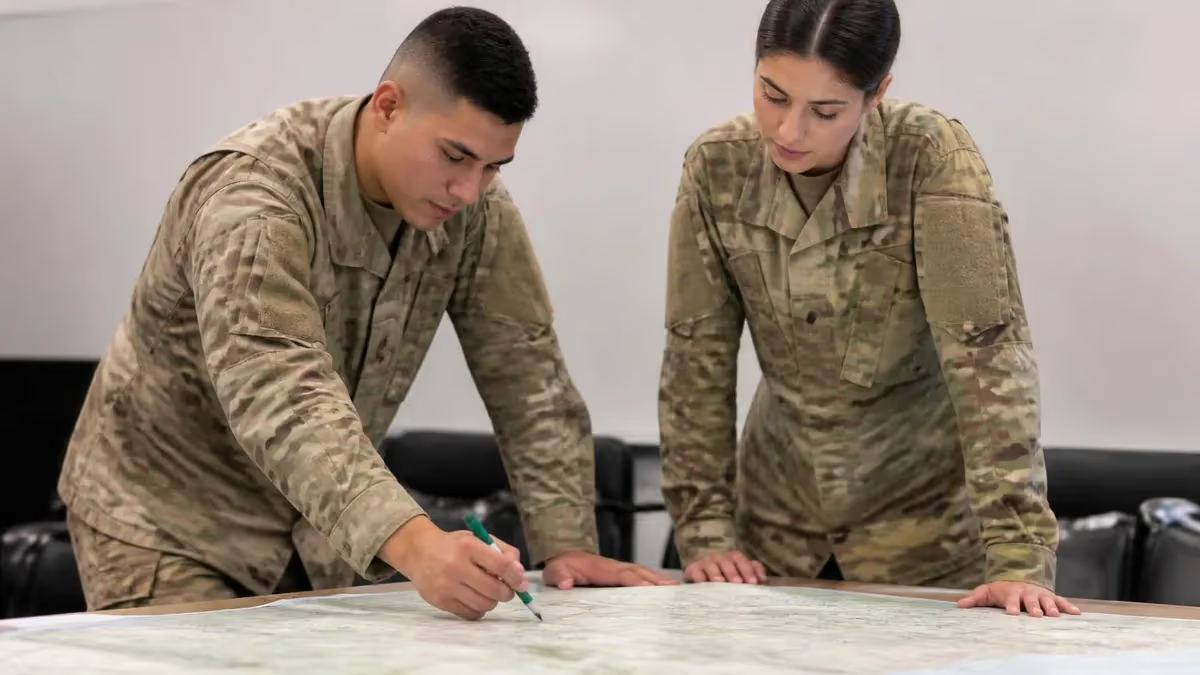
The ROTC uniform tells a story before you say a word. Walk across campus on a Tuesday morning and you'll spot cadets in their service uniforms heading to leadership lab, ACUs slung over chairs in classrooms, polished shoes catching the fluorescent light in dining halls. Every component, from the beret to the boot blousing, follows a regulation written in plain language but enforced with surprising precision. You learn quickly that the uniform is not a costume. It is a contract.
For new cadets, the first issue day at the supply room can feel overwhelming. Bags pile up. Stencils get applied. Someone hands you a name tape and a pair of trousers that need hemming by Thursday. The good news? Once you understand the categories of wear, the regulations make sense. The Army, Air Force, Navy, and Marine Corps each run their own ROTC programs with overlapping but distinct dress codes, and learning yours is part of the training.
What ROTC Uniforms Cover and Why They Matter
ROTC uniforms exist for three practical reasons: to teach you military bearing, to identify you as part of a unit, and to give civilians and senior officers a quick read on your role. When a colonel sees a cadet with a green shoulder cord and a Ranger Challenge tab, that colonel knows the program, the year group, and often the GPA tier before any conversation starts.
The uniform also enforces discipline in small ways. Sleeves must be rolled with a specific fold. Headgear comes off indoors except under arms. Hair has length and color restrictions. None of this is arbitrary. Cadets who treat the uniform standard as a puzzle to solve usually do well at the PT test and other measurable events too, because the same attention to detail carries over.
If you are still deciding which branch to join, our guide to ROTC branches covers the differences between Army, Navy, Air Force, and Marine Corps programs. The uniform you wear depends entirely on that choice.
ROTC Uniform Quick Facts
Army ROTC Uniform Components
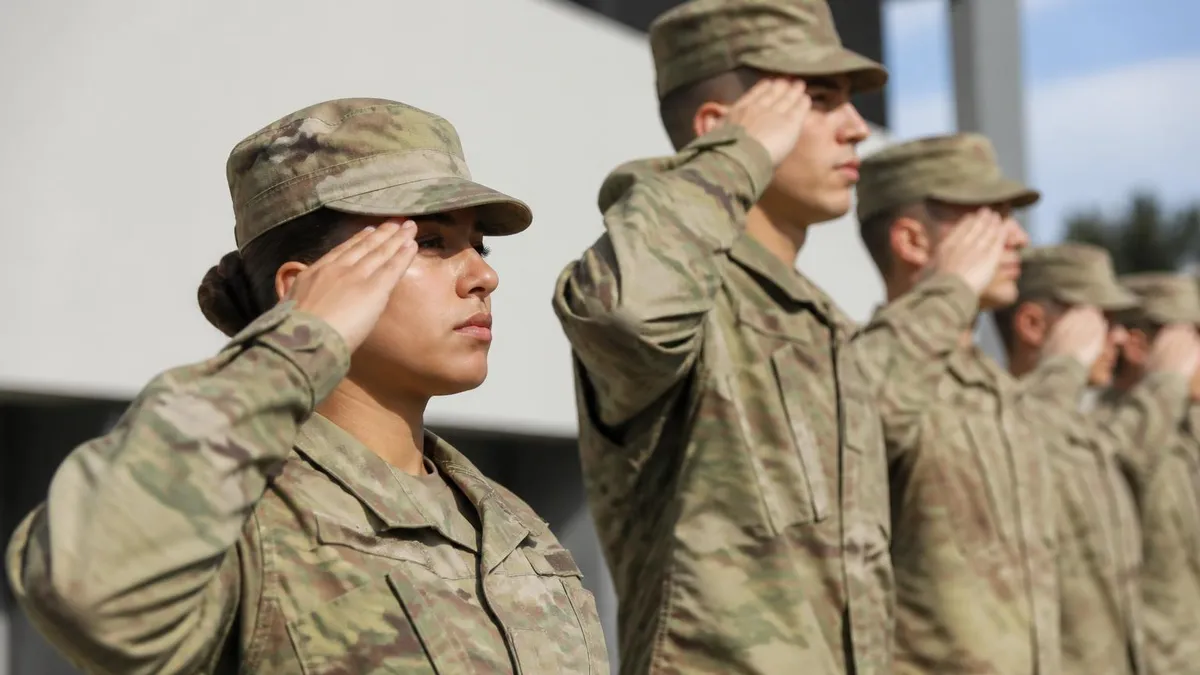
Army ROTC cadets wear three primary uniforms: the Army Combat Uniform (ACU) with the Operational Camouflage Pattern, the Army Service Uniform (ASU) for formal occasions, and PT gear for physical training. Each comes with its own rules.
The ACU is the daily workhorse. Cadets wear it for leadership labs, field training exercises, and weekly drill. The pattern is OCP. The boots are coyote brown. The patrol cap sits flat on the head with no curve in the brim. You blouse your trousers into the boot tops using elastic bands. Cadets are issued one combat shirt for warm weather wear, plus a moisture-wicking T-shirt in tan 499.
Name tapes go above the right and left chest pockets. The right side reads U.S. ARMY, the left side reads your last name. Rank insignia sits at the chest center in subdued OCP color. Cadet rank, which differs from active-duty rank, uses a black or gold pin-on device depending on year group and position.
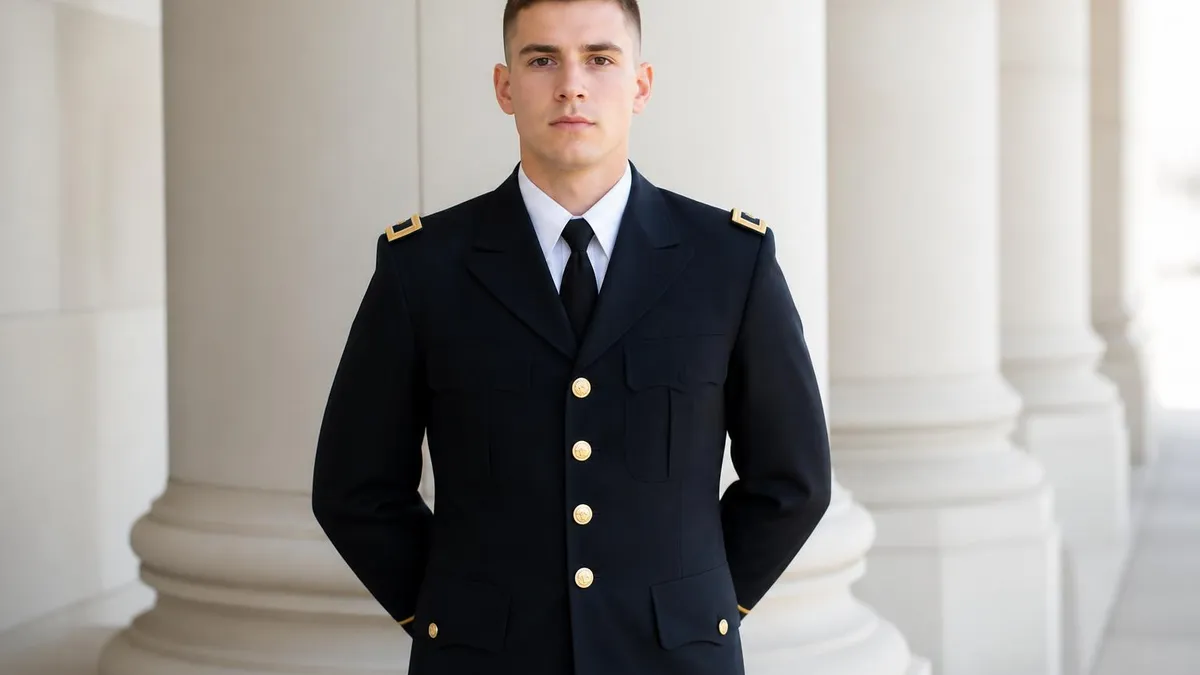
The Army Service Uniform comes out for the Military Ball, dining-in events, change of command ceremonies, and most awards ceremonies. The blue coat carries gold braid at the cuff, the trousers run a gold stripe down the seam for officers and senior cadets, and the shoes are corfam patent leather. Female cadets have the option of a skirt or trousers. The white dress shirt and bow tie for males, or the white dress shirt and neck tab for females, complete the ensemble.
Headgear and Accessories
The patrol cap is standard for daily wear with ACUs. Berets in maroon, tan, or green are issued only to cadets who attend airborne school, Ranger school, or are assigned to specific units. The garrison cap goes with the Class B variation of the ASU. Caps are removed indoors unless the cadet is under arms or formally posted.
Belts in coyote brown with an open-faced buckle hold the ACU trousers. The riggers belt in tan is authorized for cadets who have completed Air Assault school or similar qualifications. Watches must be conservative. No bright colors, no oversized sport watches, no smartwatches with visible notifications during formations.
Primary ROTC Uniform Types
OCP-patterned daily wear for labs and field training. Patrol cap, coyote boots, blouse trousers, tan 499 T-shirt underneath. Worn for leadership lab, drill, and field exercises.
Formal coat and trousers for ceremonies, dining-in, and Military Ball events. Class A and Class B variants depending on season and occasion.
Branch-issued T-shirt, shorts, and reflective belt for PT formations. Reflective belt is mandatory before sunrise and after sunset for any outdoor run.
Special-occasion uniform with awards, ribbons, and brass at full display. Used for commissioning, parades, and senior cadet leadership appointments.
Air Force ROTC Uniform Standards
Air Force ROTC cadets wear the Operational Camouflage Pattern uniform similar to the Army's, but with distinct insignia placement and a different headgear approach. The OCP became the joint combat uniform in 2021 after the Air Force phased out the Airman Battle Uniform.
The service dress uniform for Air Force cadets is darker. A navy-blue jacket with silver buttons, light blue dress shirt, blue trousers, and low-quarter shoes form the core look. The flight cap, also called the garrison cap, replaces the beret most cadets wear. Wing badges and aeronautical ratings are forbidden until earned through commissioned service. Cadets wear the AFROTC shield on the left sleeve, a cadet rank patch on the upper sleeves, and a unit patch on the right.
For physical training, AFROTC issues a navy-blue T-shirt with the AFROTC logo, matching shorts, and a reflective belt. The reflective belt is mandatory for any PT conducted before sunrise or after sunset, and many cadre will issue corrective training for cadets caught running without one.
Navy and Marine ROTC Uniform Differences
Navy ROTC has the most distinct uniform tradition because the service splits its students into Navy option and Marine Corps option midshipmen. Navy midshipmen wear khakis, summer whites, and service dress blues depending on the season and event. Marine option midshipmen wear the Marine Corps service alpha uniform with the green coat, khaki shirt, and tie.
The midshipman summer white uniform is striking and unforgiving. Any stain, any wrinkle, any thread out of place shows immediately. Cadets learn quickly to keep two sets pressed, one always hanging clean for the next inspection. Black low-quarter shoes go with whites. The combination cover, with a white top and gold device, completes the look.
Service dress blues are the formal Navy uniform. Double-breasted jacket, six brass buttons in two rows, white shirt, black tie. Midshipmen wear a single shoulder board in gold and black indicating year group. The cap device differs from commissioned officers, reflecting cadet status. Marines wear the same combat utility uniform as their fleet counterparts when in field training rotations.
Branch-by-Branch Uniform Snapshot
ACU with OCP pattern for daily wear. ASU dress blues for formal events. Patrol cap is standard for everyday wear; berets in maroon, tan, or green are reserved for cadets with airborne, Ranger, or specialty unit assignments. Coyote brown boots, name tapes above pockets, cadet rank pin at chest center. Cadets at MS-III and above wear shoulder cords indicating leadership positions. Branch insignia gets added after commissioning, never before.
Wear Out Dates and Replacement Cycles
ROTC uniforms are not unlimited issue items. Cadets receive a bag at the start of MS-I year and another at MS-III year. Items wear out. Boots crack at the toe. Trousers fray at the cuff. Many programs allow cadets to purchase replacement items at the campus exchange or through the supply room, often at reduced cost. Lost items are different. A lost ACU coat or a missing beret triggers a statement of charges, deducting the replacement cost from the cadet's stipend.
Tailoring is the cadet's responsibility. Sleeve length, trouser length, and waist adjustment have to be done locally. Most ROTC programs maintain a list of approved tailors near campus. A poorly tailored uniform fails inspection every time, and inspectors will count threads if they want to. Better to spend twenty dollars on a competent seamstress than to lose two letter grades on a uniform inspection that drops your order of merit ranking.
Hair, Grooming, and Personal Appearance
Hair regulations matter as much as the uniform itself. Male cadets cannot have hair touching the ears or the back of the collar. Sideburns end at the bottom of the ear. No beards. A neatly trimmed mustache is the only facial hair permitted, and it cannot extend past the corners of the mouth.
Female cadets have more flexibility. Hair may be worn in a bun, braid, or twist, but cannot extend below the bottom of the collar when in uniform. Color must look natural. No bright reds, blues, or pinks. Hair accessories must match the hair color and remain unobtrusive. The Army updated its grooming regulations in 2021 and 2022 to allow more inclusive hairstyles, and Air Force and Navy have followed similar paths.
Tattoos cannot be visible on the head, face, or neck. Hand tattoos are restricted to a single ring tattoo on one finger. Sleeves are generally allowed but content matters. Anything racist, sexist, gang-related, or extremist is disqualifying. Many cadets get their potential tattoos cleared through the program before they are inked, because regret runs deep when a sleeve costs a commission.
ROTC uniform items are issued, not free. Lost items trigger a statement of charges that deducts the replacement cost from your stipend. Keep your gear locked in your dorm, marked with your name, and inventoried after every field exercise. A lost beret can cost over $30; a lost ACU coat can run past $100.
Inspections and Uniform Checks
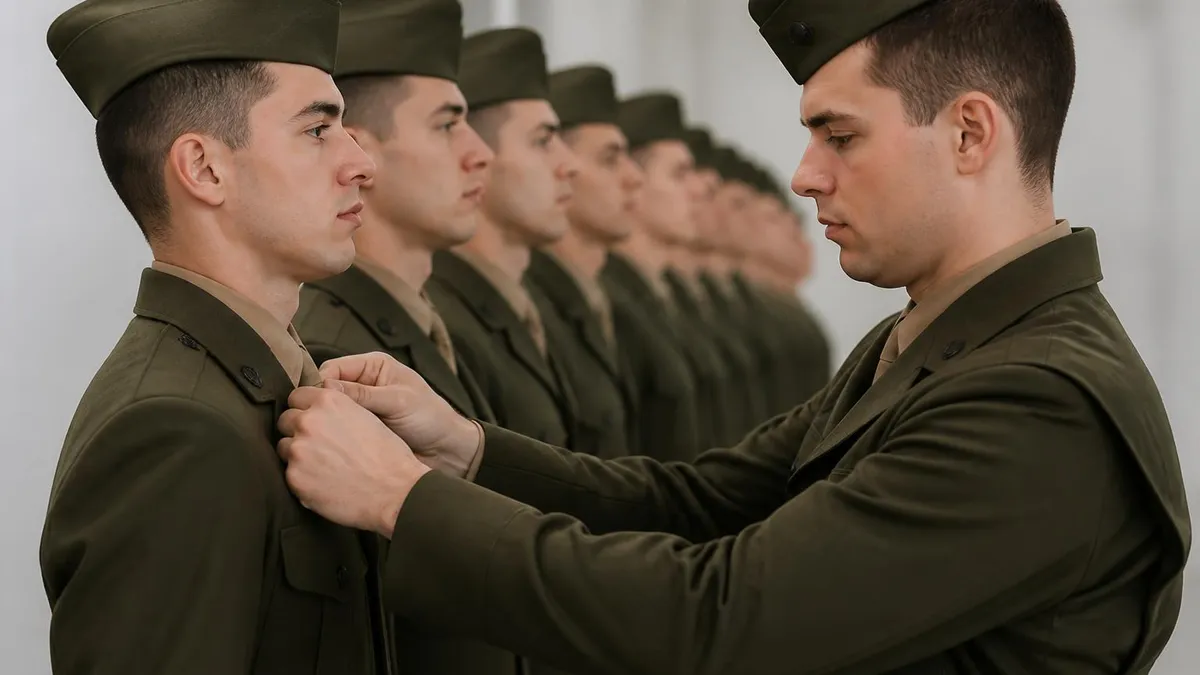
Most ROTC programs run a weekly uniform inspection during leadership lab. Cadets line up in formation. The cadet chain of command walks the line. Inspectors look for loose threads, smudged brass, scuffed boots, name tapes that are crooked, and undershirts that are visible above the collar. Each deficiency costs points. A perfect inspection gets recognized. Three consecutive failed inspections can trigger a counseling statement.
Beyond the weekly check, programs hold full Class A inspections once or twice a semester. These are far more detailed. Inspectors check the inside of the cover, the cleanliness of the brass, the alignment of awards and decorations down to a quarter-inch tolerance. Cadets who plan to compete for top performer awards prepare for these inspections like an athlete prepares for a championship.
Special Skill Badges and Tabs
Cadets who complete additional training can earn badges that appear on the uniform. Airborne School graduates wear the jump wings. Air Assault School graduates wear the Air Assault badge. CULP graduates may wear specific unit patches from their international rotation. Northern Warfare Challenge participants get a recognition device. Ranger Challenge team members may sport a Ranger Challenge tab on the OCP sleeve.
Marksmanship qualifications also appear. Expert, Sharpshooter, and Marksman badges hang above the left pocket on the ASU. Each represents a level of accuracy demonstrated on the qualification range. For Army cadets, the Excellence in Competition badge is rarer and signals top-level shooting performance.
None of these are decorative. Each tells the chain of command something specific about your capabilities. A cadet with airborne wings and Air Assault wings on the same chest has volunteered for two demanding schools and finished both. That gets noticed during branch selection. Browse our summer training programs guide to see which schools fit your timeline.
Pre-Inspection Checklist
- ✓Boots brushed clean, no mud or dust on suede
- ✓Trousers bloused with elastic bands, even on both sides
- ✓Name tapes straight and centered above pockets
- ✓Undershirt is correct color (tan 499 for OCP, white for ASU)
- ✓Patrol cap or cover sits flat with no curve in brim
- ✓Hair within regulation length and color
- ✓Brass polished to a clean shine on ASU
- ✓Pockets empty of personal items and gum wrappers
- ✓Watch is conservative, no smartwatch buzzing in formation
- ✓Pre-walk with a mirror or buddy before leaving the dorm
Common Mistakes New Cadets Make
Mistake one. Wearing the wrong undershirt color. Tan 499 with OCPs. White with the ASU. Cadets who throw on a black undershirt because it was the closest clean one in the drawer get sent home from formation. Mistake two. Skipping the boot shine. ACU boots are suede and do not take polish, but they should be brushed clean and free of mud. Service dress shoes need a high shine, and most cadets learn the spit-shine technique their MS-I year.
Mistake three. Forgetting to remove pocket flaps from a starched ASU jacket. The flaps lay flat with no items inside. Anything visible in the pocket fails inspection. Mistake four. Wearing personal jewelry above the standard. A simple wedding band is allowed. A signet ring with a stone, a chain visible at the neck, a smartwatch buzzing on the wrist, all fail.
Mistake five, and the one that costs the most. Skipping the pre-inspection checklist. Cadets who run through their own uniform before leaving the dorm catch eighty percent of issues. Cadets who don't, find them at attention while an inspector stands six inches from their face.
The ROTC uniform is a contract, not a costume. Master your branch's regulations early, run a pre-inspection check before every formation, and treat small details like they matter, because they do. Cadets who lock down the uniform standard usually lock down branch selection too. The habits you build in MS-I year carry straight into commissioning.
Cleaning, Storage, and Care
OCPs go in the washing machine on cold with a mild detergent. No bleach. Tumble dry low or hang to dry. The fabric is durable but the IR-reflective coating breaks down with hot water and harsh chemicals. Some cadets buy a second set just to rotate through field training without burning out their primary set.
The ASU has to be dry cleaned. The wool blend cannot survive a home washing machine. Most programs recommend dry cleaning the ASU once at the start of the academic year, then again before the Military Ball, with spot cleaning in between. Shoulder boards and brass should be removed before any cleaning.
Storage matters too. Hang the ASU on a wide hanger to keep the shoulders shaped. Store shoes with cedar inserts to absorb moisture. Keep the cover in a hat box or on a high shelf where it will not get crushed. Brass goes in a small bag with a soft cloth, because tarnish from open air will dull it within a week.
Cost Considerations and Budget Planning
Most ROTC uniform items are issued free. The Army, Navy, Air Force, and Marine Corps all front the bill for the initial bag. But cadets do pay for tailoring, replacement items lost or damaged, brass polish, shoe polish, lint rollers, and the occasional dry cleaning. A reasonable estimate for personal uniform care across four years runs between four hundred and seven hundred dollars, depending on how much field training the cadet does.
Scholarship cadets receive an annual uniform stipend that helps cover these costs. Non-scholarship cadets pay out of pocket but can claim some expenses as educational deductions on a tax return. Keep receipts. The supply sergeant cannot help with personal expense reimbursement, but program administrators sometimes can connect cadets to financial aid resources.
Wearing the ROTC Uniform on Campus
- +Builds discipline and attention to detail every week
- +Identifies you to faculty, alumni, and military mentors instantly
- +Creates camaraderie with other cadets across all services
- +Develops professional habits that transfer to officer life
- +Earns respect from veteran community members and recruiters
- −Requires time investment for cleaning, ironing, and tailoring
- −Failed inspections can hurt your order of merit ranking
- −Wearing the uniform on public transit invites awkward conversations
- −Replacement and tailoring costs add up over four years
- −Strict grooming rules limit personal expression in hair and tattoos
Pros and Cons at a Glance
| Pros | Cons |
|---|---|
| Builds discipline and attention to detail every week | Requires time investment for cleaning, ironing, and tailoring |
| Identifies you to faculty, alumni, and military mentors instantly | Failed inspections can hurt your order of merit ranking |
| Creates camaraderie with other cadets across all services | Wearing the uniform on public transit invites awkward conversations |
| Develops professional habits that transfer to officer life | Replacement and tailoring costs add up over four years |
| Earns respect from veteran community members and recruiters | Strict grooming rules limit personal expression in hair and tattoos |
The Final Inspection: Commissioning
Four years of inspections build up to one. Commissioning day. Cadets stand in their final cadet uniform, raise the right hand, and take the oath of office. After the oath, they swap out the cadet rank for the gold bars of a second lieutenant or the ensign device for Navy commissions. Friends and family pin the bars. The newly commissioned officer renders the first salute to a senior enlisted member, often a parent or mentor who served, and presents the silver dollar in tradition.
From that point forward, the uniform is no longer a learning tool. It is the daily wear of an officer in the United States military. Everything the cadet learned about inspections, about details, about the precision of small things carries forward. The same standards. The same expectations. Now applied to a platoon of soldiers, sailors, airmen, or Marines who will look at the new officer and read the uniform exactly the same way.
That is the moment the contract pays off. The uniform that felt strange in MS-I year, that took thirty minutes to set up correctly for the first inspection, that earned demerits and corrections and counseling statements, becomes the second skin of a leader. Cadets who treat it that way from day one are usually the ones standing at the front of the formation when commissioning day arrives.
Sample ROTC - Reserve Officer Training Corps Practice Questions
Try these questions from our free ROTC - Reserve Officer Training Corps practice tests. The correct answer and an explanation follow each question.
What should a Reserve Officer Training Corps professional do when they discover a colleague has violated ethical standards?
- A. Report the violation through proper channels according to organizational policy
- B. Ignore the violation to maintain workplace harmony
- C. Confront the colleague publicly
- D. Resign from the organization immediately
Answer: A. Report the violation through proper channels according to organizational policy
Ethical obligations typically require reporting violations through established channels to protect the public, maintain professional standards, and give the organization an opportunity to address the issue properly.
Confidentiality in Reserve Officer Training Corps practice means which of the following?
- A. Protecting sensitive information from unauthorized disclosure
- B. Sharing all information with anyone who requests it
- C. Only protecting financial data
- D. Keeping information secret from regulatory authorities when required by law
Answer: A. Protecting sensitive information from unauthorized disclosure
Confidentiality requires protecting sensitive information from unauthorized access or disclosure while still complying with legal requirements for information sharing.
In Reserve Officer Training Corps, what does the principle of accountability primarily require?
- A. Taking responsibility for one's actions and their consequences
- B. Delegating all difficult decisions to supervisors
- C. Following only the most convenient procedures
- D. Avoiding documentation of controversial decisions
Answer: A. Taking responsibility for one's actions and their consequences
Accountability means accepting responsibility for decisions and actions, being transparent about processes, and being willing to explain and justify professional conduct.
A call sign that means: I will comply with your instructions.
- A. Wilco
- B. Lima Charlie
- C. Say again
- D. Wait one
Answer: A. Wilco
Explanation: "Wilco" is a contraction of the phrase "will comply." It is commonly used in military communication to indicate acknowledgment and agreement with received instructions or orders.
Take the full ROTC - Reserve Officer Training Corps practice test
ROTC Uniform Flashcards
🪖 What camouflage pattern do Army and Air Force ROTC combat uniforms use?
Both services use the Operational Camouflage Pattern (OCP), which became the joint combat uniform in 2021. The OCP-patterned ACU is the daily workhorse for leadership labs, drill, and field training. Boots are coyote brown and the undershirt is tan 499.
START ROTC PRACTICE TEST👔 What is the Army service dress uniform composition for ROTC cadets?
The Army Service Uniform (ASU) is a blue coat with gold cuff braid, trousers with a gold seam stripe for officers and senior cadets, a white dress shirt, and corfam patent-leather shoes. Males wear a bow tie; females may choose a neck tab, and a skirt or trousers.
START ROTC PRACTICE TEST🎖️ What color undershirt is worn with the OCP uniform?
The correct undershirt is tan 499, a moisture-wicking T-shirt issued with the OCP uniform. White is worn only with the ASU. Wearing a black or wrong-color undershirt is a common new-cadet mistake that gets cadets sent home from formation.
START ROTC PRACTICE TEST🧢 What headgear is standard for daily ROTC wear versus the Air Force?
The Army patrol cap is standard with the OCP uniform and sits flat with no curve in the brim. Berets in maroon, tan, or green are reserved for airborne, Ranger, or specialty-unit cadets. Air Force ROTC cadets wear the flight (garrison) cap instead of a beret.
START ROTC PRACTICE TEST👢 How are ROTC trousers and boots worn with the combat uniform?
Trousers are bloused into coyote-brown boot tops using elastic bands, even on both sides. A coyote-brown belt with an open-faced buckle holds the trousers. ACU suede boots take no polish but must be brushed clean and free of mud for inspection.
START ROTC PRACTICE TEST⚓ What uniforms do Navy ROTC midshipmen rotate through?
Navy midshipmen wear khakis, summer whites, and service dress blues depending on season and event. Service dress blues are double-breasted with six brass buttons in two rows, a white shirt, and black tie. A combination cover with a gold device completes formal wear.
START ROTC PRACTICE TEST🪢 Where do name tapes and rank go on the Army ROTC combat uniform?
Name tapes sit above the chest pockets: U.S. ARMY on the right, your last name on the left. Subdued OCP-colored cadet rank sits at the chest center. At MS-III and above, cadets add shoulder cords indicating leadership positions.
START ROTC PRACTICE TEST💰 Are ROTC uniforms free, and what does personal care cost?
The initial uniform bag is issued free at MS-I year, with a second issue at MS-III year. Cadets still pay for tailoring, dry cleaning, polish, and lost or damaged items. A reasonable estimate for personal uniform care across four years runs $400 to $700.
START ROTC PRACTICE TEST✂️ What are the ROTC grooming rules for hair and facial hair?
Male cadets cannot have hair touching the ears or collar, and only a neatly trimmed mustache is permitted. Female cadets may wear a bun, braid, or twist that does not extend below the collar, in a natural color. Updated 2021-2022 regulations allow more inclusive hairstyles.
START ROTC PRACTICE TEST🔍 How often are ROTC uniform inspections held and what is checked?
Most programs run a weekly uniform inspection during leadership lab, plus a full Class A inspection once or twice a semester. Inspectors check loose threads, smudged brass, scuffed boots, crooked name tapes, and visible undershirts. Three consecutive failures can trigger a counseling statement.
START ROTC PRACTICE TESTROTC Questions and Answers
Official Resources
- U.S. Army ROTC (goarmy.com) — the official Army site covering ROTC programs, scholarships, and the uniforms cadets are issued.
- Air Force ROTC (afrotc.com) — the official AFROTC site with details on cadet requirements, training, and uniform standards.
- Naval ROTC (nrotc.navy.mil) — the official NROTC program site for Navy-option and Marine-option midshipmen and their uniform traditions.
About the Author

Educational Psychologist & Academic Test Preparation Expert
Columbia University Teachers CollegeDr. Lisa Patel holds a Doctorate in Education from Columbia University Teachers College and has spent 17 years researching standardized test design and academic assessment. She has developed preparation programs for SAT, ACT, GRE, LSAT, UCAT, and numerous professional licensing exams, helping students of all backgrounds achieve their target scores.
Join the Discussion
Connect with other students preparing for this exam. Share tips, ask questions, and get advice from people who have been there.
View discussion (9 replies)